Learning Tajweed is an essential part of every Muslim’s journey toward reciting the Holy Qur’an with accuracy, beauty, and reverence. Tajweed rules preserve the precise pronunciation of Quranic words exactly as they were revealed to Prophet Muhammad ﷺ, protecting the integrity of Allah’s speech across generations.
Among the rules that govern how Arabic letters interact at word boundaries, Idgham Mutajanisayn occupies a fascinating and highly practical place — governing the merging of letters that share the same articulation point but carry different names and qualities.
Understanding Idgham Mutajanisayn enables reciters to handle the meeting of phonetically related letters smoothly and correctly, avoiding the awkward and unnatural effect of pronouncing two closely related sounds in rapid succession. Mastering this rule refines recitation quality, deepens phonetic awareness, and gives the reciter greater confidence when encountering the specific letter combinations governed by this rule throughout the Qur’an.
In this article, we will explain everything you need to know about Idgham Mutajanisayn, including its definition, types, conditions, pronunciation method, Quranic examples, common mistakes, differences from related rules, and practical tips to master it with confidence.
Table of Contents
What Is Idgham Mutajanisayn?
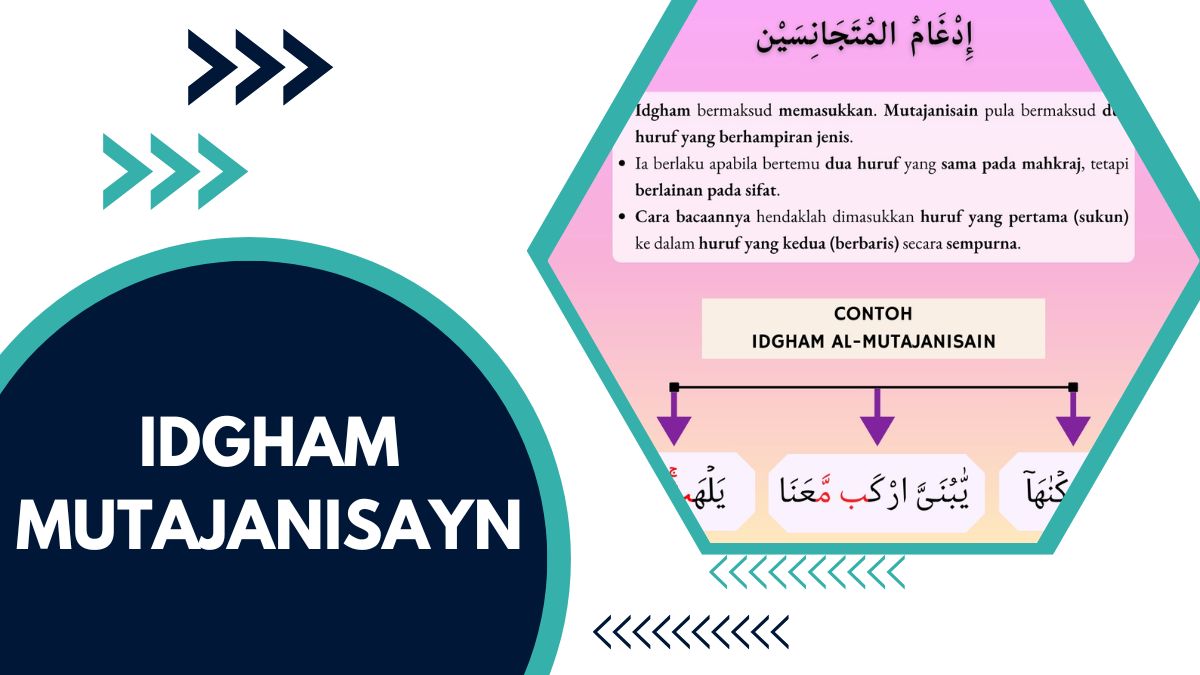
Idgham Mutajanisayn is a Tajweed rule that applies when two letters meet — the first carrying a sukoon (no vowel) and the second carrying a vowel — where both letters share the same articulation point (makhraj) but differ in name and phonetic characteristics, causing the first letter to be absorbed into the second and producing a single, merged sound.
The word “Idgham” in Arabic means merging or assimilation — the blending of one sound into another. The word “Mutajanisayn” means two of the same kind or two homorganic letters, referring to two letters that originate from the same place in the mouth or throat but are considered distinct letters with different names and qualities. Together, Idgham Mutajanisayn means the merging of two letters that share an articulation point.
When this rule is applied, the first letter dissolves into the second, and the second letter is pronounced with a strengthened, shaddah-like emphasis. The result is a clean, single articulation that absorbs the first letter completely, eliminating the need to pronounce two closely related sounds consecutively.
Idgham Mutajanisayn reflects a deeply organic feature of Arabic phonetics: when two letters that come from the same point in the mouth appear in sequence, the tongue naturally resists moving away from and returning to the same position twice. The rule formalizes and perfects this natural tendency, transforming what could be an awkward repetition into a smooth and elegant single sound.
Transform your devotion into a lifelong achievement with our Quran Memorization Course at Denk Arabisch, designed to help you commit the Divine Word to heart with proven techniques.
Why Is Idgham Mutajanisayn Important?
Idgham Mutajanisayn is important because it prevents a forced and unnatural pronunciation that would result from articulating two letters with the same articulation point separately in quick succession.
Pronouncing both letters fully would require the tongue or lips to return to the same position twice in immediate sequence — a movement that sounds strained, unauthentic, and contrary to the natural flow of Arabic speech.
By merging the first letter into the second, recitation flows naturally and effortlessly. This rule also demonstrates that Tajweed is not a set of arbitrary constraints but a precise science built on the organic phonetics of the Arabic language. Every rule has a reason, and Idgham Mutajanisayn’s reason is the instinctive economy of articulation that makes Arabic speech fluid and beautiful.
Benefits of Learning Idgham Mutajanisayn
- Eliminating the unnatural repetition of letters sharing the same articulation point
- Producing smooth and connected Quranic recitation at word boundaries
- Understanding how phonetically related letters interact across words
- Strengthening overall knowledge of the Idgham family of rules
- Improving awareness of Arabic articulation points (makhaarij) in practice
- Building the ability to recognize specific letter-pair combinations quickly during recitation
- Deepening appreciation for the phonetic elegance embedded in Tajweed
For both beginners and advanced learners, Idgham Mutajanisayn is a rule whose mastery visibly improves the authenticity and beauty of recitation whenever its specific letter pairs are encountered.
The Two Types of Idgham Mutajanisayn
Idgham Mutajanisayn is divided into two types based on the vowel status of the two merging letters.
Type 1 — Idgham Mutajanisayn Sagheer (Small)
Sagheer means small. This type occurs when the first of the two letters carries a sukoon and the second carries a vowel. It is the most commonly discussed type in Tajweed books and the standard form applied in Hafs recitation.
It is called “small” not because it is insignificant, but because only one of the two letters carries a vowel, making the merging clean and straightforward. The sukoon on the first letter creates the natural condition for assimilation.
Conditions for Sagheer:
- First letter: has sukoon (سُكون)
- Second letter: has a vowel (fathah, kasrah, or dhammah)
- The two letters share the same articulation point but have different names
Type 2 — Idgham Mutajanisayn Kabeer (Large)
Kabeer means large. This type occurs when both of the two letters carry vowels. This type is associated with specific recitation traditions, notably that of Imam Abu Amr, and is not commonly applied in the Hafs reading followed by the majority of Muslims worldwide.
For the purposes of this article, all further discussion refers to Idgham Mutajanisayn Sagheer, which is the standard, universally applied type in mainstream Tajweed education.
Which Letter Pairs Does Idgham Mutajanisayn Cover?
Unlike Idgham Mutamathilayn, which can apply to any pair of identical letters, Idgham Mutajanisayn applies only to a specific, limited set of letter pairs. These pairs are fixed and must be memorized. Each pair shares the same articulation point.
Pair 1 — Ta (ت), Dal (د), and Taa (ط) — Letters of the Tongue-Tip and Upper Teeth
These three letters all originate from the meeting of the tip of the tongue with the upper front teeth or the area just behind them. When any one of them appears with sukoon before any other from the same group (with a vowel), merging applies.
The most commonly cited combinations are:
- Dal (دْ) before Ta (تَ) — Idgham applies
- Ta (تْ) before Dal (دَ) — Idgham applies
- Ta (تْ) before Taa (طَ) — Idgham applies (Ta is absorbed into Taa)
- Taa (طْ) before Ta (تَ) — this case is subject to scholarly discussion; some apply Idgham and others do not
Pair 2 — Tha (ث), Dhal (ذ), and Dhad (ظ) — Letters of the Tongue-Tip and Teeth
These letters share an articulation point at the tip of the tongue placed lightly against or between the front teeth (interdental sounds). The commonly applied combinations are:
- Dhal (ذْ) before Tha (ثَ) — Idgham applies
Pair 3 — Ba (ب) and Meem (م) — Letters of the Two Lips
Ba and Meem are both labial letters — produced by the two lips meeting. When Ba Sakinah appears before Meem, merging may apply according to some scholars, though this case is often treated carefully given the special rules governing Meem and Ba.
- Ba (بْ) before Meem (مَ) — Idgham applies according to scholars who include this pair
Summary of the Primary Pairs
| First Letter (Sukoon) | Second Letter (Vowel) | Articulation Point (Makhraj) |
| Dal (دْ) | Ta (تَ) | Tongue-tip and the roots of the upper front teeth |
| Ta (تْ) | Dal (دَ) | Tongue-tip and the roots of the upper front teeth |
| Ta (تْ) | Ta (طَ) | Tongue-tip and the roots of the upper front teeth |
| Dhal (ذْ) | Tha (ثَ) | Tongue-tip and the edges of the upper front teeth |
| Ba (بْ) | Meem (مَ) | Between the two lips |
Important note: The exact letter pairs included under Idgham Mutajanisayn vary slightly between different Tajweed scholars and schools. Always follow the guidance of your qualified Tajweed teacher regarding which pairs your curriculum covers.
Conditions of Idgham Mutajanisayn
For Idgham Mutajanisayn to apply correctly, specific conditions must be met.
Condition 1 — The Two Letters Must Share the Same Articulation Point
The two letters must originate from the same makhraj (articulation point) in the mouth or throat. They do not need to be identical — they can differ in name, shape, and phonetic qualities — but they must come from the same physical location of articulation.
Condition 2 — The First Letter Must Have Sukoon
The first of the two letters must carry a sukoon, meaning it has no vowel of its own. This is the foundational condition that enables the merging: a letter with no vowel naturally assimilates into the following letter.
Condition 3 — The Second Letter Must Have a Vowel
The second letter must carry a vowel (fathah, kasrah, or dhammah) so that the merged, doubled sound can be properly articulated with a clear vowel.
Condition 4 — The Two Letters Must Be Different
The two letters must be different from each other in name. If they were identical, the rule would become Idgham Mutamathilayn, not Mutajanisayn. The distinction is clear: same letter = Mutamathilayn; different letters, same makhraj = Mutajanisayn.
Condition 5 — The Pairs Are Fixed
Idgham Mutajanisayn does not apply to every combination of letters that happen to share a makhraj. Only the specific, accepted pairs — as established by Tajweed scholars — are governed by this rule.
How to Pronounce Idgham Mutajanisayn Correctly?
Correct pronunciation of Idgham Mutajanisayn requires allowing the first letter to completely dissolve into the second, with the tongue or lips moving to the articulation point only once and releasing with the vowel and qualities of the second letter.
Steps to Apply Idgham Mutajanisayn Correctly
1. Identify the Applicable Pair Recognize that the two letters before you belong to one of the accepted Mutajanisayn pairs. Confirm that the first carries sukoon and the second carries a vowel.
2. Do Not Pronounce the First Letter Independently The first letter should not be articulated on its own. Do not attempt to sound out the Dal, Ta, or Ba before merging into the next letter. It is absorbed silently and completely.
3. Pronounce the Second Letter With Emphasis The second letter is pronounced as if it carries a shaddah — with a doubled, strengthened sound. The tongue or lips press firmly at the shared articulation point and release with the vowel and qualities of the second letter.
4. Adopt the Qualities of the Second Letter This is a crucial feature of Idgham Mutajanisayn that distinguishes it from Idgham Mutamathilayn. Because the two letters are different, the resulting merged sound takes on the phonetic qualities of the second letter. For example, when Ta (ت) merges into Taa (ط), the result sounds like a doubled Taa — not a mixed sound — because Taa’s qualities (isti’laa and itbaaq) dominate.
5. Maintain Smooth Recitation Flow The merging must feel natural and uninterrupted. There should be no pause, no partial articulation of the first letter, and no break at the word boundary. The transition is seamless.
6. No Ghunnah for Most Pairs Idgham Mutajanisayn generally does not carry ghunnah. However, when the merging involves Meem (as in Ba before Meem), a ghunnah is applied because of Meem’s inherent nasal quality.
| Element | Correct Application |
| First Letter | Disappears completely — it is not pronounced independently. |
| Second Letter | Pronounced with Shaddah-like emphasis (doubled sound). |
| Qualities | The merged sound takes the characteristics (Sifat) of the second letter. |
| Ghunnah | Only applied when the second letter is Meem (م). |
| Flow | Smooth, natural, and uninterrupted transition between letters. |
Important Pronunciation Tip
Because the two letters are different, the key mental shift is this: stop thinking of the first letter at all and focus entirely on the second letter. Imagine the first letter has been erased and replaced by a shaddah on the second letter. Your tongue or lips move to the articulation point of the second letter only — firmly, cleanly, and with emphasis.
The journey of a thousand miles begins with the first verse. Our Quran Reading Course at Denk Arabisch provides a gentle, step-by-step foundation for beginners to gain confidence and fluency in reading the Arabic text.
Read also: Idgham Mutaqaribayn – A Comprehensive Path To Perfect Tajweed
Examples of Idgham Mutajanisayn in the Qur’an
Idgham Mutajanisayn appears across the Qur’an wherever its specific letter pairs meet at word boundaries. Here are some of the clearest and most well-known examples.
Example 1 — Dal (دْ) meeting Ta (تَ)
قَد تَّبَيَّنَ
It has become clear
Transliteration: Qad tabayyanna — Surah Al-Baqarah (2:256)
The Dal Sakinah at the end of “قَد” merges completely into the Ta of “تَبَيَّنَ”. The result is a single, emphasized Ta — the Dal is absorbed entirely, and the Ta carries the merged weight of both letters.
Example 2 — Ta (تْ) meeting Dal (دَ)
أَثْقَلَت دَّعَوَا
It becomes heavy, they call
Transliteration: Ath-qalat da’awā — Surah Al-A’raf (7:189)
The Ta Sakinah at the end of “أَثْقَلَت” merges into the Dal of “دَعَوَا”. The first letter disappears and the Dal is pronounced with clear doubled emphasis.
Example 3 — Ta (تْ) meeting Taa (طَ)
هَمَّت طَّائِفَةٌ
A group intended
Transliteration: Hammat ṭā’ifah — Surah Aal Imran (3:122)
The Ta Sakinah at the end of “هَمَّت” merges into the Taa of “طَائِفَةٌ”. This is a particularly important example because the two letters are closely related yet distinct — Ta is absorbed into Taa, which is the heavier, emphatic counterpart. The merged result sounds like a doubled Taa.
Example 4 — Dhal (ذْ) meeting Tha (ثَ)
إِذ ثَّقُلَتْ
When it became heavy
Transliteration: Idh thaqulat — Surah Al-A’raf (7:189)
The Dhal Sakinah in “إِذ” merges into the Tha of “ثَقُلَتْ”. Both are interdental letters, and the Dhal dissolves completely into the Tha, which is pronounced with emphasis.
Example 5 — Ba (بْ) meeting Meem (مَ)
ارْكَب مَّعَنَا
Ride with us
Transliteration: Irkab ma’anā — Surah Hud (11:42)
The Ba Sakinah at the end of “ارْكَب” merges into the Meem of “مَعَنَا”. Because the resulting merged letter is Meem, a ghunnah accompanies the merge, distinguishing this pair from the others.
Key pattern: In every example, the first letter with sukoon vanishes into the second, and the second letter is pronounced with doubled emphasis and the qualities of that second letter — not a blend of both.
Experience the tranquility of the Divine Word. Our Quran Recitation Course at Denk Arabisch focuses on developing a beautiful, melodic flow, allowing you to recite with soul-stirring rhythm and heartfelt connection.
Learn the Quran with Denk Arabisch Academy
Master reading and understanding the Quran through structured and supportive learning
Try a Free TrialIdgham Mutajanisayn vs. Related Idgham Rules
Idgham Mutajanisayn belongs to a family of Idgham rules in Tajweed. Understanding how it differs from its relatives prevents confusion during recitation.
| Rule | Letters Involved | Relationship | Ghunnah? |
| Idgham Mutamathilayn | Two identical letters (e.g., بْ + بَ) | Same name, same shape, and same articulation point. | Only for Noon (ن) and Meem (م). |
| Idgham Mutajanisayn | Sharing a makhraj (e.g., دْ + تَ) | Same articulation point, but different qualities/names. | Only when the second letter is Meem (م). |
| Idgham Mutaqaribayn | Close in makhraj (e.g., قْ + كَ) | Close articulation points, but not identical. | Depends on the specific letters involved. |
| Idgham with Ghunnah | Noon Sakinah/Tanween + (و، ي، ن، م) | Different letters entirely (The “Yanmoo” group). | Yes (nasalization is required). |
| Idgham Shafawi | Meem Sakinah + Meem | Specifically related to the letter Meem. | Yes (nasalization is required). |
Key Distinctions
Mutajanisayn vs. Mutamathilayn: Mutamathilayn involves two letters that are completely identical in every way — same name, same shape, same articulation point, same qualities. Mutajanisayn involves two letters that share only the articulation point; their names, shapes, and qualities differ. If you see Dal followed by Ta, that is Mutajanisayn. If you see Dal followed by Dal, that is Mutamathilayn.
Mutajanisayn vs. Mutaqaribayn: Mutaqaribayn involves two letters whose articulation points are near each other but not the same — for example, Qaf (ق) meeting Kaf (ك), where one comes from deeper in the throat-back region and the other from a slightly more forward position. In Mutajanisayn, the articulation points are exactly the same.
Mutajanisayn vs. Idgham with Ghunnah: Idgham with Ghunnah governs Noon Sakinah or Tanween before specific letters (ي، و، ن، م), none of which are the same makhraj as Noon. Mutajanisayn applies specifically to the accepted pairs of same-makhraj letters.
Easy Way to Memorize Idgham Mutajanisayn
Because Idgham Mutajanisayn applies only to a small, fixed set of letter pairs, memorization is highly manageable. The key is to commit the specific pairs to memory first, then understand the single principle that unites them.
Memorization Strategies
Anchor the Core Concept Remember one sentence: When two letters from the same articulation point meet — the first with sukoon — the first merges completely into the second, which takes the weight of both. This single principle explains every case.
Memorize the Letter Families Group the letters by their shared makhraj:
- Tongue-tip and teeth family: ت، د، ط
- Interdental family: ث، ذ، ظ
- Labial (lip) family: ب، م
When you see the first letter of one family followed by the second letter of the same family, Mutajanisayn may apply.
Use the “Heavier Wins” Mental Image for Ta-Taa Pairs When Ta (ت) meets Taa (ط), remember that Taa is the heavier, emphatic version. The lighter letter (Ta) is absorbed into the heavier (Taa). This image helps reinforce which letter’s qualities dominate the merged sound.
Practice the Most Common Pair First The Dal-Ta and Ta-Dal pairs are the most frequently encountered examples in the Qur’an. Mastering these two combinations builds a strong foundation before tackling the others.
Use a Color-Coded Tajweed Mushaf Many Tajweed Mushafs mark Idgham with specific colors and place a shaddah above the second letter of the merged pair. Scanning for these marks while reading trains the eye to recognize Mutajanisayn cases automatically.
Listen Attentively to Expert Reciters Carefully listening to how reciters like Mahmoud Khalil Al-Husary or Mishary Rashid Alafasy handle these specific pairs trains the ear to recognize the clean, doubled emphasis of Mutajanisayn merging.
Recite with the beauty and precision the Quran deserves. Our Quran Tajweed Course at Denk Arabisch focuses on the intricate rules of pronunciation, ensuring every letter is articulated with perfect clarity.
How Children Can Learn Idgham Mutajanisayn Easily?
Teaching Idgham Mutajanisayn to children is made manageable by breaking the rule into small, memorable pieces. Because the pairs are fixed and limited, children can learn them one at a time.
Use the “Letter Families” Concept
Tell children that some letters are cousins — they live in the same place in the mouth but have different names. When a cousin with no vowel meets another cousin with a vowel, the first one quietly steps aside and lets the second one speak for both. Children respond well to this personification, which makes the concept tangible.
Introduce One Pair at a Time
Do not present all pairs at once. Begin with Dal before Ta, practice it thoroughly across several Quranic examples, and move to the next pair only when the first is secure. Incremental learning prevents overwhelm and builds genuine mastery.
Read Slowly and Feel the Difference
Have children first try to say both letters separately — so they feel the awkwardness of the double articulation — and then practice the correct merging. The contrast between the incorrect and correct version makes the benefit of the rule immediately audible.
Repeat Famous Quranic Phrases
Short, familiar phrases containing Idgham Mutajanisayn — such as “قَد تَّبَيَّنَ” and “هَمَّت طَّائِفَةٌ” — make excellent daily practice material because they are easy to remember and reinforce the rule in a meaningful Quranic context.
Practice With a Qualified Teacher
The phonetic distinctions in Mutajanisayn — particularly the way the second letter’s qualities dominate the merged sound — are subtle and best corrected in real time by a qualified Tajweed teacher who can model the correct pronunciation and provide immediate feedback.
Read also: Idgham Shafawi – The Tajweed Guide
Common Mistakes in Idgham Mutajanisayn
Even dedicated learners make errors when applying this rule. Recognizing these mistakes in advance makes them easier to avoid.
1. Pronouncing Both Letters Separately
The most common mistake is treating the two letters as independent and pronouncing each one fully. This creates an unnatural and strained effect and is a direct violation of Idgham Mutajanisayn.
2. Producing a Blended or Mixed Sound
Because the two letters are different, some reciters try to blend the qualities of both into a hybrid sound. This is incorrect. The first letter disappears entirely, and the merged sound carries only the qualities of the second letter — not a mix of the two.
3. Weak Emphasis on the Second Letter
After merging, the second letter must carry a clear, doubled emphasis resembling a shaddah. Some learners merge correctly but then pronounce the second letter too lightly, losing the weight that the merged letter should carry.
4. Applying Ghunnah Incorrectly
Ghunnah does not accompany Idgham Mutajanisayn except when the merging involves Meem as the second letter. Adding a nasal resonance to Dal-Ta or Ta-Dal merges is incorrect and a sign of confusing this rule with Idgham rules that require ghunnah.
5. Pausing at the Word Boundary
Some reciters pause briefly between the end of the first word and the start of the second before completing the merge. This pause implies the first letter is being sounded out independently. The merge must happen seamlessly, with no gap at all.
6. Confusing Mutajanisayn With Mutamathilayn
Because these two rules are closely related and similarly named, some learners apply Mutajanisayn to identical letters (which should be Mutamathilayn) or vice versa. Always confirm whether the two letters are identical or merely from the same articulation point before deciding which rule applies.
7. Applying the Rule to Non-Accepted Pairs
Some learners, knowing that Mutajanisayn involves same-makhraj letters, attempt to apply it to letter combinations that are not part of the accepted pairs. The rule applies only to the specific pairs established by Tajweed scholarship — not to every possible combination of letters from the same general area of articulation.
What Our Students Say About Denk Arabisch Academy
See what our students say about learning at Denk Arabisch Academy on Trustpilot. Read their experiences and check out more reviews to discover how our courses help improve Arabic.

Learn Tajweed With Denk Arabisch!
You’ve memorized the definitions and studied the charts, but does your recitation still feel hesitant? Knowing the theory of Tajweed is a great foundation, but the true beauty of the Quran is realized through the rhythm of the tongue and the presence of the heart.
At Denk Arabisch, we don’t just teach you the rules—we train your voice. We specialize in transforming technical knowledge into a fluent, beautiful, and precise recitation that resonates.
Why Our Students Succeed
- Direct Correction: Stop guessing if you’re right. Our instructors provide real-time, 1-on-1 feedback to perfect your articulation.
- Qualified Guidance: Skip the trial and error by learning directly from experts in Quranic sciences.
- Total Flexibility: Our online platform is designed for busy professionals and students, allowing you to learn whenever you are ready.
- Proven Curriculum: Move through a logical, step-by-step system that removes the overwhelm of Tajweed.
- Personalized Focus: You aren’t just a number; your learning plan is built around your specific strengths and areas for growth.
Choose Your Path to Mastery
Ready to elevate your connection with the Book of Allah? Select the specialized program that fits your current goal:
- Quran Memorization Course: Commit the verses to heart with a structured and sustainable Hifz plan.
- Quran Reading Course: Build a rock-solid foundation in fluency and Arabic letter recognition.
- Quran Tajweed Course: Master the intricate rules of phonetics to ensure every letter is given its due.
- Quran Recitation Course: Focus on the melodic flow and spiritual beauty of your delivery.
Your journey from student to master begins with a single click.
Don’t let another day pass by just “reading about” Tajweed. It’s time to embody it. Join Denk Arabisch today and experience the transformation for yourself.
Learn the Quran with Denk Arabisch Academy
Master reading and understanding the Quran through structured and supportive learning
Try a Free TrialConclusion
Idgham Mutajanisayn is one of the most elegant and phonetically intuitive rules in the science of Tajweed. It applies when two letters that share the same articulation point meet at a word boundary — the first carrying sukoon and the second carrying a vowel — causing the first letter to merge completely into the second, which is then pronounced with doubled, shaddah-like emphasis carrying its own phonetic qualities.
This rule is divided into Sagheer (the standard form in Hafs recitation) and Kabeer (associated with other recitation traditions). It is clearly distinguished from Idgham Mutamathilayn by the fact that the merging letters are not identical but merely homorganic, and from Idgham Mutaqaribayn by the fact that the articulation points are not merely close but exactly the same.
Mastering Idgham Mutajanisayn requires memorizing the accepted letter pairs, developing the physical habit of complete merging, ensuring the second letter carries the proper doubled emphasis with its own qualities intact, and applying ghunnah only where it belongs — specifically when the second letter is Meem.
The limited number of pairs makes this rule highly learnable, and with consistent practice, attentive listening, and guidance from a qualified Tajweed teacher, it quickly becomes a natural part of every reciter’s Tajweed toolkit.
By learning Idgham Mutajanisayn correctly, Muslims can recite the Qur’an with greater authenticity, fluency, and beauty — honoring with precision the magnificent way in which Allah’s words were revealed, transmitted, and preserved across centuries by devoted scholars and reciters.
FAQs
1. What does Mutajanisayn mean?
Mutajanisayn means two of the same kind or two homorganic letters in Arabic. It refers to two letters that share the same articulation point but differ in name and phonetic qualities.
2. How is Idgham Mutajanisayn different from Idgham Mutamathilayn?
Mutamathilayn involves two letters that are completely identical — same name, same shape, same qualities. Mutajanisayn involves two letters that share only the articulation point but differ in name and qualities. For example, Dal and Dal meeting is Mutamathilayn; Dal and Ta meeting is Mutajanisayn.
3. Which letter pairs does Idgham Mutajanisayn apply to?
The primary pairs are: Dal (دْ) before Ta (تَ), Ta (تْ) before Dal (دَ), Ta (تْ) before Taa (طَ), Dhal (ذْ) before Tha (ثَ), and Ba (بْ) before Meem (مَ). Scholars may include or discuss additional combinations, so following a qualified teacher’s guidance is always recommended.
4. Is there ghunnah in Idgham Mutajanisayn?
Generally no. Ghunnah applies only when the second letter — the one being merged into — is Meem (م), which carries an inherent nasal quality. For all other pairs, the merge is clean without nasal resonance.
5. Does the merged sound take the qualities of the first or second letter?
The merged sound takes the qualities of the second letter entirely. The first letter disappears and the second letter’s phonetic characteristics — including its sifa (qualities) such as isti’laa or itbaaq — govern the resulting sound.
6. How is Idgham Mutajanisayn different from Idgham Mutaqaribayn?
In Mutajanisayn, the two letters share exactly the same articulation point. In Mutaqaribayn, the two letters have articulation points that are close to each other but not identical, such as Qaf (ق) and Kaf (ك).
7. Is Idgham Mutajanisayn difficult to learn?
The concept is straightforward: same makhraj, different letters, first merges into second. The main challenge lies in memorizing the accepted pairs and consistently recognizing them during live recitation — particularly distinguishing this rule from Mutamathilayn and Mutaqaribayn.