Learning Tajweed is a lifelong journey for every Muslim who seeks to recite the Holy Quran with accuracy, beauty, and reverence. Among the many rules governing correct Quranic pronunciation, Idgham with Ghunnah holds a central position — it is one of the most frequent and fundamental rules in the entire science of Tajweed.
Understanding Idgham with Ghunnah helps reciters correctly handle specific instances of Noon Sakinah and Tanween when followed by certain letters. Mastering this rule ensures that the Noon sound is neither mispronounced nor incorrectly categorized.
In this article, we explain everything you need to know about Idgham with Ghunnah — including its definition, letters, pronunciation, Quranic examples, differences from other Tajweed rules, and the most common mistakes to avoid.
Table of Contents
What is Idgham with Ghunnah?
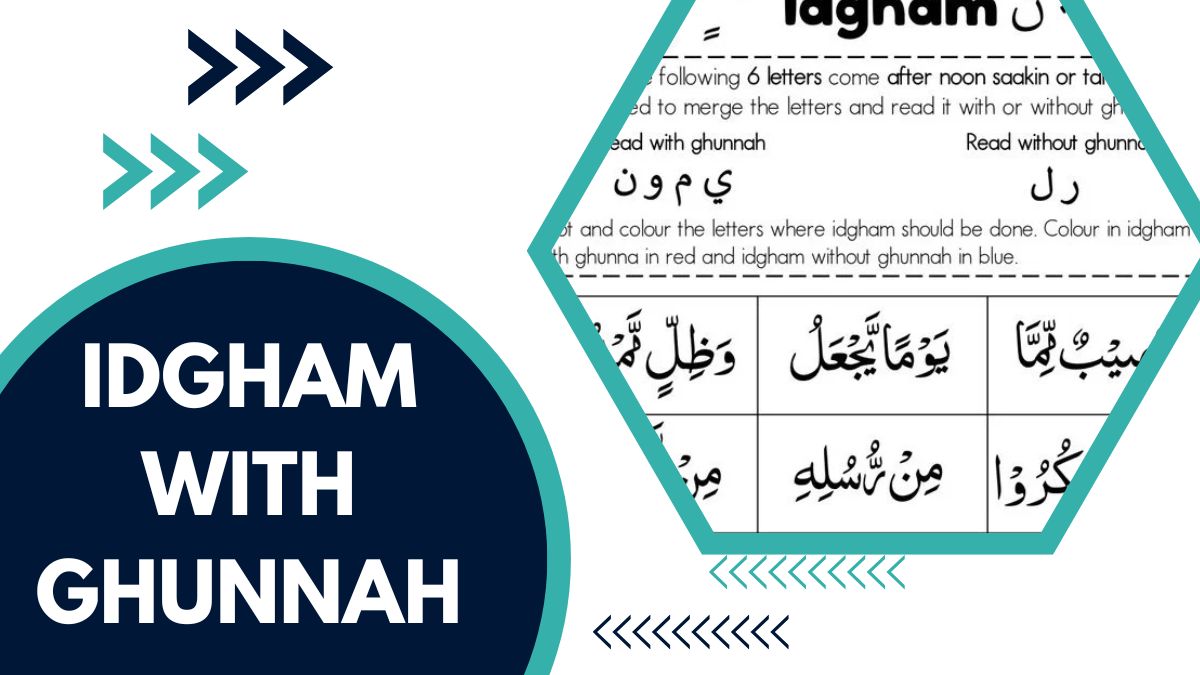
Idgham with Ghunnah is a Tajweed rule applied when a Noon Sakinah (نْ) or Tanween (ً ٍ ٌ) is followed by one of the following four letters — however, always occurring in two separate words:
- ي (Ya)
- ن (Noon)
- م (Meem)
- و (Waw)
These four letters are summarized in Arabic by the mnemonic word يَنْمُو (Yanmuu), which means “it grows” — an elegant memory aid from classical Tajweed science.
- The word “Idgham” in Arabic means “merging” or “incorporation” — the insertion of one letter into another.
- The word “Ghunnah” means nasalization — a nasal sound produced from the nose, held for approximately two counts.
Together, Idgham with Ghunnah refers to the merging of the Noon Sakinah or Tanween into the following letter, accompanied by a distinct nasal sound.
Important: This rule applies exclusively when the letters appear in two separate words. If the Noon Sakinah and the following letter are within the same word, a different rule applies — such as Izhar Mutlaq.
Why is Idgham with Ghunnah Important?
Idgham with Ghunnah is vital because it represents one of the most common situations in the Quran where a sound is not pronounced exactly as it appears on paper. Without knowledge of this rule, a reciter would pronounce the Noon Sakinah or Tanween separately and fully — which is considered a Tajweed error and interrupts the natural flow of Arabic recitation.
This rule also demonstrates the fluid and musical nature of Quranic pronunciation. Merging two sounds creates a smooth, melodic transition that is both tonally and phonetically harmonious.
Benefits of Learning Idgham with Ghunnah:
- Avoiding mispronunciation of Noon Sakinah and Tanween.
- Achieving a natural, flowing style of recitation.
- Deepening the understanding of Arabic phonetics.
- Mastering the Noon Sakinah rules entirely.
- Improving precision and confidence in recitation.
- Honoring the way the Quran was revealed and transmitted.
For both beginners and advanced students, mastering Idgham with Ghunnah is an indispensable step on the path to comprehensive Tajweed knowledge.
Begin your journey with the Quran Memorization Course at Denk Arabisch and carry the words of Allah in your heart forever.
The Letters of Idgham with Ghunnah
Idgham with Ghunnah consists of exactly four letters, summarized in the word يَنْمُو:
| Letter | Transliteration | Name |
| ي | Y | Ya |
| ن | N | Noon |
| م | M | Meem |
| و | W | Waw |
Why these specific letters?
These four letters share a unique phonetic quality with the Noon: they are all formed with strong nasal or voiced resonance. This characteristic makes the merging more tonal and natural than with other letters.
The nasalization of the Noon Sakinah or Tanween flows seamlessly into the following letter, so that both are heard as a single, elongated sound.
How to Correctly Pronounce Idgham with Ghunnah?
When applying Idgham with Ghunnah, the goal is to let the Noon Sakinah or Tanween merge completely into the following letter — accompanied by a nasal sound (Ghunnah) held for two counts.
Steps for the Correct Application of Idgham with Ghunnah
1. Do not pronounce the Noon Sakinah or Tanween separately The Noon sound must not be heard as an independent sound. It merges completely into the following letter.
2. Pronounce the following letter doubled Since the Noon is merged into the following letter, that letter phonetically receives a Shaddah (doubling sign) — even if it is not always visibly written in the Mushaf.
3. Hold the Ghunnah for two counts The nasalization must be clearly audible and held for the duration of two counts (Harakat). Neither too short nor too long.
4. Make the transition fluid The transition from the Noon/Tanween to the following letter should be seamless and without interruption. The recitation should sound natural and melodic.
Checklist for the Pronunciation of Idgham with Ghunnah
- Noon is not audible — it is completely merged.
- The following letter is pronounced with emphasis/doubling.
- Ghunnah is clearly audible.
- Ghunnah is held for two counts.
- Fluid, natural transition between words.
The best way to master this rule is by repeatedly listening to experienced Quran reciters and practicing regularly with a qualified Tajweed teacher.
Gain confidence in reading through the Quran Reading Course at Denk Arabisch and unlock a lifelong connection to the Quran.
Quranic Examples for Idgham with Ghunnah
Since Noon Sakinah and Tanween appear throughout the Qur’an, Idgham with Ghunnah is one of the most frequently applied Tajweed rules. Here are some clear and classic examples:
1. Noon Sakinah + Ya (ي)
مِنْ يَقُولُ → pronounced like مِيَّقُولُ
Surah Al-Baqarah (2:8): وَمِنَ النَّاسِ مَن يَقُولُ آمَنَّا بِاللَّهِ
Here, the Noon Sakinah in مَن merges completely into the Ya of يَقُولُ, accompanied by Ghunnah. The Noon is not heard as a separate letter.
2. Noon Sakinah + Noon (ن)
مِنْ نِعْمَةٍ → pronounced like مِنِّعْمَةٍ
Surah An-Nahl (16:53): وَمَا بِكُم مِّن نِّعْمَةٍ فَمِنَ اللَّهِ
The Noon Sakinah in مِن merges into the Noon of نِعْمَةٍ. The result is a clearly doubled, nasal Noon sound held for two counts.
3. Tanween + Meem (م)
يَوْمَئِذٍ مُّسْفِرَةٌ → the Tanween merges into Meem
Surah At-Tur (52:37): وُجُوهٌ يَوْمَئِذٍ مُّسْفِرَةٌ
The Kasrah Tanween (ٍ) at the end of a word merges seamlessly into the Meem of the following word, producing a clear Ghunnah transition.
4. Tanween + Waw (و)
غَفُورٌ وَدُودٌ → the Tanween merges into Waw
Surah Al-Buruj (85:14): وَهُوَ الْغَفُورُ الْوَدُودُ
The Dammah Tanween (ٌ) at the end of the word merges into the Waw of the following word, accompanied by a clear and smooth Ghunnah.
Perfect your recitation by joining the Quran Tajweed Course at Denk Arabisch and recite as beautifully as it was revealed.
Read also: Idgham Without Ghunnah – Your Guide In Tajweed
Simple Method to Remember Idgham with Ghunnah
The simplest and most proven way to memorize this rule is by remembering the mnemonic word:
يَنْمُو (Yanmuu)
Each letter of this word stands for one of the four letters of Idgham with Ghunnah:
- ي → Ya
- ن → Noon
- م → Meem
- و → Waw
Repeat this word daily until it becomes completely automatic. Once you have internalized it, you will immediately recognize the four letters in any Quranic text.
Additional Memory Tips
- Use Context: Read the full verses containing these letter combinations so that the context strengthens your memory.
- Listen First: Listen to how experienced reciters perform the transition from Noon/Tanween to Yanmuu letters — the merging and the Ghunnah should be clearly audible.
- Record and Check: Record your own recitation and listen to whether the Ghunnah is clear and if the Noon is completely merged.
- Use a Tajweed Mushaf: Color-coded Mushafs often clearly highlight Idgham positions.
Strengthen your voice and understanding with the Quran Recitation Course at Denk Arabisch for a more spiritual and fluid experience.
Learn the Quran with Denk Arabisch Academy
Master reading and understanding the Quran through structured and supportive learning
Try a Free TrialCommon Mistakes in Idgham with Ghunnah
Even experienced reciters sometimes make mistakes with this rule. Here are the most common ones:
1. Pronouncing the Noon Sakinah or Tanween separately
The most frequent error is pronouncing the Noon sound fully instead of merging it. Reciters hear the Noon as an independent sound — which is a clear Tajweed error.
2. Omitting the Ghunnah
Some learners merge the Noon but forget to add the Ghunnah. The result is Idgham without Ghunnah — which is incorrect for these four letters.
3. Holding the Ghunnah too short or too long
The Ghunnah must be exactly two counts long. Too short makes it barely audible; too long distorts the rhythm of the recitation.
4. Overlooking the rule with Tanween
Many learners apply the rule correctly to Noon Sakinah but forget that Tanween is subject to the same rules. Tanween at the end of a word followed by a يَنْمُو letter also requires Idgham with Ghunnah.
5. Applying the rule within a single word
Idgham with Ghunnah only applies between two separate words. Within a single word containing Noon Sakinah followed by Waw or Ya, Izhar Mutlaq applies instead. This confusion is a common mistake among advanced learners.
Practicing with a qualified Tajweed teacher remains the most effective way to identify and correct these mistakes.
How to Practice Idgham with Ghunnah Effectively?
To master Idgham with Ghunnah, focus on fluid pronunciation and consistent practice, paying close attention to how each letter is articulated in Quranic recitation.
1. Read slowly and deliberately
Slow recitation allows you to focus on every letter. When you encounter a Noon Sakinah or Tanween before a يَنْمُو letter, pause briefly and ensure the merging and Ghunnah are performed correctly.
2. Listen to experienced reciters
Paying close attention to how renowned reciters like Mahmoud Khalil Al-Husary or Mishary Rashid Alafasy perform the Ghunnah transitions is one of the fastest ways to internalize correct pronunciation.
3. Record and review your recitation
Record yourself and listen to whether the Ghunnah is clearly audible and whether the Noon merges completely into the following letter — or if it can still be heard as an independent sound.
4. Practice in context
Instead of practicing isolated word pairs, read the full verses where these connections occur. This builds the muscle memory required for natural application of the rule during full recitation.
5. Work with a teacher
A qualified Tajweed teacher can immediately tell if you are applying Idgham with Ghunnah correctly and guide you toward precise pronunciation through personalized feedback.
Read also: Idgham Mutamathilayn – The Complete Guide
Ready to learn Tajweed with Denk Arabisch?
Reading about Idgham with Ghunnah is the first step — but reciting the Quran with the confidence of a master requires more than just theory. You have seen how precise and ubiquitous this rule is — do not let a single letter of the Holy Book be mispronounced due to a lack of guidance.
At Denk Arabisch, we don’t just teach rules; we build your connection to the words of Allah through precision, passion, and professional expertise.
Why join Denk Arabisch today?
- Real-time corrections: Stop making the same hidden mistakes in your Ghunnah. Our expert tutors provide immediate feedback.
- Tailored learning paths: Whether you are an absolute beginner or looking to earn your Ijazah — our curriculum adapts to your pace.
- Master the science of Tajweed: Go beyond the basics. We help you internalize the logic of Quranic phonetics so that recitation becomes second nature.
- Flexible scheduling: Fit your spiritual growth into your busy life with our accessible online platform.
Denk Arabisch offers:
- Quran Memorization Course: Memorize the Quran with confidence, step by step, until it stays in your heart forever.
- Quran Reading Course: Begin your journey with the Quran — learn to read fluently, correctly, and with ease.
- Quran Tajweed Course: Perfect your recitation with the rules of Tajweed and recite the Quran as it was revealed.
- Quran Recitation Course: Beautify your voice and recite the Quran with clarity, rhythm, and spiritual depth.

Don’t leave your recitation to chance. Join a community of dedicated learners transforming their relationship with the Quran, verse by verse.
👉 [Book your free trial lesson at Denk Arabisch now!]
Learn the Quran with Denk Arabisch Academy
Master reading and understanding the Quran through structured and supportive learning
Try a Free TrialElevate your recitation. Honor the revelation. Begin your journey with Denk Arabisch.

Conclusion
Idgham with Ghunnah is one of the most fundamental and frequently applied rules in the science of Tajweed. It occurs when Noon Sakinah or Tanween is followed by one of the four يَنْمُو letters (ي، ن، م، و) — but exclusively in two separate words.
In all these cases, the rule is clear and consistent: let the Noon or Tanween merge completely into the following letter while maintaining a nasal resonance (Ghunnah) for two counts. This distinguishes Idgham with Ghunnah from Izhar (clear pronunciation) and Idgham without Ghunnah (merging without nasalization).
By memorizing the mnemonic word يَنْمُو and understanding why the rule applies, Muslims can recite the Quran with greater accuracy, avoid common Tajweed errors, and honor the precise way in which Allah’s words were revealed and transmitted.
Whether you are a beginner building your foundation or an advanced student completing your Tajweed knowledge — mastering Idgham with Ghunnah is a meaningful and rewarding step on your Quranic journey.
FAQs
1. Does Idgham with Ghunnah also apply to Tanween?
Yes. Idgham with Ghunnah applies to both Noon Sakinah and all three forms of Tanween (Fathah, Dammah, and Kasrah Tanween) when followed by one of the four يَنْمُو letters — always in two separate words.
2. What is the difference between Idgham with Ghunnah and Idgham without Ghunnah?
Idgham with Ghunnah occurs with the four letters ي، ن، م، و and always involves a nasal resonance. Idgham without Ghunnah occurs only with the letters ل and ر, without any nasalization.
3. What happens if Noon Sakinah is followed by Noon or Meem in the same word?
If Noon Sakinah and the following يَنْمُو letter are in the same word, Idgham with Ghunnah does not apply. Instead, other rules apply — e.g., Izhar Mutlaq for Waw and Ya within the same word.
4. How long does the Ghunnah last?
The Ghunnah is held for exactly two counts (Harakat) — the same duration as a short vowel in standard Quranic recitation.
5. Is Idgham with Ghunnah difficult to learn?
It requires regular practice to perform the Ghunnah consistently and correctly. However, the rule itself is logical and clear — once you know the four يَنْمُو letters and understand the difference between one- and two-word contexts, application becomes natural over time.
6. Do all Tajweed scholars agree on this rule?
Yes. Idgham with Ghunnah for the letters يَنْمُو is one of the most widely accepted and standardized rules in Tajweed. The pronunciation guidelines — complete merging, Ghunnah for two counts — are consistent across all classical and modern Tajweed works.