Mastering the numbers from 1 to 100 is one of the most vital milestones when learning a new language. In Arabic, a language spoken by over 400 million people worldwide, numbers carry unique cultural, historical, and grammatical significance.
Whether you are traveling to an Arabic-speaking country, studying Modern Standard Arabic (MSA), or learning a local dialect like Egyptian or Levantine, this comprehensive guide will teach you everything you need to know about Arabic numbers from 1 to 100.
Table of Contents
Arabic Numerals vs. Hindi Numerals
Before diving into the words themselves, we must clear up a common point of confusion for beginners: the actual symbols used to write numbers.
A. Eastern Arabic Numerals (Used in the Arab World)
These are the digits you often see in Egypt and many Arab countries:
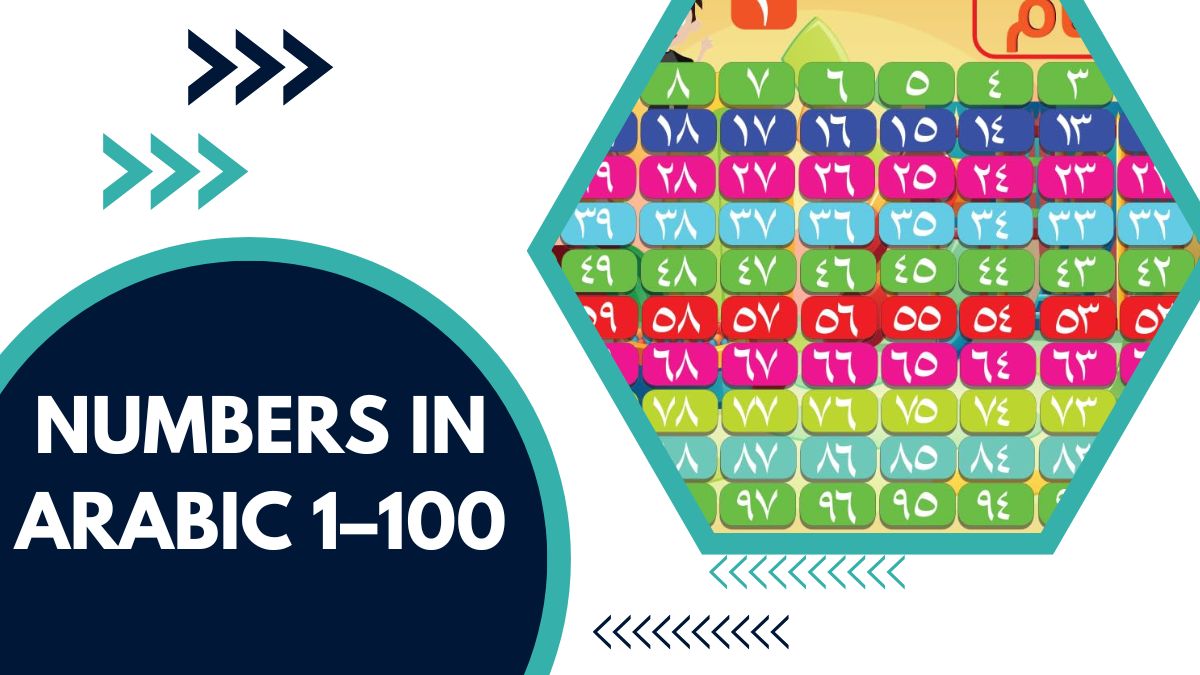
٠ ١ ٢ ٣ ٤ ٥ ٦ ٧ ٨ ٩
(0 1 2 3 4 5 6 7 8 9)
For example:
- 10 = ١٠
- 25 = ٢٥
- 100 = ١٠٠
B. Western Arabic Numerals (International System)
These are the numbers you already know:
1, 2, 3, 4, 5, etc.
Both systems are used, but in daily life in Egypt, you will often see Eastern Arabic numerals.
Reading Direction with Numbers
While Arabic text is read from right to left, Arabic numbers are read and written from left to right, just like in English. For example, the number 25 is written as ٢٥ (2 then 5), not ٥٢.
Stop letting fear of a new alphabet hold you back when you can easily smash through the basics and speak confidently using our fast-track Arabic Course For Beginners at Denk Arabisch engineered for immediate results.
Arabic Numbers 1–10
Everything in Arabic numeracy builds upon the first ten digits. Master these, and the rest of the numbers will become significantly easier to grasp.
Here is the breakdown of numbers 1–10 in Modern Standard Arabic (MSA):
| Western Symbol | Eastern Symbol | Arabic Word (Male/Female) | English Transliteration |
| 1 | ١ | واحد / واحدة | Waahid / Waahida |
| 2 | ٢ | إثنان / إثنتان | Ithnaan / Ithnataan |
| 3 | ٣ | ثلاثة | Thalatha |
| 4 | ٤ | أربعة | Arba’a |
| 5 | ٥ | خمسة | Khamsa |
| 6 | ٦ | ستة | Sitta |
| 7 | ٧ | سبعة | Sab’a |
| 8 | ٨ | ثمانية | Thamaniyya |
| 9 | ٩ | تسعة | Tis’a |
| 10 | ١٠ | عشرة | ‘Ashara |
Grammar Note: In Arabic, numbers 1 and 2 behave like adjectives and follow the noun they describe. Numbers 3 through 10, however, use a rule called gender polarity, meaning a masculine noun requires a feminine number (ending in Taa Marbuta – ة), and vice versa.
Arabic Numbers 11–19
The teen numbers in Arabic follow a very logical pattern. They combine the single digit with a modified version of the number ten (‘ashar). Think of it like saying “one-teen,” “two-teen,” and so on.
Notice that the single digit comes before the ten, which is the reverse of English (where we say “four-teen” but write 14, putting the 1 first).
| Western | Eastern | Arabic Word | Transliteration |
| 11 | ١١ | أحد عشر | Ahada ‘ashar |
| 12 | ١٢ | إثنا عشر | Ithna ‘ashar |
| 13 | ١٣ | ثلاثة عشر | Thalathata ‘ashar |
| 14 | ١٤ | أربعة عشر | Arba’ata ‘ashar |
| 15 | ١٥ | خمسة عشر | Khamsata ‘ashar |
| 16 | ١٦ | ستة عشر | Sittata ‘ashar |
| 17 | ١٧ | سبعة عشر | Sab’ata ‘ashar |
| 18 | ١٨ | ثمانية عشر | Thamaniyata ‘ashar |
| 19 | ١٩ | تسعة عشر | Tis’ata ‘ashar |
Don’t waste time learning vocabulary you will never use when you can laser-focus on your specific weak points and master targeted communication with our Arabic Courses Based On Skills & Topics at Denk Arabisch built for busy schedules.
The Tens/Decades: 20, 30, 40… to 90
The tens in Arabic are highly regular. They are formed by taking the root of the single digit (3 to 9) and adding the suffix “-oon” (ون) or “-een” (ين), depending on the grammatical case (nominative vs. accusative/genitive). In everyday speech and dialects, the “-een” ending is the most common.
For this guide, we will use the standard nominative “-oon” ending.
| Western | Eastern | Arabic Word | Transliteration |
| 20 | ٢٠ | عشرون | ‘Ishroon |
| 30 | ٣٠ | ثلاثون | Thalathoon |
| 40 | ٤٠ | أربعون | Arba’oon |
| 50 | ٥٠ | خمسون | Khamsoon |
| 60 | ٦٠ | ستون | Sittoon |
| 71 | ٧٠ | سبعون | Sab’oon |
| 80 | ٨٠ | ثمانون | Thamanoon |
| 90 | ٩٠ | تسعون | Tis’oon |
Counting from 21 to 99: The Compound Numbers
Once you reach 21, Arabic uses a strict formula: [Single Digit] + “and” (wa) + [Tens Decades].
Unlike English, where we say “twenty-one” (tens then units), Arabic says “one and twenty” (waahid wa ‘ishroon). This pattern stays exactly the same all the way up to 99.
Let’s look at the 20s as a foundational example:
- 21: واحد وعشرون (Waahid wa ‘ishroon) – Literally: One and twenty
- 22: إثنان وعشرون (Ithnaan wa ‘ishroon) – Literally: Two and twenty
- 23: ثلاثة وعشرون (Thalatha wa ‘ishroon) – Literally: Three and twenty
- 24: أربعة وعشرون (Arba’a wa ‘ishroon)
- 25: خمسة وعشرون (Khamsa wa ‘ishroon)
- 26: ستة وعشرون (Sitta wa ‘ishroon)
- 27: سبعة وعشرون (Sab’a wa ‘ishroon)
- 28: ثمانية وعشرون (Thamaniyya wa ‘ishroon)
- 29: تسعة وعشرون (Tis’a wa ‘ishroon)
Read also: Arabic Greetings – The Ultimate Guide For Muslims
Master Chart: Every Number from 31 to 99
By applying the “[Unit] + wa + [Ten]” formula, you can seamlessly construct any compound number. Here is a quick reference table for various intervals:
| Western | Eastern | Arabic Word | Transliteration |
| 31 | ٣١ | واحد وثلاثون | Waahid wa thalathoon |
| 35 | ٣٥ | خمسة وثلاثون | Khamsa wa thalathoon |
| 42 | ٤٢ | إثنان وأربعون | Ithnaan wa arba’oon |
| 48 | ٤٨ | ثمانية وأربعون | Thamaniyya wa arba’oon |
| 54 | ٥٤ | أربعة وخمسون | Arba’a wa khamsoon |
| 67 | ٦٧ | سبعة وستون | Sab’a wa sittoon |
| 73 | ٧٣ | ثلاثة وسبعون | Thalatha wa sab’oon |
| 86 | ٨٦ | ستة وثمانون | Sitta wa thamanoon |
| 99 | ٩٩ | تسعة وتسعون | Tis’a wa tis’oon |
And finally, the number 100:
- 100: مئة (Mi’ah)
- 100 books = مائة كتاب
- 100 years = مائة سنة
You may also see it written as ١٠٠ in numerals.
Don’t get stuck repeating the same basic lessons over and over when you can systematically advance your fluency step-by-step using our highly structured Arabic Courses Based On Levels at Denk Arabisch designed to track your real progress.
Learn Arabic with Denk Arabisch Academy
Speak and understand Arabic through a clear and effective learning system
Try a Free TrialGrammar Rules for Arabic Numbers
To speak Arabic like a native, you need to understand how numbers interact with nouns. In English, we simply say “three cars” or “fifty days.” In Arabic, the noun changes its form depending on the number preceding it.
Rule 1: The Number 1 and 2
As mentioned earlier, 1 and 2 act as adjectives. They come after the noun and match the noun’s gender.
- One book: كتاب واحد (Kitaab waahid) – Kitaab is masculine, waahid is masculine.
- One car: سيارة واحدة (Sayyaara waahida) – Sayyaara is feminine, waahida is feminine.
- For the number 2, you often don’t even need the word ithnaan. You can simply use the dual suffix “-ayn” or “-aan” on the noun itself. E.g., كتابان (Kitaabaan) = Two books.
Rule 2: Numbers 3 to 10 (Plural Nouns)
For numbers 3–10, the noun that follows must be plural and in the genitive case (Majroor). Furthermore, apply the gender polarity rule.
- Three boys: ثلاثة أولاد (Thalathatu awlaad) – Awlaad (boys) is masculine, so Thalatha takes the feminine ending.
Rule 3: Numbers 11 to 99 (Singular Accusative Nouns)
This is the most surprising rule for English speakers. For any number from 11 to 99, the noun that follows must be singular and in the accusative case (Mansoub), usually ending with a Tanween Fatha sound (“-an”).
- Ninety-nine names: تسعة وتسعون اسماً (Tis’a wa tis’oon isman) – Notice Ism (name) is singular, not plural!
- Fifty days: خمسون يوماً (Khamsoon yawman) – Yawm (day) is singular.
Dialect Variations: Modern Standard Arabic vs. Spoken Dialects
While Modern Standard Arabic (Fusha) is used in writing, news broadcasts, and formal education, day-to-day interactions rely on regional dialects. Fortunately, numbers don’t change drastically, but their pronunciations are simplified.
Egyptian Arabic (Most Widely Understood)
Egyptians soften the pronunciation of certain letters. The harsh “Th” (ث) sound usually turns into a “T” or “S”.
- 3 (Thalatha) becomes Talaata تلاتة
- 2 (Ithnaan) becomes Itneen اتنين
- 8 (Thamaniyya) becomes Tamanya تمانية
Levantine Arabic (Lebanon, Syria, Jordan, Palestine)
Similar to Egyptian Arabic, the Levantine dialect streamlines pronunciation:
- 2 becomes “Itneen اتنين”
- 4 (Arba’a) is often shortened to “Arba اربع”
- 5 (Khamsa) is shortened to “Khams خمس” when counting quickly.
Stop sounding like a stiff textbook and start connecting naturally with people on the street by mastering raw, authentic everyday conversation through our intensive Arabic Dialect Courses at Denk Arabisch led by native speakers.
Practical Vocabulary: Using Numbers in Daily Life
Knowing how to count is great, but applying it to real-life situations is better. Here are essential phrases where Arabic numbers 1–100 are indispensable:
Asking for Prices
- How much is this? بكم هذا؟ (Bikam haadha?)
- It costs 15 Riyals/EGP: هذا بخمسة عشر ريالا (Haadha bi khamsata ‘ashar riyal)
Telling the Time
- What time is it? كم الساعة؟ (Kam is-saa’ah?)
- It is 4:30: الساعة الرابعة والنصف (Is-saa’ah ar-raabi’ah wan-nisf)
Talking About Age
- How old are you? كم عمرك؟ (Kam ‘umruk?)
- I am 25 years old: عمري خمسة وعشرون سنة (‘Umree khamsa wa ‘ishroon sana)
Tips for Memorizing Arabic Numbers Quickly
- Learn in Chunks: Don’t try to memorize 1 to 100 in one sitting. Master 1–10 first. Then move to the teens, then learn the decades (20, 30, 40), and finally practice the compound “and” formula.
- Flashcards for Symbols: If you are traveling to the Middle East, use flashcards to recognize Eastern Arabic numerals (١, ٢, ٣). You will need them to read street signs, price tags, and license plates.
- Practice via Currency: Look up images of banknotes from countries like Egypt, Jordan, or Saudi Arabia. Try reading the values written on them in both numerals and script.
- Listen to Songs: There are dozens of counting songs available online designed for both children and language learners. Rhythm and music assist structural brain retention.
Read also: Daily Arabic Phrases
What Our Students Say About Denk Arabisch Academy
See what our students say about learning at Denk Arabisch Academy on Trustpilot. Read their experiences and check out more reviews to discover how our courses help improve Arabic.

Master Arabic with Denk Arabisch!
How many times have you told yourself that you’d finally learn Arabic? You buy textbooks you never open, watch random videos online, and constantly promise you’ll start “next week.” Meanwhile, months turn into years, and you’re still stuck at zero.
At Denk Arabisch, we don’t do fluff, and we don’t waste time.. We provide the exact, direct-to-results roadmap you need to drop the excuses and finally master the language.
You can find Your Course Here:
- Arabic Course For Beginners: Zero experience? Perfect. Stop letting the alphabet intimidate you. We break down the complex structure of Arabic into a systematic, high-speed framework so you can start understanding and speaking basic Arabic faster than you ever thought possible.
- Quranic Arabic Course for German Speakers: Stop relying blindly on translations that lose the true, deep eloquence of the divine text. Designed specifically to bridge the linguistic gap for German minds, this track unlocks the direct linguistic secrets of the Holy Quran so you can finally feel the words during prayer.
- Arabic Courses Based On Skills & Topics: Are you tired of standard courses teaching you vocabulary you will never use? Zero in on exactly what you need—whether it’s hyper-focused listening, professional writing, or specific conversation topics—and fix your weak points immediately.
- Arabic Dialect Courses: Standard Arabic is great for reading, but if you want to connect with real people on the street, you need to talk like them. Stop sounding like a textbook. Master real-world, spoken dialects and blend in effortlessly with native speakers.
- Arabic Courses Based On Levels: Stuck in intermediate purgatory? Don’t keep repeating the same basics. Safely map your journey from where you actually are right now to total, unshakeable fluency with our strictly structured, step-by-step level system.
Strictly Limited Seats: We pride ourselves on high-impact learning, not crowded virtual classrooms. To maintain elite coaching standards, we strictly cap enrollment. Once the current slots are filled, the doors close, and you will be left waiting for months.
Procrastination is the Thief of Ability: There will never be a “perfectly free” moment in your schedule. Every day you delay is another day you fall behind on your personal, spiritual, or professional goals.
Secure Your Spot Right Now!
Don’t let another year go by wishing you spoke Arabic. Stop hesitating, make the commitment, and change your life today!
Learn Arabic with Denk Arabisch Academy
Speak and understand Arabic through a clear and effective learning system
Try a Free TrialConclusion
Learning numbers in Arabic 1–100 may feel intimidating due to the unique script and grammatical rules like gender polarity. However, once you notice the structural logic—like reading numbers from left to right and the consistent “unit + wa + ten” pattern—it becomes an engaging puzzle.
Commit the first ten digits to memory, understand the overarching patterns, and you will find yourself navigating menus, markets, and conversations across the Arab world with absolute confidence.
FAQs
1. Are Arabic numbers read from right to left?
No. While Arabic text is read from right to left, Arabic numbers are read and written from left to right, exactly like in English. For example, the number 52 is written as ٥٢ (5 then 2).
2. Why are English numbers called “Arabic numerals”?
The numbers used in the Western world (1, 2, 3…) are called Hindu-Arabic numerals because they were originally developed in India, adopted by North African Arab mathematicians, and introduced to Europe in the Middle Ages. The symbols used predominantly in the Middle East today (١, ٢, ٣…) are known as Eastern Arabic or Hindi numerals.
3. What is the rule of gender polarity in Arabic numbers?
Gender polarity means that for numbers 3 through 10, the gender of the number must be the opposite of the gender of the noun it describes. If you are counting a masculine noun, you must use the feminine form of the number (the one ending in Taa Marbuta – ة), and vice versa.
4. Why do nouns after numbers 11 to 99 become singular?
This is a unique grammatical rule in Arabic called Tamyiz (specification). Unlike English, where we use plural nouns for everything above one (e.g., “50 days”), Modern Standard Arabic requires any noun following a number from 11 to 99 to be singular and in the accusative case (e.g., khamsoon yawman, literally “fifty day”).
5. How do you say “zero” in Arabic?
Zero is called Sifr (صِفْر) in Arabic, which is where the English word “cipher” comes from. In Eastern Arabic numerals, it is written simply as a dot (٠).
6. Is it hard to learn Arabic numbers if I only know a local dialect?
Not at all. The underlying system and numerical roots remain identical across all versions of the language. Local spoken dialects (like Egyptian, Levantine, or Gulf Arabic) simply drop the complex formal grammar endings and soften some pronunciations (such as changing the “Th” sound to a “T” or “S”).