Takeaway:
- A consistent daily routine is more important than how much a child memorizes at once.
- Start as early as age 4–6 with fun, pressure-free, short sessions.
- Keep daily sessions short: 10–15 minutes for ages 4–6, 15–25 minutes for 7–10, 20–30 minutes for 10+.
- Always begin with 5–10 minutes of revision before introducing new verses.
- Break new verses into small segments, let the child listen first, then repeat gradually.
- Use repetition and listening throughout the day (audio, shadow reading) to strengthen memory naturally.
- Morning after Fajr is the most effective time for memorization; a fixed time builds habit.
- Make learning playful and interactive with games, rewards, stories, and family involvement.
- Create a calm, distraction-free learning space with a consistent spot for Quran time.
- Focus on correct pronunciation and strong retention, not speed or quantity.
- Teach simple meanings to create emotional connection and deeper memorization.
- End every session positively with praise, encouragement, and a short dua.
- Parents’ supportive presence matters more than perfect Tajweed knowledge.
- Adjust the routine as the child grows, gradually increasing capacity and independence.
- Short daily consistency builds lifelong discipline, focus, and love for the Quran.
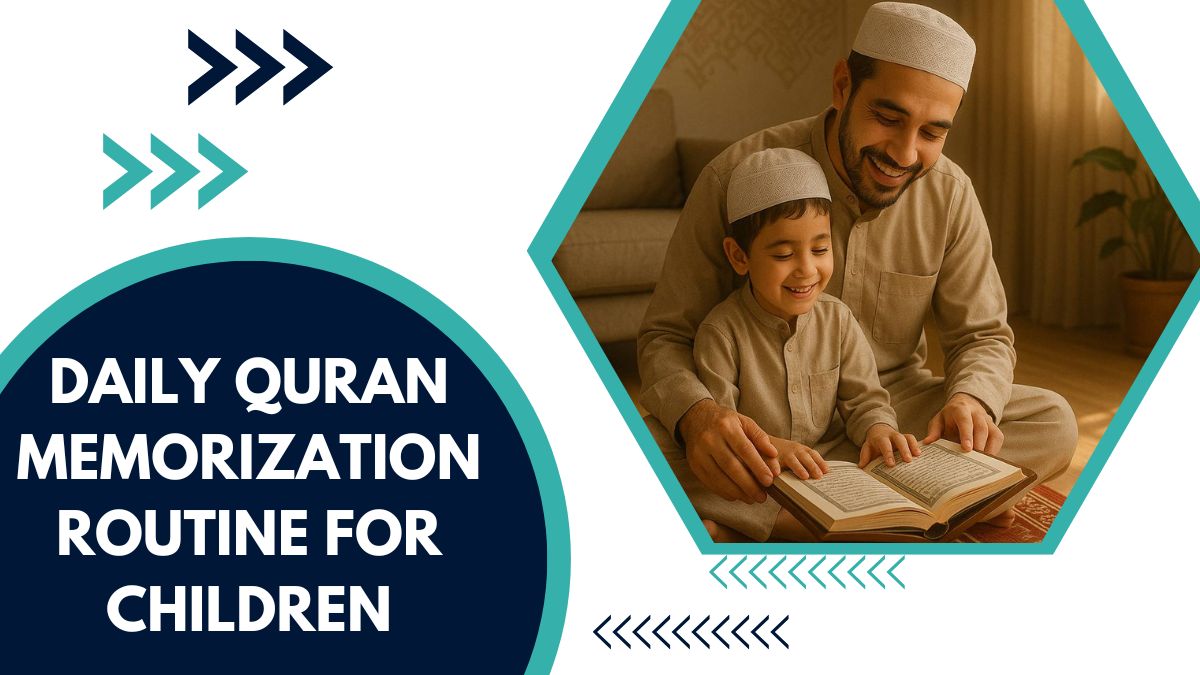
In today’s fast-paced world, raising children with a strong connection to the Quran can feel challenging—especially with the many distractions surrounding them. Yet, helping your child develop a daily Quran memorization routine is one of the most meaningful investments you can make in their spiritual and personal growth.
A consistent routine not only supports effective memorization but also nurtures discipline, focus, and a deep love for the words of Allah. The key is not how much your child memorizes in one day, but how consistently and joyfully they engage with the Quran over time.
In this guide, you’ll learn how to build a simple, practical, and child-friendly daily Quran memorization routine that fits naturally into your child’s schedule—without pressure or overwhelm.

Table of Contents
Why a Daily Quran Memorization Routine For Kids Matters
Consistency is truly the foundation of successful Quran memorization, especially for children. When memorization becomes part of a daily routine, it stops being a difficult task and turns into a natural habit.
Children thrive on structure and predictability. A clear routine helps them:
- Develop strong discipline in their daily learning habits
- Improve focus and attention span gradually over time
- Retain verses more effectively through repetition and reinforcement
- Build confidence as they notice steady progress
- Strengthen their emotional and spiritual connection with the Quran
On the other hand, without a fixed routine, memorization becomes irregular and random. This often leads to:
- Forgetting previously memorized verses
- Feeling overwhelmed or unmotivated
- Losing consistency and progress
- Frustration for both the child and parents
That is why structured programs like Denk Arabisch are helpful, as they provide guided schedules, live learning sessions, and continuous follow-ups. This removes the pressure from parents and ensures the child stays on track in a supportive environment.
Best Age to Start Quran Memorization for Children
Children can start memorizing the Quran as early as 4 to 6 years old, and in some cases even earlier depending on the child’s readiness. At this stage, children have a very strong memory and are highly receptive to sounds, repetition, and patterns.
However, what matters most is not just the age—but the approach.
At this early stage, learning should always be:
- Fun, not forced → so the child associates Quran with joy, not pressure
- Short, not overwhelming → because attention span is still developing
- Consistent, not occasional → small daily steps are more effective than long irregular sessions
As children grow older, their capacity increases, but the foundation built early makes memorization much easier later in life.
The Perfect Daily Quran Memorization Routine for Kids
A structured daily plan helps create stability and long-term success. Here is a more detailed and practical routine:
1. How a Peaceful Learning Space Helps Children Memorize Quran Faster?
A child’s environment plays a major role in how effectively they memorize the Quran. Before focusing on techniques or schedules, it is important to build a space that encourages calmness, focus, and consistency.
Choose a fixed place for daily memorization so the child associates it with learning and spiritual growth. This space does not need to be fancy, but it should always be quiet, clean, and free from distractions like television, toys, or mobile phones.
To make the environment more supportive, you can:
- Keep the Quran in a visible and respected place
- Use soft and comfortable lighting to create a peaceful atmosphere
- Ensure the seating is comfortable so the child can focus without discomfort
- Maintain consistency so the child knows this is their “Quran time” space
The goal is to help the child feel emotionally calm and mentally ready before even starting the memorization itself. When the environment feels safe and peaceful, learning becomes much easier and more enjoyable.
Quran Course For German-Speaking Children at Denk Arabisch Inspires a love for the Quran through mastery and memorization.
2. Why Daily Quran Revision (Muraja’ah) Is Essential for Strong Memorization?
Revision is the foundation of strong and long-lasting Quran memorization. Without regular revision, new memorization may be quickly forgotten, leading to frustration and lack of confidence.
Every session should begin with revising previously memorized verses for about 5–10 minutes. The child should be encouraged to recite independently first, which helps strengthen recall and memory retrieval.
During revision:
- Allow the child to try reciting without interruption at first
- Gently correct mistakes instead of focusing on criticism
- Repeat difficult sections together to reinforce accuracy
- Always praise effort, even if mistakes happen
Revision is not just about checking memory, but about strengthening it. Over time, this consistent practice builds strong retention and makes new memorization much easier.
3.The Best Way to Help Kids Memorize New Quran Verses
After revision, new memorization should be introduced carefully and in small, manageable portions. One of the most important principles here is “less is more”—especially for children.
Instead of giving long verses, break the ayah into small segments. The child should first listen carefully to correct recitation, then repeat each segment multiple times until it becomes familiar.
A structured approach can look like this:
- The teacher or parent reads the verse slowly and clearly
- The child listens without pressure to repeat immediately
- Each small part of the verse is repeated several times
- Gradually, the parts are connected until the full verse is memorized
It is important not to rush this stage. Even if progress seems slow, this method builds a strong foundation that lasts much longer and prevents forgetting.
4. How Repetition and Listening Improve Quran Memorization for Kids?
Repetition is one of the strongest pillars of Quran memorization, especially for children whose memory is still developing and highly dependent on listening and imitation rather than pure logic.
The idea is not just repeating once or twice, but building repeated exposure throughout the day in different forms so the verses become naturally embedded in the child’s memory.
To strengthen this process:
- Encourage listening to the same ayah from the same reciter repeatedly to build familiarity with tone and rhythm
- Ask the child to repeat immediately after hearing, even if imperfect at first
- Use “shadow reading” where the child reads along softly with the reciter
- Play Quran audio during calm daily activities like drawing, walking, or resting
- Revisit the same verses multiple times during the day instead of one long session
This method works because the brain of a child absorbs patterns through repetition. Over time, the verses become automatic, and the child can recall them without conscious effort.
The key is consistency and exposure, not pressure or speed.
Tajweed Course For German-Speaking Children at Denk Arabisch achieves excellence in recitation through the science of Tajweed.
5. Fun Quran Memorization Activities That Keep Children Motivated
Children do not respond well to rigid or purely academic learning methods. Their motivation grows when learning feels like an enjoyable and interactive experience rather than a strict task.
For this reason, memorization should always include elements of play, creativity, and emotional encouragement.
You can enhance engagement by:
- Turning verses into small challenges like “complete the missing word” or “who remembers the next line?”
- Using colorful flashcards that visually connect words with memory
- Creating simple reward systems that recognize effort, not just perfection
- Incorporating storytelling to explain the meaning of verses in a way children understand
- Involving family members in group recitation sessions to build confidence
What makes this powerful is that the child begins to associate Quran time with positive emotions instead of pressure. When learning feels safe and enjoyable, motivation becomes internal rather than forced. This is one of the most important factors in long-term success.
Read also: Fun Ways To Learn Arabic For Quran – A Complete Guide For Engaging And Effective Learning
6. Why Short Daily Quran Sessions Work Better for Children?
One of the most common mistakes in Quran memorization is trying to do too much in a single session. Children have limited attention spans, and pushing beyond their capacity often leads to burnout or resistance.
A better approach is to focus on short, consistent, and structured sessions that match the child’s age and energy level.
Recommended structure:
- Ages 4–6: very short sessions (10–15 minutes) focused on listening and simple repetition
- Ages 7–10: moderate sessions (15–25 minutes) combining revision and new memorization
- Ages 10+: slightly longer sessions (20–30 minutes) with stronger focus on accuracy and fluency
The key principle here is consistency over intensity. A short daily routine builds stronger memory than long irregular sessions. Children learn better when they stop before they feel exhausted, not after.
Arabic Lessons For German-Speaking Children at Denk Arabisch makes the Arabic language a natural part of your child’s world.
7. Best Time for Children to Memorize the Quran Effectively
The timing of memorization has a direct impact on focus, retention, and emotional readiness. The brain is not equally active throughout the day, so choosing the right time can significantly improve results.
The most effective times are:
- Early morning after Fajr, when the mind is calm, fresh, and free from distractions
- After school, as a light and structured review period
- Before bedtime, as a gentle reinforcement session that strengthens memory during sleep
Morning sessions are especially powerful because the brain has not yet been overloaded with daily information. At this time, children are more receptive and less mentally distracted, making memorization easier and more stable.
Keeping the same time every day also helps build a strong habit loop. The child’s brain starts expecting Quran time at a specific moment, which improves consistency automatically.
8. Teach Children to Memorize Quran Correctly, Not Quickly
In Quran memorization, quality is far more important than quantity. Many children struggle later not because they did not memorize enough, but because they memorized too quickly without proper stability.
A strong memorization process should focus on:
- Accurate pronunciation and correct Tajweed from the beginning
- Ensuring full stability of each verse before moving forward
- Repeating until the child can recite without hesitation
- Avoiding pressure to “finish more” if understanding is not strong
It is better for a child to memorize one verse perfectly than five verses weakly. Strong foundations reduce future revision problems and prevent forgetting.
This approach also builds confidence, because the child feels secure in what they know rather than overwhelmed by what they are expected to learn.
Learn the Quran with Denk Arabisch Academy
Master reading and understanding the Quran through structured and supportive learning
Try a Free Trial9. How Understanding Quran Meanings Helps Children Memorize Better?
Memorization becomes significantly stronger when the child understands even a basic meaning of what they are reciting. Understanding creates emotional attachment, and emotional attachment strengthens memory.
This does not require deep tafsir at a young age, but simple and clear explanations are very effective.
You can support understanding by:
- Explaining key words in simple language suitable for the child’s age
- Sharing short, engaging stories connected to the verse or surah
- Asking simple reflective questions like “What does this verse teach us?”
- Connecting verses to everyday situations the child can relate to
When children understand the message behind the words, memorization becomes meaningful instead of mechanical. This emotional link makes retention stronger and more natural.
10. How Positive Encouragement Builds Love for Quran Memorization for Kids?
The final moments of each memorization session are extremely important because they shape how the child feels about the entire experience. A positive ending creates motivation for the next day, while a negative or stressful ending can reduce interest.
To end effectively:
- Always praise effort, even if performance was not perfect
- Highlight small improvements to build confidence over time
- Avoid criticism at the end of the session to prevent emotional negativity
- Offer simple encouragement or small rewards when appropriate
- Make a short dua together for success, consistency, and barakah
This final step builds a positive emotional association with Quran learning. The child begins to look forward to the next session instead of feeling pressured, which is essential for long-term consistency and love for the Quran.
Simple Daily Quran Memorization Schedule for Children
Here’s a simple but highly effective daily routine that helps children build consistency without feeling overwhelmed. The key is balance between revision, new memorization, and gentle reinforcement.
Morning (after Fajr):
- 5 minutes: Revision of previously memorized verses
- 10–15 minutes: New memorization (small, manageable portion)
This is the most important part of the day because the mind is fresh, calm, and more focused. Learning in the morning significantly improves retention and accuracy.
Afternoon or Evening:
- 5–10 minutes: Quick revision of what was learned earlier in the day or previous lessons
This short session helps strengthen memory and prevents forgetting. It does not need to be intensive—just consistent reinforcement.
Before Bed:
- Listening to Quran recitation (optional but highly recommended)
- Light repetition of familiar verses
This step helps the brain reinforce memory during rest, making recall easier the next day.
Total daily time: 15–25 minutes
The goal is not long study hours, but consistent daily exposure that builds strong long-term memory.
Read also: How Can Kids Memorize The Quran? – A Complete Guide for Parents
Tips to Keep Children Motivated With Quran Memorization
Maintaining motivation is one of the most important factors in successful Quran memorization. Even the best routine will fail if the child loses interest or feels pressured.
To keep children engaged:
- Set small, realistic goals instead of large targets
- Break long surahs into achievable milestones
- Celebrate every achievement, even small ones
- Create a simple reward system (stickers, praise, small treats)
- Make memorization a shared experience rather than a solo task
- Use encouraging and positive language daily
Children are highly sensitive to emotional feedback. When they feel supported and appreciated, they naturally become more consistent and willing to learn.
The Role of Parents in Quran Memorization for Children
Parents are not just supervisors in the memorization process—they are a key part of the child’s emotional and spiritual development.
You don’t need to be a scholar or know Tajweed perfectly. What matters most is your involvement and attitude.
As a parent, you should:
- Stay consistent in following the daily routine
- Provide emotional support rather than pressure or criticism
- Be patient with slow progress and repeated mistakes
- Show genuine interest in your child’s learning journey
When a child sees that their parents value the Quran, they naturally develop respect and attachment toward it. Your presence alone sends a powerful message: the Quran is important in our life.
Benefits of Daily Quran Memorization for Children
A consistent memorization routine does not only build Quranic knowledge—it shapes the child’s personality, mindset, and emotional well-being.
1. Spiritual Benefits
- Strengthens the child’s connection with Allah from an early age
- Builds love and respect for the Quran naturally over time
- Encourages spiritual awareness in daily life
- Creates a lifelong bond with Islamic values
2. Cognitive Benefits
- Improves memory and recall abilities
- Enhances focus and attention span
- Strengthens language and pronunciation skills
- Develops discipline and structured thinking
3. Emotional Benefits
- Builds self-confidence through achievement
- Creates a sense of pride and accomplishment
- Reduces stress through structured routine
- Provides inner peace and emotional stability
These benefits extend far beyond memorization and positively shape the child’s overall development.
How to adjust your Quran Memorization Routine as your Child grows?
A Quran memorization routine is not static—it should evolve as the child develops physically, mentally, and emotionally.
As children grow:
- Gradually increase memorization capacity based on ability
- Introduce basic Tajweed rules in a simplified way
- Encourage more independence in revision and repetition
- Add deeper understanding of meanings and Tafsir gradually
- Shift from guided learning to self-driven memorization over time
Flexibility is essential. A rigid system may cause burnout, but a flexible and adaptive routine ensures long-term success and sustainability.
Daily Quran Memorization Routine Exercises for Children
What Our Students Say About Denk Arabisch Academy
See what our students say about learning at Denk Arabisch Academy on Trustpilot. Read their experiences and check out more reviews to discover how our courses help improve Arabic.

Start Your Journey With Denk Arabisch!
If you truly want your child to:
- Memorize the Quran correctly
- Stay consistent without stress
- Learn Tajweed from qualified teachers
- Enjoy the journey instead of resisting it
👉 Then Denk Arabisch is exactly what you need.
We don’t just teach—we build habits, discipline, and love for the Quran.
Why Choose Denk Arabisch?
- Specialized for Muslims in Germany
- Native, qualified Quran teachers
- Flexible schedules for busy families
- Interactive, child-friendly methods
- Proven memorization system
👉 Enroll your child today and give them the gift of the Quran for life.
Our Courses Include:
- Arabic Courses for German Speakers
- Arabic Levels for German Speakers
- Arabic Dialect Courses for German Speakers
- Qur’an Learning Courses for German Speakers
- Islamic Studies Courses for German Speakers
- Courses for Muslim Kids for German Speakers
Don’t wait until “later.”
Start now—and watch the transformation.
Learn the Quran with Denk Arabisch Academy
Master reading and understanding the Quran through structured and supportive learning
Try a Free TrialConclusion
Establishing a daily Quran memorization routine for children is not about perfection—it’s about consistency, patience, and creating a positive experience. Even a few minutes each day can lead to remarkable progress over time.
By focusing on small, achievable goals, maintaining a supportive environment, and making the process enjoyable, you help your child build a lifelong relationship with the Quran. Remember, every verse memorized is a step closer to strengthening their faith and character.
Start simple, stay consistent, and trust the process. With your guidance and encouragement, your child will not only memorize the Quran but also grow to love and live by it.
FAQs
1. At what age should my child start memorizing the Quran?
Children can begin as early as 4 to 6 years old. At this age, they have strong memorization abilities and can easily pick up sounds and short verses. The focus should be on making learning fun and pressure-free.
2. How long should daily Quran memorization sessions be?
For young children, 10 to 20 minutes per day is ideal. Short, consistent sessions are much more effective than long, irregular ones.
3. How many verses should a child memorize each day?
It depends on the child’s age and ability. For beginners, even one verse per day is enough. The goal is quality and retention, not speed.
4. What is the best time for Quran memorization?
The best time is usually after Fajr, when the mind is fresh and focused. However, any consistent time that fits your child’s routine can work well.
5. How can I help my child stay motivated?
You can keep your child motivated by:
Praising their efforts
Setting small goals
Offering rewards
Making learning interactive and fun
Positive reinforcement plays a huge role in maintaining consistency.
6. What if my child forgets what they memorized?
Forgetting is completely normal. This is why daily revision (Muraja’ah) is essential. Regular review helps strengthen memory and prevents long-term loss.
7. Should my child understand the meaning of the verses?
Yes, even a basic understanding helps children connect with what they are memorizing. Simple explanations and stories can make a big difference.