Takeaway:
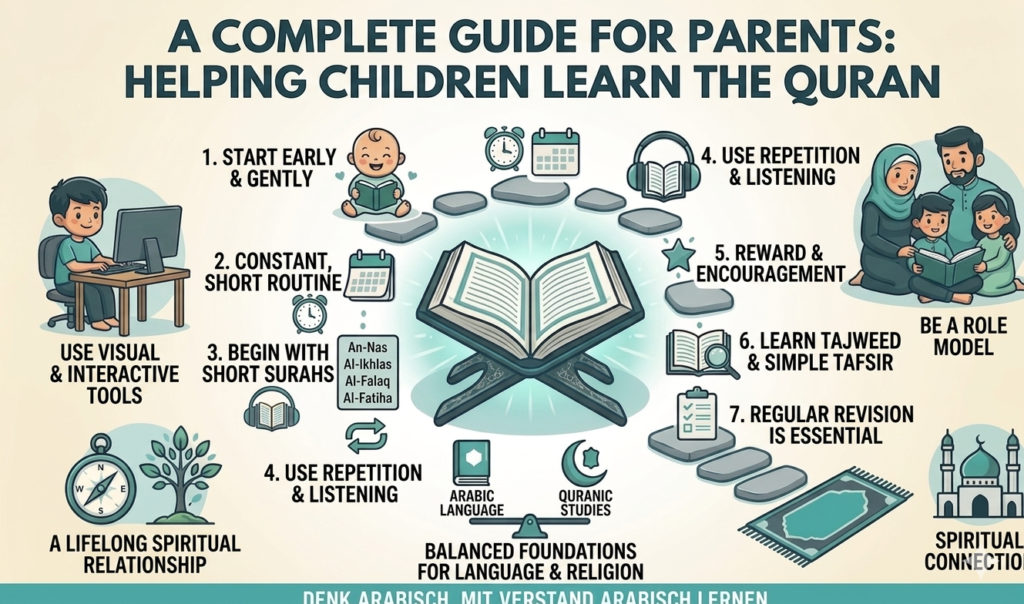
- Early childhood (4–5 years) is the ideal window to begin Quran memorization because young brains absorb sounds, rhythm, and patterns effortlessly, making learning stick for life.
- Focus on building familiarity and emotional comfort before demanding perfect memorization; short, playful sessions of 5–10 minutes prevent overwhelm and nurture a love for the Quran.
- A fixed daily routine of just 10–20 minutes—combining revision of old verses with one small new section—creates a natural habit and strengthens long-term memory far more than irregular long sessions.
- Start with the shortest, most familiar surahs (Al-Fatiha, Al-Ikhlas, Al-Falaq, An-Nas, Al-Kawthar, Al-Asr) to give children early success and the confidence to continue.
- Daily, gentle repetition is the foundation: listen to one verse multiple times, repeat slowly with correct pronunciation, then gradually connect verses, always reviewing old material before adding new.
- Passive listening to a slow, clear reciter during car rides, playtime, or bedtime allows children to absorb Quranic sounds naturally, speeding up memorization without formal study.
- Break the journey into tiny daily goals—one verse or a very short segment—to build a sense of achievement, reduce pressure, and keep motivation high.
- Engage multiple senses with child-friendly Quran apps, flashcards, color-coded mushafs, and whiteboard writing; interactive tools make memorization fun and improve focus.
- Celebrate effort, not just results, with stickers, small gifts, praise, and family recognition; positive emotional associations are stronger drivers than instruction alone.
- Introduce basic Tajweed (makharij, ghunnah) and simple meanings early; understanding what is recited creates mental “hooks” that deepen memory and prevent parrot-like repetition.
- A structured revision system is non-negotiable: daily review of recent verses, weekly review of the week’s surahs, and a monthly full revision prevent forgetting and build fluency.
- Parents are the most powerful models—children who see their parents recite, revise, and listen to the Quran daily naturally imitate that behavior and develop lasting attachment.
- Maintain a pressure-free, encouraging environment; never compare, punish, or show frustration, because emotional safety is the bedrock of sustained learning.
- Professional, structured programs (online or in-person) with qualified teachers ensure correct pronunciation from the start, steady accountability, and child-friendly progression—like the system at Denk Arabisch.
- A proven three-step method for any verse works consistently: Listen (multiple times) → Repeat (with guidance) → Recall (recite independently), building strong, independent memorization.
- Patience is essential; every child progresses at their own pace, and even a few correctly memorized surahs with understanding is a lifelong achievement far better than rushed quantity.
Helping children memorize the Quran is one of the most rewarding journeys a parent can take. It strengthens a child’s connection with their faith, builds discipline, and nurtures a lifelong love for learning. However, many parents wonder: How can kids memorize the Quran effectively without feeling overwhelmed?
In this comprehensive guide, you’ll discover practical, child-friendly strategies to make Quran memorization easier, enjoyable, and sustainable.
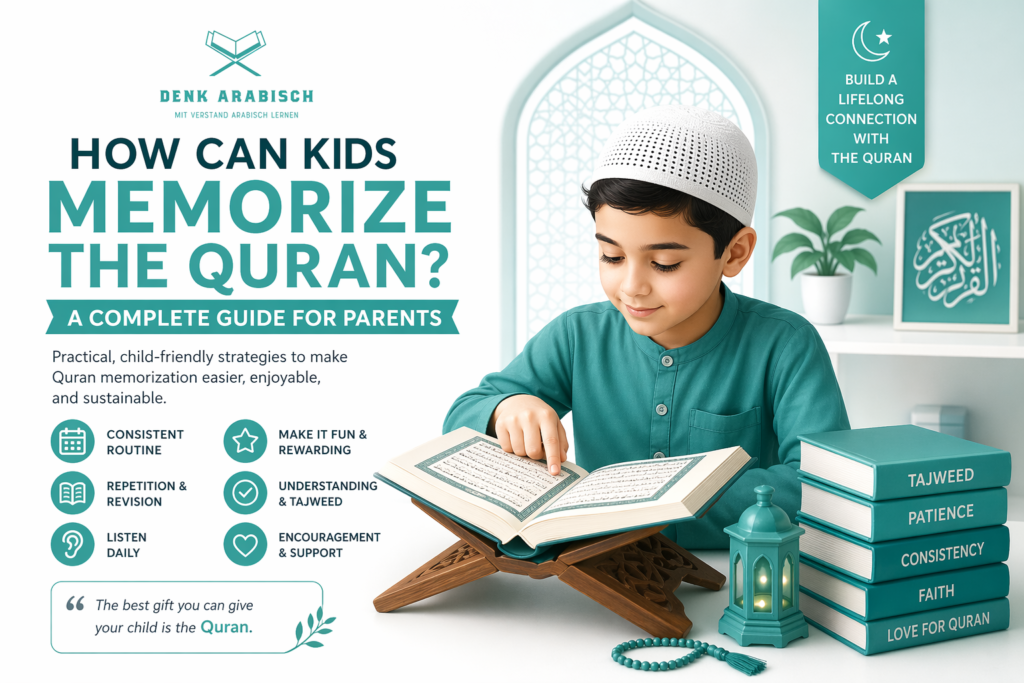
Table of Contents
Why Is Quran Memorization Important for Kids?
Before diving into methods, it’s important to understand the true value of memorizing the Quran at a young age. Childhood is a unique stage where the mind is highly receptive, making it the perfect time to plant seeds that last a lifetime.
Strong memory skills: Children naturally possess remarkable memorization abilities. At a young age, their brains are more flexible and capable of retaining information quickly and efficiently, making Quran memorization easier and more effective compared to later stages in life.
Spiritual connection: Early exposure to the Quran helps children develop a deep emotional and spiritual bond with it. Listening to and memorizing the words of Allah nurtures love, tranquility, and a sense of closeness to their faith from an early age.
Character development: Memorizing the Quran is not just about repetition—it teaches patience, discipline, commitment, and consistency. These qualities positively shape a child’s personality and carry over into other areas of life, including school and relationships.
Language foundation: Since the Quran is in Arabic, memorization helps children become familiar with the language naturally. Over time, this builds a strong foundation for understanding Arabic vocabulary, pronunciation, and eventually comprehension.
Confidence and achievement: As children progress in memorization, they experience a strong sense of accomplishment. This boosts their self-confidence and motivates them to continue learning and growing.
When approached correctly—with encouragement, positivity, and age-appropriate methods—memorizing the Quran becomes a joyful and enriching journey rather than a stressful obligation.
At Denk Arabisch, we specialize in helping children build a strong connection with the Quran through structured, engaging, and age-appropriate lessons designed especially for German-speaking families.
1. Why Early Quran Learning For Kids Sticks for Life?
Children as young as 4–5 years old can begin memorizing short surahs because this stage of life is one of the most powerful periods for memory development.
At this age, children absorb sounds, rhythms, and repeated patterns very quickly, often without even realizing they are learning. That’s why early exposure to the Quran can have a long-lasting impact on their relationship with it.
The focus at this stage should never be on speed or perfection, but on building familiarity and emotional comfort. When a child feels relaxed and happy during learning, their brain naturally retains more information without pressure.
Key approach:
- Avoid pressure, strict correction, or comparisons with other children
- Focus on listening first before expecting memorization
- Keep sessions extremely short (5–10 minutes is ideal at the beginning)
- Make learning playful, gentle, and emotionally positive
- Repeat the same short surahs frequently to build familiarity
Important note:
Early exposure is far more valuable than perfect memorization. What stays with the child is not just the words, but the love and comfort they associate with the Quran.
Start your child’s spiritual journey at Denk Arabisch with our Quran Course For German-Speaking Children, where we make learning the Holy Quran an engaging and rewarding experience.
2. Build a Daily Routine That Makes Quran Memorization For Kids Feel Natural
A consistent routine is one of the most important factors in successful Quran memorization. Children thrive on structure, and when learning happens at a fixed time every day, it becomes part of their natural lifestyle rather than something forced or occasional.
Even short daily practice is far more effective than long sessions done irregularly. Consistency helps the brain strengthen memory pathways and reduces the effort needed to recall verses over time.
Ideal routine includes:
- 10–20 minutes daily depending on the child’s age and focus level
- A fixed time every day (after Fajr, after school, or before bedtime)
- A calm environment with minimal noise and distractions
- A simple structure: revision of old verses + learning one small new part
Why it matters:
- Builds discipline and responsibility in a natural way
- Helps the child form a stable learning habit
- Improves long-term memory retention through repetition
- Reduces resistance because the routine feels familiar and predictable
At Denk Arabisch, we support families with structured learning plans that make consistency easy and sustainable without overwhelming the child.
3. Begin with Short Surahs to Build Confidence and Early Success For Kids
Starting with short surahs is one of the most effective ways to build confidence in children. When a child successfully memorizes something small at the beginning, it creates a strong sense of achievement that motivates them to continue learning.
These surahs are also beneficial because they are already heard frequently in daily prayers, which means children recognize them even before memorization begins. This familiarity reduces difficulty and increases confidence.
Recommended surahs:
- Surah Al-Fatiha
- Surah Al-Ikhlas
- Surah Al-Falaq
- Surah An-Nas
- Surah Al-Kawthar
- Surah Al-Asr
Why these surahs are effective:
- Very short and easy to repeat
- Contain simple structure and clear rhythm
- Frequently recited in Salah, increasing familiarity
- Help build early success and motivation
Result:
Children feel capable from the beginning, which creates positive momentum and encourages steady progress.
Deepen your faith and understanding with Islamic Studies For Kids at Denk Arabisch—academic excellence designed specifically for the German-speaking community.
4. How Daily Repetition Strengthens Quran Memory in Children?
Repetition is the foundation of all memorization, especially for young learners. The brain strengthens memory through repeated exposure, turning unfamiliar information into long-term knowledge.
For children, repetition must be structured and gentle, not rushed. When done correctly, it creates deep familiarity with verses and improves both accuracy and fluency.
Effective repetition method:
- Listen to one verse several times (5–10 repetitions or more if needed)
- Repeat slowly with correct pronunciation
- Focus on understanding the sound and rhythm first
- Move to the next verse only after stability is achieved
- Gradually combine verses into small connected sections
Important habits:
- Daily revision is essential for long-term retention
- Do not rush into new verses without reviewing old ones
- Focus on correct pronunciation rather than speed
- Keep repetition calm, consistent, and stress-free
Result:
The child develops strong, stable memorization that lasts longer and becomes easier to recall.
5. How Listening Helps Children Learn the Quran Faster?
Listening plays a major role in Quran memorization, especially for children who learn more through hearing than reading in early stages. Continuous exposure to Quran recitation helps the brain naturally absorb words, sounds, and patterns.
This method allows memorization to happen gradually, even outside of formal study time, making learning more natural and effortless.
How to apply it daily:
- Play Quran recitation in the morning to start the day peacefully
- Use car rides or travel time for passive listening
- Keep Quran playing softly at home during daily activities
- Use bedtime listening as part of a calming routine
Best practice:
- Choose a reciter with slow, clear, and soft pronunciation
- Repeat the same surahs regularly for stronger retention
- Keep audio exposure consistent every day
- Allow the child to hear the same verses multiple times
Result:
Children start memorizing naturally over time without feeling that they are “studying.”
Read also: How to Learn The Quran For Kids? – The Ultimate Guide
6. How Small Daily Goals Keep Kids Motivated and Progressing?
Large memorization goals can feel overwhelming for children, especially at the beginning. That is why breaking learning into small, manageable steps is essential for building confidence and avoiding frustration.
Small progress creates motivation and helps children feel successful every day, even if the progress seems minimal.
Better approach:
- Focus on one verse or a very small section per day
- Repeat previously learned verses daily before adding new ones
- Combine small parts gradually into larger sections
- Increase difficulty slowly based on the child’s ability
Benefits:
- Builds confidence through achievable goals
- Reduces stress and pressure
- Creates a sense of daily success and motivation
- Ensures steady and sustainable long-term progress
At Denk Arabisch, we follow a gradual memorization system that adapts to each child’s pace, ensuring comfort and consistency throughout the journey.
7. Engage More Senses with Visual and Interactive Tools That Make Memorization For Kids Fun
Children learn best when more than one sense is involved. Combining hearing, seeing, and active participation makes memorization stronger and more engaging.
Interactive tools also help prevent boredom and make learning feel like a fun activity rather than a repetitive task.
Helpful tools:
- Quran apps designed for children with audio repetition features
- Flashcards showing verses, keywords, or meanings
- Color-coded Mushaf to visually guide memorization
- Writing verses on a whiteboard for active recall practice
- Simple quizzes and interactive learning games
Why it works:
- Improves attention span and focus
- Strengthens memory through visual reinforcement
- Makes learning more enjoyable and less tiring
- Helps children stay motivated for longer periods
Result:
Children become more engaged, and memorization becomes easier, faster, and more effective.
Learn the Quran with Denk Arabisch Academy
Master reading and understanding the Quran through structured and supportive learning
Try a Free Trial8. Fun Ways to Motivate Children to Memorize the Quran
Motivation plays a very important role in a child’s ability to continue memorizing the Quran. When learning feels enjoyable, children naturally want to repeat it, and repetition is exactly what strengthens memory.
At this age, emotional motivation is often more powerful than instruction itself. That’s why creating a positive and rewarding experience is essential for long-term success.
Reward ideas:
- Stickers, stars, or simple reward charts
- Small gifts after completing a surah
- Verbal praise and encouragement
- Celebrating milestones like finishing a short surah
- Family recognition (sharing achievement with parents or siblings)
Important approach:
- Focus on effort, not just results
- Avoid punishment or negative reactions
- Never link Quran learning with stress or pressure
Why it matters:
Positive emotions create strong mental associations. When a child enjoys learning, they are more likely to stay consistent and develop a lifelong love for the Quran.
9. How Tajweed Improves Quran Memorization for Kids and Recitation?
Even at a young age, children can begin learning the basics of Tajweed and simple meanings. This makes memorization deeper and more meaningful, rather than just repetition without understanding.
Correct pronunciation (Tajweed) is especially important because it preserves the beauty and accuracy of the Quran. Learning it early prevents habits that become difficult to correct later.
Tajweed focus:
- Makharij (pronunciation points): Learning where each Arabic letter comes from (throat, tongue, lips)
- Ghunnah: Understanding nasal sound rules
- Ikhfa and other basic rules: Learning how letters interact in recitation
Simple Tafsir (meaning):
- Explain short meanings in a child-friendly way
- Connect surahs to simple ideas or stories
- Example: Surah Al-Fil → the story of the elephant
- Example: Surah Ash-Shams → natural signs like the sun
Why it helps:
- Creates mental “hooks” that improve memory
- Makes verses easier to recall
- Increases emotional and intellectual connection
- Turns memorization into meaningful learning
Perfect your recitation through Denk Arabisch; our Tajweed Course For German-Speaking Children provides the foundation every young Muslim needs to connect with the Quran.
10. Why Regular Revision Is the Secret to Never Forgetting What Your Child Memorized?
Revision is one of the most important parts of Quran memorization, yet it is often neglected. Without regular revision, even strong memorization can fade over time.
Children especially need repetition to strengthen long-term memory, so revision should always be part of the daily structure.
Simple revision plan:
- Daily: Review the last memorized verses before learning new ones
- Weekly: Review all surahs learned during the week
- Monthly: Do a full revision of everything memorized so far
Common mistake:
- Focusing only on new memorization and forgetting old lessons
Why revision is essential:
- Strengthens memory stability
- Prevents forgetting previously learned surahs
- Builds confidence in recitation
- Improves fluency and accuracy over time
At Denk Arabisch, we integrate structured revision systems into our programs to ensure long-term retention and strong memorization.
11. How Parents Inspire Children to Love the Quran?
Children learn more from what they see than what they are told. Parents play a powerful role in shaping a child’s attitude toward the Quran.
When children see Quran learning as part of daily family life, they naturally become more interested and motivated to follow it.
Positive behaviors to show:
- Reading the Quran regularly
- Revising or memorizing even small portions
- Showing respect and love for the Quran
- Listening to Quran recitation at home
Why it matters:
- Builds emotional connection through imitation
- Encourages children to see learning as normal
- Strengthens family bonding through shared spiritual practice
Best approach:
Make the Quran learning a family habit, not just a child’s responsibility.
12. How Encouragement Helps Kids Succeed in Quran Memorization?
The environment in which a child learns has a huge impact on their success. A positive atmosphere builds confidence, while pressure can create resistance and stress.
Children need to feel safe, supported, and encouraged during their learning journey.
Do:
- Encourage effort, not perfection
- Be patient with mistakes
- Celebrate small improvements
- Use gentle correction and guidance
Avoid:
- Comparing the child with others
- Showing frustration or disappointment
- Forcing memorization under pressure
- Creating fear around mistakes
Why it matters:
- Builds confidence and emotional safety
- Increases willingness to learn
- Strengthens love for the Quran
At Denk Arabisch, our teachers are trained to maintain a warm, supportive, and encouraging environment where every child feels valued.
Read also: Children Of The Quran – What Muslim Students Learn
13. Benefits of Professional Quran Classes for Kids
While home learning is helpful, structured programs provide guidance, consistency, and professional support that can significantly improve results.
A structured program helps children stay on track and ensures correct learning from the beginning.
Benefits of structured programs:
- Professional guidance from qualified teachers
- Correct pronunciation and Tajweed from the start
- Regular lessons and accountability
- Clear memorization plans tailored for children
- Interactive and engaging teaching methods
Types of programs:
- Online Quran classes
- Local Quran circles (Halaqah)
- One-on-one tutoring sessions
Why it helps:
- Provides structure and discipline
- Reduces learning gaps
- Keeps children motivated and consistent
14. A Proven Quran Memorization System Kids Can Follow Easily
This method is one of the simplest and most effective ways to help children memorize the Quran in a structured and stress-free way. It works because it combines listening, repetition, and active recall—all of which are essential for strong memory formation, especially in young learners.
Instead of overwhelming the child with long or complex techniques, this method breaks the process into three clear and repeatable steps that can be applied daily to any verse or short surah.
Step 1: Listen
- The child listens to the verse multiple times
- Focuses on rhythm, pronunciation, and flow
Step 2: Repeat
- The child repeats after listening
- Helps train pronunciation and memory together
Step 3: Recall
- The child recites without looking
- Builds independent memorization strength
How to use it:
- Repeat the cycle for each verse
- Apply daily with revision included
- Start with short surahs first
Why it works:
- Combines listening, speaking, and memory
- Strengthens long-term retention
- Builds confidence in independent recitation
15. Be Patient—Every Child Is Different
Patience is one of the most important factors in a child’s Quran memorization journey. Every child has a unique learning style, different attention span, and individual pace of understanding. Because of this, comparing children to one another can often create unnecessary pressure and reduce motivation.
Some children may memorize quickly and easily, while others may need more time, repetition, and encouragement—and both are completely normal. What truly matters is not how fast the child progresses, but how consistently and comfortably they continue learning over time.
Key mindset:
- Focus on steady progress, not fast results
- Accept different learning speeds
- Encourage persistence and effort
- Celebrate even small achievements
Main goals:
- Accuracy in memorization
- Consistency in practice
- Love and connection with the Quran
Important reminder:
Even memorizing a few surahs correctly and with understanding is a significant and valuable achievement.
Sample Daily Quran Memorization Plan for Kids
Duration: 15–20 minutes
1. Warm-up (5 minutes)
The session begins with a gentle revision of previously memorized verses. This step is very important because it prepares the child’s mind and helps activate memory before introducing anything new. It also ensures that older lessons are not forgotten while moving forward.
During this stage, the child recites older surahs or verses with guidance, focusing on fluency and correct pronunciation. Mistakes are corrected softly and without pressure, so the child feels confident rather than stressed.
This part of the session helps the child “wake up” their memory and enter the learning mode smoothly.
It strengthens previously learned material, builds confidence at the beginning of the session, and creates a smooth transition into new memorization without overwhelming the child.
2. New Memorization (5–7 minutes)
This is the core learning part of the session where the child is introduced to new verses. The key here is to keep the amount very small and manageable so the child does not feel overloaded.
In this step, one or two verses are introduced slowly and clearly. The verse is repeated several times until the child becomes familiar with its sound and rhythm. Sometimes it is helpful to break the verse into smaller parts and teach each part separately before combining them.
The focus is always on accuracy, correct pronunciation, and understanding the flow of the verse rather than speed. The child should feel that they are learning something simple and achievable.
It allows steady progress without pressure, builds strong understanding step by step, and ensures that each new verse is properly memorized before moving forward.
3. Practice and Connection (5 minutes)
After learning new verses, the child moves to combining everything they have learned. This step connects old memorization with the new lesson, which is essential for long-term retention.
Here, the child recites both old and new verses together multiple times. The goal is to create a smooth flow so that the child can move from one verse to another without hesitation.
Repetition during this stage helps stabilize the memorization and reduces the chance of forgetting newly learned verses.
The teacher or parent gently guides the child, ensuring correct sequence and pronunciation, while also encouraging confidence and calm recitation.
It strengthens memory connections, improves fluency, and ensures that new verses are fully integrated with previous learning.
4. Listening
Listening is a powerful support tool that can be used outside the main learning session. It helps reinforce memorization in a natural and effortless way.
The child listens to Quran recitation during daily routines such as car rides, quiet time at home, or before sleep. The same surahs can be repeated regularly so that the child becomes familiar with their rhythm and sound.
This passive learning method allows the brain to absorb information without active effort, which significantly improves memorization over time.
It strengthens auditory memory, improves pronunciation naturally, and helps the child memorize more easily through repeated exposure.
What Our Students Say About Denk Arabisch Academy
See what our students say about learning at Denk Arabisch Academy on Trustpilot. Read their experiences and check out more reviews to discover how our courses help improve Arabic.

Start Your Child’s Quran Journey Today
If you truly want your child to memorize the Quran correctly, confidently, and with love, don’t leave it to chance.
At Denk Arabisch, we provide:
- Structured Quran memorization programs
- Certified Tajweed teachers
- Special courses for German-speaking children
- Interactive and engaging lessons
- Flexible online learning from home
Whether your goal is Quran reading, Tajweed, or full memorization, we have the perfect program for your child.
Spots are limited.
Early learning makes all the difference.
Enroll your child today and give them the gift of the Quran for life.
Learn the Quran with Denk Arabisch Academy
Master reading and understanding the Quran through structured and supportive learning
Try a Free TrialConclusion
Teaching kids to memorize the Quran is a journey that requires patience, consistency, and love. By starting early, using simple techniques like repetition and listening, and creating a supportive environment, children can successfully memorize the Quran in a way that is both enjoyable and meaningful.
Every small step counts. Whether your child memorizes a few short surahs or continues to memorize the entire Quran, what truly matters is the connection they build with it.
Start small, stay consistent, and trust the process.
FAQs
1. At what age should kids start memorizing the Quran?
Children can start as early as 4–5 years old. At this age, they have strong listening and memorization abilities. However, learning should be gentle, fun, and pressure-free to build a positive connection with the Quran.
2. How long should a child spend memorizing the Quran each day?
For young children, 10 to 20 minutes per day is ideal. Short and consistent sessions are more effective than long lessons, as they help maintain focus and prevent fatigue.
3. How many verses should a child memorize daily?
It depends on the child’s age and ability. Most children can comfortably memorize:
1–2 short verses per day (beginners)
2–4 verses per day (with practice)
The key is consistency, not speed.
4. What is the best time for kids to memorize the Quran?
The best times are:
Early morning (after Fajr)
Before bedtime
These times are usually quiet and help children focus better.
5. How can I help my child remember what they memorized?
Regular revision is essential. You can:
Review previous verses daily
Set a weekly revision day
Encourage recitation during prayers
Without revision, memorization can fade quickly.
6. What if my child forgets frequently?
Forgetting is normal, especially in the early stages. To help:
Increase repetition
Focus more on revision than new memorization
Be patient and encouraging
Consistency will improve retention over time.