Learning Tajweed is an important step for every Muslim who wants to recite the Holy Qur’an correctly, clearly, and beautifully. Tajweed rules help preserve the proper pronunciation of Quranic words as they were revealed to Prophet Muhammad ﷺ. Among the rules that govern letter interactions in Arabic recitation, Idgham Mutamathilayn stands as one of the most logical, elegant, and frequently occurring rules in the entire Qur’an.
Understanding Idgham Mutamathilayn helps reciters handle the natural meeting of two identical letters with precision and fluency. Mastering this rule improves overall recitation quality, eliminates unnecessary doubling of sounds, and gives the recitation a smooth and connected flow that reflects authentic Tajweed. It also deepens the reciter’s understanding of how Arabic letters interact with one another across words and within them.
In this article, we will explain everything you need to know about Idgham Mutamathilayn, including its definition, types, conditions, pronunciation method, Quranic examples, common mistakes, differences from related rules, and practical tips to master it with confidence.
Table of Contents
What Is Idgham Mutamathilayn?
Idgham Mutamathilayn is a Tajweed rule that applies when two identical letters meet — the first carrying a sukoon (no vowel) and the second carrying a vowel — causing the first letter to be merged completely into the second, producing one stressed, doubled letter with a shaddah-like emphasis.
The word “Idgham” in Arabic means merging or assimilation — the blending of one sound into another. The word “Mutamathilayn” means two alike or two identical, referring to the two letters that share the same name, same shape, and same articulation point. Together, Idgham Mutamathilayn means the merging of two identical letters into one.
When this rule is applied, the first letter disappears completely into the second, and the second letter is pronounced with emphasis — as though it carries a shaddah (ّ). The result is a single, strengthened letter that combines the weight of both.
Idgham Mutamathilayn is considered one of the most natural and intuitive rules in Tajweed because merging two identical sounds in succession is a feature of Arabic speech itself. The rule simply formalizes and perfects what the tongue naturally tends to do when it encounters the same sound twice in a row.
Why Is Idgham Mutamathilayn Important?
Idgham Mutamathilayn is important because it prevents an unnatural and strained pronunciation that would result from articulating two identical letters separately in quick succession. Pronouncing both letters fully and independently would create a stuttering or doubled effect that does not reflect authentic Arabic speech or proper Quranic recitation.
By merging the first letter into the second, the recitation flows naturally, beautifully, and effortlessly. This rule also demonstrates how deeply Tajweed is rooted in the organic phonetics of the Arabic language — rules are not arbitrary restrictions but reflections of how the language sounds at its best.
Benefits of Learning Idgham Mutamathilayn
- Eliminating unnatural doubling of identical sounds
- Producing smooth and flowing Quranic recitation
- Understanding how identical letters interact across words
- Strengthening overall knowledge of the Idgham family of rules
- Improving Arabic phonetic awareness and listening skills
- Building consistency and confidence in mid-recitation decisions
- Completing a thorough understanding of letter assimilation in Tajweed
For both beginners and advanced learners, Idgham Mutamathilayn is a rule that appears so frequently throughout the Qur’an that mastering it produces an immediate and noticeable improvement in recitation quality.
Let the words of Allah illuminate your soul forever—start your path to Hifz with the Quran Memorization Course at Denk Arabisch.
The Two Types of Idgham Mutamathilayn
Idgham Mutamathilayn is divided into two types based on whether the merging occurs within the same word or across two separate words.
Type 1 — Idgham Mutamathilayn Sagheer (Small)
Sagheer means small. This type occurs when the first of the two identical letters carries a sukoon and the second carries a vowel, and they appear either within the same word or across two words.
This is the most common type and the one most discussed in Tajweed books. It is called “small” not because it is less important, but because only one of the two letters has a vowel — making the merging straightforward and clean.
Condition for Sagheer:
- First letter: has sukoon (سُكون)
- Second letter: has a vowel (fathah, kasrah, or dhammah)
- The two letters are identical in name and articulation point
Type 2 — Idgham Mutamathilayn Kabeer (Large)
Kabeer means large. This type occurs when both of the two identical letters carry vowels. This type is associated with the recitation of Imam Abu Amr and is less commonly discussed in standard Hafs recitation.
In the Hafs reading — which is the most widely followed recitation worldwide — Idgham Mutamathilayn Kabeer is not commonly applied. Most Tajweed learners therefore focus primarily on Sagheer.
For the purposes of this article, all further discussion refers to Idgham Mutamathilayn Sagheer, which is the standard and universally applied type.
Conditions of Idgham Mutamathilayn
For Idgham Mutamathilayn to apply correctly, specific conditions must be met. Understanding these conditions prevents incorrect application of the rule.
Condition 1 — The Two Letters Must Be Identical
The two letters must share the same name, same shape, and same articulation point. For example, Ba meeting Ba (بْ + بَ), or Dal meeting Dal (دْ + دَ), or Seen meeting Seen (سْ + سَ).
Condition 2 — The First Letter Must Have Sukoon
The first of the two identical letters must carry a sukoon — meaning it has no vowel of its own. This is what makes merging natural: a letter without a vowel smoothly assimilates into an identical letter that follows it.
Condition 3 — The Second Letter Must Have a Vowel
The second letter must carry a vowel (fathah, kasrah, or dhammah) so that the merged, doubled letter can be properly articulated.
Condition 4 — No Elongation Letter Between Them
There must be no letter of elongation (madd) separating the two identical letters. If a madd letter stands between them, the rule does not apply.
Important Exception — Meem Sakinah Before Meem
When Meem Sakinah (مْ) is followed by a Meem with a vowel, this situation is governed by Idgham Shafawi — a specific sub-rule within the Meem Sakinah rules — rather than the general Idgham Mutamathilayn. The result is the same merging, but it is classified and named differently because of the special status of Meem Sakinah.
Master the art of recitation with confidence. Join the Quran Reading Course at Denk Arabisch and build a bond with the Divine that lasts a lifetime.
How to Pronounce Idgham Mutamathilayn Correctly
Correct pronunciation of Idgham Mutamathilayn requires allowing the first letter to completely dissolve into the second, producing a single doubled letter that carries the weight and emphasis of both.
Steps to Apply Idgham Mutamathilayn Correctly
1. Identify the Two Identical Letters Recognize that the first letter has a sukoon and the second carries a vowel. Confirm they are identical in name and articulation point.
2. Do Not Pronounce the First Letter Independently The first letter should not be articulated on its own. Do not attempt to sound it out before moving to the second. It merges silently and completely into what follows.
3. Pronounce the Second Letter With Emphasis The second letter is pronounced as though it carries a shaddah — with a doubled, strengthened sound. The tongue or lip presses firmly at the articulation point and releases with the vowel of the second letter.
4. Maintain Smooth Recitation Flow The merging should feel natural and uninterrupted. There should be no pause, gap, or break between the end of the first word and the beginning of the second during the merge.
5. Check for Ghunnah Idgham Mutamathilayn does not require ghunnah — unless the letter being merged is Noon or Meem, which carry inherent nasal qualities. For all other letters, the merge is clean with no nasal resonance.
| Element | Correct Application |
| First Letter | Disappears completely — it is not pronounced independently. |
| Second Letter | Pronounced with Shaddah-like emphasis. |
| Ghunnah | Applied only for Noon and Meem — not for other letters. |
| Flow | Must be smooth, natural, and uninterrupted. |
| Duration | No extension — the merge is immediate. |
Important Pronunciation Tip
A common way to feel the correct application is to imagine the two letters as one letter with a shaddah written above it. Practice saying the second letter with double emphasis — pressing the articulation point firmly — rather than trying to say both letters separately. This mental shift makes the rule feel natural very quickly.
Read also: Idgham Without Ghunnah – Your Guide In Tajweed
Examples of Idgham Mutamathilayn in the Qur’an
Idgham Mutamathilayn appears throughout the Qur’an wherever two identical letters meet with the first carrying sukoon and the second carrying a vowel. Here are some of the clearest and most well-known examples:
Example 1 — Ba meeting Ba (بْ + بَ)
اضْرِب بِّعَصَاكَ
Strike with your staff
Transliteration: Iḍrib bi’aṣāk Surah Al-Baqarah (2:60)
The Ba Sakinah at the end of “اضْرِب” merges completely into the Ba of “بِّعَصَاكَ”. The result is a single, emphasized Ba pronounced with the vowel of the second letter.
Example 2 — Dal meeting Dal (دْ + دَ)
قَد دَّخَلُوا
They have already entered
Transliteration: Qad dakhalū Surah Al-Maidah (5:61)
The Dal Sakinah in “قَد” merges completely into the Dal of “دَخَلُوا”. The two Dals become one doubled Dal, pronounced with clear emphasis.
Example 3 — Lam meeting Lam (لْ + لَ)
بَل لَّا يَخَافُونَ
Rather, they do not fear
Transliteration: Bal lā yakhāfūn Surah Al-Muddaththir (74:53)
The Lam Sakinah in “بَل” merges into the Lam of “لَا”. A single, strengthened Lam is produced with the vowel of the second letter.
Example 4 — Noon meeting Noon (نْ + نَ)
مِن نِّعْمَةٍ
Of any blessing
Transliteration: Min ni’mah Surah An-Nahl (16:53)
The Noon Sakinah in “مِن” merges into the Noon of “نِعْمَةٍ”. Because Noon carries an inherent nasal quality, a light ghunnah accompanies this merging.
Example 5 — Meem meeting Meem (مْ + مَ)
لَهُم مَّا يَشَاءُونَ
For them is whatever they wish
Transliteration: Lahum mā yashā’ūn Surah Az-Zumar (39:34)
The Meem Sakinah in “لَهُم” merges into the Meem of “مَا”. This is technically classified as Idgham Shafawi due to the special status of Meem Sakinah, but the physical result — a merged, doubled Meem with ghunnah — is identical to Idgham Mutamathilayn.
👉 Key pattern: In each example, the rule is consistent — the first identical letter with sukoon disappears completely in the second identical letter with vowel, producing a single doubled, stressed sound.
Perfect your tilaawah with the Quran Tajweed Course at Denk Arabisch and experience the beauty of reciting the Quran as it was revealed.
Learn the Quran with Denk Arabisch Academy
Master reading and understanding the Quran through structured and supportive learning
Try a Free TrialIdgham Mutamathilayn vs. Related Idgham Rules
Idgham Mutamathilayn belongs to a family of Idgham rules in Tajweed. Understanding how it differs from its relatives prevents confusion during recitation.
| Rule | Letters Involved | Relationship | Ghunnah? |
| Idgham Mutamathilayn | Two identical letters (e.g., ب + ب) | Same name, same shape, same articulation point | Only for Noon (ن) and Meem (م) |
| Idgham Mutajanisayn | Letters sharing the same articulation point | Same point, different characteristics/names | Depends on the specific letters involved |
| Idgham Mutaqaribayn | Letters with points of articulation close to each other | Close points, but not identical | Depends on the specific letters involved |
| Idgham with Ghunnah | Noon Sakinah or Tanween before و , ي , ن , م | Different letters (Assimilation rule) | Yes |
| Idgham Shafawi | Meem Sakinah before م | Specific to the letter Meem | Yes |
Key Distinctions
Mutamathilayn vs. Mutajanisayn: Mutamathilayn involves two letters that are completely identical. Mutajanisayn involves two letters that share the same articulation point but have different names — for example, Ta (ت) meeting Dal (د), or Tha (ث) meeting Dhal (ذ).
Mutamathilayn vs. Mutaqaribayn: Mutaqaribayn involves two letters whose articulation points are close but not the same — for example, Qaf (ق) meeting Kaf (ك). In Mutamathilayn, the letters are completely identical with no difference whatsoever.
Easy Way to Memorize Idgham Mutamathilayn
Because Idgham Mutamathilayn is based on a single, clear principle — two identical letters merge into one — it is one of the most conceptually straightforward rules in Tajweed. The memorization strategy is equally simple.
Memorization Strategies
Anchor the Core Concept Remember one sentence: When two identical letters meet and the first has sukoon, they merge into one doubled letter. This single principle covers every possible case of Idgham Mutamathilayn regardless of which specific letter is involved.
Think of the Shaddah Image Whenever you see two identical letters meeting across words — with the first having sukoon — imagine a shaddah written on the second letter. This mental image immediately tells you how to pronounce the merge.
Scan for Same-Letter Pairs When reading the Qur’an, train your eye to spot when a word ends with a letter that matches the first letter of the next word. With practice, this recognition becomes automatic and fast.
Use a Color-Coded Tajweed Mushaf Many Tajweed Mushafs mark cases of Idgham with specific colors or shaddah signs above merged letters. Regular use of these visual cues reinforces recognition until it becomes instinctive.
Practice Common Pairs Focus especially on the most frequently occurring pairs in the Qur’an such as: نْ + نَ (Noon-Noon), لْ + لَ (Lam-Lam), بْ + بَ (Ba-Ba), and دْ + دَ (Dal-Dal). Repeated practice of these high-frequency combinations builds automaticity quickly.
Listen to Expert Reciters Listening carefully to how reciters like Mahmoud Khalil Al-Husary or Mishary Rashid Alafasy handle identical letter pairs trains the ear to recognize the characteristic doubled emphasis of Idgham Mutamathilayn.
How Children Can Learn Idgham Mutamathilayn Easily?
Teaching Idgham Mutamathilayn to children is made easier by its logical, pattern-based nature. Here are methods that work well for young learners:
Use the “Twin Letters” Concept
Tell children that when two twin letters meet — and the first one has no vowel — they hug each other and become one strong letter. Children naturally understand the idea of twins joining together, and this image makes the rule memorable and fun.
Clap and Stress
When practicing a merge, have the child clap once on the doubled letter to feel its emphasis. This physical reinforcement connects the concept of “one strong letter” to the actual sound being produced.
Find the Pairs in the Qur’an
Give children short Surahs and ask them to find every place where two of the same letter appear next to each other across words. Turning it into a search game builds recognition skills while engaging the child actively.
Read Slowly and Deliberately
Slow recitation gives children the time they need to notice the rule, apply it correctly, and feel the difference between merging and not merging. Speed develops naturally once the rule is internalized.
Practice With a Teacher
A qualified Tajweed teacher can guide children through correct pronunciation in real time, ensuring that the merged letter carries proper emphasis and that bad habits do not form during the learning stage.
Repeat Famous Quranic Phrases
Short and familiar phrases containing Idgham Mutamathilayn — such as “مِن نِّعْمَةٍ” and “قَد دَّخَلُوا” — make excellent daily practice material because they are easy to remember and reinforce the rule in context.
Build confidence in every verse. Our Quran Recitation Course at Denk Arabisch is designed to help you bridge the gap between fluent speech and spiritual reflection.
Read also: Idgham With Ghunnah – With Examples And Letters
Common Mistakes in Idgham Mutamathilayn
Even dedicated learners make errors when applying this rule. Recognizing these mistakes in advance makes them easier to avoid.
1. Pronouncing Both Letters Separately
The most common mistake is treating the two identical letters as independent and pronouncing each one fully. This creates an unnatural stuttering effect and is a direct violation of Idgham Mutamathilayn.
2. Incomplete Merging
Some reciters partially merge the first letter — reducing it but not eliminating it. The first letter must disappear completely. Any remnant of an independent first letter means the rule has not been fully applied.
3. Weak Emphasis on the Second Letter
After merging, the second letter must carry clear, doubled emphasis — like a shaddah. Some learners merge correctly but fail to give the second letter its proper weight, producing a sound that is too light and soft.
4. Adding Ghunnah Where It Does Not Belong
Some learners add a ghunnah to every case of Idgham Mutamathilayn regardless of which letters are involved. Ghunnah only applies when the merged letter is Noon or Meem. For all other letters, the merge is clean without nasal resonance.
5. Pausing Between the Two Words
Some reciters pause briefly at the boundary between the two words before completing the merge. This pause breaks the flow and suggests the first letter is being pronounced independently. The merge must happen seamlessly and without any gap.
6. Confusing Mutamathilayn With Mutajanisayn
Because these rules are related and similarly named, some learners apply Mutamathilayn to letters that are merely similar rather than identical. Always confirm that both letters share the exact same name and articulation point before applying Idgham Mutamathilayn.
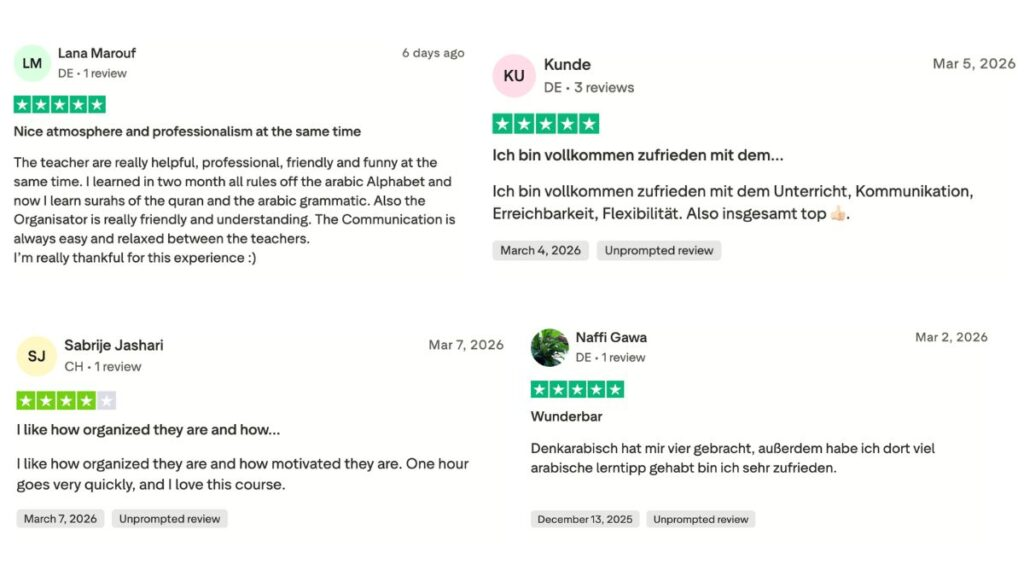
What Our Students Say About Denk Arabisch Academy
See what our students say about learning at Denk Arabisch Academy on Trustpilot. Read their experiences and check out more reviews to discover how our courses help improve Arabic.
Ready to Master Your Recitation?
If you’ve been exploring Idgham Mutamathilayn, you know that understanding the theory is just the first step. Real progress happens when you move from the page to the tongue through expert guidance and consistent practice.
At Denk Arabisch, we bridge the gap between Tajweed rules and soulful Quranic recitation. Our mission is to help you recite with confidence and precision through a structured, supportive environment.
Why Choose Denk Arabisch?
- Live Feedback: Instant pronunciation correction to ensure every letter is perfect.
- Expert Mentorship: Learn from qualified Quran and Tajweed instructors.
- Study on Your Terms: Flexible online scheduling that fits your lifestyle.
- Systematic Growth: A comprehensive Tajweed curriculum designed for all levels.
- Customized Path: Learning plans tailored specifically to your goals and pace.
Our Specialized Programs
We offer a range of targeted courses to help you connect more deeply with the Book of Allah:
Don’t just read about Tajweed—live it. Join the Denk Arabisch community today and elevate your recitation to the next level.
Learn the Quran with Denk Arabisch Academy
Master reading and understanding the Quran through structured and supportive learning
Try a Free TrialConclusion
Idgham Mutamathilayn is one of the most natural, logical, and frequently occurring rules in the science of Tajweed. It applies whenever two identical letters meet — the first carrying sukoon and the second carrying a vowel — causing the first letter to merge completely into the second, producing one emphasized, doubled sound.
This rule is divided into Sagheer (the most common type used in Hafs recitation) and Kabeer (associated with other recitations). It is further distinguished from related rules — Mutajanisayn and Mutaqaribayn — by the complete identity of the two merging letters in name, shape, and articulation point.
Mastering Idgham Mutamathilayn requires understanding its conditions, developing the physical habit of merging seamlessly, giving the second letter proper doubled emphasis, and applying ghunnah only where it belongs — with Noon and Meem. With consistent practice, attentive listening, and guidance from a qualified Tajweed teacher, this rule becomes one of the most natural and automatic in the reciter’s Tajweed toolkit.
By learning Idgham Mutamathilayn correctly, Muslims can recite the Qur’an with greater beauty, authenticity, and fluency — honoring the precise and magnificent way in which Allah’s words were revealed, preserved, and passed down through generations of devoted scholars and reciters.
FAQs
1. What does Mutamathilayn mean?
Mutamathilayn means two identical or two alike in Arabic. It refers to the two identical letters that merge in this rule.
2. Does Idgham Mutamathilayn always apply when two identical letters meet?
It applies when the first letter has sukoon and the second has a vowel. If both letters have vowels, the rule falls under Idgham Mutamathilayn Kabeer, which is not commonly applied in Hafs recitation.
3. Is there ghunnah in Idgham Mutamathilayn?
Only when the merging letter is Noon (ن) or Meem (م), which carry inherent nasal qualities. For all other letters, there is no ghunnah.
4. What is the difference between Idgham Mutamathilayn and Idgham Shafawi?
Idgham Shafawi is specific to Meem Sakinah followed by another Meem. Idgham Mutamathilayn is a broader rule covering any two identical letters. When Meem Sakinah meets another Meem, it is classified as Idgham Shafawi — though the physical pronunciation is the same.
5. Does Idgham Mutamathilayn apply within the same word?
It rarely occurs within a single word, but when it does, the same merging applies. The rule most commonly occurs across two consecutive words.
6. How is Idgham Mutamathilayn different from Idgham Mutajanisayn?
Mutamathilayn involves two letters that are completely identical. Mutajanisayn involves two letters that share the same articulation point but have different names, such as Ta and Dal, or Ba and Meem.
7. Is Idgham Mutamathilayn easy to learn?
The concept is straightforward — two identical letters merge into one. The challenge is consistent recognition during live recitation and applying the correct emphasis to the second letter every time.