Learning Tajweed is an essential part of every Muslim’s relationship with the Holy Quran. Tajweed preserves the beauty, precision, and authenticity of Quranic recitation exactly as it was revealed to Prophet Muhammad ﷺ. Among the important rules of Noon Sakinah and Tanween is the rule known as Idgham Without Ghunnah — a foundational principle that every student of Tajweed must master.
Although it shares similarities with Idgham with Ghunnah, this rule has its own unique pronunciation and characteristics. Understanding the difference between the two is critical for proper Quranic recitation and avoiding common Tajweed mistakes.
In this complete guide, we will explore everything you need to know about Idgham Without Ghunnah — including its definition, letters, pronunciation, Quranic examples, differences from other Tajweed rules, common errors, and effective learning tips.
Table of Contents
What is Idgham Without Ghunnah?
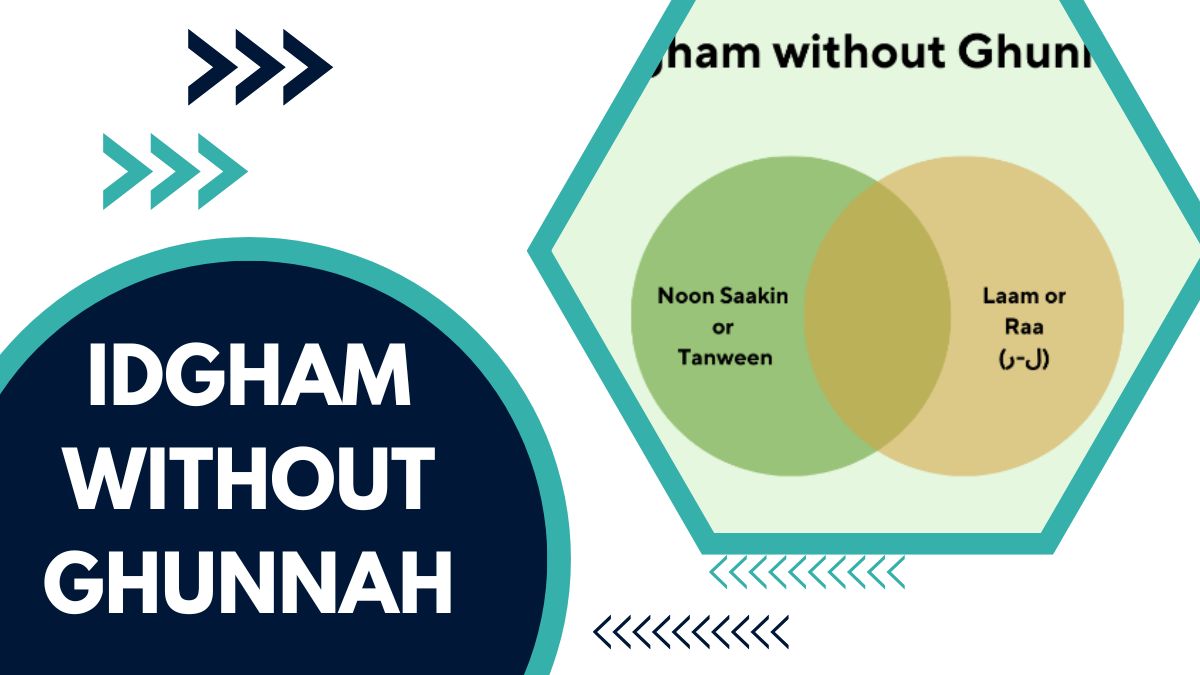
Idgham Without Ghunnah is a Tajweed rule that occurs when a Noon Sakinah (نْ) or Tanween (ً ٍ ٌ) is followed by one of the following two letters:
- ل (Lam)
- ر (Ra)
The word “Idgham” means merging or inserting one letter into another.
The phrase “Without Ghunnah” means that this merging happens without nasalization.
In this rule, the Noon Sakinah or Tanween merges completely into the following letter, but unlike Idgham with Ghunnah, there is no nasal sound during the transition.
This rule only applies when the Noon Sakinah or Tanween and the following letter appear in two separate words.
The two letters of Idgham Without Ghunnah are often remembered together as:
ل، ر
Unlike the letters of Idgham with Ghunnah, these letters do not naturally carry nasal resonance. Therefore, the merging occurs smoothly and directly without prolonging any nasal sound.
Why is Idgham Without Ghunnah Important?
Idgham Without Ghunnah is important because it ensures the accurate pronunciation of Quranic verses according to the rules transmitted through generations of Quran reciters.
Without understanding this rule, a reciter may:
- Pronounce the Noon separately when it should disappear completely
- Add an incorrect Ghunnah
- Distort the rhythm and fluency of Quranic recitation
- Confuse this rule with other Noon Sakinah rules
Correct application of Idgham Without Ghunnah creates a smooth and natural flow between words while preserving the authentic recitation style taught by the Prophet ﷺ.
Benefits of Learning Idgham Without Ghunnah
- Avoiding Tajweed mistakes in Quran recitation
- Improving fluency and smoothness
- Correctly distinguishing between Ghunnah and non-Ghunnah rules
- Strengthening understanding of Arabic phonetics
- Building confidence in recitation
- Perfecting Noon Sakinah and Tanween rules
For anyone serious about Tajweed, mastering Idgham Without Ghunnah is an essential milestone.
Begin your journey with the Quran Memorization Course at Denk Arabisch and carry the words of Allah in your heart forever.
The Letters of Idgham Without Ghunnah
Idgham Without Ghunnah consists of only two letters:
| Letter | Transliteration | Name |
| ل | L | Lam |
| ر | R | Ra |
These letters are unique because they are pronounced clearly from the tongue without nasal resonance.
When Noon Sakinah or Tanween comes before one of these letters in separate words, the Noon sound disappears entirely into the following letter without any Ghunnah.
How to Correctly Pronounce Idgham Without Ghunnah
Applying this rule correctly requires precision and attention to pronunciation.
Steps for Correct Application
1. Do not pronounce the Noon Sakinah or Tanween separately The Noon sound disappears completely into the following letter.
2. Pronounce the following letter strongly The Lam or Ra is pronounced as if it carries a Shaddah (doubling), even if the Mushaf does not visibly display it.
3. Do NOT produce Ghunnah This is the defining feature of the rule. No nasal sound should accompany the merging.
4. Make the transition smooth and direct The recitation should flow naturally from one word to the next without interruption or hesitation.
Pronunciation Checklist
- Noon is completely merged
- No nasalization is heard
- Lam or Ra is pronounced clearly and strongly
- Transition between words is smooth
- No lingering Noon sound remains
Listening carefully to skilled Quran reciters is one of the best ways to internalize this pronunciation.
Gain confidence in reading through the Quran Reading Course at Denk Arabisch and unlock a lifelong connection with the Quran.
Quranic Examples of Idgham Without Ghunnah
This rule appears frequently throughout the Quran. Here are some classic examples:
1. Noon Sakinah + Lam (ل)
مِن لَّدُنْهُ → pronounced like مِلَّدُنْهُ
Surah Al-Kahf (18:2): قَيِّمًا لِّيُنذِرَ بَأْسًا شَدِيدًا مِّن لَّدُنْهُ
The Noon Sakinah in مِن merges completely into the Lam. No Ghunnah is heard.
2. Noon Sakinah + Ra (ر)
مِن رَّبِّهِمْ → pronounced like مِرَّبِّهِمْ
Surah Al-Baqarah (2:5): أُولَٰئِكَ عَلَىٰ هُدًى مِّن رَّبِّهِمْ
The Noon disappears entirely into the Ra, producing a smooth and direct transition without nasalization.
3. Tanween + Lam (ل)
غَفُورٌ لَّهُمْ
The Dammah Tanween merges directly into the Lam with no Ghunnah.
4. Tanween + Ra (ر)
غَفُورٌ رَّحِيمٌ
The Tanween merges into the Ra smoothly and clearly without any nasal sound.
Perfect your recitation by joining the Quran Tajweed Course at Denk Arabisch and recite as beautifully as it was revealed.
Difference Between Idgham With and Without Ghunnah
Many Tajweed learners confuse these two types of Idgham. Understanding the distinction is essential.
| Type | Letters | Ghunnah |
| Idgham with Ghunnah | Ya, Noon, Meem, Waw (ي، ن، م، و) | Yes |
| Idgham without Ghunnah | Lam, Ra (ل، ر) | No |
The main difference lies in the presence or absence of nasalization.
In Idgham with Ghunnah, the reciter holds a nasal sound for two counts.
In Idgham without Ghunnah, the merging occurs instantly and directly without any nasal resonance.
Simple Method to Remember Idgham Without Ghunnah
Since Idgham Without Ghunnah consists of only two letters, memorizing this rule is much easier compared to many other Tajweed rules. The two letters are:
ل ، ر
Many students use the simple phrase:
“Lam and Ra — no Ghunnah.”
This short sentence helps learners immediately remember that whenever Noon Sakinah or Tanween is followed by Lam (ل) or Ra (ر), the sound merges completely without any nasalization.
One of the best ways to make this rule stick in your memory is through continuous repetition while reading Quranic verses. Every time you encounter these letters after Noon Sakinah or Tanween, pause mentally and remind yourself:
“No Ghunnah here.”
You can also strengthen your memory by connecting the rule to actual Quranic examples such as:
- مِن رَّبِّهِمْ
- مِن لَّدُنْهُ
The more frequently you recite these examples, the more natural the rule becomes.
Read also: Idgham Mutamathilayn – The Complete Guide
Another helpful method is comparing this rule directly with Idgham with Ghunnah. Since the letters of Idgham with Ghunnah are ي، ن، م، و, many learners remember the contrast this way:
- يَنْمُو = with Ghunnah
- ل، ر = without Ghunnah
Writing the letters repeatedly, highlighting them in your Mushaf, or creating small flashcards can also help reinforce recognition speed during recitation.
Over time, your tongue becomes trained to automatically merge the Noon into Lam or Ra smoothly and naturally without conscious effort.
Learn the Quran with Denk Arabisch Academy
Master reading and understanding the Quran through structured and supportive learning
Try a Free TrialCommon Mistakes in Idgham Without Ghunnah
Even advanced students occasionally make mistakes when applying this rule, especially because it closely resembles other types of Idgham. Being aware of these common errors helps learners avoid them early and improve their recitation faster.
1. Adding Ghunnah accidentally
This is by far the most common mistake. Since students often practice Idgham with Ghunnah more frequently, they may unintentionally add a nasal sound while reciting Lam or Ra.
For example, instead of directly merging the Noon into the letter, the learner prolongs the sound through the nose slightly. Although the mistake may seem small, it changes the Tajweed rule entirely.
To fix this issue, focus on making the transition direct and clean without any humming sound.
2. Pronouncing the Noon separately
Some learners pronounce the Noon Sakinah clearly before moving to Lam or Ra. This turns the rule into Izhar rather than Idgham.
In proper Idgham Without Ghunnah, the Noon disappears completely and should not remain audible at all.
For example:
- Incorrect: مِنْ رَبِّهِمْ
- Correct: مِرَّبِّهِمْ
The transition should sound smooth and merged.
3. Weak pronunciation of Lam or Ra
Because the Noon merges into the following letter, Lam or Ra should sound strengthened, almost as if it carries a Shaddah.
Some students pronounce these letters too lightly, which weakens the clarity of the Idgham.
Strong articulation helps preserve the beauty and precision of Quranic recitation.
4. Hesitating between words
Pausing unnaturally between the two words interrupts the smoothness of the recitation and prevents proper merging.
A common beginner mistake is stopping briefly after the Noon Sakinah or Tanween before continuing to the next word.
The recitation should flow continuously without interruption.
5. Confusing it with Izhar
Some learners become overly cautious and pronounce the Noon fully because they fear making mistakes in Idgham.
However, Izhar and Idgham are completely different rules. In Idgham Without Ghunnah, the Noon is not pronounced independently at all.
Understanding the distinction between these rules is essential for mastering Tajweed.
Strengthen your voice and understanding with the Quran Recitation Course at Denk Arabisch for a more spiritual and fluent experience.
How to Practice Idgham Without Ghunnah Effectively
To practice Idgham Without Ghunnah effectively, you should focus on the complete merging of the sound without any nasal resonance.
1. Practice slowly
Read Quranic verses carefully and focus on every Noon Sakinah and Tanween.
2. Listen to expert reciters
Listening to renowned reciters such as Mahmoud Khalil Al-Husary and Mishary Rashid Alafasy helps develop accurate pronunciation habits.
3. Repeat Quranic examples daily
Frequent repetition strengthens muscle memory.
4. Record your recitation
Listening to yourself reveals hidden pronunciation mistakes.
5. Study with a teacher
Personalized correction is essential for mastering subtle Tajweed rules.
What Our Students Say About Denk Arabisch Academy
See what our students say about learning at Denk Arabisch Academy on Trustpilot. Read their experiences and check out more reviews to discover how our courses help improve Arabic.

Read also: Idgham With Ghunnah – With Examples And Letters
Ready to Learn Tajweed with Denk Arabisch?
Reading about Idgham Without Ghunnah is only the beginning. True mastery comes through guided practice, correction, and consistent recitation.
At Denk Arabisch, we help students develop confidence, fluency, and precision in Quran recitation through structured Tajweed education and expert instruction.
Why Join Denk Arabisch?
- Real-time Tajweed correction
- Professional Quran tutors
- Flexible online learning
- Personalized study plans
- Beginner to advanced levels
- Interactive Quran recitation practice
Our Courses Include
- Quran Memorization Course: Memorize the Quran step by step with confidence and consistency.
- Quran Reading Course: Learn to read the Quran fluently and correctly from the beginning.
- Quran Tajweed Course: Master the rules of Tajweed and perfect your pronunciation.
- Quran Recitation Course: Beautify your recitation with rhythm, fluency, and spiritual depth.
Don’t leave your Quran recitation to guesswork. Learn with guidance, precision, and confidence.
Learn the Quran with Denk Arabisch Academy
Master reading and understanding the Quran through structured and supportive learning
Try a Free Trial👉 Book your free trial lesson at Denk Arabisch today!
Conclusion
Idgham Without Ghunnah is one of the core Tajweed rules governing Noon Sakinah and Tanween. It occurs when Noon Sakinah or Tanween is followed by the letters Lam (ل) or Ra (ر) in two separate words.
In every case, the Noon merges completely into the following letter without any nasalization. This smooth and direct pronunciation distinguishes it from Idgham with Ghunnah and helps preserve the authentic beauty of Quranic recitation.
By understanding the letters, pronunciation, examples, and common mistakes related to this rule, Muslims can improve their Tajweed accuracy and strengthen their connection with the words of Allah.
Whether you are a beginner or an advanced student of Tajweed, mastering Idgham Without Ghunnah is an essential step toward reciting the Quran correctly, beautifully, and confidently.
FAQs
1. Does Idgham Without Ghunnah apply to Tanween?
Yes. The rule applies to both Noon Sakinah and all forms of Tanween when followed by Lam or Ra in two separate words.
2. How many letters belong to Idgham Without Ghunnah?
There are only two letters:
Lam (ل)
Ra (ر)
3. Is Ghunnah completely forbidden here?
Yes. No nasal sound should be present during the merging.
4. What is the main difference from Idgham with Ghunnah?
The difference is nasalization. Idgham with Ghunnah includes a nasal sound for two counts, while Idgham without Ghunnah does not.
5. Does the rule apply within one word?
No. Idgham Without Ghunnah only occurs between two separate words.
6. Is this rule difficult to learn?
Not usually. Since it involves only two letters, most learners master it quickly with regular practice.