Learning Tajweed is an important step for every Muslim who wants to recite the Holy Qur’an correctly, clearly, and beautifully. Tajweed rules help preserve the proper pronunciation of Quranic words as they were revealed to Prophet Muhammad ﷺ.
Among the essential Tajweed rules that every reciter must master, Ikhfa Shafawi holds a particularly important place — especially for those who want to perfect the pronunciation of the Meem Sakinah.
Understanding Ikhfa Shafawi helps reciters handle one of the three rules governing Meem Sakinah with precision and care.
Mastering this rule improves overall recitation quality, strengthens Arabic pronunciation skills, and helps preserve the meanings and sounds of Quranic verses. It also makes Quran recitation smoother, more melodious, and more faithful to the original revelation.
In this article, we will explain everything you need to know about Ikhfa Shafawi, including its definition, its single letter, pronunciation method, Quranic examples, common mistakes, the difference between Ikhfa Shafawi and other Meem Sakinah rules, and practical tips to master it with confidence.
Table of Contents
What Is Ikhfa Shafawi?
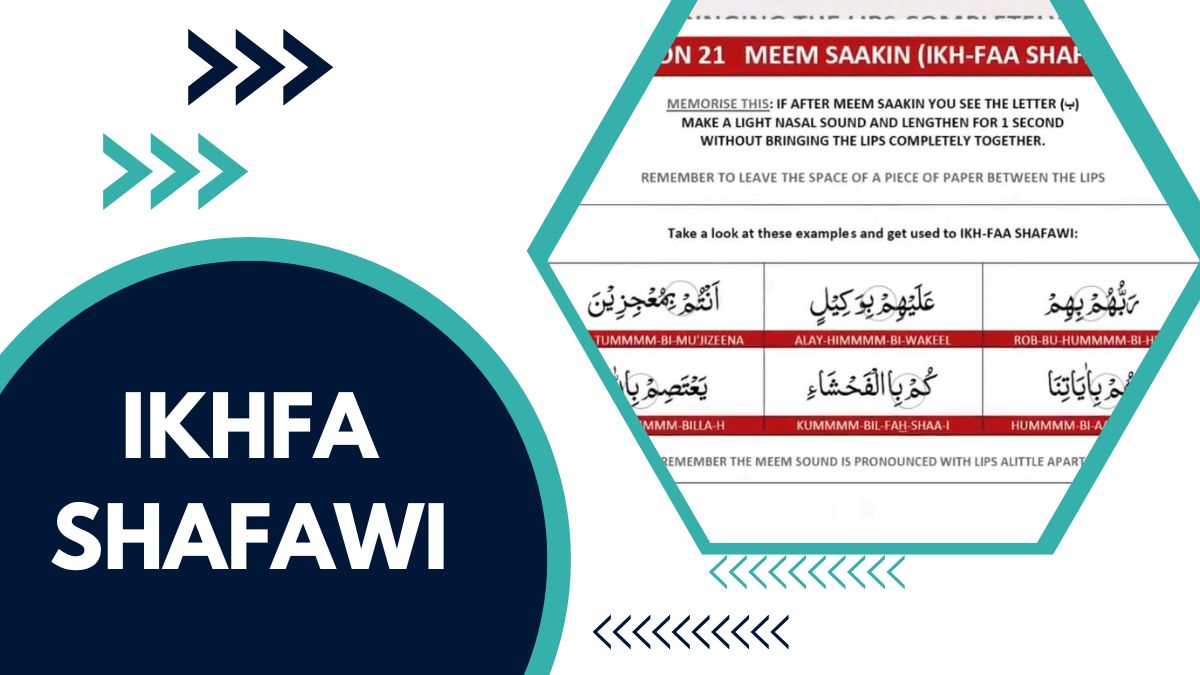
Ikhfa Shafawi is a Tajweed rule that applies when a Meem Sakinah (مْ) is followed by the letter Ba (ب). In this case, the Meem must be pronounced in a hidden or concealed manner — neither fully clear nor fully merged — while maintaining a ghunnah (nasal sound) for the duration of two counts.
The word “Ikhfa” in Arabic means concealment or hiding. The word “Shafawi” comes from the Arabic word Shafah, meaning lips. Therefore, Ikhfa Shafawi refers to the lip-based concealment — the hiding of the Meem sound at the lips when it is followed by the letter Ba.
This rule is called Shafawi because both Meem (م) and Ba (ب) are labial letters, meaning they are both pronounced using the lips. Because of this shared articulation point, a natural tendency to fully merge the Meem into the Ba exists.
Ikhfa Shafawi prevents this by requiring the Meem to be partially hidden — not disappeared, but softened and concealed — while a clear ghunnah resonates through the nasal passage.
Ikhfa Shafawi is one of the three rules that govern Meem Sakinah, alongside Idgham Shafawi and Izhar Shafawi. Understanding all three rules together gives the reciter a complete picture of how Meem Sakinah behaves in different situations.
Strengthen your bond with the Qur’an through the Quran Memorization Course at Denk Arabisch and memorize with confidence, consistency, and purpose.
Why Is Ikhfa Shafawi Important?
Ikhfa Shafawi is important because it protects the reciter from two opposite errors at once: pronouncing the Meem too clearly (which would be incorrect) or merging it completely into the Ba (which would also be incorrect). The correct pronunciation lies precisely between these two extremes — and that middle ground is Ikhfa Shafawi.
Ignoring this rule leads to imprecise recitation that does not reflect the way the Qur’an was taught by the Prophet ﷺ and transmitted through generations of scholars. Learning and applying Ikhfa Shafawi is therefore an act of honoring the divine words and preserving them as they were revealed.
Benefits of Learning Ikhfa Shafawi
- Perfecting the pronunciation of Meem Sakinah before Ba
- Avoiding both over-pronunciation and incorrect merging
- Producing the correct ghunnah in its proper context
- Deepening understanding of labial letter interactions in Arabic
- Completing knowledge of all three Meem Sakinah rules
- Improving the beauty, rhythm, and flow of Quranic recitation
- Building confidence in applying Tajweed during full recitation
For beginners and intermediate learners alike, Ikhfa Shafawi is a rule that must be understood clearly before it can be applied naturally. Once mastered, it adds a distinctive beauty to recitation that reflects true Tajweed precision.
Learn to read the Qur’an smoothly and correctly with the Quran Reading Course at Denk Arabisch and build a strong foundation from the very beginning.
The Letter of Ikhfa Shafawi
Unlike other Tajweed rules that involve multiple letters, Ikhfa Shafawi involves only one letter:
- ب (Ba)
Whenever Meem Sakinah is followed by the letter Ba — whether within the same word or across two words — the rule of Ikhfa Shafawi must be applied without exception.
Why Only Ba?
The reason Ikhfa Shafawi is triggered exclusively by Ba is rooted in Arabic phonetics. Both Meem (م) and Ba (ب) share the same articulation point: the two lips. When Meem Sakinah meets Ba, the lips are already in position for the next letter before the Meem is fully released. This creates a natural environment for concealment — the Meem sound softens and blends into a nasal resonance instead of being either fully pronounced or fully merged.
No other letter creates this precise labial interaction with Meem Sakinah, which is why Ba is the sole trigger for Ikhfa Shafawi.
Refine every letter and sound with the Quran Tajweed Course at Denk Arabisch and recite the Qur’an with accuracy and beauty.
How to Pronounce Ikhfa Shafawi Correctly?
Correct pronunciation of Ikhfa Shafawi requires careful attention to three elements simultaneously: the concealment of the Meem, the production of the ghunnah, and the smooth transition to the Ba.
Steps to Apply Ikhfa Shafawi Correctly
1. Begin Pronouncing the Meem Sakinah: Start the Meem sound normally, but do not press the lips together tightly to complete the Meem. The lips should come close together without sealing fully — this is the key physical gesture of Ikhfa Shafawi.
2. Activate the Ghunnah: While the lips are gently approaching — but not closing — produce a clear nasal resonance through the nose. This ghunnah should last for approximately two counts (the duration of two short vowels).
The ghunnah is what defines this rule. It must be audible, sustained, and produced through the nasal passage, not through the mouth.
3. Transition Smoothly to the Ba: After the ghunnah is complete, close the lips fully to pronounce the Ba. The transition should be seamless and natural — the ghunnah flows directly into the Ba without any break or pause.
4. Do Not Fully Seal the Lips During the Meem: This is the most important physical distinction of Ikhfa Shafawi. If the lips close completely for the Meem, it becomes Izhar Shafawi. If the Meem disappears entirely into the Ba, it becomes Idgham Shafawi. The correct application keeps the lips near — not sealed — while the ghunnah resonates.
| Element | Correct Application |
| Meem lips position | Near but not fully sealed; a light touch without excessive pressure. |
| Ghunnah | Present and sustained for two counts (beats). |
| Transition to Ba | Smooth and natural, moving fluidly from the concealment to the next letter. |
| Meem sound | Concealed (hidden) but not entirely eliminated. |
Important Pronunciation Tip
One of the most effective ways to feel Ikhfa Shafawi correctly is to practice in front of a mirror. Watch your lips — they should approach each other but not press together during the ghunnah. This visual feedback helps you confirm the correct physical position before the Ba is pronounced.
The pronunciation in Ikhfa Shafawi should always feel:
- Soft and concealed
- Nasally resonant
- Smoothly connected
- Neither too clear nor completely merged
Experience the beauty of heartfelt recitation through the Quran Recitation Course at Denk Arabisch and recite with clarity, fluency, and reflection.
Examples of Ikhfa Shafawi in the Qur’an
Ikhfa Shafawi appears frequently throughout the Holy Qur’an wherever Meem Sakinah is followed by Ba. Here are some of the most well-known examples:
Example 1 — Within the Same Word
تَرْمِيهِم بِحِجَارَةٍ
Pelting them with stones
Transliteration: Tarmīhim bihijārah
Here, the Meem Sakinah in “هِم” is followed immediately by Ba in “بِحِجَارَةٍ”. The Meem is concealed, the ghunnah resonates for two counts, and the Ba follows smoothly.
Example 2
وَمَا هُم بِمُؤْمِنِينَ
And they are not believers
Transliteration: Wa mā hum bimu’minīn
The Meem Sakinah in “هُم” is followed by Ba in “بِمُؤْمِنِينَ”. The reciter conceals the Meem with a clear ghunnah before transitioning to the Ba.
Example 3
يَعْتَصِم بِاللَّهِ
Whoever holds firmly to Allah
Transliteration: Ya’taṣim billāh
The Meem Sakinah in “يَعْتَصِم” is followed by Ba in “بِاللَّهِ”. The Meem is hidden with a sustained nasal sound before the Ba is pronounced.
Example 4
أَنتُم بِهِ
You with it
Transliteration: Antum bih
The Meem Sakinah at the end of “أَنتُم” is followed by Ba in “بِهِ”. Ikhfa Shafawi is applied with a clear ghunnah.
Example 5
كُنتُم بِهِ
You used to / were with it
Transliteration: Kuntum bih
Again, Meem Sakinah precedes Ba, and Ikhfa Shafawi applies with the characteristic concealed Meem and resonant ghunnah.
👉 Key Pattern: In every example above, the rule is identical — Meem Sakinah followed by Ba triggers Ikhfa Shafawi, producing a concealed Meem with a clear ghunnah lasting two counts before the Ba is pronounced.
Read also: Learning The Quran For Children In Köln – A Complete Guide For Parents
Easy Way to Memorize Ikhfa Shafawi
Because Ikhfa Shafawi involves only one letter — Ba (ب) — it is arguably the simplest Tajweed rule to identify in terms of its trigger. The challenge lies not in recognizing when the rule applies, but in applying it correctly every time.
Memorization Strategies
Connect the Name to the Concept Remember that “Shafawi” means lips. Whenever you see Meem Sakinah followed by Ba — both lip letters — think: lips concealing together. This mental image connects the name of the rule to its physical application.
Remember the One Letter Simply memorize: Meem Sakinah + Ba = Ikhfa Shafawi. There is no list of letters to learn. If the letter after Meem Sakinah is Ba, the rule is always Ikhfa Shafawi.
Use a Tajweed Mushaf Color-coded Mushafs mark Ikhfa Shafawi clearly. Whenever you see the marking, reinforce the correct physical technique — lips approaching, ghunnah resonating, smooth transition to Ba.
Practice High-Frequency Phrases Phrases like “هُم بِ” and “كُم بِ” appear frequently in the Qur’an. Practicing these short combinations daily builds the muscle memory needed to apply Ikhfa Shafawi automatically.
Listen and Imitate Listen closely to how expert reciters handle Meem Sakinah before Ba. Notice the characteristic nasal hum that appears before the Ba. Imitating this sound trains the ear and the articulation simultaneously.
Learn the Quran with Denk Arabisch Academy
Master reading and understanding the Quran through structured and supportive learning
Try a Free TrialHow Children Can Learn Ikhfa Shafawi Easily?
Teaching Ikhfa Shafawi to children requires making the concept tangible and fun. Here are practical methods that work well for young learners:
1. Use the “Humming” Description
Tell children that when Meem meets Ba, the Meem goes “into hiding” and makes a humming sound through the nose before the Ba comes. Children naturally understand the idea of hiding, and the humming image makes the ghunnah easy to reproduce.
2. Practice With a Mirror
Have children practice in front of a mirror and watch their lips. Teach them to bring their lips close — but not press them together — during the hum. This turns the rule into a physical game they can see and feel.
3. Highlight in the Qur’an
Give children a colored pencil and let them circle every Ba that follows a Meem Sakinah in a short Surah. This active search builds recognition skills while engaging them with the text.
4. Repeat Short Quranic Phrases Daily
Short phrases from familiar Surahs make excellent daily practice material. Repeating the same phrase correctly many times builds accuracy before moving to longer passages.
5. Reward Recognition
When a child correctly identifies and applies Ikhfa Shafawi during recitation, acknowledge it with praise. Positive reinforcement accelerates learning and builds confidence.
6. Learn With a Qualified Teacher
A certified Tajweed teacher can correct the child’s lip position and ghunnah quality in real time — something no recording or book can do. Early correction prevents bad habits from forming.
Common Mistakes in Ikhfa Shafawi
Even dedicated students make errors when learning this rule. Awareness of these mistakes is the first step toward correcting them.
1. Pronouncing the Meem Too Clearly
Some reciters fully close their lips during the Meem Sakinah and pronounce it with complete clarity before moving to the Ba. This turns Ikhfa Shafawi into Izhar Shafawi — an incorrect application.
2. Completely Merging the Meem Into the Ba
Other reciters go to the opposite extreme, allowing the Meem to disappear entirely into the Ba without any nasal sound. This resembles Idgham rather than Ikhfa and loses the characteristic ghunnah of this rule.
3. Weak or Absent Ghunnah
The ghunnah is the defining feature of Ikhfa Shafawi. Some learners produce it too briefly, too softly, or not at all. The ghunnah must be clearly audible and sustained for a full two counts.
4. Incorrect Duration of Ghunnah
Some reciters extend the ghunnah beyond two counts, making the recitation sound heavy and unnatural. Others cut it too short. Two counts — no more, no less — is the correct measure.
5. Breaking the Flow
Some learners pause noticeably between the ghunnah and the Ba, creating an unnatural gap. The transition should be smooth and connected — the ghunnah flows directly into the Ba.
6. Confusing Ikhfa Shafawi With Ikhfa Haqiqi
Ikhfa Haqiqi applies to Noon Sakinah and Tanween before fifteen letters. Ikhfa Shafawi applies specifically to Meem Sakinah before Ba. They share the concept of concealment, but their triggers, letters, and articulation points are entirely different.
Read also: Learning The Quran For Children In Frankfurt – Everything Parents Need To Know
Start Now!
You’ve mastered the theory of Ikhfa Shafawi, but Tajweed is an oral science—it cannot be truly mastered from a screen. One slight slip of the lips or a shortened Ghunnah can change the beauty and precision of the Divine Words. Why settle for “good enough” when you can achieve excellence?
At Denk Arabisch, we bridge the gap between knowing the rule and perfecting the sound. Our specialized Tajweed programs are designed to transform your recitation from hesitant to heavenly.
Why Choose Denk Arabisch?
- The “Mirror” Method: Our expert tutors provide real-time visual and auditory corrections, ensuring your lip position and nasal resonance are flawless every single time.
- Certified Expertise: Learn from qualified instructors who hold Ijazah and understand the nuances of teaching English and German speakers.
- Tailored for Busy Lives: High-quality, one-on-one sessions that fit your schedule. No more generic videos—get the personal attention your Quranic journey deserves.
- Proven Results: From children taking their first steps in Noorani Qaida to adults mastering the Ten Qira’at, our students recite with a confidence that radiates.
Our Courses:
- Quran Memorization Course: Build a strong connection with the Qur’an step by step with ease and consistency.
- Quran Reading Course: Take your first confident steps and learn to read the Qur’an smoothly and correctly from the start.
- Quran Tajweed Course: Master precision and beauty in recitation and apply the rules the way they were meant to be recited.
- Quran Recitation Course: Elevate your recitation experience and bring clarity, emotion, and beauty to every verse.
Don’t let your Tajweed mistakes become permanent habits. The Prophet ﷺ said, “The one who is proficient in the recitation of the Qur’an will be with the honorable and obedient scribes (angels).”

👉 Claim Your Free Trial Lesson at Denk Arabisch Today!
Master the lips. Perfect the heart. Elevate your soul with Denk Arabisch.
Learn the Quran with Denk Arabisch Academy
Master reading and understanding the Quran through structured and supportive learning
Try a Free TrialConclusion
Ikhfa Shafawi is one of the three essential rules governing Meem Sakinah in the science of Tajweed. It occurs when Meem Sakinah (مْ) is followed by the letter Ba (ب), requiring the Meem to be concealed — neither fully pronounced nor fully merged — while a clear ghunnah resonates for two counts before the Ba is articulated.
This rule is unique because it occupies the precise middle ground between clarity and merging, demanding a delicate physical technique involving the lips and the nasal passage simultaneously.
Mastering Ikhfa Shafawi requires not just memorizing a definition, but developing the correct physical sensation through guided practice, patient repetition, and attentive listening.
By learning Ikhfa Shafawi correctly, Muslims can complete their understanding of all Meem Sakinah rules, recite the Qur’an more beautifully and accurately, and honor the authentic way in which Allah’s words were revealed, preserved, and transmitted across generations.
Whether you are beginning your Tajweed journey or refining your existing knowledge, mastering Ikhfa Shafawi is a meaningful and rewarding step toward truly excellent Quranic recitation.
FAQs
1. How many letters trigger Ikhfa Shafawi?
Only one letter triggers Ikhfa Shafawi — the letter Ba (ب).
2. Does Ikhfa Shafawi have ghunnah?
Yes. A clear ghunnah lasting two counts is an essential and defining feature of Ikhfa Shafawi.
3. Why is it called Shafawi?
Shafawi comes from the Arabic word Shafah, meaning lips. It is called Shafawi because both Meem and Ba are pronounced using the lips.
4. Is Ikhfa Shafawi the same as Ikhfa Haqiqi?
No. Ikhfa Haqiqi involves Noon Sakinah or Tanween before fifteen specific letters. Ikhfa Shafawi involves only Meem Sakinah before Ba. They share the concept of concealment but are entirely separate rules.
5. Does Ikhfa Shafawi apply within the same word?
Ikhfa Shafawi most commonly occurs across two words, but it can also apply within the same word if a Meem Sakinah precedes a Ba in a single word.
6. Is Ikhfa Shafawi easy to learn?
The rule is easy to identify because it involves only one letter. The challenge is in executing the physical technique correctly — particularly the lip position and the ghunnah — which requires guided practice with a qualified teacher.
7. What is the difference between Ikhfa Shafawi and Idgham Shafawi?
In Idgham Shafawi, Meem Sakinah is followed by another Meem, and the two Meems merge into one with ghunnah. In Ikhfa Shafawi, Meem Sakinah is followed by Ba, and the Meem is concealed — not merged — while a ghunnah resonates.