The Quran is the divine book of Islam, revealed in Arabic to the Prophet Muhammad ﷺ. Millions of Muslims around the world recite the Quran daily, yet many non-Arabic speakers struggle to understand its meaning. Learning key Quranic vocabulary is one of the most effective ways to connect with the Quran, improve comprehension during recitation, and deepen one’s understanding of Islamic teachings.
The remarkable fact is that a relatively small number of words appear repeatedly throughout the Quran. By learning these frequently used Quranic words, students can begin recognizing meanings in verses and gain confidence in their Quran studies.
In this guide, we will explore the importance of Quranic vocabulary, common Quranic words, effective learning strategies, and how mastering these terms can transform your relationship with the Quran.
Table of Contents
What Is Quranic Vocabulary?
Quranic vocabulary refers to the words and expressions found throughout the Quran. These words form the linguistic foundation of Allah’s final revelation and convey its teachings, stories, commands, and guidance.
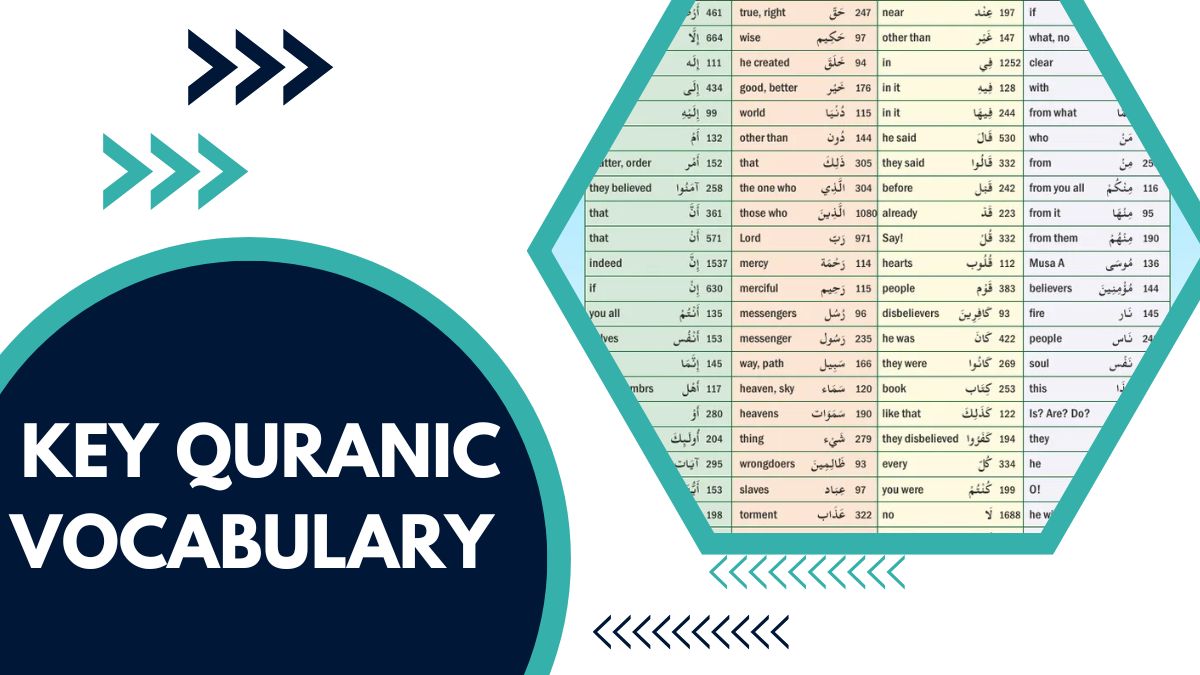
While Classical Arabic contains a vast number of words, scholars estimate that a relatively small number of high-frequency words make up a large percentage of the Quranic text. As a result, learners can make noticeable progress in comprehension by focusing on the most commonly repeated terms.
By studying these frequently occurring words, students can quickly build a strong foundation for Quran comprehension. Over time, recognizing familiar vocabulary makes reading the Quran less intimidating and far more meaningful.
Conquer your fear of a completely new script and accelerate your speaking skills by entering our structured Arabic Course For Beginners at Denk Arabisch built to unlock natural conversation from your very first hour.
Most Common Quranic Vocabulary Words
Below are some of the most frequently used Quranic words every learner should know. These words appear throughout the Quran and represent some of the most important concepts in Islamic belief and practice.
1. Allah (الله)
Meaning: Allah
This is the most frequently occurring word in the Quran and refers to the One True God, the Creator and Sustainer of everything in existence. The Quran continually reminds believers of Allah’s power, mercy, wisdom, and authority.
Example:
الحمد لله رب العالمين
All praise is due to Allah, Lord of the worlds.
2. Rabb (رب)
Meaning: Lord, Sustainer, Master
Allah is often described as Rabb because He nurtures, sustains, protects, and governs all creation. The concept of Rabb emphasizes Allah’s continuous care and authority over the universe.
Example:
ربنا آتنا في الدنيا حسنة
Our Lord, give us good in this world.
3. Rahman (الرحمن)
Meaning: The Most Merciful
One of Allah’s greatest names, emphasizing His vast and universal mercy that encompasses all of creation. This name frequently appears throughout the Quran and reminds believers of Allah’s compassion.
Example:
الرحمن الرحيم
The Most Merciful, the Especially Merciful.
4. Rahim (الرحيم)
Meaning: The Especially Merciful
This name highlights Allah’s special mercy toward His believing servants. It reflects His forgiveness, kindness, and care for those who follow His guidance and seek His pleasure.
5. Iman (إيمان)
Meaning: Faith
Iman refers to sincere belief in Allah, His angels, His books, His messengers, the Last Day, and divine decree. Faith is one of the central themes of the Quran and serves as the foundation of a Muslim’s relationship with Allah.
Example:
الذين آمنوا
Those who believe.
6. Kufr (كفر)
Meaning: Disbelief
Kufr refers to rejecting faith and denying the truth after it has become clear. The Quran frequently contrasts faith and disbelief to highlight the importance of accepting divine guidance.
7. Islam (إسلام)
Meaning: Submission to Allah
The word Islam comes from a root meaning peace and submission. In the Quran, Islam refers to willingly submitting to Allah’s commands and living according to His guidance.
Example:
إن الدين عند الله الإسلام
Indeed, the religion before Allah is Islam.
8. Taqwa (تقوى)
Meaning: God-consciousness, piety
Taqwa involves being aware of Allah at all times and striving to obey Him while avoiding sin. It is one of the most frequently emphasized qualities in the Quran and is often described as a key characteristic of successful believers.
Example:
لعلكم تتقون
So that you may become mindful of Allah.
9. Jannah (جنة)
Meaning: Paradise
Jannah is the eternal reward prepared for the righteous believers who obey Allah and follow His guidance. The Quran describes Paradise as a place of unimaginable beauty, peace, happiness, and eternal blessings.
Example:
جنات تجري من تحتها الأنهار
Gardens beneath which rivers flow.
10. Naar (نار)
Meaning: Fire
Naar usually refers to Hellfire and the punishment awaiting those who reject Allah’s guidance and persist in disbelief. The Quran mentions Hellfire as a warning and encouragement for people to turn toward faith, repentance, and righteous actions.
Understanding these essential Quranic words provides learners with a strong starting point for understanding Quranic verses and recognizing important themes that appear throughout Allah’s Book.
Elevate your focus during worship and master structural vocabulary effortlessly within our interactive Quranic Arabic Course for German Speakers at Denk Arabisch built for rapid comprehension.
Common Quranic Words Related to Worship
Worship is a central theme throughout the Quran, and many commonly repeated words are directly connected to acts of devotion that strengthen a believer’s relationship with Allah and guide daily life. Understanding these terms helps Muslims appreciate the importance of worship and recognize its role in spiritual growth and obedience to Allah.
Salah (صلاة)
Meaning: Prayer
One of the most frequently mentioned acts of worship in the Quran. Salah is the daily connection between a believer and Allah, providing spiritual guidance, discipline, and remembrance throughout the day.
Example:
أقيموا الصلاة
Establish prayer.
Zakah (زكاة)
Meaning: Charity
A mandatory act of worship involving purification of wealth. Zakah teaches generosity, social responsibility, and care for those in need while helping believers develop gratitude for Allah’s blessings.
Example:
وآتوا الزكاة
Give zakah.
Dua (دعاء)
Meaning: Supplication
Calling upon Allah and seeking His help. Dua is considered one of the most personal acts of worship, allowing believers to express their hopes, needs, gratitude, and reliance upon their Creator.
Sawm (صوم)
Meaning: Fasting
Particularly associated with Ramadan. Fasting teaches self-discipline, patience, gratitude, and empathy for those who are less fortunate while strengthening a person’s connection with Allah.
Example:
كتب عليكم الصيام
Fasting has been prescribed for you.
Common Quranic Vocabulary About Guidance
Guidance is one of the central themes of the Quran, as Allah repeatedly shows humanity the path of truth, righteousness, and success in this life and the Hereafter. These words frequently appear in verses that encourage believers to follow divine guidance and avoid misguidance.
Huda (هدى)
Meaning: Guidance
The Quran itself is described as guidance for humanity. It provides direction for every aspect of life and helps believers distinguish between right and wrong.
Example:
هدى للمتقين
Guidance for the God-conscious.
Sirat (صراط)
Meaning: Path
Most famously found in Surah Al-Fatihah. The term often refers to the straight path that leads to Allah’s pleasure and ultimate success.
Example:
اهدنا الصراط المستقيم
Guide us to the straight path.
Haqq (حق)
Meaning: Truth
Represents divine truth and reality. The Quran frequently emphasizes the victory of truth over falsehood and encourages believers to uphold what is right.
Example:
جاء الحق وزهق الباطل
Truth has come and falsehood has vanished.
Batil (باطل)
Meaning: Falsehood
The opposite of truth. It refers to anything that is misleading, unjust, or contrary to Allah’s guidance and teachings.
Refine your corporate writing mechanics or advanced conversational listening skills through interactive Arabic Courses Based On Skills & Topics at Denk Arabisch customized for target-driven adults.
Read also: Family Vocabulary – Essential Words And Phrases For Talking About Family
Important Quranic Words About Knowledge
Knowledge is highly valued in the Quran, which repeatedly encourages believers to seek understanding, reflect upon creation, and grow in wisdom throughout their lives. Learning these key terms helps students appreciate the Quran’s emphasis on education and intellectual growth.
Ilm (علم)
Meaning: Knowledge
Knowledge holds a special position in Islam. The Quran repeatedly praises those who seek beneficial knowledge and use it to strengthen their faith and actions.
Example:
رب زدني علما
My Lord, increase me in knowledge.
Kitab (كتاب)
Meaning: Book
Often refers to divine scriptures, particularly the Quran. The term highlights the importance of revelation as a source of guidance and wisdom for humanity.
Ayah (آية)
Meaning: Sign or Verse
The Quranic chapters consist of verses called ayat. The word can also refer to signs of Allah found throughout creation that point to His power and wisdom.
Example:
تلك آيات الكتاب
These are the verses of the Book.
Hikmah (حكمة)
Meaning: Wisdom
The ability to apply knowledge correctly. In the Quran, wisdom is considered a great blessing that helps believers make righteous decisions and understand deeper truths.
Learn the Quran with Denk Arabisch Academy
Master reading and understanding the Quran through structured and supportive learning
Try a Free TrialFrequently Repeated Quranic Verbs
Learning verbs is especially important because they appear repeatedly throughout the Quran. Understanding common verbs allows students to recognize actions, commands, and events described in Quranic verses more easily.
Qala (قال)
Meaning: He said
One of the most common Quranic verbs. It frequently appears in stories of the prophets and dialogues between people, angels, and Allah.
Example:
قال موسى
Musa said.
Ja’a (جاء)
Meaning: Came
Frequently appears in stories and descriptions. It is often used when discussing the arrival of prophets, signs, revelation, or important events.
Amana (آمن)
Meaning: Believed
Appears throughout the Quran when discussing faith. It refers to accepting Allah’s guidance with sincerity and conviction.
Example:
آمنوا بالله
Believe in Allah.
Sami’a (سمع)
Meaning: Heard
Used in many verses regarding hearing and listening. It often emphasizes paying attention to Allah’s message and responding to it with obedience.
Alima (علم)
Meaning: Knew
Frequently associated with Allah’s perfect knowledge. It reminds believers that Allah is fully aware of everything, whether public or hidden.
Claim your absolute mastery over genuine conversational speech right now; secure your spot in our popular Arabic Dialect Courses at Denk Arabisch before registration windows close for the season!
Key Vocabulary About the Hereafter
The Quran frequently reminds believers about the Hereafter, encouraging them to prepare for eternal life and remain mindful of their accountability before Allah. These important terms help explain what happens after death and the ultimate purpose of human existence.
Akhirah (آخرة)
Meaning: The Hereafter
A central concept in Islamic belief. The Quran consistently reminds believers that the life to come is more lasting and important than worldly life.
Example:
وللآخرة خير لك من الأولى
The Hereafter is better for you than the present life.
Yawm (يوم)
Meaning: Day
Often appears in phrases describing the Day of Judgment. It serves as a reminder that every person will eventually stand before Allah.
Qiyamah (قيامة)
Meaning: Resurrection
Refers to the Day of Judgment when all people will be raised from the dead and held accountable for their actions.
Hisab (حساب)
Meaning: Accountability
The reckoning of human deeds. The Quran teaches that every action, whether small or great, will be considered on the Day of Judgment.
Jaza (جزاء)
Meaning: Reward or Recompense
The outcome of one’s actions. It may refer to reward for righteousness or punishment for wrongdoing, reflecting Allah’s perfect justice.
Names and Titles Frequently Found in the Quran
The Quran frequently mentions prophets and messengers who were sent by Allah to guide humanity, convey His message, and serve as examples of faith, patience, and obedience. Understanding these titles helps readers better follow Quranic stories and recognize the important roles individuals play within the Quran’s teachings.
Nabi (نبي)
Meaning: Prophet
A messenger chosen by Allah to guide people. Prophets were selected to teach their communities about faith, righteousness, and obedience to Allah while serving as role models for believers.
Rasul (رسول)
Meaning: Messenger
A prophet entrusted with delivering revelation. Every rasul was given the responsibility of conveying Allah’s message clearly to their people and calling them to worship Allah alone.
Mumin (مؤمن)
Meaning: Believer
A person who possesses faith. In the Quran, believers are often praised for their sincerity, patience, trust in Allah, and commitment to righteous actions.
Kafir (كافر)
Meaning: Disbeliever
Someone who rejects faith. The Quran frequently contrasts the characteristics of believers and disbelievers to highlight the consequences of accepting or rejecting divine guidance.
Keep your learning trajectory climbing steadily toward complete mastery; select your ideal track within our comprehensive Arabic Courses Based On Levels at Denk Arabisch and lock in your live calendar schedule today!
Quranic Vocabulary About Allah’s Attributes
The Quran contains many beautiful names and attributes of Allah. These names help believers understand Allah’s perfection, mercy, wisdom, power, and knowledge. Learning these attributes strengthens faith and encourages a deeper connection with the Creator.
Al-Ghafur (الغفور)
Meaning: The Most Forgiving
This name highlights Allah’s willingness to forgive sins and accept repentance from those who sincerely turn back to Him.
Al-Hakim (الحكيم)
Meaning: The Most Wise
Allah possesses perfect wisdom in every command, decree, and action. Nothing occurs without divine wisdom and purpose.
Al-Alim (العليم)
Meaning: The All-Knowing
Allah has complete knowledge of everything, including the past, present, future, and even the thoughts hidden within hearts.
Al-Qadir (القادر)
Meaning: The All-Powerful
Allah has absolute power over all things and is capable of doing whatever He wills without limitation.
As-Sami’ (السميع)
Meaning: The All-Hearing
Allah hears every prayer, supplication, and spoken word, whether expressed publicly or privately.
Al-Basir (البصير)
Meaning: The All-Seeing
Allah sees everything that occurs in the universe, including actions, intentions, and events that are hidden from human sight.
Learning these names helps believers understand Allah’s perfection and develop a stronger relationship with Him. Reflecting on these attributes can increase trust, gratitude, hope, and reliance upon Allah in daily life.
How to Learn Quranic Vocabulary Effectively?
Building a strong Quranic vocabulary does not have to be overwhelming. By following practical and consistent learning strategies, students can gradually improve their understanding of the Quran and retain new words more effectively. Small daily efforts often produce better long-term results than occasional intensive study sessions.
Learn High-Frequency Words First
Focus on words that appear most often in the Quran. This provides the fastest improvement in comprehension because many verses contain the same recurring vocabulary and expressions.
Study a Few Words Daily
Learning five to ten words each day can lead to significant progress over time. Consistent daily practice makes vocabulary building manageable and helps prevent information overload.
Use Flashcards
Digital apps and physical flashcards help reinforce vocabulary through repetition. Regular review strengthens memory and improves long-term retention.
Read Quran with Translation
Comparing Arabic text with a reliable translation helps connect words to their meanings. Over time, learners begin recognizing familiar vocabulary without constantly referring to translations.
Practice During Recitation
When reciting verses, pause and identify words you recognize. Applying vocabulary knowledge during recitation helps reinforce learning and improves comprehension.
Review Consistently
Regular revision is essential for long-term retention. Revisiting previously learned words ensures they remain familiar and become part of your active Quranic vocabulary.
Read also: Arabic Dialects
Benefits of Mastering Quranic Vocabulary
Students who learn Quranic vocabulary often experience numerous spiritual, educational, and linguistic benefits. Even a basic understanding of frequently occurring Quranic words can significantly transform the way a person interacts with the Quran.
1. Greater Understanding of Quranic Verses
Recognizing common vocabulary allows readers to understand more of the Quran directly, making recitation more meaningful and engaging.
2. Increased Focus During Prayer
Understanding the words recited in salah helps improve concentration, reflection, and spiritual presence during worship.
3. Easier Memorization of Surahs
When learners understand the meanings of verses, memorization becomes easier because the words form a meaningful message rather than a series of unfamiliar sounds.
4. Stronger Connection with Allah’s Words
Understanding Quranic vocabulary enables believers to reflect more deeply on Allah’s guidance, promises, and teachings.
5. Improved Arabic Language Skills
Learning Quranic vocabulary naturally introduces students to Classical Arabic and helps build a foundation for broader Arabic language studies.
6. Enhanced Ability to Reflect on Quranic Meanings
Recognizing key words and concepts allows readers to think more carefully about the lessons, wisdom, and guidance found within each verse.
7. More Meaningful Quran Study Sessions
Students who understand common Quranic terms often gain greater enjoyment and benefit from Quran study because they can follow themes and concepts more easily.
Even learning a few hundred common words can dramatically increase Quran comprehension. Over time, this knowledge helps transform Quran recitation from a purely verbal practice into a deeply meaningful experience centered on understanding, reflection, and spiritual growth.
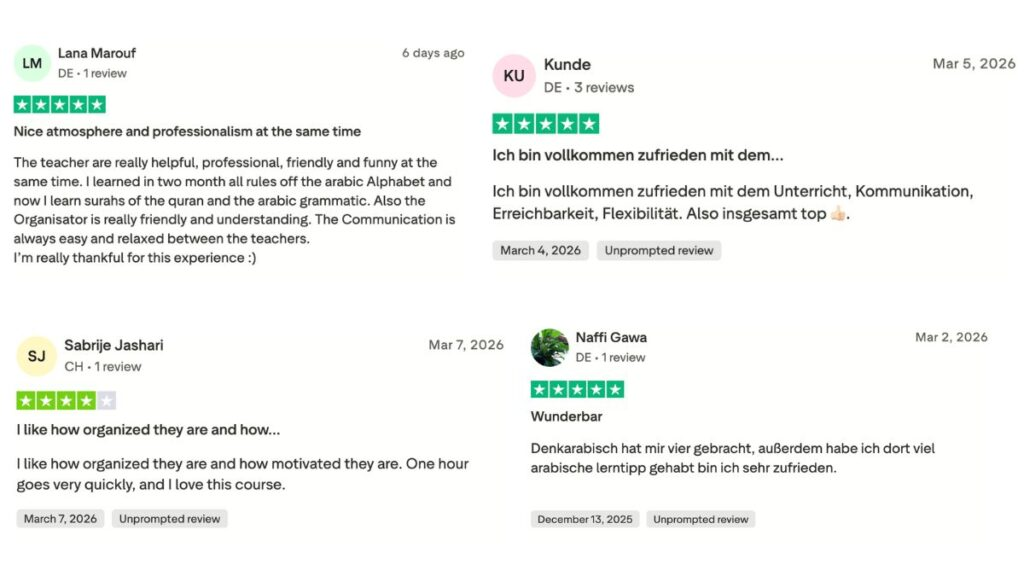
What Our Students Say About Denk Arabisch Academy
See what our students say about learning at Denk Arabisch Academy on Trustpilot. Read their experiences and check out more reviews to discover how our courses help improve Arabic.
Achieve Real Arabic Fluency with Denk Arabisch!
Let’s face the reality: jumping from one free app to another or downloading unorganized grammar charts hasn’t given you the fluency you actually want. Instead, it leaves you with a pile of disconnected vocabulary words and zero confidence when it’s time to speak. You don’t need more random resources—you need a professional system and live, real-time feedback.
The countdown to our premium, live cohorts has officially begun. To protect our strict standard of intimate interactive learning and ensure you get personalized attention from your tutor, seats in every classroom are heavily capped. Once these live groups fill up, registration will close completely for the rest of the semester.
Denk Arabisch offers:
- Arabic Course For Beginners: Stop treating the Arabic script like an impossible mountain to climb. Our modern, conversational framework sidesteps dry academic lectures to get you actively constructing and speaking real sentences from day one.
- Quranic Arabic Course for German Speakers: Experience the profound depth and eloquence of the classical text exactly as it was intended. This custom track is precision-engineered from the ground up to eliminate the structural friction between German and Arabic grammar.
- Arabic Courses Based On Skills & Topics: Pure efficiency for goal-oriented adults. Isolate and master the exact linguistic nodes you need right now—whether that’s advanced professional dialogue, complex textual reading, or advanced grammar mechanics—without any added fluff.
- Arabic Dialect Courses: Move past the rigid, robotic textbook language that native speakers don’t use on the street. Master the living, authentic regional phrasing of daily life so you can easily joke, converse, and bond with locals.
- Arabic Courses Based On Levels: Never sit through repetitive overviews or lessons you already know. We assess your exact current threshold and place you directly into the perfect tier to keep your progress climbing without a single delay.
Why waste another year guessing your way through a complex language when you can learn live from handpicked, world-class native educators? Denk Arabisch takes the stress and guesswork completely out of the equation, providing a flexible online schedule that integrates seamlessly with your busy career or university lifestyle.
Continuing to delay won’t make it any easier. Click below and claim your future fluency before our limited spaces vanish entirely!
👉 [Grab Your Live Spot & Activate Your Free Trial Lesson Instantly!]
Learn the Quran with Denk Arabisch Academy
Master reading and understanding the Quran through structured and supportive learning
Try a Free TrialConclusion
Learning key Quranic vocabulary is one of the most rewarding steps a Muslim can take toward understanding the Quran. Instead of reciting words without comprehension, students begin recognizing meanings, understanding messages, and reflecting on Allah’s guidance more deeply.
The Quran repeatedly emphasizes knowledge, reflection, and understanding. By mastering common Quranic words such as Allah, Rabb, Iman, Taqwa, Huda, and Jannah, learners can unlock a richer and more meaningful relationship with the Book of Allah.
Start with a small number of words each day, remain consistent, and gradually build your vocabulary. Over time, you’ll find yourself understanding more verses, engaging more deeply in worship, and appreciating the beauty of the Quran in a way that transforms your spiritual journey.
FAQs
1. How many Quranic words should I learn first?
Many teachers recommend starting with the 100–300 most frequently used Quranic words, as they cover a significant portion of the Quran’s vocabulary.
2. Can I understand the Quran by learning vocabulary alone?
Vocabulary is an excellent starting point, but full understanding also requires learning grammar, context, and tafsir (Quranic interpretation).
3. What is the most common word in the Quran?
The word “Allah” is among the most frequently occurring words in the Quran and is central to its message.
4. How long does it take to learn Quranic vocabulary?
The timeline varies, but learning 5–10 words daily can help students build a strong vocabulary foundation within a few months.
5. Is Quranic Arabic different from modern Arabic?
Yes. Quranic Arabic is Classical Arabic, which differs somewhat from Modern Standard Arabic, although they share much of the same vocabulary and structure.
6. What is the best way to memorize Quranic vocabulary?
Using flashcards, daily review, repetition during recitation, and studying words within Quranic verses are among the most effective methods.
Here is another high-converting version of the Hard Selling copy. This variation takes a “Frustration with the Status Quo vs. Complete Mastery” angle, positioning Denk Arabisch as the ultimate, professional solution to break free from the loop of endless self-study.