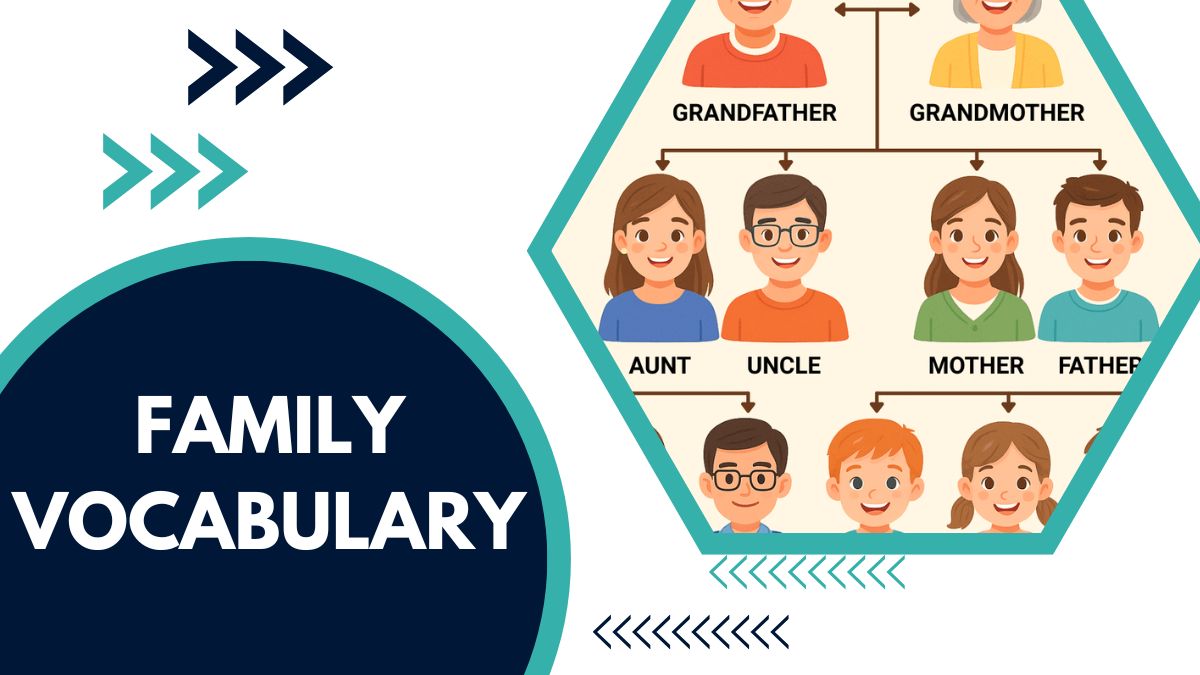
Family is one of the most important topics in everyday communication. Whether you’re introducing yourself, describing your relatives, discussing relationships, or learning English as a beginner, understanding family vocabulary is essential.
Family-related words are among the first vocabulary items taught in English because they help people talk about their personal lives, cultural traditions, and relationships. In this comprehensive guide, you’ll learn common family vocabulary, extended family terms, relationship words, useful phrases, and tips for mastering family-related English.
Table of Contents
Immediate Family Vocabulary
The immediate family consists of the people closest to you in your household.
Father (الأب – Ab)
A father is a male parent.
Example:
My father works as an engineer.
Mother (الأم – Umm)
A mother is a female parent.
Example:
My mother loves gardening.
Parents (الوالدان – Al-Walidan)
The word parents refers to both your mother and father.
Example:
My parents live in Cairo.
Son (الابن – Ibn)
A son is a male child.
Example:
Their son is ten years old.
Daughter (الابنة – Ibna)
A daughter is a female child.
Example:
She has one daughter and two sons.
Brother (الأخ – Akh)
A brother is a male sibling.
Example:
My brother studies medicine.
Sister (الأخت – Ukht)
A sister is a female sibling.
Example:
My sister enjoys reading novels.
Siblings (الإخوة والأخوات – Al-Ikhwa wal-Akhawat)
Siblings refers to brothers and sisters collectively.
Example:
I have three siblings.
Refuse to let another term slip by with unmet fluency goals; reserve your virtual seat in our high-demand Arabic Course For Beginners at Denk Arabisch before enrollment closes tight for the semester!
Extended Family Vocabulary
Extended family includes relatives beyond parents and siblings.
Grandfather (الجد – Jadd)
Your grandfather is your father’s or mother’s father.
Example:
My grandfather tells wonderful stories.
Grandmother (الجدة – Jadda)
Your grandmother is your father’s or mother’s mother.
Example:
My grandmother makes delicious food.
Grandparents (الأجداد – Al-Ajdad)
This term refers to both grandfather and grandmother.
Example:
We visit our grandparents every weekend.
Grandson (الحفيد – Hafid)
The son of your son or daughter.
Example:
They are proud of their grandson.
Granddaughter (الحفيدة – Hafida)
The daughter of your son or daughter.
Example:
Their granddaughter is learning English.
Uncle and Aunt
Uncle (العم / الخال – Amm / Khal)
An uncle is your parent’s brother.
Example:
My uncle lives abroad.
Aunt (العمة / الخالة – Amma / Khala)
An aunt is your parent’s sister.
Example:
My aunt teaches mathematics.
Cousin (ابن/ابنة العم أو الخال – Ibn/Ibnat Al-Amm Aw Al-Khal)
Ibn/Ibnat Al-Amm Aw Al-Khal
A cousin is the child of your aunt or uncle.
Example:
I spent the summer with my cousins.
Equip yourself for cross-border commercial opportunities or rigorous academic research by enrolling in specialized Arabic Courses Based On Skills & Topics at Denk Arabisch focused entirely on high-yield, real-world results.
Nephew and Niece
Nephew (ابن الأخ أو الأخت – Ibn Al-Akh Aw Al-Ukht)
The son of your brother or sister.
Example:
My nephew is starting school.
Niece (ابنة الأخ أو الأخت – Ibnat Al-Akh Aw Al-Ukht)
The daughter of your brother or sister.
Example:
My niece loves drawing.
Family Vocabulary Through Marriage
Marriage creates additional family relationships.
Husband (الزوج – Zawj)
A husband is a married man.
Example:
Her husband works in banking.
Wife (الزوجة – Zawja)
A wife is a married woman.
Example:
His wife is a doctor.
Spouse (الزوج / الزوجة – Zawj / Zawja)
A spouse can refer to either a husband or wife.
Example:
Please include your spouse on the application.
Father-in-Law (حمو – Hamu)
Your spouse’s father.
Example:
My father-in-law enjoys fishing.
Mother-in-Law (حماة – Hama)
Your spouse’s mother.
Example:
My mother-in-law is very kind.
Brother-in-Law (صهر – Sihr)
Your spouse’s brother or your sibling’s husband.
Example:
My brother-in-law works in technology.
Sister-in-Law (سلفة / نسيبة – Silfa / Nasiba)
Your spouse’s sister or your sibling’s wife.
Example:
My sister-in-law speaks three languages.
Step-Family Vocabulary
Modern families often include step-relatives.
Stepfather (زوج الأم – Zawj Al-Umm)
A man married to your mother who is not your biological father.
Example:
My stepfather helped me with homework.
Stepmother (زوجة الأب – Zawjat Al-Ab)
A woman married to your father who is not your biological mother.
Example:
My stepmother loves cooking.
Stepbrother (أخ غير شقيق – Akh Ghayr Shaqiq)
The son of your stepparent.
Example:
My stepbrother lives in another city.
Stepsister (أخت غير شقيقة – Ukht Ghayr Shaqiqa)
The daughter of your stepparent.
Example:
My stepsister is a talented artist.
Claim your place as an expressive, fluid communicator rather than a passive observer; secure your spot in our popular Arabic Dialect Courses at Denk Arabisch before registration windows close for the season!
Read also: Key Quranic Vocabulary
Relationship Vocabulary
These words describe different family situations.
Relative (قريب – Qarib)
A relative is a member of your family.
Example:
Many relatives attended the wedding.
Ancestor (سلف – Salaf)
An ancestor is a family member from a previous generation.
Example:
We researched our ancestors.
Descendant (نسل – Nasl)
A descendant is someone who comes from a particular ancestor.
Example:
She is a descendant of a famous leader.
Twin (توأم – Taw’am)
Twins are two children born at the same time.
Example:
The twins look identical.
Orphan (يتيم – Yatim)
An orphan is a child whose parents have died.
Example:
The organization helps orphaned children.
Learn Arabic with Denk Arabisch Academy
Speak and understand Arabic through a clear and effective learning system
Try a Free TrialFamily Status Vocabulary
This vocabulary is used to describe a person’s family or social status, whether unmarried, married, or in another social situation.
Single (أعزب – A’zab)
A person who is not married.
Example:
She is currently single.
Married (متزوج – Mutazawwij)
A person who has a husband or wife.
Example:
They have been married for ten years.
Divorced (مطلق – Mutallaq)
A person whose marriage has legally ended.
Example:
He is divorced and has two children.
Engaged (مخطوب – Makhtub)
A person who has agreed to marry someone.
Example:
My sister is engaged.
Common Phrases About Family
Learning phrases helps you speak naturally.
Family Members
Examples:
- I come from a large family.
- She comes from a small family.
- We are a close-knit family.
- Family means everything to me.
Talking About Relatives
Examples:
- I have two brothers and one sister.
- My grandparents live nearby.
- We often visit our relatives.
Family Gatherings
Examples:
- We get together during holidays.
- Our family celebrates special occasions together.
- Family reunions are important to us.
Keep your compounding language gains moving upward without hitting a plateau; select your ideal track within our comprehensive Arabic Courses Based On Levels at Denk Arabisch and lock in your live calendar schedule today!
Describing Family Relationships
You can use these adjectives when discussing family members.
Close (مقرب – Muqarrab)
Having a strong relationship.
Example:
I’m very close to my sister.
Supportive (داعم – Da’im)
Helpful and encouraging.
Example:
My parents are supportive.
Caring (مهتم – Muhtamm)
Kind and concerned about others.
Example:
She comes from a caring family.
Loving (محب – Muhibb)
Showing affection and kindness.
Example:
They have a loving relationship.
Protective (حامٍ – Hamin)
Wanting to keep someone safe.
Example:
My older brother is protective.
Family Vocabulary in Everyday Conversations
Here are some practical examples:
Introducing Your Family (تقديم عائلتك – Taqdim A’ilatika)
Example:
Hi, my name is Ahmed. I have a family of five. My parents, my younger sister, my older brother, and me.
Talking About Grandparents (التحدث عن الأجداد – Al-Tahadduth An Al-Ajdad)
Example:
My grandparents live in the countryside. We visit them every month.
Discussing Family Traditions (مناقشة التقاليد العائلية – Munaaqashat Al-Taqalid Al-A’iliya)
Example:
Our family gathers every Friday for dinner.
Talking About Children (التحدث عن الأطفال – Al-Tahadduth An Al-Atfal)
Example:
They have three children, two sons and one daughter.
Read also: Arabic Dialects
Family Vocabulary for Beginners
If you’re just starting English, focus on these essential words:
- Mother – الأم – Umm
- Father – الأب – Ab
- Parents – الوالدان – Al-Walidan
- Brother – الأخ – Akh
- Sister – الأخت – Ukht
- Family – العائلة – Al-A’ila
- Son – الابن – Ibn
- Daughter – الابنة – Ibna
- Grandmother – الجدة – Jadda
- Grandfather – الجد – Jadd
- Uncle – العم / الخال – Amm / Khal
- Aunt – العمة / الخالة – Amma / Khala
- Cousin – ابن/ابنة العم أو الخال – Ibn/Ibnat Al-Amm Aw Al-Khal
- Husband – الزوج – Zawj
- Wife – الزوجة – Zawja
Mastering these words will help you understand many everyday conversations.
Tips for Learning Family Vocabulary
Learning family vocabulary becomes easier when you connect words with real people and practice them regularly in meaningful contexts.
1. Create a Family Tree
Draw your family tree and label each relative in English.
2. Practice Speaking
Describe your family to a friend or language partner.
3. Use Real Examples
Connect new words to actual family members.
4. Learn in Groups
Study related words together, such as:
- Mother, father, parents
- Brother, sister, siblings
- Grandmother, grandfather, grandparents
5. Write About Your Family
Writing helps reinforce vocabulary.
Example Writing Prompt:
Describe your family and your relationship with each family member.
Common Mistakes When Learning Family Vocabulary
Many learners confuse family-related terms because some relationships seem similar. Understanding the differences between these words will help you communicate more accurately and avoid common mistakes.
Confusing Cousin and Sibling
A sibling is your brother or sister.
A cousin is the child of your aunt or uncle.
Mixing Up Niece and Nephew
A niece is female.
A nephew is male.
Using Parent Instead of Relative
Parents are only your mother and father.
Relatives include all family members.
Forgetting Plural Forms
Remember:
- Parent → Parents
- Brother → Brothers
- Sister → Sisters
- Cousin → Cousins
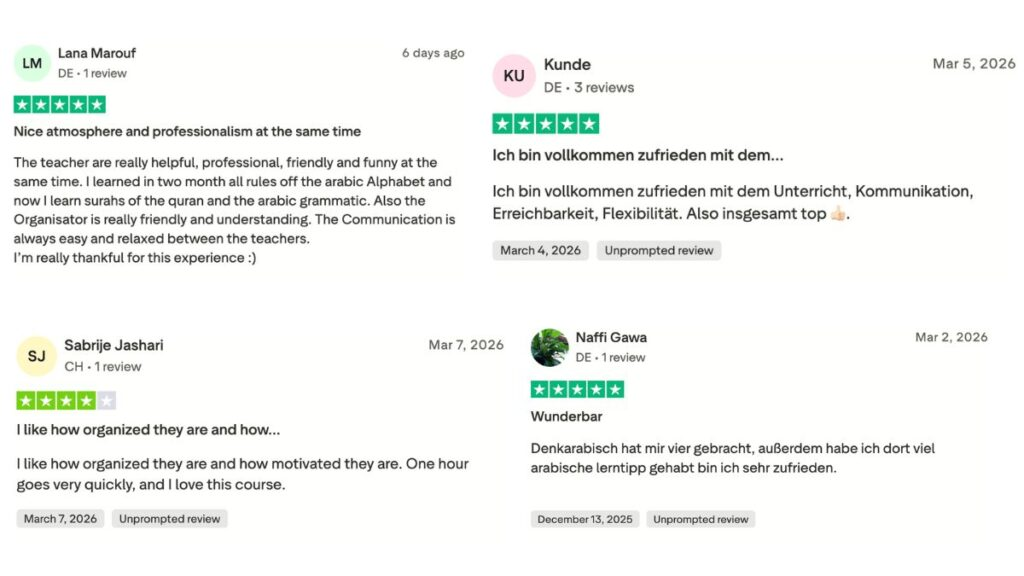
What Our Students Say About Denk Arabisch Academy
See what our students say about learning at Denk Arabisch Academy on Trustpilot. Read their experiences and check out more reviews to discover how our courses help improve Arabic.
Learn Arabic with Denk Arabisch!
Let’s be completely transparent: you are reading this because you are tired of underachieving. Watching passive video lessons or trying to memorize random word lists on your phone isn’t translating into real-world fluency. It keeps you hesitant when it’s time to speak and completely left out when it’s time to understand native speakers. Real fluency requires an elite framework—live accountability, instant professional correction, and structured momentum.
The new semester for our live, premium tracks is officially opening. To protect our strict standard of high-impact conversational feedback, we enforce absolute caps on our live group sizes. Once these specific cohorts are filled, registration will lock down completely for the rest of the term.
The Courses at Denk Arabisch:
- Arabic Course For Beginners: Quit letting a new alphabet intimidate you. Our streamlined conversational framework eliminates traditional, dry academic lecturing to get you actively building, thinking, and speaking your own complex sentences right from your very first live hour.
- Quranic Arabic Course for German Speakers: Connect directly with the profound, unadulterated depth of the classical text. This curriculum is engineered from the ground up to dismantle the structural friction between German and Arabic grammar nodes, giving you direct access to the divine language.
- Arabic Courses Based On Skills & Topics: High-efficiency training designed for goal-driven adults. Stop wasting hours on modules you don’t need; isolate and dominate your specific milestones—whether that means advanced corporate dialogue, complex text reading, or specialized mechanics.
- Arabic Dialect Courses: Leave behind the stiff, formal broadcast phrasing that local communities never use. Dive headfirst into living, authentic street language so you can laugh, converse, and build genuine, spontaneous bonds with native speakers.
- Arabic Courses Based On Levels: No more starting from scratch or moving at the pace of the slowest student. We execute a precise audit of your current linguistic baseline and drop you exactly into the ideal tier to keep your progress climbing without a single delay.
Why spend another year stuck in a learning plateau when you can train live with handpicked, world-class native educators? Denk Arabisch strips away the overwhelm and delivers a premium online structure that fits flawlessly into your high-pressure career, business, or university lifestyle.
Continuing to delay is simply choosing to stay exactly where you are right now. Click the link below and lock in your premium live spot before our classroom doors shut completely!
👉 [Secure Your Live Classroom Spot & Start Your Free Trial Now!]
Learn Arabic with Denk Arabisch Academy
Speak and understand Arabic through a clear and effective learning system
Try a Free TrialConclusion
Family vocabulary is a fundamental part of English communication. From immediate family members like parents, brothers, and sisters to extended relatives such as grandparents, uncles, aunts, and cousins, these words help you describe the people who matter most in your life.
By learning family vocabulary, practicing regularly, and using the words in real conversations, you’ll improve your English speaking, listening, reading, and writing skills. Start with the most common family terms, gradually expand your vocabulary, and you’ll soon feel confident discussing family relationships in any situation.
FAQs
1. What is family vocabulary in English?
Family vocabulary includes words used to describe family members and relationships, such as mother, father, brother, sister, cousin, aunt, uncle, grandmother, and grandfather.
2. What is the difference between immediate family and extended family?
Immediate family usually includes parents, siblings, spouse, and children. Extended family includes grandparents, aunts, uncles, cousins, nieces, nephews, and other relatives.
3. What does the word “siblings” mean?
Siblings is a collective term for brothers and sisters.
4. What is the difference between a niece and a nephew?
A niece is the daughter of your brother or sister, while a nephew is the son of your brother or sister.
5. How can I learn family vocabulary quickly?
You can learn family vocabulary by creating a family tree, practicing conversations, writing about your family, using flashcards, and reviewing words daily.
6. Why is family vocabulary important in English?
Family vocabulary is important because it is commonly used in everyday conversations, introductions, personal descriptions, and social interactions.