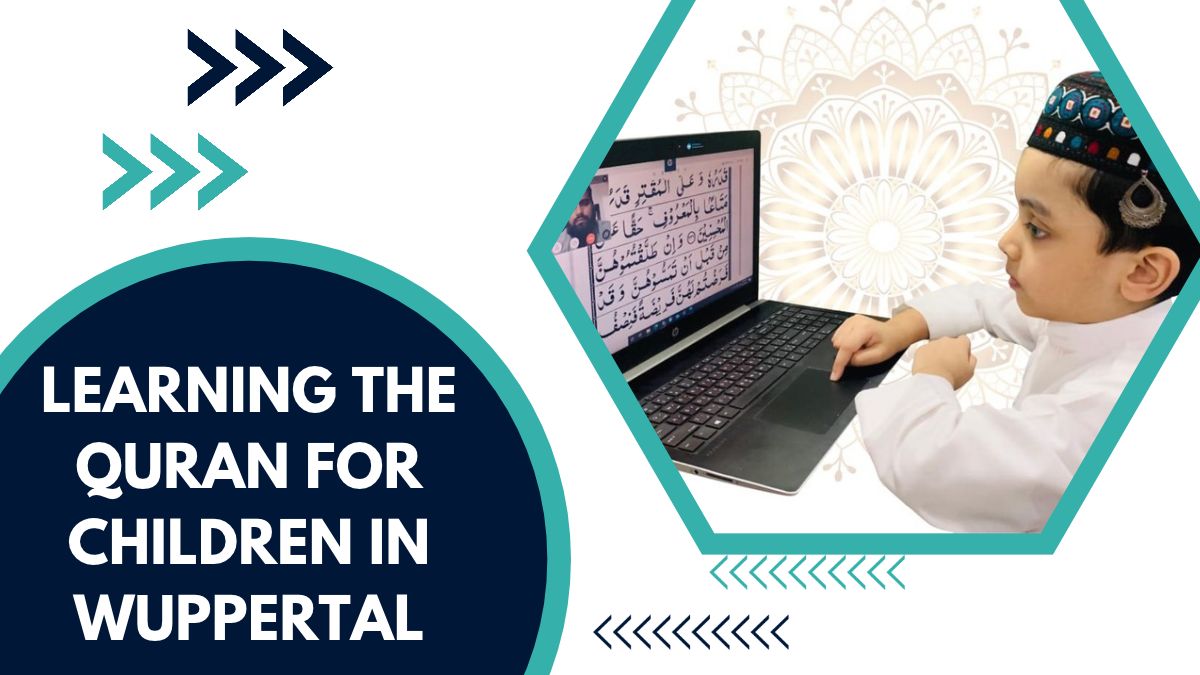
For Muslim families in Wuppertal, helping children build a lasting relationship with the Quran is an important part of their upbringing.
Yet school, homework, sports, hobbies, and family responsibilities can make regular Quran learning difficult to maintain. Finding a program that fits into everyday family life while still giving children consistent guidance can make a real difference.
Many children in Germany also grow up using German as their strongest everyday language. Arabic may be spoken at home or heard in the mosque, but this does not always mean that children can read Arabic or recite the Quran confidently.
Parents often need a learning environment where children can develop these skills gradually with a teacher who understands their level and learning needs.
Families therefore need more than occasional lessons. Children need a structured learning environment where they can start from their actual level, receive regular correction, and gradually become more confident with Quranic reading and recitation.
For families looking for Learning The Quran For Children In Wuppertal, Denk Arabisch provides an online learning approach designed to make Quran education more structured, personal, and manageable for children living in Germany.
Table of Contents
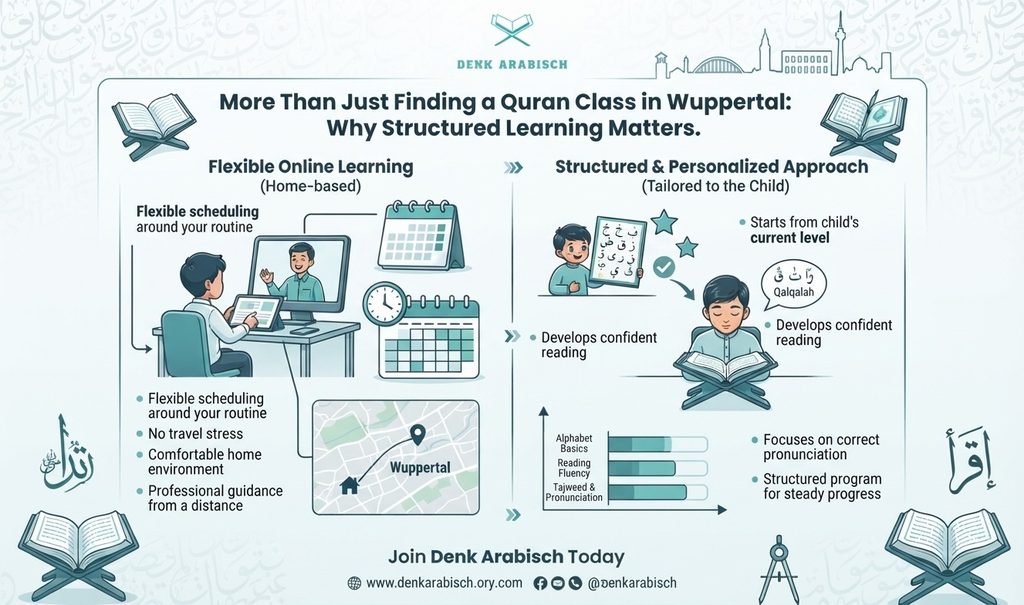
More Than Just Finding a Quran Class in Wuppertal
Choosing a Quran class is not only about finding a convenient lesson time. The quality of teaching can have a major effect on how confidently a child develops their reading skills.
A child who is still learning Arabic letters needs a different approach from a child who can already read Quranic verses but struggles with pronunciation or Tajweed. This is why the starting point should always be the child’s current ability.
A structured program can identify what the child already knows and what needs more practice before moving forward.
For families in Wuppertal, flexibility is also important. Children may have different school timetables, extracurricular activities, and family commitments throughout the week.
A good Quran program should fit realistically into this routine instead of becoming another source of pressure.
Learn how to perform Tahajjud prayer and discover its spiritual benefits in How to Pray Tahajjud and Its Benefits?.
What Children Need Before They Can Read the Quran Confidently?
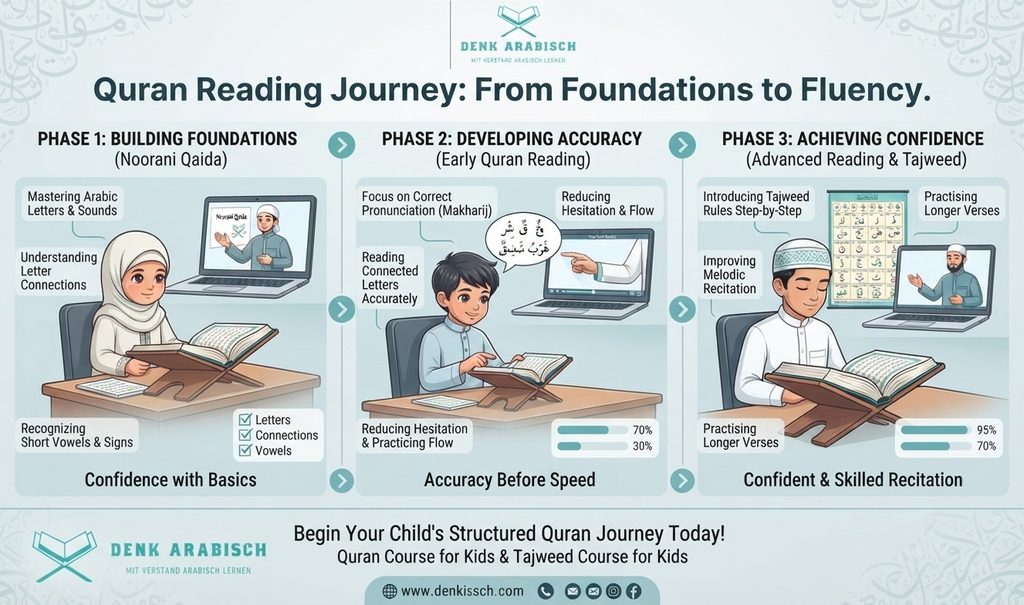
Quran reading develops through several connected skills. Children usually need to become comfortable with Arabic letters and sounds before they can read complete Quranic passages independently.
The learning process may include:
- Recognizing Arabic letters and their sounds
- Understanding different letter shapes and connections
- Reading short vowels correctly
- Recognizing basic Arabic reading patterns
- Reading Quranic words and short passages
- Improving pronunciation and fluency
- Learning appropriate Tajweed rules
- Practising longer verses with greater independence
These skills should not necessarily be taught at the same speed for every child. Some children may need more time with the Arabic alphabet, while others may progress quickly into Quran reading.
The teacher’s role is to recognize these differences and adjust the lesson accordingly. Moving forward is important, but strong foundations are even more important.
The Quran Course for kids at Denk Arabisch helps children develop confident and accurate Quran reading skills. Lessons are adapted to the child’s current level, whether they are learning to read for the first time or need more practice and correction.
Children work on:
- Reading Quranic words and verses
- Correct pronunciation of Arabic letters
- Improving reading fluency
- Building confidence through regular practice
- Correcting common reading mistakes
At Our Academy Denk Arabisch you can find Quran article about Quran Memorization For Kids
Noorani Qaida: A Foundation for Young Quran Learners
For many beginners, Noorani Qaida can provide a useful foundation before they begin reading longer Quranic passages.
Children can learn how Arabic letters sound, how they connect, and how short vowels and other reading signs affect pronunciation. This stage can be especially helpful for children who hear Arabic at home but have not yet developed independent Arabic reading skills.
The purpose is not simply to finish a book. It is to give children the reading foundation they need to approach Quranic text with greater confidence. Once these basics become familiar, the child can gradually move toward reading actual Quranic words and verses.
From Recognizing Letters to Reading the Quran
The transition from Arabic letters to Quran reading is an important stage in a child’s learning journey.
At first, children may read slowly and hesitate between letters or words. This is normal, particularly when Arabic is not the language they use most often during the day. Regular reading practice can help children become more familiar with common patterns and reduce hesitation.
A teacher can also identify mistakes that may not be obvious to parents and correct them before they become repeated habits. The focus should therefore remain on accurate and confident reading rather than simply counting how many pages a child has completed.
Pronunciation Comes Before Speed
A child who reads quickly is not necessarily a strong Quran reader. Accuracy and pronunciation should develop before speed becomes the main goal.
Arabic contains sounds that may be unfamiliar to children who mainly speak German or another language at home and school. For this reason, children need regular opportunities to listen, repeat, read, and receive immediate correction.
A good teacher pays attention to details such as:
- Correct pronunciation of individual Arabic letters
- Distinguishing between similar sounds
- Correct use of vowel marks
- Reading connected letters accurately
- Avoiding repeated pronunciation mistakes
- Developing smoother Quranic recitation
Correcting these areas early can make later Tajweed learning much easier. This personalized correction is one of the key advantages of learning with a teacher rather than relying only on independent reading practice.
When Should a Child Start Learning Tajweed?
Tajweed should be introduced progressively rather than overwhelming a beginner with many technical rules.
A child who is still struggling to recognize letters may not benefit from detailed Tajweed terminology. Their immediate priority is developing accurate Arabic reading skills. As reading becomes more comfortable, the child can gradually learn how different Tajweed rules affect recitation.
This may include learning about pronunciation points, elongation, stopping, and other rules that help improve the accuracy and quality of Quran recitation. The teacher should decide when the child is ready based on their reading ability rather than simply their age.
The Tajweed Course for Kids at Denk Arabisch is suitable for children who can already read the Quran and want to improve their recitation. They learn essential Tajweed rules and practice applying them correctly while reading.
The course focuses on:
- Correct articulation of Arabic letters
- Essential Tajweed rules
- Proper pronunciation
- Practical recitation practice
- Teacher correction and feedback
Choosing the Right Quran Teacher for Your Child
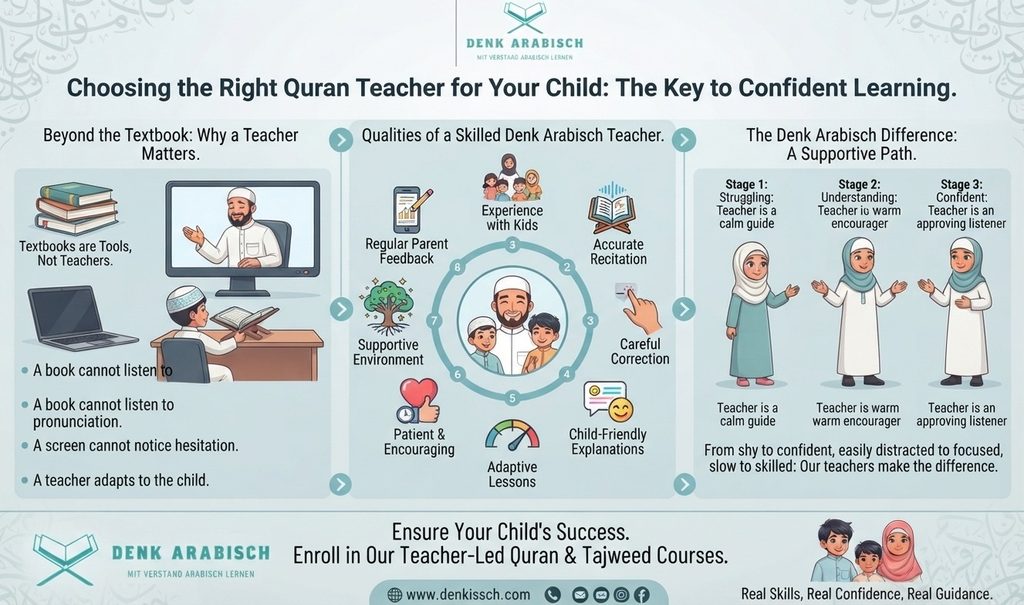
The teacher is one of the most important parts of a child’s Quran learning experience. textbook can provide material, but it cannot listen to a child’s pronunciation, notice hesitation, understand their learning style, or decide when they need more practice.
Parents should therefore look beyond the course name and consider the teacher’s actual experience with children.
A suitable Quran teacher should ideally:
- Have experience teaching young learners
- Recite the Quran accurately
- Correct pronunciation carefully
- Explain mistakes in a child-friendly way
- Adapt lessons to different ability levels
- Be patient when a child needs repetition
- Encourage children without creating unnecessary pressure
- Give parents useful feedback about progress
A skilled teacher does not simply move through the syllabus. They observe how the child is learning and make adjustments when something is not working.
This can make a significant difference, especially for children who are shy, easily distracted, or progressing at a different speed from other learners.
Discover practical steps, helpful guidance, and effective ways to build a strong Quran learning journey in “Learning the Quran”.
Read also: Learning The Quran For Children In Bonn
Why One-to-One Quran Learning Can Be Valuable?
Children do not all learn at the same pace. One child may understand a new reading rule immediately, while another may need several lessons and repeated practice.
In a group class, the teacher has to divide attention between several students. This can make it harder to identify every small pronunciation or reading problem.
One-to-one learning gives the teacher more time to listen carefully and provide immediate feedback. It also allows the lesson to move at the child’s pace. If a particular letter, rule, or reading pattern is difficult, the teacher can spend more time on it without holding back other students.
This approach can be particularly helpful for children who:
- Need additional repetition
- Have recurring pronunciation mistakes
- Feel nervous when reading aloud
- Have missed previous Quran lessons
- Learn faster or slower than their peers
- Need a personalized learning plan
For families in Wuppertal who want this kind of individual attention, Denk Arabisch offers online learning that allows children to work directly with their teacher from home.
The aim is to make every lesson relevant to the child’s actual needs rather than forcing every learner through exactly the same pace.
Quran Learning by Age: Every Child Needs a Different Approach
Age can help determine how lessons are presented, but it should not determine a child’s exact starting level. Two children of the same age may have completely different experience with Arabic and Quran reading.
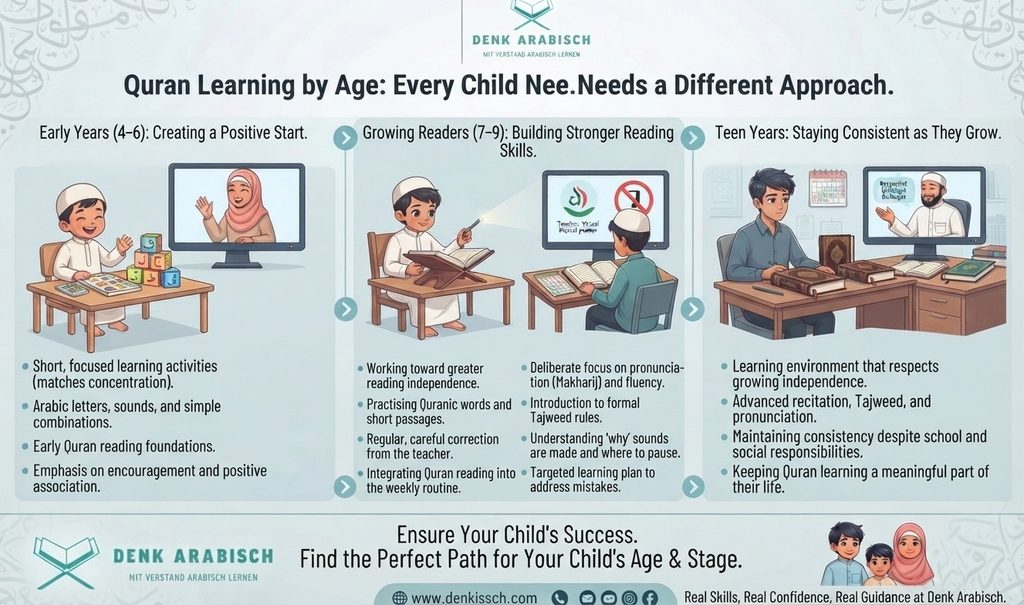
a. Early Years (4–6): Creating a Positive Start
Younger children usually need short, focused learning activities that match their concentration level.
Lessons can introduce Arabic letters, sounds, simple combinations, and early Quran reading foundations. At this age, positive experiences matter greatly. Children should gradually associate Quran learning with encouragement and progress rather than pressure.
b. Growing Readers (7–9): Building Stronger Reading Skills
Children in this age group can usually work toward stronger reading skills and greater independence.
They can practise Quranic words and short passages while receiving regular correction from their teacher. Consistent lessons can help turn Quran reading into a familiar part of their weekly routine.
c. Developing Skills (10–13): Strengthening Recitation and Tajweed
Older children can begin working more deliberately on pronunciation, fluency, and Tajweed.
They can learn why particular sounds are pronounced differently, where to pause, and how specific rules affect their recitation. At this stage, teachers can also identify recurring mistakes and create a more targeted learning plan.
d. Teen Years: Staying Consistent as They Grow
Teenagers often need a learning environment that respects their growing independence. Lessons can focus on stronger recitation, Tajweed, pronunciation, and maintaining consistency despite increasing school and social responsibilities.
The aim is to help Quran learning remain a meaningful part of their routine as they grow older.
Build your understanding of the Quran by learning essential words and meanings in Key Quranic Vocabulary.
Online or In-Person Quran Learning in Wuppertal?
In-person Quran learning can provide valuable community interaction, especially when children attend lessons through a local mosque or Islamic organization. However, travelling to lessons is not always practical for every family.
School activities, work schedules, siblings, traffic, and distance can make regular attendance difficult.
For families in Wuppertal, these practical challenges can make an online program a more convenient option when consistency is a priority.
Online learning allows children to attend lessons from home without adding travel time to the family’s schedule. It can also make it easier to maintain Quran learning during busy school periods, holidays, or weeks when family schedules change.
Online Quran learning can provide:
- Learning from the comfort of home
- No travel time before or after lessons
- More flexibility when choosing lesson times
- Access to teachers beyond the immediate local area
- Individual attention during lessons
- Easier integration with school and family schedules
However, convenience alone does not make an online program effective. The lesson should still be interactive. Children should read aloud, receive corrections, ask questions, practise difficult parts, and communicate directly with their teacher.
Read also: Learning The Quran For Children In Aachen
Why Regular Quran Learning Makes a Difference?
One of the biggest challenges for families is maintaining consistency. A child may study intensively for a few weeks and then stop because of school exams, holidays, activities, or changes in the family schedule.
Long breaks can make it harder to remember previously learned skills. A manageable routine is often more effective than an ambitious schedule that cannot be maintained.
A practical routine can include:
- Regular teacher-led lessons.
- Short reading practice between lessons.
- Reviewing previously learned material.
- Repeating difficult words or verses.
- Gradually increasing the amount of reading.
The goal is steady progress rather than rushing through the material. Even a small amount of regular practice can help children retain what they learn and feel more comfortable reading independently.
Learn the Quran with Denk Arabisch Academy
Master reading and understanding the Quran through structured and supportive learning
Try a Free TrialWhat Makes a Quran Lesson Effective for Children?
A productive Quran lesson is not simply one where the child completes many pages.
For younger learners, effective teaching usually combines explanation, demonstration, practice, repetition, and correction. A teacher may begin by reviewing previous material before introducing a new skill. The child then practises while the teacher identifies and corrects mistakes.
This creates a learning cycle in which the child learns something, applies it, receives feedback, and tries again.
An effective lesson should also leave the child with a clear sense of progress. They should gradually understand what they can now do independently and which areas still require practice.
Wondering how reciting the Quran can enrich your faith and daily life? Find out more in Rewards Of Reciting The Quran.
Supporting Your Child Without Becoming Their Teacher
Parents have an important role in Quran education, but they do not need to take over the teacher’s role.
The teacher should handle instruction, pronunciation correction, Tajweed development, and the learning plan. Parents can support the process by creating the right conditions at home.
This may include:
- Providing a quiet place for online lessons.
- Helping the child attend lessons regularly.
- Encouraging short practice sessions.
- Asking about what the child learned.
- Recognizing improvement.
- Avoiding unnecessary pressure when progress is slow.
The most useful parental support is often consistency and encouragement. When children feel that their effort is noticed, they are more likely to stay motivated and continue learning.
Arabic and Quran Reading: Two Skills That Support Each Other
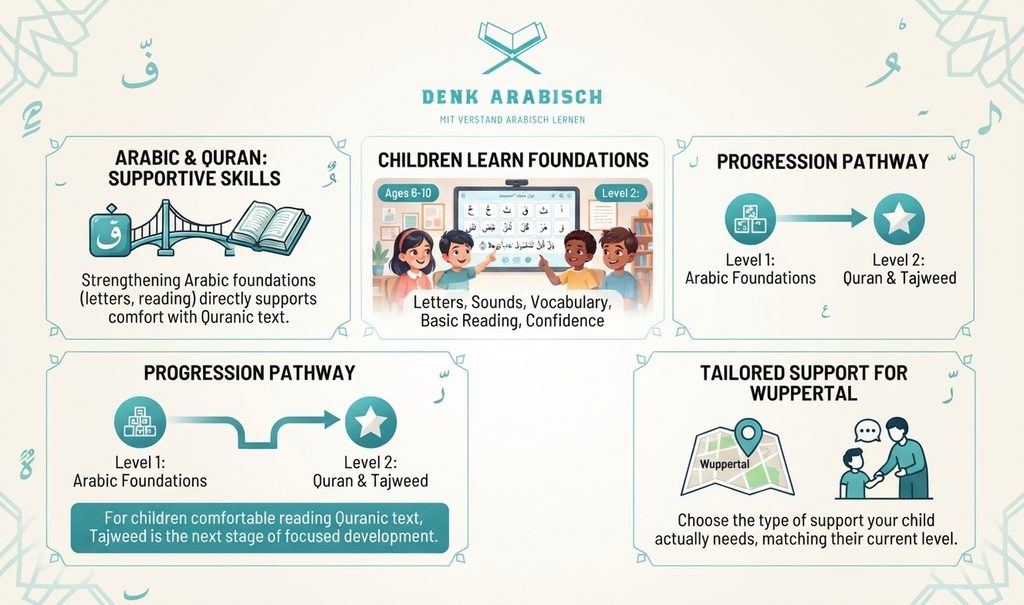
Arabic reading skills can have a direct impact on how comfortably a child approaches the Quran.
Children who struggle to recognize Arabic letters or understand basic reading patterns may also find Quranic text difficult. Strengthening these foundations can therefore support their Quran learning.
The Arabic Classes for Kids at Denk Arabisch help children build the Arabic foundations they need for Quran learning. They learn letters, sounds, vocabulary, and basic reading skills in a simple and age-appropriate way.
Children can improve:
- Arabic letters and pronunciation
- Reading and recognizing words
- Basic vocabulary
- Listening and language skills
- Confidence with Arabic text
As their Arabic reading becomes stronger, children may find it easier to recognize Quranic words and follow their lessons with greater confidence. For children who are already comfortable reading Quranic text, Tajweed can then provide the next stage of focused development.
This gives Wuppertal families the flexibility to choose the type of support their child actually needs rather than enrolling them in a program that does not match their current level.
When Should Parents Look for a More Personalized Program?
Sometimes a general children’s class is enough. In other cases, a child needs a more individualized approach.
Parents may want to consider personalized learning when they notice that their child is repeatedly struggling with the same skill.
Signs may include:
- The child continues making the same pronunciation mistakes
- Reading remains very hesitant despite regular practice
- The child feels uncomfortable reading in front of others
- Previous lessons were inconsistent
- The child’s level is very different from the rest of the group
- The child needs additional repetition before progressing
Personalized instruction allows the teacher to focus on the exact difficulty rather than spending equal time on material the child already understands.
Read also: Learning The Quran For Children In Oberhausen
Building a Positive Relationship with the Quran
Quran education should develop more than reading ability. It should also help children feel comfortable and connected to the Quran as they grow.
Children are more likely to continue learning when they can see their own progress. Being able to read a verse that once seemed difficult, pronounce a letter correctly, or complete a passage independently can give a child a genuine sense of achievement.
Not every lesson will be easy. Children may lose concentration, make repeated mistakes, or need to review the same material several times. These moments are a normal part of learning.
The important thing is to create an environment where mistakes are corrected without making the child feel that they have failed. A patient teacher, a structured learning plan, and consistent encouragement can help children build confidence while continuing to improve.
What Parents Should Look for Before Enrolling
Choosing a Quran program is an important decision because the learning experience can influence a child’s attitude toward Quran study for years.
Before enrolling, parents should look at the complete learning experience rather than focusing on one feature.
Useful questions include:
- Who will teach my child?
- Does the teacher have experience with children?
- How is the child’s level assessed?
- Will pronunciation mistakes be corrected?
- How is Tajweed introduced?
- Is the lesson adapted to the child’s pace?
- How is progress communicated to parents?
- Is the schedule realistic for our family?
- What happens if my child needs additional support?
These questions help parents compare programs based on educational quality rather than convenience alone.
Discover practical ideas for nurturing Islamic values and faith while raising children in Germany in Raising Muslim Kids In Germany.
A Quran Learning Routine That Fits Real Family Life
A successful Quran routine does not need to compete with school, sports, hobbies, or family time.
It should be realistic enough for the child to follow consistently and structured enough to produce measurable progress. For many families, regular lessons combined with short periods of reading practice can be more sustainable than long and demanding study sessions.
The routine can gradually develop as the child’s confidence grows. What matters most is that Quran learning becomes a familiar part of the child’s life rather than something that only happens when the family has extra time.
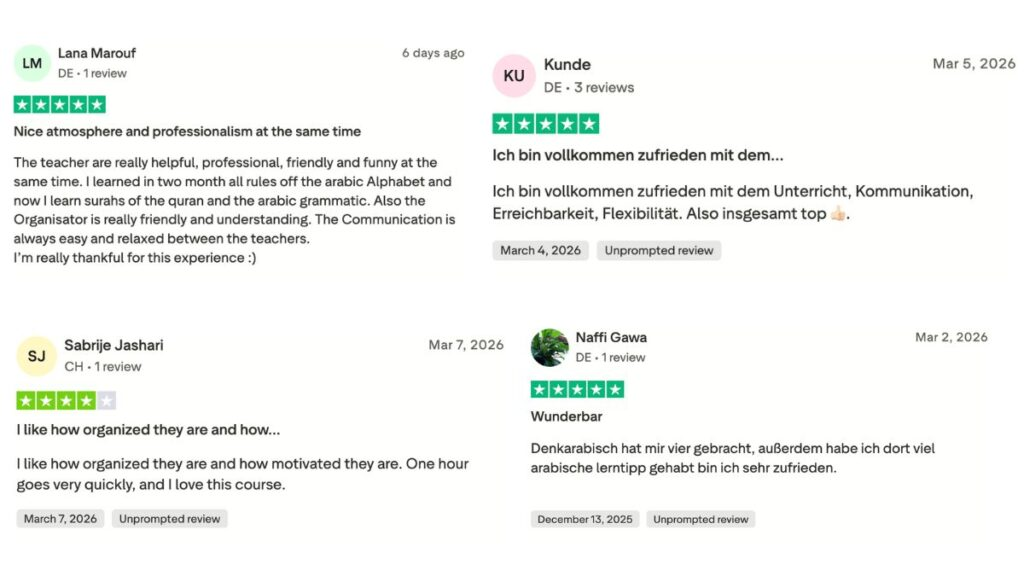
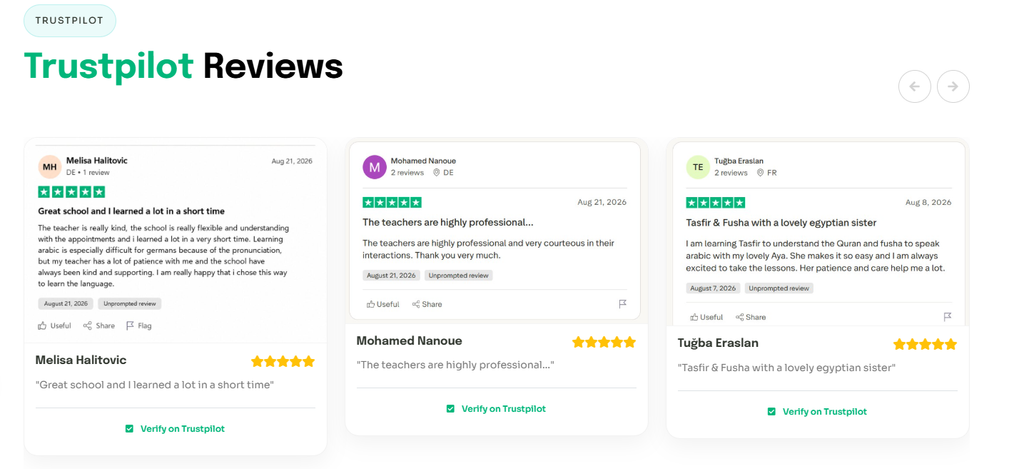
What Our Students Say About Denk Arabisch Academy
See what our students say about learning at Denk Arabisch Academy on Trustpilot. Read their experiences and check out more reviews to discover how our courses help improve Arabic.
Quran Course for Children in Wuppertal with Denk Arabisch
Denk Arabisch provides online learning programs designed to support children as they develop their Arabic and Quran skills. Each program is designed around the child’s current level, allowing families to choose the right starting point and build skills progressively.
Children can start with the course that matches their current level and move forward as their skills develop. Beginners can build their Arabic and Quran reading foundations, while more experienced readers can focus on fluency and Tajweed.
For families looking for Learning The Quran For Children In Wuppertal, our online format makes regular Quran learning easier to maintain from home, without the need for weekly travel.
Why Choose Denk Arabisch?
- Individual Attention: Each child receives guidance according to their level, learning pace, and areas that need improvement.
- Structured Learning: Our courses follow a clear learning path, helping children develop their skills gradually instead of learning without a consistent structure.
- Teacher Feedback: Regular correction helps children recognize pronunciation and reading mistakes and improve them through practice.
- Convenient Online Lessons: Children can learn from home, making it easier for families to maintain a regular Quran learning schedule.
Denk Arabisch also offers:
- Arabic Classes for Kids
- Quran Course for Kids
- Tajweed Course for Kids
- Quran Recitation Course
- Arabic Reading Course
- Quran Tajweed Course
- Islamic Studies Course
Learn the Quran with Denk Arabisch Academy
Master reading and understanding the Quran through structured and supportive learning
Try a Free TrialBook a free trial lesson with Denk Arabisch and discover a learning experience uniquely tailored to your child’s individual needs.
Conclusion
Finding the right Quran program is not simply about choosing the nearest class or the shortest lesson.
Parents need to consider the teacher’s experience, the child’s current level, the quality of pronunciation correction, the structure of the lessons, and whether the program can fit naturally into family life.
Children also need patience and encouragement as they develop. Some will progress quickly, while others need more repetition before they feel confident.
With the right learning environment, children can gradually strengthen their Arabic reading, improve their Quran recitation, develop Tajweed skills, and become more independent learners.
For families searching for Learning The Quran For Children In Wuppertal, Denk Arabisch offers flexible online programs that can support children at different stages of their Quran learning journey.
From foundational Arabic and Quran reading to focused Tajweed development, families can choose the support that best matches their child’s needs.
FAQs
1. At what age can my child start learning the Quran in Wuppertal?
Children can begin at different ages depending on their development and previous exposure to Arabic. Younger children can start with letters and basic reading skills, while older children may be ready for Quran reading or Tajweed.
2. What if my child cannot read Arabic yet?
A child does not need to already know Arabic to begin. They can start with foundational skills such as recognizing letters, learning sounds, connecting letters, and reading basic combinations before progressing to Quranic text.
3. How can I choose a good Quran teacher for my child in Wuppertal?
Look for a teacher who has experience working with children and can combine accurate Quran recitation with patience and clear explanations.
The teacher should also be able to adapt lessons to the child’s level, correct pronunciation carefully, and provide useful feedback about progress. These are important considerations for any family comparing Quran programs in Wuppertal.
4. Is one-to-one Quran learning better for children?
One-to-one learning can be especially useful for children who need additional correction, repetition, or personalized attention.
It allows the teacher to adjust the lesson according to the child’s pace instead of following the same rhythm for every student. This can be particularly valuable when a child has recurring pronunciation problems or needs additional time to master a specific reading skill.
5. Is online Quran learning suitable for families in Wuppertal?
Online learning can be a practical option for families who want to avoid travel and maintain a flexible schedule.
When lessons are interactive and led by a qualified teacher, children can receive direct instruction, reading practice, correction, and feedback from home. For busy Wuppertal families, this can make it easier to maintain a consistent Quran learning routine alongside school and family responsibilities.