Mastering the art of asking questions is one of the most critical milestones in learning any language. In Arabic, a language renowned for its structural precision and rich grammar, forming questions involves a unique blend of specific interrogative particles, nouns, and structural rules.
Whether you are studying Modern Standard Arabic (MSA), known as Fusha (فُصْحَى), or diving into regional spoken dialects (Ammiya / عَامِّيَّة), understanding how to build a question will immediately unlock your ability to navigate daily interactions, conduct interviews, and deepen your comprehension.
This comprehensive guide breaks down every core question word in Arabic, the grammatical rules that govern them, the architectural differences between closed and open questions, and how these structures morph when moving from formal text to spoken dialects.
Table of Contents
What Is Arabic Questions?
Before looking at individual words, it is essential to understand how Arabic questions are built. Unlike English, which frequently relies on auxiliary verbs like “do,” “does,” or “did” to form a question (e.g., “Do you live here?”), Arabic does not require an auxiliary helping verb.
Instead, Arabic uses two primary mechanisms to signal an inquiry:
1. Interrogative Particles (أَدَوَاتُ الِاسْتِفْهَام – Adawat al-Istifham): Specific words placed at the absolute beginning of a sentence to turn a statement into a question.
2. Intonation: In casual speech, a statement can turn into a question simply by raising the pitch of your voice at the end of the sentence, though formal writing strictly relies on grammatical particles.
Another structural detail is punctuation. The Arabic question mark is reversed (؟) to match the right-to-left flow of the script, and it is placed at the end of the sentence.
Stop letting another twelve months slip away in a cycle of hesitation and command the authoritative curriculum of Denk Arabisch and our relentless Arabic Course For Beginners to build an unshakeable mechanical foundation right now.
Yes/No Interrogatives In Arabic
In Arabic, yes/no questions are incredibly straightforward because they do not require you to rearrange the word order of the original sentence. You simply take a standard declarative sentence and place an interrogative particle at the very beginning.
There are two primary particles used for this purpose in Modern Standard Arabic: هَلْ (Hal) and the prefix أَ (A).
The Particle: هَلْ (Hal)
This is the most common and versatile way to form a yes/no question in formal Arabic. It can be placed before both nominal sentences (sentences starting with a noun) and verbal sentences (sentences starting with a verb).
- Statement: أَنْتَ طَالِبٌ (Anta talib) – You are a student.
- Question: هَلْ أَنْتَ طَالِبٌ؟ (Hal anta talib?) – Are you a student?
- Statement: تَشْرَبُ القَهْوَةَ (Tashrabu al-qahwah) – You drink coffee.
- Question: هَلْ تَشْرَبُ القَهْوَةَ؟ (Hal tashrabu al-qahwah?) – Do you drink coffee?
To answer a question starting with Hal, you will generally use نَعَمْ (Na’am – Yes) or لَا (La – No).
The Prefix: أَ (Al-Hamzah)
The single letter Hamzah (أَ) serves the exact same function as Hal, but it attaches directly as a prefix to the first word of the sentence. It is considered slightly more formal or literary.
- Question: أَتَشْرَبُ القَهْوَةَ؟ (A-tashrabu al-qahwah?) – Do you drink coffee?
Choosing Alternative Options with أَ… أَمْ
The prefix Hamzah has a unique structural superpower: it is used when asking someone to choose between two distinct options, using the structure أَ… أَمْ (A… am / Is it X… or Y?). Hal cannot be used in this specific binary choice structure.
- Example: أَقَهْوَةً شَرِبْتَ أَمْ شَايّاً؟ (A-qahwatan sharibta am shayan?) – Did you drink coffee or tea?
Eliminate the subtle particle errors that silently sabotage your meaning and expose you as an amateur by mastering the strict parameters of Denk Arabisch and our definitive Arabic Prepositions Course to lock in absolute linguistic authority.
WH- Question Words In Arabic (The Interrogative Nouns in Arabic)
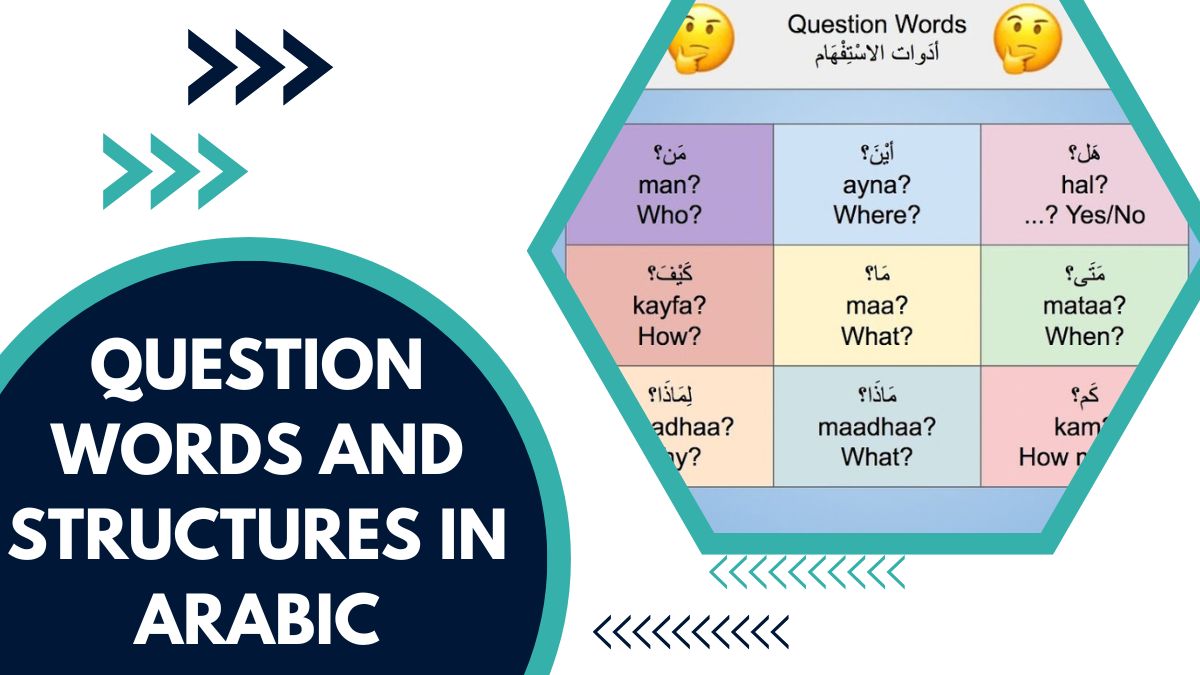
When you need information beyond a simple yes or no, Arabic utilizes a set of interrogative nouns. Each word targets a specific type of missing information (person, place, time, reason, or quantity).
Below is an exhaustive breakdown of the fundamental open-ended question words in Modern Standard Arabic.
Who: مَنْ (Man)
Used exclusively to inquire about rational beings (humans). It acts as the subject or object of the question.
- Example: مَنْ هَذَا؟ (Man hadha?) – Who is this?
- Example: مَنْ فَتَحَ البَابَ؟ (Man fataha al-bab?) – Who opened the door?
What: مَا (Ma) and مَاذَا (Madha)
Arabic splits the concept of “what” into two distinct words based entirely on the grammatical structure of the words that follow them.
1. مَا (Ma)
Used almost exclusively before nouns or pronouns.
- Example: مَا اسْمُكَ؟ (Ma ismuka?) – What is your name?
- Example: مَا هَذَا؟ (Ma hadha?) – What is this?
2. مَاذَا (Madha)
Used almost exclusively before verbs.
- Example: مَاذَا تَفْعَلُ؟ (Madha taf’al?) – What are you doing?
- Example: مَاذَا أَكَلْتَ اليَوْمَ؟ (Madha akalta al-yawm?) – What did you eat today?
When: مَتَى (Mata)
Used to inquire about time, whether past, present, or future.
- Example: مَتَى السَّفَرُ؟ (Mata as-safar?) – When is the trip?
- Example: مَتَى يَصِلُ القِطَارُ؟ (Mata yasilu al-qitar?) – When does the train arrive?
Where: أَيْنَ (Ayna)
Used to inquire about physical locations or directions.
- Example: أَيْنَ الكِتَابُ؟ (Ayna al-kitab?) – Where is the book?
- Example: أَيْنَ تَعِيشُ؟ (Ayna ta’ish?) – Where do you live?
How: كَيْفَ (Kayfa)
Used to ask about the condition, state of being, or the manner in which an action is performed.
- Example: كَيْفَ حَالُكَ؟ (Kayfa haluka?) – How are you? (Literally: How is your condition?)
- Example: كَيْفَ نَذْهَبُ إِلَى المَتْحَفِ؟ (Kayfa nadhhabu ila al-mat-haf?) – How do we go to the museum?
Why: لِمَاذَا (Limadha)
Used to ask for reasons, causes, or purposes. It is structurally a combination of the preposition Li (for) and Madha (what)—meaning “for what reason”.
- Example: لِمَاذَا تَتَعَلَّمُ العَرَبِيَّةَ؟ (Limadha tata’allamu al-‘arabiyyah?) – Why are you learning Arabic?
- Example: لِمَاذَا تَأَخَّرْتَ؟ (Limadha ta’akharta?) – Why are you late?
How Many / How Much: كَمْ (Kam)
Kam is used to inquire about quantities. However, it comes with a strict grammatical rule that frequently trips up language learners.
The Kam Rule: The noun that follows Kam must be singular, indefinite, and in the accusative case (Mansoub), which typically means it ends with a double Fatha (ً ) sound.
- Correct: كَمْ كِتَاباً قَرَأْتَ؟ (Kam kitaban qara’ta?) – How many books did you read? (Note that kitaban is singular and ends in an “an” sound, even though we translate it as plural “books” in English).
- Example: كَمْ عُمْرُكَ؟ (Kam ‘umruka?) – How old are you? (Literally: How much is your age?)
Which / Any: أَيّ (Ayy)
Ayy is used to select or distinguish between items. Unlike all the other question words listed above, which have fixed endings, Ayy changes its vowel ending based on its case role in the sentence (nominative Ayyu, accusative Ayya, genitive Ayyi).
Additionally, the noun following Ayy is always singular or plural in the genitive case (Majroor) because it functions as the second part of a possessive construction (Idafa).
- Example: فِي أَيِّ مَدِينَةٍ تَسْكُنُ؟ (Fi ayyi madinatin taskun?) – In which city do you live?
- Example: أَيُّ كِتَابٍ تُرِيدُ؟ (Ayyu kitabin turid?) – Which book do you want?
Stop allowing preventable grammar slip-ups to derail your translation accuracy and implement the hyper-targeted syntax modules of Denk Arabisch and our precision-focused Arabic Personal Pronouns Course to automate your core sentence architecture.
Learn Arabic with Denk Arabisch Academy
Speak and understand Arabic through a clear and effective learning system
Try a Free TrialArabic Prepositions Combined with Question Words
To ask more nuanced questions like “With whom?”, “From where?”, or “About what?”, Arabic attaches standard prepositions directly to the front of interrogative nouns.
When certain prepositions merge with the question words مَا (What) or مَنْ (Who), spelling shifts and abbreviations occur to make pronunciation smoother.
Prepositions with مَا (What)
When a preposition is prefixed to مَا, the long vowel Alif (ا) at the end of Ma is dropped entirely in formal writing.
| Preposition | Question Word | Combined Form | Pronunciation | Meaning |
| لِـ (For) | مَا (What) | لِمَ؟ | Lima? | Why? / For what? |
| بِـ (By/With) | مَا (What) | بِمَ؟ | Bima? | With what? / Whereby? |
| عَنْ (About) | مَا (What) | عَمَّ؟ | Amma? | About what? |
| مِنْ (From) | مَا (What) | مِمَّ؟ | Mimma? | From what? / Out of what? |
| فِي (In) | مَا (What) | فِيمَ؟ | Fima? | In what? / Regarding what? |
- Example from literature: عَمَّ تَتَحَدَّثُونَ؟ (‘Amma tatahaddathun?) – About what are you speaking?
Prepositions with مَنْ (Who)
When the prepositions مِنْ (from) or عَنْ (about) meet مَنْ (who), the two words blend into a single word, transforming the letter Noon (ن) into a Meem (م).
- مِنْ (From) + مَنْ (Who) = مِمَّنْ؟ (Mimman?) – From whom?
- Example: مِمَّنْ أَخَذْتَ هَذَا الكِتَابَ؟ (Mimman akhadhta hadha al-kitab?) – From whom did you take this book?
- مَعَ (With) + مَنْ (Who) = مَعَ مَنْ؟ (Ma’a man?) – With whom?
- Example: مَعَ مَنْ ذَهَبْتَ؟ (Ma’a man dhahabta?) – With whom did you go?
Erase the lazy reliance on auto-correct keyboard shortcuts and establish authentic, independent literacy by integrating the precision mechanics of Denk Arabisch and our specialized Arabic Writing Course to draft flawless text by hand.
Read also: Tajweed Rules – Full Guide
Arabic Formal vs. Spoken Dialects (Fusha vs. Ammiya)
One of the steepest hills to climb when learning Arabic is the divergence between Modern Standard Arabic (written text, news media, formal speeches) and regional spoken dialects (Ammiya).
While the fundamental concept of sentence structures remains consistent, spoken dialects heavily modify, shorten, or reposition question words. Crucially, while formal Arabic always places the question word at the very beginning of the sentence, many dialects allow or even require the question word to move to the end of the sentence.
Let’s examine how these shifts look across major dialect groups.
Shifting Words and Sentence Positions
| English | Modern Standard Arabic (MSA) | Egyptian Dialect | Levantine Dialect (Syria/Lebanon/Jordan) | Gulf Dialect |
| What? | مَا / مَاذَا (Ma / Madha) | إيه؟ (Eih?) | شو؟ (Shoo?) | شنو؟ / شـ؟ (Shinu / Shu?) |
| Who? | مَنْ (Man) | مين؟ (Meen?) | مين؟ (Meen?) | منو؟ (Manhoo?) |
| Where? | أَيْنَ (Ayna) | فين؟ (Feen?) | وين؟ (Ween?) | وين؟ (Ween?) |
| When? | مَتَى (Mata) | إمتى؟ (Imta?) | أيمتى؟ (Eimta?) | متى؟ (Mata?) |
| Why? | لِمَاذَا (Limadha) | ليه؟ (Leih?) | ليش؟ (Leish?) | ليش؟ (Leish?) |
| How? | كَيْفَ (Kayfa) | إزاي؟ (Izzay?) | كيف؟ (Keeft?) | شلون؟ (Shloon?) |
Structural Changes in Dialect Sentences
To illustrate how sentence structure shifts between formal and spoken forms, study these practical comparisons:
1. Asking “What is your name?”
- Formal MSA: مَا اسْمُكَ؟ (Ma ismuka?) — Question word stays at the front.
- Egyptian: اسْمَك إيه؟ (Ismak eih?) — Question word moves to the end.
2. Asking “Why are you late?”
- Formal MSA: لِمَاذَا تَأَخَّرْتَ؟ (Limadha ta’akharta?) — Front placement.
- Levantine: ليش تأخرت؟ (Leish t’akhart?) — Front placement, but the word morphs from Limadha to Leish.
3. Asking “How are you?”
- Formal MSA: كَيْفَ حَالُكَ؟ (Kayfa haluka?)
- Gulf: شْلُونِك؟ (Shloonik?) — A unique blend of Ayyu shay’in lawnuhu (literally: “What is its color?”), which evolved into a common phrase meaning “How are you?”.
Shatter the conversational performance blockages that freeze your progress in real-time and trust the relentless dialogue drills of Denk Arabisch and our immersive Arabic Speaking Course to speak with absolute authority.
Arabic Advanced Structural Rules & Common Mistakes
To write and speak Arabic with high professional accuracy, keep these finer grammatical details in mind:
The Definitive Word Order
In standard written Arabic, the interrogative word always commands the pole position of a sentence. The only words allowed to precede an interrogative are prepositions (like Fi, Min, Bi) or a noun in a possessive (Idafa) construction.
- Example of Idafa preceding a question word: سَيَّارَةَ مَنْ هَذِهِ؟ (Sayyarata man hadhihi?) — Whose car is this? (Literally: Car of whom is this?)
Pronoun Agreement in Nominal Questions
When asking questions about people using a nominal structure, ensure your detached subject pronouns match the gender and number of the target subject.
- Masculine Singular: مَنْ هُوَ مُدِيرُ المَدْرَسَةِ؟ (Man huwa mudiru al-madrasah?) – Who is the school principal?
- Feminine Singular: مَنْ هِيَ الطَّبِيبَةُ؟ (Man hiya at-tabibah?) – Who is the doctor?
Avoiding the Double-Subject Mistake
Native English speakers often make the mistake of adding an extra pronoun when asking questions in Arabic.
- English thought process: “Where is the teacher? Is he in the room?”
- Mistaken Arabic conversion: أَيْنَ المُعَلِّمُ هُوَ؟ (Ayna al-mu’allimu huwa?) — This is redundant.
- Correct Arabic structural delivery: أَيْنَ المُعَلِّمُ؟ (Ayna al-mu’allim?) — The noun itself is sufficient.
Shatter the mechanical blind spots that will ultimately bring your future fluency crashing down and deploy the strict boot camp of Denk Arabisch and our foundational Arabic Alphabet Course to lock the blueprint of the script into your memory forever.
Read also: Learning The Quran For Children In Augsburg
Reference Summary Table For Arabic Questions
| Question Word (Arabic) | Transliteration | English Translation | Core Grammatical Target |
| هَلْ | Hal | Is / Do / Does / Are | Yes/No verification |
| مَنْ | Man | Who | Rational beings (Humans) |
| مَا | Ma | What | Non-rational nouns |
| مَاذَا | Madha | What | Actions / Verbs |
| أَيْنَ | Ayna | Where | Places and locations |
| مَتَى | Mata | When | Time and dates |
| كَيْفَ | Kayfa | How | Condition / Manner |
| لِمَاذَا | Limadha | Why | Reasons and causes |
| كَمْ | Kam | How many / How much | Countable amounts (Requires singular accusative noun) |
| أَيّ | Ayy | Which / Any | Choices (Requires genitive noun) |
By systematically committing these structures to memory and recognizing how prepositions fuse with interrogative nouns, you will read formal Arabic texts with far greater ease and speak with confidence, regardless of the region or dialect you are interacting with.
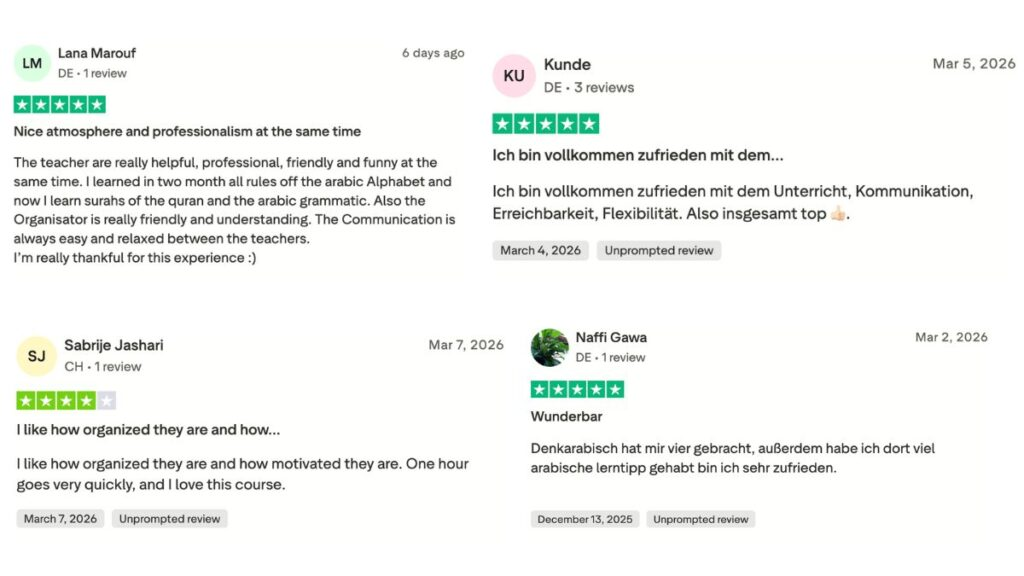
What Our Students Say About Denk Arabisch Academy
See what our students say about learning at Denk Arabisch Academy on Trustpilot. Read their experiences and check out more reviews to discover how our courses help improve Arabic.
Read also: Learning The Quran For Children In Ulm
Join Denk Arabisch Now!
You spend weeks clicking through gamified vocabulary apps, saving random social media clips, and telling yourself you’re making progress because a dashboard gave you a streak badge.
But when you open a real book, listen to a native speaker, or stand in prayer, you are still completely locked out. You are relying on a translation—which means you are trusting someone else’s mind to explain your own heritage to you.
At Denk Arabisch, we break that dependency. We don’t host loose, low-stakes study circles to make you feel good. We operate a high-velocity, milestone-driven framework engineered to turn hesitant beginners into precise, dominant speakers.
Stop living on the sidelines. Select your track and claim your absolute breakthrough today:
- Arabic Course For Beginners: Master script connection, lock in phonetic precision, and start reading real sentences from day one.
- Quranic Arabic Course for German Speakers: Dive straight into classical grammar and root systems to experience the literary genius of the verses exactly as they were revealed.
- Arabic Alphabet Course: We don’t just show you what letters look like; we train your mind to recognize, pronounce, and link them under rapid-fire conditions.
- Arabic Reading Course: Through progressive sight modules, you will train your eyes to scan text fluidly and recognize vowel marks instantly.
- Arabic Writing Course: Master the complex rules of script connection, eliminate spelling blind spots, and learn to draft elegant, accurate text with professional hand mechanics.
- Arabic Speaking Course: This high-intensity conversational track forces you entirely out of your comfort zone, using rigorous dialogue drills to surgically remove performance anxiety and train your brain to think directly in Arabic.
- Arabic Personal Pronouns Course: This targeted strike isolates singular, dual, and plural pronoun systems, cementing them into your subconscious until you use them flawlessly.
- Arabic Prepositions Course: This specialized course isolates the subtle rules of particles, patching your hidden knowledge gaps and showing you exactly how verbs interact with them to unlock advanced mastery.
The Denk Arabisch Standard:
- Irreversible Fluency: Our students do not memorize phrases for temporary validation. They transition from struggling with basic shapes to reading, writing, and articulating complex text with zero hesitation.
- A Weaponized System, Zero Guesswork: We have spent years refining a battle-tested framework that replaces chaotic study habits with a predictable, high-performance blueprint.
- The Global Choice for High-Achievers: From serious students seeking a profound spiritual connection with the text to professionals requiring localized dialects, our academy remains the undisputed industry choice.
- Uncompromising Human Accountability: Every student is backed by real academic mentors who track your metrics, audit your progress, and refuse to let you quit.
The intake window is open right now, and the clock is ticking on your current excuses. Twelve months from now, you will either be executing this language with total authority, or you will be stuck in the exact same spot, wishing you had started today.
Book your free trial lesson right now, and dominate the language with Denk Arabisch.
Learn Arabic with Denk Arabisch Academy
Speak and understand Arabic through a clear and effective learning system
Try a Free TrialConclusion
Understanding the structural architecture of Arabic questions is a massive step toward achieving true fluency. While the language presents unique rules—such as the requirement to position open-ended question words at the absolute beginning of sentences, or the structural blending that occurs when prepositions meet interrogative nouns—the system is highly logical once you break it down.
By mastering the core tools of formal written Arabic (Fusha) alongside the flexible word placements of spoken dialects (Ammiya), you gain the ability to navigate conversations smoothly, ask for directions accurately, and engage deeply with native speakers across the Arab world.
Keep practicing the variations between nominal and verbal question paths, pay attention to the nouns following Kam and Ayy, and you will quickly find yourself constructing precise, natural inquiries with ease.
FAQs
1. Do Arabic question words change form based on gender?
Most Arabic interrogative words—such as مَنْ (Man / Who), أَيْنَ (Ayna / Where), and مَتَى (Mata / When)—are completely rigid and do not change form regardless of whether you are speaking to or about a male, a female, or a group.
The notable exception is أَيّ (Ayy / Which), which can occasionally take a feminine suffix (أَيَّة / Ayyah) in highly formal classical text when paired with a feminine noun, though using the standard masculine أَيّ is perfectly acceptable and common in all modern contexts.
Note that while the question words themselves stay the same, any verbs, pronouns, or adjectives that follow them must agree with the gender of the subject.
2. Can I turn an Arabic statement into a question using tone of voice alone?
In written Modern Standard Arabic, you must use a formal particle like هَلْ (Hal) or أَ (A) to create a yes/no question.
However, in everyday spoken regional dialects, turning a statement into a question using just a rising intonation at the end of the sentence is incredibly common.
For instance, saying “Enta rayeh al-bet?” with a rising tone transforms “You are going home” into “Are you going home?”.
3. Why does the word for “What” in Arabic change between Ma and Madha?
This is a strict rule of grammar in formal Arabic designed to maintain a smooth sentence flow. Use مَا (Ma) when the very next word in your sentence is a noun, adjective, or pronoun (e.g., “What is this?”). Use مَاذَا (Madha) when the very next word is a verb (e.g., “What did you say?”).
4. How do you say “Whose” in Arabic?
Arabic does not have a single, dedicated word for “whose.” Instead, it uses a possessive construction (Idafa) by placing the object being owned directly before the word for “who” (مَنْ). For example, to ask “Whose house is this?”, you phrase it as: بَيْتُ مَنْ هَذَا؟ (Baytu man hadha?), which literally translates to “House of whom is this?”.
5. Why is the Arabic noun after Kam (How many) always singular?
While English speakers naturally say “How many books (plural)?”, Arabic structural rules dictate that the word كَمْ must be followed by a singular, indefinite noun in the accusative case (Mansoub).
Therefore, “How many books?” is structurally written as كَمْ كِتَاباً؟ (Kam kitaban?), meaning “How many of a book?”.