The Shahadah in Arabic is the most fundamental declaration of faith in Islam and serves as the first of the Five Pillars of Islam. Every Muslim believes in and recites the Shahadah as a testimony to the oneness of Allah and the prophethood of Muhammad (peace be upon him). These simple yet profound words represent the foundation of Islamic belief and the essence of a Muslim’s faith.
For Muslims around the world, the Shahadah is much more than a phrase. It is a statement of conviction, a commitment to worship Allah alone, and an affirmation of following the teachings of Prophet Muhammad. Understanding the Shahadah in Arabic helps learners appreciate its linguistic beauty, religious significance, and spiritual depth.
In this article, we will explore the Shahadah in Arabic, its meaning, pronunciation, translation, importance in Islam, and its role in the daily lives of Muslims.
Table of Contents
What Is the Shahadah?
The word Shahadah (الشهادة) comes from the Arabic root meaning “to witness” or “to testify.” In Islam, the Shahadah is the declaration that affirms the core beliefs of the religion.
The Shahadah in Arabic is:
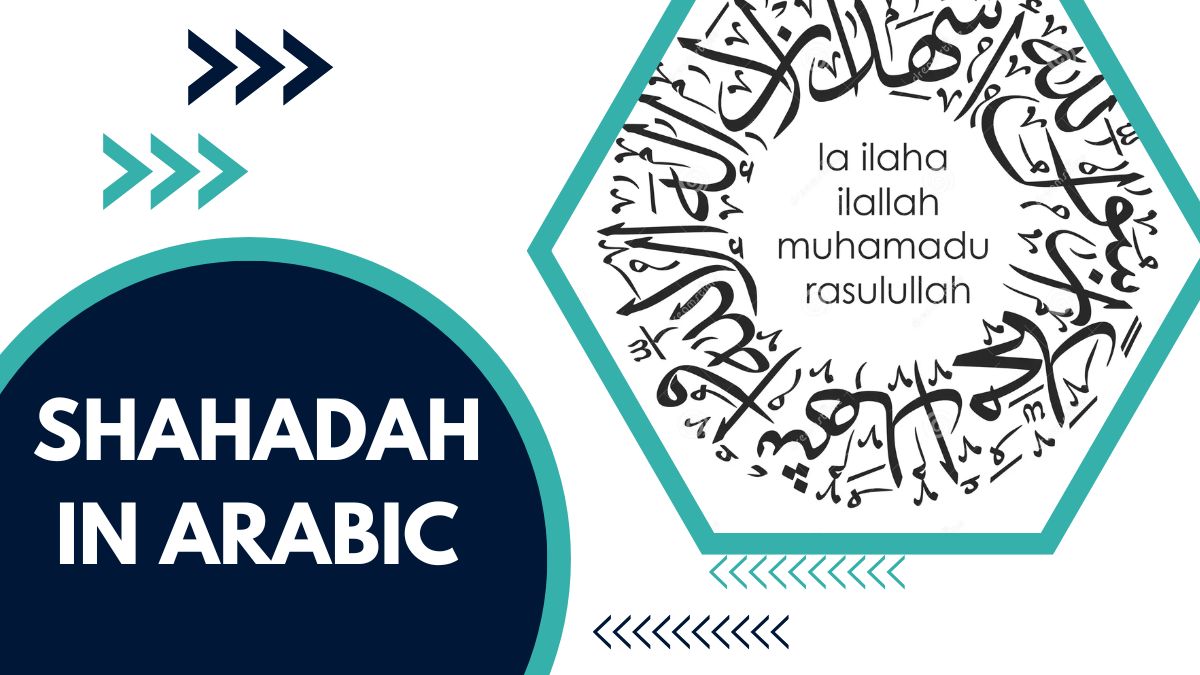
أشهد أن لا إله إلا الله وأشهد أن محمدًا رسول الله
Transliteration
Ashhadu an la ilaha illa Allah wa ashhadu anna Muhammadan rasul Allah
English Translation
“I bear witness that there is no deity worthy of worship except Allah, and I bear witness that Muhammad is the Messenger of Allah.”
This declaration summarizes the two essential beliefs of Islam:
- Belief in the oneness of Allah (Tawhid).
- Belief that Muhammad is Allah’s final messenger.
The Two Parts of the Shahadah
The Shahadah consists of two equally important sections.
First Part: Belief in Allah
أشهد أن لا إله إلا الله
Translation: I bear witness that there is no deity worthy of worship except Allah.
This statement emphasizes the concept of Tawhid, which is the belief that Allah alone deserves worship.
Muslims believe that:
- Allah is the Creator of the universe.
- Allah has no partners.
- Allah is unique and incomparable.
- All acts of worship should be directed solely to Allah.
This principle forms the heart of Islamic theology.
Second Part: Belief in Prophet Muhammad
وأشهد أن محمدًا رسول الله
Translation: And I bear witness that Muhammad is the Messenger of Allah.
This declaration confirms belief in Prophet Muhammad (peace be upon him) as the final prophet sent to guide humanity.
Muslims believe that:
- Muhammad received the Quran from Allah.
- He conveyed Allah’s message faithfully.
- His teachings provide guidance for daily life.
- He is the final prophet in a long line of messengers.
Don’t let hesitation push your self-improvement goals to the back burner again; lock in your virtual seat in our high-demand Arabic Course For Beginners at Denk Arabisch before the semester registration officially closes!
Why Is the Shahadah Important?
The Shahadah is considered the foundation upon which all other Islamic beliefs and practices are built.
First Pillar of Islam
The Shahadah is the first of the Five Pillars of Islam:
- Shahadah (Declaration of Faith)
- Salah (Prayer)
- Zakat (Charity)
- Sawm (Fasting during Ramadan)
- Hajj (Pilgrimage to Mecca)
Without belief in the Shahadah, the other pillars lose their religious meaning.
Entry into Islam
A person officially becomes a Muslim by sincerely reciting and believing in the Shahadah.
This declaration marks the beginning of one’s spiritual journey in Islam.
Daily Reminder of Faith
Muslims regularly repeat the Shahadah throughout their lives as a reminder of their commitment to Allah.
The Meaning of Tawhid in the Shahadah
The first part of the Shahadah highlights the concept of Tawhid, one of the most important teachings in Islam.
Tawhid means acknowledging that:
- Allah is One.
- Allah alone deserves worship.
- Allah has no equals or partners.
- Allah controls all creation.
The Shahadah teaches Muslims to direct their prayers, hopes, fears, and acts of worship exclusively toward Allah.
The Shahadah in Daily Muslim Life
The Shahadah is deeply integrated into everyday Islamic practice.
During Prayer
Muslims recite the Shahadah during their daily prayers.
Every Salah includes affirmations of faith and devotion to Allah.
In the Call to Prayer
The Shahadah appears in the Adhan (Islamic call to prayer).
Muslims hear these words multiple times each day from mosques around the world.
During Important Life Events
The Shahadah is often recited:
- At birth
- During conversion to Islam
- During marriage ceremonies
- During times of hardship
- Near the end of life
These occasions highlight its central role in Muslim life.
Experience the unmatched emotional and literary depth of the classical text by enrolling in a specialized Quranic Arabic Course for German Speakers at Denk Arabisch built to dissolve cross-linguistic confusion instantly.
Learning How to Pronounce the Shahadah
Correct pronunciation is important for learners studying Arabic and Islam.
Arabic Text
أشهد أن لا إله إلا الله وأشهد أن محمدًا رسول الله
Word-by-Word Transliteration
- أشهد — Ashhadu
- أن — An
- لا — La
- إله — Ilaha
- إلا — Illa
- الله — Allah
- وأشهد — Wa Ashhadu
- أن — Anna
- محمدًا — Muhammadan
- رسول — Rasul
- الله — Allah
Practicing slowly helps learners improve pronunciation and confidence.
Read also: Arabic Sentences
Benefits of Learning the Shahadah in Arabic
Learning the Shahadah in its original Arabic form offers several benefits.
Understanding Islamic Beliefs
The Shahadah introduces learners to the central teachings of Islam.
Improving Arabic Vocabulary
Students become familiar with important Islamic Arabic words such as:
- Allah (الله)
- Rasul (رسول)
- Ilah (إله)
- Shahadah (شهادة)
Strengthening Spiritual Connection
Reciting the Shahadah in Arabic allows Muslims to connect with the original language of the Quran.
Building a Foundation for Further Learning
The Shahadah often serves as the first Arabic phrase many Muslims and non-Muslims learn.
Prepare yourself for international corporate negotiations or deep academic literature analysis by registering for specialized Arabic Courses Based On Skills & Topics at Denk Arabisch focused entirely on high-yield, professional results.
Learn Arabic with Denk Arabisch Academy
Speak and understand Arabic through a clear and effective learning system
Try a Free TrialThe Historical Background of the Shahadah
The declaration of faith dates back to the earliest days of Islam.
When Prophet Muhammad began preaching in Mecca, he called people to worship Allah alone and abandon idol worship.
The Shahadah became the defining statement of the Muslim community.
Throughout Islamic history, Muslims have recited these words as a symbol of faith, unity, and devotion.
Today, billions of Muslims continue to affirm the same declaration.
Shahadah and the Quran
The message contained within the Shahadah is reflected throughout the Quran.
Many Quranic verses emphasize:
- The oneness of Allah.
- The rejection of false gods.
- The mission of the prophets.
- The importance of faith and obedience.
Although the exact wording of the Shahadah is not found as a single verse, its meaning is repeatedly reinforced throughout the Quran.
Common Misconceptions About the Shahadah
Although the Shahadah is one of the most well-known and frequently recited statements in Islam, there are several misconceptions about its meaning and purpose. Understanding these misunderstandings can help clarify the true significance of the Shahadah and its central role in a Muslim’s faith and daily life.
The Shahadah Is Not Just a Phrase
Some people assume that reciting the Shahadah is merely a ritual.
In reality, Muslims view it as a sincere commitment that influences every aspect of life.
The Shahadah Requires Belief
Simply saying the words is not enough.
Islam teaches that genuine faith and conviction must accompany the declaration.
The Shahadah Is Universal
Muslims from all cultures and languages recite the same Arabic statement of faith.
This creates a sense of unity among Muslims worldwide.
The Spiritual Impact of the Shahadah
The Shahadah provides Muslims with:
- A sense of purpose.
- Spiritual guidance.
- Inner peace.
- Connection with Allah.
- A framework for ethical living.
By affirming belief in Allah and His Messenger, Muslims establish the foundation for all acts of worship and moral conduct.
The Shahadah serves as a constant reminder of faith, responsibility, and devotion.
How Children Learn the Shahadah?
Muslim children are often introduced to the Shahadah at an early age.
Parents and teachers commonly teach:
- The Arabic text.
- Proper pronunciation.
- Basic meaning.
- Importance in Islam.
Memorizing the Shahadah is frequently one of the first steps in Islamic education.
Ensure every minute and dollar you invest in your education yields the highest possible return by choosing our premium Arabic Courses Based On Levels at Denk Arabisch supervised by world-class native instructional mentors.
The Universal Message of the Shahadah
Despite cultural differences among Muslims worldwide, the Shahadah remains a shared declaration that unites believers.
Whether in Asia, Africa, Europe, North America, or the Middle East, Muslims recite the same words in Arabic.
This universal declaration symbolizes:
- Faith in one God.
- Unity among Muslims.
- Commitment to Islamic teachings.
- Respect for Prophet Muhammad.
Read also: How to Say Hello In Arabic? – 10+ Common Way
What Our Students Say About Denk Arabisch Academy
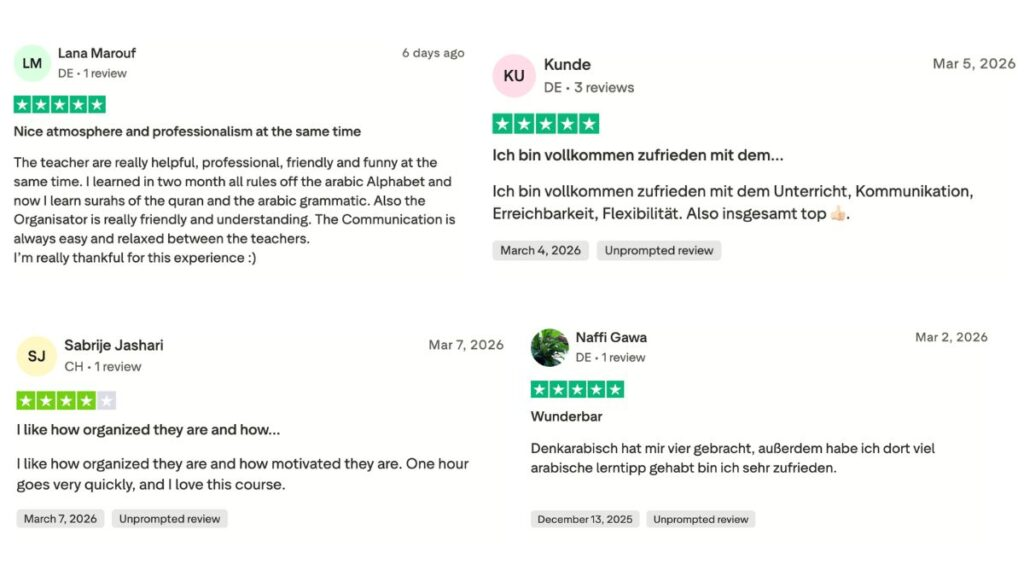
See what our students say about learning at Denk Arabisch Academy on Trustpilot. Read their experiences and check out more reviews to discover how our courses help improve Arabic.
Learn Arabic with Denk Arabisch!
Let’s be completely direct: you don’t have time to waste on strategies that yield zero results. Trying to learn a rich, deep language by piece-milling free social media clips and collecting unorganized grammar worksheets is a recipe for permanent hesitation. You are left guessing if your pronunciation is right, feeling confused by sentence structures, and staying silent when you should be speaking. True fluency demands a premium standard—an elite, structured system, live conversational practice, and direct feedback from native experts.
The enrollment window for our live, premium tracks is officially winding down. To protect our strict standard of deep student-teacher interaction and real-time pronunciation refinement, we enforce rigorous caps on every single classroom. Once these specific cohorts hit capacity, our registration gates will lock tight for the entire semester with zero exceptions.
The Courses:
- Arabic Course For Beginners: Stop viewing the Arabic script as an impossible mountain to climb. Our fast-paced, high-velocity conversational blueprint completely bypasses dry, traditional textbook lecturing to get you actively framing and speaking your own complex sentences right from your very first live hour.
- Quranic Arabic Course for German Speakers: Bridge the gap between languages to experience the profound, untranslated depth of the classical text exactly as it was intended. This custom track is precision-engineered from the ground up to dismantle the unique structural friction between German and Arabic grammar nodes.
- Arabic Courses Based On Skills & Topics: High-efficiency, targeted training for results-driven adults. Stop wasting time on generalized language paths that don’t fit your life; isolate and dominate your specific milestones—whether that means mastering advanced business dialogue, technical text reading, or core grammar logic.
- Arabic Dialect Courses: Move completely past the formal, rigid broadcast phrasing that local communities never use on the street. Master the living, authentic regional idioms of daily life so you can easily joke, converse, and build genuine, natural relationships with native speakers.
- Arabic Courses Based On Levels: No more repetitive reviews or moving at the pace of an average classroom. We execute a precise audit of your current linguistic threshold and position you directly into the optimal tier to ensure your learning momentum keeps climbing without a single pause.
Why keep spending another year stuck at the exact same learning threshold when you can train live with handpicked, world-class native educators?
Denk Arabisch strips away the overwhelm and eliminates the trial-and-error with a premium online structure that fits flawlessly around your high-pressure career, business, or university calendar.
The longer you stay in a holding pattern, the further your goals drift away. Act decisively right now and lock in your live spot before our classroom doors shut completely!
👉 [Lock In Your Live Classroom Spot & Start Your Free Trial Instantly!]
Learn Arabic with Denk Arabisch Academy
Speak and understand Arabic through a clear and effective learning system
Try a Free TrialConclusion
The Shahadah in Arabic is the cornerstone of Islamic faith and the first pillar of Islam. Its powerful message affirms belief in Allah as the only deity worthy of worship and Muhammad as His final messenger. Though simple in wording, the Shahadah carries profound spiritual meaning and guides every aspect of a Muslim’s life.
Learning the Shahadah in Arabic helps students understand Islamic beliefs, improve Arabic language skills, and appreciate the beauty of one of the most important declarations in the world. Whether you are studying Islam, learning Arabic, or seeking a deeper understanding of Muslim faith, the Shahadah provides an essential foundation for knowledge and spiritual growth.
FAQs
1. What is the Shahadah in Arabic?
The Shahadah is the Islamic declaration of faith and the first pillar of Islam. It is recited as:
أشهد أن لا إله إلا الله وأشهد أن محمدًا رسول الله
This statement affirms belief in the oneness of Allah and the prophethood of Muhammad (peace be upon him).
2. What does the Shahadah mean in English?
The Shahadah translates to:
“I bear witness that there is no deity worthy of worship except Allah, and I bear witness that Muhammad is the Messenger of Allah.”
It summarizes the core beliefs of Islam.
3. Why is the Shahadah important in Islam?
The Shahadah is important because it forms the foundation of Islamic faith. It is the first of the Five Pillars of Islam and serves as the basis for all other Islamic beliefs and practices.
4. Is the Shahadah the first pillar of Islam?
Yes. The Shahadah is the first pillar of Islam. The other pillars include prayer (Salah), charity (Zakat), fasting during Ramadan (Sawm), and pilgrimage to Mecca (Hajj).
5. Can someone become Muslim by reciting the Shahadah?
Yes. A person enters Islam by sincerely reciting the Shahadah and genuinely believing in its meaning. It is considered the formal declaration of faith for new Muslims.