Takeaway:
- An Arabic learning app is a low-barrier way to start, offering short lessons, quick wins with basic words, and flexible daily practice.
- Apps excel at vocabulary, repetition, listening drills, and building a first connection to the language — especially for busy beginners.
- Apps fall short for free speaking, precise pronunciation correction (critical for sounds like ح and ع), and systematic sentence building.
- The most effective use: short daily sessions, repeating every word aloud, and immediately turning new words into mini dialogues.
- A clean, structured learning order (listen → speak → read) matters more than speed or using multiple apps at once.
- For serious progress, combine an app for review with structured lessons from a native teacher — this gives direction, real feedback, and speaking practice.
- Beginners who only want to test the waters can start app-only, but moving to a blended approach (app + teacher) leads to faster, more confident speaking and long-term consistency.
An Arabic learning app feels like the easiest way to start for many beginners. That makes sense, because your phone is always with you, the lessons are short, and the barrier to entry is low. For German speakers in Germany, however, it is important to understand what an app really does well, where its limits are, and when structured lessons can lead to faster progress.
Table of Contents
What is an Arabic learning app?
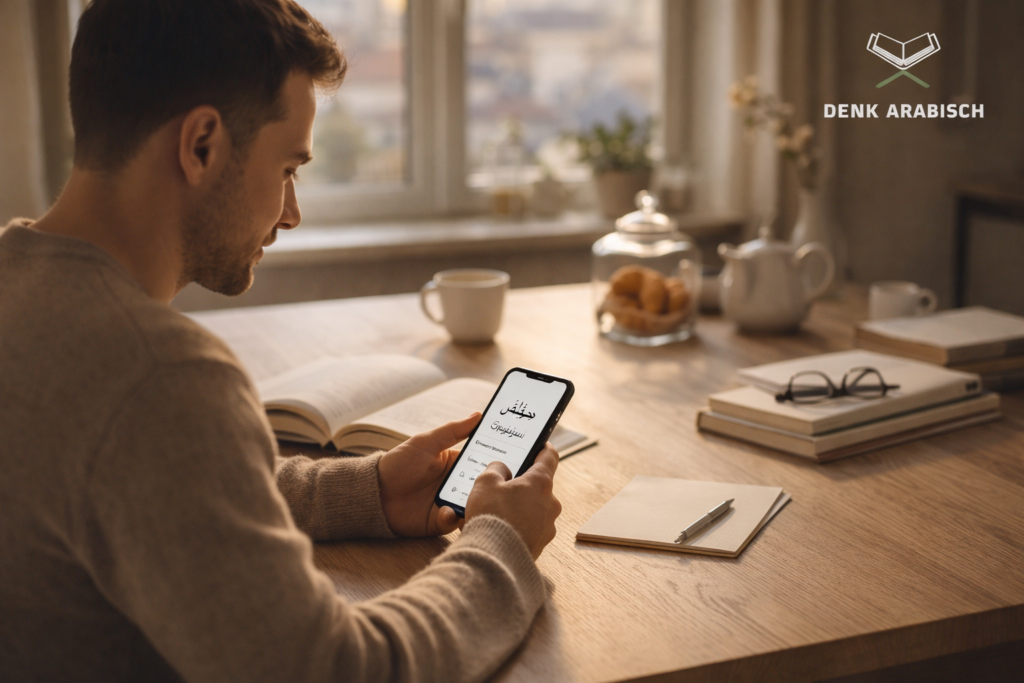
An Arabic learning app is a digital learning tool on a phone or tablet. It usually helps beginners with letters, words, listening, and short sentences.
Many beginners start with it because the first step feels small. That is exactly its biggest advantage.
An Arabic learning app explains learning in small units
Most apps work with short lessons. That is helpful for people with limited time, for example between work, university, or family duties.
For German beginners, this is practical because Arabic can feel unfamiliar at the beginning. Small units reduce pressure.
An app for learning Arabic gives quick first success moments
Many learners want to understand a few words quickly. Apps offer exactly that.
Often, on the very first day, you already see greetings, numbers, or simple daily words. That creates motivation.
An Arabic learning app does not automatically replace a clear learning path
An app is a tool, not a complete learning plan. It shows content, but it does not always build knowledge in a systematic way.
This is exactly where a structured course becomes important. Denk Arabisch combines short learning steps with clear learning plans, native teachers, and real feedback. For many beginners, this is the point where learning becomes organized instead of random.
Why many beginners start with an app?
Many German-speaking learners first look for a simple solution. An app fits this wish because it is available immediately.
That does not mean it is equally good for every goal.
Learning Arabic for beginners feels easier with an app
Getting started feels less serious than joining a full course. You open the app and begin.
This matters psychologically. Anyone who feels anxious about a new language often needs an easy first access point.
An app fits well into a busy daily routine
Many people in Germany study alongside work, university, or childcare. An app fits into small time slots.
Ten minutes a day is more realistic than large study blocks. That is why an app is often the first step.
An Arabic app gives immediate visible structure
Many apps use levels, repetition, and points. That helps beginners stay consistent.
This structure is useful. But it is not the same as a language system with real correction.
What a good app for learning Arabic should be able to do?
Not every app is equally useful. For beginners, a helpful structure matters more than attractive design.
A good app must be simple, clear, and linguistically sound.
A good Arabic app starts with sounds and not only with lists
Beginners first need sound and rhythm. Anyone who only sees word lists often learns in a superficial way.
German-speaking learners especially benefit when an app uses audio early and often.
A good app for Arabic shows letters step by step
Arabic script can feel unfamiliar at first. That is why the app should introduce letters slowly.
It is important to separate clearly between shape, sound, and example word. Everything at once is too much.
A good Arabic learning app trains repetition in a useful way
Repetition is not boring. It is necessary. New words need to come back more than once.
It is helpful when the app brings back older content in a targeted way. That helps knowledge stay longer.
A good app for learning Arabic supports listening and repeating aloud
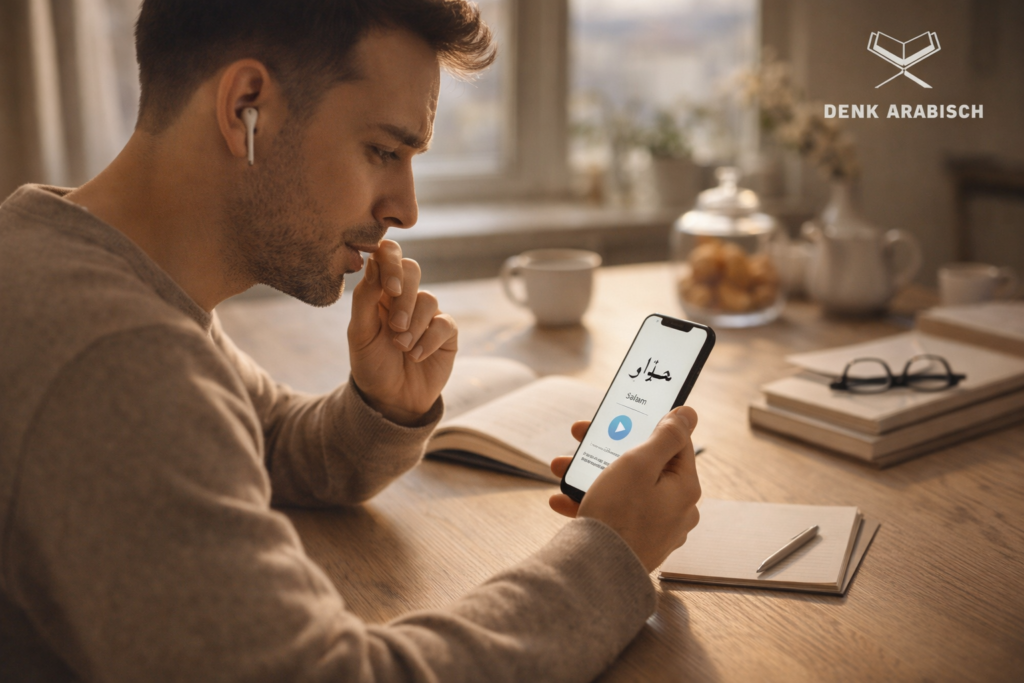
Listening alone is not enough. Beginners need to repeat words aloud.
This is especially important in Arabic, because some sounds are unfamiliar to German native speakers. That includes letters such as ح and ع. An app can help here, but real correction remains limited.
Read also: Learn Arabic Online for Free
Which content beginners really need at the beginning?
Many apps show too much too early. For beginners, less is often better.
The best beginning follows a clear order: listen, recognize, speak, read, then slowly expand.
Learning Arabic for beginners starts with useful words
Not every first word is equally helpful. Beginners need words from real situations.
These include greetings, family, numbers, food, time, and simple questions. These words are immediately useful.
Learning to speak Arabic starts with fixed mini sentences
Single words are helpful, but sentences create movement in learning.
Examples:
- Marhaban – Hello
- Ismi Anna – My name is Anna
- Kaifa haluk – How are you
Such mini sentences are better than isolated vocabulary.
Arabic letters should first be learned practically and not abstractly
Many beginners lose energy when letters are explained only in a theoretical way.
It is better to connect the letter with its sound and one simple word. That makes learning more tangible.
Learn Arabic with Denk Arabisch Academy
Speak and understand Arabic through a clear and effective learning system
Join nowWhat an app does well and what it does not do well?
An honest assessment saves time. An app is useful, but it does not solve every learning problem.
Anyone who understands that early learns faster and with less frustration.
An app is strong for vocabulary and repetition
Apps are good for frequent review. That is especially useful for new words.
Short listening exercises, flashcards, and small tests also work well in digital form.
An app is weaker for free speaking
Free speaking needs reaction, error correction, and real communication. That is exactly what many apps lack.
You can click, listen, and repeat. But you only train spontaneous answering in a limited way.
An app often does not correct pronunciation precisely enough
Arabic sounds need precise listening and targeted correction. For German learners, this is a central point.
If someone pronounces ح like ه or does not pronounce ع clearly at all, an app often does not detect that properly. Denk Arabisch works here with native teachers who recognize exactly these typical mistakes made by German-speaking learners.
Common mistakes when using an Arabic app
Many problems are not caused by the app itself, but by using it in the wrong way.
Anyone who avoids typical beginner mistakes makes much better progress.
Using too many apps at the same time
Many beginners download three or four apps. That sounds motivated, but it often creates confusion.
Each app has its own order and method. As a result, there is no clear thread.
Only watching and not speaking aloud
Silent learning feels comfortable, but it slows down progress.
Arabic is a language that should be practised with the mouth from an early stage. Repeating aloud is not optional. It is necessary.
Moving on too fast without repetition
Many learners want to see new content quickly. That often leads to fragmented learning.
Mastering three fixed sentences well is better than half-knowing twenty.
Learning only vocabulary without small use
Words stay weak if they never appear in a sentence.
It is better to connect each new word immediately to a mini question or a mini answer.
Read also: Correct Arabic Pronunciation
How to use an app the right way?
Using the app well matters more than the brand. Even a simple app can bring good results when you use it wisely.
What matters is a fixed small routine.
Study a little every day instead of a lot only sometimes
Daily repetition is more effective for beginners than large study blocks on weekends.
Even ten to fifteen minutes a day can help a lot when they happen regularly.
Repeat every new word aloud
Speaking aloud activates listening, mouth movement, and memory at the same time.
This is especially important when German sounds do not match Arabic sounds. That helps you notice differences earlier.
Turn every lesson into a mini dialogue immediately
Make every lesson into a small use moment.
If you learn a word for coffee, make a sentence with it immediately. If you learn a greeting, answer it directly.
Work with one clear weekly goal
Do not learn without direction. Set one small goal every week.
For example:
- 20 new words
- 5 mini sentences
- 2 short listening exercises
- 1 pronunciation session
App or teacher which is better for beginners

The best answer is not the same for everyone. It depends on the goal.
If you only want to discover your first words, an app can be enough to begin. If you want to speak, you usually need more.
An app is enough for first contact with Arabic
If you want to test whether the language suits you, an app is useful.
You get a first impression of script, sound, and basic vocabulary. That is a good beginning.
A teacher helps faster with pronunciation and sentence building
As soon as you want real confidence, lessons become more valuable.
A teacher hears mistakes immediately, explains patterns clearly, and guides you step by step from simple sentences to useful speaking.
The combination is best for many beginners
The app is useful for review in daily life. Lessons provide direction, correction, and speaking practice.
This combination often saves time. That is exactly why many learners work with Denk Arabisch through a mix of app training, flexible study times, and individual learning plans.
Which solution often fits beginners in Germany best?
German-speaking learners in Germany often face similar problems. They want flexibility, but not random learning.
That is why a mixed solution often works best.
| Learning goal | App only | App plus lessons |
| Getting to know first words | good | very good |
| Understanding Arabic letters | good | very good |
| Correcting pronunciation | limited | strong |
| Building free speaking | weak | strong |
| Staying consistent long term | medium | better |
| Having a clear learning path | limited | strong |
For little time an app is helpful
If your daily routine is full, the app remains a useful tool.
It keeps your connection to the language alive and prevents long breaks.
For real speaking structured lessons are usually better
Speaking develops through active use with feedback. That is exactly what many app-only systems lack.
Anyone who wants to speak faster needs real conversation situations and clear correction.
For beginners with zero prior knowledge order matters more than speed
Many beginners look for speed. In reality, order matters more at the beginning.
A clean start saves confusion later. Denk Arabisch is interesting for many learners because Denk Arabisch builds learning from the beginning in a structured, understandable, and practical way.
Learn Arabic with Denk Arabisch Academy
Speak and understand Arabic through a clear and effective learning system
Join nowStart now with Denk Arabisch
If you do not want to only click, but actually speak, a clear learning path matters more than yet another app.
With Denk Arabisch you get:
- native teachers with an understanding of German-speaking beginners
- flexible study times without commuting
- individual learning plans instead of randomness
- early speaking instead of only passive consumption
- suitable courses such as Arabic courses, Quran Arabic course, and further learning options
Our Courses Include:
- Arabic Courses for German Speakers
- Arabic Levels for German Speakers
- Arabic Dialect Courses for German Speakers
- Qur’an Learning Courses for German Speakers
- Islamic Studies Courses for German Speakers
- Courses for Muslim Kids for German Speakers
Start now with a free trial lesson at Denk Arabisch.
(FAQs)
Can you really learn Arabic with an app
Yes, but usually only up to a certain point. It is good for entry, vocabulary, and review. For free speaking, precise pronunciation, and confident sentence building, it is often not enough on its own.
Which app is best for beginners
The best app is the one that starts simply, offers a lot of audio, repeats clearly, and does not overload the learner. For beginners, less is often better than too many features at once.
Is an app enough for learning to speak Arabic
Usually not. An app can help at the beginning, but fluent speaking develops through active speaking with real reaction and correction.
Conclusion
An Arabic learning app is a good start if you want to begin in a simple way. It helps with words, listening, and small routines. For real speaking, accurate pronunciation, and long-term progress, structured lessons are usually the faster and clearer path.