Takeaway:
- Recitation at Fajr is uniquely witnessed by both the angels of the night and the angels of the day.
- Beginning the day with the Quran places you inside the Prophet’s ﷺ specific du‘a for barakah in the early morning.
- The mind is at its quietest and most receptive at dawn — the ideal state for memorization and deep reflection.
- Consistently waking for Fajr and reciting the Quran is a proof of sincerity that no hypocrite can sustain.
- Meeting the Quran before the chaos of the day begins builds a heart-level calm that carries through daily stress.
- The one who prays Fajr enters Allah’s direct protection (dhimmah); reciting the Quran afterward extends that shield.
- The stillness of dawn is the only time the day truly allows for unhurried tadabbur — reflection that unlocks deeper meanings.
- The two sunnah rak‘ahs before Fajr are worth more than the entire world; pairing them with Quran recitation magnifies the reward beyond measure.
- Allah loves small, consistent acts most — Fajr is where the transformative habit of daily recitation is built and kept.
- Walking toward the Quran in darkness now will be exchanged for perfect, complete light on the Day of Judgment.
The time just before sunrise holds a special place in Islam. It is a moment of calm, silence, and deep spiritual connection. While most of the world is still asleep, those who wake up for Fajr and recite the Quran experience a unique sense of peace, clarity, and closeness to Allah.
This early hour is often called the “golden time” — not only for worship, but for personal transformation. It is a time when the heart is soft, the mind is clear, and distractions are almost nonexistent.
In this article, we explore the deeper benefits of reading the Quran at Fajr, supported by authentic verses from the Quran and sayings of the Prophet ﷺ.
Table of Contents
1. The Angels Are Listening For Your Recitation — Both Shifts at Once
At every other prayer, the angels of night leave as the angels of day arrive. Fajr is the only moment both groups are present together — and Allah chose this exact moment to call your recitation witnessed.
This is not just a reward for waking up early. It is a sign of how much weight this moment carries in the sight of Allah. Your Fajr recitation does not disappear into the silence of the morning — it is received, attended, and carried upward by a gathering you cannot see.
The more Arabic you understand, the more you feel the weight of مَشْهُودًا every time you recite at dawn.
As mentioned in the Quran, the recitation at dawn is uniquely attended by the angels of both night and day.
أَقِمِ الصَّلَاةَ لِدُلُوكِ الشَّمْسِ إِلَىٰ غَسَقِ اللَّيْلِ وَقُرْآنَ الْفَجْرِ ۖ إِنَّ قُرْآنَ الْفَجْرِ كَانَ مَشْهُودًا
“Indeed, the recitation of dawn is ever witnessed.” (Surah Al-Isra, 17:78)
You are never alone during your Fajr recitation; a celestial audience gathers to listen to your words and carry them to the Divine presence.
When angels attend your recitation, every word deserves to be recited correctly. The Quran Recitation Course at Denk Arabisch teaches you to recite with the confidence and accuracy this witnessed moment deserves.
2. Barakah Begins With The First Light Of Your Day
Most people begin their mornings by immediately reaching for their phones, scrolling through news or messages before they have even fully woken up.
But the Prophet ﷺ singled out the early morning hours with a specific du’a for his entire Ummah — a blessing tied directly to those who rise and use that time well. This was not a general supplication. It was a targeted prayer for a targeted group of people.
When you sit with the Quran at Fajr, you are inside that group. The barakah — divine blessing — enters your time, your work, your health, and your sustenance in ways that are often felt before they are understood.
People who keep this habit describe their mornings as feeling longer, their tasks as feeling lighter, and their days as carrying a sense of direction that others cannot quite explain.
اللَّهُمَّ بَارِكْ لأُمَّتِي فِي بُكُورِهَا
“O Allah, bless my nation in their early mornings.” (Sunan Tirmidhi)
Starting your day with the Quran before anything else places your entire day inside this du’a — and the Prophet ﷺ made it for you specifically.
3. At Fajr Your Mind Is Empty — And That Is When The Quran Settles Deepest
The mind at Fajr is a blank slate. It has not yet been filled with the weight of emails, conversations, decisions, or the hundred small frictions that accumulate by midday.
Cognitive load is at its lowest point in the entire day, and this is precisely when new information settles most deeply. It is no accident that the tradition of hifz — memorizing the Quran — has always centered on the early morning hours.
What you give your mind in that first quiet window tends to stay. A verse absorbed at Fajr, with full attention and no distraction, carries differently than one read hurriedly in the afternoon.
Science and Islamic practice agree on this point, arriving at the same conclusion from different directions: if you want to learn, reflect, or memorize, the dawn is your best hour.
The Quran does not just deserve your attention — it deserves your best attention. Fajr is when that is available.
If the early morning is the best time to memorize, imagine what a structured program can do for you. The Quran Memorization Course at Denk Arabisch is built around consistency and gradual progress — exactly what Hifz requires.
4. Waking For Fajr Is A Proof Of Sincerity That No Hypocrite Can Fake
There is a particular kind of faith that only shows itself when it is inconvenient. Anyone can praise Allah in comfort. The real test is whether you will leave a warm bed in the dark to stand before Him.
The Prophet ﷺ observed that the two prayers hardest for the hypocrites were Fajr and Isha — not because those prayers are more demanding, but because they demand something genuine. Convenience cannot carry you to them.
Waking for Fajr and then sitting with the Quran is a physical act of ikhlas — sincerity that your body, not just your tongue, confirms. Every morning you rise, you are proving to yourself — not to anyone else — where your real priorities lie. Over time, this consistency purifies the heart in a way that few other acts can reach.
لَيْسَ صَلاَةٌ أَثْقَلَ عَلَى الْمُنَافِقِينَ مِنَ الْفَجْرِ وَالْعِشَاءِ
“No prayer is more burdensome to the hypocrites than the Fajr and the ‘Isha’ prayer.” (Sahih Bukhari)
Choosing the Word of Allah over the pull of sleep is one of the clearest, most honest declarations of faith a person can make — and it happens before the rest of the world even wakes up.
5. The Chaos Of The Day Has Not Started Yet — Meet The Quran Before It Does
The chaos of the day has not started yet. The demands, the pressures, the things that will go wrong — none of them have arrived. Fajr is the one moment each day when you can meet the Quran from a place of stillness rather than reaction. And that stillness, once established, tends to carry forward.
People who read the Quran in the early morning often describe facing the same stressors as before — but meeting them differently. With more patience. With more ground under their feet.
This is not a coincidence or a personality trait.
It is the effect that Allah describes directly in His Book — the inner calm that dhikr produces is not metaphorical. It is a real and named phenomenon, available to anyone who returns to it consistently.
أَلَا بِذِكْرِ اللَّهِ تَطْمَئِنُّ الْقُلُوبُ
“Verily, in the remembrance of Allah do hearts find rest.” (Surah Ar-Ra’d, 13:28)
The tranquility you build at Fajr does not stay in the prayer — it follows you into your morning, your work, and your dealings with everyone around you.
Peace at Fajr starts with being able to recite smoothly and without hesitation. The Quran Tajweed Course at Denk Arabisch removes the friction from your recitation — so you can focus entirely on the connection, not the pronunciation.
Read also: Reading The Quran On Period
6. From The Moment You Pray Fajr, You Are Under The Direct Protection Of Allah
The Arabic word dhimmah carries the meaning of a direct, personal responsibility — a covenant of care. When the Prophet ﷺ said that the one who prays Fajr is in the dhimmah of Allah, he was describing something specific and serious: that Allah takes that person into His keeping for the day ahead.
This is not a vague feeling of divine favor. It is a named state of protection that begins with the prayer. Adding Quranic recitation to your Fajr deepens that connection.
You are not simply completing a duty and moving on — you are spending time with the Book of the One who protects you, in the very window when that protection begins. For believers who face uncertainty, hardship, or fear, this is a meaningful assurance to carry into the day.
مَنْ صَلَّى الصُّبْحَ فَهُوَ فِي ذِمَّةِ اللَّهِ
“Whoever prays the Fajr prayer is under the protection of Allah.” (Sahih Muslim)
The day ahead is not yours to navigate alone — Fajr is the door through which you enter it under divine cover, and the Quran is what keeps you standing in that doorway a little longer.
Learn the Quran with Denk Arabisch Academy
Master reading and understanding the Quran through structured and supportive learning
Try a Free Trial7. The Quran Was Sent To Be Reflected On — And Dawn Is The Only Time The Day Truly Allows It
The Quran was not sent to be rushed. It was revealed over twenty-three years — slowly, deliberately, one ayah at a time — because its meanings are meant to land, not just pass through.
Tadabbur is the Arabic word for that kind of deep, unhurried reflection: sitting with a verse until it gives you something, until its meaning moves from your eyes to your chest. And it requires exactly what the predawn hour offers — silence, stillness, and a mind that has not yet been pulled in ten directions.
The sahar, the time just before Fajr, has long been described by scholars as the most spiritually charged part of the day. In that quiet, meanings that you have passed over a hundred times suddenly open up.
A verse you thought you understood reveals another layer. This is not coincidence — it is what becomes possible when you give sacred words the environment they deserve.
كِتَابٌ أَنزَلْنَاهُ إِلَيْكَ مُبَارَكٌ لِّيَدَّبَّرُوا آيَاتِهِ
“[This is] a blessed Book which We have revealed to you, [O Muhammad], that they might reflect upon its verses.” (Surah Sad, 38:29)
You do not need an Arabic degree to practice tadabbur. You need quiet and intention — and Fajr gives you both.
Reflection goes much deeper when you understand the language. The Quranic Arabic Course at Denk Arabisch is built for exactly this — helping you move from reading words to feeling their meaning.
8. Two Rakaat At Fajr Outweigh The Entire World — Imagine What Reciting The Quran After Them Is Worth
The two voluntary Rakaat (ركعات) before the Fajr prayer are described by the Prophet ﷺ in terms that are difficult to fully absorb. Everything this world contains — every comfort, every achievement, every material thing a person could accumulate — is worth less than those two rakaat.
That is the sunnah prayer, before the obligatory one has even begun. It is a statement about scale: the scale of what is happening in the spiritual realm versus what we normally consider valuable.
Consider, then, what it means to remain seated after those prayers and recite the literal, unchanged words of Allah — the same words that were recited by the Prophet ﷺ, by the Companions, by generations across fourteen centuries.
The reward for that time does not have a ceiling we can see from here. What we do know is that it carries weight in both this world and the next.
رَكْعَتَا الْفَجْرِ خَيْرٌ مِنَ الدُّنْيَا وَمَا فِيهَا
“The two Rak’ahs of Fajr are better than this world and all that it contains.” (Sahih Muslim)
If the sunnah prayer alone outweighs the entire dunya, imagine the value of following it with the actual words of Allah — in the same window of time, in the same sacred hour.
9. Allah Loves The Small Act You Keep — And Fajr Is Where That Habit Is Built
Allah does not ask for the most dramatic act. He asks for the most consistent one. The Prophet ﷺ made this principle explicit — a small deed done regularly is more beloved to Allah than a large one done once.
This is a profound reorientation away from the way we usually think about achievement: not the grand gesture, but the quiet return, morning after morning, to the same commitment.
Waking for Fajr and reciting the Quran, even just a page, builds something invisible but real: the capacity to keep your word to yourself. That muscle, trained in the dark before the world demands anything from you, shows up everywhere.
In how you work. In how you treat people. In how you handle difficulty. Discipline practised in private eventually becomes integrity lived in public — and it starts at 4am with a decision most people will never make.
أَحَبُّ الأَعْمَالِ إِلَى اللَّهِ أَدْوَمُهَا وَإِنْ قَلَّ
“The most beloved of deeds to Allah are those that are most consistent, even if they are small.” (Sahih Bukhari)
Start with five minutes if that is all you have. The size of the act matters far less than the decision to return to it — every single morning.
10. You Walk Toward The Quran In Darkness Now — On The Day Of Judgment, That Darkness Becomes Light
There is a beautiful symmetry in this final benefit. You walk toward the Quran in physical darkness — before sunrise, before the world is lit — and on the Day of Judgment, when light will be everything and its absence will be terrifying, you are given a perfect noor in return.
The hadith speaks of those who walk to the mosque in the darkness of the early hours, but scholars extend this promise to all who discipline themselves to rise and turn to Allah while others sleep.
The darkness of that walk — quiet, early, perhaps alone — is not wasted. It is being exchanged for something that will matter infinitely more than anything you gave up to be there.
Every morning you rise before the sun, you are making a deposit into an account whose full value will only be revealed on a day when currency as we know it no longer exists.
بَشِّرِ الْمَشَّائِينَ فِي الظُّلَمِ إِلَى الْمَسَاجِدِ بِالنُّورِ التَّامِّ يَوْمَ الْقِيَامَةِ
“Give glad tidings to those who walk to the mosques in the darkness, of perfect light on the Day of Resurrection.” (Sunan Abi Dawud)
Your Fajr recitation today is already writing something into your eternal record — a light being stored, quietly and faithfully, for the day you will need it most.
The journey to the Quran starts with a single step — and Denk Arabisch is here to walk it with you. Whether you are a complex.
Read also: How To Recite The Quran Beautifully? – A Comprehensive Guide
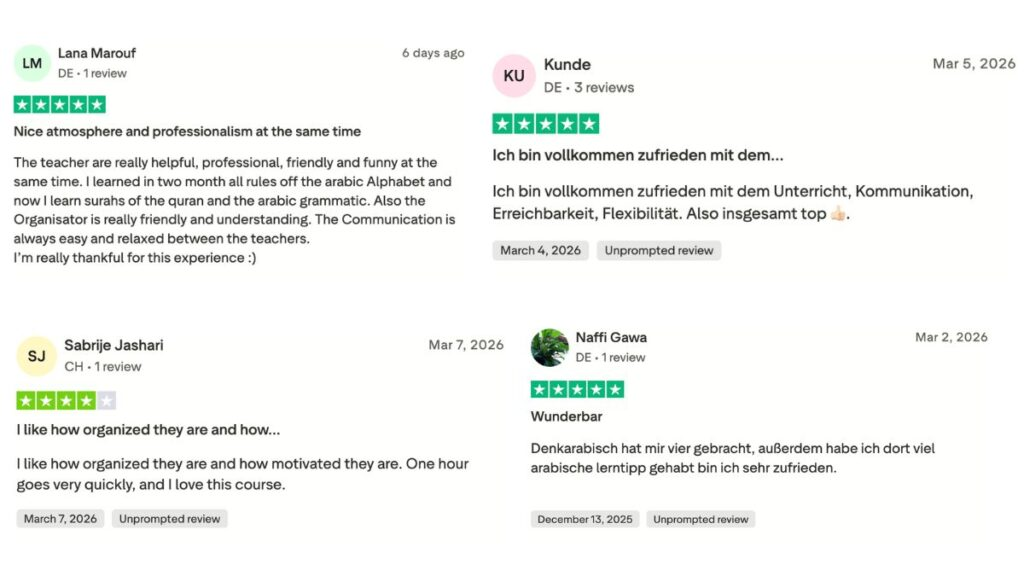
What Our Students Say About Denk Arabisch Academy
See what our students say about learning at Denk Arabisch Academy on Trustpilot. Read their experiences and check out more reviews to discover how our courses help improve Arabic.
Your Fajr Deserves More Than Just Reading — Understand Every Word
Denk Arabisch takes you from the first letter to real Quranic understanding. No pressure. No overwhelm. Just consistent progress that changes how you experience every prayer.
- Quran Reading — Start from zero and read independently
- Quran Recitation — Recite with confidence and correct pronunciation
- Tajweed — Beautify every word you offer at Fajr
- Quran Memorization — Build your hifz one ayah at a time
- Quranic Arabic — Feel the meaning, not just the words
What Makes Denk Arabisch Different?
At Denk Arabisch, we focus on:
- Real understanding, not just theory
- Friendly and supportive teaching style
- Gradual learning without pressure
- Building confidence in every student
We believe every student can succeed with the right guidance and consistency.
👉 Join Denk Arabisch courses and take your first step toward mastering Arabic and connecting deeply with the Quran.
Learn the Quran with Denk Arabisch Academy
Master reading and understanding the Quran through structured and supportive learning
Try a Free TrialConclusion
Reading the Quran at Fajr is more than just a religious duty; it is a life-altering habit. By dedicating the first moments of your day to the Word of Allah, you invite divine protection, mental clarity, and angelic presence into your life. Whether you are seeking to memorize the Holy Book or simply searching for peace in a busy world, the dawn remains the most powerful time to connect with the Divine.
Start tomorrow with just five minutes of recitation, and witness the transformation in your heart and your time.
FAQs
1. How much should I read each morning?
Quality is better than quantity. Even reading one page with deep reflection (Tadabbur) is better than rushing through a whole chapter without understanding.
2. What if I miss Fajr time? Should I still read?
Yes. While the specific rewards of the “witnessed” dawn belong to the early hours, the Quran provides Barakah at any time. However, make it a goal to return to the dawn habit as soon as possible.
3. Can I read from a mobile app?
Absolutely. While holding a physical Mushaf is traditionally preferred, reading from a phone or tablet is perfectly valid and highly convenient for maintaining consistency.
4. Is it better to read before or after the Fajr prayer?
Both are virtuous. However, many scholars suggest reading after the prayer while sitting in the same spot, as the angels continue to pray for you as long as you remain in your place of prayer.