Learning Tajweed is an essential part of every Muslim’s journey with the Holy Quran. Tajweed protects the correct pronunciation of Allah’s words and preserves the beauty, rhythm, and precision of Quranic recitation exactly as it was revealed to Prophet Muhammad ﷺ.
Among the important rules of Meem Sakinah is Idgham Shafawi, a rule that teaches Muslims how to correctly merge the sound of a silent Meem when followed by another Meem. Although the rule may seem simple at first, mastering it greatly improves fluency and smoothness in Quran recitation.
In this complete guide, you will learn everything about Idgham Shafawi — including its definition, letters, pronunciation, Quranic examples, common mistakes, and practical tips for mastering the rule correctly.
Table of Contents
What is Idgham Shafawi?
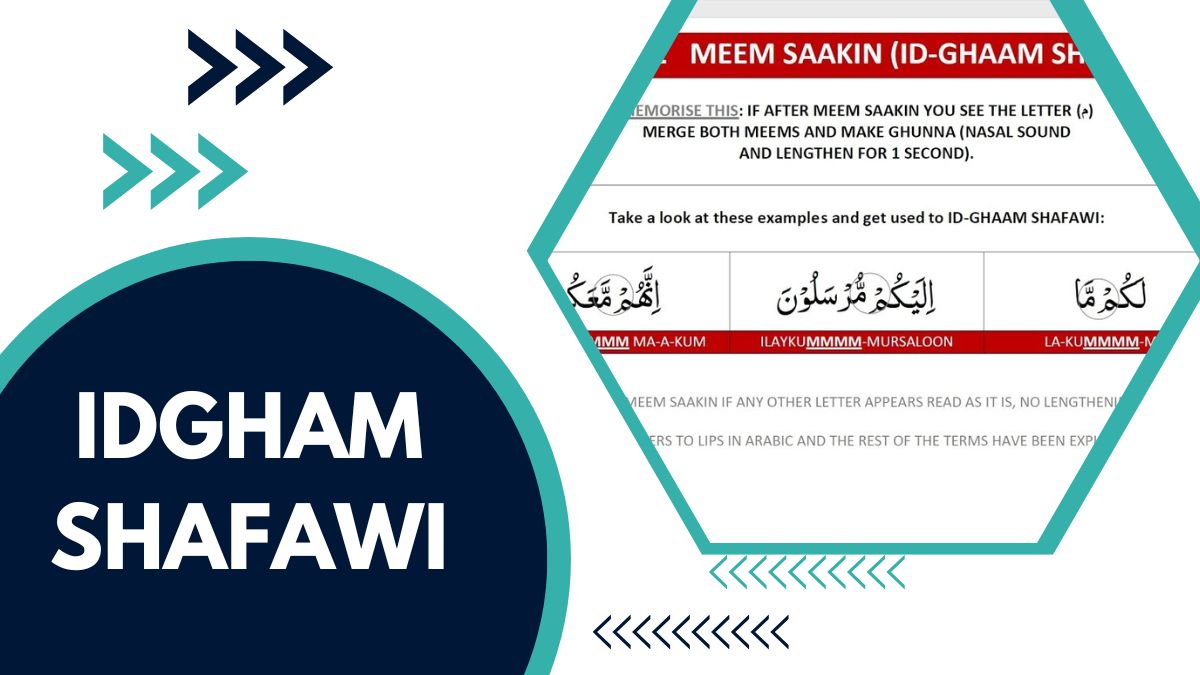
Idgham Shafawi is one of the important Tajweed rules related to Meem Sakinah (مْ). This rule occurs when a Meem Sakinah is followed directly by another Meem (م) in two separate words during Quran recitation.
- The word “Idgham” linguistically means merging, inserting, or combining one letter into another. In Tajweed, it refers to blending two letters together so they are pronounced as one strengthened letter.
- The word “Shafawi” comes from the Arabic word Shafah (شفاه), meaning lips, because the Meem sound is produced by completely closing the lips together. Since both letters involved in this rule are Meems articulated from the lips, the rule is called Idgham Shafawi.
Together, Idgham Shafawi refers to:
- The complete merging of a Meem Sakinah into a following Meem with a clear Ghunnah (nasal sound).
When applying the rule, the first Meem is no longer pronounced independently. Instead, it merges smoothly into the second Meem, creating one emphasized Meem sound accompanied by Ghunnah for approximately two counts.
This rule reflects the beauty and precision of Quranic recitation. Rather than pronouncing two separate Meems heavily and awkwardly, Tajweed creates a smooth, flowing transition that makes the recitation easier, clearer, and more melodious.
When Does Idgham Shafawi Occur?
Idgham Shafawi occurs under one specific condition:
- A Meem Sakinah (مْ) is followed by another Meem (م).
- The two Meems appear in two separate words.
This is the only situation where Idgham Shafawi is applied. Whenever these conditions are present, the first Meem merges completely into the second Meem while maintaining Ghunnah.
Formula of Idgham Shafawi
مْ + م = إدغام شفوي مع غنة
Unlike the rules of Noon Sakinah and Tanween, which involve multiple letters, Idgham Shafawi involves only one letter:
| Rule | Letter |
| Idgham Shafawi | Meem (م) |
This makes the rule relatively simple to recognize and memorize for beginners learning Tajweed.
Why is Idgham Shafawi Important?
Idgham Shafawi is important because it creates a smooth and natural flow during Quran recitation. Without applying the rule correctly, the reciter may pronounce the two Meems separately, causing heaviness and interrupting the rhythm of the Quran.
This rule also preserves the authentic pronunciation transmitted by the scholars of Tajweed through generations.
Benefits of Learning Idgham Shafawi
- Improves fluency in Quran recitation.
- Prevents incorrect pronunciation of Meem Sakinah.
- Enhances the beauty and rhythm of recitation.
- Helps distinguish between Meem Sakinah rules.
- Strengthens understanding of Arabic phonetics.
- Builds confidence during Quran reading.
For students of Tajweed, mastering Idgham Shafawi is an important step toward perfect Quran recitation.
Begin your journey with the Quran Memorization Course at Denk Arabisch and carry the words of Allah in your heart forever.
The Letter of Idgham Shafawi
Unlike many other Tajweed rules that involve several letters, Idgham Shafawi is unique because it involves only one letter:
| Arabic Letter | Transliteration | Name |
| م | M | Meem |
This simplicity makes Idgham Shafawi one of the easier Tajweed rules for beginners to recognize and memorize. Whenever a reciter notices a Meem Sakinah followed directly by another Meem in two separate words, the rule is automatically applied.
The reason this merging occurs so naturally is because both letters share the exact same articulation point (Makharij). The Meem sound is produced by closing the lips completely, making the transition between the two Meems smooth and effortless.
Because the articulation point is identical, pronouncing the two Meems separately would sound heavy and repetitive. Tajweed solves this by merging the first Meem into the second, creating a softer and more fluid recitation style.
Another important feature of the Meem letter is its strong nasal quality. This is why the Ghunnah (nasal sound) is very clear and noticeable in Idgham Shafawi compared to some other Tajweed rules.
Although the rule involves only one letter, applying it correctly requires attention to:
- Proper merging.
- Clear Ghunnah.
- Correct timing.
- Smooth pronunciation.
Mastering this single rule can significantly improve the fluency and beauty of Quran recitation.
How to Correctly Pronounce Idgham Shafawi?
When applying Idgham Shafawi, the Meem Sakinah merges completely into the following Meem while maintaining a clear and natural Ghunnah.
The goal is not simply to connect two letters, but to produce one smooth, strengthened Meem sound with proper nasalization.
Many beginners make the mistake of pronouncing both Meems independently, which interrupts the natural flow of recitation. Correct application creates ease, softness, and harmony in the sound.
Steps for Correct Pronunciation
1. Do not pronounce the first Meem separately The Meem Sakinah should not be heard independently. It merges entirely into the second Meem.
2. Pronounce the second Meem with strengthening The following Meem is pronounced as though it carries a Shaddah (ّ), even if the Mushaf does not visibly display it.
3. Hold the Ghunnah for two counts The nasal sound must be held clearly for approximately two Harakat.
4. Keep the transition smooth The connection between the two words should sound natural and flowing without interruption.
Checklist for Idgham Shafawi
- The first Meem disappears into the second Meem.
- The second Meem sounds doubled.
- Ghunnah is clearly audible.
- Ghunnah lasts for two counts.
- The pronunciation flows smoothly.
Consistent listening and repetition are essential for mastering this rule. Listening regularly to expert Quran reciters helps train the ear to recognize the correct sound and rhythm of Idgham Shafawi.
Gain confidence in reading through the Quran Reading Course at Denk Arabisch and unlock a lifelong connection with the Quran.
Learn the Quran with Denk Arabisch Academy
Master reading and understanding the Quran through structured and supportive learning
Try a Free TrialQuranic Examples of Idgham Shafawi:
Idgham Shafawi appears frequently throughout the Quran. Here are some clear examples:
1. Example from Surah Al-Baqarah
لَهُم مَّا يَشَاءُونَ
The Meem Sakinah at the end of لَهُم merges directly into the following Meem in مَّا.
Instead of pronouncing two separate Meems, the sound becomes one connected Meem with a clear Ghunnah held for two counts.
This creates a smoother and more beautiful recitation flow.
2. Example from Surah Al-Qari’ah
هُم مِّنْ
In this example, the silent Meem at the end of هُم merges completely into the Meem of مِّنْ.
The Ghunnah becomes clearly audible, while the first Meem is no longer heard independently.
Read also: Idgham Mutaqaribayn – A Comprehensive Path To Perfect Tajweed
3. Example from Surah Quraysh
أَطْعَمَهُم مِّن جُوعٍ
The Meem Sakinah at the end of أَطْعَمَهُم merges smoothly into the Meem of مِّن.
4. Example from Surah Al-Fil
هُم مُّقْبِلُونَ
The Meem Sakinah merges fully into the second Meem with a clear nasal resonance and smooth flow.
Practicing these Quranic examples repeatedly helps students recognize Idgham Shafawi instantly while reciting. Over time, the rule becomes automatic and natural during Quran reading.
Perfect your recitation by joining the Quran Tajweed Course at Denk Arabisch and recite as beautifully as it was revealed.
Simple Way to Remember Idgham Shafawi:
The easiest and most effective way to remember Idgham Shafawi is:
“When Meem meets Meem, merge them with Ghunnah.”
Since this rule is very specific and involves only one condition, most students are able to memorize it quickly and apply it with consistent practice.
Idgham Shafawi becomes even easier once you train your ear to recognize the sound pattern rather than focusing only on theory.
Helpful Memory Tips
To make Idgham Shafawi easier to master, use the following practical strategies:
- Focus on recognizing Meem Sakinah (مْ)
Train yourself to instantly notice the silent Meem at the end of words during recitation. - Watch for a second Meem immediately after it
The rule only applies when a Meem Sakinah is followed by another Meem in the next word. - Practice common Quranic examples repeatedly
Repetition builds automatic recognition and improves fluency over time. - Listen carefully to professional recitation
Pay attention to how expert reciters produce a soft, nasal, and connected sound. - Use a color-coded Tajweed Mushaf
Visual cues help you quickly identify where Idgham Shafawi occurs in the Quran.
Strengthen your voice and understanding with the Quran Recitation Course at Denk Arabisch for a more spiritual and fluent experience.
Common Mistakes in Idgham Shafawi
Even though Idgham Shafawi is one of the simpler Tajweed rules, many learners still make common mistakes that affect the quality of recitation.
1. Pronouncing both Meems separately
One of the most frequent errors is reading both Meems clearly without merging them.
This makes the recitation sound heavy and breaks the natural flow of the verse.
Correct practice requires the first Meem to completely merge into the second.
2. Omitting the Ghunnah
Some learners merge the Meems correctly but forget to produce the nasal sound.
However, Ghunnah is an essential part of Idgham Shafawi, and without it, the rule is incomplete.
3. Shortening the Ghunnah
The Ghunnah must be held for exactly two counts (Harakat). If it is too short, the sound becomes weak and unclear.
If it is too long, it distorts the rhythm of recitation. Balance is key.
4. Exaggerating the Ghunnah
Another mistake is stretching the Ghunnah too much, which makes the recitation unnatural.
Tajweed emphasizes moderation — not excess.
The sound should remain soft, controlled, and rhythmic.
5. Confusing Idgham Shafawi with Ikhfa Shafawi
Many beginners mix up these two Meem Sakinah rules.
To clarify:
- Idgham Shafawi = Meem Sakinah + Meem (مْ + م) → merging with Ghunnah
- Ikhfa Shafawi = Meem Sakinah + Ba (مْ + ب) → hidden sound with slight nasalization
Understanding this difference is essential for accurate recitation.
How to Practice Idgham Shafawi Effectively
Consistent practice is the key to mastering Tajweed rules. Here are the most effective methods:
1. Read slowly and carefully
Slow recitation allows you to focus on each letter and apply the rule correctly without rushing.
2. Listen to skilled reciters
Hearing correct application is one of the fastest ways to learn. Reciters such as Mahmoud Khalil Al-Husary and Mishary Rashid Alafasy are excellent examples to follow for clear and precise Tajweed application.
3. Record your recitation
Recording yourself helps you detect mistakes you may not notice while reading. Compare your recitation with professional reciters to improve accuracy.
4. Practice complete Quranic passages
Instead of practicing isolated words, read full verses and pages. This builds natural flow and helps you apply the rule automatically during real recitation.
5. Learn with a qualified Tajweed teacher
Personal feedback is one of the fastest ways to improve. A teacher can immediately correct subtle mistakes in Ghunnah, timing, and merging that are difficult to notice alone.
Read also: Idgham Mutajanisayn – The Complete Guide
Join Denk Arabisch Now?
Reading about Idgham Shafawi is only the beginning. True mastery comes through guided practice, correction, and consistent recitation.
At Denk Arabisch, we help students transform Tajweed theory into confident Quran recitation through structured lessons and personalized support.
Why Join Denk Arabisch?
- Real-time pronunciation correction.
- Experienced Quran and Tajweed teachers.
- Flexible online scheduling.
- Step-by-step Tajweed curriculum.
- Personalized learning plans for every level.
Denk Arabisch Offers:

Whether you are a beginner or an advanced learner, our courses help you build a stronger connection with the Quran through correct recitation.
👉 Book your free trial lesson at Denk Arabisch now!
Elevate your recitation. Honor the revelation. Begin your journey with Denk Arabisch.
Learn the Quran with Denk Arabisch Academy
Master reading and understanding the Quran through structured and supportive learning
Try a Free TrialConclusion
Idgham Shafawi is one of the essential rules of Meem Sakinah in Tajweed. It occurs when a Meem Sakinah is followed by another Meem in two separate words.
The rule is simple yet extremely important:
- Merge the first Meem into the second.
- Apply a clear Ghunnah.
- Hold the nasalization for two counts.
Mastering Idgham Shafawi improves fluency, strengthens pronunciation, and helps Muslims recite the Quran exactly as it was revealed.
Whether you are beginning your Tajweed journey or refining advanced recitation skills, understanding and practicing Idgham Shafawi is a valuable step toward beautiful and accurate Quran recitation.
FAQs
1. What is Idgham Shafawi in Tajweed?
It is the merging of a Meem Sakinah into a following Meem with Ghunnah.
2. How many letters does Idgham Shafawi have?
Only one letter:
م (Meem)
3. How long should the Ghunnah last?
The Ghunnah lasts for two counts (Harakat).
4. Does Idgham Shafawi happen within one word?
No. It occurs between two separate words.
5. Is Idgham Shafawi difficult to learn?
No. Since it involves only one letter, it is considered one of the easier Tajweed rules to recognize and apply.
6. What is the difference between Idgham Shafawi and Idgham with Ghunnah?
Idgham with Ghunnah relates to Noon Sakinah and Tanween with four letters (ي، ن، م، و).
Idgham Shafawi specifically relates to Meem Sakinah followed by Meem.