The letter Raa (ر) is the 10th letter of the Arabic alphabet and one of the most frequent consonants in the language.
You make it with the tip of your tongue tapping the gum ridge just behind your upper front teeth. Linguists call it an alveolar trill or tap, written [r] or [ɾ] in IPA.
This sound does exist in German, but not in the standard pronunciation most textbooks teach. The usual German R in rot or Regen is made at the back of the mouth, and that sound is actually much closer to Arabic Ghain (غ).
If you grew up with Bavarian, Austrian or Swiss German, or you sing in a choir, you probably already use the tongue-tip R that Arabic needs.
Short exercises at the end let you check what you have learned.
| Fact | Raa (ر) |
| Name | رَاءٌ (rāʾ) |
| Sound | [r] trill / [ɾ] tap, like the tongue-tip R in Bavarian rot or Spanish pero |
| Position in the alphabet | 10th letter (hijāʾī order) |
| Abjad value | 20th in Abjad order, value 200 |
| Transliteration | Common: r · DIN 31635: r · Doubled: rr · Arabizi: plain r (no number needed) |
| Point of articulation | Tip of the tongue against the gum ridge of the upper front teeth |
| Sun or Moon letter | Sun letter |
| Heavy or light | Variable: heavy or light depending on its vowels |
| Dots | None |
| Connection | Non-connecting: joins only to the letter before it |
A note on the examples: Arabic words in this guide carry full vowel marks, including their case ending, while the transliteration shows the form you say when you stop on the word (قَمَرٌ = qamar).
Read our Article: How Many Words Are In Arabic?
Table of Contents
Raa’s Place in the Arabic Letter Order
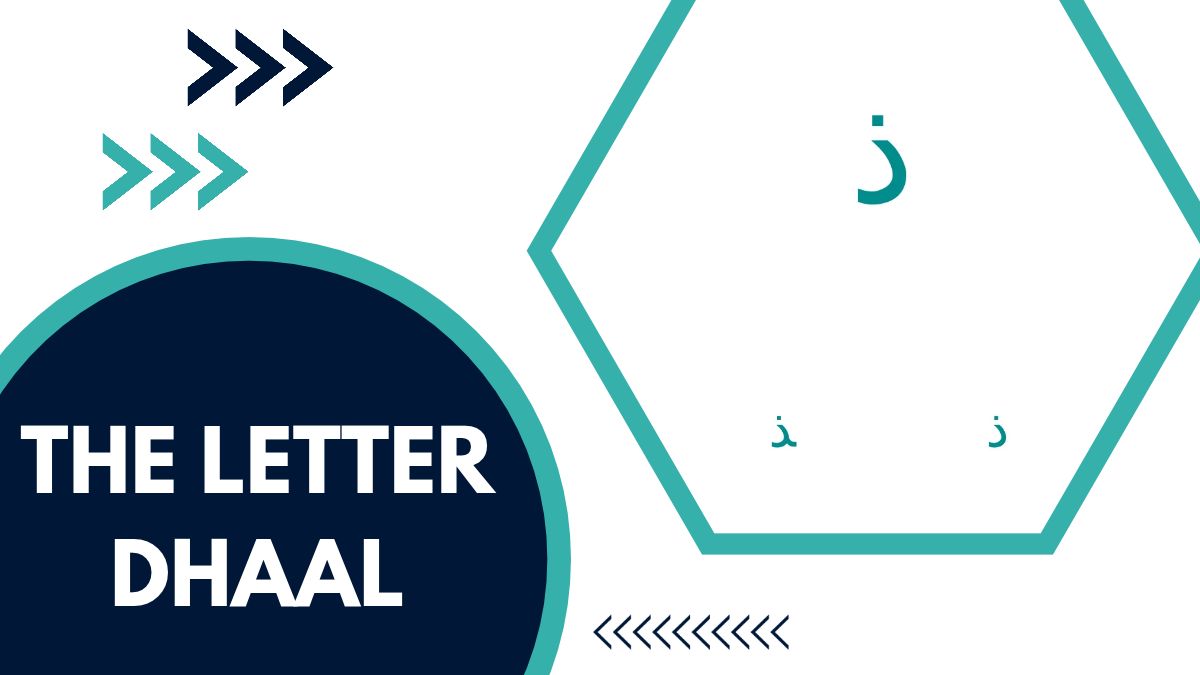
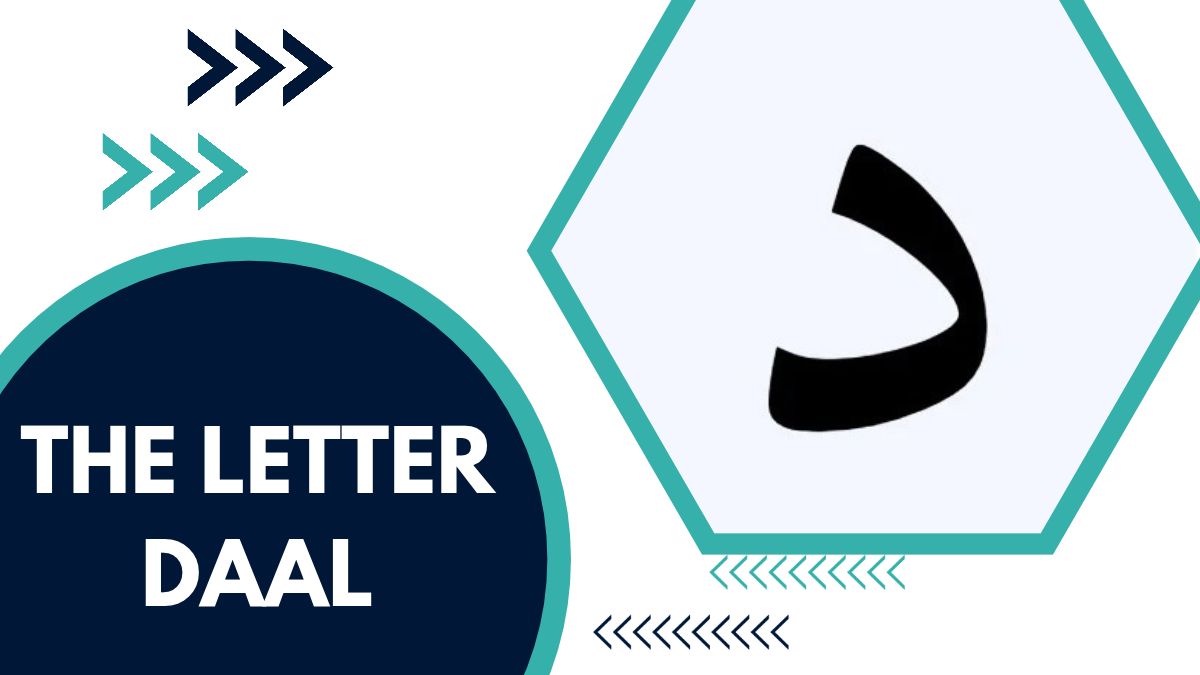
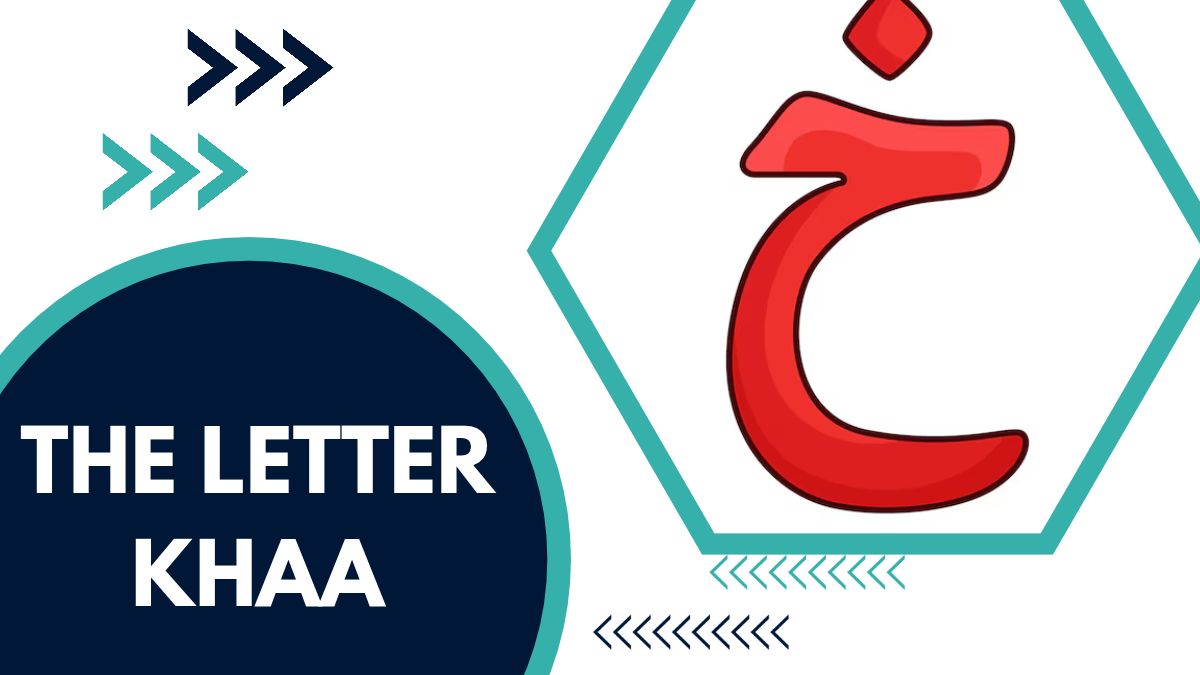
In the modern hijāʾī order, Raa comes right after Dhaal: ا ب ت ث ج ح خ د ذ ر. That makes it the 10th letter, and it opens the second third of the alphabet.
In the older Abjad order (أَبْجَدْ هَوَّزْ حُطِّي كَلَمَنْ سَعْفَصْ قَرَشَتْ ثَخَذْ ضَظَغْ), Raa is the 20th letter, inside the word قَرَشَتْ, and carries the value 200.
This order still matters today: it numbers points in formal documents, and it was used to encode dates on manuscripts, gravestones and building inscriptions.
The Twin of Raa: Same Shape, One Dot Apart
Raa has exactly one sister letter with the same body shape:
- ر (Raa): no dots
- ز (Zaay): one dot above
Learn them as a pair: once your hand knows the curve, the dot is the only thing left to decide.
Raa and the Definite Article: A Sun Letter at Work
When the definite article الْـ (al-) comes before a Sun letter, the lām is not pronounced. Instead, it merges into the next letter, which is then doubled. Raa is one of the 14 Sun letters, so al- + r becomes ar-r.
- الرَّجُلُ (ar-rajul): the man
- الرَّحْمٰنُ (ar-Raḥmān): the Most Merciful
- الرِّزْقُ (ar-rizq): sustenance, provision
In writing, the lām stays on the page but carries no vowel sign, and ر receives a shadda (ـّ). Compare a Moon letter, where the lām keeps its sukūn and is pronounced: الْقَمَرُ (al-qamar, the moon).
Just starting with the Arabic alphabet? The Arabic Alphabet Course at Denk Arabisch takes you through every letter, its forms and its Sun or Moon behavior, explained through German.
Where Raa Comes From: Its Makhraj in Tajweed
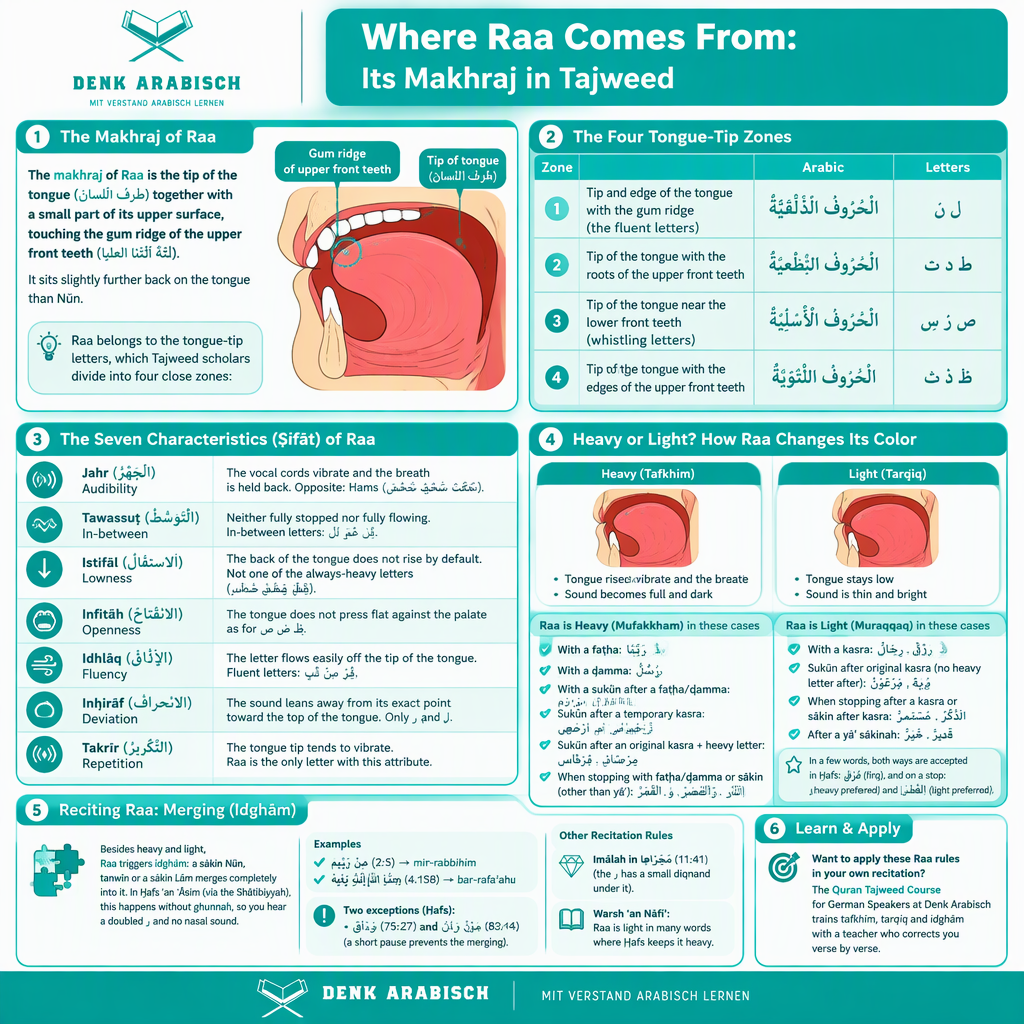
The makhraj of Raa is the tip of the tongue (طَرَفُ اللِّسَانِ) together with a small part of its upper surface, touching the gum ridge of the upper front teeth (لِثَةُ الثَّنَايَا الْعُلْيَا). It sits slightly further back on the tongue than Nūn.
Raa belongs to the tongue-tip letters, which Tajweed scholars divide into four close zones:
| Zone | Arabic | Letters |
| Tip and edge of the tongue with the gum ridge (the fluent letters) | الْحُرُوفُ الذَّلْقِيَّةُ | ل ن ر |
| Tip of the tongue with the roots of the upper front teeth | الْحُرُوفُ النِّطْعِيَّةُ | ط د ت |
| Tip of the tongue near the lower front teeth (whistling letters) | الْحُرُوفُ الْأَسَلِيَّةُ | ص ز س |
| Tip of the tongue with the edges of the upper front teeth | الْحُرُوفُ اللِّثَوِيَّةُ | ظ ذ ث |
No letter shares the exact makhraj of Raa, but Lām and Nūn are its closest neighbors, which is why ر and ل can blur in fast speech (see mistake 4 below).
The Seven Characteristics (Ṣifāt) That Define Raa
Raa has five attributes with an opposite and two without one:
- Jahr (الْجَهْرُ), audibility: the vocal cords vibrate and the breath is held back. Its opposite, hams, belongs to the letters of فَحَثَّهُ شَخْصٌ سَكَتَ.
- Tawassuṭ (التَّوَسُّطُ), in-between: the sound is neither fully stopped nor fully flowing. The in-between letters are gathered in لِنْ عُمَرْ.
- Istifāl (الِاسْتِفَالُ), lowness: the back of the tongue does not rise by default. Raa is not one of the always-heavy letters of خُصَّ ضَغْطٍ قِظْ; its heaviness comes from its vowels.
- Infitāḥ (الِانْفِتَاحُ), openness: the tongue does not press flat against the palate as it does for ص ض ط ظ.
- Idhlāq (الْإِذْلَاقُ), fluency: the letter flows easily off the tip of the tongue. The fluent letters are gathered in فَرَّ مِنْ لُبٍّ.
- Inḥirāf (الِانْحِرَافُ), deviation: the sound leans away from its exact point toward the top of the tongue. Only ر and ل have this attribute.
- Takrīr (التَّكْرِيرُ), repetition: the tongue tip tends to vibrate. Raa is the only letter with this attribute, and in Tajweed you learn it in order to control it, not to exaggerate it.
Heavy or Light? How Raa Changes Its Color
Raa is one of the few letters that switch between a heavy sound (tafkhīm, تَفْخِيمٌ) and a light sound (tarqīq, تَرْقِيقٌ).
For heavy Raa, the back of the tongue rises toward the soft palate and the sound becomes full and dark. For light Raa, the tongue stays low and the sound is thin and bright.
Here is a quick overview before the detailed rules:
| Raa is heavy (tafkhīm) | Raa is light (tarqīq) |
| With fatḥa or ḍamma | With kasra |
| Sākin after fatḥa or ḍamma | Sākin after an original kasra, with no heavy letter after it |
| Sākin after a temporary kasra | Stopping on it after a kasra |
| Sākin after an original kasra, when a heavy letter follows | Stopping on it after yāʾ sākinah |
| Stopping on it after fatḥa or ḍamma |
Raa is heavy (mufakhkham) in these cases:
- With a fatḥa: رَبَّنَا (rabbanā).
- With a ḍamma: رُسُلٌ (rusul).
- With a sukūn after a fatḥa or ḍamma: مَرْيَمُ (Maryam), الْقُرْآنُ (al-Qurʾān).
- With a sukūn after a temporary kasra, such as the kasra of hamzat al-waṣl: ارْجِعِي (irjiʿī, Surah Al-Fajr 89:28) and أَمِ ارْتَابُوا (ami rtābū, Surah An-Nur 24:50).
- With a sukūn after an original kasra, when a heavy letter (خ ص ض غ ط ق ظ) follows in the same word: قِرْطَاسٍ (qirṭās, Surah Al-An’am 6:7), مِرْصَادًا (mirṣādā, Surah An-Naba 78:21).
- When you stop on it and the letter before it has a fatḥa or ḍamma, or is a sākin letter (other than yāʾ) after a fatḥa or ḍamma: الْقَمَرُ (al-qamar), وَالْعَصْرِ (wal-ʿaṣr, Surah Al-Asr 103:1), النَّارُ (an-nār).
Raa is light (muraqqaq) in these cases:
- With a kasra: رِجَالٌ (rijāl), رِزْقٌ (rizq).
- With a sukūn after an original kasra in the same word, with no heavy letter after it: فِرْعَوْنُ (Firʿawn, Surah An-Naziat 79:17), مِرْيَةٍ (miryah, Surah Hud 11:17).
- When you stop on it after a kasra, or after a sākin letter that follows a kasra: مُسْتَمِرٌّ (mustamirr, Surah Al-Qamar 54:2), الذِّكْرُ (adh-dhikr).
- When you stop on it after a yāʾ sākinah: خَيْرٌ (khayr), قَدِيرٌ (qadīr, Surah Al-Baqarah 2:20).
In a few words, both ways are accepted in Ḥafṣ: فِرْقٍ (firq, Surah Ash-Shu’ara 26:63), and on a stop, مِصْرَ (Miṣr, heavy preferred) and الْقِطْرِ (al-qiṭr, light preferred). Your teacher will tell you which one to use in your recitation.
Reciting Raa in the Quran: Heaviness, Lightness and Merging
Besides heavy and light, Raa triggers one more rule: a sākin Nūn, a tanwīn or a sākin Lām merges completely into it. In Ḥafṣ ʿan ʿĀṣim (via the Shāṭibiyyah), this idghām happens without ghunnah, so you hear a doubled ر and no nasal sound.
- مِنْ رَبِّهِمْ (Surah Al-Baqarah 2:5): the Nūn disappears and you read mir-rabbihim.
- بَلْ رَفَعَهُ اللَّهُ إِلَيْهِ (Surah An-Nisa 4:158): the Lām disappears and you read bar-rafaʿahu.
Two exceptions belong to Ḥafṣ: a short pause (saktah) in مَنْ رَاقٍ (Surah Al-Qiyamah 75:27) and بَلْ رَانَ (Surah Al-Mutaffifin 83:14) prevents the merging.
Ḥafṣ also reads the Raa of مَجْرَاهَا (Surah Hud 11:41) with imālah, leaning the ā toward an ē sound; it is marked with a small diamond under the ر in the Madinah Muṣḥaf.
Other readings differ: Warsh ʿan Nāfiʿ, for example, makes Raa light in many words where Ḥafṣ keeps it heavy.
Discover “Idgham Without Ghunnah” and learn how to apply this Tajweed rule for clearer, more accurate Quranic recitation.
Want to apply these Raa rules in your own recitation? The Quran Tajweed Course for German Speakers at Denk Arabisch trains tafkhīm, tarqīq and idghām with a teacher who corrects you verse by verse.
Saying Raa the Right Way
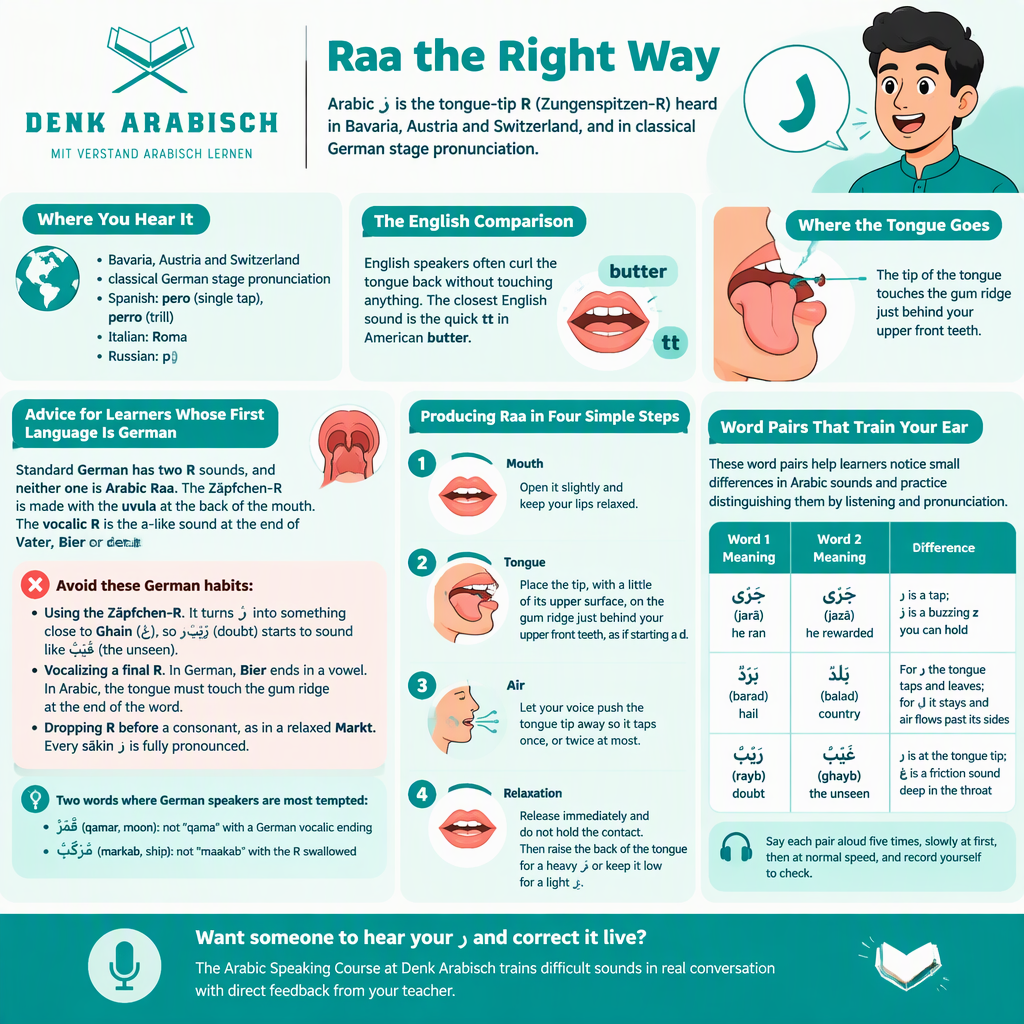
Arabic ر is the tongue-tip R (Zungenspitzen-R) heard in Bavaria, Austria and Switzerland, and in classical German stage pronunciation. Outside German, you hear it in Spanish pero (a single tap) and perro (a trill), in Italian Roma, and in Russian р.
English speakers often curl the tongue back without touching anything. The closest English sound is actually the quick tt in American butter.
Advice for Learners Whose First Language Is German
Standard German has two R sounds, and neither one is Arabic Raa. The Zäpfchen-R is made with the uvula at the back of the mouth. The vocalic R is the a-like sound at the end of Vater, Bier or der.
Avoid these German habits:
- Using the Zäpfchen-R. It turns ر into something close to Ghain (غ), so رَيْبٌ (doubt) starts to sound like غَيْبٌ (the unseen).
- Vocalizing a final R. In German, Bier ends in a vowel. In Arabic, the tongue must touch the gum ridge at the end of the word.
- Dropping R before a consonant, as in a relaxed Markt. Every sākin ر is fully pronounced.
Two words where German speakers are most tempted:
- قَمَرٌ (qamar, moon): not “qama” with a German vocalic ending
- مَرْكَبٌ (markab, ship): not “maakab” with the R swallowed
Producing Raa in Four Simple Steps
- Mouth: open it slightly and keep your lips relaxed.
- Tongue: place the tip, with a little of its upper surface, on the gum ridge just behind your upper front teeth, as if starting a d.
- Air: let your voice push the tongue tip away so it taps once, or twice at most.
- Relaxation: release immediately and do not hold the contact. Then raise the back of the tongue for a heavy رَ or keep it low for a light رِ.
Word Pairs That Train Your Ear
These word pairs help learners notice small differences in Arabic sounds and practice distinguishing them by listening and pronunciation.
| Word 1 | Meaning | Word 2 | Meaning | Difference |
| جَرَى (jarā) | he ran | جَزَى (jazā) | he rewarded | ر is a tap; ز is a buzzing z you can hold |
| بَرَدٌ (barad) | hail | بَلَدٌ (balad) | country | For ر the tongue taps and leaves; for ل it stays and air flows past its sides |
| رَيْبٌ (rayb) | doubt | غَيْبٌ (ghayb) | the unseen | ر is at the tongue tip; غ is a friction sound deep in the throat |
Say each pair aloud five times, slowly at first, then at normal speed, and record yourself to check.
Want someone to hear your ر and correct it live? The Arabic Speaking Course at Denk Arabisch trains difficult sounds in real conversation with direct feedback from your teacher.
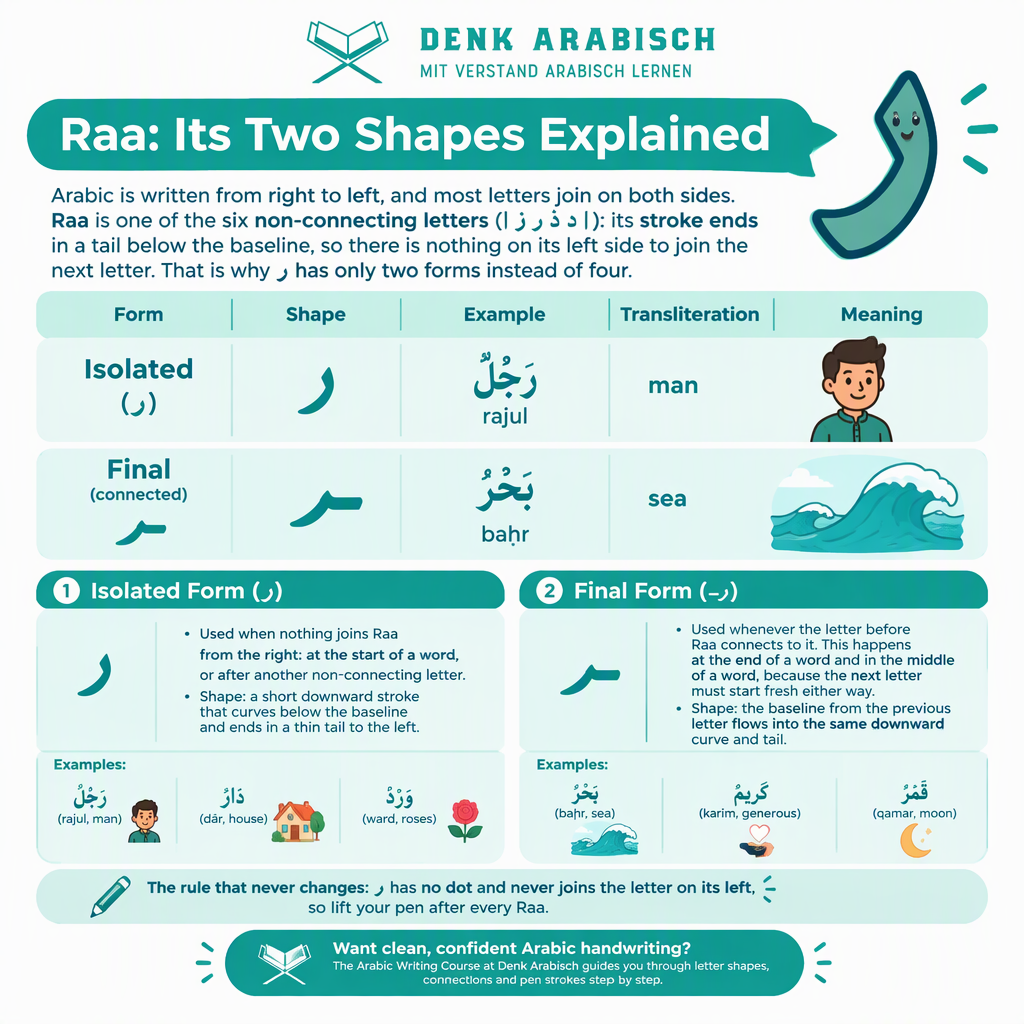
Writing Raa: Its Two Shapes Explained
Arabic is written from right to left, and most letters join on both sides. Raa is one of the six non-connecting letters (ا د ذ ر ز و): its stroke ends in a tail below the baseline, so there is nothing on its left side to join the next letter. That is why ر has only two forms instead of four.
| Form | Shape | Example | Transliteration | Meaning |
| Isolated | ر | رَجُلٌ | rajul | man |
| Final (connected) | ـر | بَحْرٌ | baḥr | sea |
1. Isolated Form (ر)
You use this form when nothing joins Raa from the right: at the start of a word, or after another non-connecting letter. This is also what the beginning of a word looks like, since Raa has no separate initial shape.
Shape: a short downward stroke that curves below the baseline and ends in a thin tail to the left.
Examples: رَجُلٌ (rajul, man), دَارٌ (dār, house, after Alif), وَرْدٌ (ward, roses, after Wāw).
2. Final Form (ـر)
You use this form whenever the letter before Raa connects to it. This happens at the end of a word and in the middle of a word, because the next letter must start fresh either way.
Shape: the baseline from the previous letter flows into the same downward curve and tail.
Examples: بَحْرٌ (baḥr, sea), كَرِيمٌ (karīm, generous: ر joins كَ, then ي starts again), قَمَرٌ (qamar, moon).
The rule that never changes: ر has no dot and never joins the letter on its left, so lift your pen after every Raa.
Want clean, confident Arabic handwriting? The Arabic Writing Course at Denk Arabisch guides you through letter shapes, connections and pen strokes step by step.
How Vowels Shape the Sound of Raa
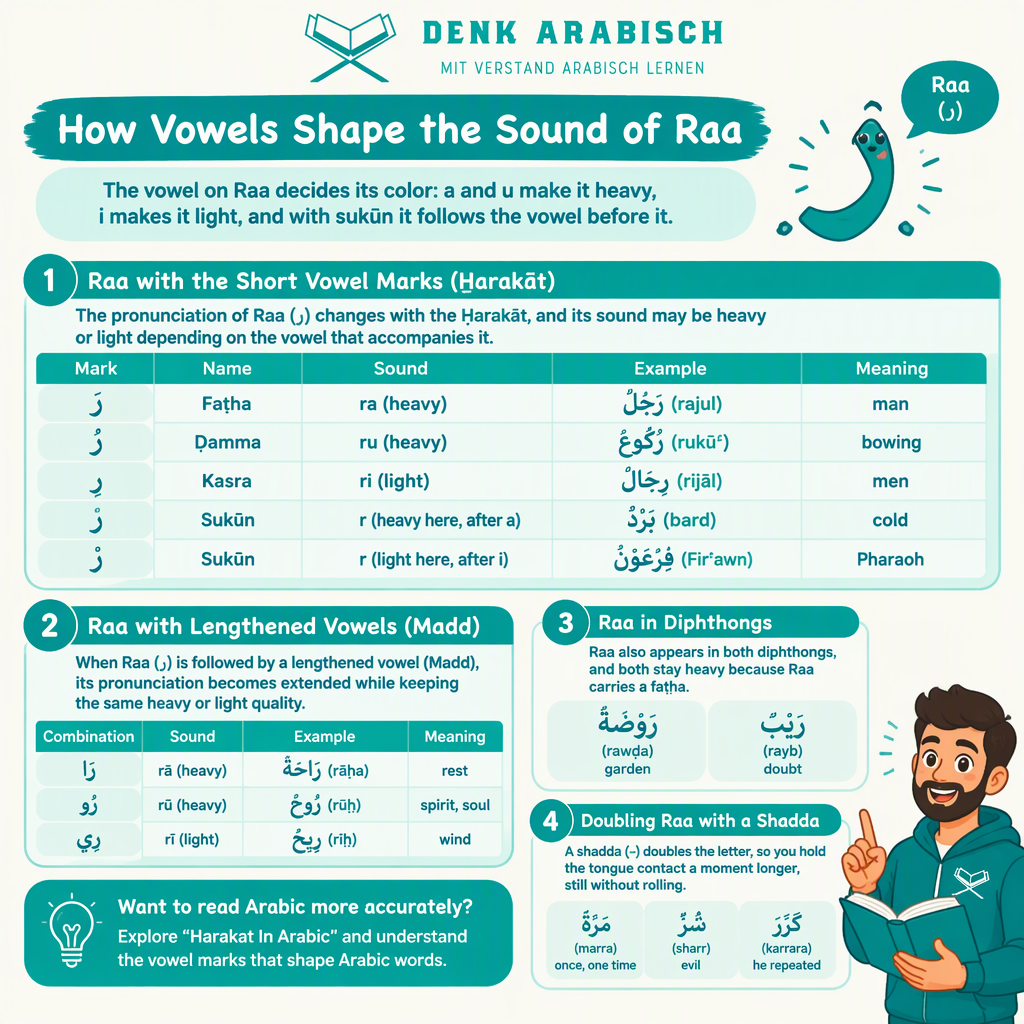
The vowel on Raa decides its color: a and u make it heavy, i makes it light, and with sukūn it follows the vowel before it.
Raa with the Short Vowel Marks (Ḥarakāt)
The pronunciation of Raa (ر) changes with the Ḥarakāt, and its sound may be heavy or light depending on the vowel that accompanies it.
| Mark | Name | Sound | Example | Meaning |
| رَ | Fatḥa | ra (heavy) | رَجُلٌ (rajul) | man |
| رُ | Ḍamma | ru (heavy) | رُكُوعٌ (rukūʿ) | bowing |
| رِ | Kasra | ri (light) | رِجَالٌ (rijāl) | men |
| رْ | Sukūn | r (heavy here, after a) | بَرْدٌ (bard) | cold |
| رْ | Sukūn | r (light here, after i) | فِرْعَوْنُ (Firʿawn) | Pharaoh |
Raa with Lengthened Vowels (Madd)
When Raa (ر) is followed by a lengthened vowel (Madd), its pronunciation becomes extended while keeping the same heavy or light quality.
| Combination | Sound | Example | Meaning |
| رَا | rā (heavy) | رَاحَةٌ (rāḥa) | rest |
| رُو | rū (heavy) | رُوحٌ (rūḥ) | spirit, soul |
| رِي | rī (light) | رِيحٌ (rīḥ) | wind |
Raa also appears in both diphthongs, and both stay heavy because Raa carries a fatḥa: رَوْضَةٌ (rawḍa, garden) and رَيْبٌ (rayb, doubt).
Learn Arabic with Denk Arabisch Academy
Speak and understand Arabic through a clear and effective learning system
Try a Free TrialDoubling Raa with a Shadda
A shadda (ـّ) doubles the letter, so you hold the tongue contact a moment longer, still without rolling.
- مَرَّةٌ (marra): once, one time
- شَرٌّ (sharr): evil
- كَرَّرَ (karrara): he repeated
Want to read Arabic more accurately? Explore “Harakat In Arabic” and understand the vowel marks that shape Arabic words.
Key Root Families Built on Raa
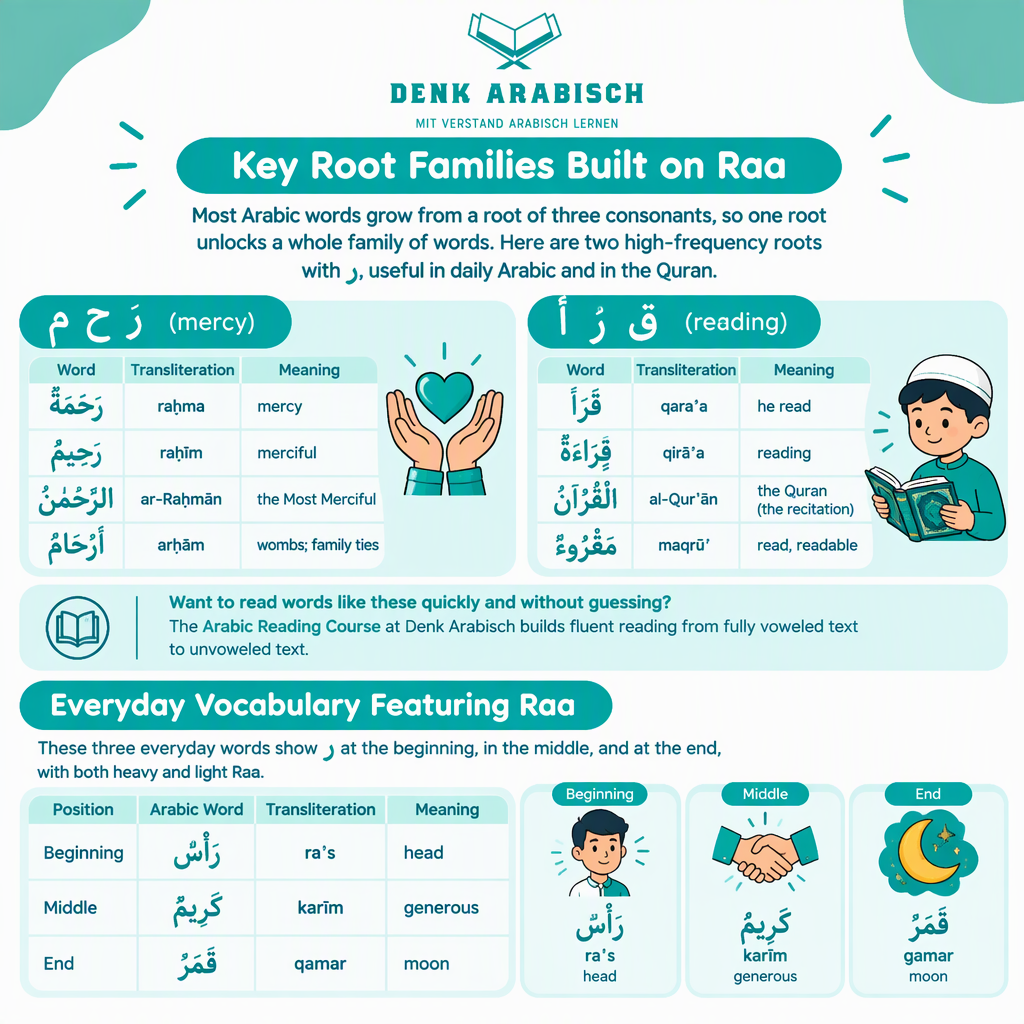
Most Arabic words grow from a root of three consonants, so one root unlocks a whole family of words. Here are two high-frequency roots with ر, useful in daily Arabic and in the Quran.
ر ح م (mercy)
Here are the primary words derived from the root ر ح م and their meanings:
| Word | Transliteration | Meaning |
| رَحْمَةٌ | raḥma | mercy |
| رَحِيمٌ | raḥīm | merciful |
| الرَّحْمٰنُ | ar-Raḥmān | the Most Merciful |
| أَرْحَامٌ | arḥām | wombs; family ties |
You already met الرَّحْمٰنُ as a Sun letter example: the lām of al- disappears into ر.
ق ر أ (reading)
Below are the key words and forms derived from the root ق ر أ and their meanings:
| Word | Transliteration | Meaning |
| قَرَأَ | qaraʾa | he read |
| قِرَاءَةٌ | qirāʾa | reading |
| الْقُرْآنُ | al-Qurʾān | the Quran (the recitation) |
| مَقْرُوءٌ | maqrūʾ | read, readable |
Want to read words like these quickly and without guessing? The Arabic Reading Course at Denk Arabisch builds fluent reading from fully voweled text to unvoweled text.
Everyday Vocabulary Featuring Raa
These three everyday words show ر at the beginning, in the middle, and at the end, with both heavy and light Raa.
| Position | Arabic Word | Transliteration | Meaning |
| Beginning | رَأْسٌ | raʾs | head |
| Middle | كَرِيمٌ | karīm | generous |
| End | قَمَرٌ | qamar | moon |
Read them aloud and decide for each ر whether it is heavy or light: only the Raa of كَرِيمٌ is light.
Raa in Complete Sentences
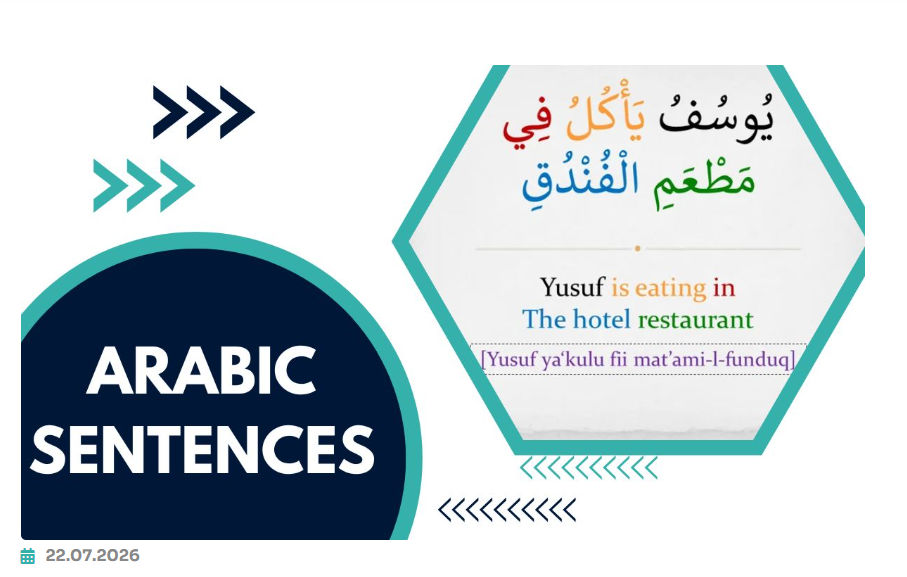
These three sentences reuse words from the table above, so you can focus on the sound of ر.
| Arabic Sentence | Transliteration | Meaning |
| هٰذَا قَمَرٌ جَمِيلٌ. | hādhā qamarun jamīl | This is a beautiful moon. |
| قَرَأْتُ رِسَالَةً مِنْ صَدِيقٍ كَرِيمٍ. | qaraʾtu risālatan min ṣadīqin karīm | I read a letter from a generous friend. |
| رَأَيْتُ مَرْكَبًا فِي الْبَحْرِ. | raʾaytu markaban fī l-baḥr | I saw a ship in the sea. |
Read each sentence three times: slowly, at normal speed, and once more with full attention on every ر.
Read our Article: Arabic Sentences
Typical Raa Errors and How to Fix Them
Here are four common pronunciation and writing mistakes learners make with Raa (ر), along with simple tests to help you correct them.
1. Confusing Raa (ر) with Ghain (غ)
This is the classic German mistake. The standard German Zäpfchen-R is made at the back of the mouth, exactly where Arabic غ lives, so رَيْبٌ (doubt) turns into غَيْبٌ (the unseen).
Test: say a long “rrr” and notice where it vibrates. If you feel it at the back of your throat, it is غ; the vibration of ر must be at the tip of your tongue, behind your upper teeth.
2. Dropping Raa at the End of a Word
German turns a final R into a vowel, as in Bier or Vater. Learners then say “qama” for قَمَرٌ or “baḥa” for بَحْرٌ.
Test: say قَمَرٌ and freeze at the end. Your tongue tip should be touching the gum ridge; if your mouth is open and the tongue is resting low, the ر is missing.
3. Confusing Raa (ر) with Zaay (ز)
The two letters share one body shape, so a missing or extra dot changes the word. In speech, learners sometimes let ر buzz like a z.
Test: try to hold each sound. You can hold “zzzz” as long as your breath lasts, but ر is a tap and cannot be held. In writing, check the dot: ر has none, ز has one above.
4. Letting Raa (ر) Slide into Lām (ل)
Both letters are made at the tip of the tongue. In fast speech, the tongue can stay flat on the gum ridge, and بَرَدٌ (hail) becomes بَلَدٌ (country).
Test: say “lll” and then ر. For ل the tongue stays in contact and air escapes at its sides; for ر the tongue touches and leaves at once.
Practice Time: Check What You’ve Learned About Raa
Put your knowledge of the letter Raa (ر) to the test with these quick exercises covering pronunciation, vocabulary, writing, and core rules.
Exercise 1: Pick the Right Answer
Which sound matches ر best?
- A) The standard German R in rot
- B) The tongue-tip R in Bavarian rot or Spanish pero
- C) The English sh
Answer: B. The standard German R is made at the back of the mouth and sounds closer to غ.
Exercise 2: Connect Each Word to Its Meaning
Match each word to its meaning: قَمَرٌ, رِسَالَةٌ, بَحْرٌ, مَرْكَبٌ → sea, ship, moon, letter.
Answers: قَمَرٌ = moon, رِسَالَةٌ = letter, بَحْرٌ = sea, مَرْكَبٌ = ship.
Exercise 3: Handwriting Drill
Write each of these three times: ر on its own, رَأْسٌ, مَرْكَبٌ, بَحْرٌ, دَارٌ, كَرِيمٌ. Check two things every time: there is no dot on ر, and your pen lifts after it.
Exercise 4: Correct or Incorrect?
- ر has one dot above it.
- ر is heavy with a fatḥa and light with a kasra.
- ر connects to the letter on its left.
- In الرَّحْمٰنُ, the lām of al- is not pronounced.
Answers: 1. False (that is ز). 2. True. 3. False (ر is non-connecting). 4. True (ر is a Sun letter).
What Our Students Say About Denk Arabisch Academy
See what our students say about learning at Denk Arabisch Academy on Trustpilot. Read their experiences and check out more reviews to discover how our courses help improve Arabic.

Build Your Arabic Gradually with Denk Arabisch
Raa is one of 28 letters, and each one has its own sound, forms and rules. Learning them in a clear order saves you months of guessing and relearning.
Denk Arabisch is built for German-speaking learners and explains Arabic through German, from the first letter to fluent reading and recitation.
- Lessons that compare every Arabic sound with German sounds you already know
- Live teachers who hear your pronunciation and correct it directly
- A structured path for adults and for children, with clear goals for each level
- Practice that combines reading, writing, speaking and Quranic recitation
Choose Your Specialized Course:
- Arabic Course For Beginners: a complete path from your first letter to independent sentences.
- Quranic Arabic Course for German Speakers: the vocabulary and grammar you need to understand the Quran in Arabic.
- Quran Tajweed Course for German Speakers: correct recitation, including the rules of heavy and light Raa.
- Arabic Alphabet Course: all 28 letters, their forms, connections and sounds.
- Arabic Reading Course: from slow decoding to smooth reading, with and without vowels.
- Arabic Writing Course: clean handwriting, letter shapes and connections.
- Arabic Speaking Course: everyday conversation with real-time feedback on your pronunciation.
Learn Arabic with Denk Arabisch Academy
Speak and understand Arabic through a clear and effective learning system
Try a Free TrialBook a free trial lesson at Denk Arabisch and find the right course for your level.

Conclusion
The letter Raa (ر) is a small letter with a lot of personality: one tap of the tongue, two written forms and a sound that changes color with its vowels.
- Sound: a tongue-tip tap at the gum ridge, never the German Zäpfchen-R and never swallowed at the end of a word.
- Writing: two forms, no dots, and no connection to the letter on its left.
- Recognition: the same body as ز, with the missing dot as your signal.
Practice a little every day. Say the tap slowly, write the two forms, drill the pairs ر/غ, ر/ز and ر/ل, and read the words of the roots ر ح م and ق ر أ aloud. Within a few weeks, a clean Arabic Raa will feel as natural as any German sound.
Ready to go further? Book a free trial lesson at Denk Arabisch.
FAQs
1. What is the difference between Raa (ر) and Zaay (ز)?
They share the same body shape and both are non-connecting letters. Zaay has one dot above and is a buzzing z sound you can hold, while Raa has no dots and is a short tap of the tongue tip.
2. Is the German R the same as Arabic Raa?
Not the standard one. The usual German Zäpfchen-R is made at the back of the mouth and sounds closer to Ghain (غ). The tongue-tip R of Bavarian, Austrian and Swiss German is the right sound for ر.
3. Is Raa a Sun letter or a Moon letter?
Raa is a Sun letter. After al-, the lām is silent and ر is doubled with a shadda, so الرَّجُلُ is read ar-rajul, not al-rajul.
4. Is Raa heavy or light?
Raa is variable. It is heavy with a fatḥa or ḍamma, or with a sukūn after them, and light with a kasra, or with a sukūn after an original kasra. When you stop on it, the letter before it decides, for example خَيْرٌ is light and النَّارُ is heavy.
5. Which Tajweed rule applies when Nūn or Lām comes before Raa?
A sākin Nūn, a tanwīn or a sākin Lām merges fully into Raa (idghām). In Ḥafṣ ʿan ʿĀṣim this happens without ghunnah, so مِنْ رَبِّهِمْ is read mir-rabbihim, except for the saktah in مَنْ رَاقٍ and بَلْ رَانَ.