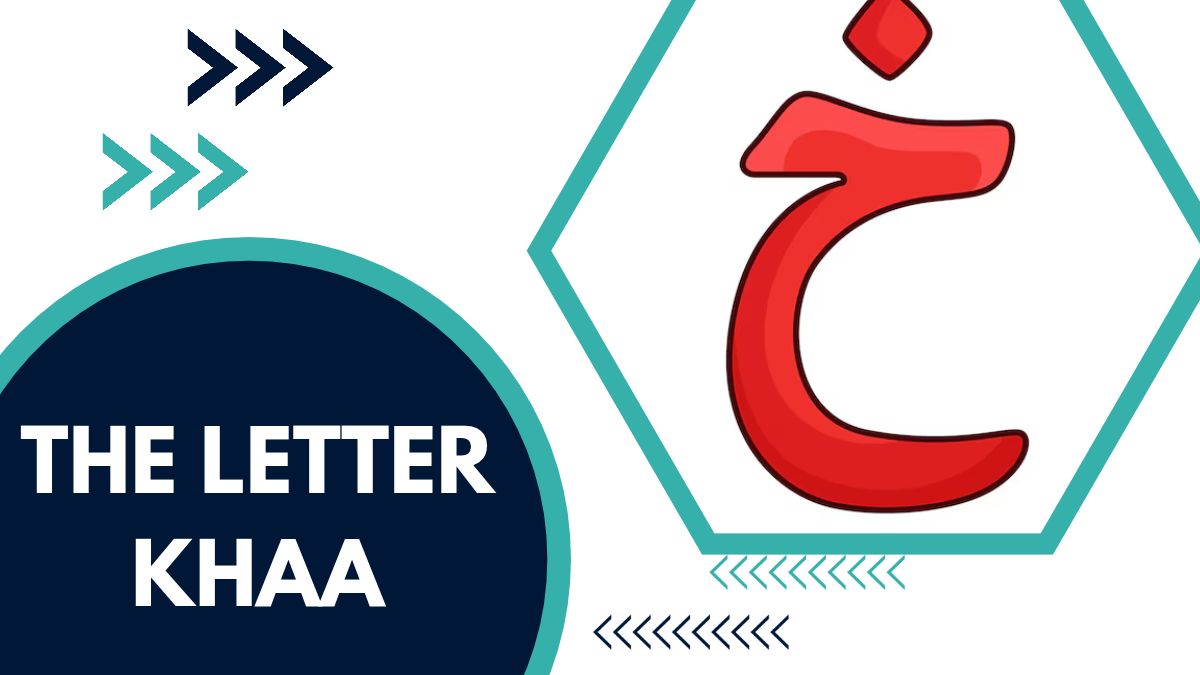
Khaa (خ) is the 7th letter of the Arabic alphabet. It stands for a raspy “kh” sound made where the back of the tongue meets the soft palate. Linguists call it a voiceless velar fricative, written [x] in the International Phonetic Alphabet.
Many learners find this sound hard at first. German speakers have a head start, though. They already say it every day in words like Bach, Buch and machen.
This guide covers everything you need to know about Khaa:
- How to pronounce it correctly
- How to write its four forms
- How it behaves with short and long vowels
- What Tajweed says about it
- The most common Arabic words and roots that contain it
Short exercises at the end let you check what you have learned.
| Feature | Details |
| Name | Khaa (خَاء) |
| Sound | Voiceless velar fricative [x], like German ach or Scottish loch |
| Position in the alphabet | 7th letter (alphabetical/hijāʾī order) |
| Abjad value | 600 |
| Transliteration | kh, ḫ (DIN 31635), ẖ; in Arabizi: 5 |
| Point of articulation | Nearest part of the throat (Adnā al-Ḥalq) |
| Sun or Moon letter | Moon letter: the “l” in al- is pronounced |
| Heavy or light | Heavy letter (mufakhkham) |
| Dots | One dot above |
| Connection | Joins letters on both sides |
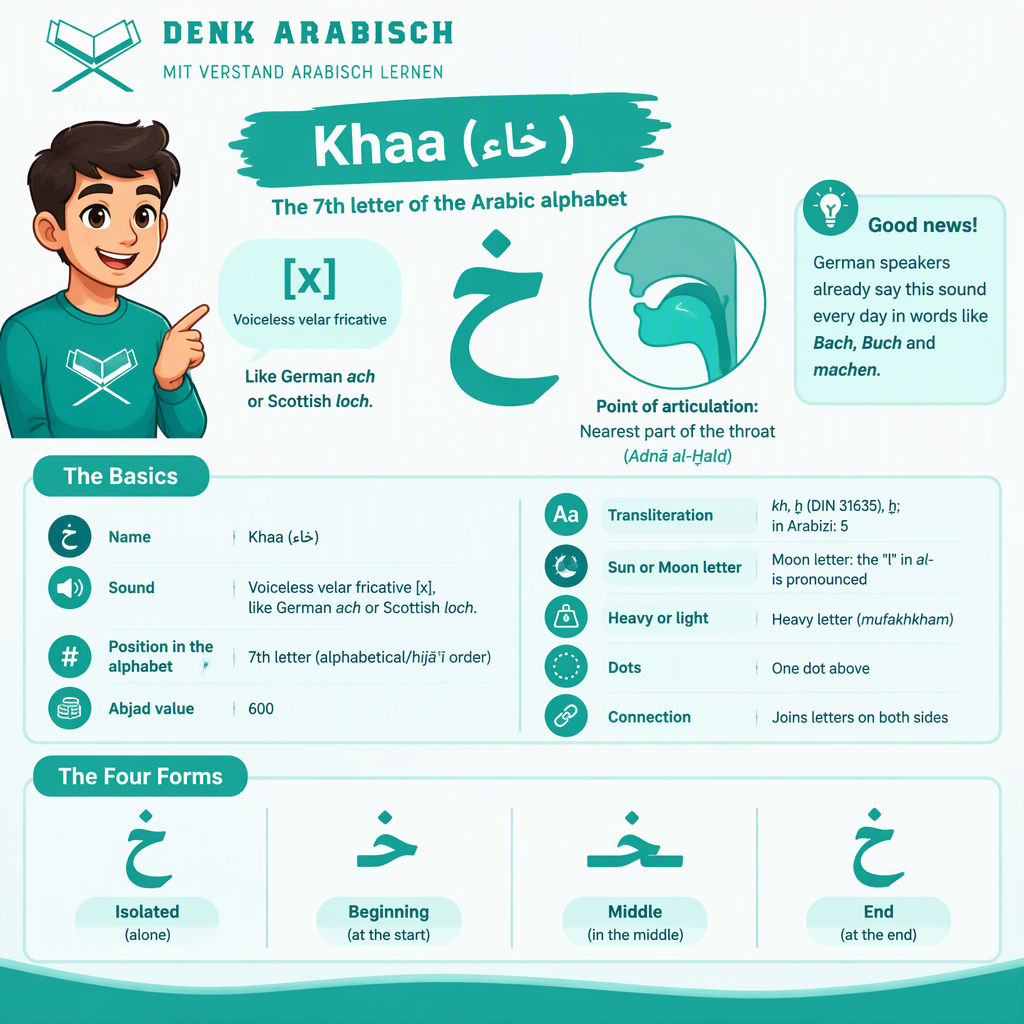
Table of Contents
Where Khaa Fits in the Arabic Alphabet
In the standard alphabetical order (ا ب ت ث ج ح خ), Khaa is the 7th letter. In the older abjad order (أبجد هوز حطي … ثخذ ضظغ), it comes 24th and has a numerical value of 600. The abjad order was used to write numbers with letters, and it still appears in dates on old manuscripts and inscriptions.
Khaa and Its Sister Letters
Khaa shares its body shape with two sister letters. Only the dot tells them apart:
- Jeem (ج): one dot below
- Ḥaa (ح): no dot
- Khaa (خ): one dot above
Learning these three together saves time. Once you can write one, you can write all three.
Khaa Is a Moon Letter
The Arabic letters are split into Sun letters and Moon letters. Khaa is a Moon letter (حَرْف قَمَرِي). That means it does not absorb the “l” of the definite article al- (الـ), so you pronounce the “l” clearly:
- الْخُبْز: al-khubz (the bread), not akh-khubz
- الْخَيْر: al-khayr (the good)
- الْخَرِيف: al-kharīf (the autumn)
In writing, the lām of the article carries a sukūn (لْ), and Khaa has no shadda.
New to Arabic? The Arabic Course For Beginners at Denk Arabisch gives you a clear, step-by-step foundation, from the alphabet to your first sentences.
Point of Articulation (Makhraj) and Tajweed
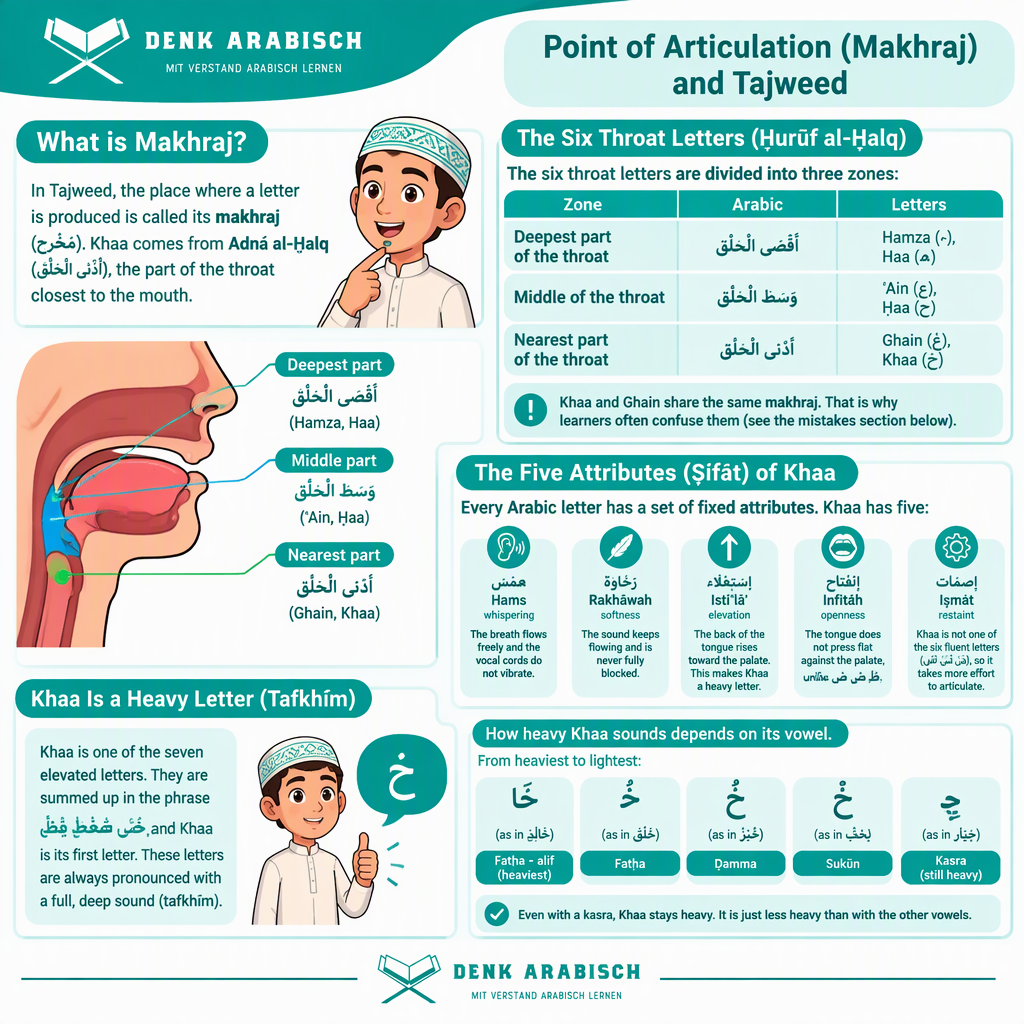
In Tajweed, the place where a letter is produced is called its makhraj (مَخْرَج). Khaa comes from Adnā al-Ḥalq (أَدْنَى الْحَلْق), the part of the throat closest to the mouth.
The six throat letters (Ḥurūf al-Ḥalq) are divided into three zones:
| Zone | Arabic | Letters |
| Deepest part of the throat | أَقْصَى الْحَلْق | Hamza (ء), Haa (ه) |
| Middle of the throat | وَسَط الْحَلْق | ʿAin (ع), Ḥaa (ح) |
| Nearest part of the throat | أَدْنَى الْحَلْق | Ghain (غ), Khaa (خ) |
Khaa and Ghain share the same makhraj. That is why learners often confuse them (see the mistakes section below).
The Five Attributes (Ṣifāt) of Khaa
Every Arabic letter has a set of fixed attributes. Khaa has five:
- Hams (هَمْس), whispering: the breath flows freely and the vocal cords do not vibrate.
- Rakhāwah (رَخَاوَة), softness: the sound keeps flowing and is never fully blocked.
- Istiʿlāʾ (اِسْتِعْلَاء), elevation: the back of the tongue rises toward the palate. This makes Khaa a heavy letter.
- Infitāḥ (اِنْفِتَاح), openness: the tongue does not press flat against the palate, unlike the emphatic letters ص ض ط ظ.
- Iṣmāt (إِصْمَات), restraint: Khaa is not one of the six fluent letters (فَرَّ مِنْ لُبّ), so it takes more effort to articulate.
Khaa Is a Heavy Letter (Tafkhīm)
Khaa is one of the seven elevated letters. They are summed up in the phrase خُصَّ ضَغْطٍ قِظْ, and Khaa is its first letter. These letters are always pronounced with a full, deep sound (tafkhīm).
How heavy Khaa sounds depends on its vowel. From heaviest to lightest:
- Fatḥa followed by alif: خَا (as in خَالِد)
- Fatḥa: خَ (as in خَلَقَ)
- Ḍamma: خُ (as in خُبْز)
- Sukūn: خْ (as in بَخْت)
- Kasra: خِ (as in خِيَار)
Even with a kasra, Khaa stays heavy. It is just less heavy than with the other vowels.
Khaa in Quranic Recitation: Iẓhār Ḥalqī
Khaa affects the letters that come before it. When a nūn sākinah (نْ) or tanwīn comes before one of the six throat letters, the nūn is pronounced clearly, with no nasal hiding. This rule is called Iẓhār Ḥalqī (إِظْهَار حَلْقِي), clear pronunciation before the throat letters.
Examples from the Quran:
- مِنْ خَوْفٍ (Surah Quraysh 106:4): the nūn in min is pronounced clearly before Khaa.
- يَوْمَئِذٍ خَاشِعَةٌ (Surah Al-Ghāshiyah 88:2): the tanwīn in yawma’idhin is pronounced clearly before Khaa.
Some recitation traditions allow a slight hiding (ikhfāʾ) of the nūn before خ and غ. In the most common recitation, Ḥafṣ ʿan ʿĀṣim, the rule is clear pronunciation.
Learning Khaa for Quran recitation? The Quran Tajweed Course at Denk Arabisch teaches you the makharij, sifat and rules like Iẓhār step by step, with a teacher correcting your recitation.
How to Pronounce Khaa
Khaa sounds like the “ch” in German Bach, Buch or lachen, or in Scottish loch. In Castilian Spanish, the “j” in jamón is the same sound. English has no native word with this sound, so English speakers usually need the most practice.
Tip for German Speakers
You already have this sound. It is the ach-Laut. In German, though, “ch” changes depending on the vowel before it:
- After a, o, u it is the ach-Laut [x]: Bach, doch, Buch
- After e, i and consonants it becomes the softer ich-Laut [ç]: ich, echt, Milch
Arabic Khaa is always the ach-Laut, whatever vowel comes with it. So in خِيَار (khiyār, cucumber) or شَيْخ (shaykh, elder), keep the “kh” at the back of the throat, like in Bach, not like in ich.
Step by Step
- Relax your mouth. Keep it slightly open and your lips loose.
- Raise the back of your tongue toward the soft palate, without touching it.
- Blow air through the narrow gap. You should hear a steady, raspy friction.
- Keep it dry. Do not gargle or force it. A smooth stream of air is enough.
Minimal Pairs: Hear the Difference
Minimal pairs are words that differ in only one sound. They train your ear to hear the difference between letters:
| Word 1 | Meaning | Word 2 | Meaning | Difference |
| خَال (khāl) | maternal uncle | حَال (ḥāl) | state, condition | خ / ح |
| خَيْر (khayr) | good | غَيْر (ghayr) | other, not | خ / غ |
| خَلِيل (khalīl) | close friend | جَلِيل (jalīl) | great, majestic | خ / ج |
Say each pair aloud several times. If both words sound the same to you, go back to the step-by-step exercise.
Struggling to hear the difference between خ, غ and ح? The Arabic Alphabet Course at Denk Arabisch helps you master every letter’s sound and shape, with direct feedback on your pronunciation.
How to Write Khaa: The Four Forms
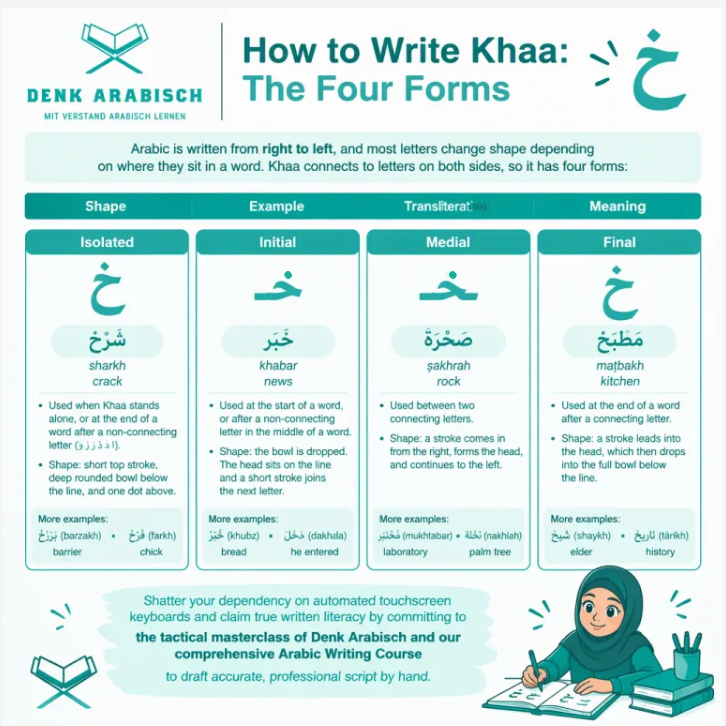
Arabic is written from right to left, and most letters change shape depending on where they sit in a word. Khaa connects to letters on both sides, so it has four forms:
| Form | Shape | Example | Transliteration | Meaning |
| Isolated | خ | شَرْخ | sharkh | crack |
| Initial | خـ | خَبَر | khabar | news |
| Medial | ـخـ | صَخْرَة | ṣakhrah | rock |
| Final | ـخ | مَطْبَخ | maṭbakh | kitchen |
1. Isolated Form (خ)
This form is used when Khaa stands alone, or when it comes at the end of a word after a letter that does not connect to the left (ا د ذ ر ز و).
- Shape: a short top stroke, a deep rounded bowl below the line, and one dot above.
- Example: in شَرْخ (sharkh, crack), the ر does not connect to the left, so Khaa stands alone.
- More examples: بَرْزَخ (barzakh, barrier), فَرْخ (farkh, chick)
2. Initial Form (خـ)
This form is used at the start of a word, or after a non-connecting letter in the middle of a word.
- Shape: the bowl is dropped. The head sits on the line and a short stroke joins the next letter.
- Examples: خَبَر (khabar, news), خُبْز (khubz, bread), دَخَلَ (dakhala, he entered)
3. Medial Form (ـخـ)
This form is used between two connecting letters.
- Shape: a stroke comes in from the right, forms the head, and continues to the left.
- Examples: صَخْرَة (ṣakhrah, rock), مُخْتَبَر (mukhtabar, laboratory), نَخْلَة (nakhlah, palm tree)
4. Final Form (ـخ)
This form is used at the end of a word after a connecting letter.
- Shape: a stroke leads into the head, which then drops into the full bowl below the line.
- Examples: مَطْبَخ (maṭbakh, kitchen), شَيْخ (shaykh, elder), تَارِيخ (tārīkh, history)
In every form, the dot always sits above the letter.
Want to write Arabic confidently by hand? The Arabic Writing Course at Denk Arabisch guides you through letter shapes, connections and clean handwriting step by step.
Khaa with Vowels
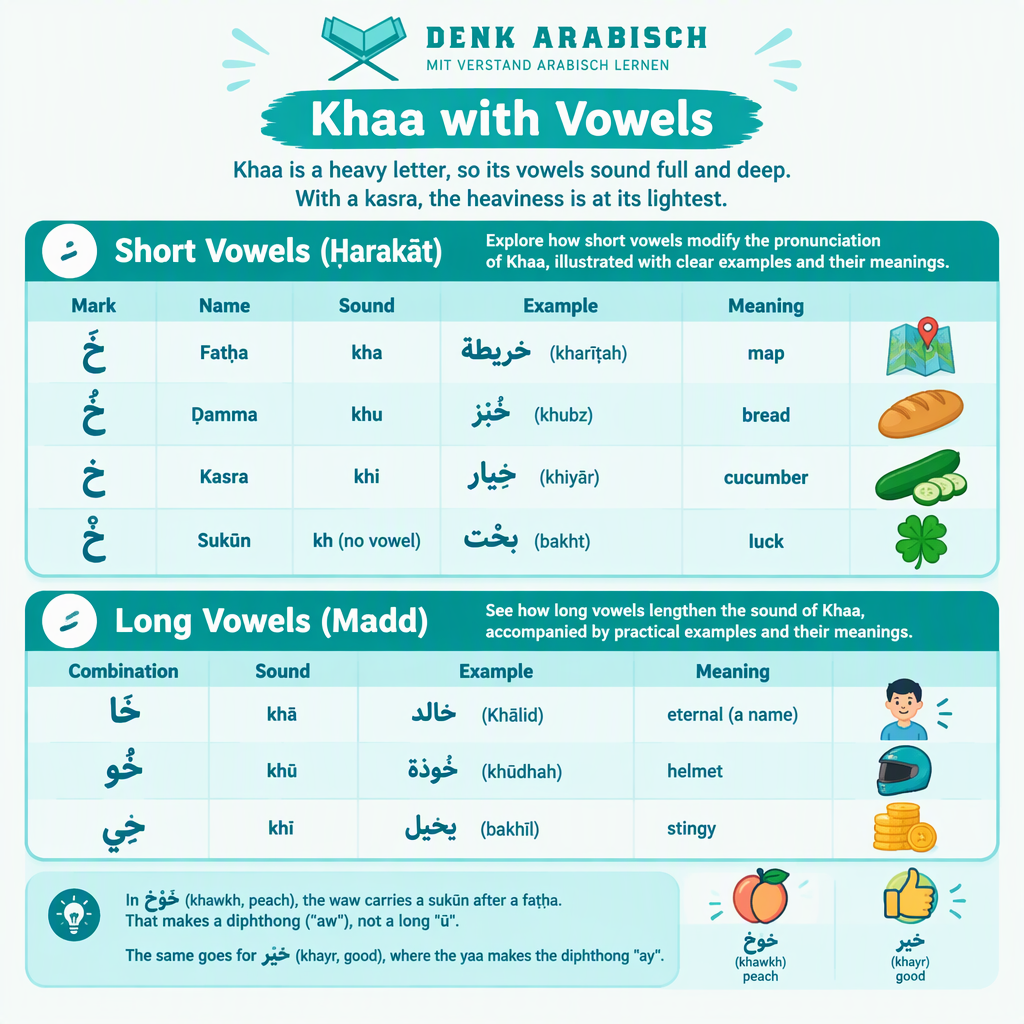
Khaa is a heavy letter, so its vowels sound full and deep. With a kasra, the heaviness is at its lightest.
Short Vowels (Ḥarakāt)
Explore how short vowels modify the pronunciation of Khaa, illustrated with clear examples and meanings.
| Mark | Name | Sound | Example | Meaning |
| خَ | Fatḥa | kha | خَرِيطَة (kharīṭah) | map |
| خُ | Ḍamma | khu | خُبْز (khubz) | bread |
| خِ | Kasra | khi | خِيَار (khiyār) | cucumber |
| خْ | Sukūn | kh (no vowel) | بَخْت (bakht) | luck |
Long Vowels (Madd)
See how long vowels lengthen the sound of Khaa, accompanied by practical examples and their meanings.
| Combination | Sound | Example | Meaning |
| خَا | khā | خَالِد (Khālid) | eternal (a name) |
| خُو | khū | خُوذَة (khūdhah) | helmet |
| خِي | khī | بَخِيل (bakhīl) | stingy |
in خَوْخ (khawkh, peach), the waw carries a sukūn after a fatḥa. That makes a diphthong (“aw”), not a long “ū”. The same goes for خَيْر (khayr, good), where the yaa makes the diphthong “ay”.
Learn Arabic with Denk Arabisch Academy
Speak and understand Arabic through a clear and effective learning system
Try a Free TrialKhaa with Shadda (خّ)
A shadda doubles the letter, so you hold the sound a little longer:
- مُخّ (mukhkh): brain
- فَخّ (fakhkh): trap
- بَخَّاخ (bakhkhākh): spray bottle
Important Arabic Roots with Khaa
Arabic words are built from roots, usually made of three letters. Once you know a root, you can recognize dozens of related words. Here are three common roots with Khaa:
خ ر ج (going out)
| Word | Transliteration | Meaning |
| خَرَجَ | kharaja | he went out |
| مَخْرَج | makhraj | exit (also the Tajweed term for a letter’s point of articulation) |
| خَارِج | khārij | outside |
| إِخْرَاج | ikhrāj | directing (a film), taking out |
خ ل ق (creating)
| Word | Transliteration | Meaning |
| خَلَقَ | khalaqa | he created |
| خَالِق | khāliq | creator |
| خُلُق | khuluq | character |
| أَخْلَاق | akhlāq | morals, manners |
Ready to read full words and sentences with ease? The Arabic Reading Course at Denk Arabisch helps you build reading speed and accuracy through regular guided practice.

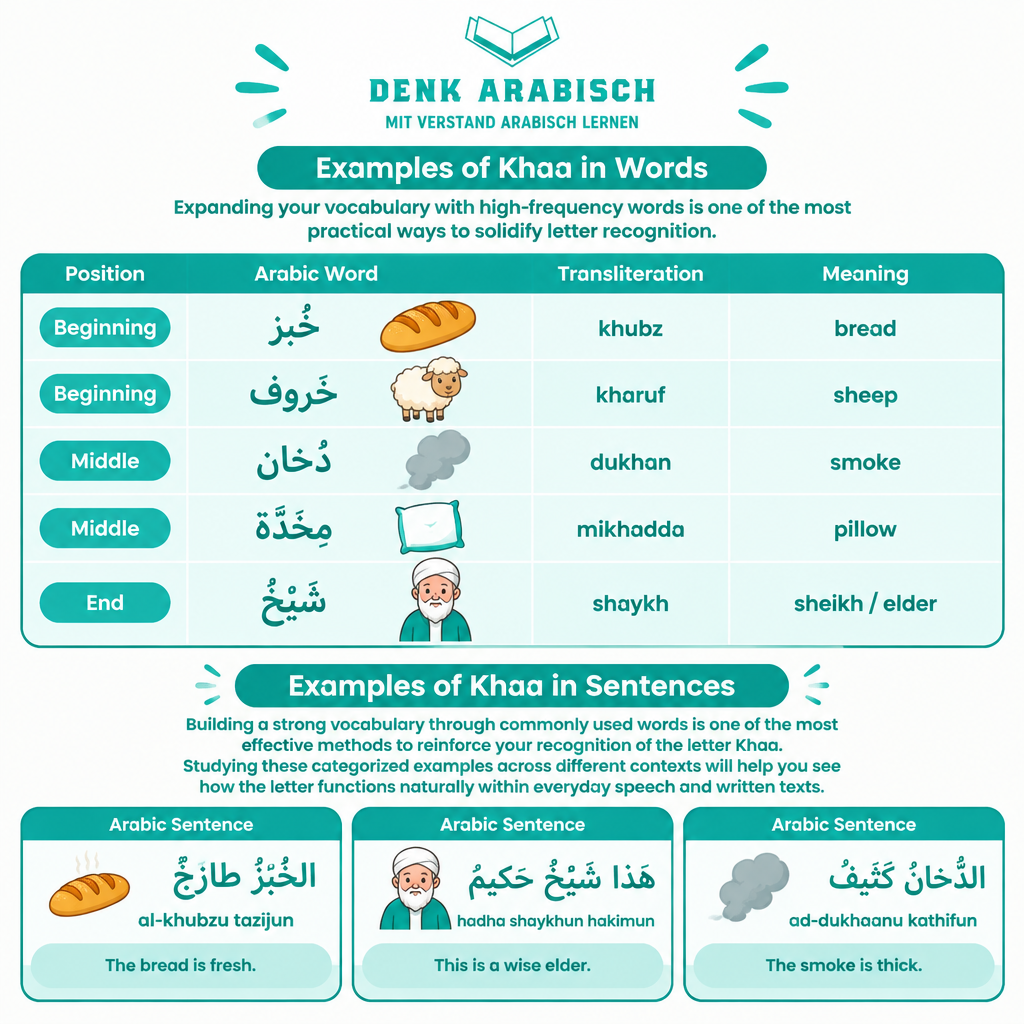
Examples of Letter Khaa in words
Expanding your vocabulary with high-frequency words is one of the most practical ways to solidify letter recognition. Below is a categorized selection of common Arabic words containing Khaa across different contexts.
| Position | Arabic Word | Transliteration | Meaning |
| Beginning | خُبز | khubz | bread |
| Beginning | خَروف | kharūf | sheep |
| Middle | دُخان | dukhān | smoke |
| Middle | مِخدَّة | mikhaddah | pillow |
| End | شَيْخ | shaykh | sheikh / elder |
Read How Many Words Are In Arabic? and discover fascinating facts about Arabic vocabulary and its incredible depth.
Examples of Khaa in sentences
Seeing Khaa in complete sentences gives you more opportunities to recognize the letter in context and gradually become more familiar with its shape and sound while reading Arabic.
| Arabic Sentence | Transliteration | Meaning |
| الخُبزُ طازَجٌ | al-khubzu ṭāzajun | The bread is fresh. |
| هَذا شَيْخٌ حَكيمٌ | hādhā shaykhun ḥakīmun | This is a wise elder. |
| الدُّخانُ كَثيفٌ | ad-dukhānu kathīfun | The smoke is thick. |
Ready to use words like these in real conversations? Read How To Speak Arabic? for simple, practical steps to improve your speaking skills.
Common Mistakes and How to Avoid Them
Discover the most common mistakes when pronouncing the letter Khaa (خ) and how to avoid them to master its correct articulation and sound.
1. Mixing up Khaa (خ) and Ghain (غ)
Both come from the same place in the throat. The difference is your voice. Khaa is voiceless (only air), and Ghain is voiced (your vocal cords vibrate).
Test: put your fingers on your throat. For خ you should feel nothing. For غ you should feel a light buzz.
2. Mixing up Khaa (خ) and Kaaf (ك)
Kaaf and Khaa are made in almost the same spot. The difference is the airflow. For ك, the tongue briefly blocks the air (a stop). For خ, the air keeps flowing (a fricative).
Test: try to hold the sound. You can hold “khhhh” as long as you have breath. You cannot hold “k”.
3. Mixing up Khaa (خ) and Ḥaa (ح)
Ḥaa comes from the middle of the throat. It sounds like a smooth, breathy “h” with no scraping. Khaa comes from higher up and has clear friction.
Test: compare خَال (khāl, maternal uncle) with حَال (ḥāl, state). If they sound the same, you are either scraping too little on خ or too much on ح.
4. Using the German ich-Laut
German speakers sometimes soften Khaa after “i” or “e”, as they would in ich or echt. In Arabic, Khaa never changes. It always stays at the back of the throat.
5. Forcing the Sound
Khaa should not sound like gargling or coughing. If your throat hurts, you are pushing too hard. A relaxed, steady stream of air is enough.
6. Forgetting or Misplacing the Dot
Without its dot, خ becomes ح, and the meaning changes. For example, خَال (uncle) becomes حَال (state). Remember:
- Dot below = Jeem (ج)
- No dot = Ḥaa (ح)
- Dot above = Khaa (خ)
Read Arabic Letters Connected Forms and learn how each letter appears in different positions within Arabic words.
Exercises
Exercise 1: Multiple choice. Which word begins with خ?
A) بَاب B) خُبْز C) وَرْد
Answer: B
Exercise 2: Match the word to its meaning.
خُبْز · دُخَان · مِخَدَّة → pillow · bread · smoke
Answer: خُبْز = bread, دُخَان = smoke, مِخَدَّة = pillow
Exercise 3: Writing practice. Write خ in all four forms: isolated, initial, medial and final. Then copy these words: خُبْز · دُخَان · شَيْخ · نَخْلَة
Exercise 4: True or false?
- خ has one dot above it.
- خ sounds exactly like ك.
- دُخَان contains the letter خ.
- خ is a Sun letter.
Answers: 1. True · 2. False · 3. True · 4. False (it is a Moon letter)
Exercise 5: Find the letter. Which word contains خ?
A) قَلَم B) مِخَدَّة C) وَلَد
Answer: B
What Our Students Say About Denk Arabisch Academy
See what our students say about learning at Denk Arabisch Academy on Trustpilot. Read their experiences and check out more reviews to discover how our courses help improve Arabic.

Learn Arabic Step by Step with Denk Arabisch
Khaa is one of 28 letters. If you want to learn all of them properly and move on to reading, writing and speaking, a clear structure makes all the difference.
Denk Arabisch is built for German-speaking learners. Its courses explain Arabic through the language you already know, with practical exercises instead of dry theory:
With Denk Arabisch you get:
- A clear, step-by-step learning path
- Rules explained simply, so you can apply them right away
- Practical exercises in every lesson
- Explanations designed for German-speaking learners
Choose Your Specialized Course:
- Arabic Course For Beginners: Build a strong foundation in Arabic from the basics and develop essential language skills step by step.
- Quranic Arabic Course for German Speakers: Learn the vocabulary and grammar needed to understand the language of the Quran more directly.
- Arabic Alphabet Course: Learn the Arabic letters, their shapes, connections, and correct pronunciation.
- Arabic Reading Course: Develop your Arabic reading skills and learn to read words and texts more accurately and confidently.
- Arabic Writing Course: Learn how to write Arabic letters, words, and sentences correctly and clearly.
- Arabic Speaking Course: Improve your Arabic speaking skills and practice using Arabic naturally in everyday conversations.
- Quran Tajweed Course for German Speakers: Learn the rules of Tajweed and improve your Quran recitation with correct pronunciation and articulation.
Learn Arabic with Denk Arabisch Academy
Speak and understand Arabic through a clear and effective learning system
Try a Free TrialBook a free Trial with Denk Arabisch

Conclusion
Khaa (خ) is easier than it looks, especially for German speakers, who already use the same sound in Bach and Buch. Keep three things in mind:
- It comes from the top of the throat.
- Its dot always sits above.
- It takes four forms depending on its position in the word.
Practice the sound with real words, write the four forms by hand, and pay attention to the difference between خ, غ and ح. Learn a few roots like خ ر ج and خ ل ق, and you will start spotting Khaa everywhere. Before long, it will feel like a natural part of your Arabic.
Ready to improve your Arabic? Book a free trial lesson with Denk Arabisch and start learning with personalized guidance.
FAQs
1. What is the difference between Ḥaa (ح) and Khaa (خ)?
They have the same shape, but Khaa has a dot above it. Ḥaa comes from the middle of the throat and sounds like a smooth, breathy “h”. Khaa comes from higher up and has a raspy friction, like German ach.
2. What is the difference between Khaa (خ) and Ghain (غ)?
Both are made at the same point in the throat. Khaa is voiceless (air only). Ghain is voiced (the vocal cords vibrate), so it sounds a bit like a gargled French “r”.
3. Is Khaa a Sun letter or a Moon letter?
Khaa is a Moon letter. The “l” of the article al- is pronounced clearly, as in الْخَيْر (al-khayr, the good).
4. Is Khaa a heavy or a light letter?
Khaa is a heavy letter (mufakhkham). It is one of the seven elevated letters in the phrase خُصَّ ضَغْطٍ قِظْ, and it is always pronounced with a full, deep sound.
5. What happens to nūn sākinah before Khaa in Quran recitation?
In the common recitation of Ḥafṣ ʿan ʿĀṣim, the nūn is pronounced clearly, with no nasal hiding. This is called Iẓhār Ḥalqī, as in مِنْ خَوْفٍ (Surah Quraysh 106:4).