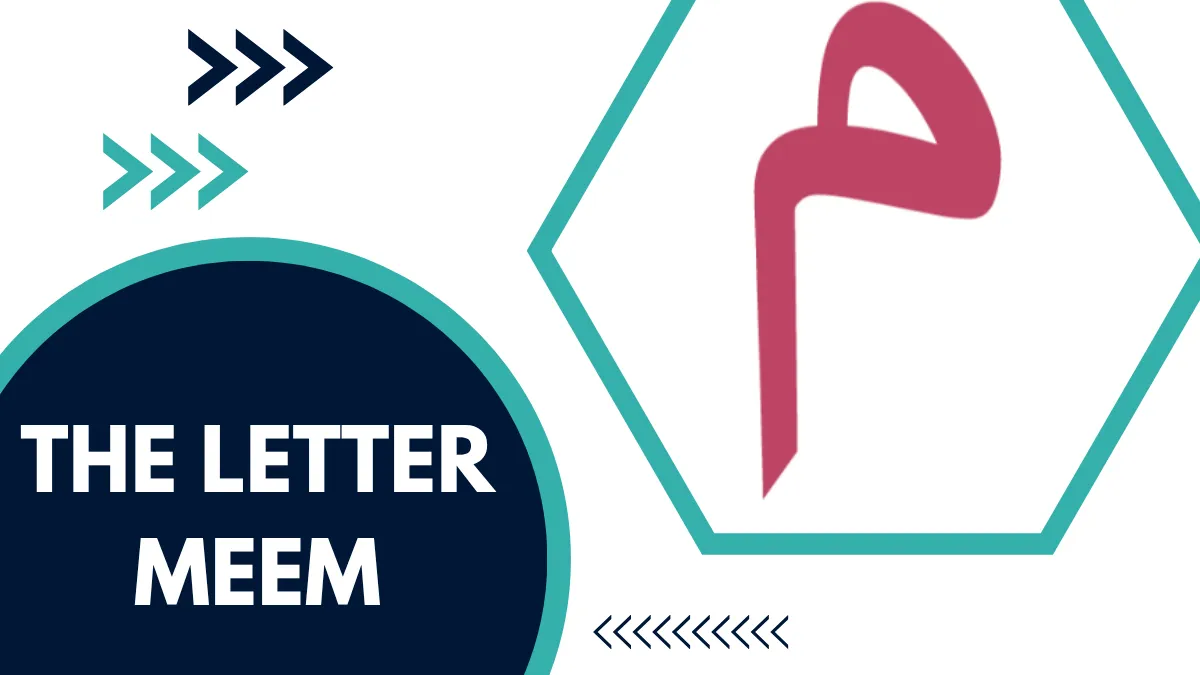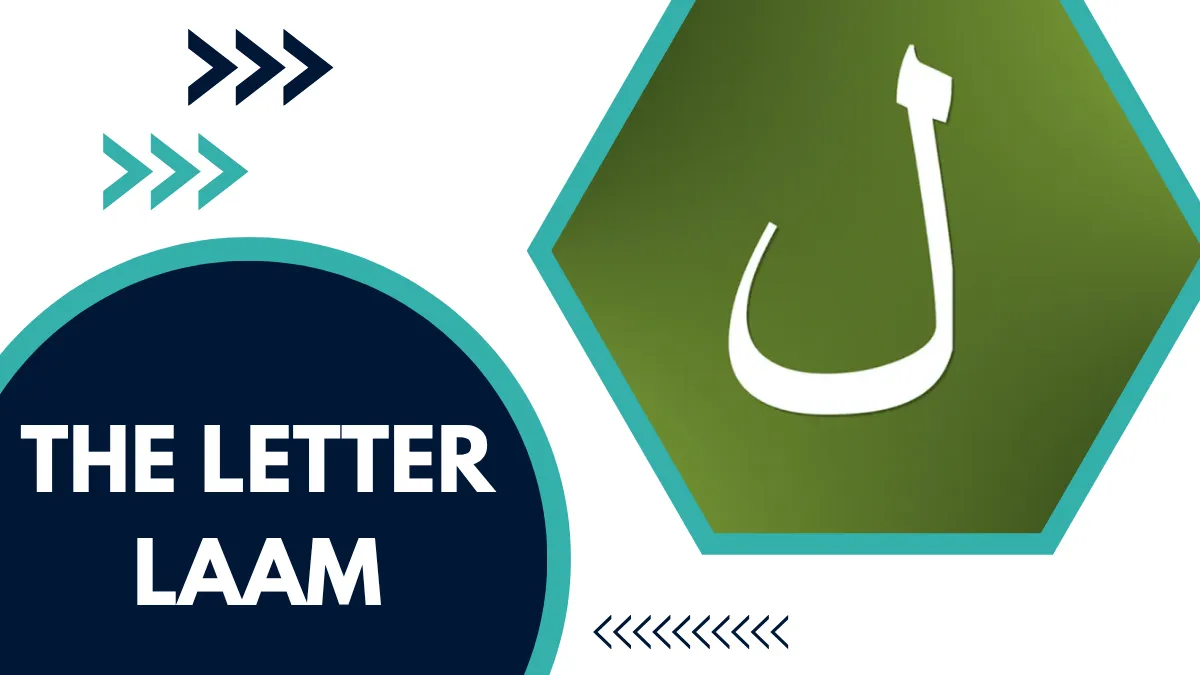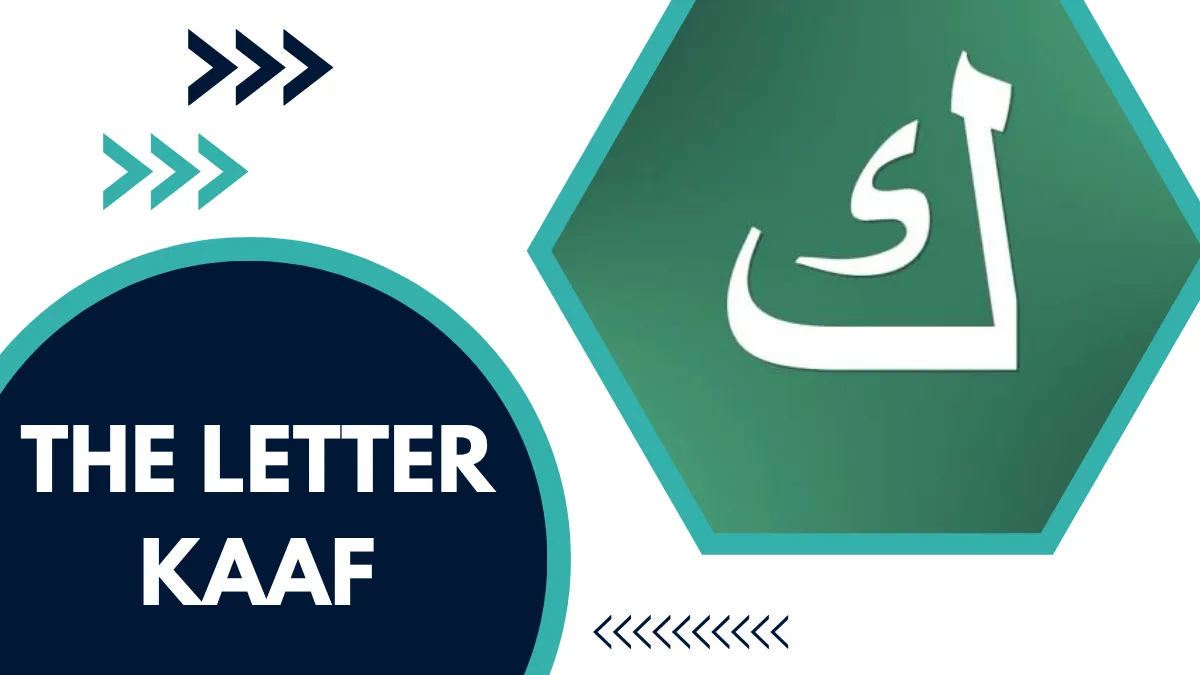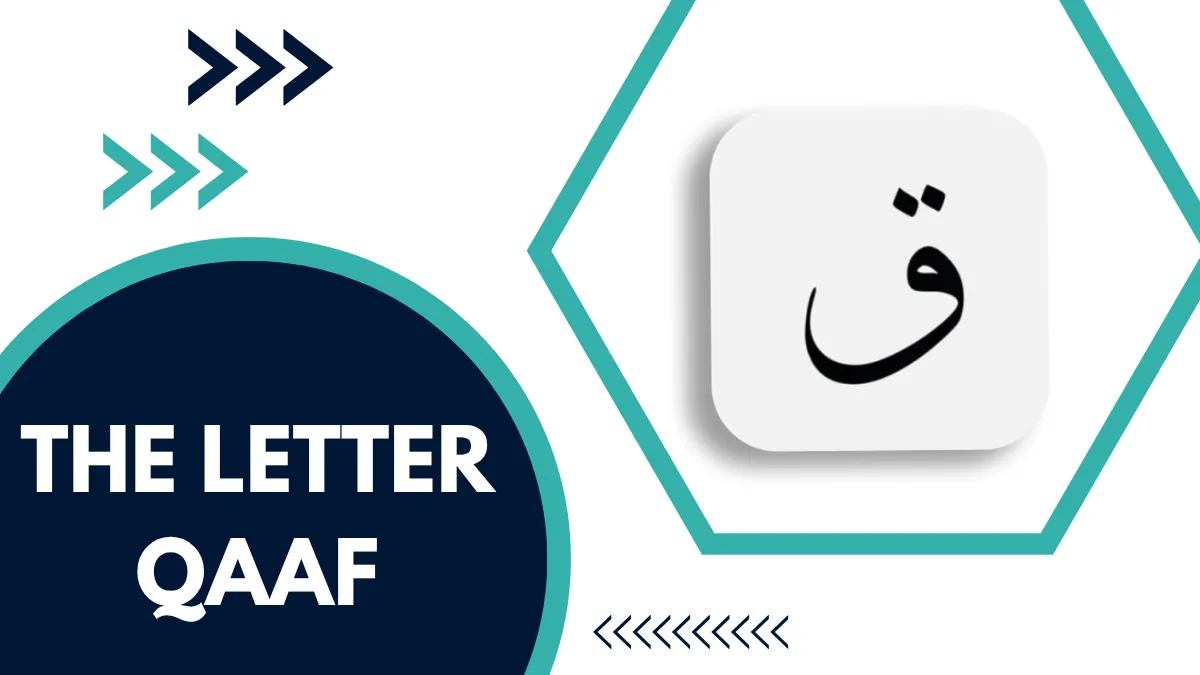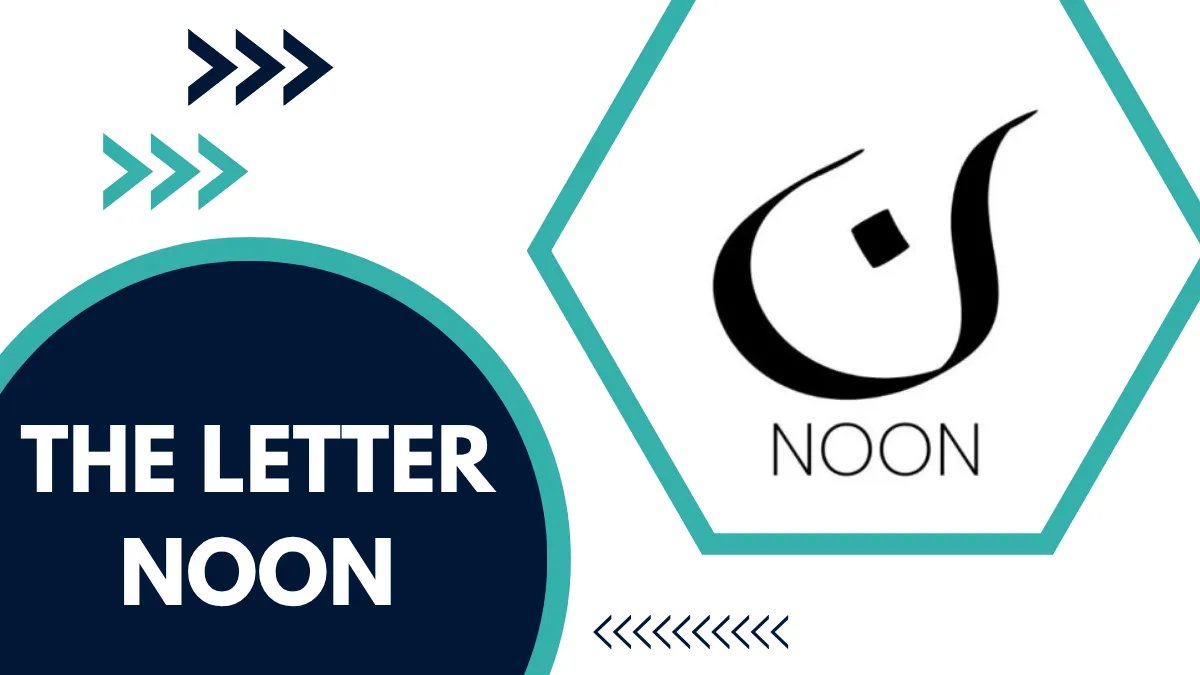
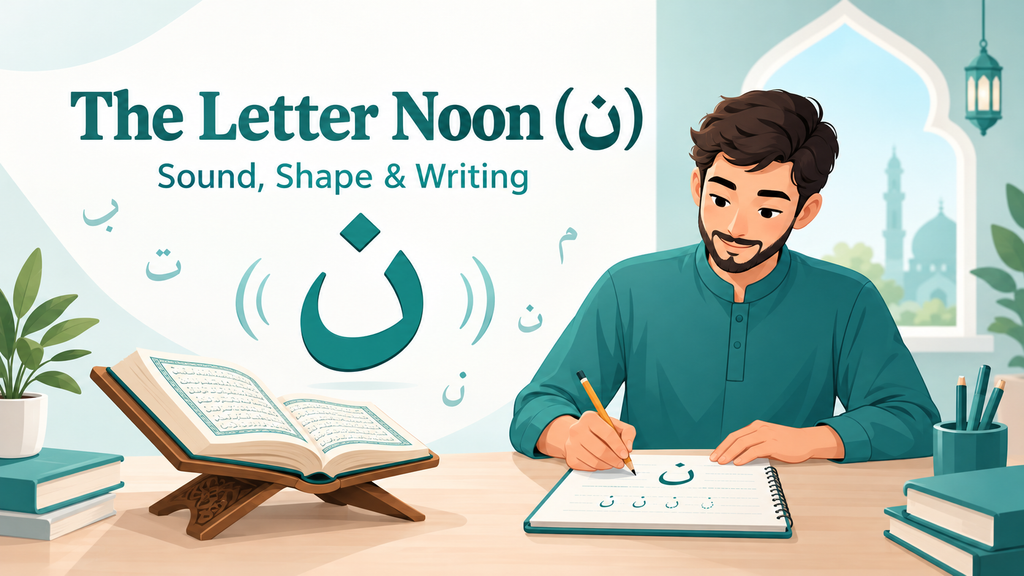
Noon (نُون) is the 25th letter of the Arabic alphabet. You make it by pressing the tip of your tongue against the ridge behind your upper front teeth while air flows through your nose. Linguists call it a voiced alveolar nasal, written [n] in IPA. The Arabic letter Noon (ن) is one of the easiest sounds to start with.
German speakers have a head start. You already say this sound in Nase, Name and Mann. The Arabic Noon is almost the same, only cleaner and more precise.
| Fact | Details |
| Name | Noon (نُون) |
| Sound | [n], as in German Nase, Name, Mann |
| Position in the alphabet | 25th |
| Abjad value | 14th in Abjad order, value 50 |
| Transliteration | Common: n or Noon. DIN 31635: n (letter name nūn). Variants: Nun, Nuun. Arabizi: n (no number) |
| Point of articulation | Tongue tip with the gum ridge; nasal passage for ghunna |
| Sun or Moon letter | Sun letter |
| Heavy or light | Light (muraqqaq) |
| Dots | One dot above |
| Connection | Connects on both sides (4 forms) |
Table of Contents
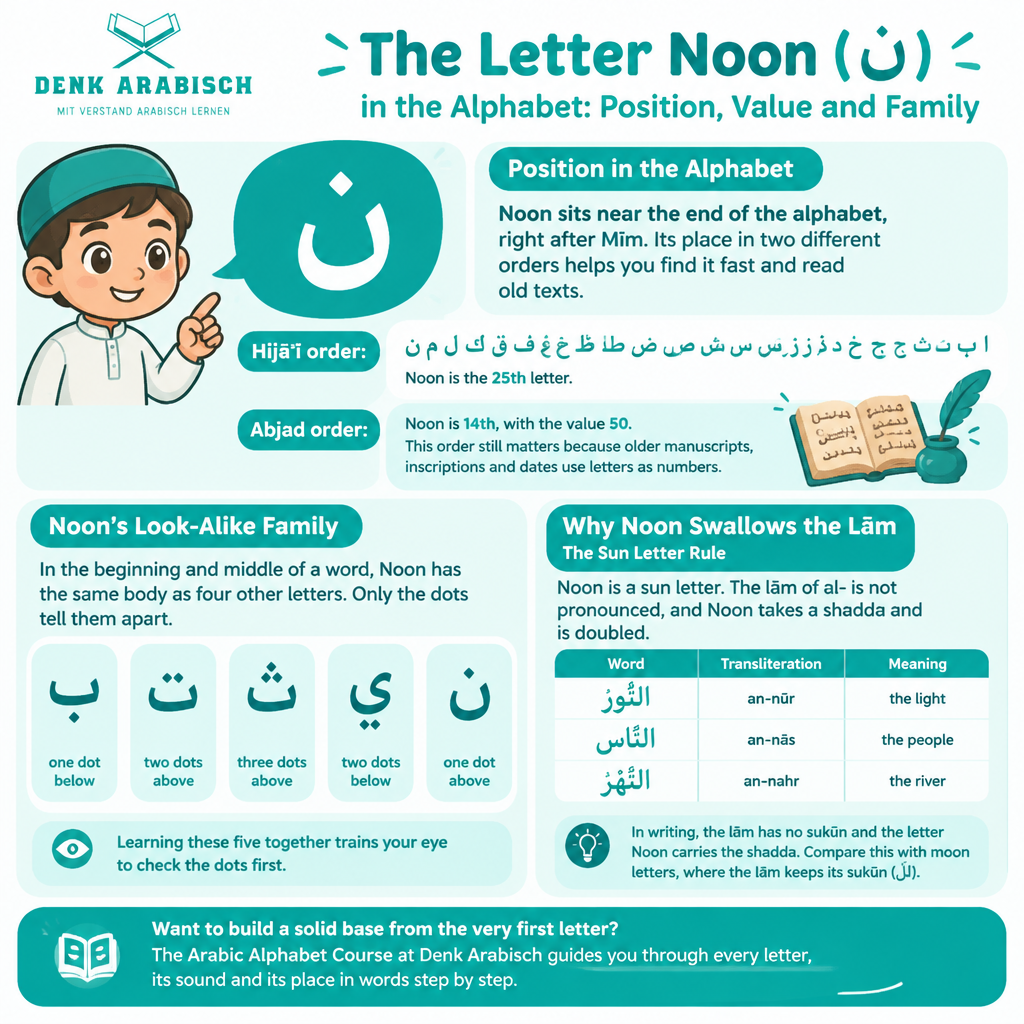
The Letter Noon (ن) in the Alphabet: Position, Value and Family
Noon sits near the end of the alphabet, right after Mīm. Its place in two different orders helps you find it fast and read old texts.
Hijāʾī order: ا ب ت ث ج ح خ د ذ ر ز س ش ص ض ط ظ ع غ ف ق ك ل م ن. Noon is the 25th letter.
Abjad order: Noon is 14th, with the value 50. This order still matters because older manuscripts, inscriptions and dates use letters as numbers.
Noon’s Look-Alike Family: ب ت ث ي
In the beginning and middle of a word, Noon has the same body as four other letters. Only the dots tell them apart.
- ب: one dot below
- ت: two dots above
- ث: three dots above
- ي: two dots below
- ن: one dot above
Learning these five together trains your eye to check the dots first.
Read our Article: Learning Arabic
Why Noon Swallows the Lām: Sun Letter Rule
Noon is a sun letter. The lām of al- is not pronounced, and Noon takes a shadda and is doubled.
| Word | Transliteration | Meaning |
| النُّورُ | an-nūr | the light |
| النَّاسُ | an-nās | the people |
| النَّهْرُ | an-nahr | the river |
In writing, the lām has no sukūn and the letter Noon carries the shadda. Compare this with moon letters, where the lām keeps its sukūn (الْ).
Want to build a solid base from the very first letter? The Arabic Alphabet Course at Denk Arabisch guides you through every letter, its sound and its place in words step by step.
Where Noon Sounds Come From: Makhraj and Tajweed Basics
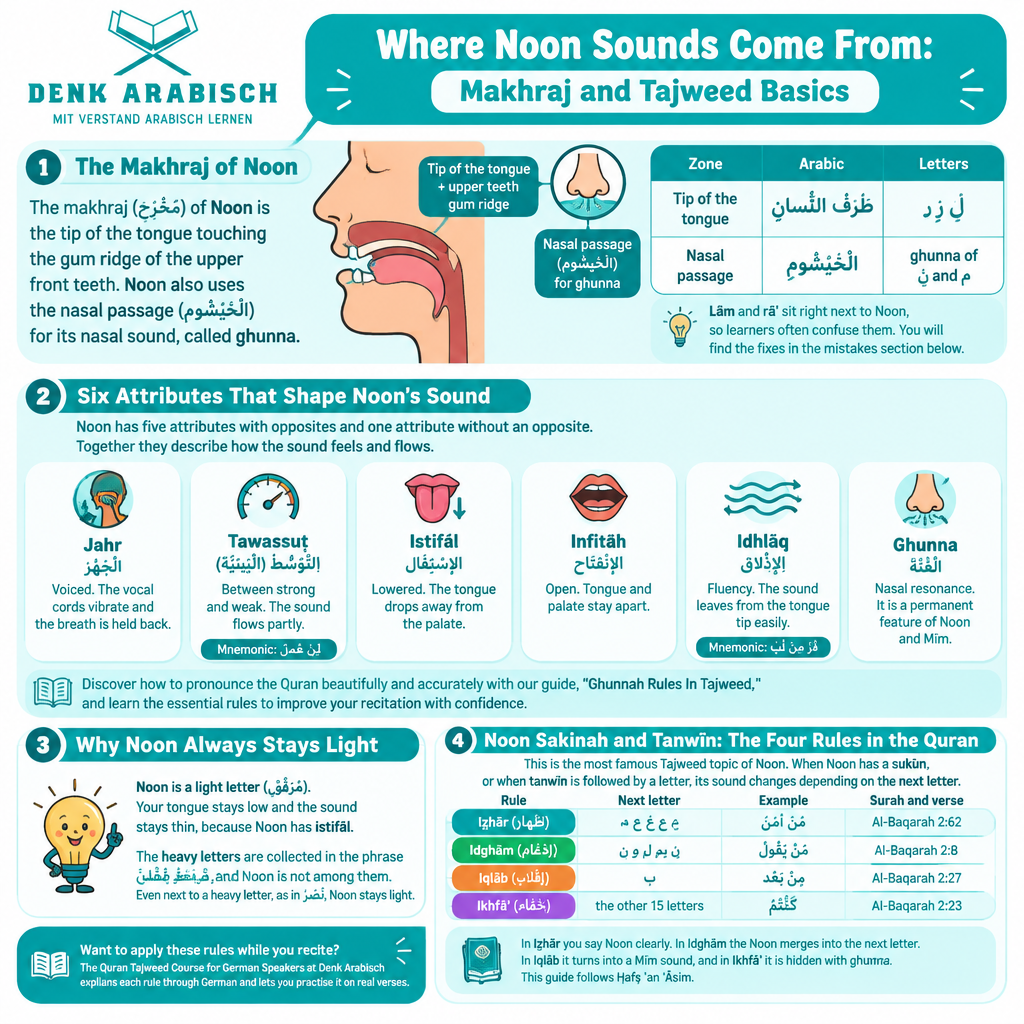
The makhraj (مَخْرَج) of Noon is the tip of the tongue touching the gum ridge of the upper front teeth. Noon also uses the nasal passage (الْخَيْشُوم) for its nasal sound, called ghunna.
| Zone | Arabic | Letters |
| Edge of the tongue, front | حَافَّةُ اللِّسَانِ | ل |
| Tip of the tongue, with the gum ridge | طَرَفُ اللِّسَانِ | ن ر |
Lām and rā’ sit right next to Noon, so learners often confuse them. You will find the fixes in the mistakes section below.
Six Attributes That Shape Noon’s Sound
Noon has five attributes with opposites and one attribute without an opposite. Together they describe how the sound feels and flows.
- Jahr (الْجَهْر): voiced. The vocal cords vibrate and the breath is held back.
- Tawassuṭ (التَّوَسُّط, also called الْبَيْنِيَّة): between strong and weak. The sound flows partly. The mnemonic is لِنْ عُمَر.
- Istifāl (الِاسْتِفَال): lowered. The tongue drops away from the palate.
- Infitāḥ (الِانْفِتَاح): open. Tongue and palate stay apart.
- Idhlāq (الْإِذْلَاق): fluency. The sound leaves from the tongue tip easily. The mnemonic is فَرَّ مِنْ لُبّ.
- Ghunna (الْغُنَّة): nasal resonance. It is a permanent feature of Noon and Mīm.
Discover how to pronounce the Quran beautifully and accurately with our guide, “Ghunnah Rules In Tajweed,” and learn the essential rules to improve your recitation with confidence.
Why Noon Always Stays Light
Noon is a light letter (مُرَقَّق). Your tongue stays low and the sound stays thin, because Noon has istifāl.
The heavy letters are collected in the phrase خُصَّ ضَغْطٍ قِظْ, and Noon is not among them. Even next to a heavy letter, as in نَصْر, Noon stays light.
Noon Sākina and Tanwīn: The Four Rules in the Quran
This is the most famous Tajweed topic of Noon. When Noon has a sukūn, or when tanwīn is followed by a letter, its sound changes depending on the next letter.
| Rule | Next letter | Example | Surah and verse |
| Iẓhār (إِظْهَار): clear | ء ه ع ح غ خ | مَنْ آمَنَ | Al-Baqarah 2:62 |
| Idghām (إِدْغَام): merging | ي ر م ل و ن | مَنْ يَقُولُ | Al-Baqarah 2:8 |
| Iqlāb (إِقْلَاب): turning | ب | مِنْ بَعْدِ | Al-Baqarah 2:27 |
| Ikhfā’ (إِخْفَاء): hiding | the other 15 letters | كُنْتُمْ | Al-Baqarah 2:23 |
In Iẓhār you say Noon clearly. In Idghām the Noon merges into the next letter. In Iqlāb it turns into a Mīm sound, and in Ikhfā’ it is hidden with ghunna. This guide follows Ḥafṣ ʿan ʿĀṣim.
Idghām in Detail: With and Without Ghunna
Idghām has two types. Before ي ن م و, the Noon merges with ghunna, as in مَن يَقُولُ (Al-Baqarah 2:8). Before ل and ر, it merges without ghunna, as in مِن رَّبِّهِمْ (Al-Baqarah 2:5).
Two exceptions are worth knowing. If Noon sākina and و or ي sit in the same word, there is no merging, as in الدُّنْيَا and صِنْوَانٌ. In Ḥafṣ, مَنْ ۜ رَاقٍ (Al-Qiyamah 75:27) is read with a short pause (sakt), so the Noon stays clear.
Read more in our guides: [Ikhfa Rules With Examples] · [Idgham With Ghunnah] · [Ghunnah Rules In Tajweed]
Want to apply these rules while you recite? The Quran Tajweed Course for German Speakers at Denk Arabisch explains each rule through German and lets you practise it on real verses.
Say Noon Like a Native: Pronunciation Made Simple
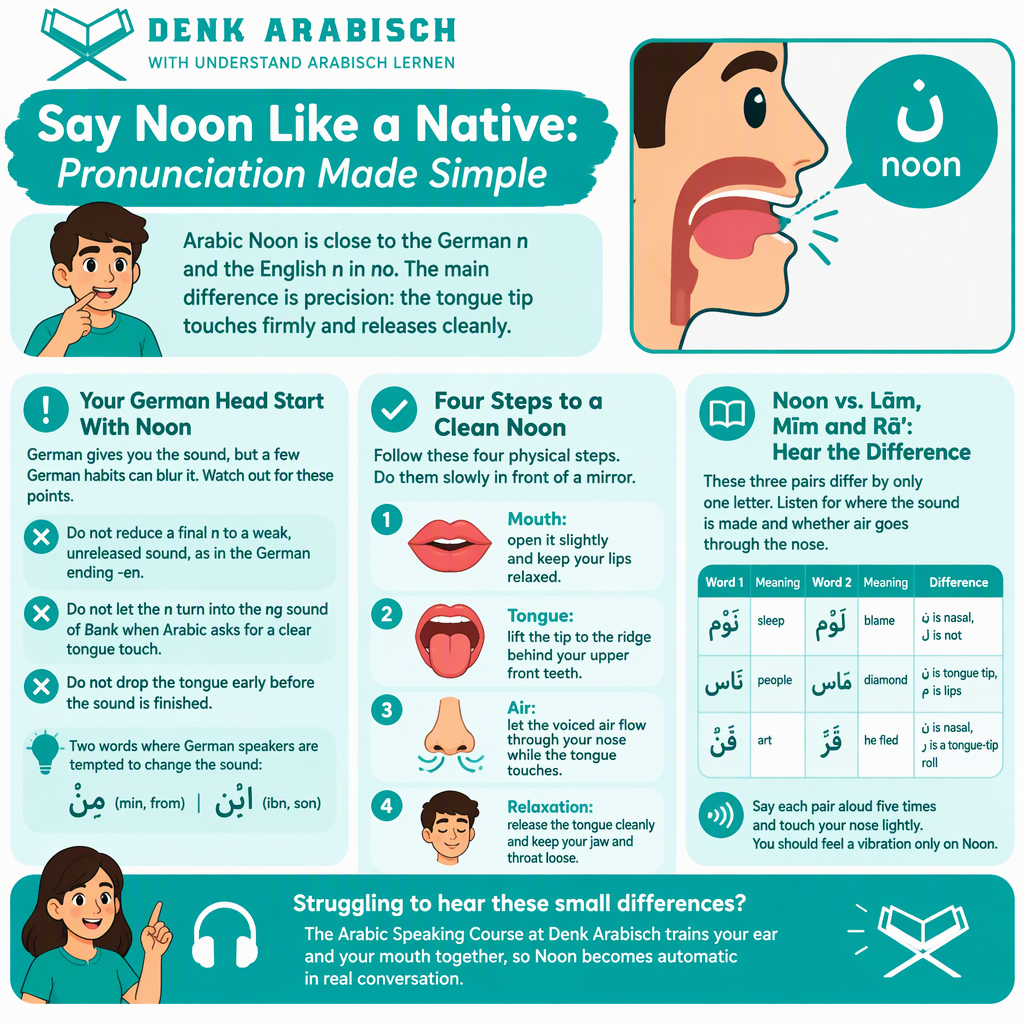
Arabic Noon is close to the German n and the English n in no. The main difference is precision: the tongue tip touches firmly and releases cleanly.
Your German Head Start With Noon
German gives you the sound, but a few German habits can blur it. Watch out for these points.
- Do not reduce a final n to a weak, unreleased sound, as in the German ending -en.
- Do not let the n turn into the ng sound of Bank when Arabic asks for a clear tongue touch.
- Do not drop the tongue early before the sound is finished.
Two words where German speakers are tempted to change the sound: مِنْ (min, from) and ابْن (ibn, son).
Four Steps to a Clean Noon
Follow these four physical steps. Do them slowly in front of a mirror.
- Mouth: open it slightly and keep your lips relaxed.
- Tongue: lift the tip to the ridge behind your upper front teeth.
- Air: let the voiced air flow through your nose while the tongue touches.
- Relaxation: release the tongue cleanly and keep your jaw and throat loose.
Read our guide, “How To Speak Arabic?”, and discover practical tips to improve your speaking skills and start communicating in Arabic naturally.
Noon vs. Lām, Mīm and Rā’: Hear the Difference
These three pairs differ by only one letter. Listen for where the sound is made and whether air goes through the nose.
| Word 1 | Meaning | Word 2 | Meaning | Difference |
| نَوْم | sleep | لَوْم | blame | ن is nasal, ل is not |
| مَدَى | range, extent | نَدَى | dew | ن is tongue tip, م is lips |
| فَنّ | art | فَرّ | he fled | ن is nasal, ر is a tongue-tip roll |
Say each pair aloud five times and touch your nose lightly. You should feel a vibration only on Noon.
Struggling to hear these small differences? The Arabic Speaking Course at Denk Arabisch trains your ear and your mouth together, so Noon becomes automatic in real conversation.
Writing Noon by Hand: Its Four Shapes
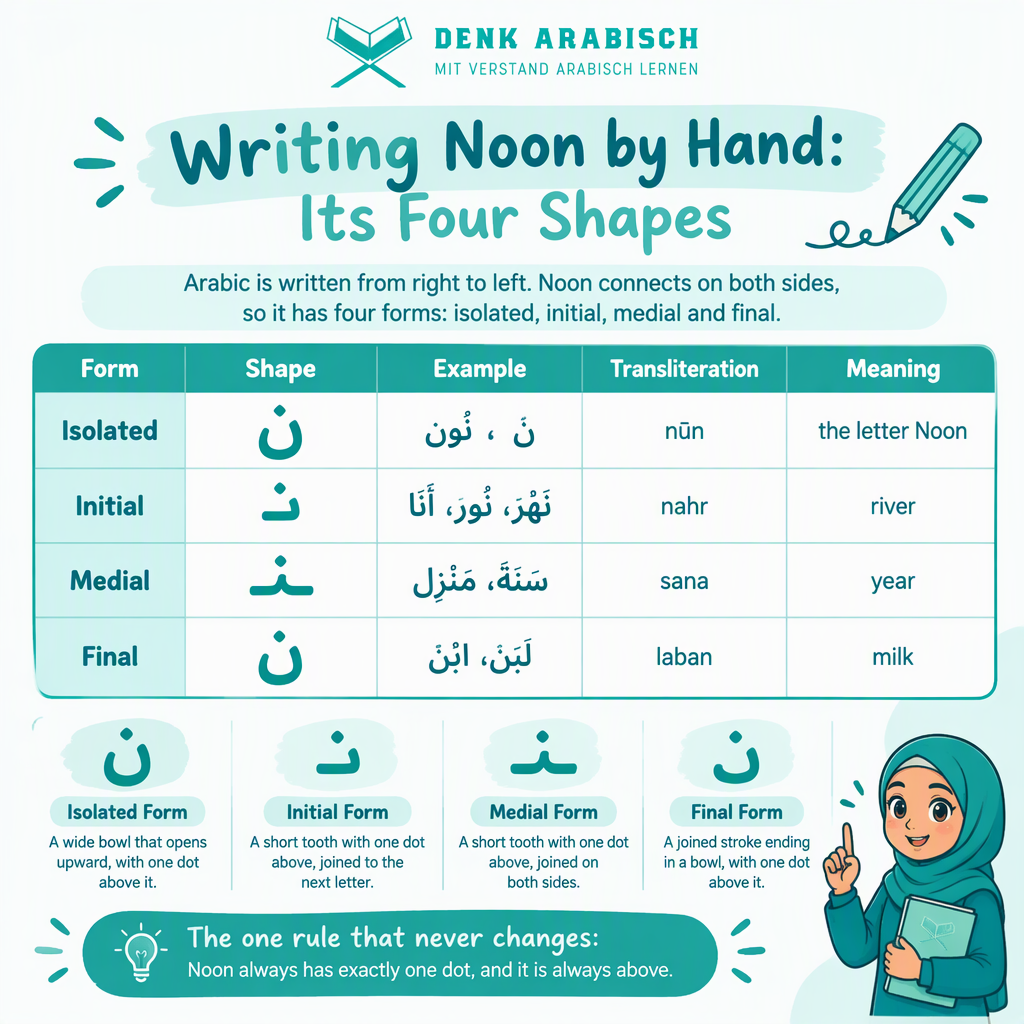
Arabic is written from right to left. Noon connects on both sides, so it has four forms: isolated, initial, medial and final.
| Form | Shape | Example | Transliteration | Meaning |
| Isolated | ن | كَانَ | kāna | he was |
| Initial | نـ | نَهْر | nahr | river |
| Medial | ـنـ | سَنَة | sana | year |
| Final | ـن | لَبَن | laban | milk |
1. Isolated Form (ن)
You use it when Noon stands alone, or at the end of a word after a non-connecting letter such as ا, د, ذ, ر, ز or و.
Shape: a wide bowl that opens upward, with one dot above it.
Examples: كَانَ (kāna, he was), إِنْسَان (insān, human being), where Noon follows alif.
2. Initial Form (نـ)
You use it at the beginning of a word, and also after a non-connecting letter such as ا, د, ذ, ر, ز or و.
Shape: a short tooth with one dot above it, joined to the next letter.
Examples: نَهْر، نُور، أَنَا
3. Medial Form (ـنـ)
You use it in the middle of a word, between two connected letters.
Shape: a short tooth with one dot above it, joined on both sides.
Examples: سَنَة، مَنْزِل
Learn Arabic with Denk Arabisch Academy
Speak and understand Arabic through a clear and effective learning system
Try a Free Trial4. Final Form (ـن)
You use it at the end of a word when it joins the letter before it.
Shape: a joined stroke ending in a bowl, with one dot above it.
Examples: لَبَن، ابْن
The one rule that never changes: Noon always has exactly one dot, and it is always above.
Read our guide, “Arabic Letters Connected Forms,” and learn how Arabic letters change their shapes when connected to form words.
Want to write Arabic confidently by hand? The Arabic Writing Course at Denk Arabisch guides you through letter shapes, connections and clean handwriting step by step.
Noon Plus Vowels: Every Sound It Can Make
Since Noon is a light letter, every vowel after it stays thin and clear. You never need to add the heavy colour of letters like ص or ط.
Short Vowels (Ḥarakāt)
The four marks below change how Noon sounds. Each one gives a different syllable.
| Mark | Name | Sound | Example | Meaning |
| نَ | Fatḥa | na | نَهْر (nahr) | river |
| نُ | Ḍamma | nu | نُور (nūr) | light |
| نِ | Kasra | ni | نِعْمَة (niʿma) | blessing |
| نْ | Sukūn | n, no vowel | مِنْ (min) | from |
Long Vowels (Madd)
A long vowel is held for two beats. It changes the length of the syllable, not the sound of Noon itself.
| Combination | Sound | Example | Meaning |
| نَا | nā | نَاس (nās) | people |
| نُو | nū | نُور (nūr) | light |
| نِي | nī | نِيل (Nīl) | Nile |
The diphthong aw appears in نَوْم (nawm, sleep).
Noon with Shadda
A shadda doubles the Noon: you press the tongue, hold it and release it with a full ghunna of two counts, as in إِنَّ and جَنَّة.
| Word | Transliteration | Meaning |
| إِنَّ | inna | indeed |
| جَنَّة | janna | garden, paradise |
| فَنّ | fann | art |

Three Roots That Put Noon to Work
Most Arabic words grow from a root of three letters. When you know a root, you can guess the meaning of many related words.
ن ص ر (help, victory)
The root ن ص ر carries the idea of helping and winning. It gives you everyday words like naṣr (victory) and the common name manṣūr.
| Word | Transliteration | Meaning |
| نَصْر | naṣr | victory |
| نَاصِر | nāṣir | helper |
| مَنْصُور | manṣūr | victorious |
| اِنْتِصَار | intiṣār | triumph |
ن ظ ر (looking)
The root ن ظ ر is about looking and watching. From it come the words for sight, observer, view and waiting that you see below.
| Word | Transliteration | Meaning |
| نَظَر | naẓar | sight |
| نَاظِر | nāẓir | observer |
| مَنْظَر | manẓar | view |
| اِنْتِظَار | intiẓār | waiting |
ن و ر (light)
The root ن و ر is all about light and shining. You already met نُور in the vowel tables, and the same root gives the word for a minaret.
| Word | Transliteration | Meaning |
| نُور | nūr | light |
| مُنِير | munīr | shining, radiant |
| مَنَارَة | manāra | lighthouse, minaret |
| تَنْوِير | tanwīr | enlightenment |
Want to read these words in real Arabic texts? The Arabic Reading Course at Denk Arabisch helps you recognise roots and read new words with confidence.
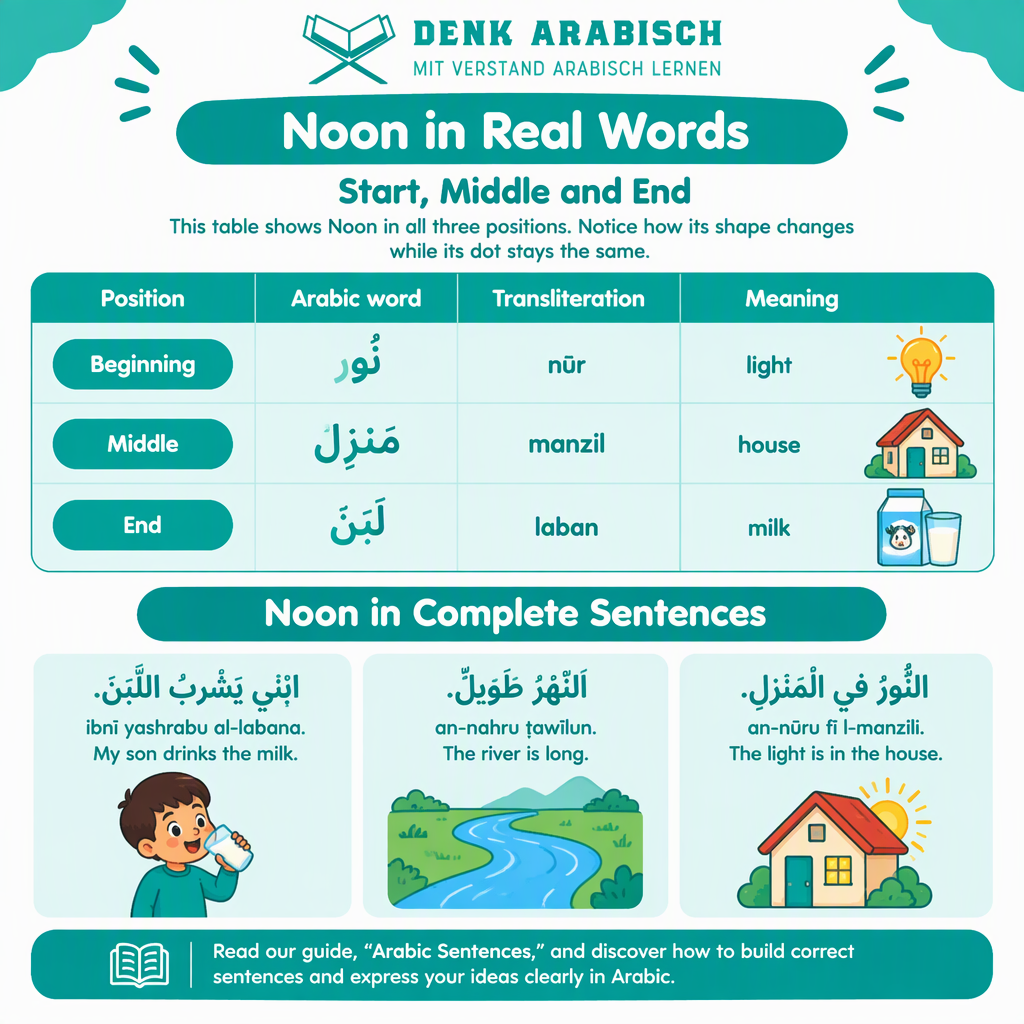
Noon in Real Words: Start, Middle and End
Below Noon in all three positions. Notice how its shape changes while its dot stays the same.
Noon in Complete Sentences
These three short sentences reuse words you met earlier in this guide. Read them aloud and check each Noon.
| Arabic sentence | Transliteration | Meaning |
| اِبْنِي يَشْرَبُ اللَّبَنَ. | ibnī yashrabu l-labana | My son drinks the milk. |
| النَّهْرُ طَوِيلٌ. | an-nahru ṭawīlun. | The river is long. |
| النُّورُ فِي الْمَنْزِلِ. | an-nūru fī l-manzili. | The light is in the house. |
Read our guide, “Arabic Sentences,” and discover how to build correct sentences and express your ideas clearly in Arabic.
Four Noon Slip-Ups and Quick Fixes
Most Noon mistakes come from sounds that feel similar. Each fix below takes less than a minute to try.
1. Mixing up Noon (ن) and Lām (ل)
Both sounds use the tongue tip, but Lām sends air around the sides and Noon sends it through the nose.
Test: say نَوْم and لَوْم while holding your nose. Only لَوْم should stay unchanged.
2. Mixing up Noon (ن) and Mīm (م)
Both are nasal sounds, but Mīm closes the lips and Noon touches the ridge behind the teeth.
Test: say نَاس and مَاس in front of a mirror. Your lips should close only on مَاس.
3. Mixing up Noon (ن) and Rā’ (ر)
Rā’ is a quick roll of the tongue tip, while Noon is a firm touch with nasal air.
Test: say فَنّ and فَرّ and put a finger on your nose. You feel vibration only on فَنّ.
4. Swallowing the Final Noon (German habit)
German endings like -en often lose their clear n. In Arabic, final Noon must be heard, as in مِنْ and ابْن.
Test: record yourself saying مِنْ. If you cannot hear a clear tongue touch at the end, repeat it.
Practice Round: Check What You Know About Noon
Try these four short exercises. All words come from this guide.
Exercise 1: Multiple choice.
Where is the dot of Noon?
a) Two dots above b) One dot above c) One dot below
Answer: b
Exercise 2: Matching.
Match the word to its meaning.
- نَهْر
- لَبَن
- سَنَة
a) milk b) river c) year
Answer: 1-b, 2-a, 3-c
Exercise 3: Writing practice.
Write ن in its four forms, then write the words نَاس and ابْن.
Exercise 4: True or false.
- Noon is a sun letter.
- Noon is a heavy letter.
- Noon has four forms.
- In النُّورُ the lām is pronounced.
Answers: 1 true, 2 false, 3 true, 4 false
What Our Students Say About Denk Arabisch Academy
See what our students say about learning at Denk Arabisch Academy on Trustpilot. Read their experiences and check out more reviews to discover how our courses help improve Arabic.

Keep Going With Noon: Your Path at Denk Arabisch
Noon is one of 28 letters. A clear structure helps you move from single letters to words, reading and recitation without gaps.
Denk Arabisch is built for German-speaking learners and explains Arabic through German.
- Clear explanations that start from German sounds
- Step-by-step lessons for adults and children
- Practice that connects letters, reading and speaking
- Tajweed and Quranic Arabic tracks for deeper study
Choose Your Specialized Course:
- Arabic Course For Beginners: your first steps in Arabic
- Quranic Arabic Course for German Speakers: understand Quranic vocabulary
- Quran Tajweed Course for German Speakers: apply Tajweed rules in recitation
- Arabic Alphabet Course: letters, sounds and forms
- Arabic Reading Course: read words and texts with confidence
- Arabic Writing Course: clean handwriting and connections
- Arabic Speaking Course: speak and understand everyday Arabic
Learn Arabic with Denk Arabisch Academy
Speak and understand Arabic through a clear and effective learning system
Try a Free TrialBook your free trial lesson with Denk Arabisch and take the first step toward mastering Arabic!
You can read what our students say on Trustpilot.

Conclusion
You now know the letter Noon (ن) from sound to shape to Tajweed. It is a letter you can master quickly.
- Sound: a clear [n] from the tongue tip, with nasal air.
- Writing: four forms, always one dot above.
- Recognition: a sun letter, light, and part of the family ب ت ث ي ن.
Practice by saying the pairs نَوْم and لَوْم, نَاس and مَاس, and فَنّ and فَرّ. Then write the four forms and read the roots ن ص ر, ن ظ ر and ن و ر aloud. Small daily practice will make Noon feel natural.
Try a free Arabic lesson at Denk Arabisch and discover your potential!
FAQs
1. What is the difference between Noon (ن) and Lām (ل)?
Noon uses the tongue tip and sends air through the nose. Lām sends air around the sides of the tongue and has no nasal sound.
2. What is the difference between Noon (ن) and Mīm (م)?
Both are nasal, but Mīm is made with closed lips. Noon is made with the tongue tip on the gum ridge.
3. Is Noon a sun or moon letter?
Noon is a sun letter. The lām of al- is silent and Noon takes a shadda, as in النُّورُ.
4. Is Noon heavy or light?
Noon is light. Its tongue stays low and the sound stays thin, even next to heavy letters.
5. Which Tajweed rules involve Noon?
Noon sākina and tanwīn follow four rules: Iẓhār, Idghām, Iqlāb and Ikhfāʾ, depending on the next letter. A Noon with shadda, as in إِنَّ, always carries a ghunna of two counts.