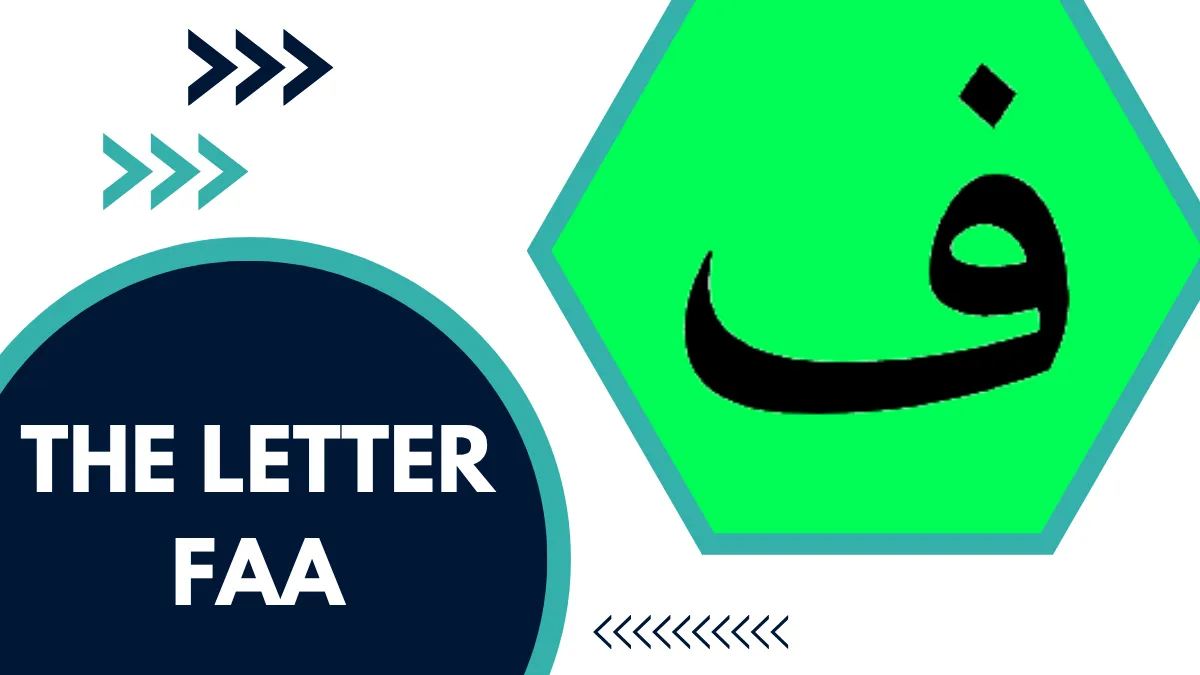
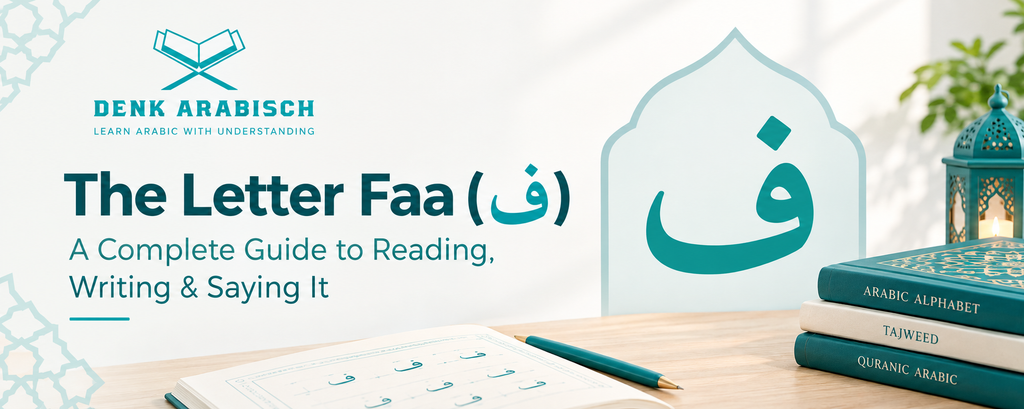
The letter Faa (ف) is the 20th letter of the Arabic alphabet. You make it by touching your upper front teeth to your lower lip and letting air flow out. Linguists call it a voiceless labiodental fricative, written [f] in IPA.
German speakers have a head start. You already know this sound from Fisch, Fenster and Vogel, where the v is also pronounced [f]. Your mouth knows the move already, so you only need the letter and a few Arabic habits.
Short exercises at the end let you check what you learned.
| Property | Detail |
| Name | Faa (فَاء), DIN 31635: Fāʾ |
| Sound | [f], voiceless labiodental fricative, as in German Fisch and English fish |
| Position in the Alphabet | 20th letter (hijāʾī order) |
| Abjad Value | 17th in Abjad order, value 80 |
| Transliteration | f (common form and DIN 31635); Arabizi: f, no number |
| Point of Articulation | Inner edge of the lower lip and tips of the upper front teeth |
| Sun or Moon | Moon letter (حرف قمري) |
| Heavy or Light | Light (مُرَقَّقٌ) |
| Dots | One dot above |
| Connection | Connects on both sides, so it has four forms |
Discover “How Many Letters in Arabic?” and learn about the Arabic alphabet, its letters, and how to start recognizing and pronouncing them with confidence!
Table of Contents
Faa (ف) in the Alphabet: Its Place and Its Number
In alphabet order, Faa comes after ghain (غ): ا ب ت ث ج ح خ د ذ ر ز س ش ص ض ط ظ ع غ ف. In Abjad order, it sits inside the word سَعْفَصْ between ʿayn (70) and ṣād (90). That makes Faa the 17th letter with the value 80.
Abjad order still matters because older manuscripts and inscriptions write numbers and dates with letters.
Faa’s Look-Alike: Meet Qaaf (ق)
Faa and Qaaf share the same loop in their initial and medial forms, so the dots are your main clue. Learning them as a pair makes reading faster and prevents the most common mix-up.
- ف: one dot above the loop
- ق: two dots above the loop
- Final and isolated shapes: ف has a shallow tail, while ق has a deeper, rounder one
A Moon Letter: Why the Lām Stays Clear Before Faa
Faa is a moon letter (حَرْفٌ قَمَرِيٌّ), which means the lām of al- is fully pronounced and does not blend into the next sound. Here are three everyday examples:
- الْفَجْرُ (al-fajr): the dawn
- الْفِيلُ (al-fīl): the elephant
- الْفَمُ (al-fam): the mouth
In writing, the lām carries a sukūn (الْ) and Faa has no shadda.
Not sure where to begin with the Arabic alphabet? The Arabic Course For Beginners at Denk Arabisch takes you from your first letters to confident reading, with every step explained in German.
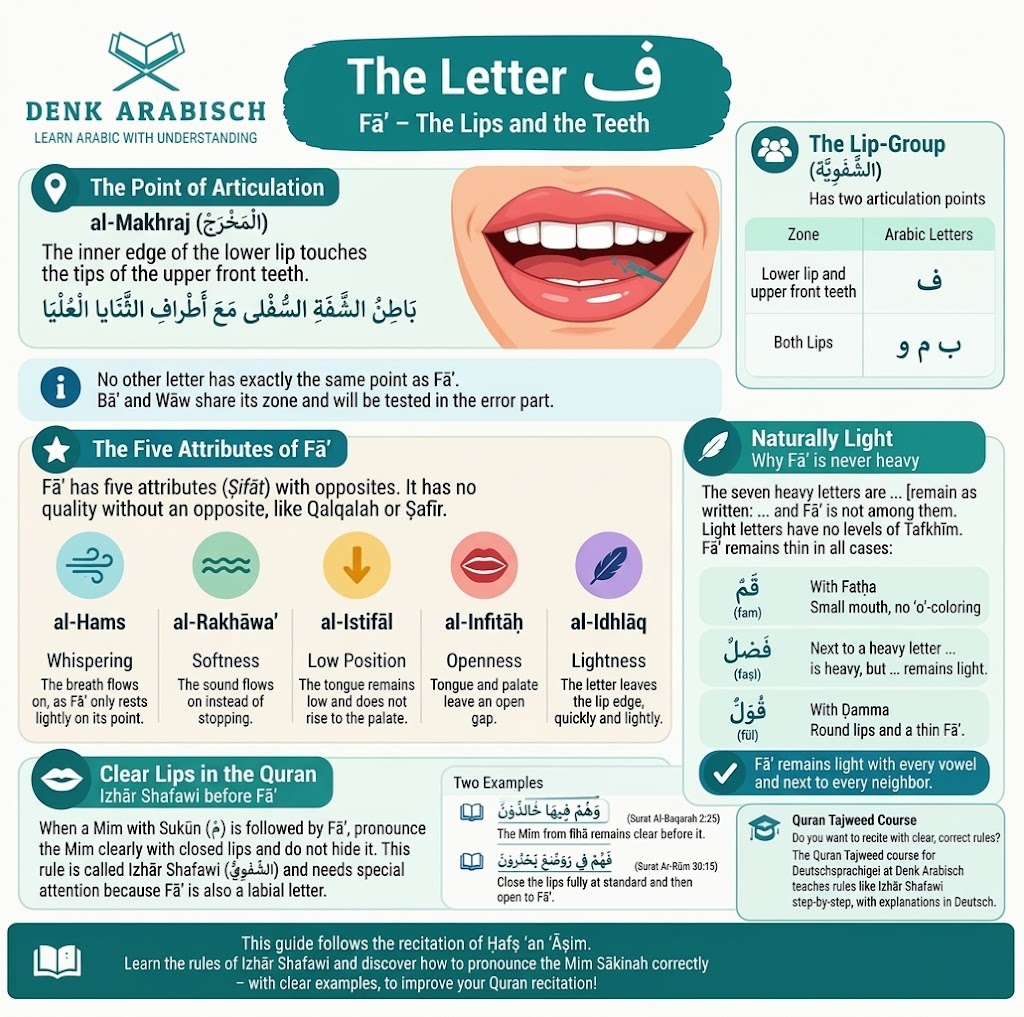
Where Faa (ف) Is Made: The Lips and the Teeth
The makhraj (الْمَخْرَجُ) of Faa is the inner edge of the lower lip touching the tips of the upper front teeth (بَاطِنُ الشَّفَةِ السُّفْلَى مَعَ أَطْرَافِ الثَّنَايَا الْعُلْيَا). It belongs to the lip group (الشَّفَوِيَّةُ), which has two points of articulation.
| Zone | Arabic Letters | Description (Arabic) |
| Lower lip and upper front teeth | ف | بَاطِنُ الشَّفَةِ السُّفْلَى مَعَ أَطْرَافِ الثَّنَايَا الْعُلْيَا |
| Both lips | ب م و | مَا بَيْنَ الشَّفَتَيْنِ |
No other letter shares the exact point of Faa. Baa and Waaw share its zone, and we will test them in the mistakes section.
Five Attributes That Describe Faa
Faa carries five attributes (ṣifāt) that have opposites. It has none of the attributes without opposites, such as qalqalah or ṣafīr.
- Hams (الْهَمْسُ), whispering: breath keeps flowing because Faa leans only lightly on its point. The ten hams letters are gathered in فَحَثَّهُ شَخْصٌ سَكَتَ.
- Rakhāwa (الرَّخَاوَةُ), softness: the sound flows on instead of stopping.
- Istifāl (الِاسْتِفَالُ), lowering: the tongue stays low and does not rise toward the palate.
- Infitāḥ (الِانْفِتَاحُ), openness: tongue and palate leave an open gap.
- Idhlāq (الْإِذْلَاقُ), ease: the letter leaves from the edge of the lip, quick and light. The idhlāq letters are gathered in فَرَّ مِنْ لُبٍّ.
Light by Nature: Why Faa Never Turns Heavy
The seven heavy letters are gathered in خُصَّ ضَغْطٍ قِظْ, and Faa is not among them. Light letters have no levels of tafkhīm to learn. These cases show Faa staying thin:
- With fatḥa: فَمٌ (fam), with a narrow mouth and no “o” colour
- Beside a heavy letter: فَصْلٌ (faṣl), where ص is heavy but ف stays light
- With ḍamma: فُولٌ (fūl), with rounded lips and a thin f
Faa stays light with every vowel and next to every neighbour.
Clear Lips in the Quran: Iẓhār Shafawī Before Faa
When a mīm with sukūn (مْ) is followed by Faa, you pronounce the mīm clearly with closed lips and do not hide it. This rule is called Iẓhār Shafawī (الْإِظْهَارُ الشَّفَوِيُّ), and it needs extra care because Faa is also a lip letter. Two examples:
- وَهُمْ فِيهَا خَالِدُونَ (Surah Al-Baqarah 2:25): the mīm of هُمْ stays clear before فِيهَا.
- فَهُمْ فِي رَوْضَةٍ يُحْبَرُونَ (Surah Ar-Rūm 30:15): close the lips fully on مْ, then open to f.
This guide follows the recitation of Ḥafṣ ʿan ʿĀṣim.
Learn the rules of Izhar Shafawi and discover how to pronounce the Meem Sakinah correctly with clear examples to improve your Quran recitation!
Want to recite with clear, correct rules? The Quran Tajweed Course for German Speakers at Denk Arabisch teaches rules like Iẓhār Shafawī step by step, with explanations in German.
Saying Faa (ف) Out Loud
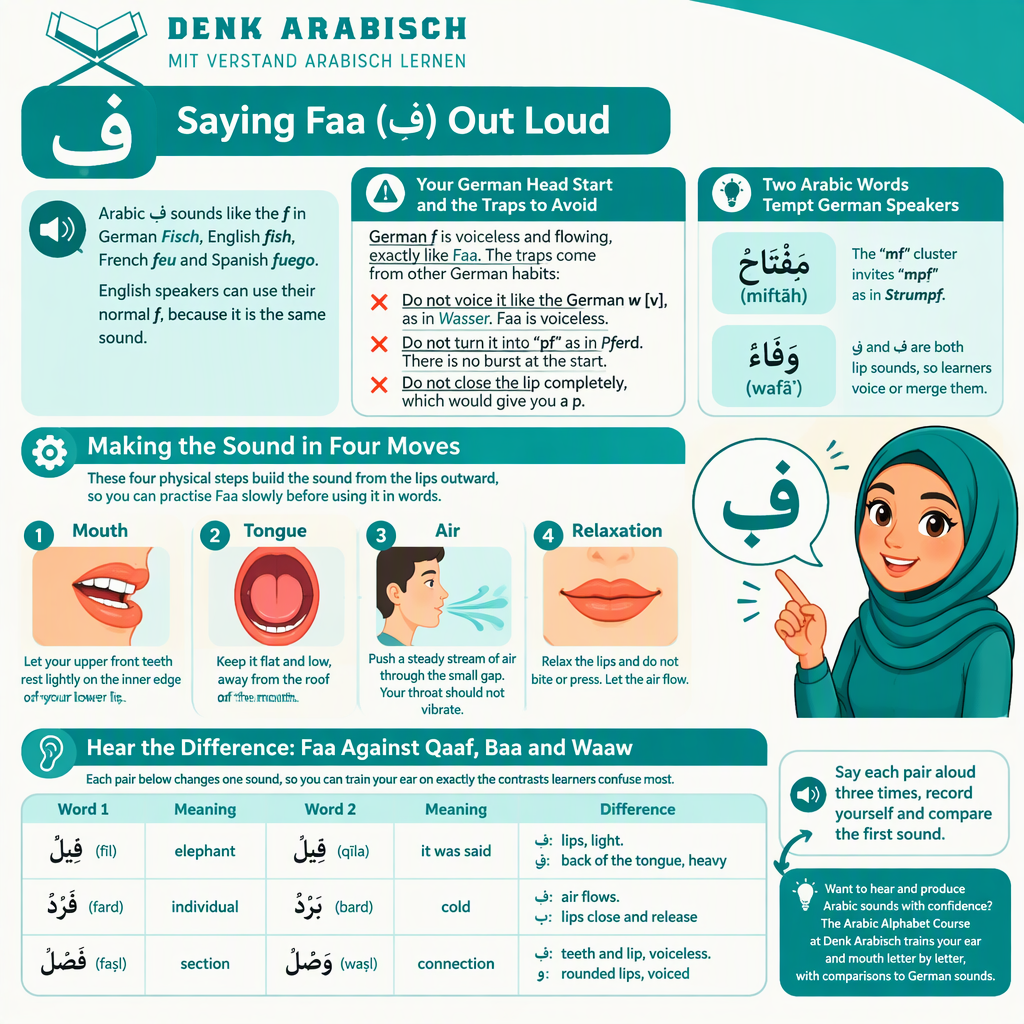
Arabic ف sounds like the f in German Fisch, English fish, French feu and Spanish fuego. English speakers can use their normal f, because it is the same sound.
Your German Head Start and the Traps to Avoid
German f is voiceless and flowing, exactly like Faa. The traps come from other German habits:
- Do not voice it like the German w [v], as in Wasser. Faa is voiceless.
- Do not turn it into “pf” as in Pferd. There is no burst at the start.
- Do not close the lip completely, which would give you a p.
Two Arabic words tempt German speakers:
- مِفْتَاحٌ (miftāḥ): the “mf” cluster invites “mpf” as in Strumpf.
- وَفَاءٌ (wafāʾ): و and ف are both lip sounds, so learners voice or merge them.
Making the Sound in Four Moves
These four physical steps build the sound from the lips outward, so you can practise Faa slowly before using it in words.
- Mouth: let your upper front teeth rest lightly on the inner edge of your lower lip.
- Tongue: keep it flat and low, away from the roof of the mouth.
- Air: push a steady stream of air through the small gap. Your throat should not vibrate.
- Relaxation: relax the lips and do not bite or press. Let the air flow.
Hear the Difference: Faa Against Qaaf, Baa and Waaw
Each pair below changes one sound, so you can train your ear on exactly the contrasts learners confuse most.
| Word 1 | Meaning | Word 2 | Meaning | Difference |
| فِيلٌ (fīl) | elephant | قِيلَ (qīla) | it was said | ف: lips, light. ق: back of the tongue, heavy |
| فَرْدٌ (fard) | individual | بَرْدٌ (bard) | cold | ف: air flows. ب: lips close and release |
| فَصْلٌ (faṣl) | section | وَصْلٌ (waṣl) | connection | ف: teeth and lip, voiceless. و: rounded lips, voiced |
Say each pair aloud three times, record yourself and compare the first sound.
Want to hear and produce Arabic sounds with confidence? The Arabic Alphabet Course at Denk Arabisch trains your ear and mouth letter by letter, with comparisons to German sounds.
Writing Faa (ف) by Hand: Four Shapes, One Dot
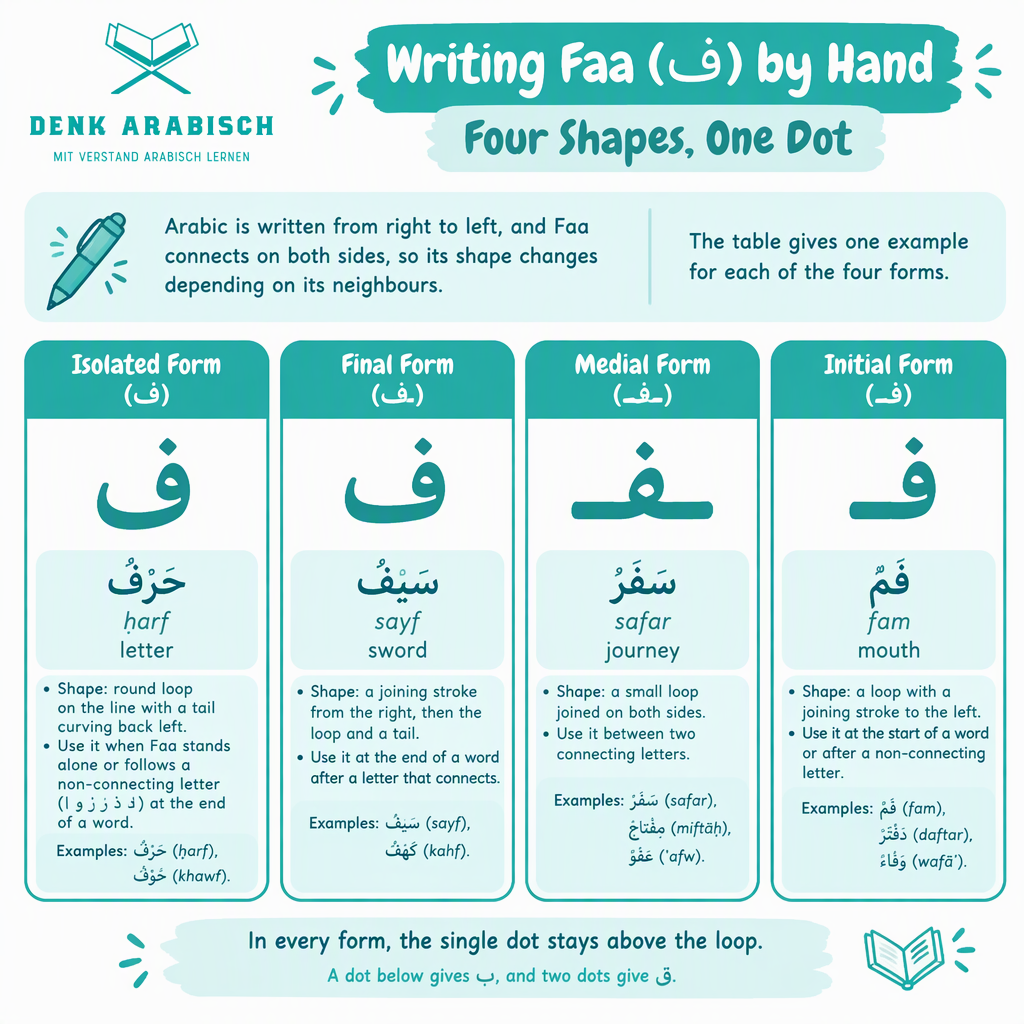
Arabic is written from right to left, and Faa connects on both sides, so its shape changes depending on its neighbours. The table gives one example for each of the four forms.
| Form | Shape | Example | Transliteration | Meaning |
| Isolated | ف | حَرْفٌ | ḥarf | letter |
| Initial | فـ | فَمٌ | fam | mouth |
| Medial | ـفـ | سَفَرٌ | safar | journey |
| Final | ـف | سَيْفٌ | sayf | sword |
1. Isolated Form (ف)
Use it when Faa stands alone or follows a non-connecting letter (ا د ذ ر ز و) at the end of a word.
Shape: a round loop on the line with a tail that curves down and back to the left.
Examples: حَرْفٌ (ḥarf), خَوْفٌ (khawf), where the ر and و do not connect forward.
2. Initial Form (فـ)
Use it at the start of a word or after a non-connecting letter.
Shape: a loop with a short stroke leading to the next letter.
Examples: فَمٌ (fam), دَفْتَرٌ (daftar), وَفَاءٌ (wafāʾ), where ف starts a new joined group after د and و.
3. Medial Form (ـفـ)
Use it between two connecting letters.
Shape: a small loop on the line, joined on both sides.
Examples: سَفَرٌ (safar), مِفْتَاحٌ (miftāḥ), عَفْوٌ (ʿafw).
Learn Arabic with Denk Arabisch Academy
Speak and understand Arabic through a clear and effective learning system
Try a Free Trial4. Final Form (ـف)
Use it at the end of a word after a letter that connects.
Shape: a joining stroke from the right, then the loop and a tail.
Examples: سَيْفٌ (sayf), كَهْفٌ (kahf).
In every form, the single dot stays above the loop. A dot below gives ب, In every form, the single dot stays above the loop. Two dots above the same loop give you ق.
Discover simple tips and practical steps in our guide “How To Learn To Write Arabic?” and start improving your Arabic writing skills with confidence!
Want to write Arabic confidently by hand? The Arabic Writing Course at Denk Arabisch guides you through letter shapes, connections and clean handwriting step by step.
Faa (ف) Plus Vowels: Short, Long and Doubled
Because Faa is light, every vowel stays clean and bright: fatḥa stays an “a” and never drifts toward “o”.
Three Short Vowels and the Silent Faa
The table shows how each short mark changes Faa, including the sukūn that silences the vowel.
| Mark | Name | Sound | Example | Meaning |
| فَ | فَتْحَةٌ | fa | فَتَحَ (fataḥa) | he opened |
| فُ | ضَمَّةٌ | fu | فُرْصَةٌ (furṣa) | opportunity |
| فِ | كَسْرَةٌ | fi | فِكْرَةٌ (fikra) | idea |
| فْ | سُكُونٌ | f (no vowel) | مِفْتَاحٌ (miftāḥ) | key |
Stretching Faa: Three Long Vowels
Each long vowel holds the sound for two beats. Keep Faa light before every one of them.
| Combination | Sound | Example | Meaning |
| فَا | fā | فَاكِهَةٌ (fākiha) | fruit |
| فُو | fū | فُولٌ (fūl) | fava beans |
| فِي | fī | فِيلٌ (fīl) | elephant |
Diphthongs: فَوْ (faw) as in فَوْقَ (fawqa, above), and فَيْ (fay) as in فَيْضٌ (fayḍ, flood).
Doubling Faa with Shadda
A shadda doubles the sound, like the “ff” in German Waffe. Hold the lip contact a little longer and do not repeat it twice. Three examples:
- صَفٌّ (ṣaff): row
- كَفٌّ (kaff): palm of the hand
- خَفَّفَ (khaffafa): he lightened
Three Root Families Built on Faa (ف)
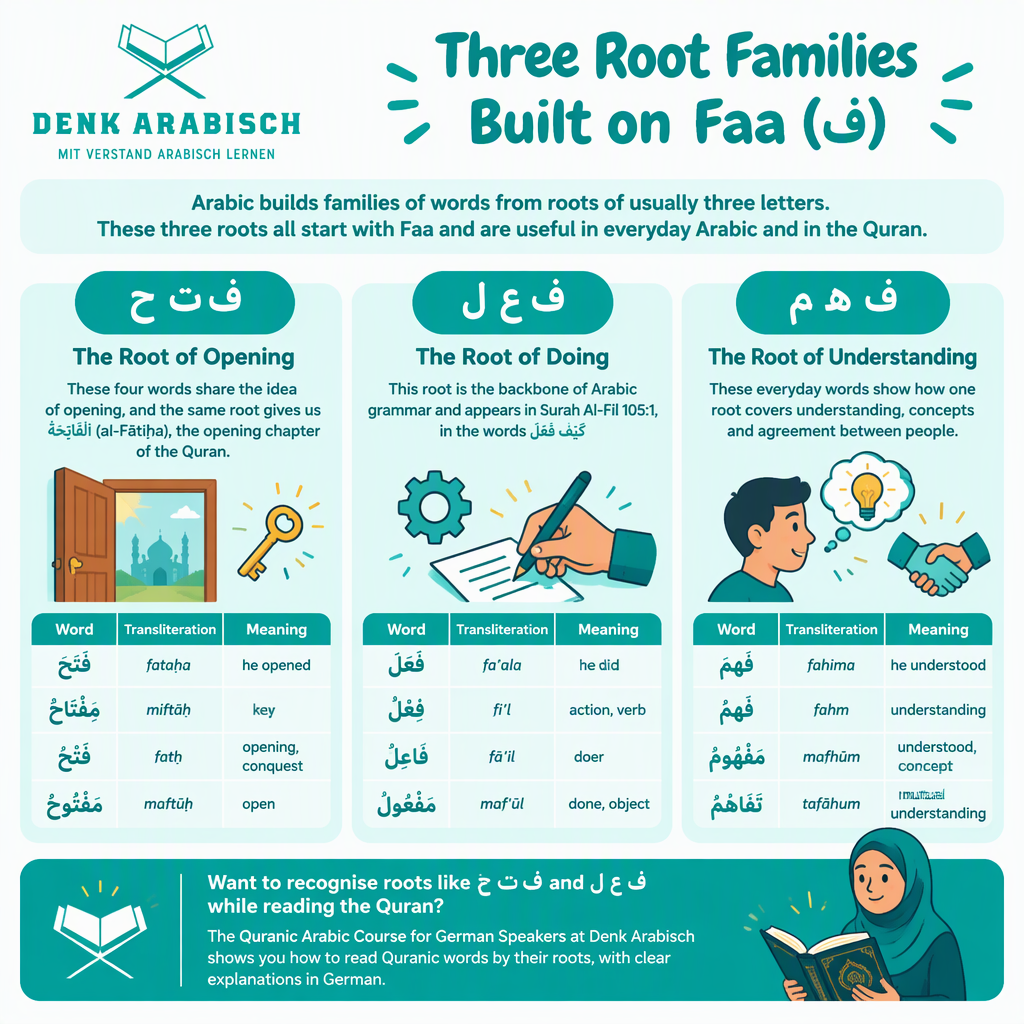
Arabic builds families of words from roots of usually three letters. These three roots all start with Faa and are useful in everyday Arabic and in the Quran.
ف ت ح: The Root of Opening
These four words share the idea of opening, and the same root gives us الْفَاتِحَةُ (al-Fātiḥa), the opening chapter of the Quran.
| Word | Transliteration | Meaning |
| فَتَحَ | fataḥa | he opened |
| مِفْتَاحٌ | miftāḥ | key |
| فَتْحٌ | fatḥ | opening, conquest |
| مَفْتُوحٌ | maftūḥ | open |
ف ع ل: The Root of Doing
This root is the backbone of Arabic grammar and appears in Surah Al-Fīl 105:1, in the words كَيْفَ فَعَلَ.
| Word | Transliteration | Meaning |
| فَعَلَ | faʿala | he did |
| فِعْلٌ | fiʿl | action, verb |
| فَاعِلٌ | fāʿil | doer |
| مَفْعُولٌ | mafʿūl | done, object |
ف ه م: The Root of Understanding
These everyday words show how one root covers understanding, concepts and agreement between people.
| Word | Transliteration | Meaning |
| فَهِمَ | fahima | he understood |
| فَهْمٌ | fahm | understanding |
| مَفْهُومٌ | mafhūm | understood, concept |
| تَفَاهُمٌ | tafāhum | mutual understanding |
Want to recognise roots like ف ت ح and ف ع ل while reading the Quran? The Quranic Arabic Course for German Speakers at Denk Arabisch shows you how to read Quranic words by their roots, with clear explanations in German.
Faa (ف) at the Start, Middle and End of Words
The dot above Faa stays the same in every position while the shape changes, and these words show all three positions.
| Position | Arabic Word | Transliteration | Meaning |
| Beginning | فَمٌ | fam | mouth |
| Middle | سَفَرٌ | safar | journey |
| End | كَهْفٌ | kahf | cave |
Faa (ف) in Short Sentences
These three short sentences reuse words from the table above, with full case endings, so you can read Faa in a real context.
| Arabic Sentence | Transliteration | Meaning |
| الْفِيلُ فِي الْكَهْفِ. | al-fīlu fī l-kahfi | The elephant is in the cave. |
| يَبْدَأُ السَّفَرُ بَعْدَ الْفَجْرِ. | yabdaʾu s-safaru baʿda l-fajri | The journey begins after dawn. |
| هَذَا حَرْفُ الْفَاءِ. | hādhā ḥarfu l-fāʾi | This is the letter Faa. |
Read our Article: Arabic Sentences
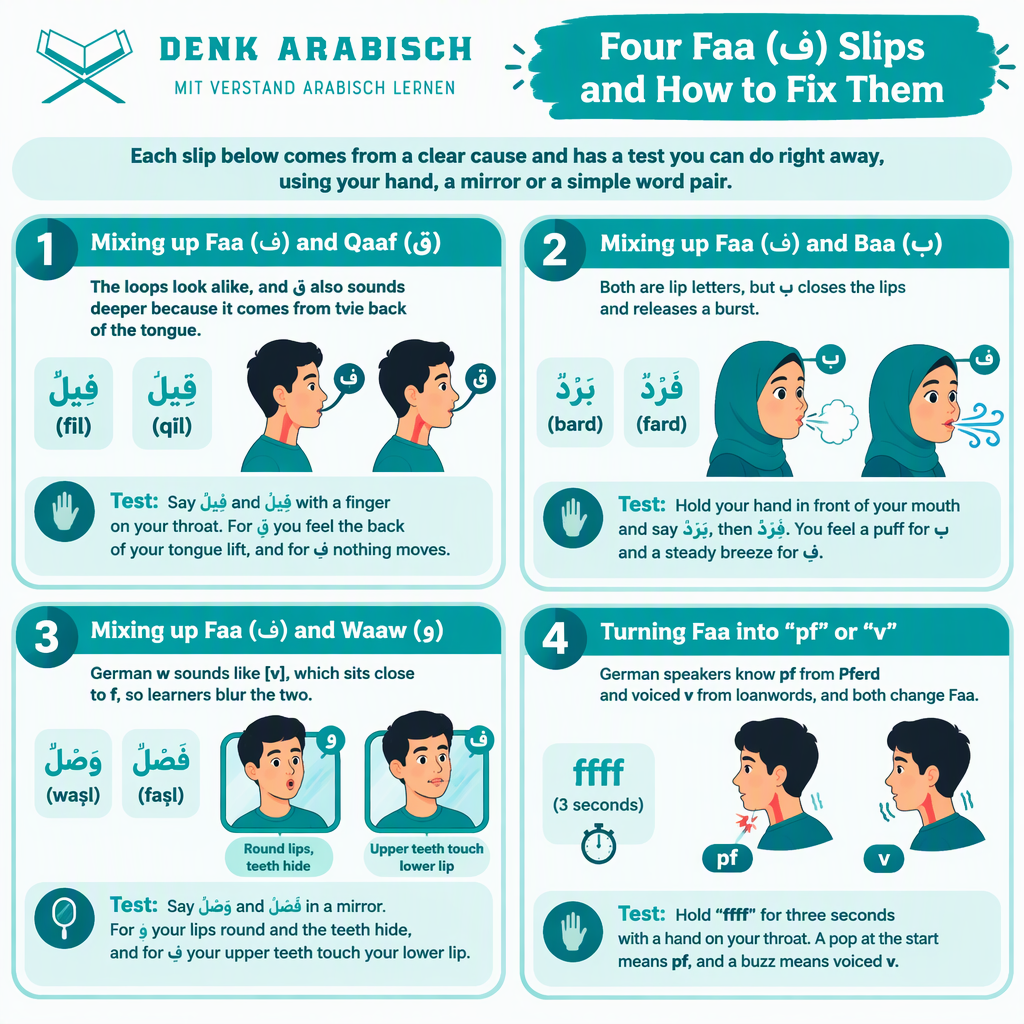
Four Faa (ف) Slips and How to Fix Them
Each slip below comes from a clear cause and has a test you can do right away, using your hand, a mirror or a simple word pair.
1. Mixing up Faa (ف) and Qaaf (ق)
The loops look alike, and ق also sounds deeper because it comes from the back of the tongue.
Test: Say فِيلٌ and قِيلَ with a finger on your throat. For ق you feel the back of your tongue lift, and for ف nothing moves.
2. Mixing up Faa (ف) and Baa (ب)
Both are lip letters, but ب closes the lips and releases a burst.
Test: Hold your hand in front of your mouth and say بَرْدٌ, then فَرْدٌ. You feel a puff for ب and a steady breeze for ف.
3. Mixing up Faa (ف) and Waaw (و)
German w sounds like [v], which sits close to f, so learners blur the two.
Test: Say وَصْلٌ and فَصْلٌ in a mirror. For و your lips round and the teeth hide, and for ف your upper teeth touch your lower lip.
4. Turning Faa into “pf” or “v”
German speakers know pf from Pferd and voiced v from loanwords, and both change Faa.
Test: Hold “ffff” for three seconds with a hand on your throat. A pop at the start means pf, and a buzz means voiced v.
Four Quick Checks on Faa (ف)
Work through these Four exercises to test the sound, shape and rules you learned. Answers follow each one.
Check 1: Multiple Choice
Choose the point of articulation of Faa from the three options below.
- A) The throat
- B) The inner lower lip and the tips of the upper front teeth
- C) The tip of the tongue
Answer: B.
Check 2: Matching
Match each Arabic word to its meaning from the list: sword, dawn, mouth, cave.
- فَمٌ
- سَيْفٌ
- كَهْفٌ
- فَجْرٌ
Answers: فَمٌ = mouth, سَيْفٌ = sword, كَهْفٌ = cave, فَجْرٌ = dawn.
Check 3: Writing Practice
Write ف in all four forms, then copy these words with their dots: حَرْفٌ, سَيْفٌ, سَفَرٌ, فَمٌ.
Check 4: True or False
Decide whether each statement about Faa is true or false.
- Faa is a sun letter.
- Faa has one dot above in all its forms.
- The mīm of هُمْ in وَهُمْ فِيهَا is hidden.
- Faa is a heavy letter.
Answers: 1. False, it is a moon letter. 2. True. 3. False, it is clear (Iẓhār Shafawī). 4. False, it is light.
What Our Students Say About Denk Arabisch Academy
See what our students say about learning at Denk Arabisch Academy on Trustpilot. Read their experiences and check out more reviews to discover how our courses help improve Arabic.

Keep Going with Denk Arabisch After Faa (ف)
Faa is one of the 28 letters of the Arabic alphabet, and a clear learning path helps you connect all of them without gaps. Denk Arabisch is built for German-speaking learners and explains Arabic through German.
Here is what you get when you learn with a structured program:
- Explanations that start from sounds and words you already know in German
- A clear order from letters to words to sentences
- Practice for pronunciation, writing and reading
- Guidance for both adults and parents learning with their children
See what students and parents say about Denk Arabisch on Trustpilot
Pick the course that matches your goal, from your first letters to Quranic recitation and everyday conversation:
- Arabic Course For Beginners
- Arabic Alphabet Course
- Arabic Reading Course
- Arabic Writing Course
- Arabic Speaking Course
- Quranic Arabic Course for German Speakers
- Quran Tajweed Course for German Speakers
Learn Arabic with Denk Arabisch Academy
Speak and understand Arabic through a clear and effective learning system
Try a Free TrialBook a free trial lesson at Denk Arabisch and meet your teacher.

Conclusion
The letter Faa (ف) is one of the friendliest letters in Arabic, especially for German speakers. Three things to remember:
- Sound: voiceless [f], made with the lower lip and upper teeth, light in every vowel.
- Writing: four forms, one dot above the loop.
- Recognition: count the dots above the loop: one for ف, two for ق.
Practice by saying فَمٌ, سَيْفٌ and مِفْتَاحٌ aloud, writing each Faa in its correct form, and testing it against ق, ب and و. Then read the roots ف ت ح, ف ع ل and ف ه م once more. You have already done the hardest part, so keep going with the next letter.
Book a free trial lesson at Denk Arabisch and take your next step in Arabic.
FAQs
These five answers cover the confusions and rules that learners ask about most for this letter.
1. What is the difference between Faa (ف) and Qaaf (ق)?
Faa has one dot and comes from the lips. Qaaf has two dots and comes from the back of the tongue, with a heavy sound.
2. What is the difference between Faa (ف) and Baa (ب)?
Both are lip letters. Baa closes the lips and releases a burst, while Faa lets air flow through the gap between teeth and lip.
3. Is Faa a sun or moon letter?
Faa is a moon letter. The lām of al- stays clear, as in الْفَجْرُ (al-fajr), and Faa carries no shadda.
4. Is Faa heavy or light?
Faa is light (مُرَقَّقٌ). It stays thin with every vowel and next to heavy letters, as in فَصْلٌ.
5. Which Tajweed rule applies to Faa?
When a mīm with sukūn meets Faa, you apply Iẓhār Shafawī. Pronounce the mīm clearly with closed lips, as in وَهُمْ فِيهَا.