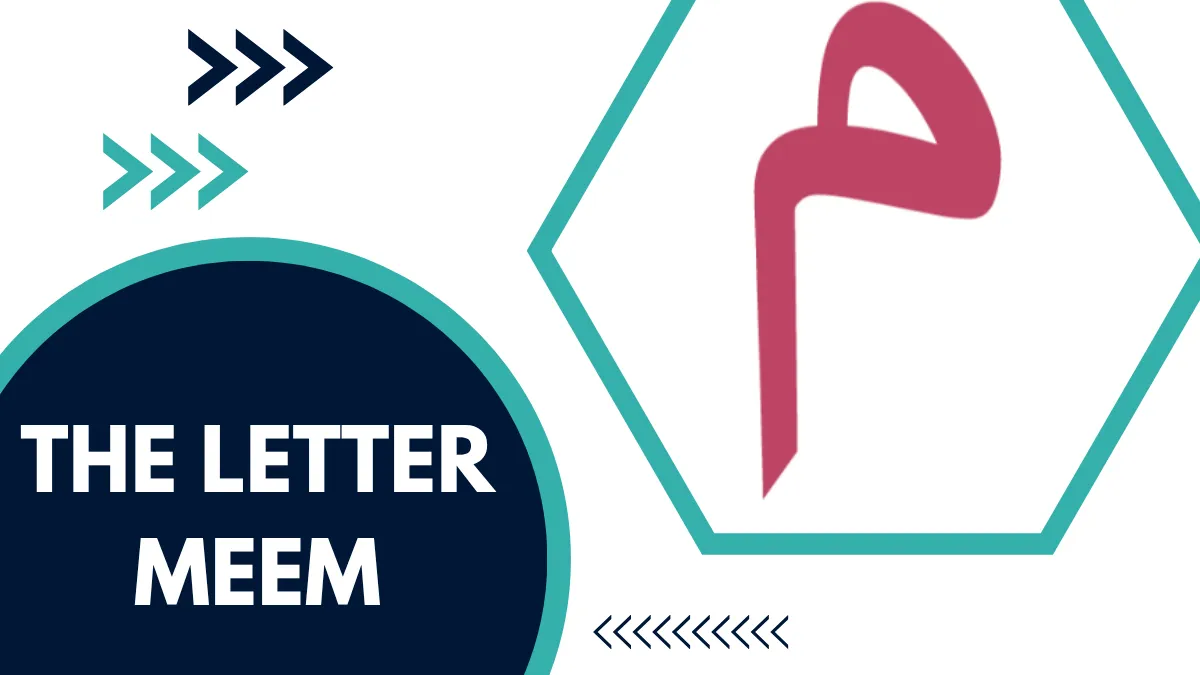
The letter Meem (م), called مِيم in Arabic, is the 24th letter of the Arabic alphabet. You make it by pressing your lips together and letting your voice hum through your nose. Linguists call it a voiced bilabial nasal, written [m] in IPA.
German speakers have a head start here. The Arabic Meem sounds exactly like the m in “Mama”, “Milch” and “Mond”. Your real work is in the details: doubled Meem, its nasal hum in recitation and its clean written shapes.
This guide covers everything you need to know about Meem, from the first sound to the last Tajweed rule:
- How to pronounce Meem and keep it distinct from ب and ن
- How to write Meem in its four forms
- How Meem combines with short vowels, long vowels and shadda
- The Tajweed rules of Meem in Quran recitation
- Common words and three important roots with Meem
Short exercises at the end let you check what you have learned.
The table below collects the core facts about Meem in one place, so you can return to it whenever you need a fast reminder of its sound, position or behavior.
| Feature | Meem (م) |
| Name | مِيم (Mīm), often spelled Meem |
| Sound | [m], voiced bilabial nasal, as in German “Mama” or English “moon” |
| Position in the alphabet | 24th letter in hijāʾī order |
| Abjad value | 13th in Abjad order, value 40 |
| Transliteration | Common: m; DIN 31635: m; ALA-LC: m; Arabizi: m (no number needed) |
| Point of articulation | Both lips (اَلشَّفَتَانِ), with nasal sound from the nose (اَلْخَيْشُومُ) |
| Sun or Moon letter | Moon letter |
| Heavy or light | Always light (muraqqaq) |
| Dots | None |
| Connection | Connects on both sides, so it has four forms |
Discover helpful tips, effective strategies, and practical guidance in our article “Learning Arabic” and take your first step toward mastering the Arabic language!
Table of Contents
Finding The Letter Meem (م) in the Alphabet Order
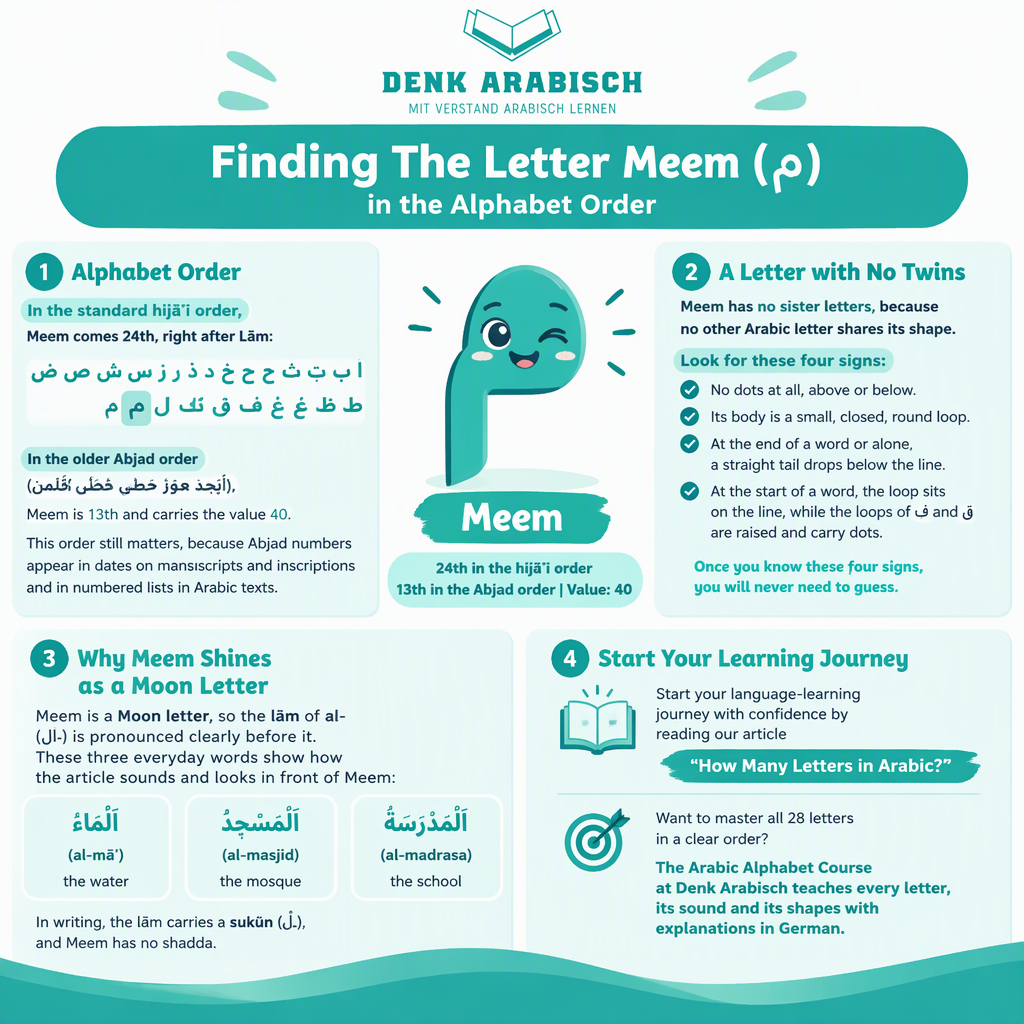
In the standard hijāʾī order, Meem comes 24th, right after Lām:
ا ب ت ث ج ح خ د ذ ر ز س ش ص ض ط ظ ع غ ف ق ك ل م
In the older Abjad order (أَبْجَدْ هَوَّزْ حُطِّي كَلَمَنْ), Meem is 13th and carries the value 40. This order still matters, because Abjad numbers appear in dates on manuscripts and inscriptions and in numbered lists in Arabic texts.
A Letter with No Twins: Recognizing Meem at First Sight
Meem has no sister letters, because no other Arabic letter shares its body shape. These features help you identify it instantly on any page, in print or in handwriting:
- Meem has no dots at all, above or below.
- Its body is a small, closed, round loop.
- At the end of a word or standing alone, a straight tail drops below the line.
- At the start of a word, the loop sits on the line, while the loops of ف and ق are raised and carry dots.
Once you know these four signs, you will never need to guess.
Why Meem Shines as a Moon Letter
Meem is a Moon letter, so the lām of al- (الْـ) is pronounced clearly before it. These three everyday words show how the article sounds and looks in front of Meem:
- اَلْمَاءُ (al-māʾ) – the water
- اَلْمَسْجِدُ (al-masjid) – the mosque
- اَلْمَدْرَسَةُ (al-madrasa) – the school
In writing, the lām carries a sukūn (لْ), and Meem has no shadda.
Start your language-learning journey with confidence by reading our article “How Many Letters in Arabic?”
Two Lips, One Hum: Meem’s Makhraj and Its Tajweed Role
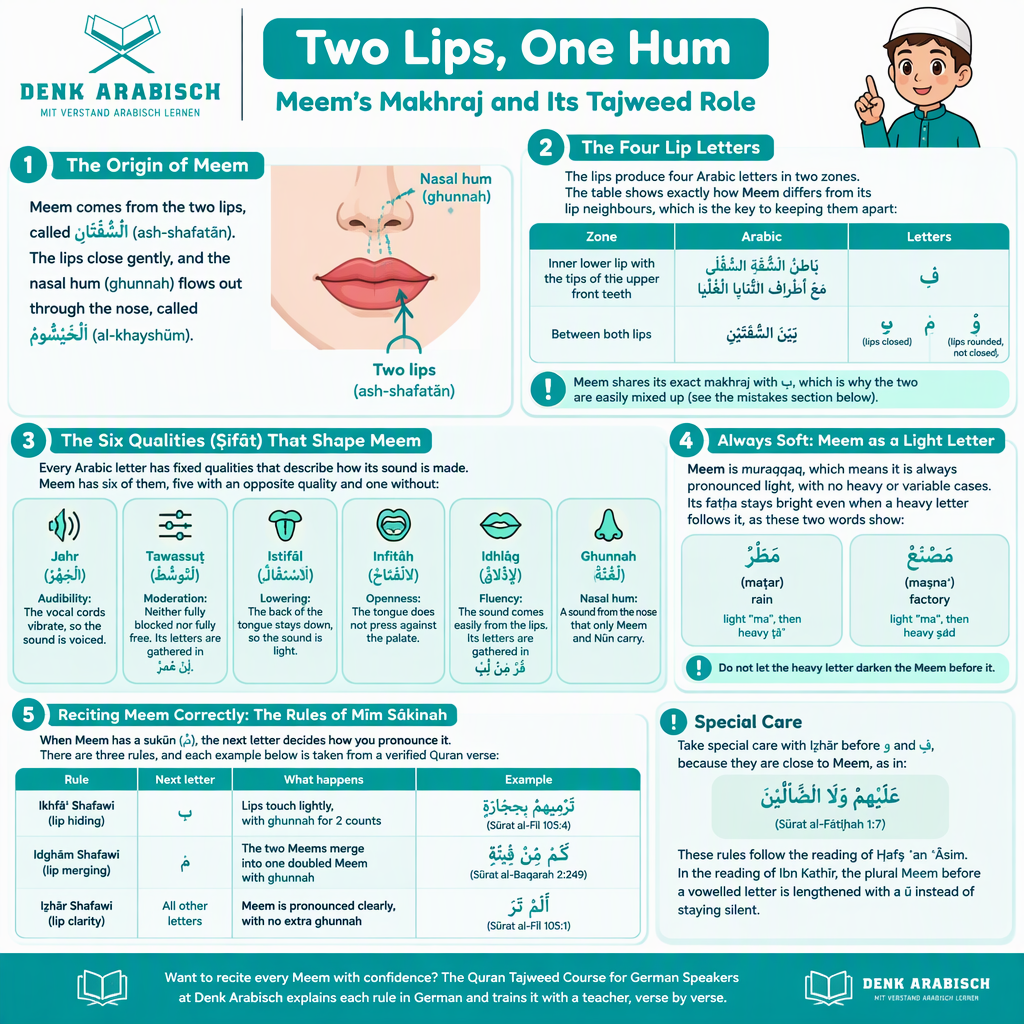
Meem comes from the two lips, called اَلشَّفَتَانِ (ash-shafatān). The lips close gently, and the nasal hum (ghunnah) flows out through the nose, called اَلْخَيْشُومُ (al-khayshūm).
The lips produce four Arabic letters in two zones. The table shows exactly how Meem differs from its lip neighbours, which is the key to keeping them apart:
| Zone | Arabic | Letters |
| Inner lower lip with the tips of the upper front teeth | بَاطِنُ الشَّفَةِ السُّفْلَى مَعَ أَطْرَافِ الثَّنَايَا الْعُلْيَا | ف |
| Between both lips | بَيْنَ الشَّفَتَيْنِ | ب م (lips closed), و (lips rounded, not closed) |
Meem shares its exact makhraj with ب, which is why the two are easily mixed up (see the mistakes section below).
The Six Qualities (Ṣifāt) That Shape Meem
Every Arabic letter has fixed qualities that describe how its sound is made. Meem has six of them, five with an opposite quality and one without:
- Jahr (اَلْجَهْرُ), audibility: the vocal cords vibrate, so the sound is voiced.
- Tawassuṭ (اَلتَّوَسُّطُ), moderation: the sound is neither fully blocked nor fully free. Its letters are gathered in لِنْ عُمَرْ.
- Istifāl (اَلْاِسْتِفَالُ), lowering: the back of the tongue stays down, so the sound is light.
- Infitāḥ (اَلْاِنْفِتَاحُ), openness: the tongue does not press against the palate.
- Idhlāq (اَلْإِذْلَاقُ), fluency: the sound comes easily from the lips. Its letters are gathered in فَرَّ مِنْ لُبِّ.
- Ghunnah (اَلْغُنَّةُ), nasal hum: a sound from the nose that only Meem and Nūn carry.
Always Soft: Meem as a Light Letter
Meem is muraqqaq, which means it is always pronounced light, with no heavy or variable cases. Its fatḥa stays bright even when a heavy letter follows it, as these two words show:
- مَطَرٌ (maṭar) – rain: light “ma”, then heavy ṭāʾ
- مَصْنَعٌ (maṣnaʿ) – factory: light “ma”, then heavy ṣād
Do not let the heavy letter darken the Meem before it.
Reciting Meem Correctly: The Rules of Mīm Sākinah
When Meem has a sukūn (مْ), the next letter decides how you pronounce it. There are three rules, and each example below is taken from a verified Quran verse:
| Rule | Next letter | What happens | Example |
| Ikhfāʾ Shafawī (lip hiding) | ب | Lips touch lightly, with ghunnah for 2 counts | تَرْمِيهِم بِحِجَارَةٍ (Sūrat al-Fīl 105:4) |
| Idghām Shafawī (lip merging) | م | The two Meems merge into one doubled Meem with ghunnah | كَم مِّن فِئَةٍ (Sūrat al-Baqarah 2:249) |
| Iẓhār Shafawī (lip clarity) | All other letters | Meem is pronounced clearly, with no extra ghunnah | أَلَمْ تَرَ (Sūrat al-Fīl 105:1) |
Take special care with Iẓhār before و and ف, because they are close to Meem, as in عَلَيْهِمْ وَلَا الضَّالِّينَ (Sūrat al-Fātiḥah 1:7). These rules follow the reading of Ḥafṣ ʿan ʿĀṣim. In the reading of Ibn Kathīr, the plural Meem before a vowelled letter is lengthened with a ū instead of staying silent.
Two More Tajweed Rules Where Meem Appears
- Ghunnah of the doubled Meem: every Meem with shadda is recited with a full ghunnah of two counts, as in ثُمَّ (thumma) and عَمَّ يَتَسَاءَلُونَ (Sūrat an-Nabaʾ 78:1).
- Iqlāb (conversion): when a Nūn sākinah or tanwīn comes before ب, it turns into a hidden Meem with ghunnah, as in مِنۢ بَعْدِ مِيثَاقِهِ (Sūrat al-Baqarah 2:27) and إِنَّ اللَّهَ سَمِيعٌۢ بَصِيرٌ (Sūrat al-Ḥajj 22:75). In the Mushaf, a small Meem above the Nūn or tanwīn marks this rule.
Want to recite every Meem with confidence? The Quran Tajweed Course for German Speakers at Denk Arabisch explains each rule in German and trains it with a teacher, verse by verse.
Saying Meem Right: A Sound You Already Own
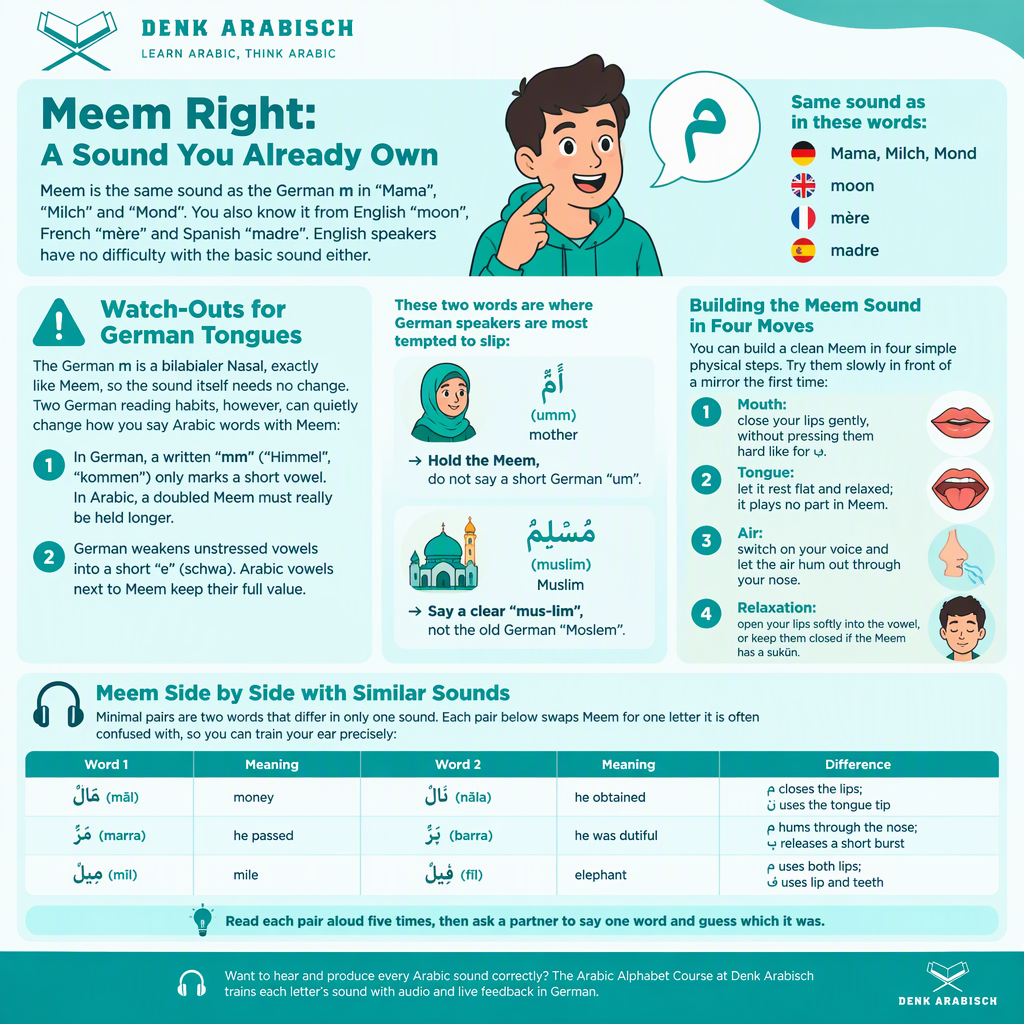
Meem is the same sound as the German m in “Mama”, “Milch” and “Mond”. You also know it from English “moon”, French “mère” and Spanish “madre”. English speakers have no difficulty with the basic sound either.
Watch-Outs for German Tongues
The German m is a bilabialer Nasal, exactly like Meem, so the sound itself needs no change. Two German reading habits, however, can quietly change how you say Arabic words with Meem:
- In German, a written “mm” (“Himmel”, “kommen”) only marks a short vowel. In Arabic, a doubled Meem must really be held longer.
- German weakens unstressed vowels into a short “e” (schwa). Arabic vowels next to Meem keep their full value.
These two words are where German speakers are most tempted to slip:
- أُمٌّ (umm) – mother: hold the Meem, do not say a short German “um”.
- مُسْلِمٌ (muslim) – Muslim: say a clear “mus-lim”, not the old German “Moslem”.
Building the Meem Sound in Four Moves
You can build a clean Meem in four simple physical steps. Try them slowly in front of a mirror the first time:
- Mouth: close your lips gently, without pressing them hard like for ب.
- Tongue: let it rest flat and relaxed; it plays no part in Meem.
- Air: switch on your voice and let the air hum out through your nose.
- Relaxation: open your lips softly into the vowel, or keep them closed if the Meem has a sukūn.
Discover practical tips and effective methods to Learn to Speak Arabic and communicate naturally in everyday situations.
Meem Side by Side with Similar Sounds
Minimal pairs are two words that differ in only one sound. Each pair below swaps Meem for one letter it is often confused with, so you can train your ear precisely:
| Word 1 | Meaning | Word 2 | Meaning | Difference |
| مَالٌ (māl) | money | نَالَ (nāla) | he obtained | م closes the lips; ن uses the tongue tip |
| مَرَّ (marra) | he passed | بَرَّ (barra) | he was dutiful | م hums through the nose; ب releases a short burst |
| مِيلٌ (mīl) | mile | فِيلٌ (fīl) | elephant | م uses both lips; ف uses lip and teeth |
Read each pair aloud five times, then ask a partner to say one word and guess which it was.
Want to hear and produce every Arabic sound correctly? The Arabic Alphabet Course at Denk Arabisch trains each letter’s sound with audio and live feedback in German.
Shaping Meem on Paper: Its Four Written Forms
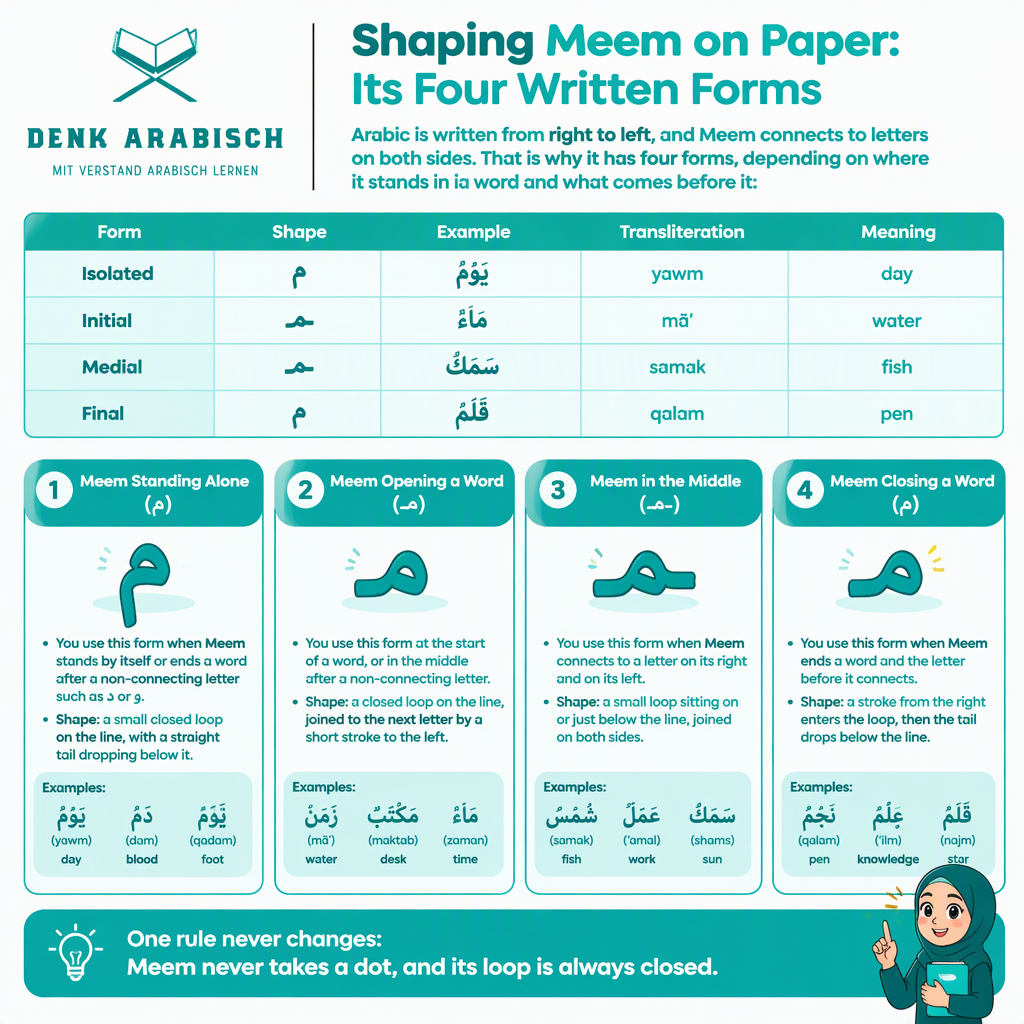
Arabic is written from right to left, and Meem connects to letters on both sides. That is why it has four forms, depending on where it stands in a word and what comes before it:
| Form | Shape | Example | Transliteration | Meaning |
| Isolated | م | يَوْمٌ | yawm | day |
| Initial | مـ | مَاءٌ | māʾ | water |
| Medial | ـمـ | سَمَكٌ | samak | fish |
| Final | ـم | قَلَمٌ | qalam | pen |
1. Meem Standing Alone (م)
You use this form when Meem stands by itself or ends a word after a non-connecting letter such as د or و.
Shape: a small closed loop on the line, with a straight tail dropping below it.
Examples: يَوْمٌ (yawm, day), دَمٌ (dam, blood), قَدَمٌ (qadam, foot).
2. Meem Opening a Word (مـ)
You use this form at the start of a word, or in the middle after a non-connecting letter.
Shape: a closed loop on the line, joined to the next letter by a short stroke to the left.
Examples: مَاءٌ (māʾ, water), مَكْتَبٌ (maktab, desk), زَمَنٌ (zaman, time) after ز.
Learn Arabic with Denk Arabisch Academy
Speak and understand Arabic through a clear and effective learning system
Try a Free Trial3. Meem in the Middle (ـمـ)
You use this form when Meem connects to a letter on its right and on its left.
Shape: a small loop sitting on or just below the line, joined on both sides.
Examples: سَمَكٌ (samak, fish), عَمَلٌ (ʿamal, work), شَمْسٌ (shams, sun).
4. Meem Closing a Word (ـم)
You use this form when Meem ends a word and the letter before it connects.
Shape: a stroke from the right enters the loop, then the tail drops below the line.
Examples: قَلَمٌ (qalam, pen), عِلْمٌ (ʿilm, knowledge), نَجْمٌ (najm, star).
One rule never changes: Meem never takes a dot, and its loop is always closed.
Want to write Arabic neatly by hand? The Arabic Writing Course at Denk Arabisch guides you through letter shapes, connections and clean handwriting step by step.
Giving Meem Its Voice: Meem with Vowels
Because Meem is always light, every vowel on it sounds bright and open, like the “ma” in German “Mama”.
Meem with the Short Vowel Marks
Short vowels (ḥarakāt) are small marks above or below the letter. Each one gives Meem a short sound, and the sukūn removes the vowel completely:
| Mark | Name | Sound | Example | Meaning |
| مَ | Fatḥa | ma | مَطَرٌ (maṭar) | rain |
| مُ | Ḍamma | mu | مُدِيرٌ (mudīr) | director |
| مِ | Kasra | mi | مِلْحٌ (milḥ) | salt |
| مْ | Sukūn | m (no vowel) | شَمْسٌ (shams) | sun |
Stretching Meem: Long Vowels and Diphthongs
A long vowel (madd) is made when Meem is followed by ا, و or ي. Hold these vowels for two counts, about twice as long as a short vowel:
| Combination | Sound | Example | Meaning |
| مَا | mā | مَاءٌ (māʾ) | water |
| مُو | mū | مُوسَى (Mūsā) | Moses |
| مِي | mī | مِيزَانٌ (mīzān) | scale |
Meem also forms two diphthongs: مَوْ (maw) as in مَوْجٌ (mawj, waves), and مَيْ (may) as in مَيْدَانٌ (maydān, square).
Doubling Meem with Shadda
A shadda (ّ) doubles the Meem: you close your lips and hold the hum for about two counts before releasing it. Practise the doubled sound with these three common words:
- أُمٌّ (umm) – mother
- هَمٌّ (hamm) – worry
- مُحَمَّدٌ (Muḥammad) – Muhammad
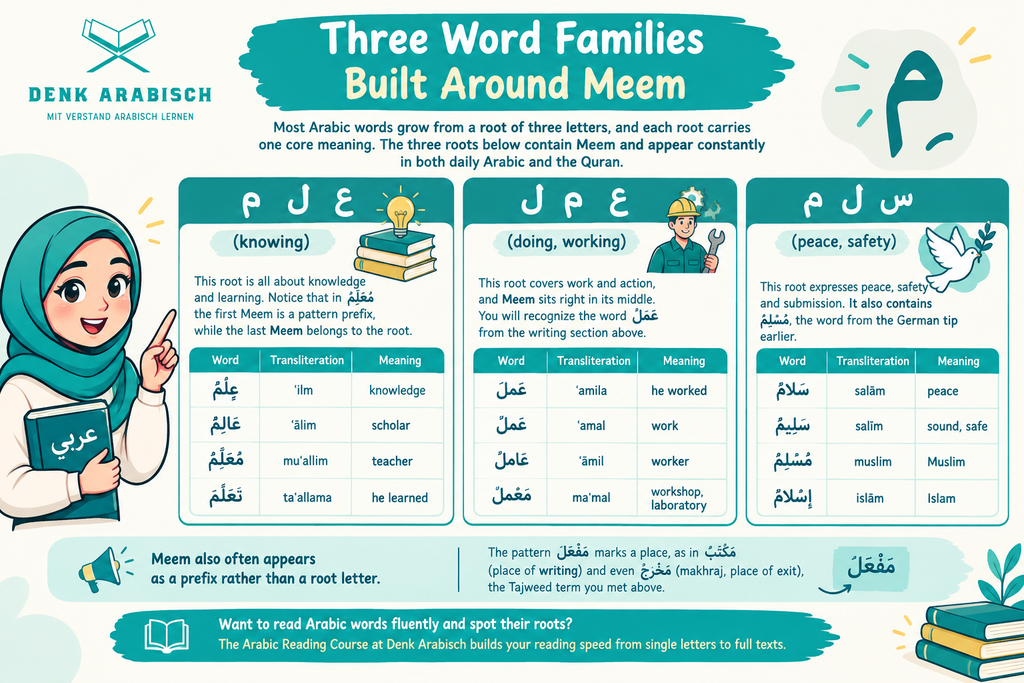
Three Word Families Built Around Meem
Most Arabic words grow from a root of three letters, and each root carries one core meaning. The three roots below contain Meem and appear constantly in both daily Arabic and the Quran.
ر ح م (mercy)
This root expresses mercy and compassion, and Meem is its last letter. You already recite it every time you say بِسْمِ اللَّهِ الرَّحْمَٰنِ الرَّحِيمِ:
In words like مُعَلِّمٌ (muʿallim, teacher) and مُسْلِمٌ, the first Meem is not a root letter but a prefix.
| Word | Transliteration | Meaning |
| رَحِمَ | raḥima | he had mercy |
| رَحْمَةٌ | raḥma | mercy |
| رَحِيمٌ | raḥīm | merciful |
| اَلرَّحْمَٰنُ | ar-Raḥmān | the Most Merciful |
ع م ل (doing, working)
This root covers work and action, and Meem sits right in its middle. You will recognize the word عَمَلٌ from the writing section above:
| Word | Transliteration | Meaning |
| عَمِلَ | ʿamila | he worked |
| عَمَلٌ | ʿamal | work |
| عَامِلٌ | ʿāmil | worker |
| مَعْمَلٌ | maʿmal | workshop, laboratory |
س ل م (peace, safety)
This root expresses peace, safety and submission. It also contains مُسْلِمٌ, the word from the German tip earlier:
| Word | Transliteration | Meaning |
| سَلَامٌ | salām | peace |
| سَلِيمٌ | salīm | sound, safe |
| مُسْلِمٌ | muslim | Muslim |
| إِسْلَامٌ | islām | Islam |
Meem also often appears as a prefix rather than a root letter. The pattern مَفْعَل marks a place, as in مَكْتَبٌ (place of writing) and even مَخْرَجٌ (makhraj, place of exit), the Tajweed term you met above.
Want to read Arabic words fluently and spot their roots? The Arabic Reading Course at Denk Arabisch builds your reading speed from single letters to full texts.
Meem in Full Sentences
Now you can see Meem working inside complete sentences. These three short sentences reuse words you met earlier in this guide, with full vowel marks and case endings:
| Arabic Sentence | Transliteration | Meaning |
| شَرِبْتُ الْمَاءَ. | sharibtu l-māʾa. | I drank the water. |
| اَلْقَلَمُ عَلَى الْمَكْتَبِ. | al-qalamu ʿalā l-maktabi. | The pen is on the desk. |
| ذَهَبْنَا إِلَى الْمَسْجِدِ يَوْمَ الْجُمُعَةِ. | dhahabnā ilā l-masjidi yawma l-jumuʿati. | We went to the mosque on Friday. |
Read our Article: Arabic Sentences
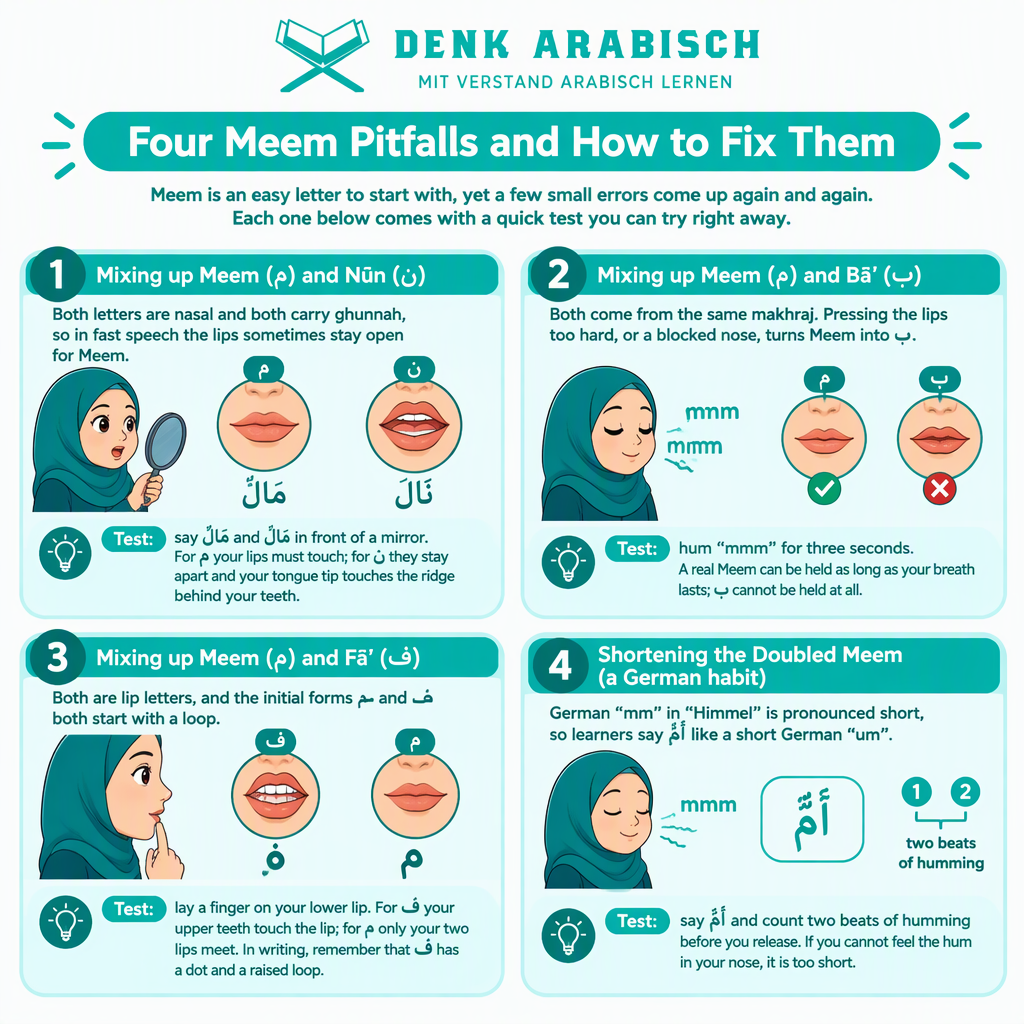
Four Meem Pitfalls and How to Fix Them
Meem is an easy letter to start with, yet a few small errors come up again and again. Each one below comes with a quick test you can try right away.
1. Mixing up Meem (م) and Nūn (ن)
Both letters are nasal and both carry ghunnah, so in fast speech the lips sometimes stay open for Meem.
Test: say مَالٌ and نَالَ in front of a mirror. For م your lips must touch; for ن they stay apart and your tongue tip touches the ridge behind your teeth.
2. Mixing up Meem (م) and Bāʾ (ب)
Both come from the same makhraj. Pressing the lips too hard, or a blocked nose, turns Meem into ب.
Test: hum “mmm” for three seconds. A real Meem can be held as long as your breath lasts; ب cannot be held at all.
3. Mixing up Meem (م) and Fāʾ (ف)
Both are lip letters, and the initial forms مـ and فـ both start with a loop.
Test: lay a finger on your lower lip. For ف your upper teeth touch the lip; for م only your two lips meet. In writing, remember that ف has a dot and a raised loop.
4. Shortening the Doubled Meem (a German habit)
German “mm” in “Himmel” is pronounced short, so learners say أُمٌّ like a short German “um”.
Test: say أُمٌّ and count two beats of humming before you release. If you cannot feel the hum in your nose, it is too short.
Practice Corner: Check Your Meem Skills
These four short exercises use only words from this guide. Try each one before you read the answer underneath.
Exercise 1: Multiple Choice
This question checks whether you remember where Meem is made. Choose the letter that shares exactly the same makhraj as Meem:
- a) ن
- b) ب
- c) ق
Answer: b) ب. Both are made by closing the two lips.
Exercise 2: Matching
This exercise connects four Meem words with their meanings. Match each Arabic word on the left with the correct English meaning on the right:
| Arabic | Meaning |
| 1. مَاءٌ | a) day |
| 2. قَلَمٌ | b) sun |
| 3. شَمْسٌ | c) water |
| 4. يَوْمٌ | d) pen |
Answer: 1-c, 2-d, 3-b, 4-a.
Exercise 3: Writing Practice
This task trains your hand on all four forms of Meem. Copy each item three times, and name the form of Meem in every word:
- م – مـ – ـمـ – ـم
- زَمَنٌ
- سَمَكٌ
- قَلَمٌ
- يَوْمٌ
Exercise 4: True or False
These four statements test the key facts about Meem from this guide. Decide whether each one is true or false:
- Meem is a Sun letter.
- Meem is always pronounced light.
- Mīm sākinah before ب is pronounced with Iẓhār Shafawī.
- Meem has four written forms.
Answers: 1. False, it is a Moon letter. 2. True. 3. False, it is Ikhfāʾ Shafawī. 4. True.
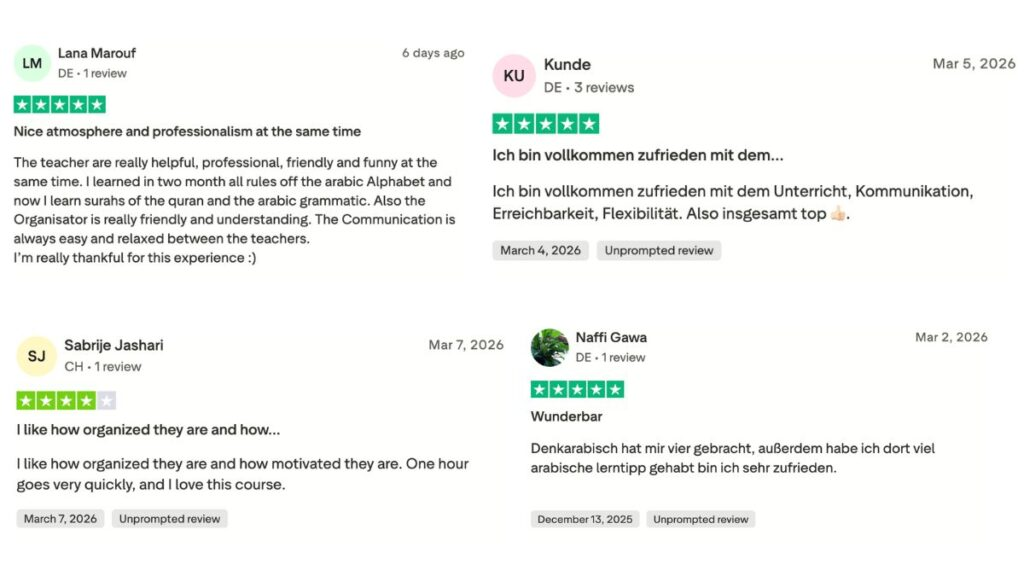
What Our Students Say About Denk Arabisch Academy
See what our students say about learning at Denk Arabisch Academy on Trustpilot. Read their experiences and check out more reviews to discover how our courses help improve Arabic.
Keep Going After Meem with Denk Arabisch
Meem is one of 28 letters, and every one of them gets easier when you learn in a clear order. Denk Arabisch is built for German-speaking learners and explains Arabic through German, step by step.
Here is what makes learning with Denk Arabisch different. These four benefits are designed around the needs of German-speaking adults and parents of children:
- Explanations in German that compare Arabic sounds with sounds you already know
- Qualified teachers who correct your pronunciation live
- A structured path from the alphabet to reading, writing and speaking
- Flexible online lessons for adults and children
Choose Your Specialized Course. Each course below focuses on one clear goal, so you can start exactly where you need it most:
- Arabic Course For Beginners: your first steps in the language, from zero.
- Arabic Alphabet Course: all 28 letters, their sounds and shapes.
- Arabic Reading Course: fluent reading with and without vowel marks.
- Arabic Writing Course: clean handwriting and correct letter connections.
- Arabic Speaking Course: everyday conversations with confidence.
- Quranic Arabic Course for German Speakers: understand the language of the Quran.
- Quran Tajweed Course for German Speakers: recite with correct rules and sound.
Learn Arabic with Denk Arabisch Academy
Speak and understand Arabic through a clear and effective learning system
Try a Free TrialBook a free trial lesson at Denk Arabisch and see how quickly your Arabic grows.
You can read what our students say on Trustpilot.

Conclusion
The letter Meem (م) is one of the friendliest letters for German speakers, and now you know it from sound to script. These three points are the core of everything this guide has covered:
- Sound: close both lips gently and let the voice hum through the nose.
- Writing: four forms, always a closed loop, never a dot.
- Recognition: no sister letters, a round loop and a straight tail at the end.
Practise a little every day. Hum a long Meem, write the four forms, and train the pairs مَالٌ / نَالَ, مَرَّ / بَرَّ and مِيلٌ / فِيلٌ. Then review the roots ر ح م, ع م ل and س ل م.”
You already own this sound, so every new word with Meem is a step forward. Book a free trial lesson at Denk Arabisch and take the next step with a teacher.
FAQs
These four questions are the ones learners ask most often about Meem. Each answer is short, so you can use this part as a quick review:
1. What is the difference between Meem (م) and Bāʾ (ب)?
Both are made by closing the two lips. Meem hums through the nose and can be held long, while ب is a short burst of air that stops at once.
2. What is the difference between Meem (م) and Nūn (ن)?
Both are nasal letters with ghunnah. Meem closes the lips, while Nūn keeps the lips open and presses the tongue tip behind the upper teeth.
3. Is Meem a Sun letter or a Moon letter?
Meem is a Moon letter. The lām of al- is pronounced and carries a sukūn, as in اَلْمَاءُ (al-māʾ).
4. Is Meem a heavy or a light letter?
Meem is always light (muraqqaq). It stays light even next to heavy letters, as in مَطَرٌ (maṭar).