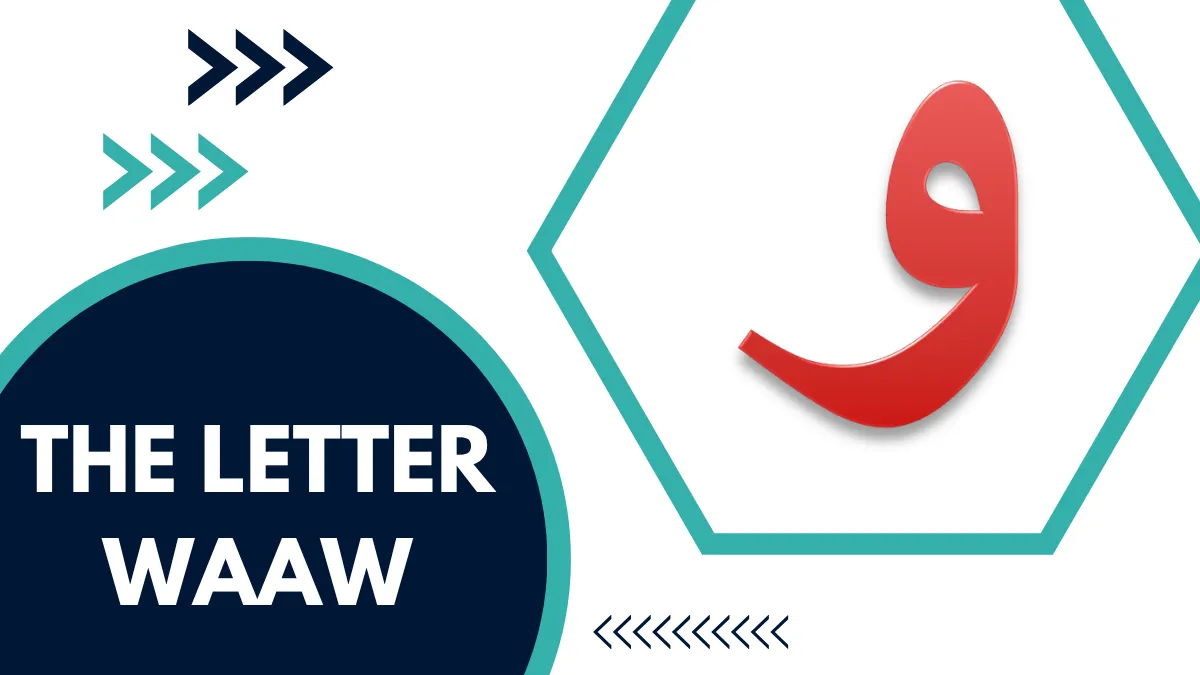
The Letter Waaw (و), written وَاو and pronounced wāw, is the 27th letter of the Arabic alphabet. You make it with your two lips, rounded as if for a German “u”, while your teeth stay out of the way. Linguists call it a voiced labial-velar approximant, IPA [w]. As a long vowel it gives [uː], and after fatḥa it forms the diphthong [aw].
German speakers need an honest start here: the consonant [w] does not exist in German. The German W in “Wasser” is [v], a sound Arabic does not use at all. The good news is that you already own the vowel side of Waaw. The long u in “gut” and the “au” in “Haus” are almost exactly Arabic ū and aw.
| Fact | Waaw (و) |
| Name | وَاو (wāw) |
| Sound | [w] as in English “water”; as a long vowel [uː], like the u in German “gut” |
| Position in the alphabet | 27th letter (hijāʾī order) |
| Abjad value | 6th letter, value 6 |
| Transliteration | Common: w (ū for the long vowel). DIN 31635: w, ū, and au for the diphthong. Other variant: ou (French-influenced). Arabizi: no number, written w or ou |
| Point of articulation | The two lips, الشَّفَتَانِ; the long ū comes from the mouth cavity, الْجَوْفُ |
| Sun or Moon letter | Moon letter |
| Heavy or light | Always light (muraqqaq) |
| Dots | None |
| Connection | Non-connecting: joins the letter before it, never the letter after it |
Table of Contents
Waaw’s Place in the Arabic Alphabet: Hijāʾī and Abjad Order
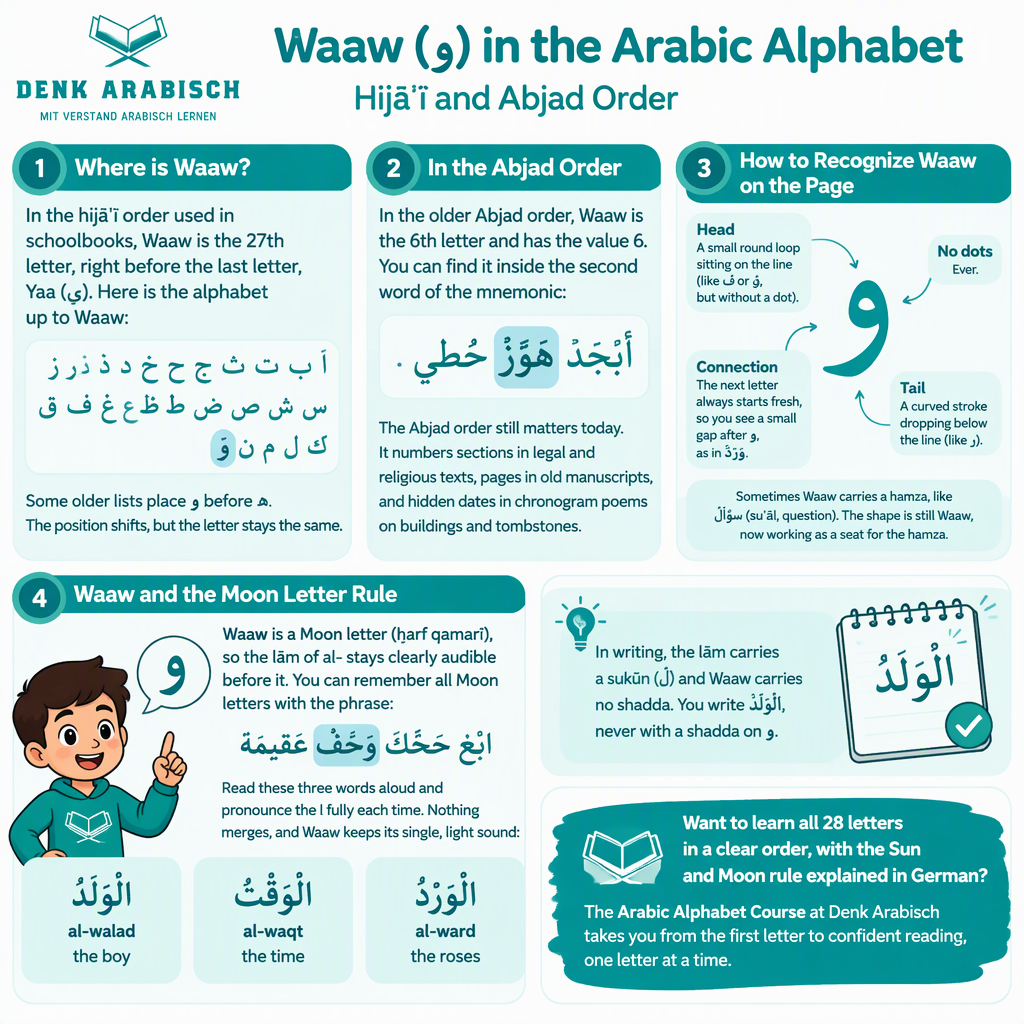
In the hijāʾī order used in schoolbooks, Waaw is the 27th letter, right before the last letter, Yaa (ي). Here is the alphabet up to Waaw:
ا ب ت ث ج ح خ د ذ ر ز س ش ص ض ط ظ ع غ ف ق ك ل م ن ه و
Some older lists place و before ه. The position shifts, but the letter stays the same.
In the older Abjad order, Waaw is the 6th letter and has the value 6. You can find it inside the second word of the mnemonic أَبْجَدْ هَوَّزْ حُطِّي.
The Abjad order still matters today. It numbers sections in legal and religious texts, pages in old manuscripts, and hidden dates in chronogram poems on buildings and tombstones.
How to Recognize Waaw on the Page
Waaw has no sister letters, because no other letter shares its exact body. Four visual clues let you spot it instantly in any Arabic text:
- Head: a small round loop sitting on the line, like the head of Faa (ف) or Qaaf (ق), but without a dot.
- Tail: a curved stroke dropping below the line, like the tail of Raa (ر).
- Dots: none, ever.
- Connection: the next letter always starts fresh, so you see a small gap after و, as in وَرْدٌ.
Sometimes Waaw carries a hamza, as in سُؤَالٌ (suʾāl, question). The shape is still Waaw, now working as a seat for the hamza.
Waaw and the Moon Letter Rule
Waaw is a Moon letter (ḥarf qamarī), so the lām of al- stays clearly audible before it. You can remember all Moon letters with the phrase اِبْغِ حَجَّكَ وَخَفْ عَقِيمَهُ, where و appears in وَخَفْ.
Read these three words aloud and pronounce the l fully each time. Nothing merges, and Waaw keeps its single, light sound:
- الْوَلَدُ (al-walad): the boy
- الْوَقْتُ (al-waqt): the time
- الْوَرْدُ (al-ward): the roses
In writing, the lām carries a sukūn (لْ) and Waaw carries no shadda. You write الْوَلَدُ, never with a shadda on و.
Want to learn all 28 letters in a clear order, with the Sun and Moon rule explained in German? The Arabic Alphabet Course at Denk Arabisch takes you from the first letter to confident reading, one letter at a time.
Where Waaw Is Born: Makhraj, Qualities and Tajweed
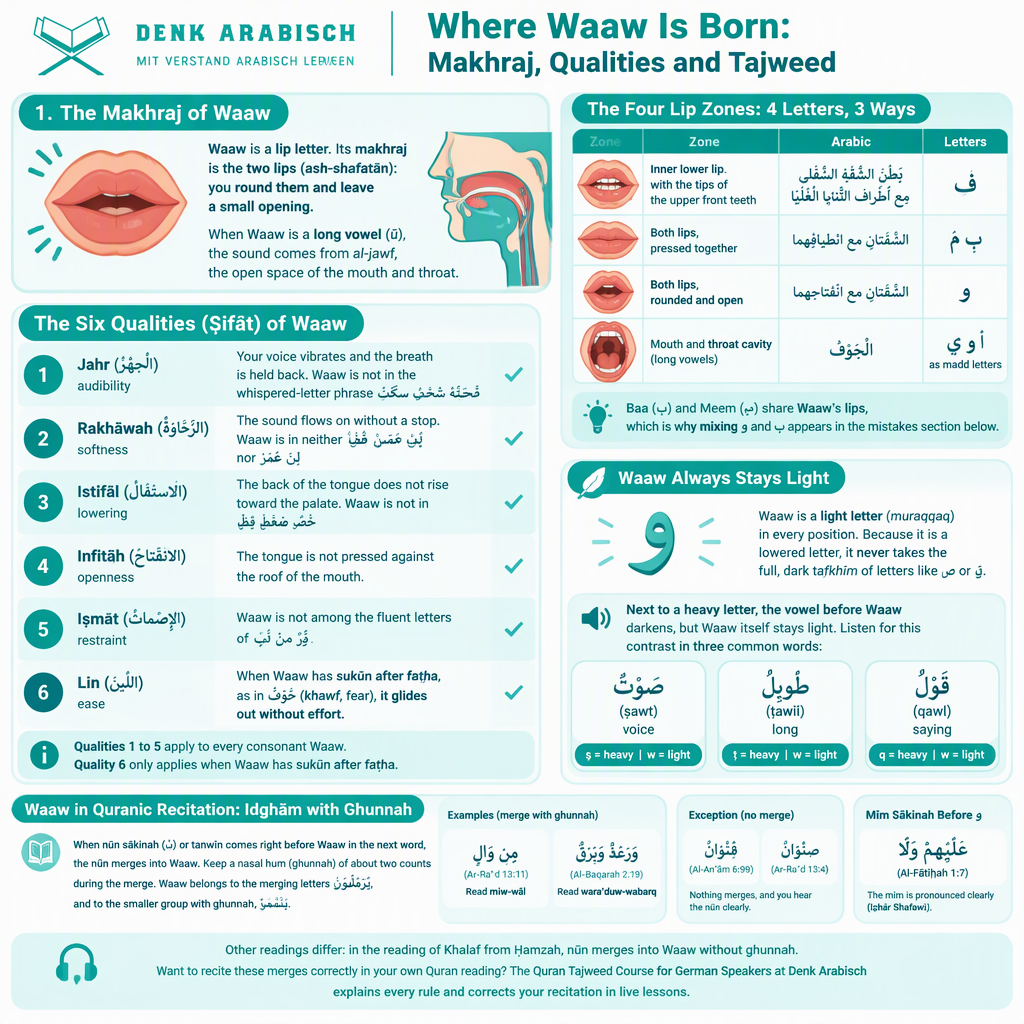
Waaw is a lip letter. Its makhraj is the two lips, الشَّفَتَانِ (ash-shafatān): you round them and leave a small opening. When Waaw is a long vowel (ū), the sound comes from الْجَوْفُ (al-jawf), the open space of the mouth and throat.
The lips produce four letters in three different ways. The table shows exactly how Waaw differs from its neighbours, and that difference explains most of the mistakes later in this guide:
| Zone | Arabic | Letters |
| Inner lower lip with the tips of the upper front teeth | بَطْنُ الشَّفَةِ السُّفْلَى مَعَ أَطْرَافِ الثَّنَايَا الْعُلْيَا | ف |
| Both lips, pressed together | الشَّفَتَانِ مَعَ انْطِبَاقِهِمَا | ب م |
| Both lips, rounded and open | الشَّفَتَانِ مَعَ انْفِتَاحِهِمَا | و |
| Mouth and throat cavity (long vowels) | الْجَوْفُ | ا و ي as madd letters |
Baa (ب) and Meem (م) share Waaw’s lips, which is why mixing و and ب appears in the mistakes section below.
The Six Qualities (Ṣifāt) of Waaw
Tajweed describes every letter by a set of fixed qualities. Waaw has five qualities with opposites and one without, and each one tells you something practical about its sound:
- Jahr (الْجَهْرُ), audibility: your voice vibrates and the breath is held back. Waaw is not in the whispered-letter phrase فَحَثَّهُ شَخْصٌ سَكَتْ.
- Rakhāwah (الرَّخَاوَةُ), softness: the sound flows on without a stop. Waaw is in neither أَجِدْ قَطٍ بَكَتْ nor لِنْ عُمَرْ.
- Istifāl (الِاسْتِفَالُ), lowering: the back of the tongue does not rise toward the palate. Waaw is not in خُصَّ ضَغْطٍ قِظْ.
- Infitāḥ (الِانْفِتَاحُ), openness: the tongue is not pressed against the roof of the mouth.
- Iṣmāt (الْإِصْمَاتُ), restraint: Waaw is not among the fluent letters of فَرَّ مِنْ لُبٍّ.
- Līn (اللِّينُ), ease: when Waaw has sukūn after fatḥa, as in خَوْفٌ (khawf, fear), it glides out without effort.
Qualities 1 to 5 apply to every consonant Waaw. Quality 6 only applies when Waaw has sukūn after fatḥa.
Waaw Always Stays Light
Waaw is a light letter (muraqqaq) in every position. Because it is a lowered letter, it never takes the full, dark tafkhīm of letters like ص or ق.
Next to a heavy letter, the vowel before Waaw darkens, but Waaw itself stays thin. Listen for this contrast in three common words:
- صَوْتٌ (ṣawt, voice): the ṣ is heavy, the w stays light.
- طَوِيلٌ (ṭawīl, long): the ṭ is heavy, the w stays light.
- قَوْلٌ (qawl, saying): the q is heavy, the w stays light.
Waaw in Quranic Recitation: Idghām with Ghunnah
When nūn sākinah (نْ) or tanwīn comes right before Waaw in the next word, the nūn merges into Waaw. In the reading of Ḥafṣ ʿan ʿĀṣim, you keep a nasal hum (ghunnah) of about two counts during the merge. Waaw belongs to the merging letters يَرْمَلُونَ, and to the smaller group with ghunnah, يَنْمُو.
Look at how the merge works in these two verses. In the muṣḥaf, the nūn before Waaw is written without a sukūn, which signals the merge:
- مِن وَالٍ (Ar-Raʿd 13:11): read miw-wāl, with the nasal hum carried into Waaw.
- وَرَعْدٌ وَبَرْقٌ (Al-Baqarah 2:19): the tanwīn of raʿdun merges, read waraʿduw-wabarq.
There is one exception. When nūn and Waaw sit in the same word, nothing merges, and you hear the nūn clearly in قِنْوَانٌ (Al-Anʿām 6:99) and صِنْوَانٌ (Ar-Raʿd 13:4).
Waaw also matters for mīm sākinah. Before و, the mīm is pronounced clearly (Iẓhār Shafawī), as in عَلَيْهِمْ وَلَا (Al-Fātiḥah 1:7). Teachers stress this because both letters come from the lips.
Other readings differ: in the reading of Khalaf from Ḥamzah, nūn merges into Waaw without ghunnah.
When Waaw Meets Waaw, and the Līn Lengthening
Two Waaws in a row usually merge into one doubled Waaw, as in عَصَوا وَّكَانُوا (Al-Baqarah 2:61), where the first Waaw follows a fatḥa. But if the first Waaw is a long ū, nothing merges, so you protect the long vowel and then say a fresh w: آمَنُوا وَعَمِلُوا (Al-Baqarah 2:277).
The Līn quality also matters when you stop. If a word ends in Waaw with sukūn after fatḥa plus one more letter, you may stretch the aw for two, four or six counts when you pause on it, as in مِّنْ خَوْفٍ (Quraysh 106:4).
Want to recite these merges correctly in your own Quran reading? The Quran Tajweed Course for German Speakers at Denk Arabisch explains every rule in German and corrects your recitation in live lessons.
Pronouncing The Letter Waaw (و) the Arabic Way
Arabic و sounds like the w in English “water” and the ou in French “oui”. The Polish ł in “łódź” is the same sound. English speakers need no adjustment at all, because their w is the Arabic Waaw.
Waaw Advice Made for German Ears
German has no [w] consonant. The German W, as in “Wasser” or “Wein”, is [v]: your upper teeth touch your lower lip. Arabic Waaw never uses the teeth.
The closest German route is the vowel u. Say a short u, as in “und”, and slide straight into the next vowel: u-a becomes wa.
Watch out for three German sound habits that change Waaw. Each one turns a correct Arabic word into a foreign-sounding or even different word:
- W becomes [v]: وَلَدٌ turns into “valad”.
- The diphthong aw becomes o: يَوْمٌ (yawm) turns into “yōm”. Use the “au” of German “Haus” instead.
- Long ū gets shortened: نُورٌ (nūr) needs the long u of “gut”, not the short u of “Butter”.
Two words tempt German speakers most. وَاحِدٌ (wāḥid, one) often comes out as “vāḥid”, and وَقْتٌ (waqt, time) as “vaqt”. Say both with round lips and no teeth.
Four Moves to a Clean Waaw
Practise these steps slowly in front of a mirror. The mirror matters, because the one thing you must see is that your teeth never touch your lips:
- Mouth: round your lips as if to say German “u”, leaving a small opening.
- Tongue: let it rest low and relaxed; it does no special work for Waaw.
- Air: switch your voice on so your throat vibrates, and let the air flow through the round opening without friction.
- Release: open your lips straight into the next vowel, wa, wu or wi, without a pause.
Read also: The Letter Yaa (ي) – Sound, Shapes, Tajweed & Everyday Words
Hear the Difference: Waaw and Its Look-alike Sounds
Each pair below changes only one sound, and the meaning changes completely. These are the three letters German learners most often swap with Waaw:
| Word 1 | Meaning | Word 2 | Meaning | Difference |
| وَصْلٌ (waṣl) | connection | فَصْلٌ (faṣl) | separation, chapter | و: round lips, no teeth. ف: upper teeth on lower lip |
| وَلَدٌ (walad) | boy, child | بَلَدٌ (balad) | country | و: lips stay apart. ب: lips close, then open |
| فُولٌ (fūl) | fava beans | فِيلٌ (fīl) | elephant | و: lips round for ū. ي: lips spread for ī |
Read each pair five times aloud, then record yourself and check that your lips do the right thing in every word.
Want to say و naturally in real conversations, not only in drills? The Arabic Speaking Course at Denk Arabisch trains your pronunciation through guided speaking practice with your teacher.
Writing Waaw by Hand: Its Two Shapes
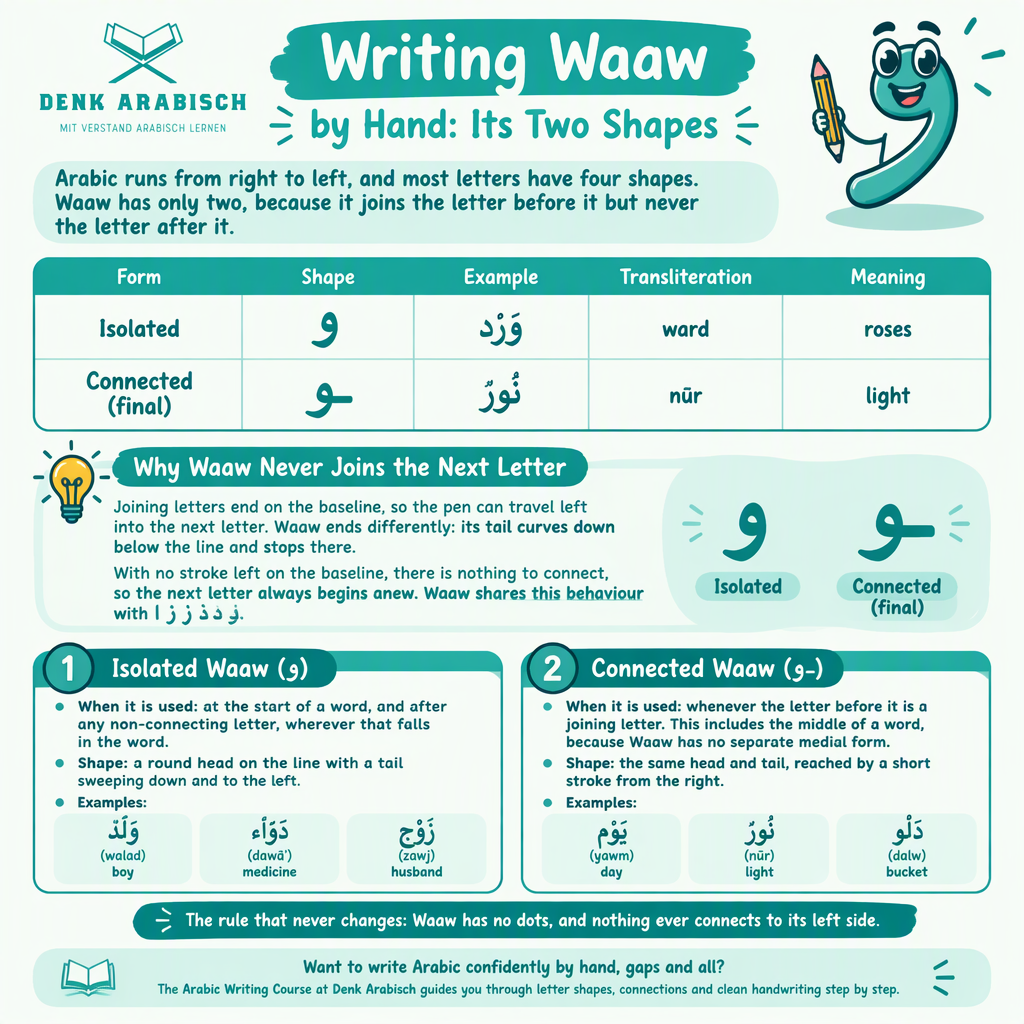
Arabic runs from right to left, and most letters have four shapes. Waaw has only two, because it joins the letter before it but never the letter after it.
Both shapes look almost identical on the page. The only difference is a short connecting stroke on the right, which appears when the letter before Waaw reaches out to it:
| Form | Shape | Example | Transliteration | Meaning |
| Isolated | و | وَرْدٌ | ward | roses |
| Connected (final) | ـو | نُورٌ | nūr | light |
Why Waaw Never Joins the Next Letter
Joining letters end on the baseline, so the pen can travel left into the next letter. Waaw ends differently: its tail curves down below the line and stops there.
With no stroke left on the baseline, there is nothing to connect, so the next letter always begins anew. Waaw shares this behaviour with ا د ذ ر ز.
See all six non-connecting letters side by side in our guide, [Arabic Letters Connected Forms].
1. Isolated Waaw (و)
When it is used: at the start of a word, and after any non-connecting letter, wherever that falls in the word.
Shape: a round head on the line with a tail sweeping down and to the left.
Examples: وَلَدٌ (walad, boy) at the start, دَوَاءٌ (dawāʾ, medicine) after د, and زَوْجٌ (zawj, husband) after ز.
Learn Arabic with Denk Arabisch Academy
Speak and understand Arabic through a clear and effective learning system
Try a Free Trial2. Connected Waaw (ـو)
When it is used: whenever the letter before it is a joining letter. This includes the middle of a word, because Waaw has no separate medial form.
Shape: the same head and tail, reached by a short stroke from the right.
Examples: يَوْمٌ (yawm, day) and نُورٌ (nūr, light) in the middle, and دَلْوٌ (dalw, bucket) at the end.
The rule that never changes: Waaw has no dots, and nothing ever connects to its left side.
Want to write Arabic confidently by hand, gaps and all? The Arabic Writing Course at Denk Arabisch guides you through letter shapes, connections and clean handwriting step by step.
Waaw Meets the Vowels: Short, Long and Doubled
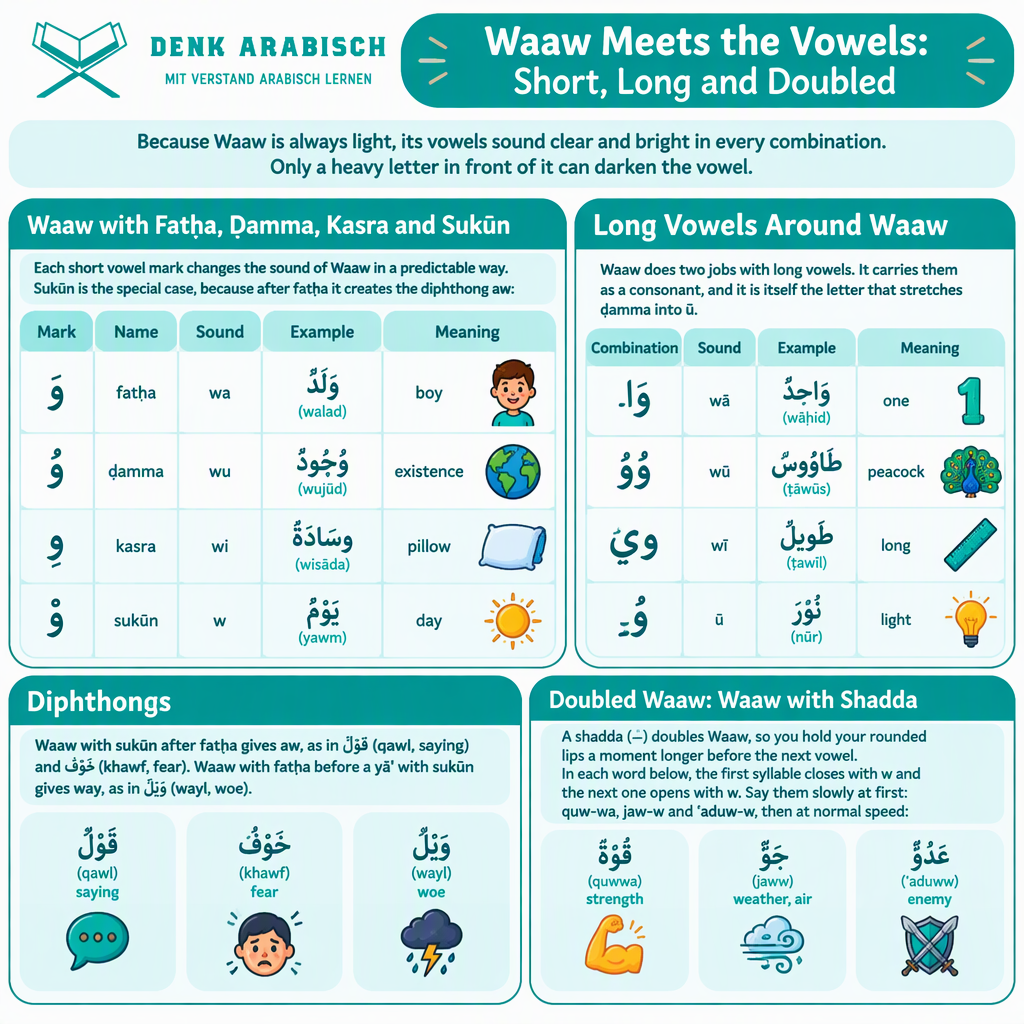
Because Waaw is always light, its vowels sound clear and bright in every combination. Only a heavy letter in front of it can darken the vowel.
Waaw with Fatḥa, Ḍamma, Kasra and Sukūn
Each short vowel mark changes the sound of Waaw in a predictable way. Sukūn is the special case, because after fatḥa it creates the diphthong aw:
| Mark | Name | Sound | Example | Meaning |
| وَ | fatḥa | wa | وَلَدٌ (walad) | boy |
| وُ | ḍamma | wu | وُجُودٌ (wujūd) | existence |
| وِ | kasra | wi | وِسَادَةٌ (wisāda) | pillow |
| وْ | sukūn | w | يَوْمٌ (yawm) | day |
For a full overview of the vowel marks, read [Harakat In Arabic].
Read also: Dua For Entering And Leaving The Mosque – The Complete Guide
Long Vowels Around Waaw
Waaw does two jobs with long vowels. It carries them as a consonant, and it is itself the letter that stretches ḍamma into ū.
The first three rows show Waaw as a consonant followed by a long vowel. The last row shows Waaw as the madd letter that makes ū after another consonant:
| Combination | Sound | Example | Meaning |
| وَا | wā | وَاحِدٌ (wāḥid) | one |
| وُو | wū | طَاوُوسٌ (ṭāwūs) | peacock |
| وِي | wī | طَوِيلٌ (ṭawīl) | long |
| ـُو | ū | نُورٌ (nūr) | light |
Diphthongs: Waaw with sukūn after fatḥa gives aw, as in قَوْلٌ (qawl, saying) and خَوْفٌ (khawf, fear). Waaw with fatḥa before a yāʾ with sukūn gives way, as in وَيْلٌ (wayl, woe).
Doubled Waaw: Waaw with Shadda
A shadda (ـّ) doubles Waaw, so you hold your rounded lips a moment longer before the next vowel.
In each word below, the first syllable closes with w and the next one opens with w. Say them slowly at first, quw-wa, jaw-w and ʿaduw-w, then at normal speed:
- قُوَّةٌ (quwwa): strength
- جَوٌّ (jaww): weather, air
- عَدُوٌّ (ʿaduww): enemy
Three Arabic Roots Built on Waaw
Most Arabic words grow from a root of three consonants. Waaw can be any of the three, and sometimes it hides or turns into a vowel inside the word.
و ل د (birth)
This root gives you family words you need from day one. It also appears in Sūrat Al-Ikhlāṣ 112:3, لَمْ يَلِدْ وَلَمْ يُولَدْ, where Waaw first drops out and then returns as a long ū:
| Word | Transliteration | Meaning |
| وَلَدٌ | walad | boy, child |
| وَالِدٌ | wālid | father |
| وَالِدَةٌ | wālida | mother |
| مَوْلُودٌ | mawlūd | newborn |
و ج د (finding, existing)
This root moves between finding something and something being there. You already met وُجُودٌ in the short vowels table above:
| Word | Transliteration | Meaning |
| وَجَدَ | wajada | he found |
| وُجُودٌ | wujūd | existence |
| مَوْجُودٌ | mawjūd | present, available |
| وِجْدَانٌ | wijdān | feelings, conscience |
ق و ل (saying)
This root shows Waaw’s most surprising trick. In قَالَ it turns into an alif, in يَقُولُ it becomes a long ū, and in قَوْلٌ it appears as a consonant in the diphthong aw:
| Word | Transliteration | Meaning |
| قَالَ | qāla | he said |
| يَقُولُ | yaqūlu | he says |
| قَوْلٌ | qawl | saying, statement |
| مَقَالَةٌ | maqāla | article |
Want to read words like these fluently and spot their root at a glance? The Arabic Reading Course at Denk Arabisch builds your reading speed step by step with fully vowelled texts.
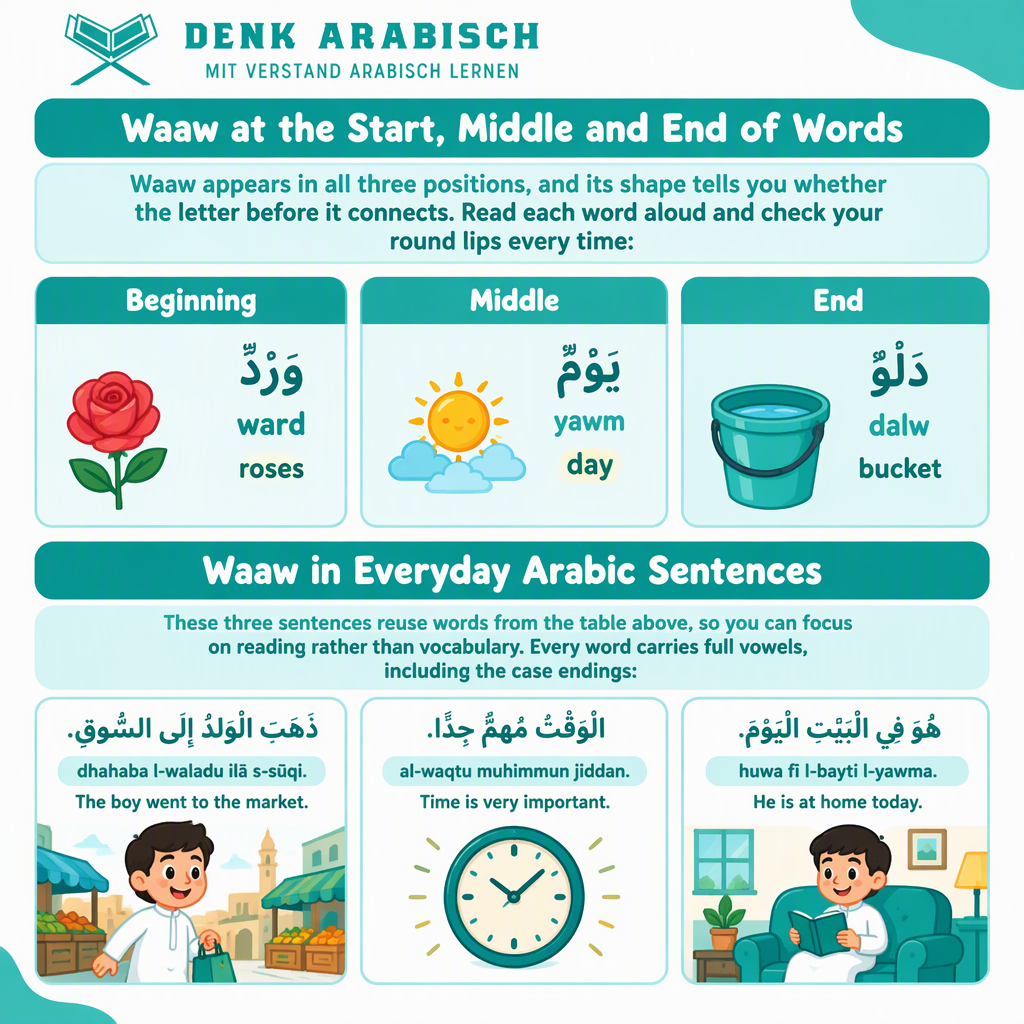
Waaw in Everyday Arabic Sentences
These three sentences reuse words you met earlier in this guide, so you can focus on reading rather than vocabulary. Every word carries full vowels, including the case endings:
| Arabic Sentence | Transliteration | Meaning |
| ذَهَبَ الْوَلَدُ إِلَى السُّوقِ. | dhahaba l-waladu ilā s-sūqi. | The boy went to the market. |
| الْوَقْتُ مُهِمٌّ جِدًّا. | al-waqtu muhimmun jiddan. | Time is very important. |
| هُوَ فِي الْبَيْتِ الْيَوْمَ. | huwa fī l-bayti l-yawma. | He is at home today. |
Read our guide, “Arabic Sentences”, to build your own sentences step by step.
Four Waaw Mistakes Learners Make and How to Fix Them
Each mistake below comes with a quick test you can do right now, with your finger, a mirror or your own ears.
1. Pronouncing Waaw as a German W
German spelling trains you to read w as [v], so وَلَدٌ becomes “valad”. This is the most common Waaw mistake among German speakers.
Test: put a finger on your lower lip and say walad. If your upper teeth touch your lip, you said [v].
2. Mixing up Waaw (و) and Faa (ف)
Once the teeth touch the lip, و drifts toward ف, and وَصْلٌ (connection) starts to sound like فَصْلٌ (chapter). In writing, the two heads look alike, but ف has a dot and connects to the left.
Test: whisper both letters. ف still sounds clear as a soft hiss, while و almost disappears, because it needs your voice.
3. Mixing up Waaw (و) and Baa (ب)
Both letters use the two lips, so a tense mouth closes them fully, and وَلَدٌ (boy) turns into بَلَدٌ (country).
Test: say each letter slowly and feel your lips. For ب they touch completely and then release; for و they never touch.
4. Mixing up Long ū (و) and Long ī (ي)
Both are madd letters, and a relaxed mouth blurs them, so فُولٌ (fava beans) slides toward فِيلٌ (elephant).
Test: look in the mirror. Your lips must be round and pushed forward for ū, and spread like a smile for ī.
Read also: Dua For Entering And Leaving Home
Practice Time: Four Waaw Exercises
Every word in these exercises appears earlier in this guide, so you can scroll back whenever you need a reminder.
Exercise 1: Multiple Choice
Choose one answer for each question. Say the Arabic options aloud before you decide, because your lips often know the answer first:
- Where is consonant Waaw produced? a) the throat, b) the two lips, c) the lower lip and upper teeth
- Which word contains the diphthong aw? a) نُورٌ, b) وَاحِدٌ, c) يَوْمٌ
- Which word means “country”? a) بَلَدٌ, b) وَلَدٌ, c) وَرْدٌ
Answers: 1 b, 2 c, 3 a.
Exercise 2: Writing Practice
Copy each word three times on lined paper, saying it as you write. Pay attention to the small gap that follows every Waaw:
- وَرْدٌ
- دَوَاءٌ
- يَوْمٌ
- نُورٌ
Exercise 3: True or False
Decide whether each statement is true or false. Each one checks a rule from a different part of this guide:
- Waaw is a Sun letter.
- Waaw connects to the letter that comes after it.
- Waaw has no dots.
- In Ḥafṣ ʿan ʿĀṣim, nūn sākinah before Waaw merges into it with ghunnah.
Answers: 1 false (Waaw is a Moon letter, as in الْوَلَدُ), 2 false, 3 true, 4 true.
Exercise 4: Find the Letter
Count every Waaw in the two sentences below. Remember that Waaw can hide in the middle of a word, as a long ū or inside a diphthong:
- ذَهَبَ الْوَلَدُ إِلَى السُّوقِ.
- هُوَ فِي الْبَيْتِ الْيَوْمَ.
Answer: four, in الْوَلَدُ, السُّوقِ, هُوَ and الْيَوْمَ.
What Our Students Say About Denk Arabisch Academy
See what our students say about learning at Denk Arabisch Academy on Trustpilot. Read their experiences and check out more reviews to discover how our courses help improve Arabic.
Join Denk Arabisch To Learn Arabic!
Waaw is one of 28 letters, and each one becomes easier when you learn it inside a clear structure. Structure turns separate facts into a skill you can actually use.
Denk Arabisch is built for German-speaking learners and explains Arabic through German, sound by sound and rule by rule.
Here is what learning with Denk Arabisch gives you. Each benefit targets the habits German speakers bring to Arabic, like the ones you met in this guide:
- Explanations in German, with German sounds as your reference point
- Personal feedback on your pronunciation from your teacher
- A clear path from the alphabet to reading, writing and speaking
- Learning paths for adults and for families with children
Choose Your Specialized Course
Each course focuses on one skill, so you can start exactly where you need help. Pick the one that matches your next goal:
- Arabic Course For Beginners: your structured start from zero.
- Arabic Alphabet Course: all 28 letters, their sounds and their shapes.
- Arabic Reading Course: fluent reading of fully vowelled texts.
- Arabic Writing Course: clean handwriting and correct connections.
- Arabic Speaking Course: confident pronunciation and everyday conversation.
- Quranic Arabic Course for German Speakers: the vocabulary and grammar of the Quran, explained in German.
- Quran Tajweed Course for German Speakers: correct recitation, rule by rule.
Learn Arabic with Denk Arabisch Academy
Speak and understand Arabic through a clear and effective learning system
Try a Free TrialReady to start? Book your free trial lesson at Denk Arabisch and find the course that fits you.
You can read what our students say on Trustpilot.

Conclusion
The Letter Waaw (و) is small on the page but busy in the language: it works as a consonant, a long vowel and part of a diphthong. Keep these three takeaways in mind whenever you meet it:
- Sound: round lips, voice on, no teeth. Use the English w, never the German W.
- Writing: two forms only, no dots, and never a connection to the left.
- Recognition: a round head on the line, a tail below it, and a Moon letter that keeps the lām of al- audible.
For daily practice, say wa, wu and wi in front of a mirror, and write وَرْدٌ, دَوَاءٌ and يَوْمٌ until the gap after و feels natural. Then read the pairs وَصْلٌ and فَصْلٌ, وَلَدٌ and بَلَدٌ, and فُولٌ and فِيلٌ aloud. Finish by reviewing the roots و ل د, و ج د and ق و ل.
With round lips and a few minutes a day, Waaw will soon feel as natural as the German u.
Ready to go further? Book a free trial lesson at Denk Arabisch and learn the next letters with a teacher who explains everything in German.
FAQs
1. What is the difference between Waaw (و) and Faa (ف)?
Waaw is made with rounded lips that never touch the teeth, and it needs your voice. Faa is made by the upper teeth touching the lower lip, with breath only. In writing, ف has a dot and connects to the next letter, while و has neither.
2. How is Waaw (و) different from Baa (ب)?
Both letters come from the two lips. For ب the lips close completely and then open, while for و they stay apart in a round shape. That one difference separates وَلَدٌ (boy) from بَلَدٌ (country).
3. How do I tell long ū (و) from long ī (ي)?
For ū your lips are rounded and pushed forward, as in German “gut”. For ī your lips are spread, as in German “Biene”. Practise with فُولٌ (fava beans) and فِيلٌ (elephant).
4. Is Waaw a Sun or Moon letter, and is it heavy or light?
Waaw is a Moon letter, so you pronounce the lām of al- clearly, as in الْوَلَدُ (al-walad). It is also always light (muraqqaq), even next to heavy letters like ص and ق.
5. Which Tajweed rules involve Waaw?
A nūn sākinah or tanwīn before Waaw merges into it with ghunnah, as in مِن وَالٍ. A mīm sākinah before Waaw stays clear (Iẓhār Shafawī). And a long ū followed by Waaw never merges, as in آمَنُوا وَعَمِلُوا.