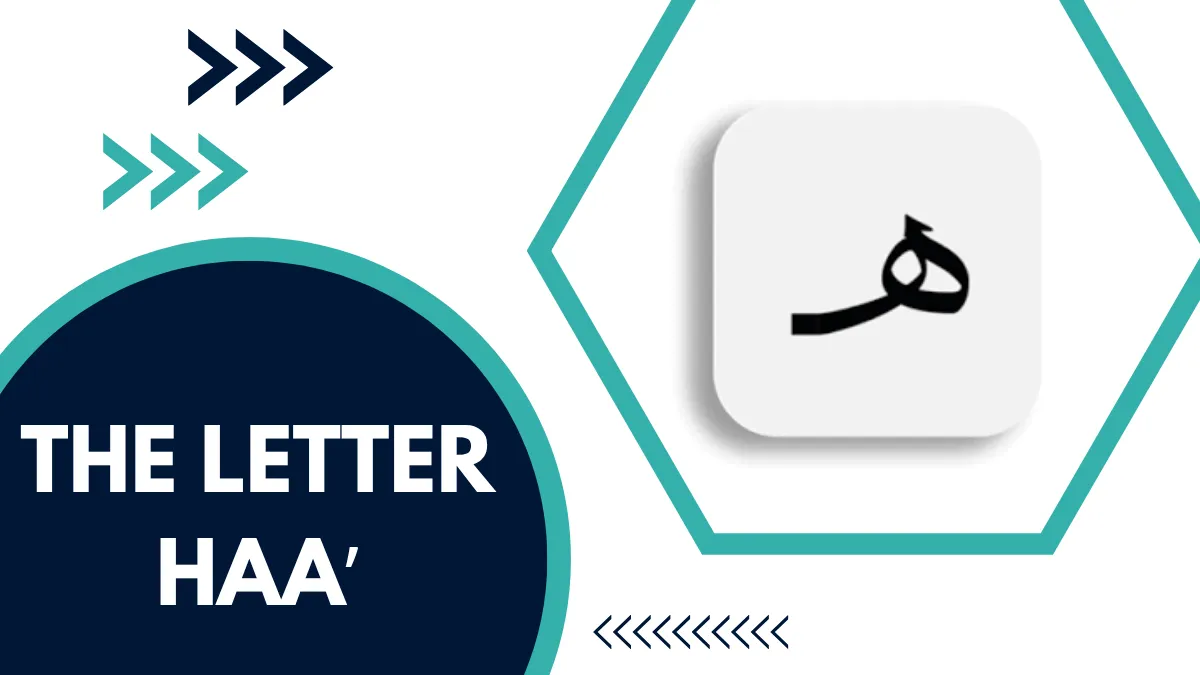
The Letter Haaʼ (ه), called هَاء in Arabic, is the 26th letter of the Arabic alphabet. It is a soft breath that starts at the very bottom of your throat, close to the voice box. Linguists call it a voiceless glottal fricative, written [h] in IPA.
German speakers have a real head start here. Haaʼ sounds just like the h in Haus, Hund and heute. The only trap is German spelling habits, which you will learn to avoid in this guide.
The table below gathers the facts you will meet again in the sections that follow. Keep it as a quick reference whenever you need to check a detail about Haaʼ.
| Feature | Haaʼ (ه) |
| Name | Haaʼ, هَاء |
| Sound | [h], like h in German Haus or English house |
| Position in the alphabet | 26th letter (hijāʾī order) |
| Abjad value | 5th letter, value 5 |
| Transliteration | Common: h · DIN 31635: h · ALA-LC: h · Arabizi: h (the number 7 is used for ح, not for ه) |
| Point of articulation | Deepest part of the throat (أَقْصَى الْحَلْقِ) |
| Sun or Moon letter | Moon letter |
| Heavy or light | Always light (muraqqaq) |
| Dots | None |
| Connection | Connects on both sides, so it has four forms |
Table of Contents
Where The Letter Haaʼ (ه) Sits in the Arabic Alphabet
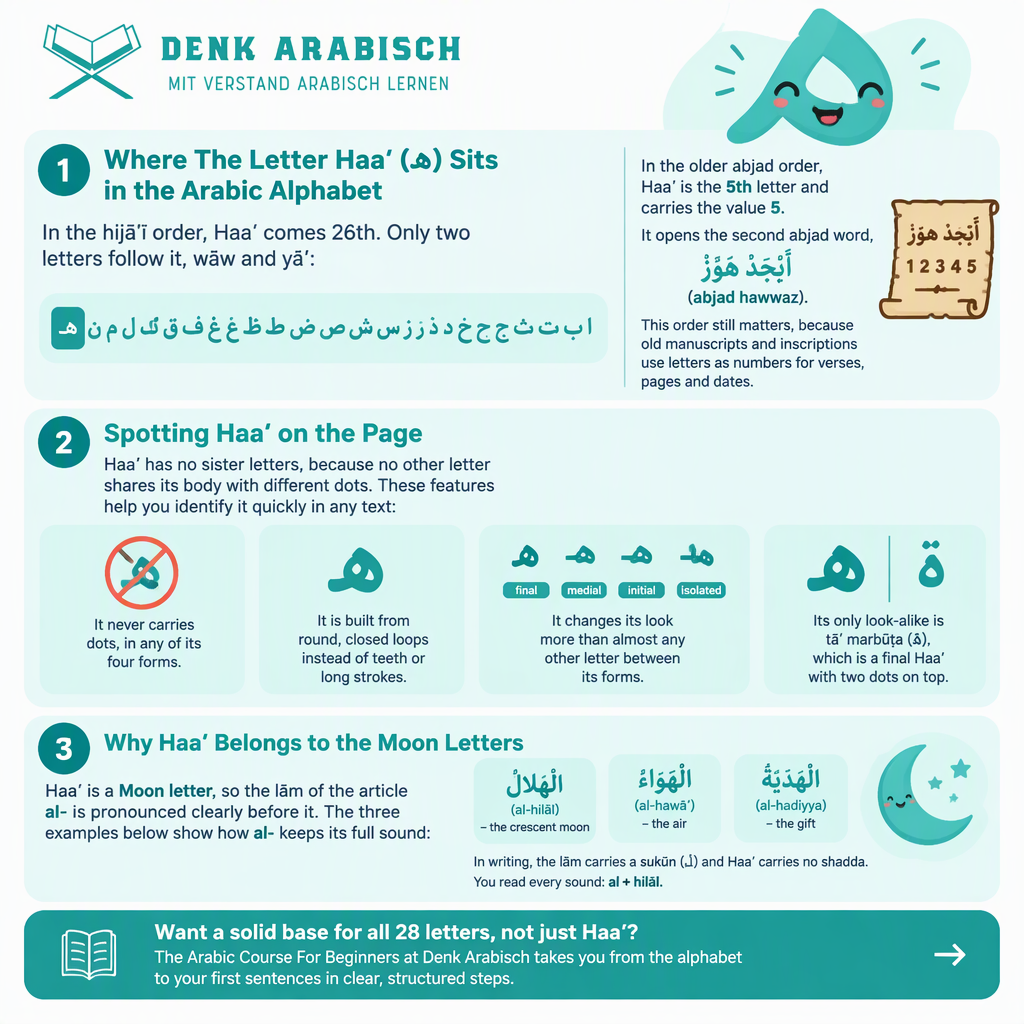
In the hijāʾī order, the order taught in schools today, Haaʼ comes 26th. Only two letters follow it, wāw and yāʾ:
ا ب ت ث ج ح خ د ذ ر ز س ش ص ض ط ظ ع غ ف ق ك ل م ن ه
In the older abjad order, Haaʼ is the 5th letter and carries the value 5. It opens the second abjad word, أَبْجَدْ هَوَّزْ (abjad hawwaz). This order still matters, because old manuscripts and inscriptions use letters as numbers for verses, pages and dates.
Spotting Haaʼ on the Page
Haaʼ has no sister letters, because no other letter shares its body with different dots. These features help you identify it quickly in any text:
- It never carries dots, in any of its four forms.
- It is built from round, closed loops instead of teeth or long strokes.
- It changes its look more than almost any other letter between its forms.
- Its only look-alike is tāʾ marbūṭa (ة), which is a final Haaʼ with two dots on top.
Once you know these four features, you will find Haaʼ in a sentence within seconds.
Why Haaʼ Belongs to the Moon Letters
Haaʼ is a Moon letter, so the lām of the article al- is pronounced clearly before it. The three examples below show how al- keeps its full sound:
- الْهِلَالُ (al-hilāl) – the crescent moon
- الْهَوَاءُ (al-hawāʾ) – the air
- الْهَدِيَّةُ (al-hadiyya) – the gift
In writing, the lām carries a sukūn (لْ) and Haaʼ carries no shadda. You read every sound: al + hilāl.
Want a solid base for all 28 letters, not just Haaʼ? The Arabic Course For Beginners at Denk Arabisch takes you from the alphabet to your first sentences in clear, structured steps.
Deep in the Throat: Haaʼ’s Makhraj and Its Role in Tajweed
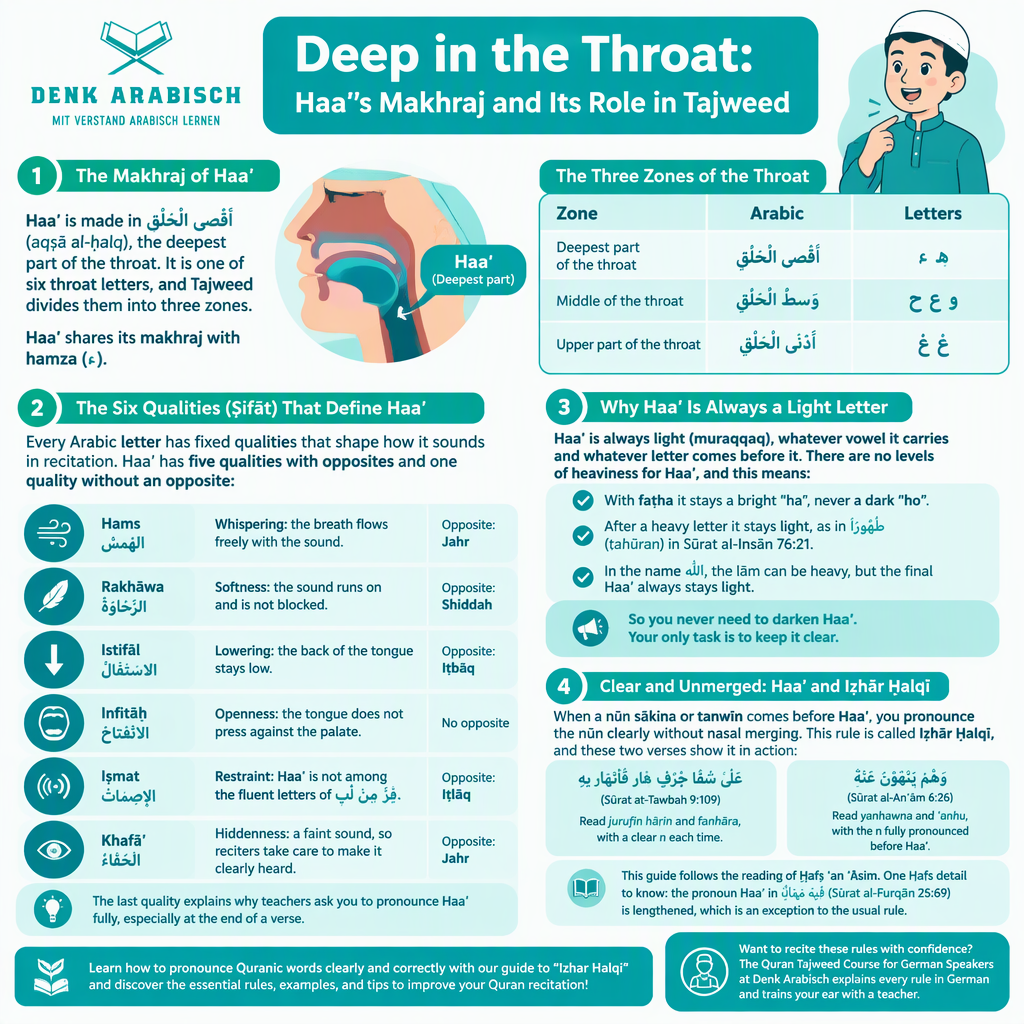
Haaʼ is made in أَقْصَى الْحَلْقِ (aqṣā al-ḥalq), the deepest part of the throat. It is one of six throat letters, and Tajweed divides them into three zones. The table shows where Haaʼ stands compared to its throat neighbours:
| Zone | Arabic | Letters |
| Deepest part of the throat | أَقْصَى الْحَلْقِ | ء ه |
| Middle of the throat | وَسَطُ الْحَلْقِ | ع ح |
| Upper part of the throat | أَدْنَى الْحَلْقِ | غ خ |
Haaʼ shares its makhraj with hamza (ء). That is why learners sometimes mix them up, as you will see in the mistakes section.
The Six Qualities (Ṣifāt) That Define Haaʼ
Every Arabic letter has fixed qualities that shape how it sounds in recitation. Haaʼ has five qualities with opposites and one quality without an opposite:
- Hams – الْهَمْسُ – whispering: the breath flows freely with the sound. Haaʼ is one of the letters in فَحَثَّهُ شَخْصٌ سَكَتْ.
- Rakhāwa – الرَّخَاوَةُ – softness: the sound runs on and is not blocked. Haaʼ is not in the strong group أَجِدْ قَطٍ بَكَتْ.
- Istifāl – الِاسْتِفَالُ – lowering: the back of the tongue stays low. Haaʼ is not in the heavy group خُصَّ ضَغْطٍ قِظْ.
- Infitāḥ – الِانْفِتَاحُ – openness: the tongue does not press against the palate.
- Iṣmāt – الْإِصْمَاتُ – restraint: Haaʼ is not among the fluent letters of فِرَّ مِنْ لُبٍّ.
- Khafāʾ – الْخَفَاءُ – hiddenness: Haaʼ is a faint sound, so reciters take care to make it clearly heard.
The last quality explains why teachers ask you to pronounce Haaʼ fully, especially at the end of a verse.
Why Haaʼ Is Always a Light Letter
Haaʼ is always light (muraqqaq), whatever vowel it carries and whatever letter comes before it. There are no levels of heaviness for Haaʼ, and the points below show what this means in practice:
- With fatḥa it stays a bright “ha”, never a dark “ho”.
- After a heavy letter it stays light, as in طَهُورًا (ṭahūran) in Sūrat al-Insān 76:21.
- In the name اللّٰه, the lām can be heavy, but the final Haaʼ always stays light.
So you never need to darken Haaʼ. Your only task is to keep it clear.
Clear and Unmerged: Haaʼ and Iẓhār Ḥalqī
When a nūn sākina or tanwīn comes before Haaʼ, you pronounce the nūn clearly without nasal merging. This rule is called Iẓhār Ḥalqī, and these two verses show it in action:
- عَلَىٰ شَفَا جُرُفٍ هَارٍ فَانْهَارَ بِهِ (Sūrat at-Tawbah 9:109): read jurufin hārin and fanhāra, with a clear n each time.
- وَهُمْ يَنْهَوْنَ عَنْهُ (Sūrat al-Anʿām 6:26): read yanhawna and ʿanhu, with the n fully pronounced before Haaʼ.
This guide follows the reading of Ḥafṣ ʿan ʿĀṣim.
The Pronoun Haaʼ: When to Lengthen It
The Haaʼ that means “him” or “his” (هَاءُ الْكِنَايَة) follows its own lengthening rule, called ṣila:
- Between two vowelled letters, it is lengthened for two counts: إِنَّهُۥ كَانَ (innahū kāna).
- If a hamza follows, it is lengthened for four to five counts: يَحْسَبُ أَنَّ مَالَهُۥٓ أَخْلَدَهُ (Sūrat al-Humazah 104:3).
- If a silent letter comes before or after it, it stays short: فِيهِ هُدًى (Sūrat al-Baqarah 2:2) and لَهُ الْمُلْكُ.
Ḥafṣ has a few well-known exceptions. فِيهِۦ مُهَانًا (Sūrat al-Furqān 25:69) is lengthened even after a silent yāʾ, while يَرْضَهُ لَكُمْ (Sūrat az-Zumar 39:7) stays short even between two vowels.
Learn how to pronounce Quranic words clearly and correctly with our guide to “Izhar Halqi” and discover the essential rules, examples, and tips to improve your Quran recitation!
Want to recite these rules with confidence? The Quran Tajweed Course for German Speakers at Denk Arabisch explains every rule in German and trains your ear with a teacher.
Getting the Sound Right: Haaʼ Pronunciation
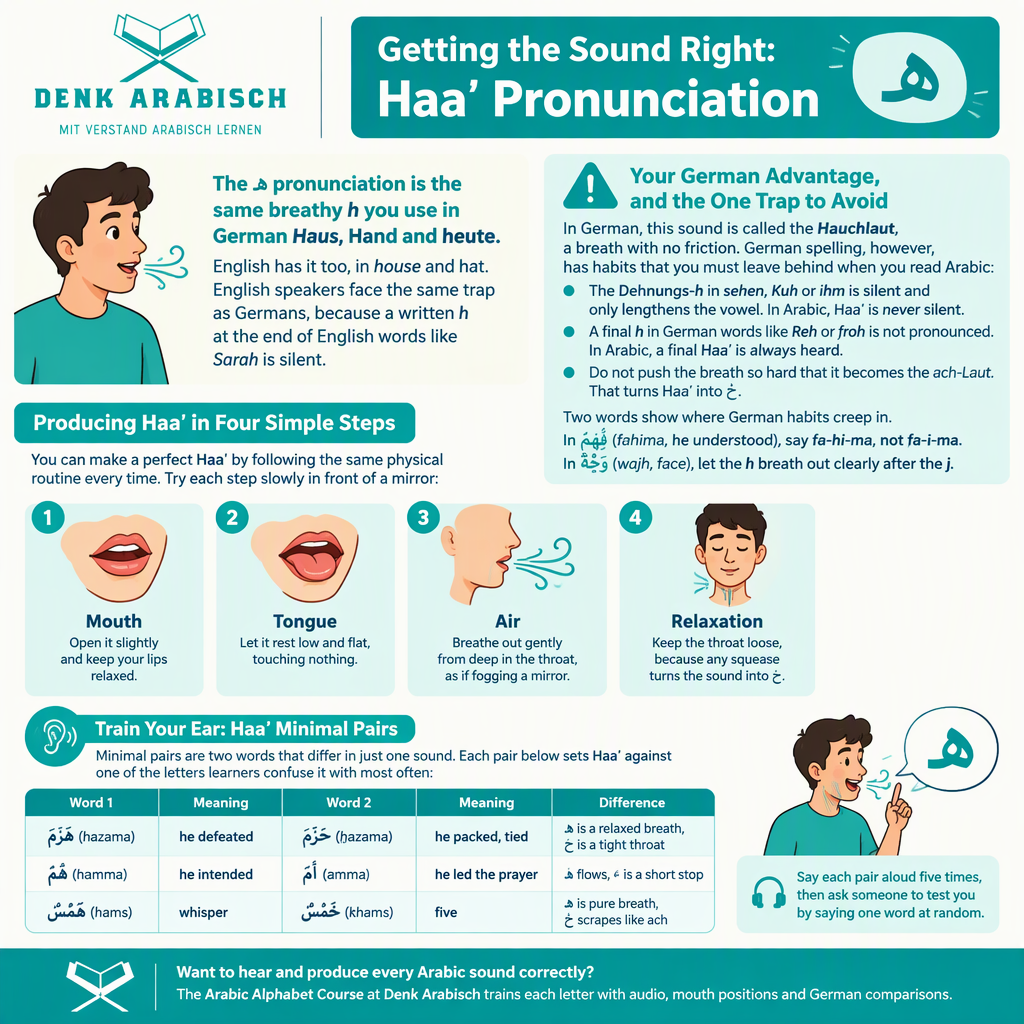
The ه pronunciation is the same breathy h you use in German Haus, Hand and heute. English has it too, in house and hat. English speakers face the same trap as Germans, because a written h at the end of English words like Sarah is silent.
Your German Advantage, and the One Trap to Avoid
In German, this sound is called the Hauchlaut, a breath with no friction. German spelling, however, has habits that you must leave behind when you read Arabic:
- The Dehnungs-h in sehen, Kuh or ihm is silent and only lengthens the vowel. In Arabic, Haaʼ is never silent.
- A final h in German words like Reh or froh is not pronounced. In Arabic, a final Haaʼ is always heard.
- Do not push the breath so hard that it becomes the ach-Laut. That turns Haaʼ into خ.
Two words show where German habits creep in. In فَهِمَ (fahima, he understood), say fa-hi-ma, not fa-i-ma. In وَجْهٌ (wajh, face), let the h breath out clearly after the j.
Producing Haaʼ in Four Simple Steps
You can make a perfect Haaʼ by following the same physical routine every time. Try each step slowly in front of a mirror:
- Mouth: open it slightly and keep your lips relaxed.
- Tongue: let it rest low and flat, touching nothing.
- Air: breathe out gently from deep in the throat, as if fogging a mirror.
- Relaxation: keep the throat loose, because any squeeze turns the sound into ح.
Read also: The Letter Laam (ل) – Your Complete Guide To Reading, Writing & Pronouncing It
Train Your Ear: Haaʼ Minimal Pairs
Minimal pairs are two words that differ in just one sound. Each pair below sets Haaʼ against one of the letters learners confuse it with most often:
| Word 1 | Meaning | Word 2 | Meaning | Difference |
| هَزَمَ (hazama) | he defeated | حَزَمَ (ḥazama) | he packed, tied | ه is a relaxed breath, ح is a tight throat |
| هَمَّ (hamma) | he intended | أَمَّ (amma) | he led the prayer | ه flows, ء is a short stop |
| هَمْسٌ (hams) | whisper | خَمْسٌ (khams) | five | ه is pure breath, خ scrapes like ach |
Say each pair aloud five times, then ask someone to test you by saying one word at random.
Want to hear and produce every Arabic sound correctly? The Arabic Alphabet Course at Denk Arabisch trains each letter with audio, mouth positions and German comparisons.
How to Write ه: Haaʼ’s Four Shapes
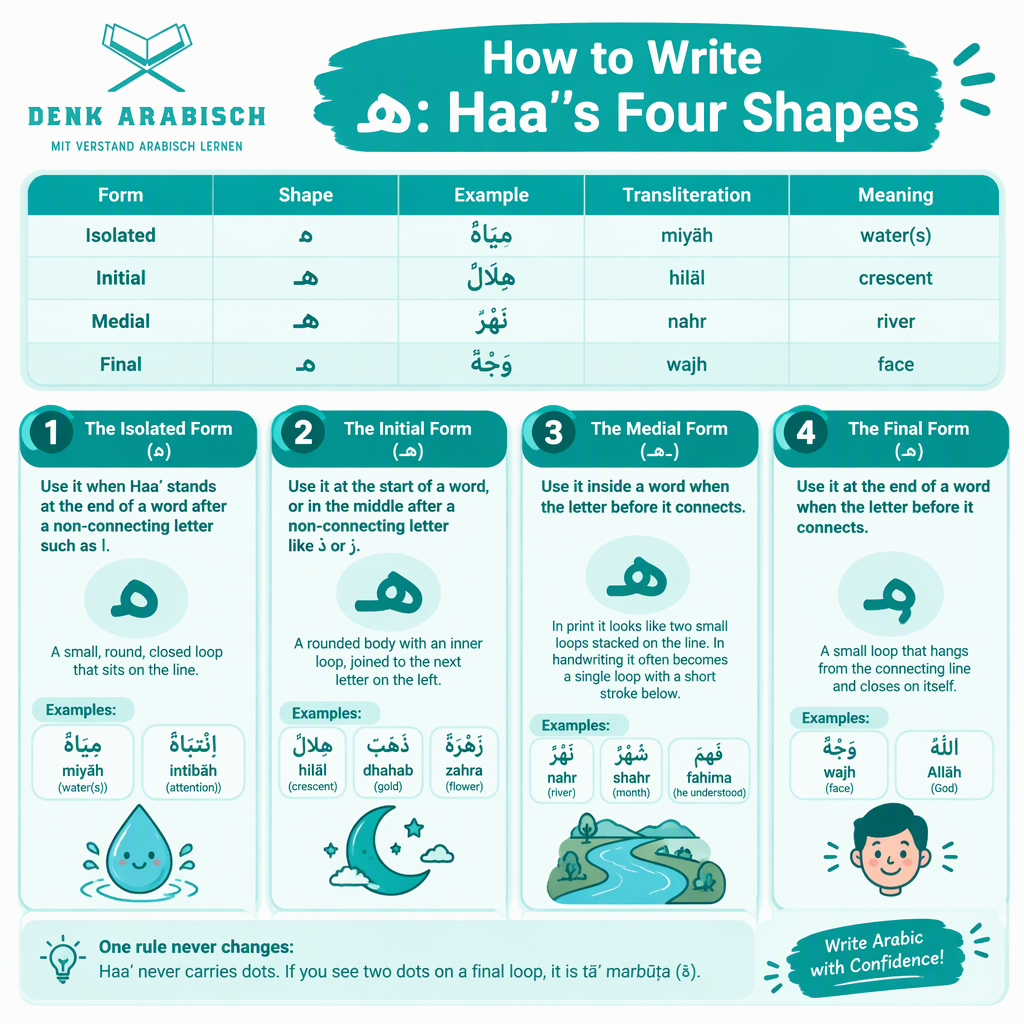
Arabic runs from right to left, and Haaʼ connects on both sides. That is why it has four forms, and the table gives you one clear example for each:
| Form | Shape | Example | Transliteration | Meaning |
| Isolated | ه | مِيَاهٌ | miyāh | water(s) |
| Initial | هـ | هِلَالٌ | hilāl | crescent |
| Medial | ـهـ | نَهْرٌ | nahr | river |
| Final | ـه | وَجْهٌ | wajh | face |
1. Standing Alone: The Isolated Form (ه)
Use it when Haaʼ stands at the end of a word after a non-connecting letter such as ا.
Shape: a small, round, closed loop that sits on the line.
Examples: مِيَاهٌ (miyāh, water), اِنْتِبَاهٌ (intibāh, attention).
2. Opening the Word: The Initial Form (هـ)
Use it at the start of a word, or in the middle after a non-connecting letter like ذ or ز.
Shape: a rounded body with an inner loop, joined to the next letter on the left.
Examples: هِلَالٌ (hilāl, crescent), ذَهَبٌ (dhahab, gold), زَهْرَةٌ (zahra, flower).
3. Linked on Both Sides: The Medial Form (ـهـ)
Use it inside a word when the letter before it connects.
Shape: in print it looks like two small loops stacked on the line. In handwriting it often becomes a single loop with a short stroke below.
Examples: نَهْرٌ (nahr, river), شَهْرٌ (shahr, month), فَهِمَ (fahima, he understood).
Learn Arabic with Denk Arabisch Academy
Speak and understand Arabic through a clear and effective learning system
Try a Free Trial4. Closing the Word: The Final Form (ـه)
Use it at the end of a word when the letter before it connects.
Shape: a small loop that hangs from the connecting line and closes on itself.
Examples: وَجْهٌ (wajh, face), اللّٰهُ (Allāh).
One rule never changes: Haaʼ never carries dots. If you see two dots on a final loop, it is tāʾ marbūṭa (ة).
Read “How To Learn To Write Arabic?” and discover practical tips to write Arabic letters correctly, improve your handwriting, and build your confidence in writing Arabic!
Want to write Arabic confidently by hand? The Arabic Writing Course at Denk Arabisch guides you through letter shapes, connections and clean handwriting step by step.
Reading Haaʼ with Every Vowel
Because Haaʼ is always light, its vowels keep their bright, natural sound. You never darken them as you would after a heavy letter.
Haaʼ with the Short Vowels (Ḥarakāt)
The four basic marks change how you read Haaʼ in one short beat. Each row gives a common word, so you learn the sound and useful vocabulary together:
| Mark | Name | Sound | Example | Meaning |
| هَ | fatḥa | ha | هَلْ (hal) | question word (is / does) |
| هُ | ḍamma | hu | هُوَ (huwa) | he |
| هِ | kasra | hi | هِيَ (hiya) | she |
| هْ | sukūn | h | فَهْمٌ (fahm) | understanding |
Stretching Haaʼ: The Long Vowels (Madd)
A long vowel letter after Haaʼ holds the vowel for two beats. The table pairs each combination with a word you will meet often:
| Combination | Sound | Example | Meaning |
| هَا | hā | هَاتِفٌ (hātif) | telephone |
| هُو | hū | هُودٌ (Hūd) | the prophet Hūd |
| هِي | hī | إِبْرَاهِيمُ (Ibrāhīm) | Abraham |
Haaʼ also forms two diphthongs: هَيْ (hay), as in هَيْبَةٌ (hayba, awe), and هَوْ (haw), as in هَوْلٌ (hawl, terror).
Read also: The Letter Meem (م) – A Complete Guide to Saying, Writing & Reciting It
Doubling Haaʼ with Shadda
A shadda (ـّ) doubles the letter, so you hold the breath of Haaʼ a moment longer. These three verbs give you clear practice with a doubled Haaʼ:
- فَهَّمَ (fahhama) – he made someone understand
- تَنَهَّدَ (tanahhada) – he sighed
- تَوَهَّمَ (tawahhama) – he imagined wrongly
Read “Harakat In Arabic” to understand the essential Arabic vowel marks, learn how to pronounce words correctly, and improve your Arabic reading skills with confidence.
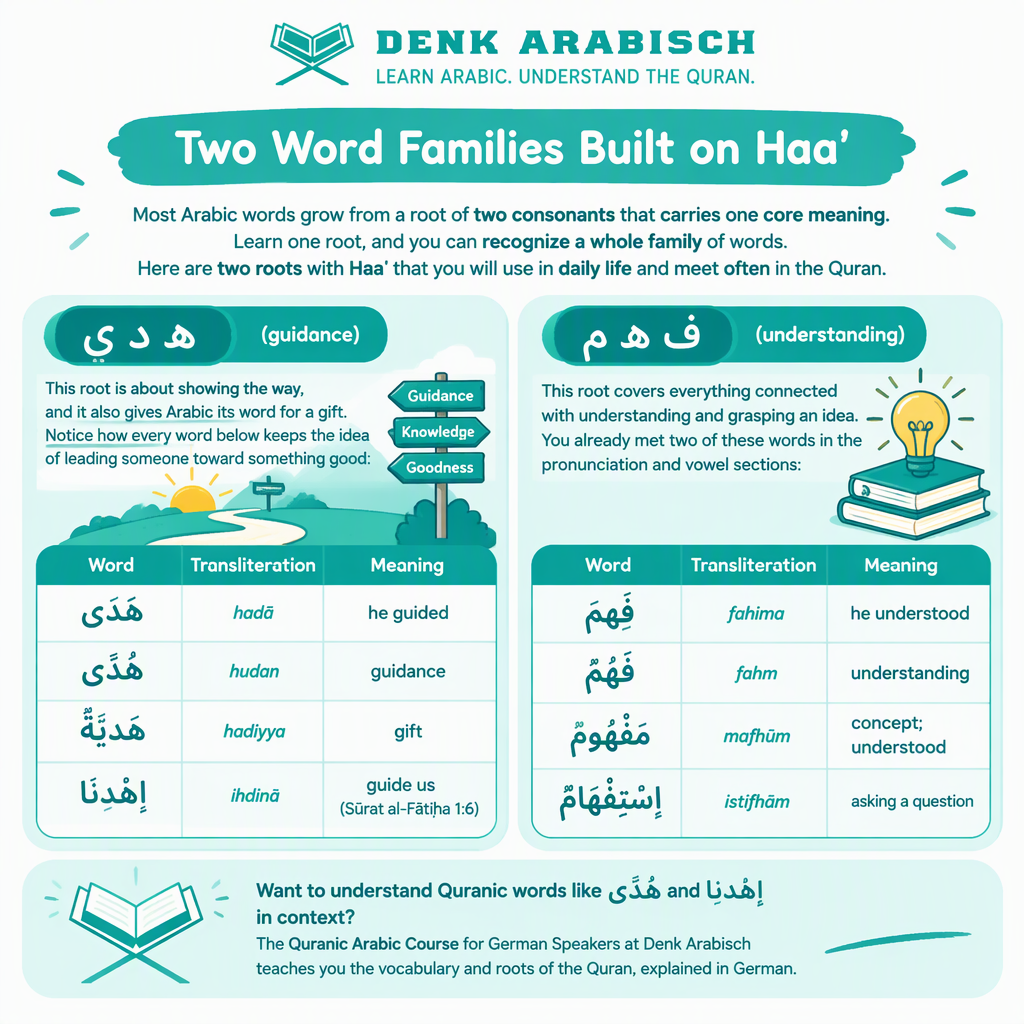
Three Word Families Built on Haaʼ
Most Arabic words grow from a root of three consonants that carries one core meaning. Learn one root, and you can recognize a whole family of words. Here are three roots with Haaʼ that you will use in daily life and meet often in the Quran.
ه د ي (guidance)
This root is about showing the way, and it also gives Arabic its word for a gift. Notice how every word below keeps the idea of leading someone toward something good:
| Word | Transliteration | Meaning |
| هَدَى | hadā | he guided |
| هُدًى | hudan | guidance |
| هَدِيَّةٌ | hadiyya | gift |
| اِهْدِنَا | ihdinā | guide us (Sūrat al-Fātiḥa 1:6) |
ف ه م (understanding)
This root covers everything connected to understanding and grasping an idea. You already met two of these words in the pronunciation and vowel sections:
| Word | Transliteration | Meaning |
| فَهِمَ | fahima | he understood |
| فَهْمٌ | fahm | understanding |
| مَفْهُومٌ | mafhūm | concept; understood |
| اِسْتِفْهَامٌ | istifhām | asking a question |
ش ه د (witnessing)
This root is about being present and bearing witness. Haaʼ sits in the middle, and the root gives Muslims the word for the declaration of faith:
| Word | Transliteration | Meaning |
| شَهِدَ | shahida | he witnessed |
| شَهِيدٌ | shahīd | witness; martyr |
| شَهَادَةٌ | shahāda | testimony; declaration of faith |
| مُشَاهِدٌ | mushāhid | viewer |
Want to understand Quranic words like هُدًى and اِهْدِنَا in context? The Quranic Arabic Course for German Speakers at Denk Arabisch teaches you the vocabulary and roots of the Quran, explained in German.
Hearing Haaʼ in Real Sentences
These short sentences reuse words you met earlier in this guide, so you can focus fully on the sound. Read them slowly first, and make sure every Haaʼ is heard, including the final one:
| Arabic Sentence | Transliteration | Meaning |
| هٰذَا نَهْرٌ كَبِيرٌ. | hādhā nahrun kabīrun. | This is a big river. |
| أَعْطَيْتُ أُمِّي هَدِيَّةً جَمِيلَةً. | aʿṭaytu ummī hadiyyatan jamīlatan. | I gave my mother a beautiful gift. |
| غَسَلَ الْوَلَدُ وَجْهَهُ. | ghasala al-waladu wajhahu. | The boy washed his face. |
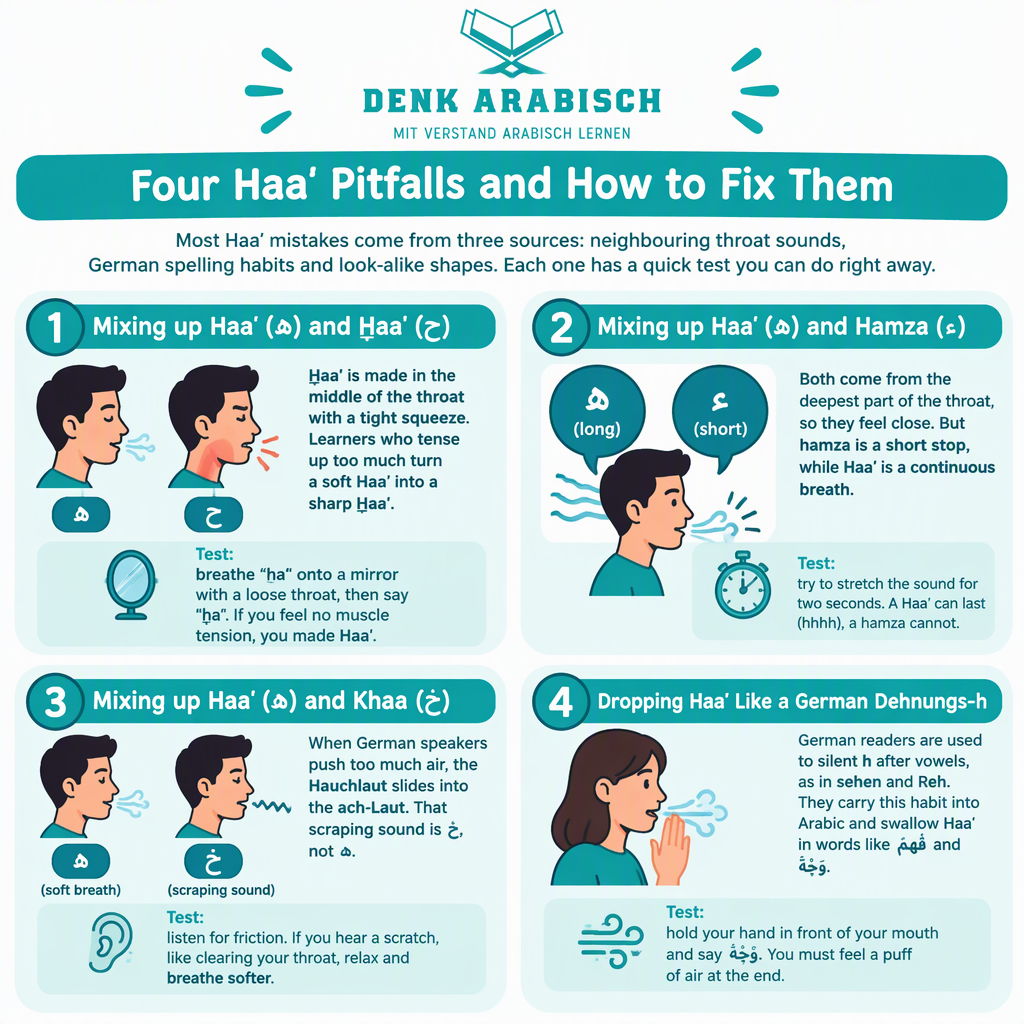
Four Haaʼ Pitfalls and How to Fix Them
Most Haaʼ mistakes come from three sources: neighbouring throat sounds, German spelling habits and look-alike shapes. Each one has a quick test you can do right away.
1. Mixing up Haaʼ (ه) and Ḥaaʼ (ح)
Ḥaaʼ is made in the middle of the throat with a tight squeeze. Learners who tense up too much turn a soft Haaʼ into a sharp Ḥaaʼ.
Test: breathe “ha” onto a mirror with a loose throat, then say “ḥa”. If you feel no muscle tension, you made Haaʼ.
2. Mixing up Haaʼ (ه) and Hamza (ء)
Both come from the deepest part of the throat, so they feel close. But hamza is a short stop, while Haaʼ is a continuous breath.
Test: try to stretch the sound for two seconds. A Haaʼ can last (hhhh), a hamza cannot.
Read also: The Letter Noon (ن) – Sound, Shape & Writing
3. Mixing up Haaʼ (ه) and Khaa (خ)
When German speakers push too much air, the Hauchlaut slides into the ach-Laut. That scraping sound is خ, not ه.
Test: listen for friction. If you hear a scratch, like clearing your throat, relax and breathe softer.
4. Dropping Haaʼ Like a German Dehnungs-h
German readers are used to silent h after vowels, as in sehen and Reh. They carry this habit into Arabic and swallow Haaʼ in words like فَهِمَ and وَجْهٌ.
Test: hold your hand in front of your mouth and say وَجْهٌ. You must feel a puff of air at the end.
Practice Time: Check Your Haaʼ Skills
These four exercises only use words from this guide. Try each one before you look at the answer.
Exercise 1: Multiple Choice
Read the three words below and decide which one contains Haaʼ. Say all three aloud first, so you hear the difference as well as see it:
- a) حَزَمَ
- b) شَهْرٌ
- c) خَمْسٌ
Answer: b) شَهْرٌ (shahr, month).
Exercise 2: Matching
Match each Arabic word on the left with its meaning from the list of four. All four words appeared earlier in this guide:
- هِلَالٌ · نَهْرٌ · وَجْهٌ · هَدِيَّةٌ
- face · gift · crescent · river
Answer: هِلَالٌ = crescent, نَهْرٌ = river, وَجْهٌ = face, هَدِيَّةٌ = gift.
Exercise 3: Writing Practice
Take a pen and paper and write slowly from right to left. Complete each task three times before moving to the next one:
- Write Haaʼ in its four forms: ه هـ ـهـ ـه
- Copy these words: هِلَالٌ، شَهْرٌ، وَجْهٌ، مِيَاهٌ
Exercise 4: True or False
Decide whether each statement about Haaʼ is true or false. Think back to the alphabet and Tajweed sections if you are unsure:
- Haaʼ is a Sun letter.
- Haaʼ has no dots in any form.
- Haaʼ is a heavy letter.
- A nūn sākina before Haaʼ is pronounced clearly.
Answer: 1. False (it is a Moon letter) · 2. True · 3. False (it is always light) · 4. True (Iẓhār Ḥalqī).
What Our Students Say About Denk Arabisch Academy
See what our students say about learning at Denk Arabisch Academy on Trustpilot. Read their experiences and check out more reviews to discover how our courses help improve Arabic.

Beyond Haaʼ with Denk Arabisch
Haaʼ is one of 28 letters, and each one builds on the last. A clear structure turns scattered letters into real reading, writing and speaking.
Denk Arabisch is built for German-speaking learners and explains Arabic through German. Here is what that means for your learning:
- Explanations in German, with German sounds as your reference point
- Qualified teachers who correct your pronunciation live
- A clear path from the first letter to fluent reading
- Courses for adults and for children, with flexible lesson times
Choose Your Specialized Course: each course below focuses on one skill. Pick the one that matches your goal right now:
- Arabic Course For Beginners – your complete start in Arabic
- Quranic Arabic Course for German Speakers – understand the words of the Quran
- Quran Tajweed Course for German Speakers – recite with correct rules
- Arabic Alphabet Course – master all 28 letters and their sounds
- Arabic Reading Course – read fluently with and without tashkeel
- Arabic Writing Course – write clean, connected Arabic by hand
- Arabic Speaking Course – speak confidently in everyday situations
Learn Arabic with Denk Arabisch Academy
Speak and understand Arabic through a clear and effective learning system
Try a Free TrialReady to start? Book a free trial lesson at Denk Arabisch today.

Conclusion
The Letter Haaʼ (ه) is one of the easiest Arabic letters for German speakers, as long as you never let it go silent. Keep these three points in mind as you move on:
- Sound: a relaxed breath from the deepest part of the throat, always heard, even at the end of a word.
- Writing: four forms, all without dots, from the isolated loop ه to the medial ـهـ.
- Recognition: no dots and round loops, with ة as its only look-alike.
Practise a little every day. Say هِلَالٌ and وَجْهٌ aloud, write the four forms, and compare Haaʼ with ح, ء and خ using the minimal pairs. Then review the roots ه د ي, ف ه م and ش ه د until the words feel familiar.
You already have the sound in your German. Now it only needs a little Arabic practice.
Ready to start? Book a free trial lesson at Denk Arabisch today.
You can read what our students say on Trustpilot.
FAQs
1. What is the difference between Haaʼ (ه) and Ḥaaʼ (ح)?
Haaʼ comes from the deepest part of the throat and is a soft, relaxed breath like the German h. Ḥaaʼ comes from the middle of the throat and needs a tight squeeze. Compare هَزَمَ (hazama) and حَزَمَ (ḥazama) to hear it.
2. Is Haaʼ a Sun letter or a Moon letter?
Haaʼ is a Moon letter. The lām of al- is pronounced and carries a sukūn, as in الْهِلَالُ (al-hilāl).
3. Is Haaʼ a heavy or a light letter?
Haaʼ is always light (muraqqaq). It stays light with every vowel and even after heavy letters, as in طَهُورًا.
4. Which Tajweed rule does Haaʼ trigger?
A nūn sākina or tanwīn before Haaʼ is pronounced clearly (Iẓhār Ḥalqī), as in جُرُفٍ هَارٍ (Sūrat at-Tawbah 9:109). The pronoun Haaʼ also follows its own lengthening rule, as in إِنَّهُۥ كَانَ, where the Haaʼ is stretched for two counts.