Learning the Quran is a gradual journey that can become an important part of a child’s Islamic upbringing. For children growing up in Ravensburg, Quran education can help them stay connected to Arabic, Quranic recitation, and Islamic values, even when German is the language they use most often at school and in everyday life.
Children do not need to master Arabic before they begin learning the Quran. With the right teaching approach, they can start with simple letters and sounds and gradually develop the ability to read words, verses, and short Surahs with greater confidence.
Every child learns differently, so Quran lessons should take individual abilities into consideration.
For families searching for Learning The Quran For Children In Ravensburg, it is therefore useful to look beyond the number of lessons or Surahs a child can complete. Consistent practice, patient correction, effective teaching, and a suitable learning pace can have a greater impact on long-term progress.
Denk Arabisch offers structured online Quran and Arabic lessons for children, with teaching adapted to their age, level, and individual learning needs.
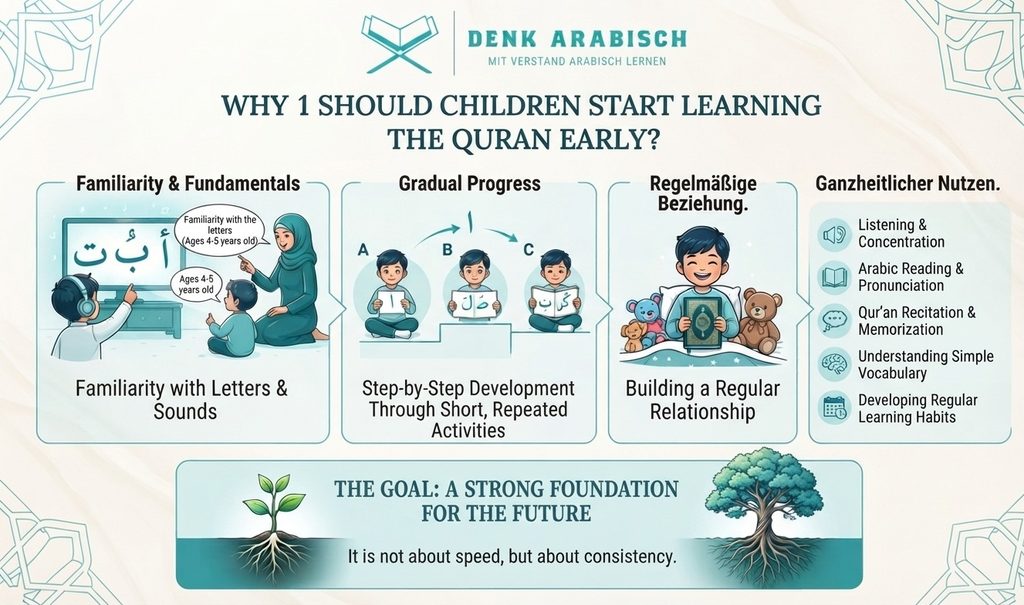
Table of Contents
How Can Children Learn The Quran When German Is Their Main Language?
Many children in Ravensburg grow up using German in school, with friends, and in everyday communication. Some may understand a little Arabic at home, while others may have very limited experience with the language.
This does not prevent them from learning the Quran. Quran reading can be taught as a separate skill, beginning with the Arabic alphabet and gradually introducing the sounds and reading patterns children need.
A child may initially find certain Arabic sounds unfamiliar. This is normal, especially when a sound does not have a direct equivalent in German. Regular listening and repetition can help children become more comfortable with these sounds over time.
Teachers can make this process easier by:
- Introducing difficult sounds gradually
- Using simple explanations and demonstrations
- Repeating pronunciation exercises regularly
- Correcting mistakes immediately but positively
Children can also learn Arabic language skills alongside Quran reading. Learning vocabulary and basic Arabic structures may eventually make Quranic words more familiar, but conversational Arabic is not a requirement for beginning Quran reading.
Support your child’s Quran journey with Quran Course for Kids at Denk Arabisch.
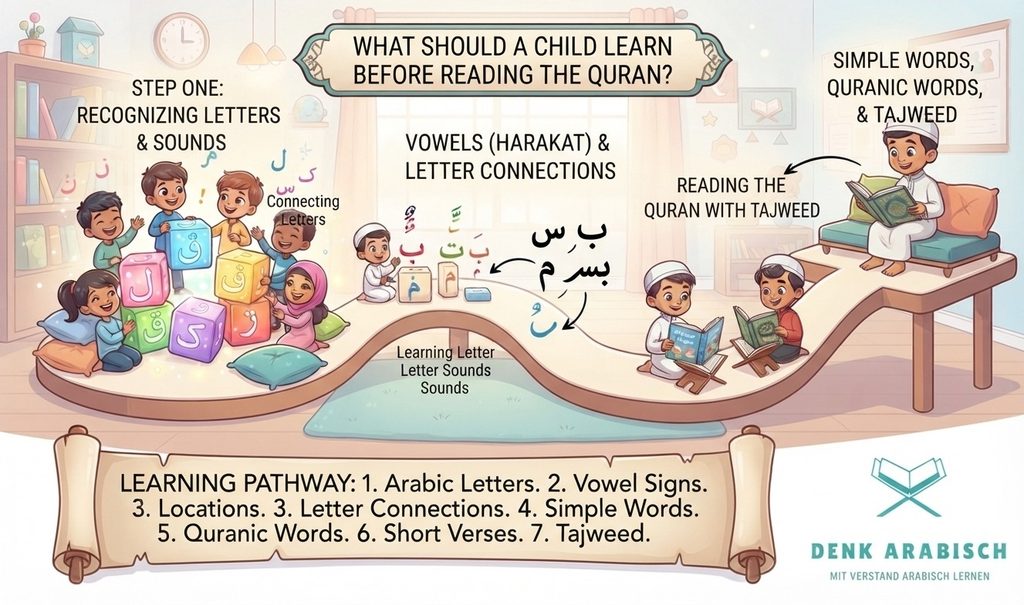
What Should A Child Learn Before Reading The Quran?
A strong foundation makes later Quran reading much easier. Children who are introduced directly to complete verses without understanding basic Arabic letters and vowel patterns may find reading more difficult than necessary.
The first stage should therefore focus on recognizing letters and producing their sounds correctly. Children can then learn how letters behave when they are connected and how vowel signs change pronunciation.
A practical learning sequence can include:
| Learning Stage | Main Focus |
| Arabic letters | Recognizing letters and their sounds |
| Harakat | Understanding basic vowel signs |
| Letter connections | Reading joined Arabic letters |
| Simple words | Building reading confidence |
| Quranic words | Recognizing common Quran vocabulary |
| Short verses | Developing continuous reading |
| Tajweed | Improving recitation accuracy |
This sequence does not have to be identical for every child. A child who already reads Arabic may move quickly toward Quranic reading, while a complete beginner may need more time with letters and vowel combinations.
The teacher should therefore use the sequence as a guide rather than a strict timetable.
Read our Article: Arabic Basics for Children
How Can Children Improve Their Quran Recitation?
Quran recitation requires more than recognizing words on a page. Children also need to learn how to pronounce Arabic letters correctly and apply appropriate recitation rules.
At the beginning, the teacher can focus on the child’s basic pronunciation. If a child has difficulty with a particular letter, it is usually better to practise that sound repeatedly before moving too quickly into more advanced material.
As the child’s reading becomes stronger, Tajweed can be introduced in a practical way. Instead of presenting many technical rules at once, the teacher can explain one principle and immediately show the child how it appears in Quranic verses.
Children may gradually learn areas such as:
- Makharij al-Huruf
- Noon Sakinah and Tanween
- Meem Sakinah
- Qalqalah
- Madd
- Rules of stopping and beginning
The purpose of Tajweed education is to help correct recitation become a natural part of reading. Children should have enough practical experience to apply the rules rather than simply memorize their names.
Learning about Idgham Mutajanisayn can help children understand how certain Arabic letters are pronounced together during Quran recitation.
When Is A Child Ready For Quran Memorization?
Memorization can be introduced once the child has enough reading ability to pronounce the selected verses reasonably accurately. However, memorization does not need to wait until the child becomes an advanced Quran reader.
Short Surahs can give children manageable goals and help them experience progress. The amount should be adjusted according to the child’s age, concentration, previous memorization, and ability to retain what has already been learned.
A useful memorization routine normally includes both new material and revision. Children should not continuously add new verses while neglecting the Surahs they memorized previously.
A simple routine can involve:
- Listening to the selected passage
- Reading it with the teacher
- Repeating short sections
- Reciting from memory
- Reviewing older Surahs regularly
Revision is particularly important because memorization becomes stronger through repeated recall over time.
Read also: Learning The Quran For Children In Villingen-Schwenningen
How Our Teachers Support Your Child’s Quran Learning
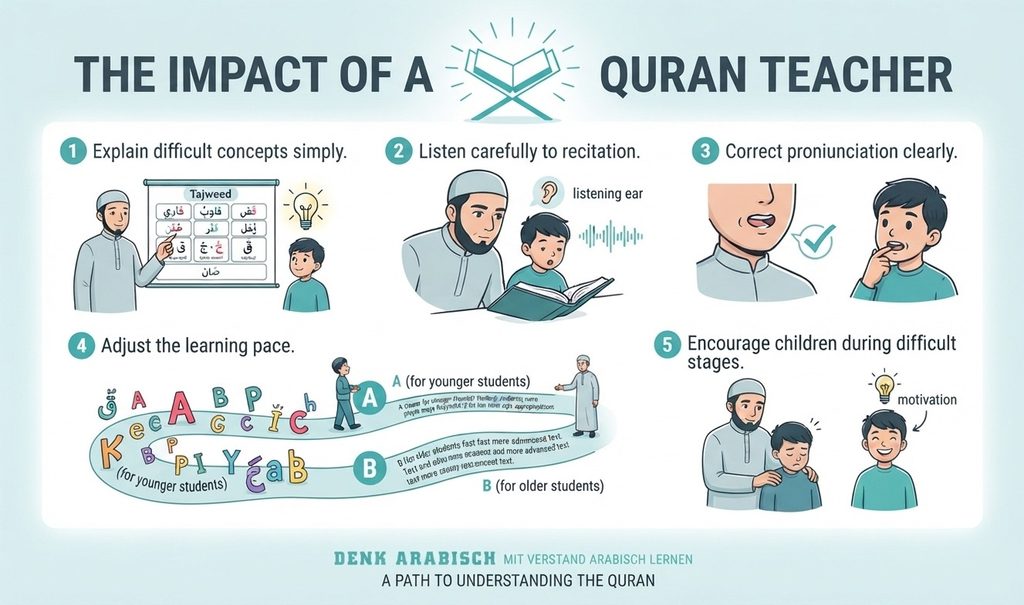
The teacher has a major role in shaping the child’s experience of Quran learning. Knowledge of Quran recitation is important, but teaching children also requires patience, clear communication, and the ability to adjust explanations according to age and ability.
A young beginner may need a completely different lesson from an older child who already reads fluently. The teacher should be able to recognize this difference and adapt the lesson instead of using exactly the same approach for everyone.
Good teaching also involves careful listening. A child may appear to know a particular rule but still make the same pronunciation mistake repeatedly. Regular observation allows the teacher to identify these patterns and provide focused practice.
Denk teachers should therefore be able to:
- Explain difficult concepts simply
- Listen carefully to recitation
- Correct pronunciation clearly
- Adjust the learning pace
- Encourage children during difficult stages
The relationship between teacher and child can have a strong influence on motivation and confidence.
Online Quran Learning For Children In Ravensburg
Online Quran lessons can provide families in Ravensburg with a flexible way to organize regular Quran education from home. Instead of travelling to a classroom, children can attend lessons using a computer or other suitable device.
One-to-one lessons can be particularly useful when the child’s learning needs are different from those of other students. The teacher can spend additional time on pronunciation, reading, Tajweed, or memorization depending on what the child currently needs.
The home environment can also make scheduling easier for families. Parents can organize lessons around school hours, homework, family activities, and other responsibilities without adding regular travel time.
Family calendars in Ravensburg also follow their own local rhythm. The Rutenfest, the city’s traditional five-day festival at the end of the school year, has been celebrated since the 17th century, and schoolchildren take part in its processions and theatre performances.
During busy weeks like this, flexible online scheduling makes it easier to move or catch up on lessons without breaking the child’s routine.
Online learning can be useful when it provides:
- Direct interaction with the teacher
- Individual correction
- A consistent weekly schedule
- Lessons adapted to the child’s level
The effectiveness of online learning still depends on the quality of teaching and the child’s participation. A suitable lesson structure and regular practice remain important regardless of where the lesson takes place.
Build accurate and confident Quran recitation through Tajweed Course for Kids at Denk Arabisch, where children learn essential Tajweed principles and put them into practice through guided recitation.
Not sure if online lessons are the right fit for your child? Try a free trial lesson with Denk Arabisch and see how your child responds to the teacher, the lesson format, and learning from home before you choose a course.
Learn the Quran with Denk Arabisch Academy
Master reading and understanding the Quran through structured and supportive learning
Try a Free TrialOnline Or Local Quran Classes: What Should Parents Consider?
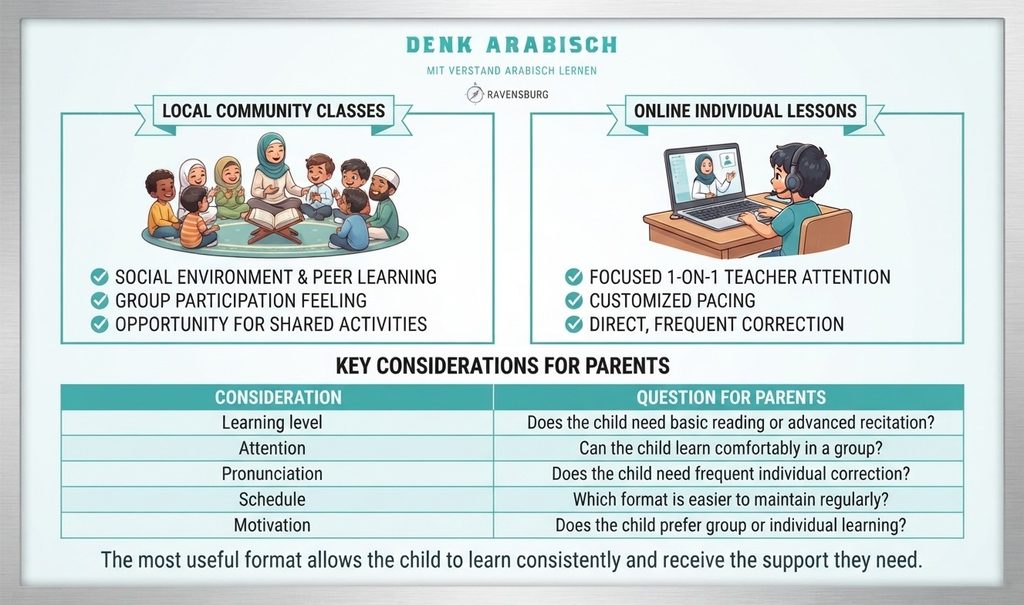
Parents in Ravensburg may have access to different Quran learning options, including local community classes and online individual lessons. Each format can provide useful benefits depending on the child’s personality and learning needs.
Ravensburg has an active Muslim community, including the Mevlana Mosque and several other Islamic communities in the city. Local classes can offer children a valuable community setting, while online one-to-one lessons give them focused attention and a schedule that fits around school and family life.
Parents who are considering a local option can contact these communities directly and ask whether they currently offer Quran classes for children, what level the classes are designed for, and which language is used for teaching.
Local group classes can give children opportunities to learn alongside other Muslim children. They may enjoy the social environment and the feeling of participating in a shared activity.
Online individual lessons provide a different type of learning experience. The teacher can focus on one child without having to divide attention among several students.
For children who need regular correction and a flexible schedule, one-to-one online lessons are often the easier option to maintain:
| Consideration | Question For Parents |
| Learning level | Does the child need basic reading or advanced recitation? |
| Attention | Can the child learn comfortably in a group? |
| Pronunciation | Does the child need frequent individual correction? |
| Schedule | Which format is easier to maintain regularly? |
| Motivation | Does the child prefer group or individual learning? |
The most useful format is usually the one that allows the child to learn consistently and receive the support they actually need.
Read also: Learning The Quran For Children In Leipzig
Common Mistakes Parents Should Avoid
Parents naturally want their children to make progress, but too much pressure can sometimes have the opposite effect. Comparing a child with another student, sibling, or friend may make the child feel that their own progress is not good enough.
Another common mistake is focusing only on how much the child has memorized. Memorization is valuable, but accurate reading, pronunciation, revision, and understanding also need attention.
Parents should also avoid expecting every child to follow the same timetable. One child may learn the Arabic alphabet quickly, while another may need more repetition before feeling comfortable.
A healthier approach is to focus on:
- The child’s own improvement
- Consistent practice
- Accurate pronunciation
- Positive encouragement
This allows Quran learning to remain a long-term educational journey rather than a competition.
Parents can also learn about Common Mistakes Kids Make When Reading Quran to better understand the challenges children may face and support them in improving their Quran reading skills.
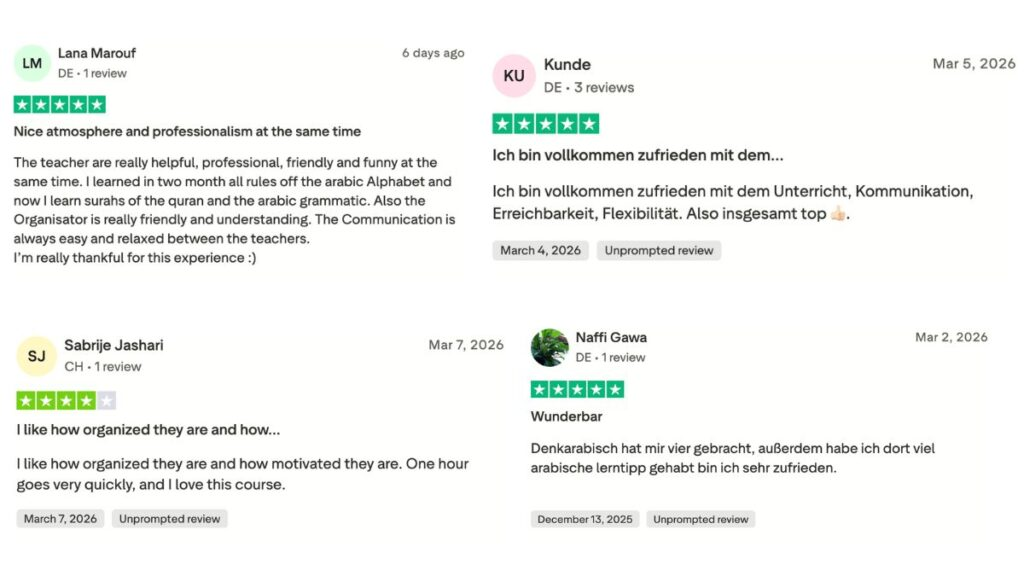
What Our Students Say About Denk Arabisch Academy
See what our students say about learning at Denk Arabisch Academy on Trustpilot. Read their experiences and check out more reviews to discover how our courses help improve Arabic.
Learn the Quran With Denk Arabisch!
At Denk Arabisch, children in Ravensburg can study Arabic and the Quran through structured online lessons that can be adapted to their current level and learning needs.
A beginner can start with Arabic letters, pronunciation, and basic reading skills, while a child with previous experience can work on Quran recitation, Tajweed, memorization, or more advanced reading.
Because lessons can focus directly on the individual learner, the teacher can spend additional time on areas that need attention. This may include a difficult Arabic sound, a reading problem, a Tajweed rule, or a Surah that needs more revision.
Children can also learn from home, which can make regular Quran education easier to fit around school and family responsibilities in Ravensburg.
Available learning options include:
- Quran Course for Kids – structured Quran reading, memorization, and revision for children.
- Arabic Classes for Kids – Arabic reading, vocabulary, pronunciation, and language foundations.
- Tajweed Course for Kids – practical Tajweed and recitation training.
- Quran Recitation Course– improving accuracy and confidence in Quran recitation.
- Quran Tajweed Course – developing stronger knowledge and application of Tajweed.
- Quran Memorization Course – structured memorization with regular revision.
- Islamic Studies Course – broader Islamic learning suitable for children and learners.
Learn the Quran with Denk Arabisch Academy
Master reading and understanding the Quran through structured and supportive learning
Try a Free TrialParents who want to understand the learning approach can also book a free trial lesson and see how the teacher works with their child.
Book a free trial lesson with Denk Arabisch to see how the teacher works with your child and find the right starting point.” .

Conclusion
Choosing the right approach to learning the Quran for children in Ravensburg helps children build strong Quran and Arabic skills without feeling overwhelmed. Progress rarely comes from rushing. It comes from steady lessons, patient correction, and a child who enjoys coming back to learn.
At Denk Arabisch, we make this journey structured, age-appropriate, and encouraging from the very first lesson. Each stage builds on the one before it: recognizing letters, pronouncing sounds correctly, reading words and verses, then reciting and memorizing with growing confidence.
We also know that many children in Ravensburg speak German for most of their day. For them, a regular connection with the Quran and the Arabic language keeps an important part of their identity alive. Our teachers work to make that connection feel natural and positive, so it doesn’t become a burden.
With the right teacher, consistent practice, and a clear plan, your child can make the Quran a lasting part of their Islamic education and keep growing with it for years to come.
Read also: Learning The Quran For Children In Dresden – Local Classes and Online Options
FAQs
1. Can children learn the Quran online from Ravensburg?
Yes. Children can learn Quran reading, recitation, Tajweed, and memorization through structured online lessons from home.
Online lessons can be particularly practical for families who want regular Quran education without adding travel to the weekly schedule. The lesson can also be adapted according to the child’s current reading level and learning needs.
2. Does my child have to speak Arabic before learning the Quran?
No. Conversational Arabic is not required before a child begins learning Quran reading.
Children can start with Arabic letters and sounds and gradually develop the skills required to read Quranic words and verses. Arabic language learning can also be added alongside Quran education when appropriate.
3. What should a complete beginner learn first?
A beginner normally starts with the Arabic alphabet and correct pronunciation. After that, the child can learn vowel signs, connected letters, simple words, and gradually move toward Quranic verses.
The pace should depend on how comfortably the child is developing each skill rather than following a fixed timetable.
4. When should Tajweed be introduced?
Correct pronunciation should be encouraged from the beginning, but detailed Tajweed rules can be introduced progressively.
As the child’s reading improves, the teacher can add rules such as Qalqalah, Madd, Noon Sakinah and Tanween, Meem Sakinah, and appropriate stopping and beginning rules.
5. How much should children practise at home?
There is no single amount that works for every child. Younger learners can often benefit from short, focused practice sessions rather than long periods of study.
Around 10–20 minutes can be a practical starting point for some younger children, but parents should adjust the routine according to the child’s age, concentration, school schedule, and learning level.