Learning the Quran for children in Konstanz goes beyond memorizing Surahs. A strong foundation also includes reading Arabic letters correctly, pronouncing Quranic sounds accurately, and gradually applying basic Tajweed.
For many Muslim families in Konstanz, Quran learning has to fit around German school, homework, sports, and family life. Children also start at different levels. Some are learning the Arabic alphabet for the first time, while others already read short Surahs and need help with fluency or Tajweed.
At Denk Arabisch, children learn through one-to-one online lessons built around their age and current level. Each child moves step by step from reading foundations toward confident Quran recitation.
Table of Contents
Why Children in Konstanz Benefit From Structured Quran Learning?
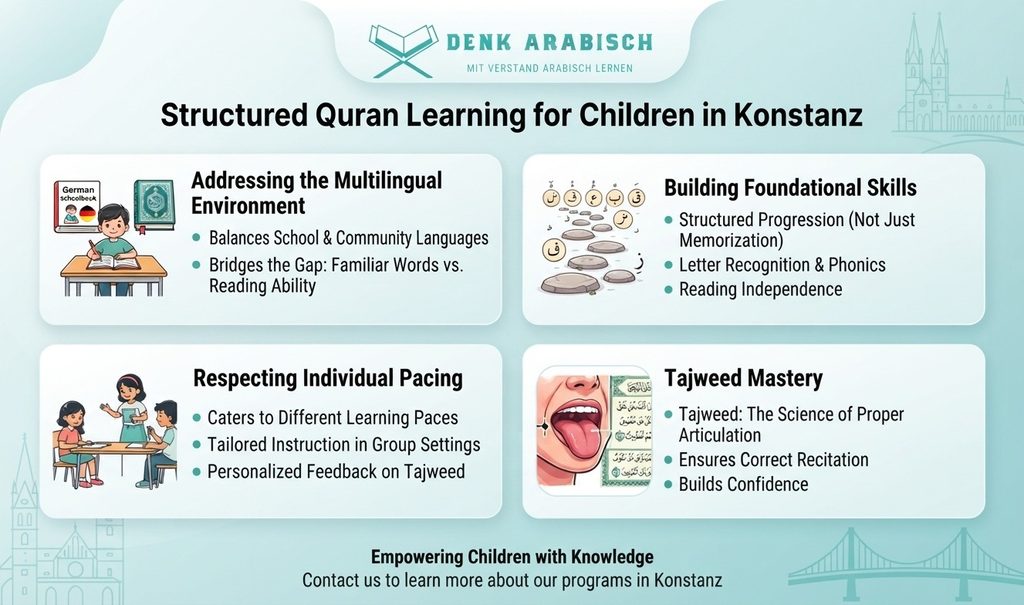
Children growing up in Konstanz can experience different languages and educational environments throughout the week. German may be the main language used at school, while Arabic may only be heard occasionally at home or during religious activities.
This can make Quranic Arabic feel unfamiliar at first. The child may recognize some words or sounds without being able to read them independently, or may know how to recite certain surahs without fully understanding the Arabic reading system.
A structured Quran program can bridge this gap by introducing each skill at the appropriate stage. Instead of moving immediately to memorization, children can first build the reading abilities they need to become confident Quran readers.
Local Islamic community activities can also play an important role in children’s religious education. Konstanz has an established Muslim community, including Mevlana Camii, where children can encounter Islamic learning within a community setting.
However, children do not all learn at the same pace. A child attending a group lesson may have a different reading level, pronunciation ability, or memorization background from the other children.
For this reason, parents should consider both the educational environment and the child’s individual needs.
A useful Quran learning structure should take into account:
- The child’s age and current level
- Previous experience with Arabic
- Ability to recognize Arabic letters
- Quran reading ability
- Pronunciation and articulation
- Tajweed knowledge
The purpose of structure is not to make Quran learning feel strict or academic. It is to give children a clear path so that each new skill builds naturally on what they have already learned.
What Kids Really Learn in a Quran Course in Konstanz?
A children’s Quran course should follow a gradual progression rather than treating every learner as if they are starting from the same point.
Some children may be learning Arabic letters for the first time, while others may already read short surahs. The teacher can assess each child’s current ability and then choose an appropriate pace.
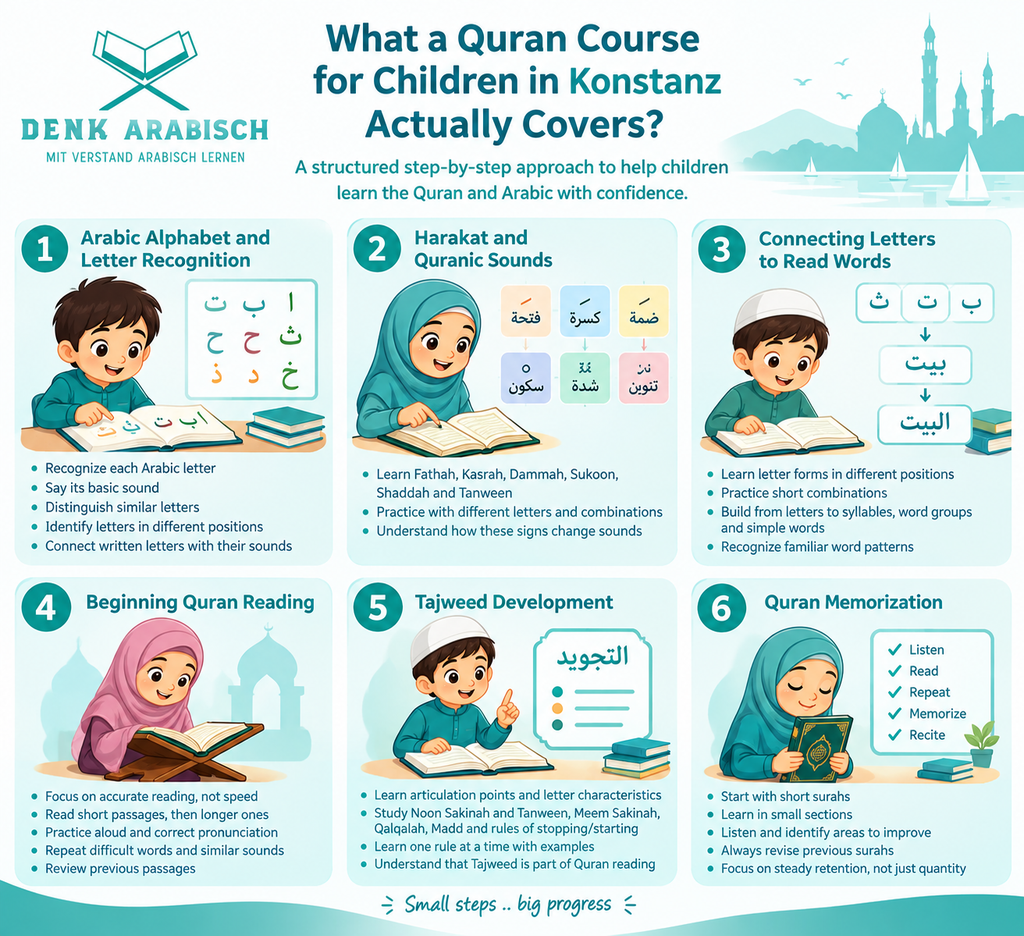
1. Arabic Reading Foundations
Children begin by building the basic reading skills needed for Quranic Arabic. This includes recognizing Arabic letters, understanding their sounds, learning Harakat such as Fathah, Kasrah, and Dammah, and gradually connecting letters to form simple words.
With regular practice, children become more comfortable recognizing letters in different forms and reading familiar Quranic words.
Children can gradually learn to:
- Recognize Arabic letters and their sounds
- Read basic Harakat and letter combinations
- Connect letters and recognize simple words
2. Beginning Quran Reading
Once children have developed basic Arabic reading skills, they can begin applying them directly to the Quran. The focus should be on accurate pronunciation and building confidence rather than reading quickly. Teachers can use short passages and repeated practice to help children become more familiar with Quranic words and verses.
Practice may include:
- Reading short verses aloud
- Correcting pronunciation
- Repeating difficult words
- Reviewing previously learned passages
3. Tajweed Development
Tajweed helps children understand and apply the rules needed for correct Quranic recitation. Instead of introducing too much terminology at once, teachers can explain each rule through examples from the Quran and give children opportunities to practice it during their reading.
Depending on their level, children may gradually learn:
- Articulation points and letter characteristics
- Noon Sakinah, Tanween, and Meem Sakinah
- Qalqalah and Madd
- Basic stopping and starting rules
Children who need focused Tajweed practice can also study through the Tajweed Course for Kids at Denk Arabisch.
4. Quran Memorization
Memorization can become an important part of Quran education after children develop basic reading and pronunciation skills. Short surahs can be divided into manageable sections, allowing children to learn gradually while regularly revising what they have already memorized.
A balanced routine can include:
- Listening to the passage
- Reading and repeating short sections
- Memorizing gradually
- Reciting to the teacher
- Reviewing previous surahs
Common Challenges Children May Face When Learning the Quran
Children can face different challenges depending on their age, language environment, previous experience, and learning style.
A child who rarely hears Arabic may find pronunciation difficult at first. Another child may recognize the letters but struggle to connect them into complete words.
These difficulties do not necessarily mean that the child is unable to learn. They usually indicate that the child needs more practice in a particular area.
| Challenge | Core Issue | Recommended Solution |
| Similar Arabic Letters | Confusion between letters with similar shapes or sounds | Use repeated exposure, targeted examples, and focused pronunciation exercises. |
| Pronunciation Barriers | Unfamiliar sounds (especially for German speakers) | Provide patient guidance, repeated listening, and supportive correction rather than flat rejection. |
| Connecting Letters | Difficulty transitioning from isolated letters to whole words | Practice step-by-step: move gradually from single letters to combinations and complete words. |
| Losing Confidence | Discouragement after repeated mistakes | Normalize mistakes, apply positive correction, and break practice into manageable steps. |
| Forgetting Memorized Surahs | Retention loss due to lack of regular review | Build revision permanently into the core learning routine instead of treating it as an afterthought. |
Read our Article: Common Mistakes Kids Make When Reading Quran
Quran Learning by Age in Konstanz
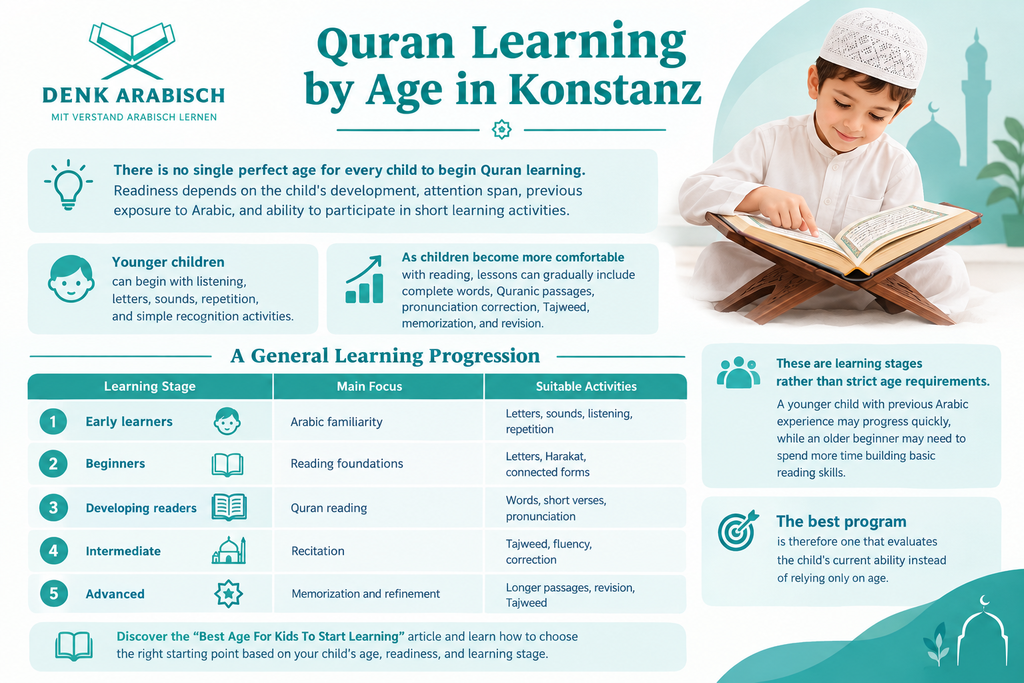
There is no single perfect age for every child to begin Quran learning. Readiness depends on the child’s development, attention span, previous exposure to Arabic, and ability to participate in short learning activities.
Younger children can begin with listening, letters, sounds, repetition, and simple recognition activities.
As children become more comfortable with reading, lessons can gradually include complete words, Quranic passages, pronunciation correction, Tajweed, memorization, and revision.
A general learning progression can look like this:
| Learning Stage | Main Focus | Suitable Activities |
| Early learners | Arabic familiarity | Letters, sounds, listening, repetition |
| Beginners | Reading foundations | Letters, Harakat, connected forms |
| Developing readers | Quran reading | Words, short verses, pronunciation |
| Intermediate | Recitation | Tajweed, fluency, correction |
| Advanced | Memorization and refinement | Longer passages, revision, Tajweed |
These are learning stages rather than strict age requirements.
A younger child with previous Arabic experience may progress quickly, while an older beginner may need to spend more time building basic reading skills.
The best program is therefore one that evaluates the child’s current ability instead of relying only on age.
Discover the “Best Age For Kids To Start Learning” article and learn how to choose the right starting point based on your child’s age, readiness, and learning stage.
Read also: Learning The Quran For Children In Freiburg
Can Children Learn the Quran Without Knowing Arabic?
A child does not need to speak Arabic fluently before learning to read the Quran.
Learning to speak Arabic and learning Quranic reading are different skills. A child can learn the Arabic alphabet and Quranic reading system without being able to hold a conversation in Arabic.
This distinction is particularly useful for children growing up in Germany.
They may speak German at school and with friends while using little Arabic in everyday life. Quran lessons can gradually introduce them to Arabic reading without requiring full conversational Arabic first.
At the same time, Arabic language learning can support Quran education by making children more familiar with vocabulary, sentence patterns, and pronunciation.
Families interested in developing both skills can combine Quran education with structured Arabic Classes for Kids at Denk Arabisch.
Learn the Quran with Denk Arabisch Academy
Master reading and understanding the Quran through structured and supportive learning
Try a Free TrialQuran Learning From Home for Children in Konstanz
Online learning can be useful for families who want Quran education without adding regular travel to the weekly schedule.
Instead of spending time traveling to and from a class, the child can join the lesson from home.
This can be particularly useful when parents have multiple children with different schedules or when the family wants to combine Quran learning with other activities.
Online lessons can provide:
- Learning from home
- Flexible lesson scheduling
- Individual teacher attention
- Direct pronunciation correction
- Personalized pacing
- Regular communication with the teacher
However, online learning still needs structure. Children benefit when they have a quiet learning space, a regular lesson time, and a consistent practice routine.
Why One-to-One Quran Learning Can Work Well for Children in Konstanz?
Online lessons let children in Konstanz learn the Quran from home, without adding travel to an already busy week. This makes it easier to keep a regular lesson time, even when families juggle school schedules, activities, or several children.
The one-to-one format is what makes the biggest difference. Children learn at very different speeds. One child may need extra time with a difficult Arabic sound, while another is ready to move on to the next Tajweed rule. With one teacher focused on one child, the lesson follows the child’s actual level instead of a group’s pace.
One-to-one lessons are especially helpful for children who:
- Need regular pronunciation correction
- Have gaps in their reading foundations
- Learn faster or slower than their peers
- Need focused support with Tajweed or memorization
Start with the Quran Course for Kids at Denk Arabisch, or book a free trial lesson so the teacher can assess your child’s level first.
Finding the Right Quran Course for Children in Konstanz
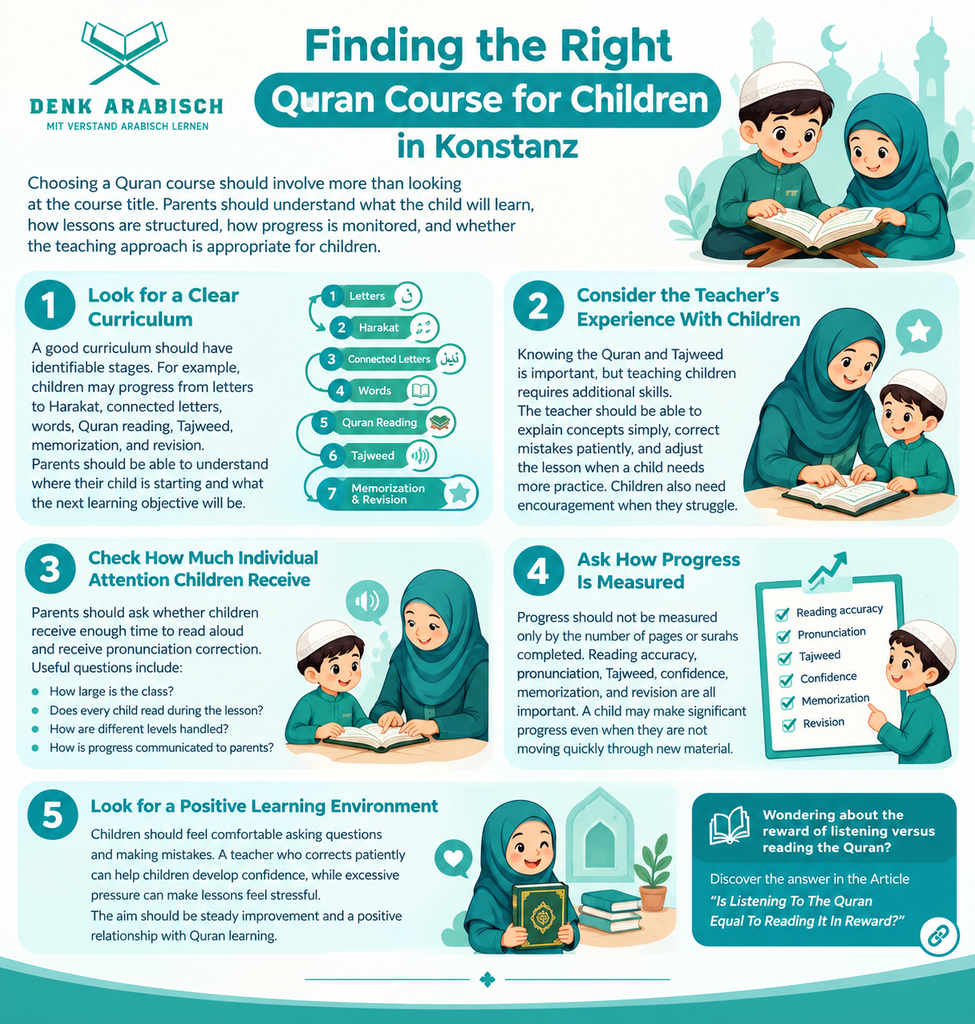
Choosing a Quran course should involve more than looking at the course title.
Parents should understand what the child will learn, how lessons are structured, how progress is monitored, and whether the teaching approach is appropriate for children.
1. Look for a Clear Curriculum
A good curriculum should have identifiable stages.
For example, children may progress from letters to Harakat, connected letters, words, Quran reading, Tajweed, memorization, and revision.
Parents should be able to understand where their child is starting and what the next learning objective will be.
2. Consider the Teacher’s Experience With Children
Knowing the Quran and Tajweed is important, but teaching children requires additional skills.
The teacher should be able to explain concepts simply, correct mistakes patiently, and adjust the lesson when a child needs more practice.
Children also need encouragement when they struggle.
3. Check How Much Individual Attention Children Receive
Parents should ask whether children receive enough time to read aloud and receive pronunciation correction.
Useful questions include:
- How large is the class?
- Does every child read during the lesson?
- How are different levels handled?
- How is progress communicated to parents?
These questions can reveal how personalized the learning experience really is.
Read also: Learning The Quran For Children In Tübingen
4. Ask How Progress Is Measured
Progress should not be measured only by the number of pages or surahs completed.
Reading accuracy, pronunciation, Tajweed, confidence, memorization, and revision are all important.
A child may make significant progress even when they are not moving quickly through new material.
5. Look for a Positive Learning Environment
Children should feel comfortable asking questions and making mistakes.
A teacher who corrects patiently can help children develop confidence, while excessive pressure can make lessons feel stressful.
The aim should be steady improvement and a positive relationship with Quran learning.
At Denk Arabisch, Quran lessons for children are one-on-one, so the questions above have clear answers. There is no class size to worry about, your child reads aloud for the entire lesson, and the teacher follows your child’s level instead of a group’s pace.
The individual format also makes it easier to move through the curriculum stage by stage, correct pronunciation right away, and track progress in reading accuracy, Tajweed, and memorization, not only in the number of pages completed.
Wondering about the reward of listening versus reading the Quran? Discover the answer in the Article “Is Listening To The Quran Equal To Reading It In Reward?”
How Long Should Children Practice the Quran Each Day?
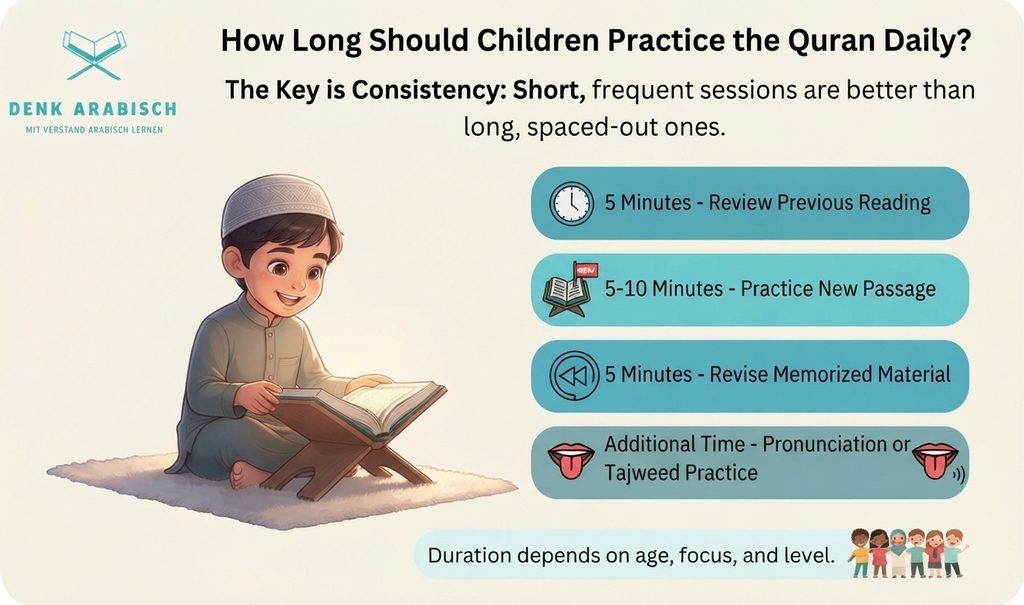
Children do not necessarily need long study sessions to make progress.
For younger learners, around 10–20 minutes of focused practice can often be more manageable than a long session that leaves them tired or frustrated.
The exact amount depends on age, attention span, school schedule, and current level.
A short routine might include:
| Practice Time | Activity |
| 5 minutes | Review previous reading |
| 5–10 minutes | Practice a new passage |
| 5 minutes | Revise memorized material |
| Additional time | Pronunciation or Tajweed practice |
As children become older and more confident, practice time can gradually increase.
The main objective is consistency. Ten focused minutes practiced regularly can be more useful than a long session that happens only occasionally.
Read also: Learning The Quran For Children In Reutlingen
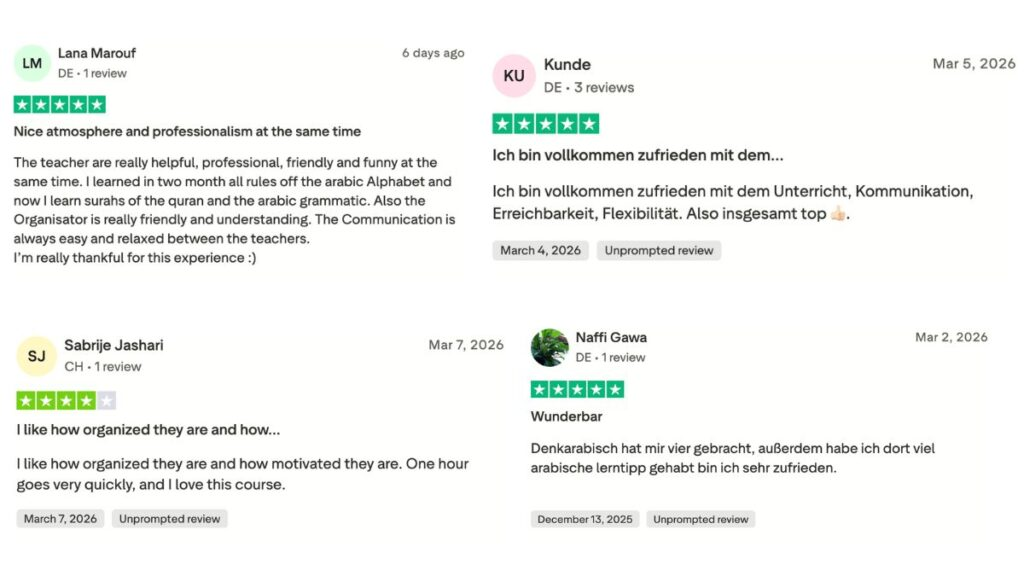
What Our Students Say About Denk Arabisch Academy
See what our students say about learning at Denk Arabisch Academy on Trustpilot. Read their experiences and check out more reviews to discover how our courses help improve Arabic.
Learn The Quran With Denk Arabisch
At Denk Arabisch, children can learn Arabic and the Quran through structured online lessons designed around their age, level, and individual learning needs.
In a typical lesson, your child may work on:
- Letters that sound alike. Many children mix up ح and ه, or ع and ء. The teacher catches this as it happens and repeats the letter with the child until it sounds right.
- The right starting point. A child still learning how letters join starts with short, guided reading drills. A child who already reads well moves on to Tajweed rules such as ghunnah and madd.
- Short, focused activities. Younger children switch between reading, listening and repeating, so they stay focused for the whole lesson.
- Revising what they’ve memorized. For children in the Hifz course, part of each lesson goes to reviewing earlier surahs so they don’t forget them while learning new ones.
- Clear progress for parents. The teacher can tell you which rules your child now applies correctly and what comes next.
Our Courses:
- Quran Course for Kids
- Tajweed Course for Kids
- Quran Recitation Course
- Quran Tajweed Course
- Quran Memorization Course
- Quran Reading Course
- Islamic Studies Course
Learn the Quran with Denk Arabisch Academy
Master reading and understanding the Quran through structured and supportive learning
Try a Free TrialFor families in Konstanz, online learning also provides the convenience of studying from home without adding regular travel to an already busy weekly schedule.
Book a free trial lesson with Denk Arabisch and give your child the opportunity to develop a strong and structured foundation in Quran learning.
Conclusion
Learning the Quran for children in Konstanz is a gradual process. Children need time to become familiar with Arabic letters, sounds, reading patterns, pronunciation, and Quranic recitation.
For Muslim families in Konstanz, this learning process takes place alongside German school, extracurricular activities, family commitments, and everyday life. A structured course can help children progress without feeling pressured to master everything at once.
Individual attention can also help children who learn at different speeds or need extra support with reading and pronunciation. Each stage can be adapted to the child’s current level and abilities.
Successful Quran education is not only about how many Surahs a child memorizes. It is also about developing accurate reading, correct recitation, confidence, consistency, and a positive relationship with the Quran. Book a free trial lesson with Denk Arabisch and find the right starting point for your child.
FAQs
1. Can children in Konstanz learn the Quran online?
Yes. Online Quran lessons can provide children with structured learning from home and direct interaction with a teacher.
This can be especially practical for families who need Quran education to fit around school, homework, activities, and other weekly commitments.
2. Does my child need to speak Arabic before learning the Quran?
No. A child can learn to read the Quran without being able to speak Arabic fluently.
They can begin with Arabic letters, sounds, Harakat, and reading foundations before gradually developing more Quranic vocabulary and language knowledge.
3. What should a beginner learn first?
A complete beginner will generally need to start with the Arabic alphabet and letter sounds.
After that, the child can progress to Harakat, connected letters, simple words, Quranic reading, pronunciation, and eventually Tajweed and memorization.
4. What if my child already knows how to read the Quran?
The child does not necessarily need to repeat beginner material.
A teacher can assess the existing level and identify areas that need improvement, such as pronunciation, fluency, Tajweed, memorization, or revision.
5. When should children start learning Tajweed?
Children should be guided toward correct pronunciation from the beginning.
More detailed Tajweed rules can be introduced gradually as their reading ability develops. This allows children to improve their recitation without being overwhelmed by technical terminology.