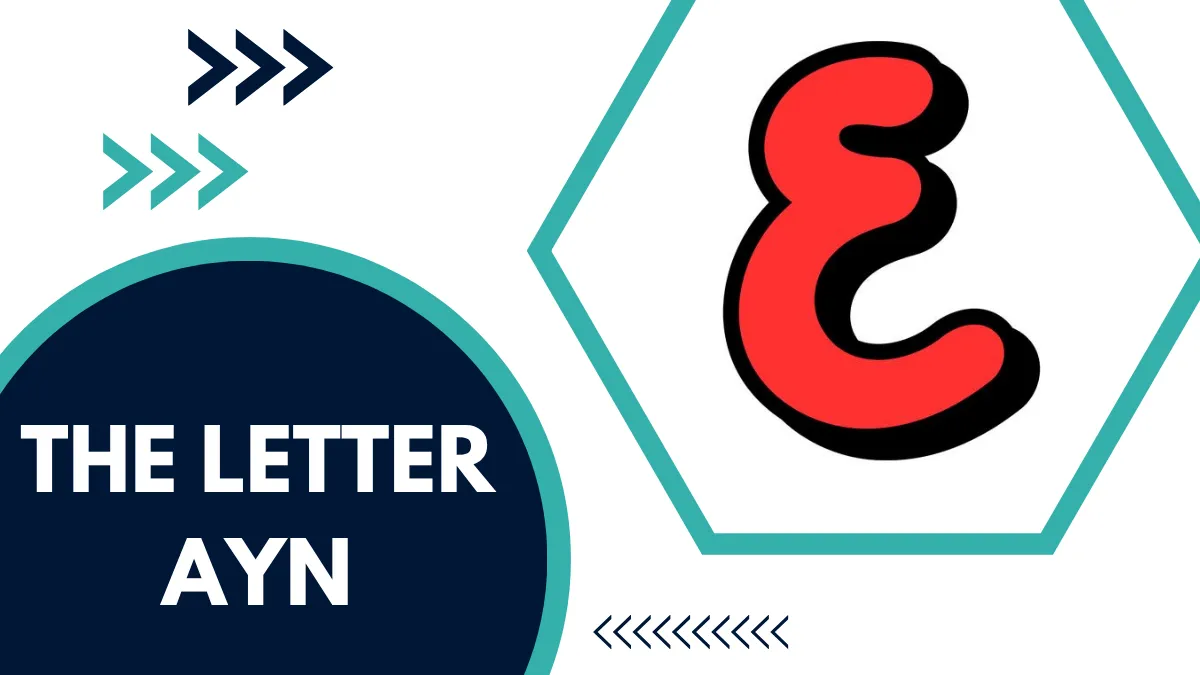
The letter Ayn (ع) is the 18th letter of the Arabic alphabet. Its full Arabic name is عَيْنٌ (ʿayn), which also means “eye”. You make it in the middle of your throat, with your voice switched on. Linguists call it a voiced pharyngeal fricative, written [ʕ] in IPA.
This sound doesn’t exist in German, so you start without a head start here. That is fine. Ayn is a physical movement you can train, and this guide shows you which muscles to use and which German habits to switch off.
This guide covers everything you need to know about Ayn:
- How to pronounce ع, step by step
- How to write its four forms
- How ع behaves with short and long vowels
- Ayn in Tajweed: makhraj, attributes and Iẓhār Ḥalqī
- Common words and roots with ع
Short exercises at the end let you check what you learned.
| Fact | Ayn (ع) |
| Name | عَيْنٌ (ʿayn) |
| Sound | [ʕ], voiced pharyngeal fricative. No German equivalent. Found in Somali (written c) and in traditional Mizrahi Hebrew (ע) |
| Position in the alphabet | 18th letter (hijāʾī order) |
| Abjad value | 16th letter, value 70 |
| Transliteration | Common: ʿ or ‘ · DIN 31635: ʿ · Variant: ` · Arabizi: 3 |
| Point of articulation | Middle of the throat (وَسَطُ الْحَلْقِ) |
| Sun or Moon letter | Moon letter |
| Heavy or light | Light (muraqqaq) |
| Dots | None |
| Connection | Connects on both sides (4 forms) |
Table of Contents
Ayn’s Placement in Arabic Orders and Numerology
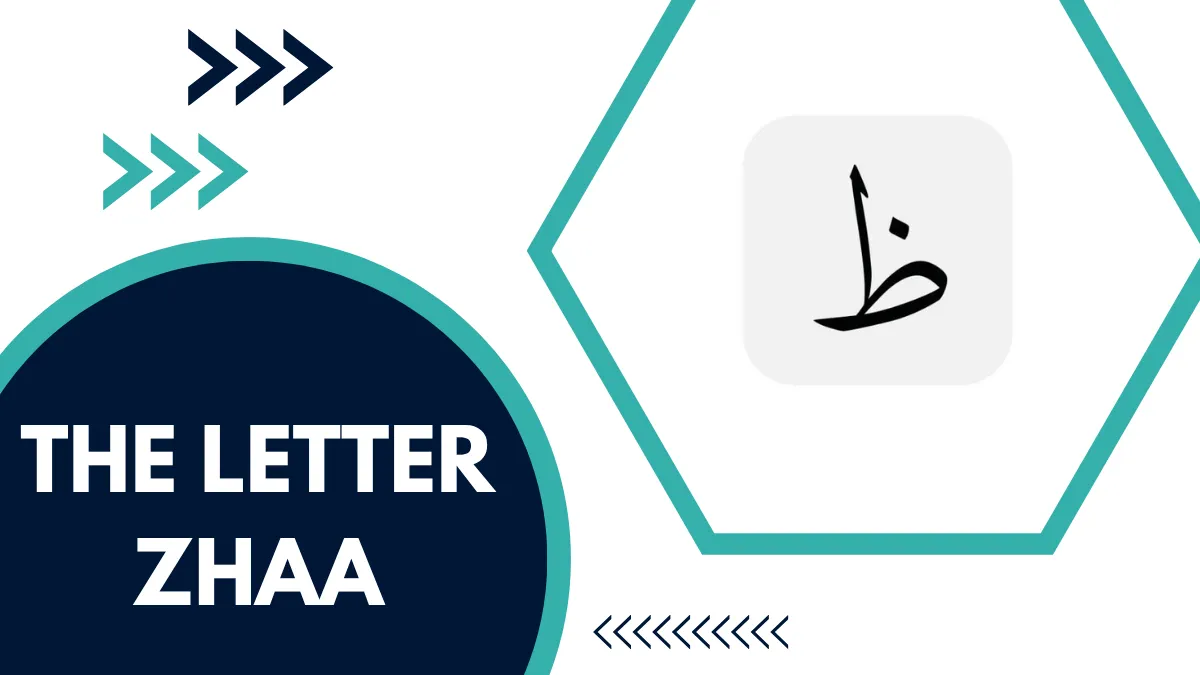
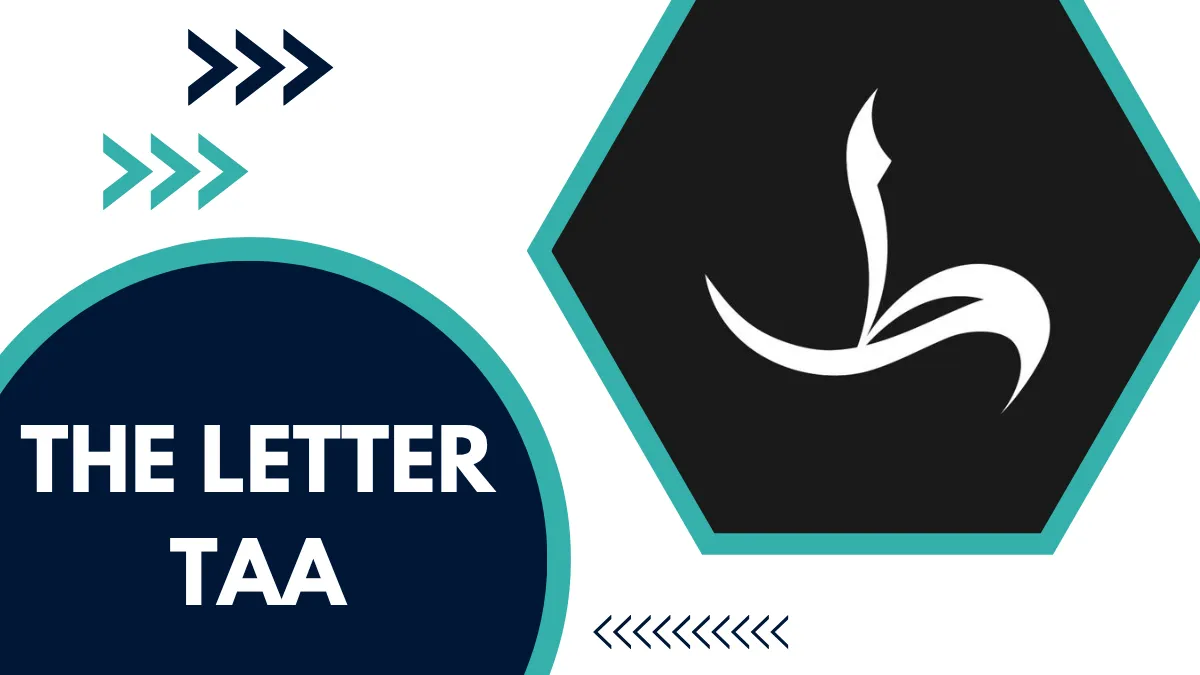
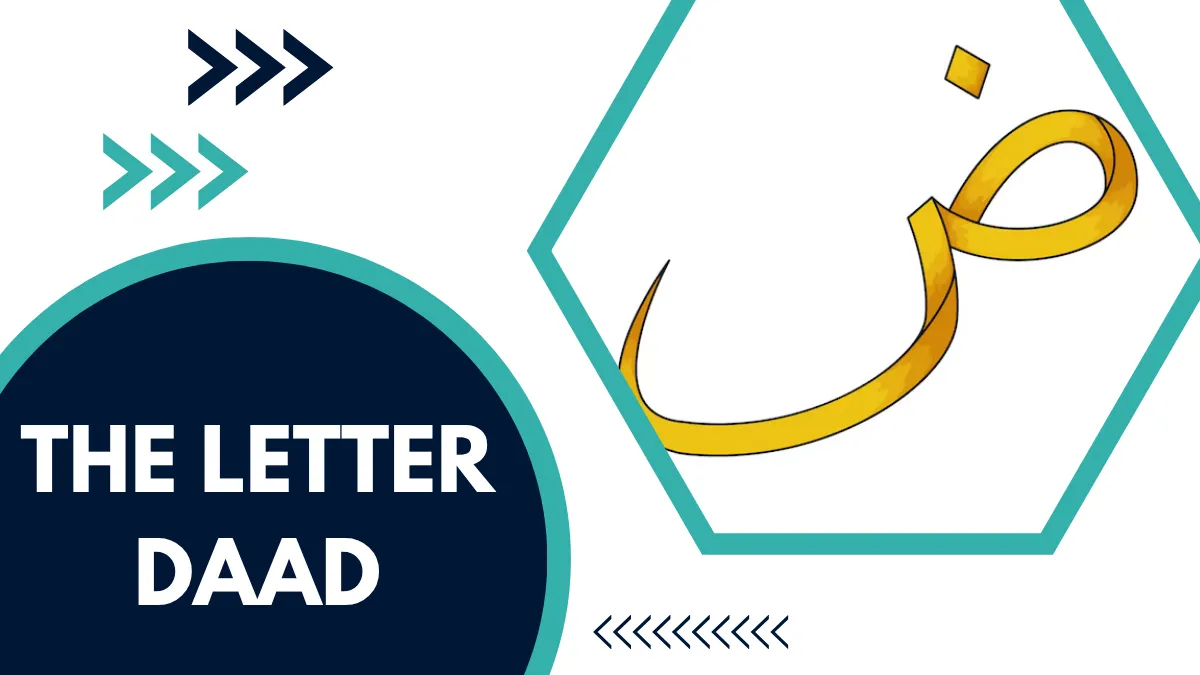
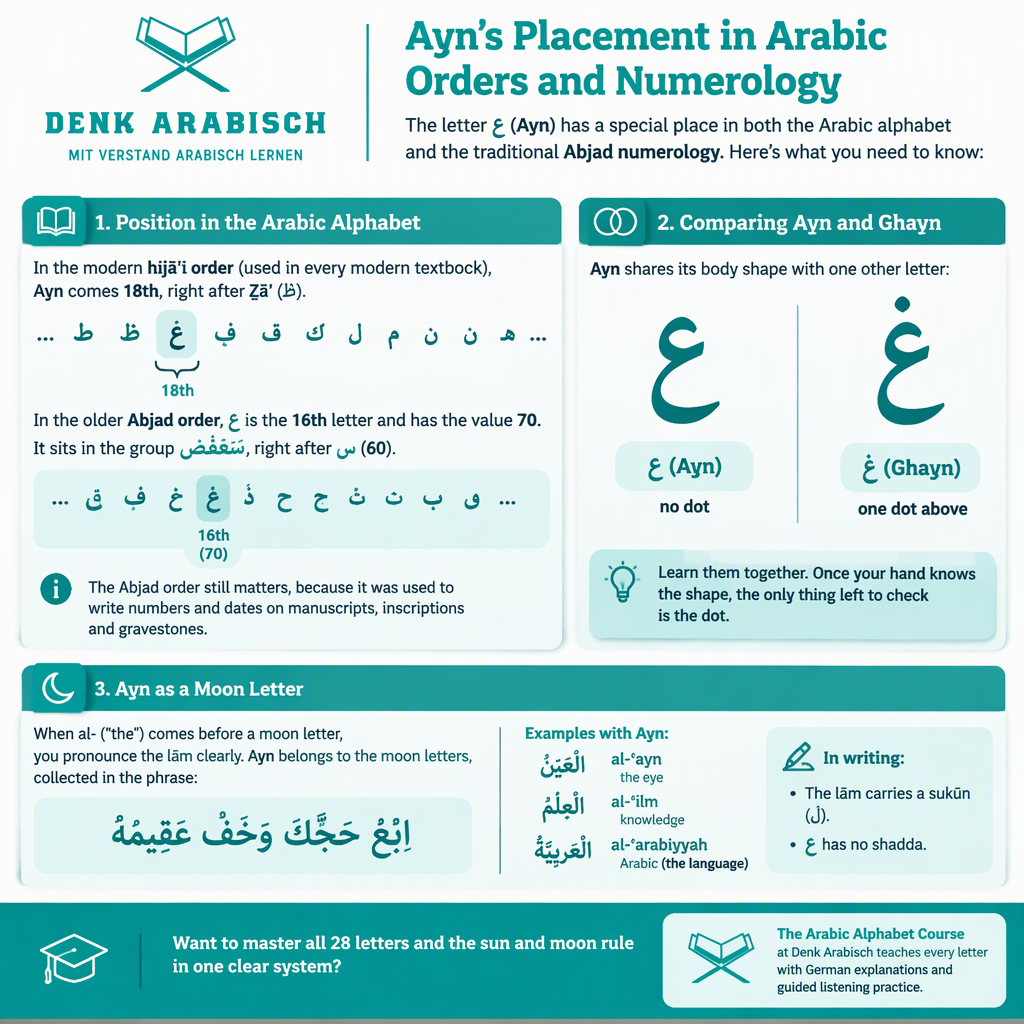
In the hijāʾī order used in every modern textbook, ع comes 18th, right after ظ:
ا ب ت ث ج ح خ د ذ ر ز س ش ص ض ط ظ ع
In the older Abjad order, ع is the 16th letter and has the value 70. It sits in the group سَعْفَصْ, right after س (60). The Abjad order still matters, because it was used to write numbers and dates on manuscripts, inscriptions and gravestones.
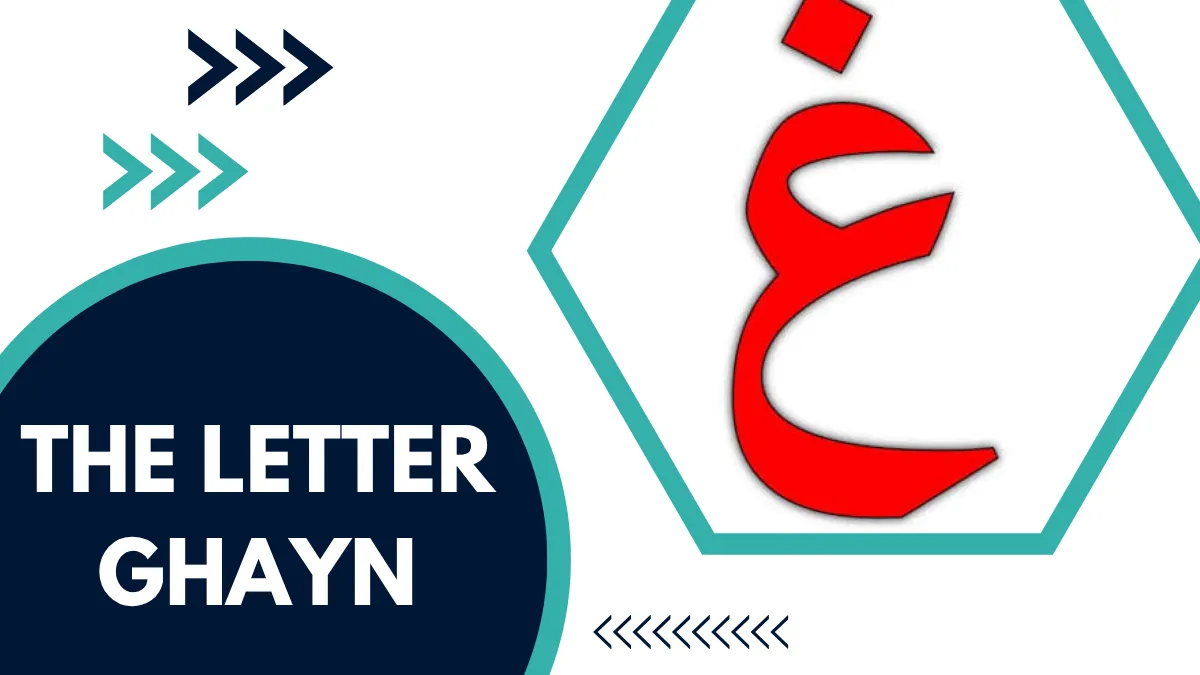
Comparing Ayn (ع) and Ghayn (غ)
Ayn shares its body shape with one other letter:
- ع (Ayn): no dot
- غ (Ghayn): one dot above
Learn them together. Once your hand knows the shape, the only thing left to check is the dot.
Ayn as a Moon Letter
When al- (“the”) comes before a moon letter, you pronounce the lām clearly. Ayn belongs to the moon letters, collected in the phrase اِبْغِ حَجَّكَ وَخَفْ عَقِيمَهُ.
- الْعَيْنُ (al-ʿayn): the eye
- الْعِلْمُ (al-ʿilm): knowledge
- الْعَرَبِيَّةُ (al-ʿarabiyyah): Arabic (the language)
In writing, the lām carries a sukūn (لْ), and ع has no shadda.
Want to master all 28 letters and the sun and moon rule in one clear system? The Arabic Alphabet Course at Denk Arabisch teaches every letter with German explanations and guided listening practice.
Defining Makhraj and Tajweed Context of Letter Ayn
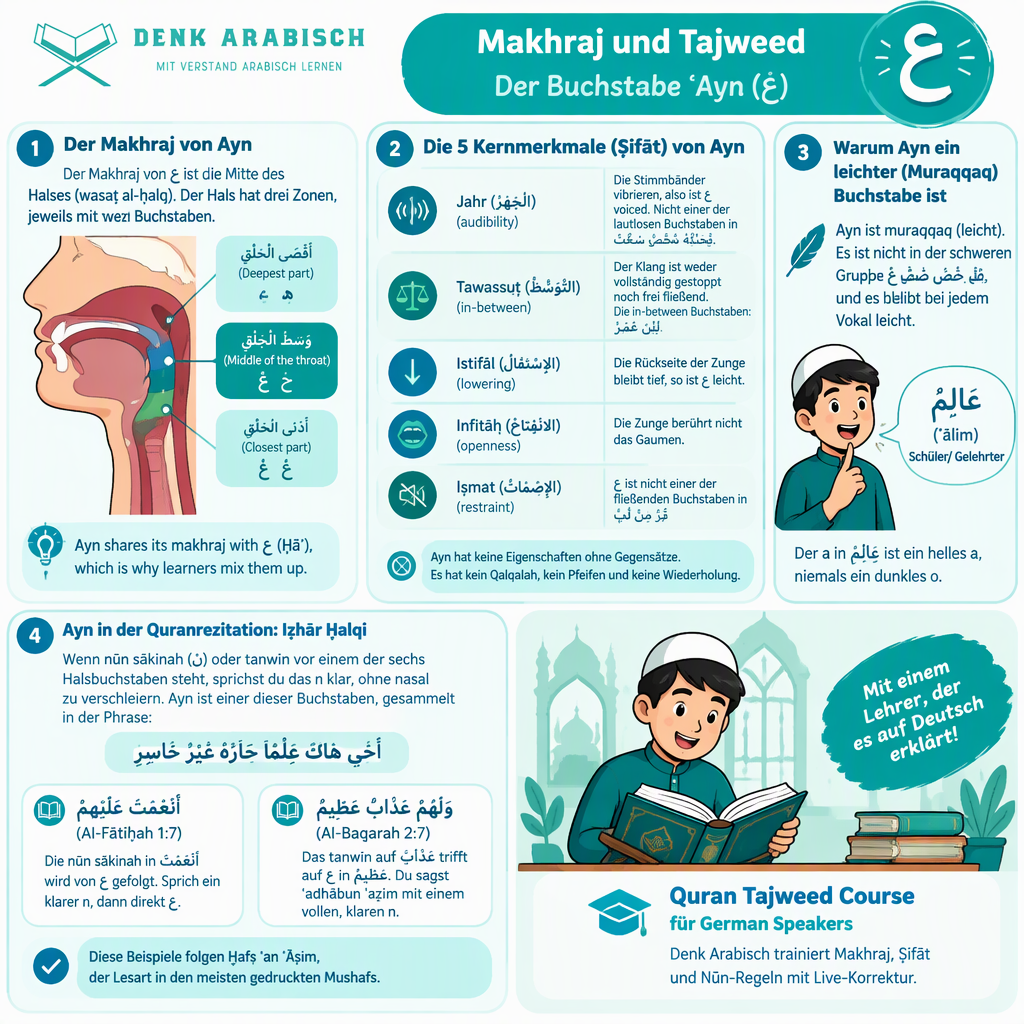
The makhraj of ع is the middle of the throat, وَسَطُ الْحَلْقِ (wasaṭ al-ḥalq). The throat has three zones, each with two letters.
| Zone | Arabic | Letters |
| Deepest part of the throat | أَقْصَى الْحَلْقِ | ء ه |
| Middle of the throat | وَسَطُ الْحَلْقِ | ع ح |
| Closest part of the throat | أَدْنَى الْحَلْقِ | غ خ |
Ayn shares its makhraj with ح (Ḥāʾ), which is why learners mix them up. Mistake 2 below shows you how to keep them apart.
The 5 Core Characteristics (Ṣifāt) of Ayn
The letter ʿAyn (ع) has five distinctive Ṣifāt that explain how its sound is produced, where it comes from, and how it should be pronounced correctly.
- Jahr (الْجَهْرُ), audibility: your vocal cords vibrate, so ع is voiced. It is not one of the whispered letters in فَحَثَّهُ شَخْصٌ سَكَتْ.
- Tawassuṭ (التَّوَسُّطُ), in-between: the sound is neither fully stopped nor freely flowing. The in-between letters are لِنْ عُمَرْ.
- Istifāl (الِاسْتِفَالُ), lowering: the back of the tongue stays low, so ع is light.
- Infitāḥ (الِانْفِتَاحُ), openness: the tongue does not press against the roof of the mouth.
- Iṣmāt (الْإِصْمَاتُ), restraint: ع is not one of the fluent letters in فَرَّ مِنْ لُبٍّ.
Ayn has no attributes without opposites. It has no qalqalah, no whistle and no repetition.
Why Ayn Is a Light (Muraqqaq) Letter
Ayn is muraqqaq (light). It is not in the heavy group خُصَّ ضَغْطٍ قِظْ, and it stays light with every vowel. The a in عَالِمٌ (ʿālim, scholar) is a bright a, never a dark o.
Ayn in Quranic Recitation: Iẓhār Ḥalqī
When nūn sākinah (نْ) or tanwīn comes before one of the six throat letters, you pronounce the n clearly, with no nasal hiding. Ayn is one of these letters, collected in the phrase أَخِي هَاكَ عِلْمًا حَازَهُ غَيْرُ خَاسِرِ.
- أَنْعَمْتَ عَلَيْهِمْ (Al-Fātiḥah 1:7): the nūn sākinah in أَنْعَمْتَ is followed by ع inside the same word. Say a clear n, then move straight to ع.
- وَلَهُمْ عَذَابٌ عَظِيمٌ (Al-Baqarah 2:7): the tanwīn on عَذَابٌ meets the ع of عَظِيمٌ. You say ʿadhābun ʿaẓīm with a full, clear n.
These examples follow Ḥafṣ ʿan ʿĀṣim, the reading in most printed Mushafs.
Want to recite these rules correctly with a teacher who explains them in German? The Quran Tajweed Course for German Speakers at Denk Arabisch trains makhraj, ṣifāt and nūn rules with live correction.
Step-by-Step Instructions to Produce Ayn
German has no sound like ع. Somali has it (written c), and so does Hebrew ע in traditional Mizrahi pronunciation. English speakers have no equivalent either, which is why they often drop it, as in “Arab” for عَرَبٌ.
Tip for German Speakers
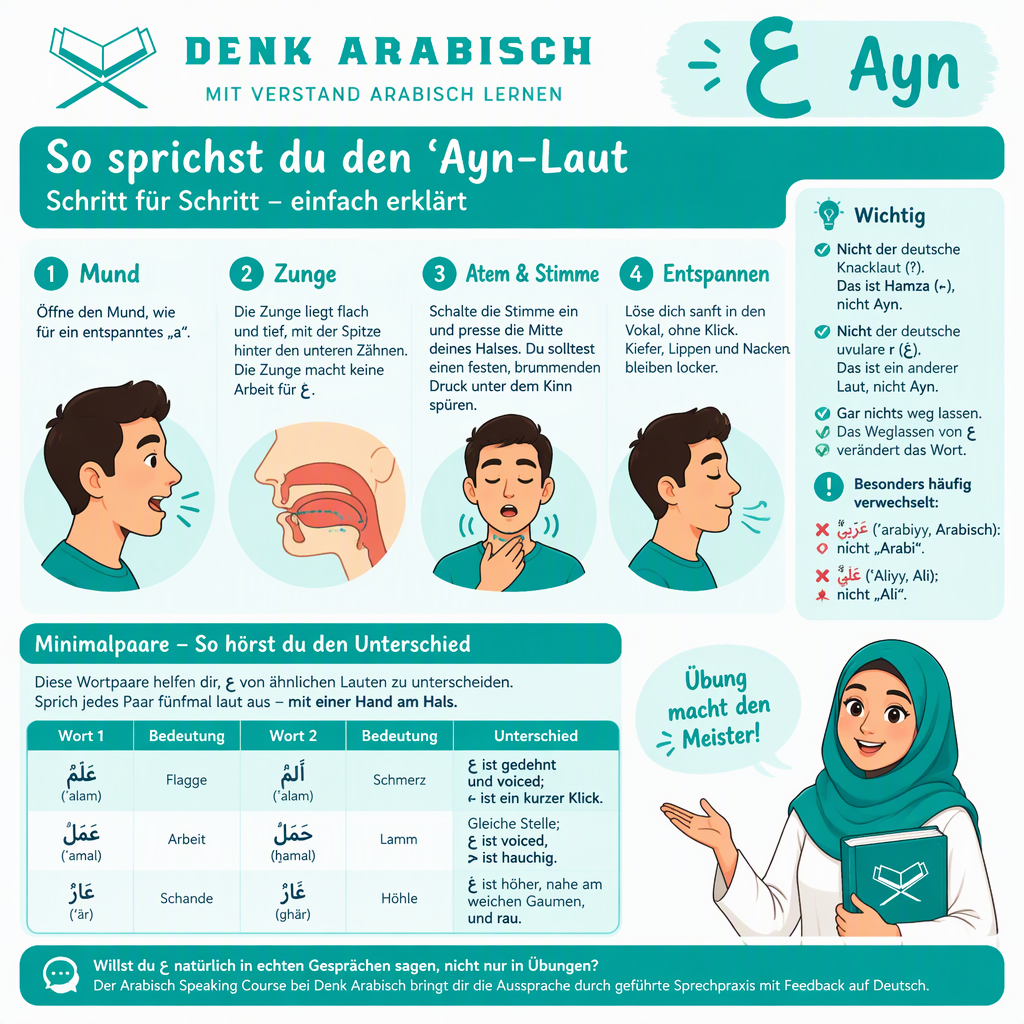
The closest German starting point is a long, relaxed “aaa”. Now tighten the walls of your throat while you keep the voice going. The sound becomes pressed and slightly strained, almost like a soft gag. That is the direction of ع.
What NOT to substitute:
- The German Knacklaut (the glottal stop in “be-achten” or “Spiegel-ei”). That is Hamza (ء), not Ayn.
- The German uvular r in “rot”. It is made higher up and sounds close to غ.
- Nothing at all. Dropping ع changes the word.
Two words where German speakers are tempted to use the Knacklaut:
- عَرَبِيٌّ (ʿarabiyy, Arabic): not “Arabi” as in German “Arabisch”
- عَلِيٌّ (ʿAliyy, Ali): not the German name “Ali”
Step by Step
Follow these simple steps to produce the ʿAyn sound clearly and correctly, focusing on the mouth, tongue, airflow, and throat position.
- Mouth: open your mouth as for a relaxed “a”.
- Tongue: let it lie flat and low, with the tip behind your lower teeth. The tongue does no work for ع.
- Air: switch on your voice and squeeze the middle of your throat. You should feel a tight, buzzing pressure under your jaw.
- Relaxation: release smoothly into the vowel, with no click. Keep your jaw, lips and neck loose.
Minimal Pairs Comparing Ayn with Similar Sounds
These minimal pairs help you hear the difference between ʿAyn (ع) and similar Arabic sounds by comparing words that differ in just one sound.
| Word 1 | Meaning | Word 2 | Meaning | Difference |
| عَلَمٌ (ʿalam) | flag | أَلَمٌ (ʾalam) | pain | ع is squeezed and voiced; ء is a short click |
| عَمَلٌ (ʿamal) | work | حَمَلٌ (ḥamal) | lamb | Same place; ع is voiced, ح is breathy |
| عَارٌ (ʿār) | shame | غَارٌ (ghār) | cave | غ is higher, near the soft palate, and rasps |
Say each pair aloud five times, with one hand on your throat, until the two words feel different.
Want to say ع naturally in real conversations, not just in drills? The Arabic Speaking Course at Denk Arabisch builds your pronunciation through guided speaking practice with feedback in German.
How to Write Ayn in Its 4 Positions
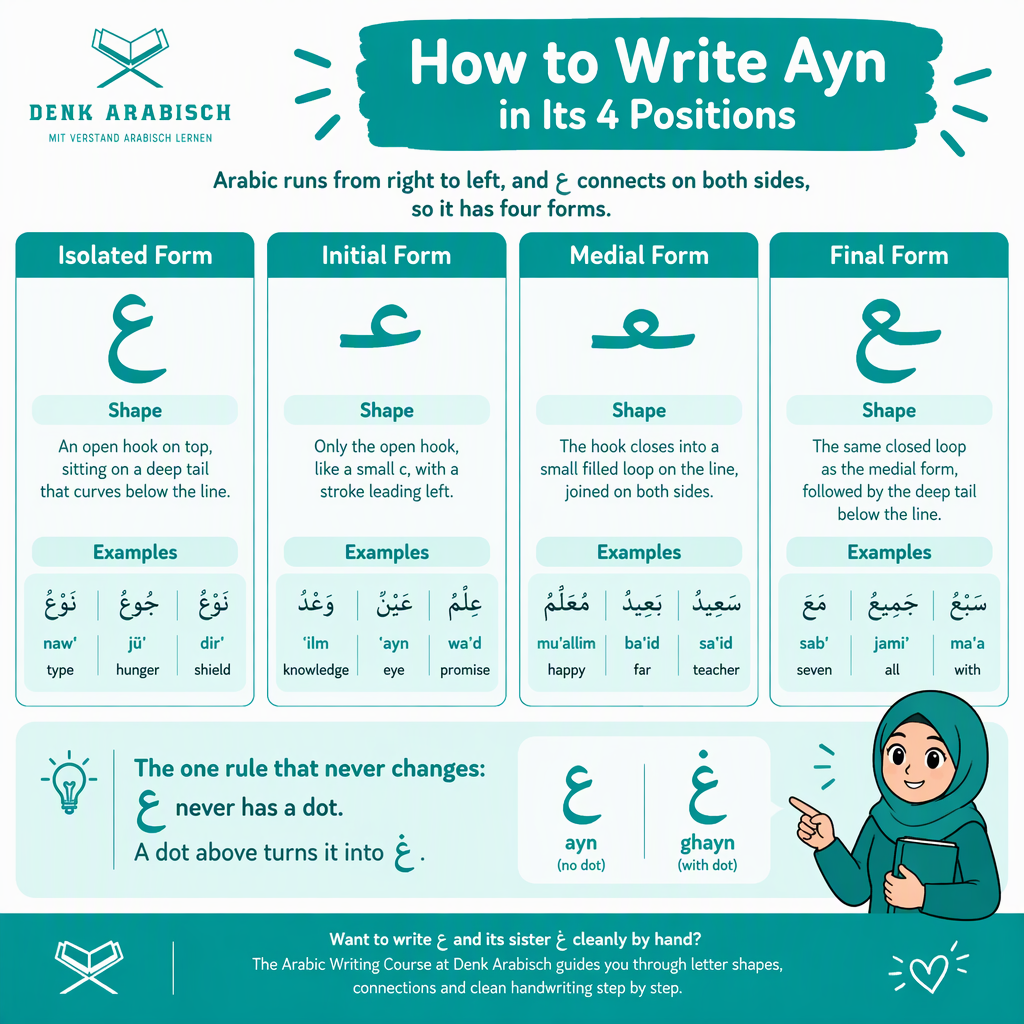
Arabic runs from right to left, and ع connects on both sides, so it has four forms.
| Form | Shape | Example | Transliteration | Meaning |
| Isolated | ع | نَوْعٌ | nawʿ | type, kind |
| Initial | عـ | عِلْمٌ | ʿilm | knowledge |
| Medial | ـعـ | سَعِيدٌ | saʿīd | happy |
| Final | ـع | سَبْعٌ | sabʿ | seven |
1. Isolated Form (ع)
Used when ع stands alone, or at the end of a word after a non-connecting letter (ا د ذ ر ز و).
Shape: an open hook on top, sitting on a deep tail that curves below the line.
Examples: نَوْعٌ (nawʿ, type), جُوعٌ (jūʿ, hunger), دِرْعٌ (dirʿ, shield).
2. Initial Form (عـ)
Used at the start of a word, and inside a word after a non-connecting letter.
Shape: only the open hook, like a small c, with a stroke leading left.
Examples: عِلْمٌ (ʿilm, knowledge), عَيْنٌ (ʿayn, eye), وَعْدٌ (waʿd, promise), where ع follows the non-connecting و.
3. Medial Form (ـعـ)
Used between two connecting letters.
Shape: the hook closes into a small filled loop on the line, joined on both sides.
Examples: سَعِيدٌ (saʿīd, happy), بَعِيدٌ (baʿīd, far), مُعَلِّمٌ (muʿallim, teacher).
4. Final Form (ـع)
Used at the end of a word after a connecting letter.
Shape: the same closed loop as the medial form, followed by the deep tail below the line.
Examples: سَبْعٌ (sabʿ, seven), جَمِيعٌ (jamīʿ, all), مَعَ (maʿa, with).
The one rule that never changes: ع never has a dot. A dot above turns it into غ.
Learn how Arabic letters change when they connect in “Arabic Letters Connected Forms” and make Arabic reading and writing easier to understand.
Want to write ع and its sister غ cleanly by hand? The Arabic Writing Course at Denk Arabisch guides you through letter shapes, connections and clean handwriting step by step.
How Short and Long Vowels Affect Ayn
Because ع is a light letter, every vowel after it stays clear and bright: a stays a, u stays u, i stays i.
Ayn with Fatḥa, Ḍamma, Kasra, and Sukūn
Short vowels change the sound of ʿAyn (ع) and help you read Arabic words accurately and naturally.
| Mark | Name | Sound | Example | Meaning |
| عَ | Fatḥa | ʿa | عَمَلٌ (ʿamal) | work |
| عُ | Ḍamma | ʿu | عُمْرٌ (ʿumr) | age, lifetime |
| عِ | Kasra | ʿi | عِلْمٌ (ʿilm) | knowledge |
| عْ | Sukūn | ʿ (no vowel) | بَعْدَ (baʿda) | after |
With sukūn, ع closes the syllable. Hold the throat squeeze for a moment before the next letter.
Stretching Ayn with Madd and Diphthongs
Long vowels stretch the sound of ʿAyn (ع), helping you pronounce words with the correct length and rhythm.
| Combination | Sound | Example | Meaning |
| عَا | ʿā | عَالَمٌ (ʿālam) | world |
| عُو | ʿū | عُودٌ (ʿūd) | oud (lute) |
| عِي | ʿī | عِيدٌ (ʿīd) | festival |
Ayn also forms the diphthongs ʿay and ʿaw, as in عَيْنٌ (ʿayn, eye) and عَوْدَةٌ (ʿawdah, return).
Learn Arabic with Denk Arabisch Academy
Speak and understand Arabic through a clear and effective learning system
Try a Free TrialPronouncing Ayn with Shadda
A shadda doubles ع, so you hold the throat squeeze twice as long.
- فَعَّالٌ (faʿʿāl): effective
- دَعَّمَ (daʿʿama): he supported
- يَدُعُّ (yaduʿʿu): he drives away, as in Al-Māʿūn 107:2
Read “Harakat In Arabic” to understand Arabic vowel marks and learn how they help you read and pronounce Arabic words correctly.
Key Three-Letter Arabic Roots Containing Ayn
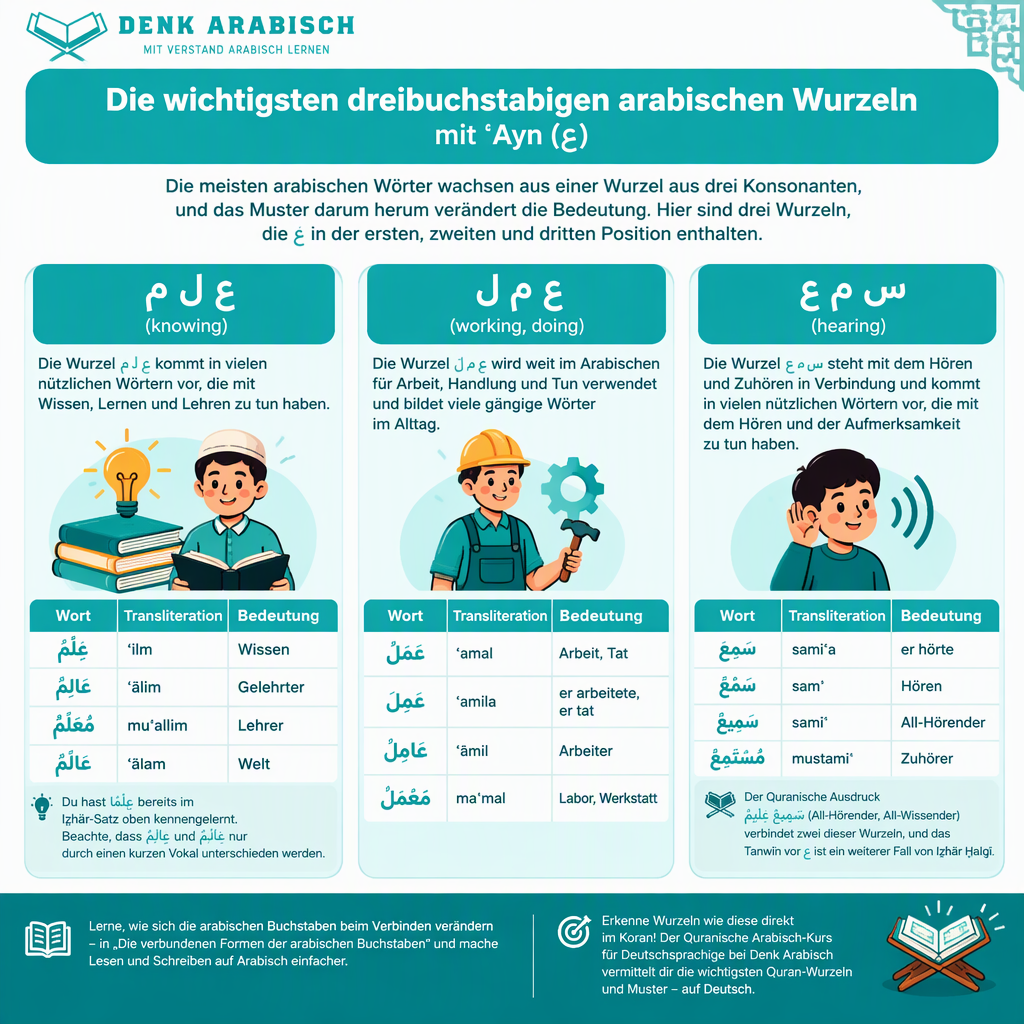
Most Arabic words grow from a root of three consonants, and the pattern around them changes the meaning. Here are three roots: two with ع in first position and one with ع in last position:
ع ل م (knowing)
The root ع ل م appears in many useful Arabic words, all connected to the ideas of knowledge, learning, and teaching.
| Word | Transliteration | Meaning |
| عِلْمٌ | ʿilm | knowledge |
| عَالِمٌ | ʿālim | scholar |
| مُعَلِّمٌ | muʿallim | teacher |
| عَالَمٌ | ʿālam | world |
You already met عِلْمًا in the Iẓhār phrase above. Note that عَالِمٌ and عَالَمٌ differ only in one short vowel.
ع م ل (working, doing)
The root ع م ل is widely used in Arabic to express work, action, and doing, and it forms several common words used in everyday language.
| Word | Transliteration | Meaning |
| عَمَلٌ | ʿamal | work, deed |
| عَمِلَ | ʿamila | he worked, he did |
| عَامِلٌ | ʿāmil | worker |
| مَعْمَلٌ | maʿmal | laboratory, workshop |
س م ع (hearing)
The root س م ع is connected with hearing and listening, and it appears in many useful Arabic words related to the act of hearing and paying attention.
| Word | Transliteration | Meaning |
| سَمِعَ | samiʿa | he heard |
| سَمْعٌ | samʿ | hearing |
| سَمِيعٌ | samīʿ | all-hearing |
| مُسْتَمِعٌ | mustamiʿ | listener |
The Quranic phrase سَمِيعٌ عَلِيمٌ (All-Hearing, All-Knowing) joins two of these roots, and its tanwīn before ع is another case of Iẓhār Ḥalqī.
Want to recognize roots like these directly in the Quran? The Quranic Arabic Course for German Speakers at Denk Arabisch teaches you the most frequent Quranic roots and patterns, explained in German.
Practice Words with Ayn in Different Positions
These three everyday words show ع at the beginning, in the middle and at the end.
| Position | Arabic Word | Transliteration | Meaning |
| Beginning | عَيْنٌ | ʿayn | eye |
| Middle | سَعِيدٌ | saʿīd | happy |
| End | سَبْعٌ | sabʿ | seven |
Reading Full Sentences Containing Ayn
These three short sentences show ع at the start, in the middle and at the end of everyday words:
| Arabic Sentence | Transliteration | Meaning |
| الْعِيدُ بَعِيدٌ. | al-ʿīdu baʿīdun. | The festival is far away. |
| الْعَيْنُ نِعْمَةٌ. | al-ʿaynu niʿmatun. | The eye is a blessing. |
| أَنَا سَعِيدٌ مَعَ الْجَمِيعِ. | anā saʿīdun maʿa l-jamīʿi. | I am happy with everyone. |
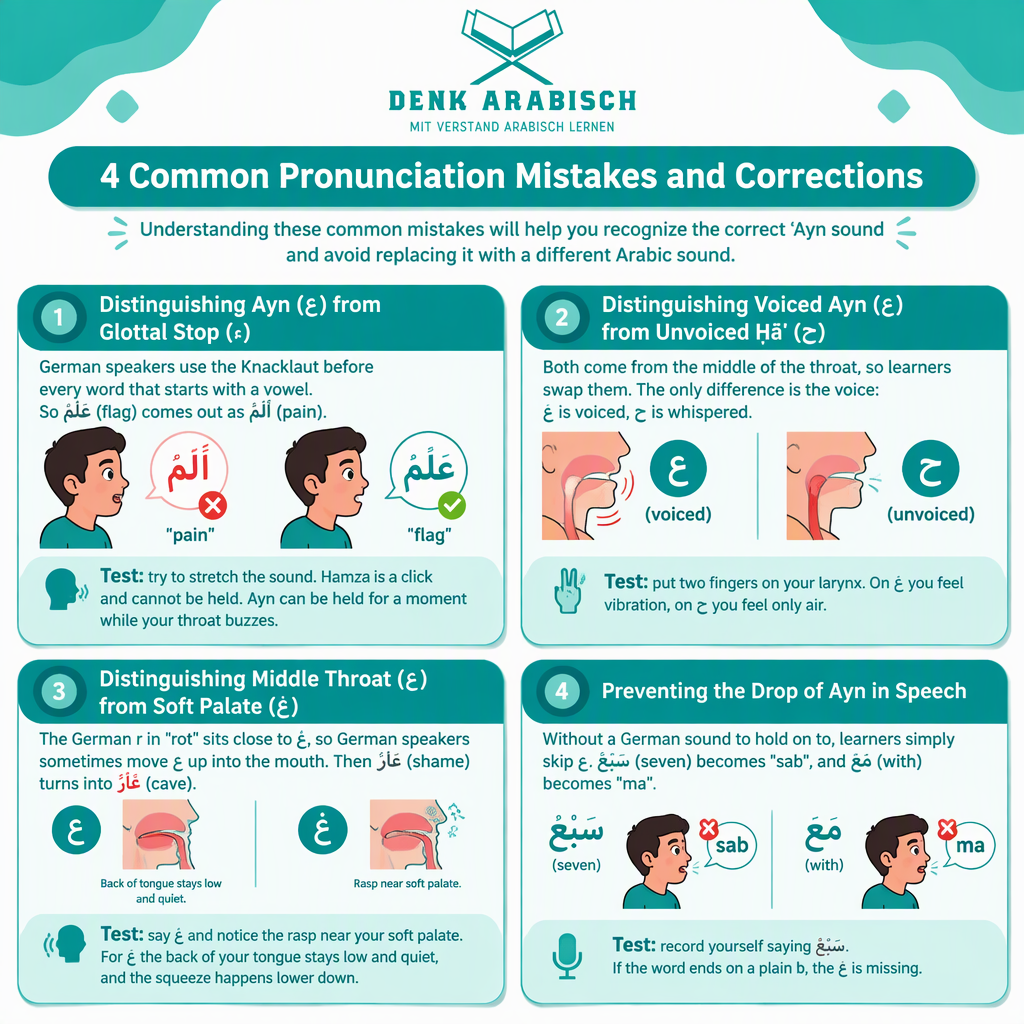
4 Common Pronunciation Mistakes and Corrections
Understanding these common mistakes will help you recognize the correct ʿAyn sound and avoid replacing it with a different Arabic sound.
1. Distinguishing Ayn (ع) from Glottal Stop (ء)
German speakers use the Knacklaut before every word that starts with a vowel. So عَلَمٌ (flag) comes out as أَلَمٌ (pain).
Test: try to stretch the sound. Hamza is a click and cannot be held. Ayn can be held for a moment while your throat buzzes.
2. Distinguishing Voiced Ayn (ع) from Unvoiced Ḥāʾ (ح)
Both come from the middle of the throat, so learners swap them. The only difference is the voice: ع is voiced, ح is whispered.
Test: put two fingers on your larynx. On ع you feel vibration, on ح you feel only air.
3. Distinguishing Middle Throat (ع) from Soft Palate (غ)
The German r in “rot” sits close to غ, so German speakers sometimes move ع up into the mouth. Then عَارٌ (shame) turns into غَارٌ (cave).
Test: say غ and notice the rasp near your soft palate. For ع the back of your tongue stays low and quiet, and the squeeze happens lower down.
4. Preventing the Drop of Ayn in Speech
Without a German sound to hold on to, learners simply skip ع. سَبْعٌ (seven) becomes “sab”, and مَعَ (with) becomes “ma”.
Test: record yourself saying سَبْعٌ. If the word ends on a plain b, the ع is missing.
Practice Exercises: Testing Your Knowledge of Ayn
These exercises help you review the makhraj, pronunciation, letter forms, and key rules of ʿAyn while checking your understanding through different types of practice.
Exercise 1: Multiple Choice Quiz
Which letter shares its makhraj with ع?
- a) غ
- b) ح
- c) ء
Answer: b) ح. Both come from the middle of the throat.
Exercise 2: Vocabulary Matching Exercise
Match each word to its meaning: عِلْمٌ, سَبْعٌ, مَعَ, عَيْنٌ.
Meanings: with, eye, knowledge, seven.
Answer: عِلْمٌ = knowledge, سَبْعٌ = seven, مَعَ = with, عَيْنٌ = eye.
Exercise 3: Handwriting Practice
Write ع in its four forms: ع عـ ـعـ ـع. Then copy these words five times each: عَيْنٌ, سَعِيدٌ, جَمِيعٌ, نَوْعٌ.
Exercise 4: True or False Phonetics Check
- ع is a sun letter.
- ع has no dots.
- ع is a heavy letter.
- A nūn sākinah before ع is pronounced clearly.
Answers: 1. False, it is a moon letter. 2. True. 3. False, it is light. 4. True, this is Iẓhār Ḥalqī.
Exercise 5: Spot the Ayn
Which words contain ع? عَلَمٌ، أَلَمٌ، حَمَلٌ، سَبْعٌ، غَارٌ
Answer: عَلَمٌ، سَبْعٌ.
What Our Students Say About Denk Arabisch Academy
See what our students say about learning at Denk Arabisch Academy on Trustpilot. Read their experiences and check out more reviews to discover how our courses help improve Arabic.

Learn Arabic from the Basics with Denk Arabisch
Ayn is one of 28 letters, and each one is easier when you learn it in a clear order. Structure turns scattered facts into reading, writing and speaking.
Denk Arabisch is built for German-speaking learners and explains Arabic through German.
- Explanations that start from German sounds and grammar
- Qualified teachers who correct your pronunciation live
- A clear path from the alphabet to reading the Quran and speaking
- Courses for adults and for children
Choose Your Specialized Course:
- Arabic Course For Beginners: your first steps in reading, writing and basic conversation
- Arabic Alphabet Course: all 28 letters, their sounds and their forms
- Arabic Reading Course: fluent reading with and without vowel marks
- Arabic Writing Course: clean handwriting and correct letter connections
- Arabic Speaking Course: everyday conversation with confident pronunciation
- Quranic Arabic Course for German Speakers: understand the vocabulary and roots of the Quran
- Quran Tajweed Course for German Speakers: correct recitation, from makhraj to nūn rules
Learn Arabic with Denk Arabisch Academy
Speak and understand Arabic through a clear and effective learning system
Try a Free TrialBook a free trial lesson at Denk Arabisch and hear your own ع checked by a teacher.

Conclusion
The letter Ayn (ع) feels unfamiliar at first, but it follows clear physical rules you can train.
- Sound: a voiced squeeze in the middle of the throat, never a Knacklaut and never silent.
- Writing: four forms, an open hook at the start, a closed loop in the middle and at the end, and never a dot.
- Recognition: a light moon letter that triggers Iẓhār Ḥalqī after nūn sākinah and tanwīn.
Practice a little every day. Squeeze and hold the sound, write the four forms, and compare ع with ء, ح and غ using the minimal pairs. Then read the words from the roots ع ل م, ع م ل and س م ع aloud.
With a few minutes of daily practice, ع will soon feel as natural as any German sound.
Ready for the next step? Book a free trial lesson at Denk Arabisch and start learning Arabic in a structured way.
FAQs
1. What is the difference between Ayn (ع) and Hamza (ء)?
Hamza is a short click in the deepest part of the throat, like the German Knacklaut. Ayn is a voiced squeeze in the middle of the throat that you can hold. Compare عَلَمٌ (flag) and أَلَمٌ (pain).
2. What is the difference between Ayn (ع) and Ḥāʾ (ح)?
Both come from the middle of the throat. Ayn is voiced, so your vocal cords vibrate, while Ḥāʾ is a whispered, breathy sound. Compare عَمَلٌ (work) and حَمَلٌ (lamb).
3. Is Ayn a sun letter or a moon letter?
Ayn is a moon letter. The lām of al- is pronounced and carries a sukūn, and ع has no shadda, as in الْعِلْمُ (al-ʿilm).
4. Is Ayn a heavy or a light letter?
Ayn is light (muraqqaq) because it has the attribute istifāl. The vowels after it stay bright, so عَالِمٌ is pronounced ʿālim, never with a dark o.
5. Which Tajweed rule involves Ayn?
Ayn is one of the six throat letters. When a nūn sākinah or tanwīn comes before it, the nūn is pronounced clearly with no nasal hiding. This is Iẓhār Ḥalqī, as in أَنْعَمْتَ (Al-Fātiḥah 1:7) and عَذَابٌ عَظِيمٌ (Al-Baqarah 2:7).