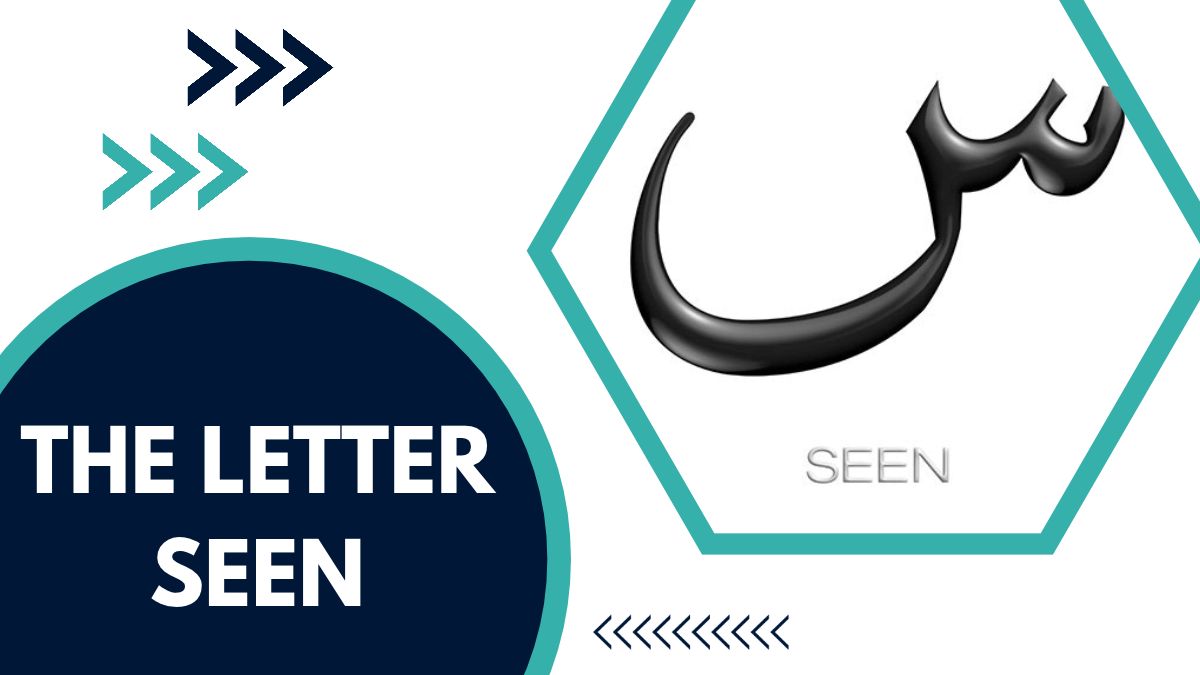
The Letter Seen (س), called سِين (Sīn) in Arabic, is the 12th letter of the Arabic alphabet. It is the sharp, whistling “s” you make with the tip of your tongue just behind your front teeth. Linguists call it a voiceless alveolar fricative, written [s] in IPA.
German speakers already know this sound, but there is a trap. German turns many “s” sounds into a buzzing [z], as in Sonne, Salat or Rose. Arabic Seen never buzzes. It always sounds like the ss in Wasser, the ß in Straße or the s in Haus.
This guide covers everything you need to know about Seen:
- How to pronounce it, and how to stop German from voicing it
- Its four written forms and how they connect
- Seen with short vowels, long vowels and shadda
- Its role in Tajweed, including the Sun letter rule
- Key words and three useful Arabic roots
Short exercises at the end let you check what you have learned.
| Feature | Details |
| Seen (س) | Name: سِين (Sīn), written “Seen” in English |
| Sound | [s], like ss in “Wasser” or s in English “sun” |
| Position in the alphabet | 12th (hijāʾī order) |
| Abjad value | 15th in abjad order, value 60 |
| Transliteration | Common: s · DIN 31635: s · ISO 233: s · Arabizi: s (no number needed) |
| Point of articulation | Tip of the tongue, just above the lower front teeth |
| Sun or Moon letter | Sun letter |
| Heavy or light | Always light (muraqqaq) |
| Dots | None |
| Connection | Connects on both sides (four forms) |
In DIN 31635, “s” always means the voiceless sound and “z” stands for ز. So when you read “salām” in German transliteration, say it with a sharp s, never with a German z-like s.
Table of Contents
Where Does Seen (س) Come in the Arabic Alphabet?
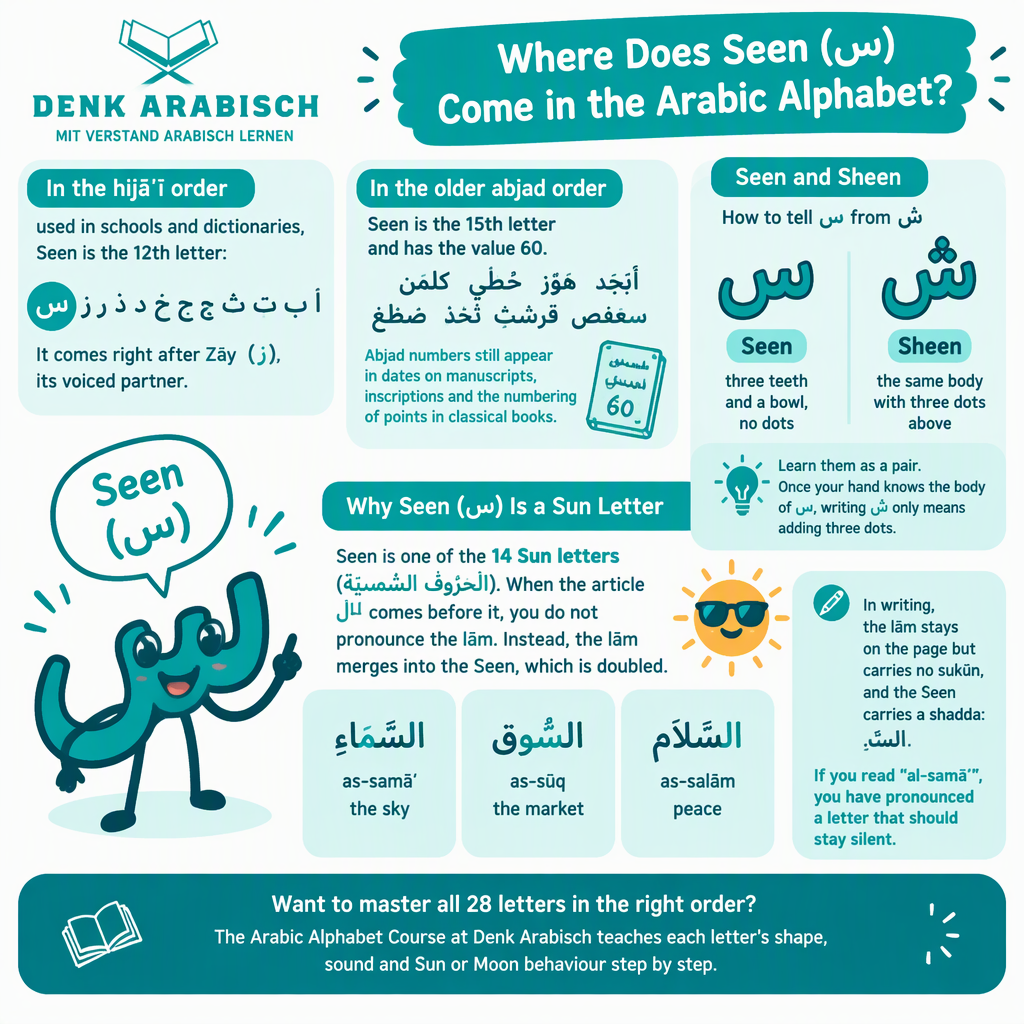
In the hijāʾī order used in schools and dictionaries, Seen is the 12th letter: ا ب ت ث ج ح خ د ذ ر ز س. It comes right after Zay (ز), its voiced partner. Learn more in our guide to The Letter Zay (ز).
In the older abjad order (أَبْجَد هَوَّز حُطِّي كَلَمَن سَعْفَص قَرَشَت ثَخَذ ضَظَغ), Seen is the 15th letter and has the value 60. Abjad numbers still appear in dates on manuscripts, inscriptions and the numbering of points in classical books.
Read our Article: How Many Letters in Arabic?
Seen and Sheen: How to Tell س from ش
Seen shares its body with exactly one letter:
- س Seen: three teeth and a bowl, no dots
- ش Sheen: the same body with three dots above
Learn the twin letter in detail in our guide to The Letter Sheen (ش). Once your hand knows the body of س, writing ش only means adding three dots.
Why Seen (س) Is a Sun Letter
Seen is one of the 14 Sun letters (الْحُرُوفُ الشَّمْسِيَّة). When the article الْـ comes before it, you do not pronounce the lām. Instead, the lām merges into the Seen, which is doubled.
- السَّمَاء, as-samāʾ, the sky
- السُّوق, as-sūq, the market
- السَّلَام, as-salām, peace
In writing, the lām stays on the page but carries no sukūn, and the Seen carries a shadda: السَّـ. If you read “al-samāʾ”, you have pronounced a letter that should stay silent.
Want to master all 28 letters in the right order? The Arabic Alphabet Course at Denk Arabisch teaches each letter’s shape, sound and Sun or Moon behaviour step by step.
Where Seen Is Made: Makhraj and Tajweed
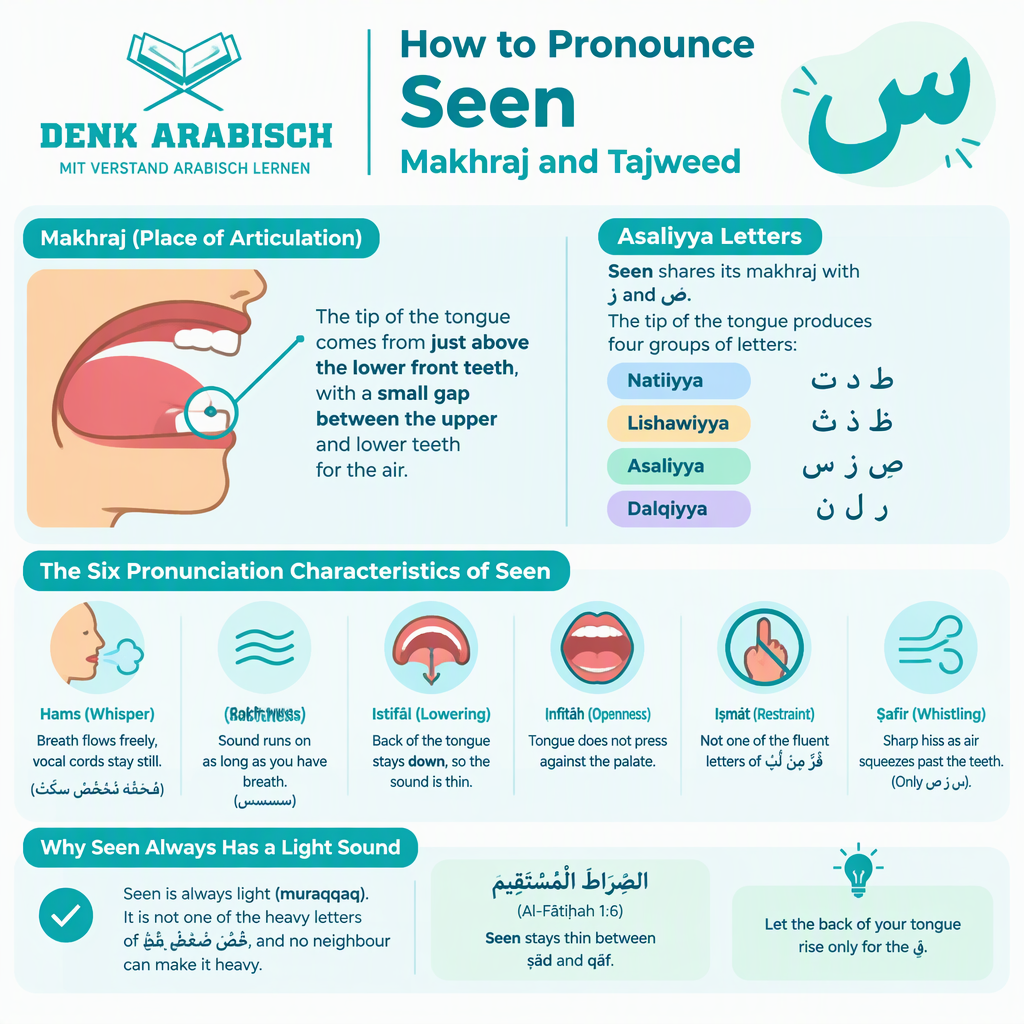
Seen comes from the tip of the tongue (أَسَلَةُ اللِّسَانِ), placed just above the lower front teeth, with a small gap between the upper and lower teeth for the air. Scholars call this group the asaliyya letters (الْحُرُوفُ الْأَسَلِيَّة).
The tip of the tongue produces four groups of letters:
| Zone | Arabic | Letters |
| Tip of the tongue + gum ridge of the upper teeth | نِطْعِيَّة | ط د ت |
| Tip of the tongue + edges of the upper teeth | لِثَوِيَّة | ظ ذ ث |
| Tip of the tongue + just above the lower teeth | أَسَلِيَّة | ص ز س |
| Tip and edge of the tongue | ذَلْقِيَّة | ر ل ن |
Seen shares its exact makhraj with ز and ص. Only their attributes separate them, which is why they appear in the mistakes section below.
The Six Pronunciation Characteristics of Seen
The letter Seen (س) has six distinctive pronunciation characteristics that shape how its sound is produced, from the flow of breath and softness of the sound to its thin quality and characteristic whistling.
- Hams (الْهَمْس), whisper: the breath flows freely and the vocal cords stay still. Its letters gather in فَحَثَّهُ شَخْصٌ سَكَتْ.
- Rakhāwa (الرَّخَاوَة), softness: the sound runs on as long as you have breath, like سسسس.
- Istifāl (الِاسْتِفَال), lowering: the back of the tongue stays down, so the sound is thin.
- Infitāḥ (الِانْفِتَاح), openness: the tongue does not press against the palate.
- Iṣmāt (الْإِصْمَات), restraint: Seen is not one of the “fluent” letters of فَرَّ مِنْ لُبّ, which are made with the tongue tip or lips.
- Ṣafīr (الصَّفِير), whistling: a sharp hiss as air squeezes past the teeth. Only ص ز س have it.
Why Seen Always Has a Light Sound
Seen is always light (muraqqaq). It is not one of the heavy letters of خُصَّ ضَغْطٍ قِظْ, and no neighbour can make it heavy.
This matters next to heavy letters. In الصِّرَاطَ الْمُسْتَقِيمَ (Al-Fātiḥah 1:6), the phrase starts with a heavy ṣād, and the Seen of الْمُسْتَقِيمَ comes just before the heavy ق. Yet the Seen stays thin. Let the back of your tongue rise only for the ق.
Seen in Quran Recitation: Sun-Letter Assimilation and Ikhfāʾ
Seen triggers two rules. First, the Sun letter rule (idghām shamsī): the lām of الْـ disappears into the Seen.
- اقْتَرَبَتِ السَّاعَةُ وَانشَقَّ الْقَمَرُ (Al-Qamar 54:1): السَّاعَة has a silent lām and a doubled Seen, while الْقَمَر keeps its lām. One verse shows both rules.
- هُوَ اللَّهُ الَّذِي لَا إِلَٰهَ إِلَّا هُوَ الْمَلِكُ الْقُدُّوسُ السَّلَامُ (Al-Ḥashr 59:23): read as-salām, never al-salām.
Second, Seen is one of the 15 letters of ikhfāʾ. A nūn sākina or tanwīn before Seen is hidden with a light nasal sound, held for two counts.
- إِنَّ الْإِنسَانَ لَفِي خُسْرٍ (Al-ʿAṣr 103:2): the nūn in الْإِنسَانَ is hidden before the Seen.
- تَرْمِيهِم بِحِجَارَةٍ مِّن سِجِّيلٍ (Al-Fīl 105:4): the nūn of مِن is hidden before سِجِّيل.
Seen in the Opening Letters of Quranic Surahs
Seen appears among the separated letters (الْحُرُوفُ الْمُقَطَّعَة) at the start of some surahs:
- يس (Yā Sīn 36:1)
- طسٓمٓ (Ash-Shuʿarāʾ 26:1 and Al-Qaṣaṣ 28:1)
- طسٓ (An-Naml 27:1)
- عٓسٓقٓ (Ash-Shūrā 42:2)
Here you read the letter’s name, sīn, and stretch its long ī for six counts (madd lāzim).
When Ṣād (ص) Is Pronounced as Seen (س)
In the Ḥafṣ ʿan ʿĀṣim reading, two words are written with ص but read with Seen. The muṣḥaf marks them with a small س above the ṣād.
- وَاللَّهُ يَقْبِضُ وَيَبْصُۜطُ (Al-Baqarah 2:245), read wa-yabsuṭ
- وَزَادَكُمْ فِي الْخَلْقِ بَصْۜطَةً (Al-Aʿrāf 7:69), read basṭatan
Other readings may differ here. If you recite in another riwāya, check with your teacher.
Want your recitation checked letter by letter? The Quran Tajweed Course for German Speakers at Denk Arabisch explains each rule in German and corrects your recitation live.
How to Pronounce the Arabic Letter Seen (س)
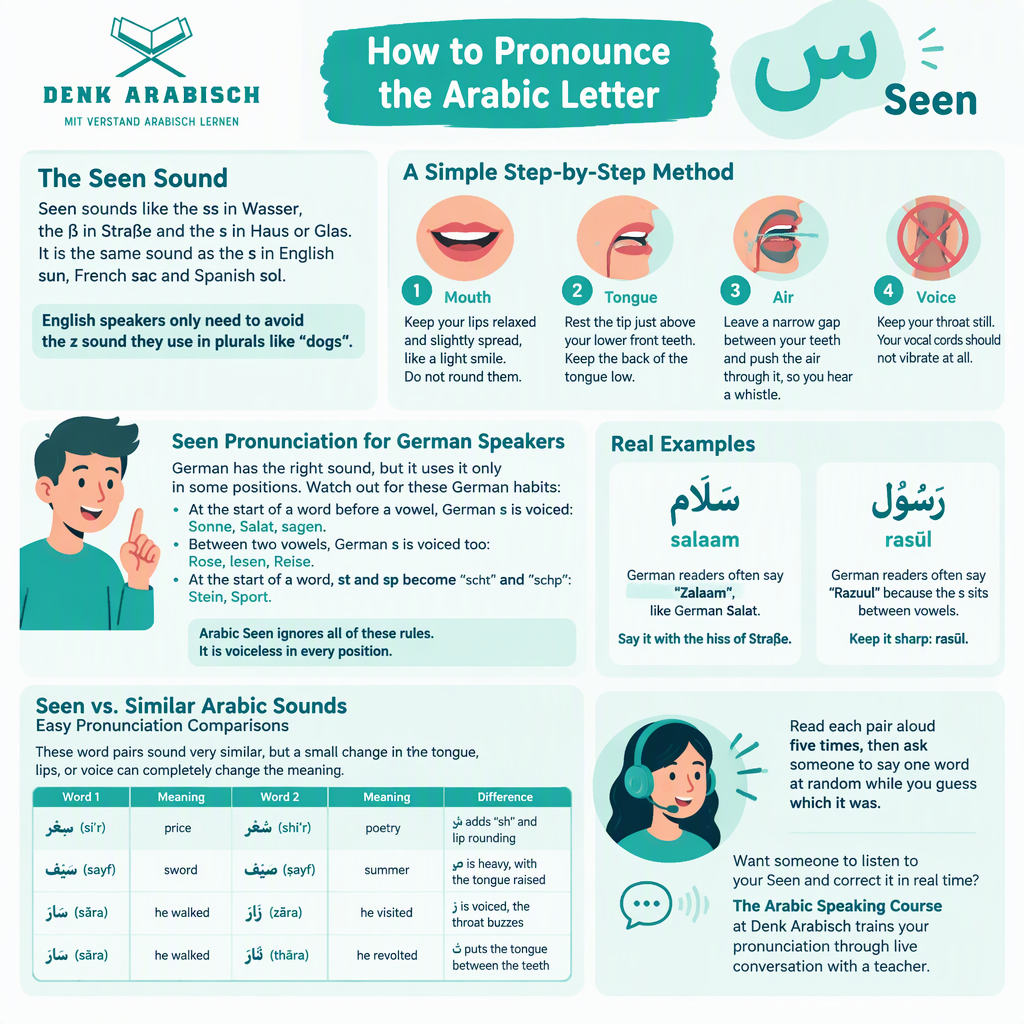
Seen sounds like the ss in Wasser, the ß in Straße and the s in Haus or Glas. It is the same sound as the s in English “sun”, French “sac” and Spanish “sol”. English speakers only need to avoid the z sound they use in plurals like “dogs”.
Seen Pronunciation for German Speakers
German has the right sound, but it uses it only in some positions. Watch out for these German habits:
- At the start of a word before a vowel, German s is voiced: Sonne, Salat, sagen.
- Between two vowels, German s is voiced too: Rose, lesen, Reise.
- At the start of a word, st and sp become “scht” and “schp”: Stein, Sport.
Arabic Seen ignores all of these rules. It is voiceless in every position.
- سَلَام: German readers often say “Zalaam”, like German Salat. Say it with the hiss of Straße.
- رَسُول: German readers often say “Razuul” because the s sits between vowels. Keep it sharp: rasūl.
A Simple Step-by-Step Method for Pronouncing Seen
Pronouncing Seen (س) correctly becomes easier when you follow a few simple steps. Pay attention to the position of the lips and tongue, the flow of air, and the absence of vocal-cord vibration.
- Mouth: keep your lips relaxed and slightly spread, as for a light smile. Do not round them.
- Tongue: rest the tip just above your lower front teeth. Keep the back of the tongue low.
- Air: leave a narrow gap between your teeth and push the air through it, so you hear a whistle.
- Voice: keep your throat still. Your vocal cords should not vibrate at all.
Seen vs. Similar Arabic Sounds: Easy Pronunciation Comparisons
These word pairs sound very similar, but a small change in the tongue, lips, or voice can completely change the meaning.
| Word 1 | Meaning | Word 2 | Meaning | Difference |
| سِعْر (siʿr) | price | شِعْر (shiʿr) | poetry | ش adds “sh” and lip rounding |
| سَيْف (sayf) | sword | صَيْف (ṣayf) | summer | ص is heavy, with the tongue raised |
| سَارَ (sāra) | he walked | زَارَ (zāra) | he visited | ز is voiced, the throat buzzes |
| سَارَ (sāra) | he walked | ثَارَ (thāra) | he revolted | ث puts the tongue between the teeth |
Read each pair aloud five times, then ask someone to say one word at random while you guess which it was.
Want to practice your س out loud, not only on paper? The Arabic Speaking Course at Denk Arabisch gives you regular speaking practice with a teacher, so a sharp, voiceless Seen becomes a habit in real conversation.
How to Write Seen (س) in Arabic: All Four Forms
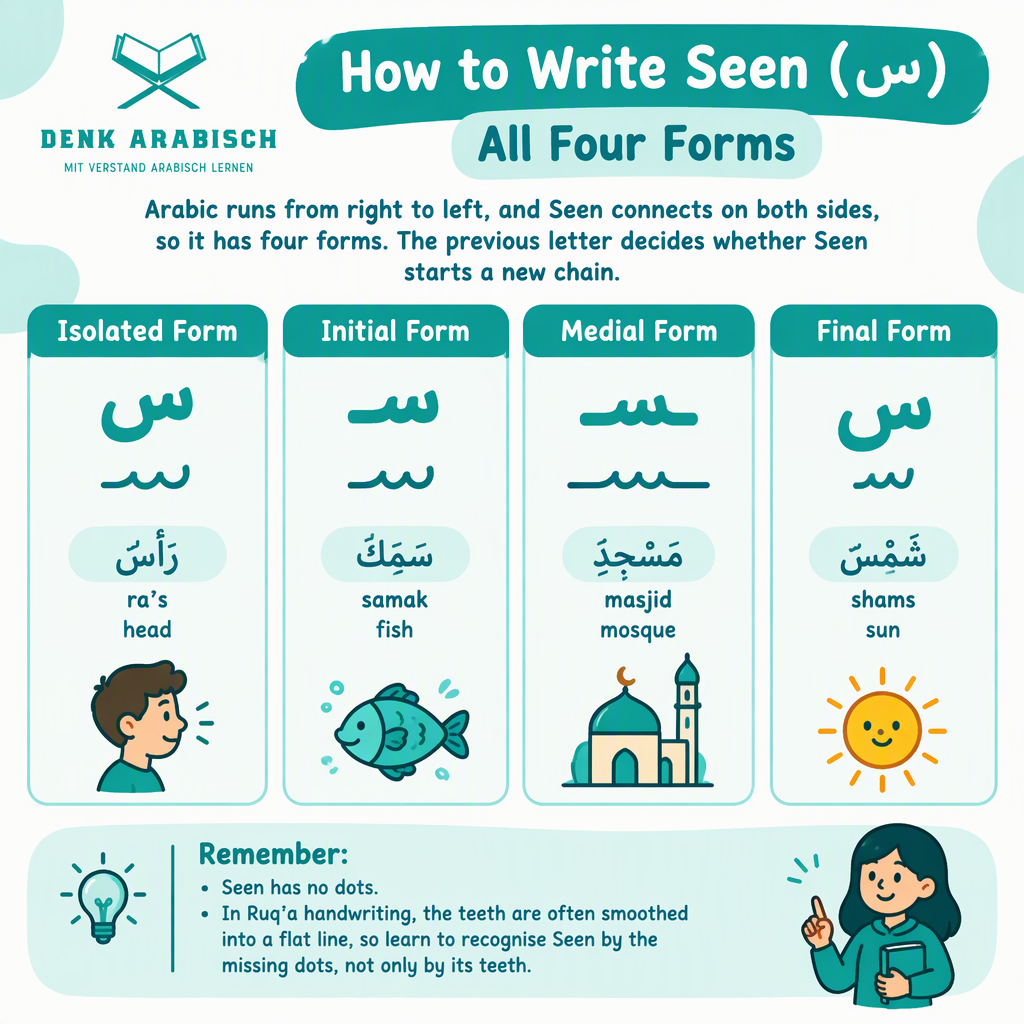
Arabic runs from right to left, and Seen connects on both sides, so it has four forms. The previous letter decides whether Seen starts a new chain.
| Form | Shape | Example | Transliteration | Meaning |
| Isolated | س | رَأْس | raʾs | head |
| Initial | سـ | سَمَك | samak | fish |
| Medial | ـسـ | مَسْجِد | masjid | mosque |
| Final | ـس | شَمْس | shams | sun |
1. Isolated Form (س)
Used when Seen stands alone or follows a non-connecting letter (ا د ذ ر ز و) at the end of a word.
Shape: three small teeth on the line, followed by a deep, round bowl that dips below the line.
Examples: رَأْس (raʾs, head), دُرُوس (durūs, lessons), نَاس (nās, people).
2. Initial Form (سـ)
Used at the start of a word, or in the middle after a non-connecting letter.
Shape: the three teeth only, with a short line leading to the next letter. The bowl disappears.
Examples: سَمَك (samak, fish), سُوق (sūq, market), رَسُول (rasūl, messenger), where ر does not connect.
3. Medial Form (ـسـ)
Used between two letters that both connect to it.
Shape: a line coming in, three teeth, and a line going out.
Examples: مَسْجِد (masjid, mosque), إِنْسَان (insān, human being), مُسْلِم (muslim, Muslim).
Learn Arabic with Denk Arabisch Academy
Speak and understand Arabic through a clear and effective learning system
Try a Free Trial4. Final Form (ـس)
Used at the end of a word after a connecting letter.
Shape: a line coming in, three teeth, then the full bowl below the line.
Examples: شَمْس (shams, sun), جَلَسَ (jalasa, he sat), خَمْس (khams, five).
One rule never changes: Seen has no dots. In Ruqʿa handwriting, the teeth are often smoothed into a flat line, so learn to recognise Seen by the missing dots, not only by its teeth.
Want clean, confident Arabic handwriting? The Arabic Writing Course at Denk Arabisch guides you through every letter shape and connection step by step.
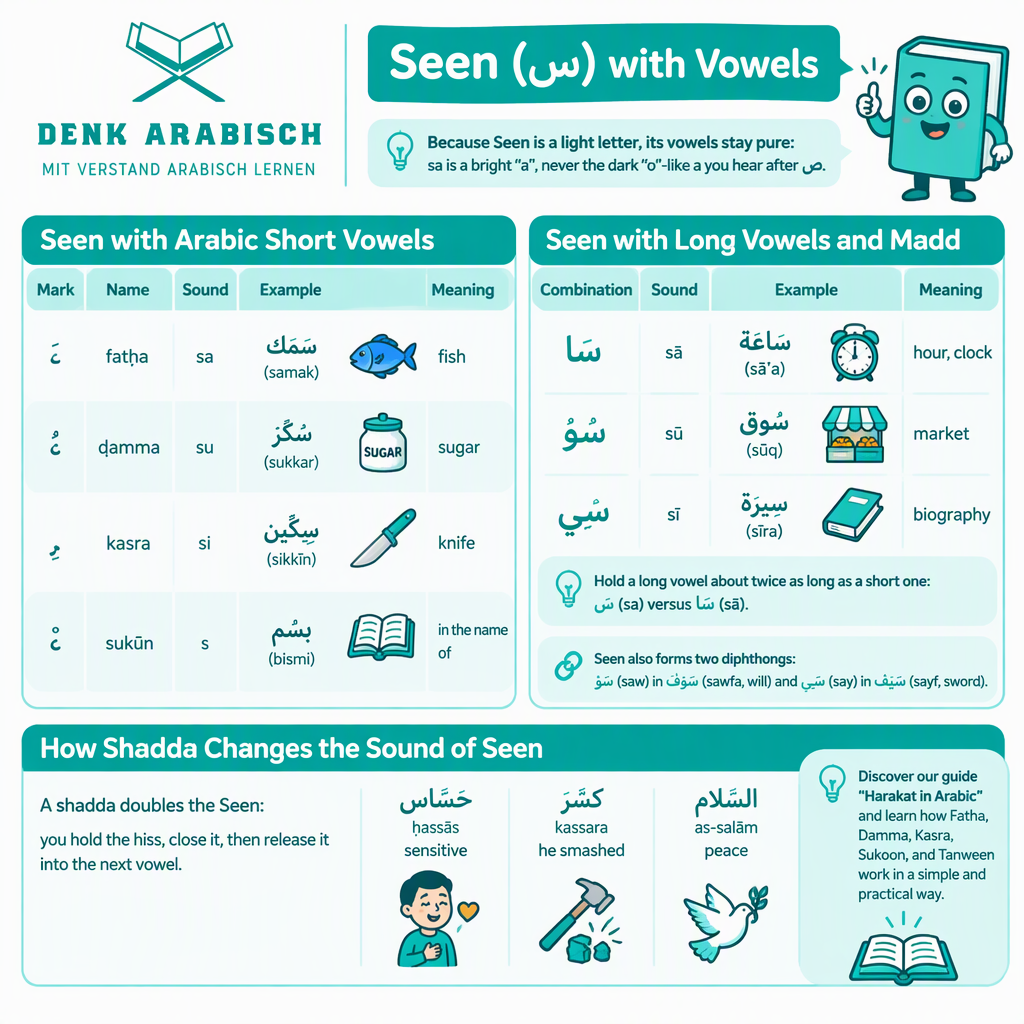
Seen with Vowels
Because Seen is a light letter, its vowels stay pure: sa is a bright “a”, never the dark “o”-like a you hear after ص.
Seen with Arabic Short Vowels
Seen (س) can be pronounced with the three short Arabic vowels—fatḥa, ḍamma, and kasra—as well as with sukūn. Learning these forms helps learners recognize and pronounce Seen correctly in different Arabic words.
| Mark | Name | Sound | Example | Meaning |
| سَ | fatḥa | sa | سَمَك (samak) | fish |
| سُ | ḍamma | su | سُكَّر (sukkar) | sugar |
| سِ | kasra | si | سِكِّين (sikkīn) | knife |
| سْ | sukūn | s | بِسْمِ (bismi) | in the name of |
With sukūn, Seen keeps hissing for a moment. This is hams at work: the breath does not stop.
Seen with Long Vowels and Madd
Seen (س) can be combined with the long vowels Alif, Wāw, and Yā to produce extended sounds. These forms are an important part of Arabic pronunciation and help learners understand how the sound of Seen changes with Madd.
| Combination | Sound | Example | Meaning |
| سَا | sā | سَاعَة (sāʿa) | hour, clock |
| سُو | sū | سُوق (sūq) | market |
| سِي | sī | سِيرَة (sīra) | biography |
Hold a long vowel about twice as long as a short one: سَ (sa) versus سَا (sā).
Seen also forms two diphthongs: سَوْ (saw) in سَوْفَ (sawfa, will) and سَيْ (say) in سَيْف (sayf, sword).
How Shadda Changes the Sound of Seen
A shadda doubles the Seen: you hold the hiss, close it, then release it into the next vowel.
- حَسَّاس, ḥassās, sensitive
- كَسَّرَ, kassara, he smashed
- السَّلَام, as-salām, peace (shadda from the Sun letter rule)
Discover our guide “Harakat in Arabic” and learn how Fatha, Damma, Kasra, Sukoon, and Tanween work in a simple and practical way.
Three Useful Arabic Roots That Contain Seen
Most Arabic words grow from a root of three consonants, so one root can unlock a whole family of words. Here are three roots with Seen that you will meet in daily Arabic and in the Quran.
س ل م (peace, safety)
The root س ل م is connected with meanings of peace, safety, and submission. Learning words from this root helps learners see how the same Arabic letters can form related words with different meanings.
| Word | Transliteration | Meaning |
| سَلَام | salām | peace, greeting |
| سَلِيم | salīm | sound, safe |
| مُسْلِم | muslim | Muslim (one who submits) |
| سَلَّمَ | sallama | he greeted, he handed over |
د ر س (studying)
The root د ر س is connected with learning and education. These related words show how the same Arabic root can be used to describe studying, lessons, schools, and teachers.
| Word | Transliteration | Meaning |
| دَرَسَ | darasa | he studied |
| دَرْس | dars | lesson |
| مَدْرَسَة | madrasa | school |
| مُدَرِّس | mudarris | teacher |
Here Seen is the last root letter. In مَدْرَسَة it takes its initial form, because ر before it does not connect.
س ج د (prostrating)
The root س ج د is connected with prostration and worship. These related words show how the same Arabic root can describe the act of prostrating, prostration itself, the place of worship, and the person who prostrates.
| Word | Transliteration | Meaning |
| سَجَدَ | sajada | he prostrated |
| سُجُود | sujūd | prostration |
| مَسْجِد | masjid | mosque, place of prostration |
| سَاجِد | sājid | one who prostrates |
Want to read Quranic words and recognise their roots? The Quranic Arabic Course for German Speakers at Denk Arabisch builds your vocabulary root by root, explained in German.
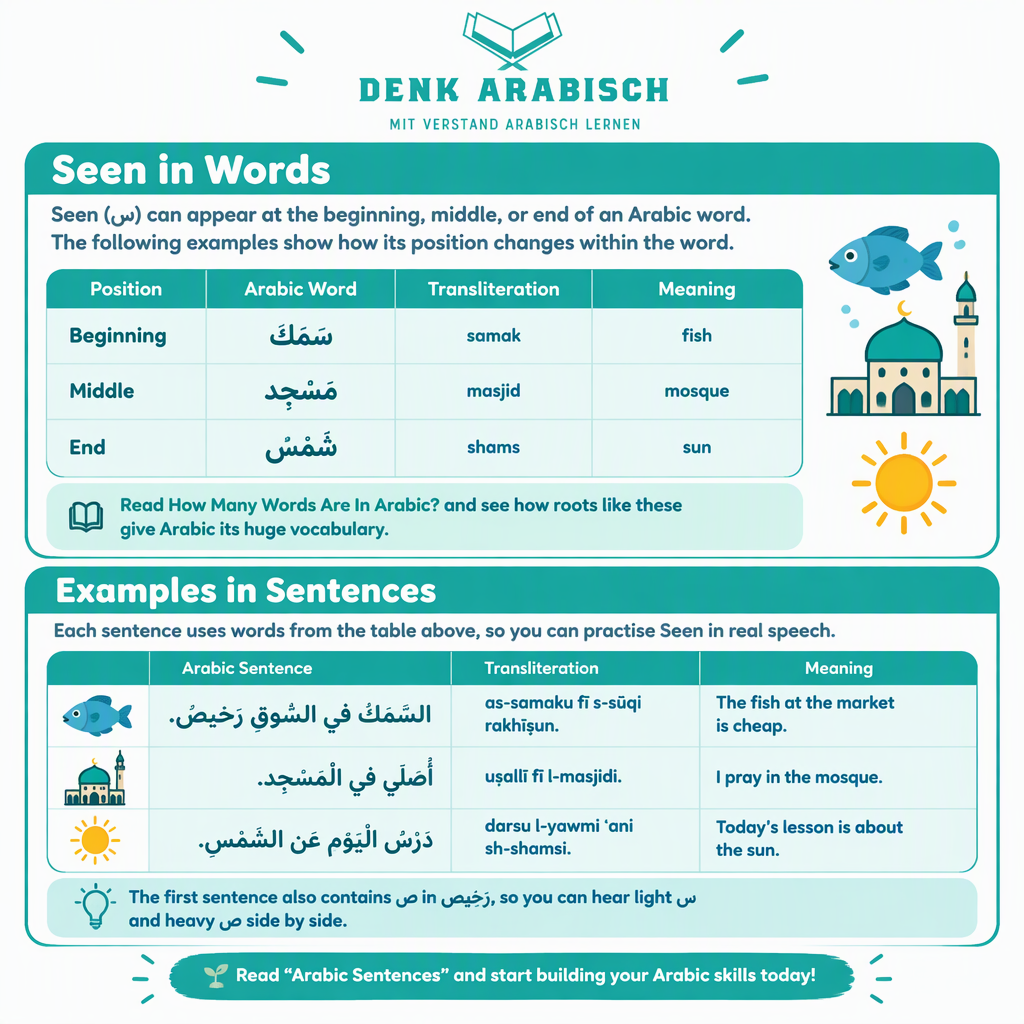
Examples of Seen in Words
Seen (س) can appear at the beginning, middle, or end of an Arabic word. The following examples show how its position changes within the word.
| Position | Arabic Word | Transliteration | Meaning |
| Beginning | سَمَك | samak | fish |
| Middle | مَسْجِد | masjid | mosque |
| End | شَمْس | shams | sun |
Examples of Seen in Sentences
Each sentence uses words from the table above, so you can practise Seen in real speech.
| Arabic Sentence | Transliteration | Meaning |
| السَّمَكُ فِي السُّوقِ رَخِيصٌ. | as-samaku fī s-sūqi rakhīṣun. | The fish at the market is cheap. |
| أُصَلِّي فِي الْمَسْجِدِ. | uṣallī fī l-masjidi. | I pray in the mosque. |
| دَرْسُ الْيَوْمِ عَنِ الشَّمْسِ. | darsu l-yawmi ʿani sh-shamsi. | Today’s lesson is about the sun. |
The first sentence also contains ص in رَخِيص, so you can hear light س and heavy ص side by side.
Read “Arabic Sentences” and start building your Arabic skills today!
Common Seen Pronunciation Mistakes and How to Fix Them
Understanding these common mistakes can help learners pronounce Seen correctly and maintain a clear distinction between similar Arabic sounds.
1. Voicing Seen into Zāy (ز), the German Habit
German voices s at the start of a word and between vowels, so سَلَام turns into “zalām” and رَسُول into “razūl”. In Arabic this can change the word: سَارَ (he walked) becomes زَارَ (he visited).
Test: put two fingers on your throat and say سسسس, then ززززز. You should feel a buzz only for ز.
2. Making Seen Heavy like Ṣād (ص)
Near heavy letters, learners raise the back of the tongue and Seen darkens into ṣād. Then سَيْف (sword) sounds like صَيْف (summer).
Test: say سَيْف in front of a mirror. Your lips should stay spread and the “a” should stay bright, not sound like “o”.
3. Mixing up Seen and Sheen (ش)
In speech, rounding the lips turns s into sh. In reading, beginners miss the three dots above ش.
Test: say سِعْر and شِعْر. For س your lips stay flat; for ش they push slightly forward.
4. Reading Thāʾ (ث) as Seen
In many spoken dialects ث is pronounced as s, so learners read ثَارَ as سَارَ. In Quran recitation and standard Arabic, the two must stay apart.
Test: look in a mirror while saying ثَارَ. The tip of your tongue should be visible between your teeth. For سَارَ it stays hidden.

Practice Exercises: Test Your Knowledge of Letter Seen
These exercises will help you review the shape, pronunciation, and correct use of Seen while testing your ability to recognize it in different Arabic words and sentences.
Exercise 1: Multiple Choice
Which word begins with Seen?
- a) شَمْس
- b) صَيْف
- c) سَيْف
- d) زَارَ
Answer: c) سَيْف (sayf, sword).
Exercise 2: Matching
Match each word with its meaning: سَمَك, سُوق, مَسْجِد, دَرْس → lesson, mosque, fish, market.
Answer: سَمَك = fish, سُوق = market, مَسْجِد = mosque, دَرْس = lesson.
Exercise 3: Writing Practice
Write Seen in its four forms: س سـ ـسـ ـس. Then copy these words and name the form of Seen in each: سَمَك, مَسْجِد, شَمْس, رَأْس.
Exercise 4: True or False
- Seen is a Moon letter.
- Seen has three dots above it.
- Seen is always a light letter.
- In مَدْرَسَة, Seen is written in its medial form.
Answers: 1. False, it is a Sun letter. 2. False, that is ش. 3. True. 4. False, it takes its initial form because ر does not connect.
Exercise 5: Find the Letter
How many times does Seen appear in this sentence? السَّمَكُ فِي السُّوقِ رَخِيصٌ.
Answer: Two times, in السَّمَك and السُّوق. The ص in رَخِيص is a different letter.
Explore “Arabic Texts for Beginners” and discover simple texts that make learning Arabic more enjoyable and effective.
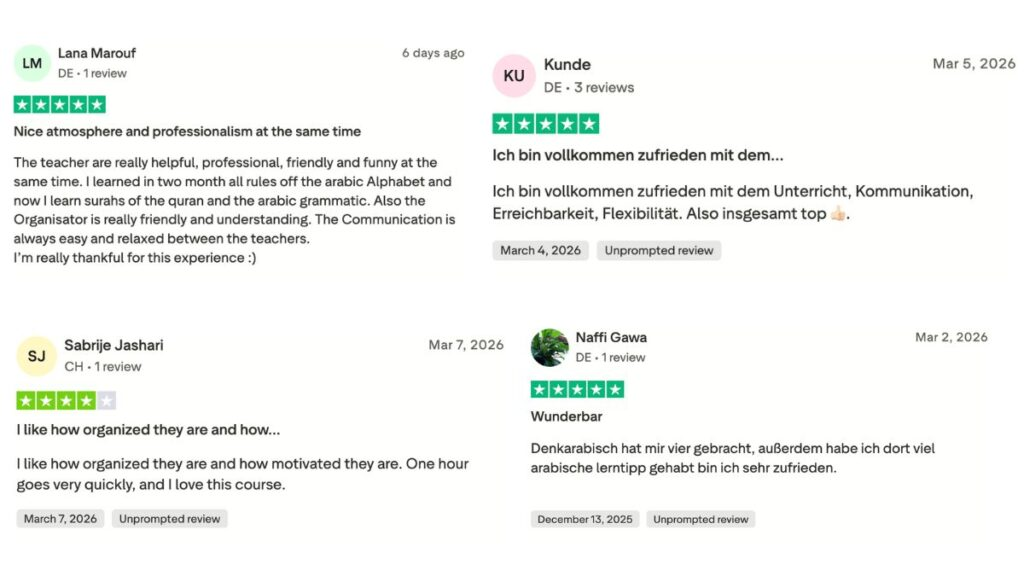
What Our Students Say About Denk Arabisch Academy
See what our students say about learning at Denk Arabisch Academy on Trustpilot. Read their experiences and check out more reviews to discover how our courses help improve Arabic.
Learn the Arabic Alphabet Step by Step with Denk Arabisch
Seen is one of 28 letters. Each new letter is easier when it builds on the one before, in a clear order with a teacher who hears your mistakes.
Denk Arabisch is built for German-speaking learners and explains Arabic through German, including the sound traps German sets for you.
- Live lessons with experienced teachers
- Explanations in German, with German sounds as reference points
- A clear path from the alphabet to reading the Quran
- Courses for adults and for children
Choose Your Specialized Course:
- Arabic Course For Beginners: your first steps in reading, writing and speaking
- Arabic Alphabet Course: all 28 letters, their sounds and their forms
- Arabic Reading Course: from single letters to fluent reading
- Arabic Writing Course: clean handwriting and correct connections
- Arabic Speaking Course: practical conversation with a teacher
- Quranic Arabic Course for German Speakers: understand the language of the Quran
- Quran Tajweed Course for German Speakers: correct recitation, rule by rule
Learn Arabic with Denk Arabisch Academy
Speak and understand Arabic through a clear and effective learning system
Try a Free TrialBook a free trial lesson with Denk Arabisch and find the course that fits your goal.
Below you can read our Student’s Reviews

Conclusion
The Letter Seen (س) is one of the easiest Arabic letters to learn, as long as you keep it sharp and light.
- Sound: a voiceless, whistling [s], like ss in Wasser, never the buzzing German s of Sonne.
- Writing: three teeth with no dots, in four forms, and a bowl only in the isolated and final forms.
- Recognition: no dots means س, three dots means ش, and a closed loop means ص.
Practise the hiss with your hand on your throat, write the four forms, and read the minimal pairs with ش ص ز and ث. Then review the roots س ل م, د ر س and س ج د until their words feel familiar.
With a few minutes a day, Seen will soon be one of the letters you read without thinking. Book a free trial lesson at Denk Arabisch and take the next letter with a teacher at your side.
FAQs
1. What is the difference between Seen (س) and Sheen (ش)?
Seen is pronounced s and has no dots. Sheen is pronounced sh and has three dots above the same body. Compare سِعْر (price) and شِعْر (poetry).
2. What is the difference between Seen (س) and Ṣād (ص)?
Both share the same makhraj and the whistling quality. Seen is light, with the back of the tongue low, while Ṣād is heavy, with the tongue raised. Compare سَيْف (sword) and صَيْف (summer).
3. Is Seen a Sun or a Moon letter?
Seen is a Sun letter. After الْـ the lām is silent and Seen takes a shadda, so السَّمَاء is read as-samāʾ.
4. Is Seen a heavy or a light letter?
Seen is always light (muraqqaq). It stays light even next to heavy letters, as in الْمُسْتَقِيم.
5. Which Tajweed rules involve Seen?
Seen triggers idghām shamsī after الْـ, as in السَّاعَة. It is also an ikhfāʾ letter: a nūn sākina or tanwīn before it is hidden, as in الْإِنسَان.