The letter Zay (ز), which Arabs call زَاي (zāy), holds the 11th place in the Arabic alphabet. It is the humming sound at the start of زَيْتُون (zaytūn, olives). Air hisses past the tip of your tongue, just behind the front teeth, while your voice keeps buzzing. Phoneticians call it a voiced alveolar sibilant fricative: [z] in IPA.
Good news first: German already has this exact sound. Say Hase, Reise or Gemüse and listen to the middle. That soft, humming s is Arabic ز. The only catch is spelling: when German readers see a z, their mouth says ts, as in Zucker.
This guide covers everything you need to know about Zay:
- The sound of ز, from your tongue tip to your vocal cords
- The two shapes of ز on paper, and why it always stands apart from the next letter
- How ز behaves with fatḥa, ḍamma, kasra, sukūn, long vowels and shadda
- Its makhraj, its six ṣifāt and its role in ikhfāʾ and idghām shamsī
- Three word families, plus everyday words and sentences
At the end, five short exercises show you how much has stuck.
| Question | Answer |
| Name | زَاي (zāy), in some regions زَيْن (zayn) |
| Sound | [z], the s in German Hase, the z in English lazy |
| Position in the alphabet | 11th (hijāʾī order), right after ر |
| Abjad value | 7 (7th letter of أَبْجَد هَوَّز) |
| Transliteration | Common: z · DIN 31635: z · ISO 233: z · Arabizi: z (no digit) |
| Point of articulation | Tongue tip, close to the lower front teeth |
| Sun or Moon letter | Sun |
| Heavy or light | Light, in every position |
| Dots | 1, above |
| Connection | Joined from the right only |
Table of Contents
Where Does Zay (ز) Come in the Arabic Alphabet?
Count the letters from the start and Zay is number 11: ا ب ت ث ج ح خ د ذ ر ز. It closes a small run of non-connecting letters, د ذ ر ز, that all stand apart from what follows.
The older Abjad order is a memory chant: أَبْجَد هَوَّز حُطِّي كَلَمُن… In it, Zay comes 7th and counts as 7. Scribes used these values to write numbers and to hide dates inside words, so they still help when you read old manuscripts and inscriptions.
The Difference Between Zay (ز) and Rāʾ (ر)
Only one letter shares Zay’s body:
- ر (Rāʾ): the bare curve, no dot.
- ز (Zay): the same curve with one dot on top.
Once you can write ر, you can write ز. One dot is the whole difference.
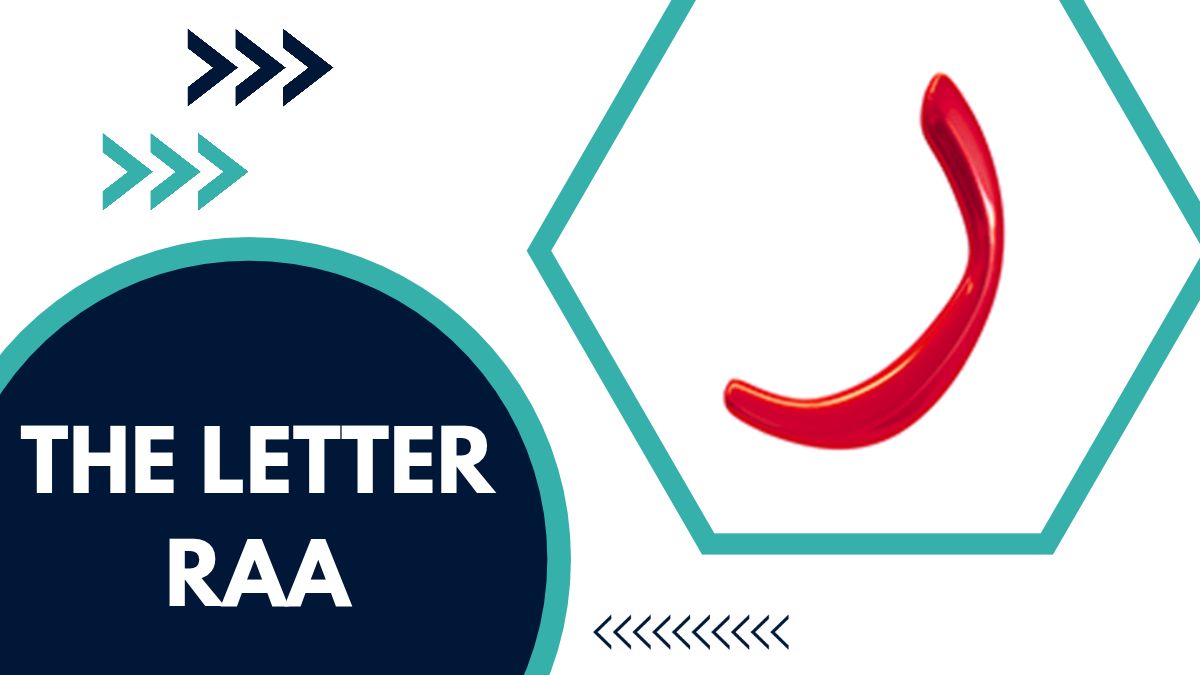
Learn the twin letter in detail in our guide to The Letter Raa (ر).
Zay (ز) as a Sun Letter
Sun letters swallow the l of the article. Before ز, you write الْـ but say only a, then a doubled z.
- الزَّيْتُون (az-zaytūn): the olives
- الزَّمَن (az-zaman): the time
- الزُّجَاج (az-zujāj): the glass
On the page, you can spot this rule at a glance: the lām carries no sukūn, and the shadda sits on the ز.
Starting Arabic from zero and want every letter in the right order? The Arabic Course For Beginners at Denk Arabisch takes you from the alphabet to your first sentences, explained in German.
Understanding the Makhraj of Zay (ز)
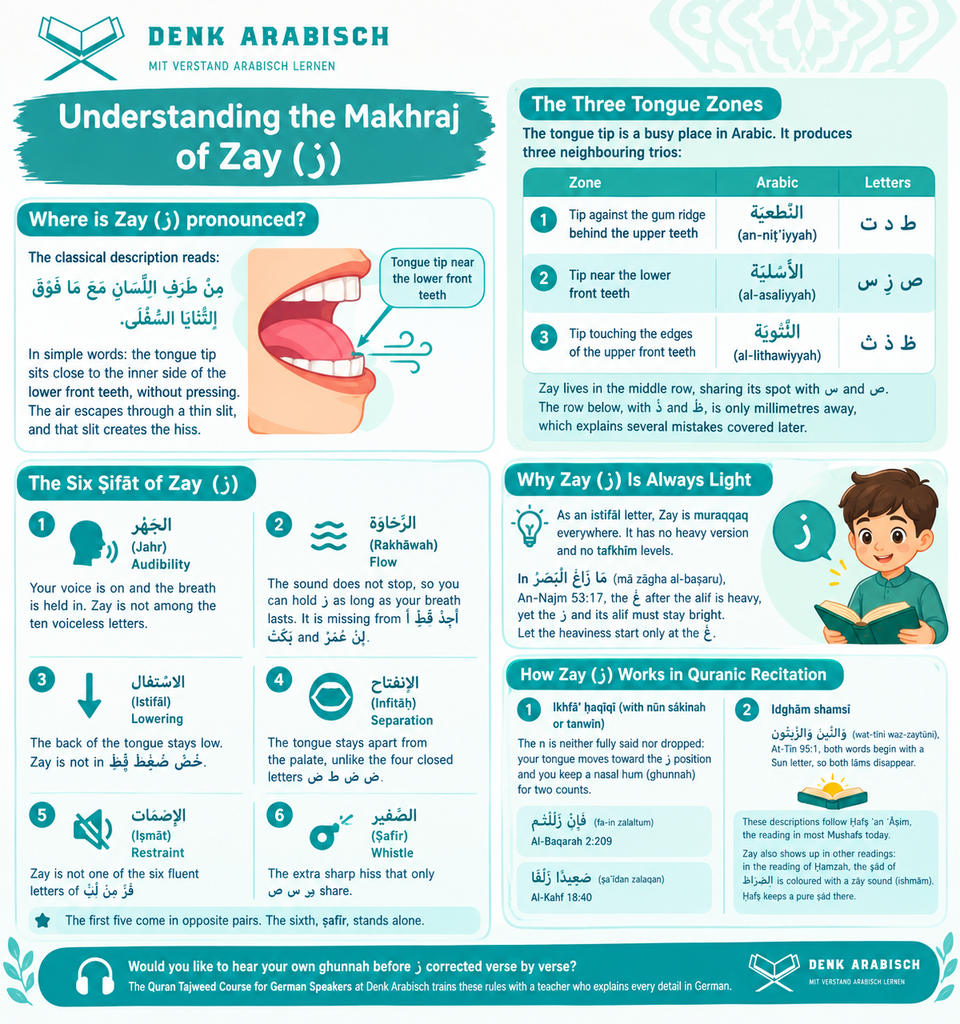
The classical description reads: مِنْ طَرَفِ اللِّسَانِ مَعَ مَا فَوْقَ الثَّنَايَا السُّفْلَى. In plain words, the tongue tip sits close to the inner side of the lower front teeth, without pressing. The air escapes through a thin slit, and that slit creates the hiss.
The tongue tip is a busy place in Arabic. It produces three neighbouring trios:
| Zone | Arabic | Letters |
| Tip against the gum ridge behind the upper teeth | النِّطْعِيَّة (an-niṭʿiyyah) | ط د ت |
| Tip near the lower front teeth | الْأَسَلِيَّة (al-asaliyyah) | ص ز س |
| Tip touching the edges of the upper front teeth | اللِّثَوِيَّة (al-lithawiyyah) | ظ ذ ث |
Zay lives in the middle row, sharing its spot with س and ص. The row below it, with ذ and ظ, is only millimetres away, which explains several mistakes covered later.
The Six Ṣifāt of Zay (ز)
The letter Zay (ز) has six distinctive pronunciation characteristics that shape its sound, including voicing, continuous airflow, a lowered tongue position, openness, restraint, and its characteristic whistling quality.
- Jahr (الْجَهْر), audibility: your voice is on and the breath is held in. Check it against فَحَثَّهُ شَخْصٌ سَكَتْ, the ten voiceless letters; ز is not among them.
- Rakhāwah (الرَّخَاوَة), flow: the sound does not stop, so you can hold ز as long as your breath lasts. It is missing from both أَجِدْ قَطٍ بَكَتْ and لِنْ عُمَرْ.
- Istifāl (الِاسْتِفَال), lowering: the back of the tongue stays low. ز is not in خُصَّ ضَغْطٍ قِظْ.
- Infitāḥ (الِانْفِتَاح), separation: the tongue stays apart from the palate, unlike the four closed letters ص ض ط ظ.
- Iṣmāt (الْإِصْمَات), restraint: ز is not one of the six fluent letters of فَرَّ مِنْ لُبّ.
- Ṣafīr (الصَّفِير), whistle: the extra sharp hiss that only ص ز س share.
The first five come in opposite pairs. The sixth, ṣafīr, stands alone.
Why Zay (ز) Is Always Light
As an istifāl letter, Zay is muraqqaq everywhere. It has no heavy version and no tafkhīm levels.
The test comes when a heavy letter is close by. In مَا زَاغَ الْبَصَرُ (mā zāgha al-baṣaru), An-Najm 53:17, the غ after the alif is heavy, yet the ز and its alif must stay bright. Let the heaviness start only at the غ.
How Zay (ز) Works in Quranic Recitation
When nūn sākinah or tanwīn meets ز, the rule is ikhfāʾ ḥaqīqī. The n is neither fully said nor dropped: your tongue moves toward the ز position and you keep a nasal hum (ghunnah) for two counts.
- فَإِنْ زَلَلْتُمْ (fa-in zalaltum), Al-Baqarah 2:209: the نْ melts into a nasal hum, then the z begins.
- صَعِيدًا زَلَقًا (ṣaʿīdan zalaqan), Al-Kahf 18:40: the tanwīn of the first word is hidden before the ز of the second.
The second rule is idghām shamsī. In وَالتِّينِ وَالزَّيْتُونِ (wat-tīni waz-zaytūni), At-Tīn 95:1, both words begin with a Sun letter, so both lāms disappear.
These descriptions follow Ḥafṣ ʿan ʿĀṣim, the reading in most Mushafs today. Zay also shows up in other readings in a surprising way: in the reading of Ḥamzah, the ṣād of الصِّرَاط is coloured with a zāy sound (ishmām). Ḥafṣ keeps a pure ṣād there.
Would you like to hear your own ghunnah before ز corrected verse by verse? The Quran Tajweed Course for German Speakers at Denk Arabisch trains these rules with a teacher who explains every detail in German.
How to Pronounce the Arabic Letter Zay (ز)
In standard German, Zay is the s between two vowels or at the start of a syllable: Hase, Reise, Gemüse, Sahne. You hear the same sound in English lazy, French maison and Turkish zor. English speakers simply read ز as their z and are done.
Zay (ز) for German Speakers: What to Watch Out For
Your reference sound is the stimmhaftes S. Hold on to it, and let go of these German reflexes:
- The letter Z means [ts] in German, as in Zucker. Arabic ز never has a t inside it.
- At the end of a word, German turns a voiced s voiceless: Gras sounds with [s], Gräser with [z]. Arabic keeps ز voiced in every position.
- Many speakers from Bavaria, Austria and Switzerland say every s voiceless. If that is you, ز needs a conscious hum.
Two words that trigger these reflexes:
- زَيْتُون (zaytūn, olives): the German eye wants “tsaytūn”.
- كَنْز (kanz, treasure): German final devoicing wants “kans”.
A Step-by-Step Guide to Pronouncing Zay
Follow these simple steps to position your mouth, tongue, and voice to pronounce the letter Zay accurately:
- Mouth: open slightly and spread the lips a little, as if smiling.
- Tongue: rest the tip just behind the lower front teeth and lift the front of the tongue toward the upper teeth, leaving a thin slit.
- Air: blow through the slit and switch your voice on. It should sound like a bee: zzzz.
- Relaxation: slide straight into the vowel. Keep the jaw loose and the voice running.
Zay (ز) and Similar Arabic Sounds
Understanding the difference between ز and similar Arabic sounds is important for accurate pronunciation and for distinguishing between words with different meanings.
The following examples show how small changes in the sound or articulation can completely change the meaning of a word.
| Word 1 | Meaning | Word 2 | Meaning | Difference |
| زَادَ (zāda) | it increased | سَادَ (sāda) | it prevailed | Voice on for ز, voice off for س |
| زَلَّ (zalla) | he slipped | ذَلَّ (dhalla) | he was humbled | ذ needs the tongue tip between the teeth |
| زَهَرَ (zahara) | it shone | ظَهَرَ (ẓahara) | it appeared | ظ is between the teeth and heavy |
Record yourself reading each pair, then listen back: can a stranger tell the two words apart?
Would you like to train your ear for ز and its look-alikes from the very first lesson? The Arabic Alphabet Course at Denk Arabisch lets you hear, repeat and compare every letter sound with a teacher.
How to Write Zay (ز) in Arabic
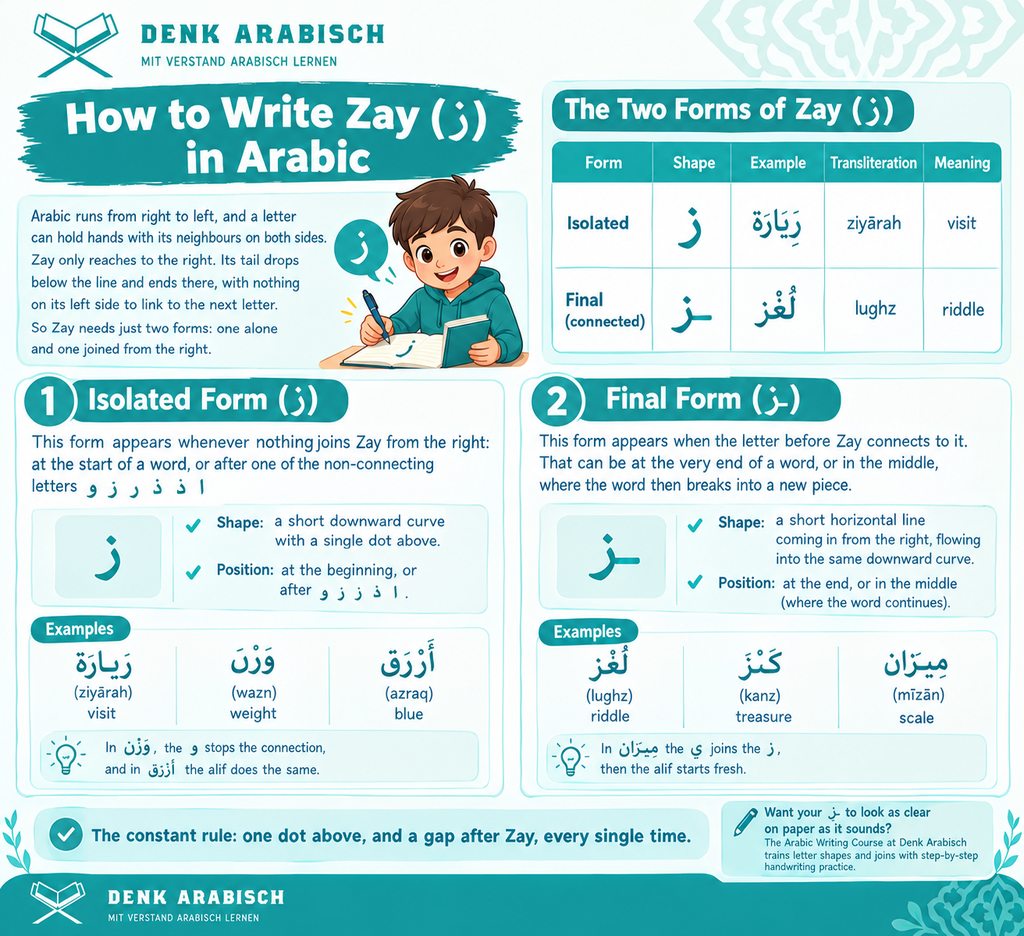
Arabic runs from right to left, and a letter can hold hands with its neighbours on both sides. Zay only reaches to the right. Its tail drops below the line and ends there, with nothing on its left side to link to the next letter. So Zay needs just two forms: one alone and one joined from the right.
| Form | Shape | Example | Transliteration | Meaning |
| Isolated | ز | زِيَارَة | ziyārah | visit |
| Final (connected) | ـز | لُغْز | lughz | riddle |
1. Isolated Form (ز)
This form appears whenever nothing joins Zay from the right: at the start of a word, or after one of the non-connecting letters ا د ذ ر ز و.
Shape: a short downward curve with a single dot above it.
Examples: زِيَارَة (ziyārah, visit), وَزْن (wazn, weight), أَزْرَق (azraq, blue). In وَزْن the و stops the connection, and in أَزْرَق the alif does the same.
2. Final Form (ـز)
This form appears when the letter before Zay connects to it. That can be at the very end of a word, or in the middle, where the word then breaks into a new piece.
Shape: a short horizontal line coming in from the right, flowing into the same downward curve.
Examples: لُغْز (lughz, riddle), كَنْز (kanz, treasure), مِيزَان (mīzān, scale). In مِيزَان the ي joins the ز, then the alif starts fresh.
The constant rule: one dot above, and a gap after Zay, every single time.
Would you like your ز to look as clear on paper as it sounds? The Arabic Writing Course at Denk Arabisch trains letter shapes and joins with step-by-step handwriting practice.
Zay (ز) with Short and Long Vowels
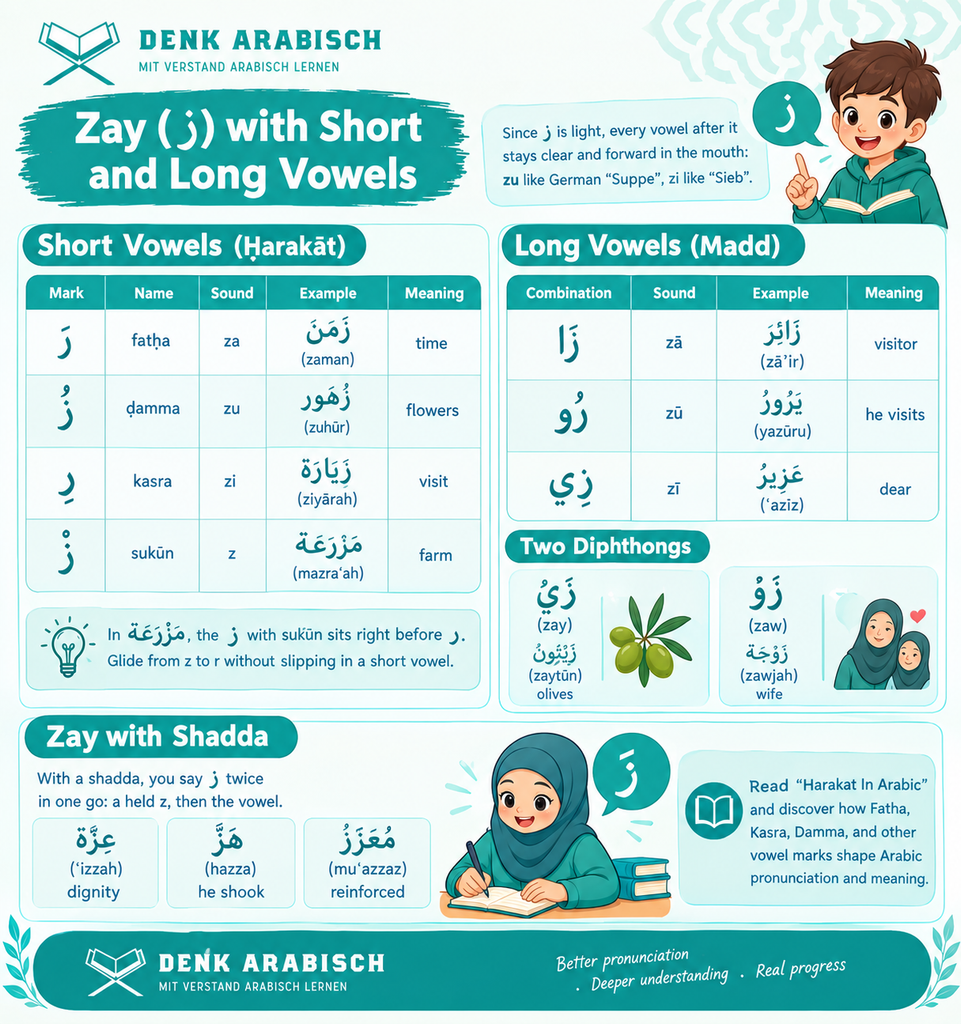
Since ز is light, every vowel after it stays clear and forward in the mouth: zu like German “Suppe”, zi like “Sieb”.
Short Vowels (Ḥarakāt)
Master the core Arabic short vowel marks (Ḥarakāt) and see how they modify the sound of the letter Zay in everyday vocabulary.
| Mark | Name | Sound | Example | Meaning |
| زَ | fatḥa | za | زَمَن (zaman) | time |
| زُ | ḍamma | zu | زُهُور (zuhūr) | flowers |
| زِ | kasra | zi | زِيَارَة (ziyārah) | visit |
| زْ | sukūn | z | مَزْرَعَة (mazraʿah) | farm |
In مَزْرَعَة, the ز with sukūn sits right before ر. Glide from z to r without slipping in a short vowel.
Learn Arabic with Denk Arabisch Academy
Speak and understand Arabic through a clear and effective learning system
Try a Free TrialLong Vowels (Madd)
Learn how long vowel extensions (Madd) stretch the sound of the letter Zay to build distinct words in Arabic.
| Combination | Sound | Example | Meaning |
| زَا | zā | زَائِر (zāʾir) | visitor |
| زُو | zū | يَزُورُ (yazūru) | he visits |
| زِي | zī | عَزِيز (ʿazīz) | dear |
Two diphthongs complete the picture: زَيْ (zay) in زَيْتُون (zaytūn, olives) and زَوْ (zaw) in زَوْجَة (zawjah, wife).
Zay with Shadda
With a shadda, you say ز twice in one go: a held z, then the vowel.
- عِزَّة (ʿizzah): dignity
- هَزَّ (hazza): he shook
- مُعَزَّز (muʿazzaz): reinforced
Read “Harakat In Arabic” and discover how Fatha, Kasra, Damma, and other vowel marks shape Arabic pronunciation and meaning.
Useful Arabic Roots Containing Zay (ز)
Arabic builds words like a tree: three root letters carry the core meaning, and patterns grow new words from them. Here are three Zay roots that pay off quickly, in conversation and in the Quran.
ز و ج (pairing)
Explore essential Arabic vocabulary built from the three-letter root ز – و – ج, which carries the core concept of pairing, partnership, and marriage.
| Word | Transliteration | Meaning |
| زَوْج | zawj | husband, pair |
| زَوْجَة | zawjah | wife |
| زَوَاج | zawāj | marriage |
| أَزْوَاج | azwāj | spouses, pairs |
You met زَوْجَة in the diphthong note above.
ز ي د (increasing)
Discover foundational Arabic words derived from the root ز – ي – د, which revolves around the core concept of growth, abundance, and addition.
| Word | Transliteration | Meaning |
| زَادَ | zāda | it increased |
| يَزِيدُ | yazīdu | it increases |
| زِيَادَة | ziyādah | increase |
| مَزِيد | mazīd | more |
The first minimal pair in this guide, زَادَ vs. سَادَ, comes from this root.
ف و ز (succeeding)
Discover essential Arabic vocabulary built from the root ف – و – ز, which centered on the core concept of victory, achievement, and success.
| Word | Transliteration | Meaning |
| فَازَ | fāza | he won |
| فَوْز | fawz | success |
| فَائِز | fāʾiz | winner |
| الْفَائِزُون | al-fāʾizūn | the successful ones |
Look at فَازَ and فَوْز: the alif and the و do not connect, so ز keeps its isolated shape.
Do you want to read new words by spotting their roots, not by guessing? The Arabic Reading Course at Denk Arabisch builds fluent, accurate reading one word family at a time.
Examples of Zay (ز) in Arabic Words
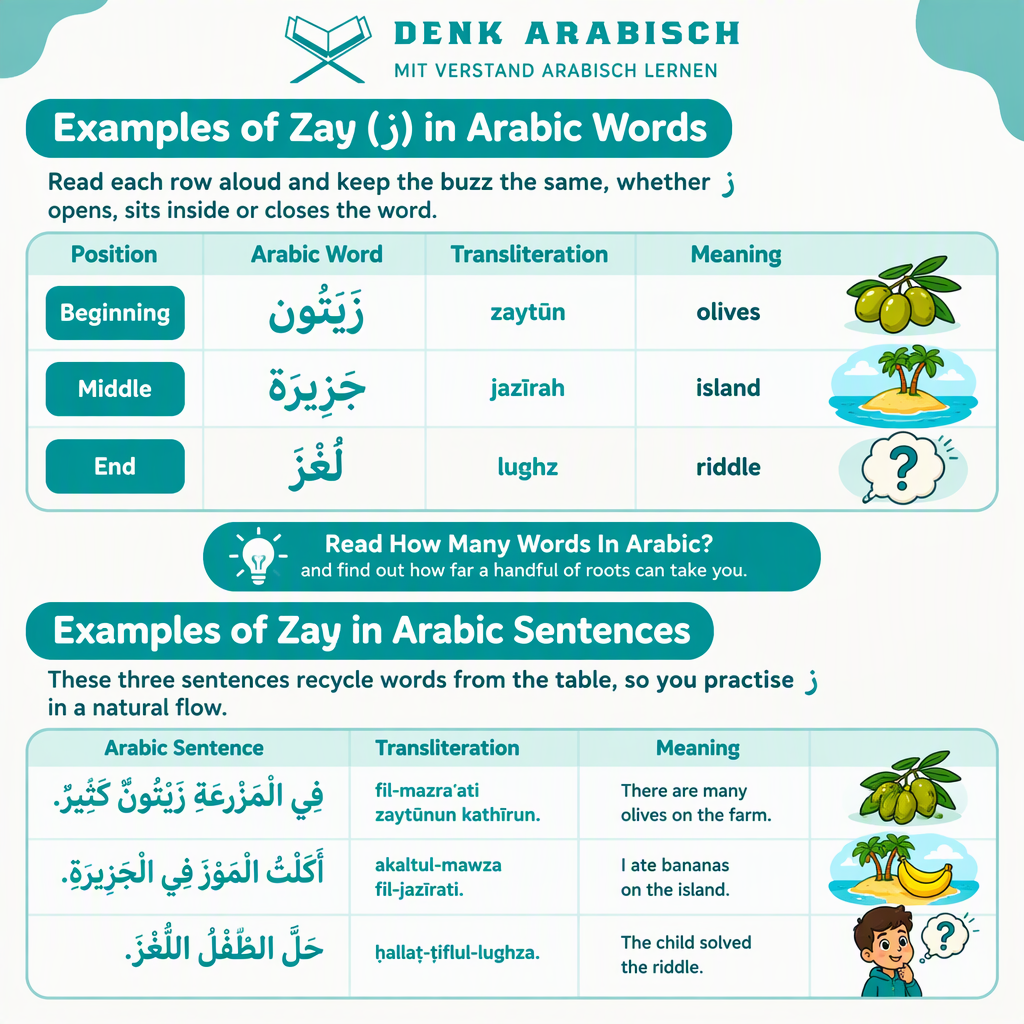
Read each row aloud and keep the buzz the same, whether ز opens, sits inside or closes the word.
| Position | Arabic Word | Transliteration | Meaning |
| Beginning | زَيْتُون | zaytūn | olives |
| Middle | جَزِيرَة | jazīrah | island |
| End | لُغْز | lughz | riddle |
Examples of Zay in Arabic Sentences
These three sentences recycle words from the table, so you practise ز in a natural flow.
| Arabic Sentence | Transliteration | Meaning |
| فِي الْمَزْرَعَةِ زَيْتُونٌ كَثِيرٌ. | fil-mazraʿati zaytūnun kathīrun. | There are many olives on the farm. |
| أَكَلْتُ الْمَوْزَ فِي الْجَزِيرَةِ. | akaltul-mawza fil-jazīrati. | I ate bananas on the island. |
| حَلَّ الطِّفْلُ اللُّغْزَ. | ḥallaṭ-ṭiflul-lughza. | The child solved the riddle. |
Common Zay (ز) Pronunciation Mistakes
Because a minor slip in pronouncing Zay can completely alter a word’s meaning, here are the most common mistakes learners make—and practical tests to fix them.
1. Mixing up Zay (ز) and Sīn (س)
The two letters share the same tongue position and the same whistle. When the voice drops out, زَادَ (it increased) turns into سَادَ (it prevailed).
Test: whisper both words. They sound the same, because a whisper has no voice. Now say them aloud: only ز should hum.
2. Saying Dhāl (ذ) as Zay
Spoken Egyptian and Levantine Arabic often replace ذ with z. Learners who pick up Arabic from family or dialect videos carry this into the Quran, where ذَلَّ (he was humbled) becomes زَلَّ (he slipped).
Test: hold your index finger upright against your lips. For ذ your tongue tip should touch the finger; for ز it never leaves your mouth.
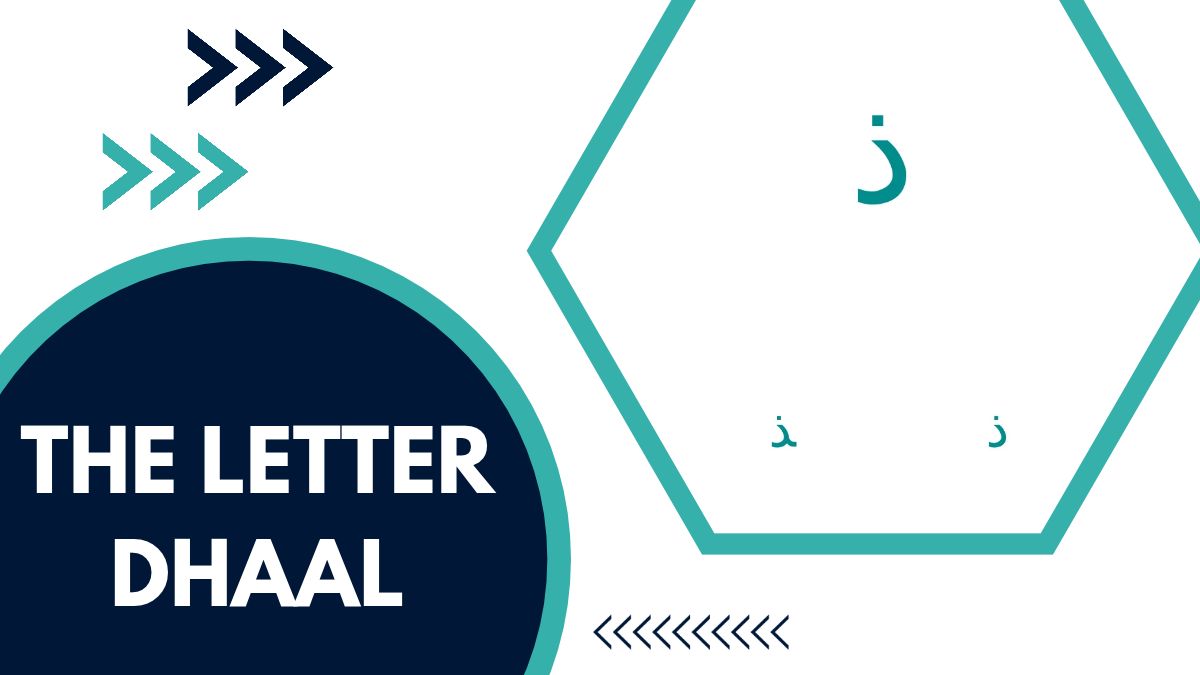
For more on ذ, read our guide to The Letter Dhaal (ذ).
3. Saying Ẓāʾ (ظ) as Zay
The same dialect habit flattens ظَهَرَ (it appeared) into زَهَرَ (it shone). Here you lose two features at once: the tongue position between the teeth and the heaviness.
Test: watch yourself in a mirror. For ظ your tongue tip shows and your lips round a little; for ز the tip hides and your lips stay spread.
4. Reading Zay with German Habits
German spelling makes زَيْتُون come out as “tsaytūn”, and German final devoicing makes كَنْز and مَوْز end in s.
Test: hold a strip of paper in front of your lips. A ts start makes it jump with a small burst; a clean z makes it flutter evenly. For the word endings, keep a hand on your throat until the very last sound.
Practice Exercises for Zay (ز)
Test your understanding of the letter Zay with these quick practice exercises designed to reinforce pronunciation rules and check your progress.
Exercise 1: Multiple Choice
- Which word means “treasure”? a) لُغْز b) مَوْز c) كَنْز
- How do you read الزَّمَن? a) al-zaman b) az-zaman c) as-saman
- Which pair differs only in voicing? a) زَلَّ / ذَلَّ b) زَادَ / سَادَ c) زَهَرَ / ظَهَرَ
Answers: 1 c, 2 b, 3 b.
Exercise 2: Matching
Match the words زُجَاج, جَزِيرَة, مِيزَان and زِيَارَة with these meanings: island, visit, glass, scale.
Answers: زُجَاج = glass, جَزِيرَة = island, مِيزَان = scale, زِيَارَة = visit.
Exercise 3: Writing Practice
Write one line alternating ر and ز: ر ز ر ز ر ز. Then copy وَزْن, أَزْرَق, لُغْز and مِيزَان, and label each ز as isolated or final.
Exercise 4: True or False
- Zay is the 7th letter in the hijāʾī order.
- Nūn sākinah before ز is hidden with ghunnah.
- Zay shares the attribute of ṣafīr with ث.
- In وَزْن, the ز has its isolated shape.
Answers: 1 false (it is 11th; 7 is its Abjad position), 2 true (ikhfāʾ), 3 false (only ص ز س have ṣafīr), 4 true (و does not connect).
Exercise 5: Find the Letter
How many times is ز written in each word: عَزِيز, زَوْجَة, كَنْز, زِيَارَة?
Answers: عَزِيز = 2, زَوْجَة = 1, كَنْز = 1, زِيَارَة = 1.
What Our Students Say About Denk Arabisch Academy
See what our students say about learning at Denk Arabisch Academy on Trustpilot. Read their experiences and check out more reviews to discover how our courses help improve Arabic.

Learn Arabic Step by Step with Denk Arabisch
Zay is one letter out of 28. Learn them in a planned sequence, and each new letter builds on the one before.
Denk Arabisch is made for German-speaking learners: every sound, rule and exception is explained through German, starting from what you already know.
- A clear learning path, from the first letter to confident reading
- Teachers who listen to you and correct you live
- Explanations that use German sounds as anchors, like the stimmhaftes S for ز
- Courses for adults and for children
Choose Your Specialized Course:
- Arabic Course For Beginners: a guided start from letters to everyday sentences.
- Arabic Alphabet Course: all 28 letters, their sounds, shapes and Sun or Moon status.
- Arabic Reading Course: steady, accurate reading, with and without vowel marks.
- Arabic Writing Course: clear handwriting and correct letter connections.
- Arabic Speaking Course: practical conversation with direct feedback.
- Quranic Arabic Course for German Speakers: the vocabulary and grammar behind the Quranic text.
- Quran Tajweed Course for German Speakers: correct makhārij, ṣifāt and Tajweed rules in recitation.
Learn Arabic with Denk Arabisch Academy
Speak and understand Arabic through a clear and effective learning system
Try a Free TrialBook your free trial lesson at Denk Arabisch and find the right course for your level.

Conclusion
The letter Zay (ز) is a sound German speakers already own; the work is in reading it as Hase, not as Zucker.
- Sound: a light, humming [z] with a whistle, voiced from the first moment to the last.
- Writing: two forms, one dot above, and always a break after it.
- Recognition: the dotted twin of ر, a Sun letter, and one of the 15 ikhfāʾ letters.
Spend a few minutes a day on the bee sound, then write ر and ز side by side until the dot is automatic. Run through the pairs with س, ذ and ظ, and revisit the roots ز و ج, ز ي د and ف و ز. With that routine, ز will soon feel effortless.
Book a free trial lesson at Denk Arabisch and get personal feedback on your Zay.
FAQs
1. How is Zay (ز) different from Sīn (س)?
They are made in the same place and both whistle. The only difference is your voice: on for ز, off for س. That is why زَادَ (it increased) and سَادَ (it prevailed) are different words.
2. How is Zay (ز) different from Dhāl (ذ)?
Dhāl is made with the tongue tip between the teeth, like English th in this, while Zay stays behind them. Dialects often merge the two, but standard Arabic and the Quran keep زَلَّ (he slipped) and ذَلَّ (he was humbled) apart.
3. How is Zay (ز) different from Ẓāʾ (ظ)?
Ẓāʾ is made between the teeth and is heavy; Zay is made behind the teeth and is light. Merging them turns ظَهَرَ (it appeared) into زَهَرَ (it shone).
4. Is Zay a Sun letter, and what Tajweed rules apply to it?
Yes, Zay is a Sun letter, so the lām of الْـ is silent and ز is doubled, as in الزَّيْتُون. It is also an ikhfāʾ letter: nūn sākinah or tanwīn before it is hidden with ghunnah, as in فَإِنْ زَلَلْتُمْ.
5. Can Zay ever be pronounced heavy?
No. Zay has the attribute of istifāl, so it is light in every word. Even next to a heavy letter, as in زَاغَ, it keeps its thin, bright sound.