Why Arabic Is Difficult
Arabic feels difficult to many beginners in Germany because it differs from German in script, sounds, and language structure at the same time. Yet it is not impossible to learn. The real difficulty usually comes from starting without a clear system.
Inhaltsverzeichnis
What Why Arabic Is Difficult really means for beginners
Most learners do not mean that Arabic cannot be learned. They usually mean that the beginning feels unfamiliar, slow, and mentally demanding.
This difficulty often comes from three sources. The script is new. Several sounds do not exist in German. The language also relies heavily on roots and patterns instead of the structures learners already know.
When German speakers understand these points early, Arabic becomes more manageable. That is where Denk Arabisch and its Arabischkurse offer a more structured path for learners in Germany.
A. Why Arabic feels unfamiliar at first
German and Arabic are not closely related. That means beginners cannot rely on the same shortcuts they may use with English or other European languages.
Even the direction of reading changes. That alone can make the first contact with Arabic feel harder than it really is.
B. Why Arabic is not equally difficult in every skill
Reading, speaking, listening, and grammar do not progress at the same speed. Many beginners feel weak in one area and assume the whole language is equally difficult.
In practice, some learners read early but struggle with pronunciation. Others understand simple speech but need more time with grammar patterns.
Lerne Arabisch mit Denk Arabisch Akademie
Sprich und verstehe Arabisch mit einer klaren und effektiven Lernmethode
Jetzt anmeldenUnderstanding the Arabic script

The Arabic script is one of the clearest reasons why Arabic seems difficult in the beginning. Still, it is usually a temporary obstacle rather than a permanent one.
Once letter shapes become familiar, the pressure drops. Progress comes faster when learners connect script, sound, and word recognition from the start.
A. Learning the new alphabet
Arabic letters change shape depending on where they appear in a word. A beginner must therefore learn both the letter and its connected forms.
This makes words look denser at first. With repeated exposure, the visual system adapts and reading becomes much easier.
B. Reading from right to left
This change is simple in theory but unfamiliar in practice. The eye needs time to build a new reading habit.
Short daily reading sessions usually solve this problem. It is a matter of adaptation, not a sign that the learner lacks ability.
C. Understanding short and long vowels
A major challenge is that short vowels are often not fully written in everyday texts. Beginners therefore see less pronunciation support than they expect.
For that reason, Arabic should not be learned through text alone. Denk Arabisch uses qualified tutors and guided listening to connect written forms with accurate sound.
Read also: arabic texts for beginners
Why pronunciation often feels harder than grammar

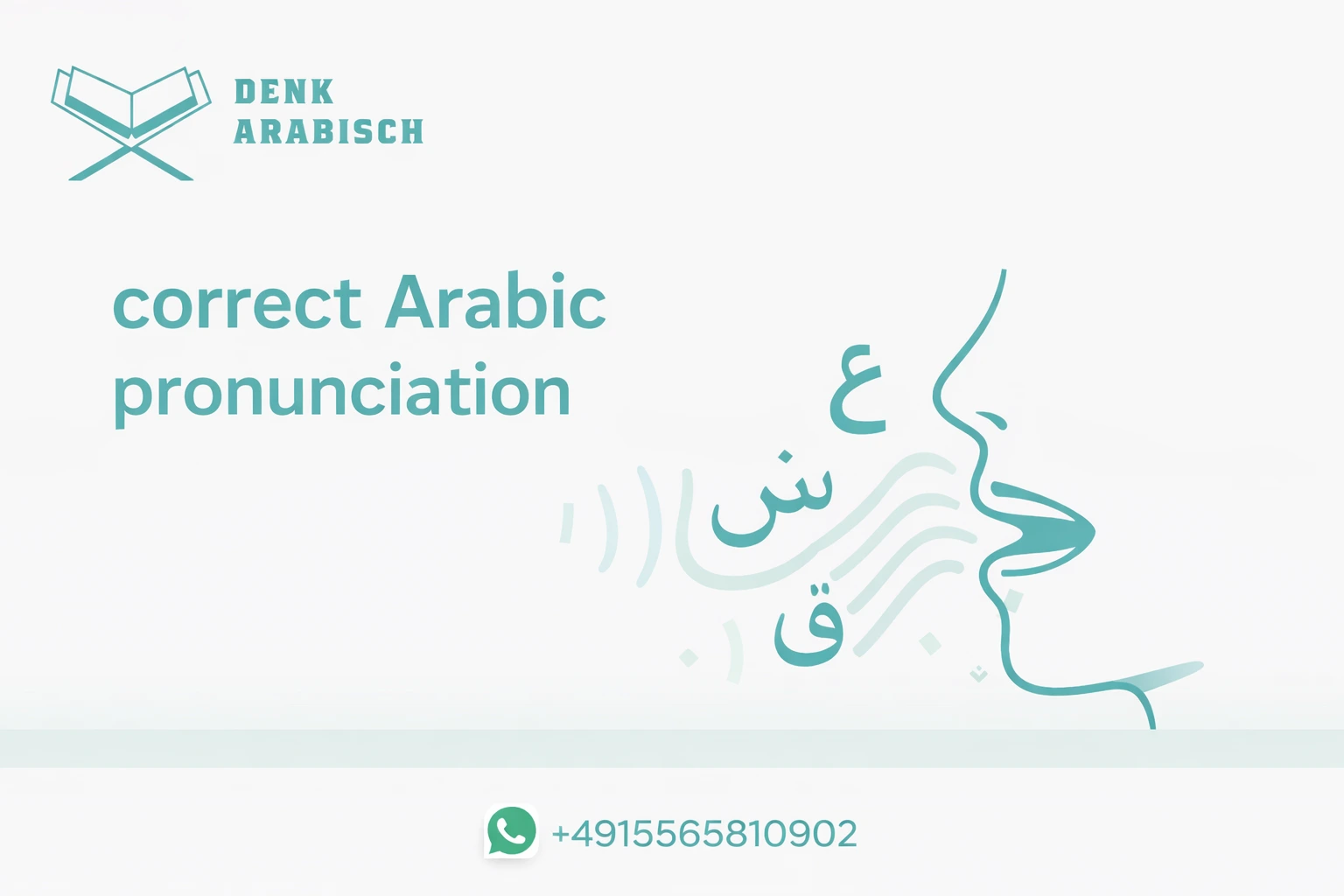
For German speakers, the first real obstacle is often pronunciation rather than grammar. Several Arabic sounds have no direct equivalent in German.
This is especially true for ح, ع, خ, and ق. These sounds require awareness of where the sound is produced, not just imitation.
A. Arabic sounds that feel completely new
The sound ح is not the same as a soft German h. It comes from deeper in the throat and needs controlled airflow.
The sound ع is often even harder. It is a throat-based sound that must be felt physically and trained slowly.
B. Similar sounds that are hard to separate
Many beginners confuse s and ṣ, d and ḍ, or h and ḥ. These are not minor details, because pronunciation can affect meaning.
That is why early correction matters. Precise sound training prevents deeper habits from forming later.
Read also: correct Arabic pronunciation
Why Arabic grammar feels different
Arabic grammar is not random. It follows a different internal logic. Once learners see that logic, the language becomes more transparent.
One key principle is the root system. Many words grow from three basic consonants that enter different patterns.
A. Understanding verbs and word patterns
A single root can produce several related meanings. That helps vocabulary growth when learners study word families rather than isolated items.
For German speakers, this feels unusual at first. Later, many find it efficient because meaning relationships become clearer.
B. Learning gender and plural forms
Arabic marks gender more visibly than German in many structures. Plural forms also do not always follow one simple rule.
Broken plurals are a common surprise. They show that Arabic sometimes changes a word internally instead of simply adding an ending.
Modern Standard Arabic and dialects explained simply

A frequent source of frustration is mixing Modern Standard Arabic with dialects too early. Learners often hear one form in real life and see another in learning materials.
A clear goal is essential. Do you want to read, understand religious texts, travel, or speak with family? The answer shapes the best starting point.
A. What Modern Standard Arabic is for
Modern Standard Arabic is the shared formal written language. It provides a strong foundation for reading and structured learning.
B. Why dialects can create extra confusion
Dialects differ in pronunciation, vocabulary, and common expressions. Trying to learn all of them too early often weakens the learner’s internal structure.
Read also: Arabic Learning Books
Table of the main challenges
| Area | Why it feels difficult | What helps most |
| Script | new shapes and direction | short daily reading |
| Pronunciation | unfamiliar throat sounds | targeted sound training |
| Grammar | new word logic | learning patterns |
| Dialects | too many varieties at once | a clear goal |
Common mistakes when learning Arabic
Many problems come less from Arabic itself and more from poor learning habits. Too much input and too little structure slow down beginners.
A. Learning too much too fast
Trying to master script, dialect, grammar, and free conversation at once overloads the learner.
B. Memorizing words without context
Word lists rarely stay active for long. Short phrases, simple sentences, and recurring patterns work better.
C. Correcting pronunciation too late
Errors that become automatic early are harder to remove later. That is why early guidance matters, especially for German speakers.
Is Arabic really difficult or simply different
Arabic is demanding, but it is fully learnable. The hardest stage is usually the beginning, when several unfamiliar systems appear together.
After that stage, many learners improve faster than expected. This is especially true when they study with strong routines and expert guidance.
Lerne Arabisch mit Denk Arabisch Akademie
Sprich und verstehe Arabisch mit einer klaren und effektiven Lernmethode
Jetzt anmeldenStart with Denk Arabisch
A clear learning path is better than random material. Denk Arabisch offers native Arab teachers, flexible online schedules, and personalized lesson plans for German speakers in Germany.
Learners receive support in script, pronunciation, listening, and structured vocabulary building. The Arabischkurse are designed to reduce common beginner mistakes early.
With Denk Arabisch, learning becomes more organized.
❌ random resources without direction
✅ structured teaching with a clear sequence
Unsere Kurse im Überblick:
- Arabischkurse
- Arabisch Niveaustufen
- Arabische Dialektkurse
- Qur’an Lernkurs
- Kurse für muslimische Kinder
Book your free trial lesson with Denk Arabisch today.
(FAQs)
A. Is Arabic harder than English
For most German beginners, yes. The distance in script, sounds, and language structure is greater.
B. Can adults still learn Arabic well
Yes. Adults may need more sound training, but they often understand systems and routines better.
C. Should beginners start with dialect or Modern Standard Arabic
For most learners, Modern Standard Arabic is the stronger foundation. A dialect can be added later when the goal becomes more specific.
Conclusion
Arabic is not difficult because it is unreachable. It feels difficult because it is built differently. With the right order, pronunciation support, and structured teaching, the language becomes far more accessible.