Arabic is one of the most beautiful and widely spoken languages in the world. With more than 400 million speakers, it serves as the language of the Quran and plays a significant role in culture, literature, and international communication.
One of the first challenges that beginners encounter when learning Arabic is understanding Arabic letters connected forms. Unlike English, where letters generally maintain the same appearance regardless of their position in a word, Arabic letters change shape depending on where they appear.
Learning these connected forms is essential for reading Arabic fluently. Once you understand how Arabic letters connect, words become easier to recognize, pronunciation improves, and reading speed increases significantly.
In this comprehensive guide, you will learn everything about Arabic connected letters, why they change shape, which letters connect, which letters do not connect, and practical tips to master Arabic script quickly.
Table of Contents
What Are Arabic Letters Connected Forms?
Arabic is written in a cursive style. This means that most letters join together within a word.
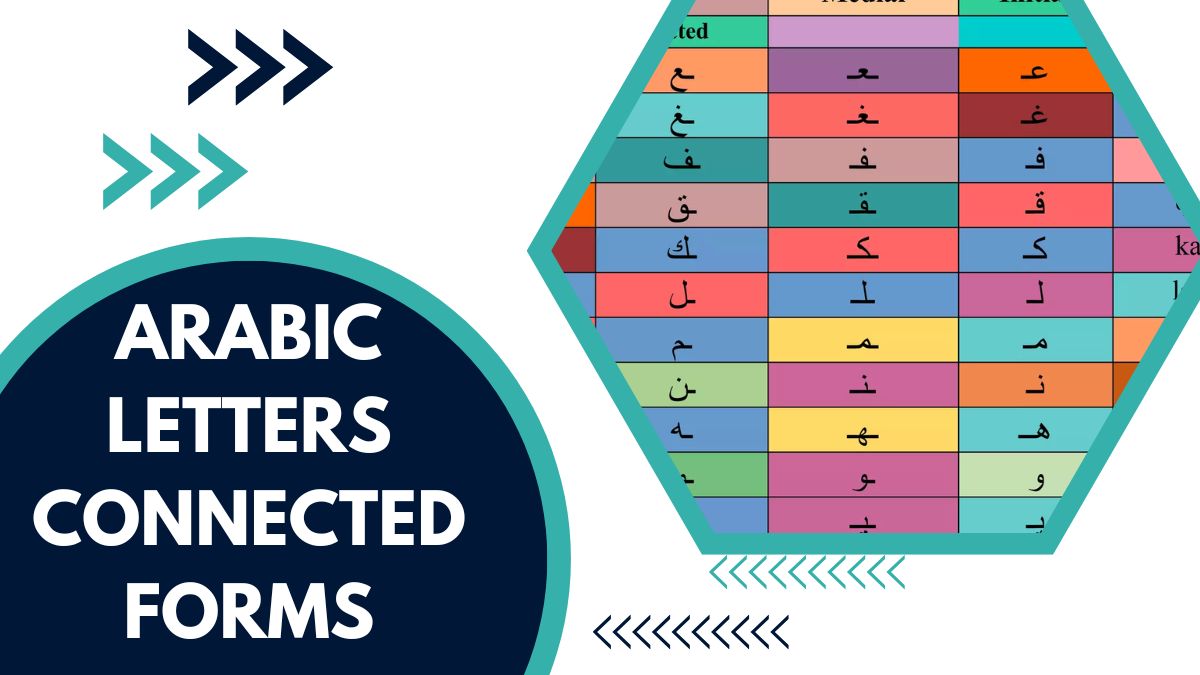
Each Arabic letter can have up to four different forms:
- Isolated Form
- Initial Form
- Medial Form
- Final Form
The shape of a letter changes depending on its position in the word.
For example, the Arabic letter ع (Ayn) looks different when:
- Standing alone
- Appearing at the beginning of a word
- Appearing in the middle
- Appearing at the end
Although the appearance changes, the letter itself remains the same.
Understanding these position-based forms is the foundation of reading Arabic.
Why Do Arabic Letters Change Shape?
Arabic script was designed to be written quickly and smoothly by hand.
Connecting letters creates a flowing writing style that:
- Improves readability
- Enhances writing speed
- Creates visual harmony
- Preserves the artistic nature of Arabic calligraphy
Instead of lifting the pen after every letter, writers can create continuous strokes throughout a word.
This flowing structure explains why letters adapt their shapes when connected.
Stop wasting your time on confusing, random apps and start building a real foundation with our Arabic Course For Beginners at Denk Arabischto master the core structural mechanics of the language from day one.
The Four Forms of Arabic Letters
Before exploring the different connected forms, it is important to understand that Arabic letters change their appearance depending on their position within a word. These variations allow letters to connect smoothly, creating the distinctive flowing script that characterizes written Arabic.
1. Isolated Form
The isolated form appears when a letter stands alone.
Examples:
- ا
- ب
- ت
- ج
This is typically the first form beginners learn when studying the Arabic alphabet.
2. Initial Form
The initial form appears when a letter starts a word and connects to the following letter.
Examples:
- بـ
- تـ
- جـ
The letter extends toward the next letter to establish a connection.
3. Medial Form
The medial form appears when a letter occurs in the middle of a word and connects to letters on both sides.
Examples:
- ـبـ
- ـتـ
- ـجـ
This form usually differs most from the isolated shape.
4. Final Form
The final form appears at the end of a word.
Examples:
- ـب
- ـت
- ـج
The letter connects to the previous letter but ends the word.
Do All Arabic Letters Connect?
No.
This is one of the most important rules in Arabic writing.
Although most Arabic letters connect to surrounding letters, several letters only connect from one side.
These letters break the connection within a word.
The six primary non-connecting letters are:
- ا (Alif)
- د (Dal)
- ذ (Dhal)
- ر (Ra)
- ز (Zay)
- و (Waw)
When one of these letters appears, the following letter must begin a new connection.
Example
Word:
زار
The letter ز connects to ا.
However, ا does not connect to ر.
As a result, ر appears separately even though it belongs to the same word.
Understanding these connection breaks is essential for reading Arabic correctly.
Stop repeating basic lessons you already know and fix your specific weaknesses using our Arabic Courses Based On Skills & Topics at Denk Arabisch to target exactly what you need to improve immediately.
Arabic Letters That Connect on Both Sides
Most Arabic letters can connect to both preceding and following letters.
Examples include:
- ب
- ت
- ث
- ج
- ح
- خ
- س
- ش
- ص
- ض
- ط
- ظ
- ع
- غ
- ف
- ق
- ك
- ل
- م
- ن
- ه
- ي
These letters adapt their appearance depending on their position within a word.
Because they connect naturally, they form the flowing structure that characterizes Arabic writing.
Understanding Arabic Word Formation
Let’s examine a simple word:
كتب
Meaning: “He wrote”
This word consists of:
- ك
- ت
- ب
When combined:
- ك appears in initial form.
- ت appears in medial form.
- ب appears in final form.
Together they create a connected word.
This illustrates how each letter changes shape according to position.
Common Examples of Connected Arabic Words
مدرسة
Meaning: School
Letters:
- م
- د
- ر
- س
- ة
Notice how some letters connect while others create natural breaks.
كتاب
Meaning: Book
Letters:
- ك
- ت
- ا
- ب
The letter ا interrupts the connection before ب.
مسلم
Meaning: Muslim
Letters:
- م
- س
- ل
- م
All letters connect smoothly, creating a flowing word shape.
Practicing words like these helps learners recognize connection patterns naturally.
Don’t settle for weak translations when you can unlock the original divine text directly through our Quranic Arabic Course for German Speakers at Denk Arabisch to achieve perfect pronunciation and deep linguistic understanding.
Learn Arabic with Denk Arabisch Academy
Speak and understand Arabic through a clear and effective learning system
Try a Free TrialWhy Learning Connected Forms Matters?
Many beginners memorize the Arabic alphabet but struggle when reading actual words.
This happens because letters rarely appear in isolated form in real texts.
Learning connected forms helps you:
1. Improve Reading Speed
Instead of decoding individual letters, you begin recognizing entire word patterns.
2. Enhance Pronunciation
Correct identification of connected letters leads to more accurate pronunciation.
3. Build Vocabulary Faster
Recognizing words quickly allows you to focus on meaning rather than letter identification.
4. Read the Quran More Easily
The Quran is written entirely in connected Arabic script.
Mastering connected forms significantly improves Quran reading ability.
5. Gain Writing Confidence
Understanding how letters connect allows you to write Arabic naturally and correctly.
Read also: Harakat In Arabic – The Ultimate Guide To Arabic Diacritics
Most Difficult Letters for Beginners
Some letters undergo dramatic visual changes when connected.
Learners often find these letters challenging:
ع (Ayn)
The shape changes significantly between isolated, initial, medial, and final positions.
غ (Ghayn)
Similar to Ayn but includes a dot.
هـ (Ha)
Can appear very different depending on placement.
ي (Ya)
The connected forms may seem unfamiliar initially.
م (Meem)
Often changes shape noticeably in medial positions.
These letters require extra practice but become familiar through repetition.
Get rid of the confusion of unstructured learning and follow a clear, step-by-step path with our Arabic Courses Based On Levels at Denk Arabisch to guarantee you actually advance your skills instead of staying stuck in place.
How to Practice Arabic Connected Forms?
Mastering Arabic connected forms requires regular exposure and consistent practice. The more frequently you read and interact with Arabic text, the faster your brain will recognize letter patterns and connections automatically.
1. Read Daily
Consistency is more important than intensity.
Reading for 15–20 minutes daily produces better results than long weekly study sessions.
2. Trace Connected Words
Writing words repeatedly helps your brain recognize connection patterns.
3. Use Children’s Arabic Books
Beginner-level books provide clear and simple examples of connected script.
4. Study One Letter at a Time
Learn how each letter behaves in all four positions before moving to the next.
5. Read Aloud
Speaking while reading reinforces visual recognition and pronunciation simultaneously.
6. Listen and Follow Along
Listening to Arabic audio while following written text strengthens reading fluency.
Tips for Memorizing Arabic Connected Forms
Memorizing Arabic connected forms becomes much easier when you use structured learning techniques. Combining visual repetition, active recall, and regular practice helps reinforce letter recognition and accelerates reading fluency.
Create Flashcards
Include:
- Isolated form
- Initial form
- Medial form
- Final form
Review them regularly.
Group Similar Letters
For example:
- ب
- ت
- ث
These letters share the same basic shape.
Learning them together accelerates memorization.
Practice Short Words
Examples:
- باب
- بيت
- قلم
- نور
Short words allow you to focus on letter connections without becoming overwhelmed.
Use Repetition
Repeated exposure is the key to mastery.
The more words you read, the more natural connected forms become.
Arabic Calligraphy and Connected Forms
Arabic calligraphy is built upon the principles of connected writing.
Styles such as:
- Naskh
- Ruq’ah
- Thuluth
- Diwani
all rely on letter connections to create artistic compositions.
Learning connected forms not only improves reading skills but also provides a foundation for appreciating Arabic calligraphy.
Many students find that studying calligraphy deepens their understanding of how letters interact within words.
Learning Connected Forms for Quran Reading
For Quran students, mastering connected forms is especially important.
The Quran uses classical Arabic script, where letters appear in various connected positions throughout every verse.
Students who understand connected forms can:
- Identify words more quickly
- Improve Tajweed practice
- Reduce reading hesitation
- Increase fluency
- Strengthen confidence during recitation
Many Quran learners discover that understanding letter connections is the turning point in their reading journey.
Read also: How To Learn To Read Arabic? – A Complete Beginner’s Guide
What Our Students Say About Denk Arabisch Academy
See what our students say about learning at Denk Arabisch Academy on Trustpilot. Read their experiences and check out more reviews to discover how our courses help improve Arabic.

ACHIEVE ARABIC FLUENCY NOW With Denk Arabisch!
Stop wasting time jumping between random Arabic lessons that don’t lead anywhere. If you’re serious about real progress, you need a clear path built for results, not confusion.
At Denk Arabisch, every course is designed with one goal: turn learners into confident Arabic speakers step by step.
Choose the path that fits you best:
- Arabic Course For Beginners – Start from zero and build strong reading, writing, and pronunciation foundations without overwhelm.
- Quranic Arabic Course for German Speakers – Finally understand the Quran with structured explanations designed specifically for German-speaking learners.
- Arabic Courses Based On Skills & Topics – Learn exactly what you need: conversation, grammar, reading, and real-life Arabic usage without wasting time.
- Arabic Dialect Courses – Speak like natives and understand real spoken Arabic from different regions with confidence.
- Arabic Courses Based On Levels – Move step by step from beginner to advanced with a structured system that guarantees measurable progress.
This is not random learning. This is a designed system that builds fluency with direction and speed.
👉 Stop delaying your Arabic journey. Every week without structure keeps you stuck at the same level.
Join Denk Arabisch today and start with the course that matches your level and goals.
Limited seats available – enrollment closes soon.
Start now with a trial class and experience the difference real structure makes.
Learn Arabic with Denk Arabisch Academy
Speak and understand Arabic through a clear and effective learning system
Try a Free TrialConclusion
Learning Arabic letters connected forms is one of the most important steps in mastering Arabic reading and writing. Since Arabic is a cursive script, letters change shape depending on their position within a word. Understanding isolated, initial, medial, and final forms allows learners to recognize words more quickly and read with greater confidence.
While the system may appear challenging at first, consistent practice makes connected forms feel natural. Focus on learning one letter at a time, practice reading daily, and pay close attention to non-connecting letters such as Alif, Dal, Ra, and Waw.
With patience and repetition, you will soon move beyond individual letters and begin reading Arabic words smoothly and fluently. Whether your goal is conversational Arabic, academic study, or Quran reading, mastering Arabic connected forms is a foundational skill that opens the door to true Arabic literacy.
FAQs
1. What are Arabic letters connected forms?
Arabic letters connected forms are the different shapes that Arabic letters take when they appear at the beginning, middle, or end of a word.
2. Why do Arabic letters change shape?
Arabic is written in a cursive script, so letters connect to one another. Their shapes change to facilitate smooth and continuous writing.
3. How many forms does an Arabic letter have?
Most Arabic letters have four forms:
Isolated
Initial
Medial
Final
4. Do all Arabic letters connect?
No. Letters such as ا، د، ذ، ر، ز، and و do not connect to the following letter.
5. Is learning connected forms necessary for Quran reading?
Yes. Since the Quran is written in connected Arabic script, understanding connected forms is essential for fluent and accurate Quran reading.