Arabic is one of the richest and most expressive languages in the world. It is spoken by hundreds of millions of people across the Middle East and North Africa and is the language of the Quran, Islamic scholarship, poetry, and a vast literary tradition. One of the most common questions among Arabic learners is: How many words are in Arabic?
The answer is fascinating because Arabic is unlike many other languages. Thanks to its unique root system, Arabic can generate an enormous number of words from a relatively small set of roots. This linguistic feature has led many scholars to describe Arabic as one of the richest languages in terms of vocabulary.
In this article, we will explore how many words Arabic contains, why it has such a large vocabulary, how words are formed, and what this means for Arabic learners.
Table of Contents
How Many Words Are in Arabic?
There is no single exact number because languages constantly evolve. However, many linguistic studies estimate that Arabic contains more than 12 million words.
This number is often compared to English, which is estimated to have around 600,000 to 1 million words when counting technical, historical, and regional vocabulary.
The famous Arabic dictionary Lisan al-Arab alone contains tens of thousands of entries, while modern Arabic dictionaries continue to add new terms for technology, science, and contemporary life.
It is important to note that counting words in Arabic is more complex than in many other languages. Because Arabic relies heavily on roots and patterns, a single root can generate dozens or even hundreds of related words. As a result, the total number of possible Arabic words is exceptionally large.
The reason Arabic vocabulary appears so large is not merely because of individual words but because of the language’s sophisticated word-building system, which has allowed the language to expand naturally over centuries without losing its structure or consistency.
Don’t let the fear of a new script hold you back any longer; secure your seat in our high-demand Arabic Course For Beginners at Denk Arabisch today before the upcoming term fills up completely!
Why Does Arabic Have So Many Words?
Arabic uses a root-based structure that allows speakers to create numerous related words from a single root.
Most Arabic roots consist of three letters known as a trilateral root.
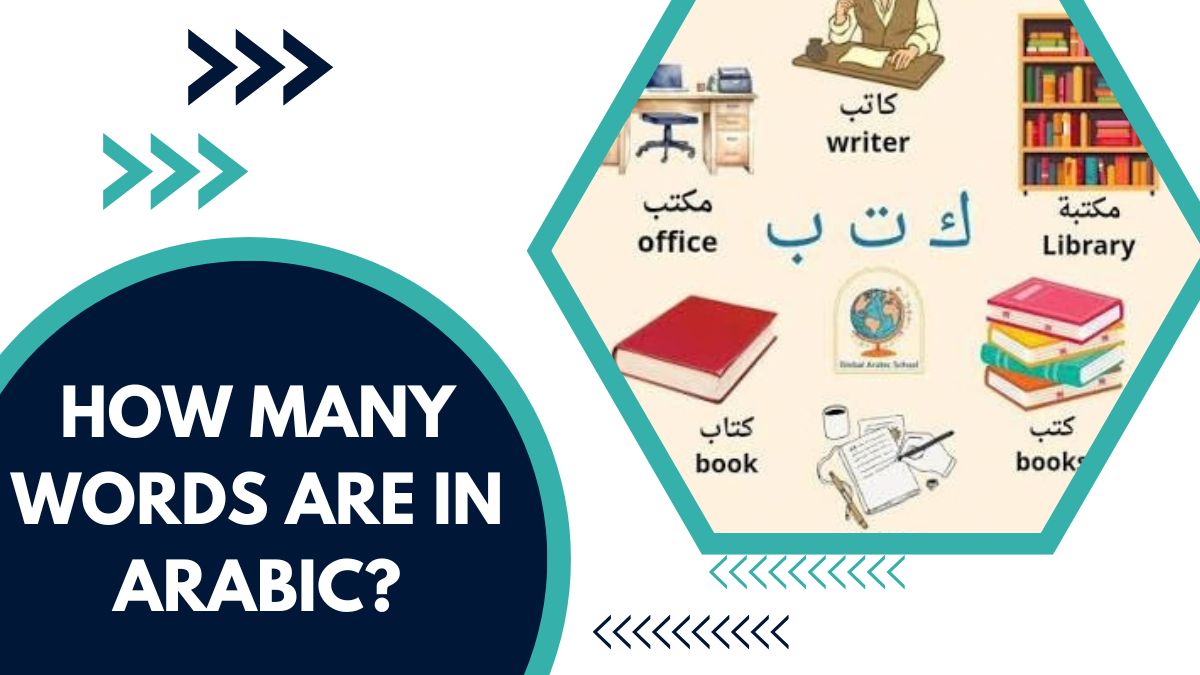
For example, the root:
ك-ت-ب (K-T-B)
relates to writing.
From this single root, many words can be derived:
- كتب (kataba) – he wrote
- كتاب (kitab) – book
- كاتب (katib) – writer
- مكتبة (maktaba) – library
- مكتوب (maktub) – written
- كتابة (kitabah) – writing
- مكتب (maktab) – office or desk
This system allows Arabic to generate extensive vocabulary while maintaining clear relationships between words.
The root system makes Arabic highly organized. Once learners understand the meaning of a root, they can often recognize and predict the meanings of many related words. This not only enriches vocabulary but also makes reading comprehension easier over time.
Another reason Arabic has such a vast vocabulary is its long literary tradition. For centuries, poets, scholars, linguists, and writers developed highly specialized vocabulary to describe emotions, nature, science, religion, and daily life. Classical Arabic poetry, in particular, is famous for its extensive use of precise and descriptive language.
In addition, Arabic contains many synonyms that express subtle differences in meaning. For example, there are numerous words related to concepts such as knowledge, love, courage, rain, and light, each carrying a unique nuance. This linguistic richness contributes significantly to the enormous number of words found in Arabic.
The Arabic Root System Explained
One reason Arabic learners find the language both challenging and rewarding is the root system.
Unlike many languages where words often need to be memorized individually, Arabic is built on a highly organized system of roots and patterns. Once learners understand how this system works, they can recognize connections between words and expand their vocabulary much more efficiently.
Most Arabic words originate from a root consisting of three letters. These letters carry a core meaning, while different patterns are applied to create related words with specific functions and meanings.
Instead of memorizing every word individually, learners can recognize patterns and identify familiar roots within new vocabulary.
For example, if you know the root:
ع-ل-م (A-L-M)
which relates to knowledge, learning, and understanding, you can understand words such as:
- علم (ilm) – knowledge
- عالم (alim) – scholar
- تعليم (ta’lim) – education
- معلم (mu’allim) – teacher
- تعلم (ta’allum) – learning
- معلوم (ma’lum) – known
- معلومات (ma’lumat) – information
By understanding the core meaning of the root, learners can often make educated guesses about the meanings of unfamiliar words they encounter while reading or listening.
This feature makes Arabic unique because vocabulary is interconnected rather than random. Words belonging to the same root family often share a common concept, making them easier to remember and understand.
The root system also helps learners improve reading comprehension. When encountering a new word, recognizing its root can provide valuable clues about its meaning, even if the exact word has never been studied before.
For example, someone who knows the root ك-ت-ب (K-T-B), which relates to writing, can easily identify connections between words such as كتاب (book), كاتب (writer), مكتبة (library), and كتابة (writing). This ability significantly reduces the amount of vocabulary that must be memorized separately.
Another advantage of learning roots is that it strengthens both speaking and writing skills. As learners become familiar with common roots and patterns, they can more easily form new words and understand how different grammatical structures work.
The Number of Classical Arabic vs Modern Arabic Vocabulary
When discussing how many words Arabic contains, it is important to distinguish between Classical Arabic and Modern Standard Arabic (MSA). While both forms share the same linguistic foundation, they differ in vocabulary, usage, and historical context.
Understanding this distinction helps explain why Arabic has accumulated such a vast number of words over the centuries.
Classical Arabic
Classical Arabic refers primarily to the language of:
- The Quran
- Early Islamic literature
- Classical poetry
- Historical texts
- Medieval scholarly works
Classical Arabic preserves many rare words and expressions that are not commonly used in everyday conversation today. It is renowned for its linguistic precision, eloquence, and depth of meaning.
The language of classical poetry, for example, often includes highly descriptive vocabulary for nature, emotions, animals, and human characteristics. Arab poets developed an extraordinary range of words to express subtle differences in meaning, contributing significantly to the growth of Arabic vocabulary.
Many Islamic sciences, including Quranic studies, Hadith studies, and classical jurisprudence, continue to rely on Classical Arabic. As a result, thousands of ancient words remain preserved and studied even after centuries.
Another unique aspect of Classical Arabic is its stability. Unlike many languages that have changed dramatically over time, the language of the Quran remains accessible to modern Arabic speakers with proper study, helping preserve a large portion of the language’s historical vocabulary.
Modern Standard Arabic
Modern Standard Arabic (MSA) is used in:
- News broadcasts
- Books and publications
- Education
- Government communication
- Academic writing
- Formal speeches
- International media
MSA evolved from Classical Arabic while adapting to the needs of the modern world. It maintains the grammatical structure of Classical Arabic but incorporates new terminology for contemporary concepts.
MSA includes many modern terms that did not exist centuries ago, such as words related to:
- Computers
- Medicine
- Engineering
- Social media
- Artificial intelligence
- Telecommunications
- Aviation
- Environmental science
As technology and society continue to develop, new Arabic terms are constantly being created or adapted. Language academies across the Arab world work to develop Arabic equivalents for modern concepts, ensuring that the language remains relevant while preserving its linguistic identity.
As a result, Arabic vocabulary continues to grow, combining ancient linguistic heritage with modern innovation.
Accelerate your professional growth or academic mastery by enrolling in a specialized Arabic Writing Course at Denk Arabisch that deliver practical results in record time.
The Number of Arabic Words Compared to Other Languages
Many people wonder whether Arabic truly has more words than other languages.
While exact comparisons are difficult because languages use different methods of counting vocabulary, Arabic is often considered among the richest languages due to:
- Its root-and-pattern system
- Its long literary history
- Its extensive poetic tradition
- Its preservation of ancient vocabulary
- Its ability to generate new words from existing roots
- Its vast collection of classical and modern texts
For comparison:
| Language | Estimated Vocabulary |
| Arabic | More than 12 million words |
| English | Around 600,000–1 million words |
| French | Approximately 100,000 words in common dictionaries |
| German | Several hundred thousand words |
The exact figures vary depending on how words are counted, but Arabic consistently ranks among the languages with the largest vocabularies.
One reason Arabic stands out is that a single root can generate dozens of related words through different patterns and grammatical forms. This feature allows the language to expand naturally without losing consistency.
Arabic also benefits from more than a millennium of continuous literary production, preserving vocabulary from different historical periods while simultaneously creating new expressions for modern life.
Read also: Islamic Arabic Morning Sayings
The Influence of the Quran on Arabic Vocabulary
The Quran has played a major role in preserving Arabic vocabulary.
Unlike many ancient texts that gradually became inaccessible to ordinary speakers, the Quran continues to be read, memorized, recited, and studied by millions of people around the world every day. This ongoing engagement has helped preserve countless Arabic words and expressions across generations.
Muslims around the world continue to study Quranic Arabic, ensuring that ancient words remain understood and appreciated.
Allah says:
إِنَّا أَنزَلْنَاهُ قُرْآنًا عَرَبِيًّا لَعَلَّكُمْ تَعْقِلُونَ
“Indeed, We have sent it down as an Arabic Quran that you might understand.”
— Surah Yusuf (12:2)
The Quran contains profound linguistic richness, with words chosen carefully for precision, beauty, and depth of meaning.
Many Quranic words carry layers of meaning that scholars continue to analyze and discuss centuries after the revelation of the Quran. This linguistic depth has inspired the development of dictionaries, grammar books, and entire fields of Arabic linguistic study.
Many scholars dedicate entire careers to studying Quranic vocabulary and its nuances. Their efforts have helped preserve classical Arabic and contributed to the survival of thousands of words that might otherwise have disappeared over time.
Transform your understanding of the Holy Book from the comfort of your home; register for our premier Quranic Arabic Course for German Speakers at Denk Arabisch before the registration window closes!
Learn Arabic with Denk Arabisch Academy
Speak and understand Arabic through a clear and effective learning system
Try a Free TrialDo Native Arabic Speakers Know All Arabic Words?
No, Just as English speakers do not know every English word, Arabic speakers do not know all Arabic vocabulary.
Most native speakers use:
- Everyday vocabulary
- Professional terminology related to their field
- Regional expressions and dialect words
- Common Modern Standard Arabic words
The vocabulary used by an engineer, for example, may differ greatly from that used by a doctor, lawyer, historian, or Islamic scholar. Each field contains specialized terminology that may not be familiar to people outside that profession.
Additionally, Arabic dialects across different countries include unique local expressions that may be unfamiliar to speakers from other regions.
Even scholars frequently consult dictionaries when encountering rare classical terms, unusual poetic expressions, or specialized academic vocabulary.
This is completely normal and does not reflect a lack of fluency. In fact, the enormous size of Arabic vocabulary means that continuous learning is part of the language experience, even for highly educated native speakers.
The true measure of fluency is not knowing every word in the language but being able to communicate effectively, understand context, and continue expanding one’s vocabulary over time.
How Many Words Does an Arabic Learner Need?
The good news is that learners do not need to memorize millions of words to become proficient in Arabic.
Although Arabic has one of the largest vocabularies in the world, everyday communication relies on a relatively small number of frequently used words. Research in language acquisition suggests that understanding a few thousand high-frequency words allows learners to communicate effectively and comprehend a large percentage of everyday speech and written texts.
The key is not learning every word in the language but focusing on the vocabulary that appears most often in conversations, books, media, and educational materials.
Approximate milestones include:
500 Words
You can:
- Understand basic conversations
- Introduce yourself
- Ask simple questions
- Talk about family, work, and daily activities
- Recognize common greetings and expressions
At this stage, learners can begin participating in simple interactions and building confidence in the language.
1,000–2,000 Words
You can:
- Read simple texts
- Understand common discussions
- Express daily needs
- Describe experiences and routines
- Follow basic educational content
Many learners find that reaching this level significantly improves their ability to navigate real-life situations in Arabic-speaking environments.
3,000–5,000 Words
You can:
- Follow news articles
- Participate in longer conversations
- Read many books with assistance
- Understand a wide range of topics
- Communicate more naturally and fluently
At this stage, learners start recognizing vocabulary patterns and root families, making it easier to acquire new words.
8,000+ Words
You can:
- Understand advanced texts
- Engage in academic discussions
- Read much of Modern Standard Arabic comfortably
- Follow lectures and formal presentations
- Appreciate more complex literary and religious works
For most learners, reaching this level provides a strong foundation for advanced proficiency in Arabic.
Ensure you are always appropriately challenged and supported by registering for our premium Arabic Alphabet Course at Denk Arabisch led by handpicked academic mentors.
Read also: Alhamdulillah In Arabic
The Role of Arabic Dictionaries
Arabic dictionaries are essential tools for understanding the language’s vast vocabulary.
Because Arabic words are organized around roots, dictionaries often help learners discover entire families of related words rather than just individual definitions. This makes them particularly valuable for expanding vocabulary and understanding how the language functions.
Some famous dictionaries include:
- Lisan al-Arab
- Taj al-Arus
- Al-Mu’jam Al-Wasit
- Hans Wehr Dictionary
These resources help learners explore root meanings and discover connections between related words.
In addition to providing definitions, many Arabic dictionaries explain word origins, grammatical forms, and usage examples. Advanced learners and researchers often rely on these references to study the subtle differences between similar words and understand how meanings have evolved over time.
Today, many digital Arabic dictionaries and language-learning apps make vocabulary research easier than ever, allowing students to search roots instantly and explore related terms with just a few clicks.
Arabic Dialects Add Even More Words
Arabic vocabulary becomes even larger when regional dialects are considered.
While Modern Standard Arabic serves as a common written language, everyday speech varies across the Arab world. Each region has developed its own expressions, pronunciation patterns, and vocabulary over centuries.
Major dialect groups include:
- Egyptian Arabic
- Levantine Arabic
- Gulf Arabic
- Moroccan Arabic
- Sudanese Arabic
- Yemeni Arabic
Each dialect has developed unique words and expressions over centuries.
For example, the same object may have different names depending on the country. A speaker from Egypt may use a different everyday word than someone from Morocco or the Gulf region, even though both understand Modern Standard Arabic.
These regional variations enrich the language and reflect the diverse histories and cultures of Arabic-speaking communities. While dialects share a common foundation, they contribute thousands of additional words and expressions to the overall Arabic vocabulary.
This diversity contributes further to the richness of the Arabic language and demonstrates its remarkable adaptability across different regions and cultures.
Connect deeply with friends, family, or colleagues on a completely different level through immersive Arabic Dialect Courses at Denk Arabisch that teach you native idioms and expressions.
Why Is Arabic Vocabulary So Descriptive?
Arabic often contains multiple words for similar concepts, each carrying a slightly different meaning.
This characteristic has made Arabic particularly famous for its precision and expressive power. Rather than relying on a single word for a concept, Arabic frequently offers numerous alternatives that capture subtle distinctions.
For example, classical Arabic includes numerous words describing:
- Rain
- Camels
- Horses
- Love
- Courage
- Desert landscapes
Poets and scholars used these distinctions to express subtle shades of meaning.
A particular word for rain might describe light rainfall, while another refers to heavy rain or rain that arrives at a specific time. Similarly, different words for love may indicate affection, deep attachment, passion, or spiritual devotion.
This precision makes Arabic particularly powerful in literature, poetry, rhetoric, and religious texts. Writers and speakers can choose words that communicate not only the basic meaning but also emotional depth, intensity, and context.
The richness of descriptive vocabulary is one reason Arabic literature has been admired for centuries.
Tips for Learning Arabic Vocabulary Efficiently
Instead of memorizing isolated words, focus on learning roots and patterns.
A strategic approach to vocabulary learning can dramatically improve both retention and comprehension.
Learn Root Families
Study groups of related words together.
Example:
- علم – knowledge
- معلم – teacher
- تعليم – education
- تعلم – learning
This approach helps learners understand the relationships between words and remember vocabulary more effectively.
Read Regularly
Reading helps vocabulary grow naturally.
Try:
- Children’s books
- Short stories
- News articles
- Quranic passages with explanations
Regular exposure to written Arabic reinforces vocabulary in context and strengthens reading skills.
Use Flashcards
Digital flashcards can improve retention through spaced repetition.
Reviewing vocabulary at carefully timed intervals helps move words from short-term memory into long-term memory.
Listen to Arabic Daily
Exposure to spoken Arabic reinforces vocabulary and pronunciation.
Podcasts, Quran recitations, educational videos, and Arabic news broadcasts can help learners hear words used naturally in context.
Focus on High-Frequency Words
The most common words provide the greatest benefit early in the learning journey.
Learning frequently used vocabulary first allows learners to understand a large percentage of everyday conversations more quickly.
Practice Vocabulary in Context
Instead of memorizing word lists, try using new words in sentences, conversations, or short writing exercises. Contextual learning improves both understanding and long-term retention.
Read also: Good Night In Arabic
The Beauty of Arabic Word Formation
One of the most fascinating aspects of Arabic is how words remain connected to their roots.
This creates a logical structure that helps learners understand unfamiliar vocabulary.
Unlike many languages where word relationships may not always be obvious, Arabic often reveals clear connections between words that share the same root. As learners become familiar with common roots, they begin to recognize patterns throughout the language.
When you recognize a root, you can often guess the meaning of new words, making vocabulary acquisition more efficient than it may initially appear.
This system encourages analytical thinking and allows learners to expand their vocabulary more quickly than they might expect. A single root can unlock dozens of related words, helping students build a strong vocabulary foundation with less memorization.
The beauty of Arabic word formation lies in its balance between structure and creativity. It provides consistency while also allowing for remarkable linguistic richness and flexibility.
This system is one of the reasons Arabic has maintained its linguistic elegance, depth, and expressive power for centuries, continuing to captivate learners, scholars, and language enthusiasts around the world.
What Our Students Say About Denk Arabisch Academy
See what our students say about learning at Denk Arabisch Academy on Trustpilot. Read their experiences and check out more reviews to discover how our courses help improve Arabic.

Master Arabisch with Denk Arabisch Before Spots Fill Up!
How many times have you said, “I’ll start learning Arabic next month”? The truth is, standard apps and generic videos will never make you fluent. If you want to confidently speak the language, understand the Quran in its original form, or connect with regional dialects, you need a structured, professional system—and you need to start today.
Our new premium cohorts are launching right now, and seats are strictly limited to ensure high-quality, personalized attention. Once these live slots are fully booked, registration will close for the entire term!
Choose Your Path to Mastery – Which One is Stopping You?
- Arabic Course For Beginners: Stop feeling overwhelmed by the alphabet. Our proven, step-by-step method takes you from zero to speaking your first full sentences with absolute confidence in record time.
- Quranic Arabic Course for German Speakers: Decode the profound beauty of the Holy Quran without relying solely on translations. Specially engineered for German speakers to bridge linguistic gaps seamlessly.
- Arabic Writing Course: No fluff, no wasted time. Focus exactly on what you need—whether it’s business, reading, or advanced grammar—and master it completely.
- Arabic Dialect Courses: Stop sounding like a textbook. Learn to speak naturally and connect instantly with native speakers in daily life through our specialized dialect tracks.
- Arabic Alphabet Course: Perfect for continuing learners. Skip what you already know and get placed exactly where you belong to ensure continuous, rapid progress.
The Last Remaining Spots Are Being Booked Right Now!
Why keep guessing your way through a difficult language when you can learn directly from handpicked, elite native instructors?
Denk Arabisch eliminates the guesswork, saves you years of frustration, and fits perfectly into your busy work or study schedule.
Delaying will only cost you more time. Secure your absolute future fluency today before the doors close!
Learn Arabic with Denk Arabisch Academy
Speak and understand Arabic through a clear and effective learning system
Try a Free TrialConclusion
So, how many words are in Arabic? While no exact number exists, many experts estimate that Arabic contains more than 12 million words, making it one of the richest languages in the world. This extraordinary vocabulary comes largely from Arabic’s root-based system, which allows thousands of related words to be formed from a single root.
Despite this vast vocabulary, learners do not need to memorize millions of words. By focusing on common vocabulary, understanding roots, and practicing consistently, anyone can make steady progress in Arabic.
Whether your goal is to understand the Quran, communicate with Arabic speakers, or explore one of the world’s most beautiful languages, Arabic offers a remarkable linguistic journey filled with depth, history, and endless opportunities for learning.
FAQs
1. How many words are there in the Arabic language?
There is no exact number because languages continuously evolve. However, many linguistic estimates suggest that Arabic contains more than 12 million words, making it one of the richest languages in the world in terms of vocabulary.
2. Does Arabic have more words than English?
According to many linguistic comparisons, Arabic has a significantly larger vocabulary than English. While English is estimated to contain around 600,000 to 1 million words, Arabic’s root-based system allows for the creation of millions of related words and expressions.
3. Why does Arabic have such a large vocabulary?
Arabic uses a root-and-pattern system that allows numerous words to be derived from a single root. Combined with centuries of literature, poetry, religious scholarship, and scientific writing, this system has contributed to the language’s enormous vocabulary.
4. How many Arabic words does a beginner need to learn?
A beginner can start communicating with approximately 500 to 1,000 common words. Learning the most frequently used vocabulary allows students to understand basic conversations and express everyday needs.
5. How many Arabic words are needed for fluency?
Fluency levels vary, but many learners become comfortable with everyday communication after learning 3,000–5,000 words. Advanced proficiency in reading and formal communication often requires 8,000 words or more.
6. What is the Arabic root system?
The Arabic root system is a method of word formation in which most words are derived from a set of three root letters. These roots carry a core meaning, and different patterns create related words with specific meanings and grammatical functions.