For Muslim families in Freiburg, learning the Quran for children in Freiburg can be an important part of a child’s education and everyday development.
Quran learning is not only about memorizing Surahs, but also about developing reading skills, pronunciation, recitation, Islamic values, and a meaningful connection with the Quran.
Children growing up in Germany may use German as their main language at school and in everyday life, while Arabic is often practiced at home or during religious education.
For parents looking for Quran classes for children in Freiburg, it is helpful to choose a program that develops several skills together.
A structured course can guide children from recognizing Arabic letters to reading Quranic words, applying basic Tajweed, memorizing short Surahs, and becoming more confident in recitation.
A consistent learning environment can also help children understand that Quran education is a gradual process. Instead of expecting immediate results, children can develop their skills step by step through regular lessons, practice, revision, and encouragement.
Table of Contents
Why Is Quran Learning Important For Children?
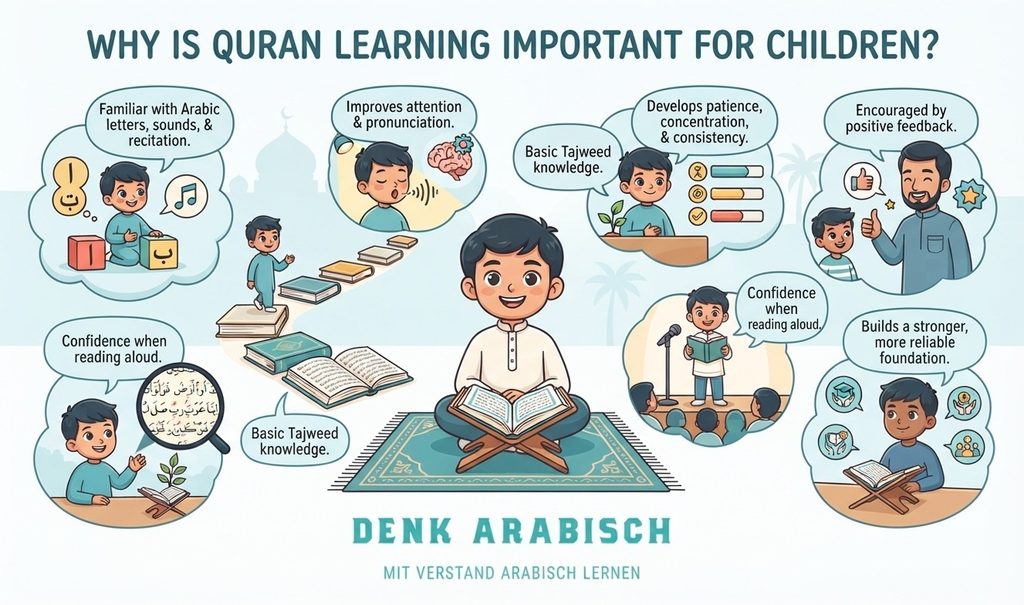
Starting Quran education at an early age can help children become familiar with Arabic letters, Quranic sounds, and regular recitation. When learning is introduced gradually, children can develop these abilities as part of their routine rather than seeing Quran study as an overwhelming responsibility.
Quran learning can also support several areas of a child’s development at the same time. Reading practice can improve attention and pronunciation, while memorization and revision can encourage children to develop patience, concentration, and consistency.
A good Quran program should give children enough time to understand and practice each skill before moving to something more advanced. This gradual approach can make learning more comfortable while helping children build a stronger and more reliable foundation.
Children can gradually develop:
- Arabic reading and pronunciation skills
- Familiarity with Quranic vocabulary
- Accurate Quran recitation
- Basic Tajweed knowledge
- Memorization and revision habits
- Understanding of simple Islamic concepts
- Confidence when reading aloud
- A consistent relationship with Quran learning
When children understand what they are learning and receive positive feedback, they can gradually become more comfortable with Quran reading.
Help your child build strong Arabic skills with Arabic Classes for Kids.
Building Strong Quran Skills From An Early Age
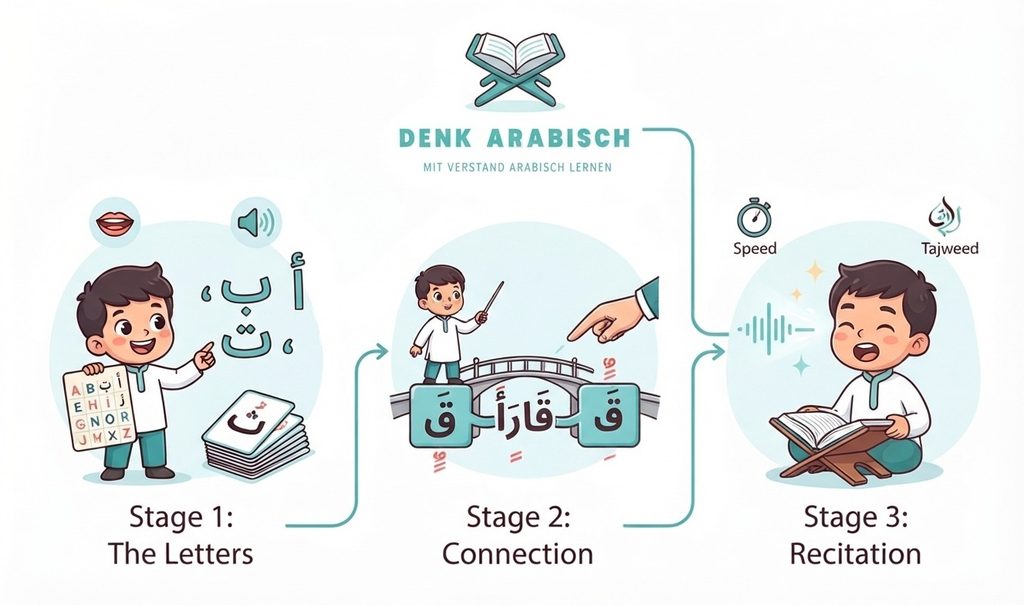
A child’s Quran journey can begin with very simple skills. Before expecting a child to read complete verses or memorize longer Surahs, it is useful to establish familiarity with Arabic letters, vowel signs, pronunciation, and connected words.
These early skills provide the foundation for everything that comes later. When children can recognize letters and pronounce them correctly, they are better prepared to read Quranic words and gradually improve their recitation.
As these foundations become stronger, children can gradually move toward independent Quran reading and recitation. Each stage builds on the previous one, making it easier for children to recognize mistakes and improve their fluency.
A structured learning path may include:
- Learning Arabic letters and their different forms
- Recognizing short vowels and other basic signs
- Reading simple Arabic combinations
- Connecting letters into words
- Reading Quranic words and short verses
- Improving pronunciation
- Practicing Quran recitation
- Introducing basic Tajweed
- Memorizing short Surahs
- Reviewing previously memorized material
Children do not need to master all of these skills at the same time. Giving them realistic goals and regular opportunities to practice can help them make steady progress without unnecessary pressure.
It is also useful to adjust the learning pace according to the child. Some children may progress quickly in reading but need more time with memorization, while others may memorize easily but require additional pronunciation practice.
Help your child build better Quran reading habits and avoid common mistakes that may affect their pronunciation and recitation. Read “Common Mistakes Kids Make When Reading Quran” to learn how to recognize and avoid these mistakes.
Learning Tajweed In A Simple And Child-Friendly Way
Tajweed is an important part of learning how to recite the Quran correctly. However, children do not necessarily need to begin with complicated definitions or large amounts of terminology.
For younger learners, Tajweed can first be introduced through listening, repetition, and direct correction. The child listens carefully to the teacher, repeats the sound or verse, and gradually learns to reproduce it correctly.
This practical approach allows children to experience the rules while reciting instead of trying to memorize many definitions before they understand how the rules work. As their reading improves, more formal explanations can gradually be introduced.
As their reading becomes stronger, children can begin learning essential Tajweed rules such as:
- Makharij al-Huruf – learning where Arabic letters are pronounced
- Ghunnah – practicing the correct nasal sound
- Qalqalah – recognizing the appropriate echoing sound
- Madd – learning correct elongation
- Noon Sakinah and Tanween
- Meem Sakinah
- Tafkhim and Tarqiq
- Rules related to stopping and starting
The order and depth of these topics should depend on the child’s ability. Introducing rules gradually can make Tajweed easier to understand and help children apply what they learn during actual Quran recitation.
Children also benefit from hearing accurate recitation regularly. Listening to a skilled reciter can help them become familiar with correct pronunciation, rhythm, pauses, and the natural flow of Quranic verses.
Help your child improve Quran pronunciation and recitation with the Tajweed Course for Kids from Denk Arabisch, through simple and engaging lessons designed for young learners.
Making Quran Memorization More Effective
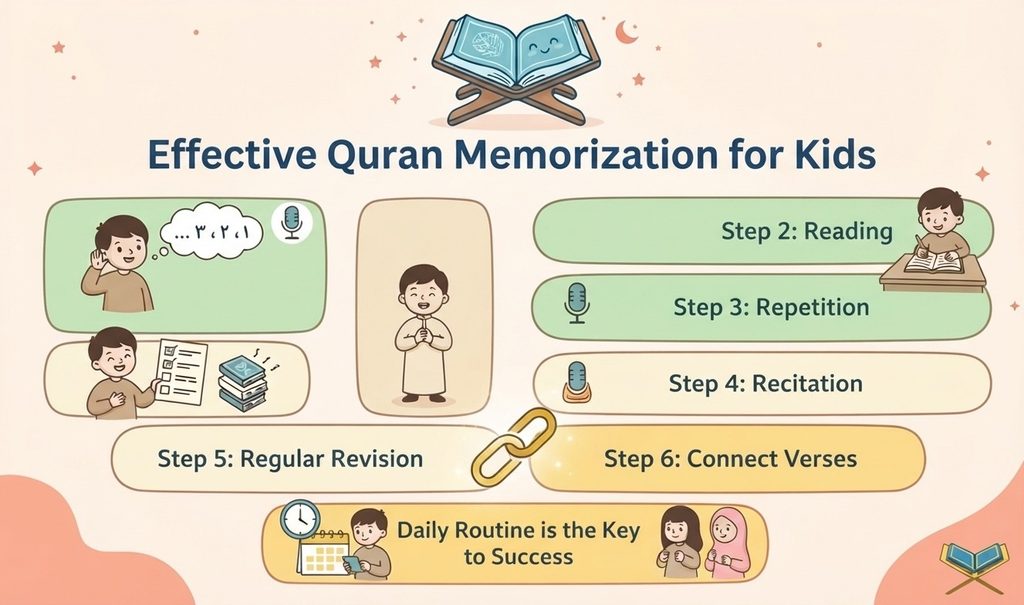
Quran memorization can become a positive learning experience when children are given manageable goals. Instead of expecting a child to memorize large portions at once, a teacher can divide each Surah into smaller sections and give the child enough time to listen, repeat, memorize, and revise.
The child can first become familiar with the verses by listening and reading them from the Mushaf. After that, repeated practice can help move the verses from short-term familiarity toward stronger memorization.
Revision is particularly important because memorization is not complete simply because a child can recite a new passage once. Previously learned Surahs need to be revisited regularly so that the child can maintain what they have learned.
A practical memorization process can include:
| Step | Focus Area | Action |
| 1 | New verses | Read the new verses carefully and correctly looking at the Mushaf. |
| 2 | Practice | Repeat the new verses multiple times to lock them into your short-term memory. |
| 3 | Recitation | Recite the new verses from memory smoothly and without looking. |
| 4 | Revision | Review your recent past memorization to keep it fresh. |
| 5 | Connection | Connect the newly memorized verses with the older verses before them for a seamless flow. |
This approach allows children to work on several skills at the same time. They practice memory, pronunciation, fluency, and accurate recitation rather than focusing only on the number of verses memorized.
The main objective should be accurate and lasting memorization. A child who memorizes a smaller amount and regularly reviews it may develop a stronger foundation than a child who memorizes quickly without sufficient revision.
Parents can also make memorization easier by creating a predictable routine. Practicing at a similar time each day can help children understand when Quran learning takes place and reduce the need for repeated reminders.
Help your child start memorizing the Quran with suitable and meaningful Surahs that match their age and learning level. Read “Best Surahs For Kids To Memorize” to discover helpful Surahs to begin with and make Quran memorization easier and more enjoyable.
Quran Learning For Different Ages In Freiburg
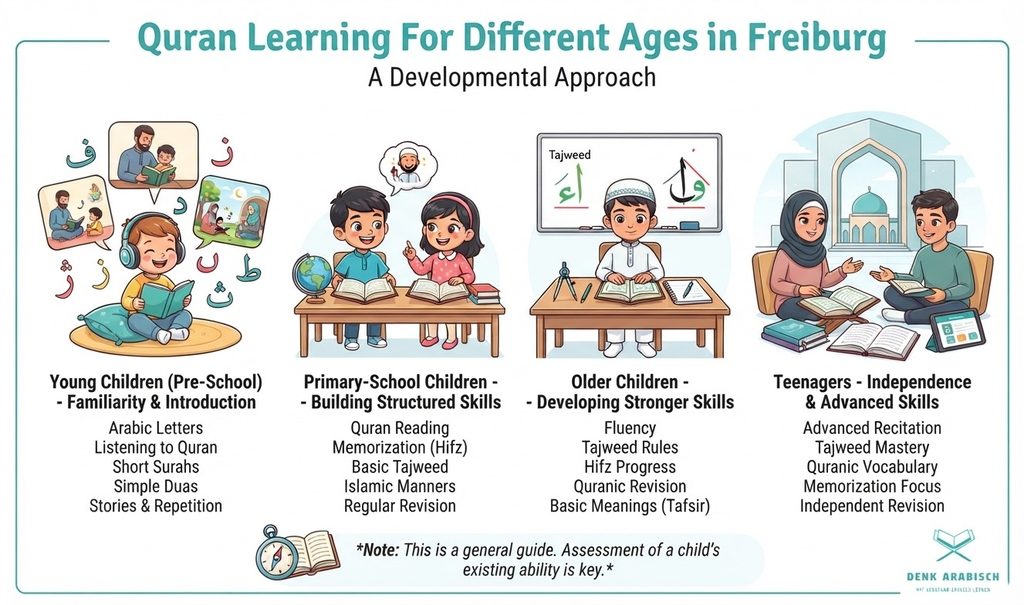
Children learn differently as they grow, so Quran education should develop alongside their abilities. A preschool child may need short, engaging activities, while an older student may be ready for structured Tajweed, memorization, and independent revision.
The teaching style can therefore change as children become older. Younger children may benefit from repetition and interactive activities, while older children can gradually take more responsibility for reading, memorization, and revision.
The following structure can help parents understand how learning goals may change with age:
| Age Group | Main Learning Focus | Suitable Activities |
| Young Children | Familiarity and positive introduction | Arabic letters, listening to Quran, short Surahs, simple Duas, stories, repetition |
| Primary-School Children | Building structured skills | Quran reading, memorization, basic Tajweed, Islamic manners, regular revision |
| Older Children | Developing stronger Quran skills | Fluency, Tajweed, Hifz, revision, basic understanding of meanings |
| Teenagers | Greater independence and advanced skills | Advanced recitation, Tajweed, Quranic vocabulary, memorization, independent revision |
These age groups are only a general guide. A child’s existing level is often more important than age alone. Two children of the same age may need completely different lesson structures depending on their previous experience.
A good teacher can assess the child’s current ability before deciding where to begin. This helps prevent lessons from becoming too difficult for beginners or too repetitive for children who already have experience.
Want to understand how children can build a meaningful connection with the Quran from an early age? Read “Children Of The Quran” to discover what Muslim children can learn through Quran education and how it can support their learning journey.
Read also: Learning The Quran For Children In Reutlingen
Choosing The Right Learning Environment In Freiburg
Families in Freiburg have different schedules, educational preferences, and learning needs. Some parents prefer local Islamic or community classes where children can learn with other Muslim children, while others prefer online lessons because they provide greater flexibility.
Local classes can offer valuable face-to-face interaction and a sense of community. Online lessons, on the other hand, can make it easier to arrange learning around school, homework, sports, and family commitments.
When comparing different options, parents can consider:
- Teacher qualifications and experience
- Experience teaching children
- Individual attention
- Lesson structure
- Quran and Tajweed focus
- Frequency of practice
- Flexibility of scheduling
- The child’s comfort and engagement
- Opportunities for regular feedback
The learning environment should ultimately support consistent progress rather than simply providing a place for children to attend lessons.
It is also important to consider how comfortable the child feels during lessons. A supportive environment can make children more willing to read aloud, ask questions, repeat difficult verses, and accept corrections.
Learn the Quran with Denk Arabisch Academy
Master reading and understanding the Quran through structured and supportive learning
Try a Free TrialLocal Quran Classes Vs Online Quran Classes
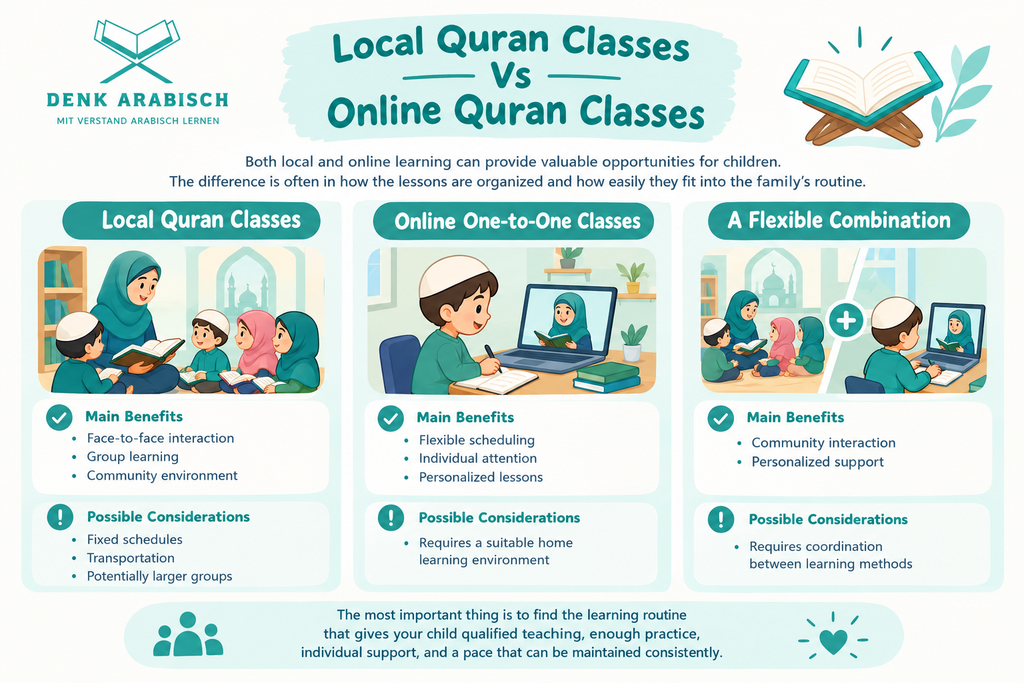
Both local and online learning can provide valuable opportunities for children. The difference is often in how the lessons are organized and how easily they fit into the family’s routine.
For some families, the community aspect of local classes is especially valuable. For others, online lessons may provide the individual attention and scheduling flexibility needed to maintain regular Quran education.
| Learning Option | Main Benefits | Possible Considerations |
| Local Quran Classes | Face-to-face interaction, group learning, community environment | Fixed schedules, transportation, potentially larger groups |
| Online One-to-One Classes | Flexible scheduling, individual attention, personalized lessons | Requires a suitable home learning environment |
| Combination | Community interaction plus personalized support | Requires coordination between learning methods |
The Advantages Of Online Quran Classes In Freiburg
Online Quran learning can be particularly useful for families with busy weekly schedules. Children can attend lessons from home while avoiding additional travel time.
This can make it easier for parents to organize Quran lessons around school, homework, meals, sports, and family activities. A more convenient schedule may also help children attend lessons consistently.
Depending on the program, online learning can provide:
- Flexible lesson times
- One-to-one instruction
- Personalized learning plans
- Direct pronunciation correction
- Regular Quran practice
- Individual feedback
- A comfortable home environment
- Lessons adapted to the child’s current level
Individual instruction can be especially helpful when a child needs extra support with reading, pronunciation, Tajweed, or memorization.
For families who cannot find a suitable local class at a convenient time, online learning can make it easier to maintain a regular Quran routine alongside school and other activities.
The home environment can also allow parents to observe their child’s progress more easily. They can communicate with the teacher, understand areas that need improvement, and support practice between lessons.
Give your child a structured start with the Quran Course for Kids at Denk Arabisch. Book a free trial lesson so the teacher can assess your child’s level and show you how the lessons work.
Read also: Learning The Quran For Children In Tübingen
Creating A Simple Quran Routine For Busy Families
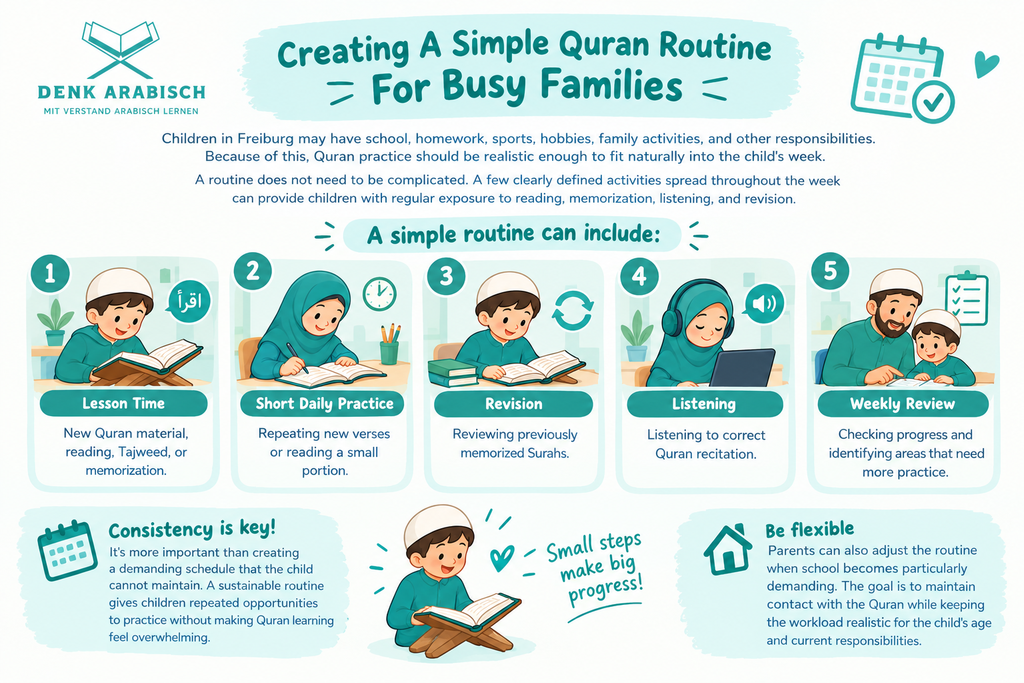
Children in Freiburg may have school, homework, sports, hobbies, family activities, and other responsibilities. Because of this, Quran practice should be realistic enough to fit naturally into the child’s week.
A routine does not need to be complicated. A few clearly defined activities spread throughout the week can provide children with regular exposure to reading, memorization, listening, and revision.
A simple routine can include:
| Routine Element | Example Focus |
| Lesson Time | New Quran material, reading, Tajweed, or memorization |
| Short Daily Practice | Repeating new verses or reading a small portion |
| Revision | Reviewing previously memorized Surahs |
| Listening | Listening to correct Quran recitation |
| Weekly Review | Checking progress and identifying areas that need more practice |
Consistency is more important than creating a demanding schedule that the child cannot maintain. A sustainable routine gives children repeated opportunities to practice without making Quran learning feel overwhelming.
Parents can also adjust the routine when school becomes particularly demanding. The goal is to maintain contact with the Quran while keeping the workload realistic for the child’s age and current responsibilities.
Help your child develop a strong and enjoyable Quran memorization routine with simple, practical approaches. Read “Quran Memorization For Kids” to discover helpful tips for making memorization easier and more consistent.
Finding A Good Quran Teacher For Your Child In Freiburg
The teacher has a major influence on how children experience Quran learning. A teacher needs strong Quran recitation and Tajweed knowledge, but teaching children also requires patience, clear communication, and the ability to adapt lessons to different learning levels.
A child-friendly teacher should understand that mistakes are a normal part of learning. Instead of making children afraid of errors, effective correction can show them exactly what needs to change and give them opportunities to try again.
When choosing Quran lessons for kids in Freiburg, parents can look for a teacher who is:
- Patient and encouraging
- Experienced with children
- Clear when explaining new concepts
- Careful when correcting pronunciation
- Able to adapt lessons to different levels
- Consistent with feedback
- Attentive to the child’s progress
- Focused on long-term development
Children need correction, but they also need encouragement. A supportive teacher can help children feel comfortable making mistakes, asking questions, and participating actively during lessons.
Parents can also consider whether the teacher communicates clearly about progress. Regular feedback can help families understand what the child is doing well and which areas should receive additional practice.
Read also: Learning The Quran For Children In Konstanz
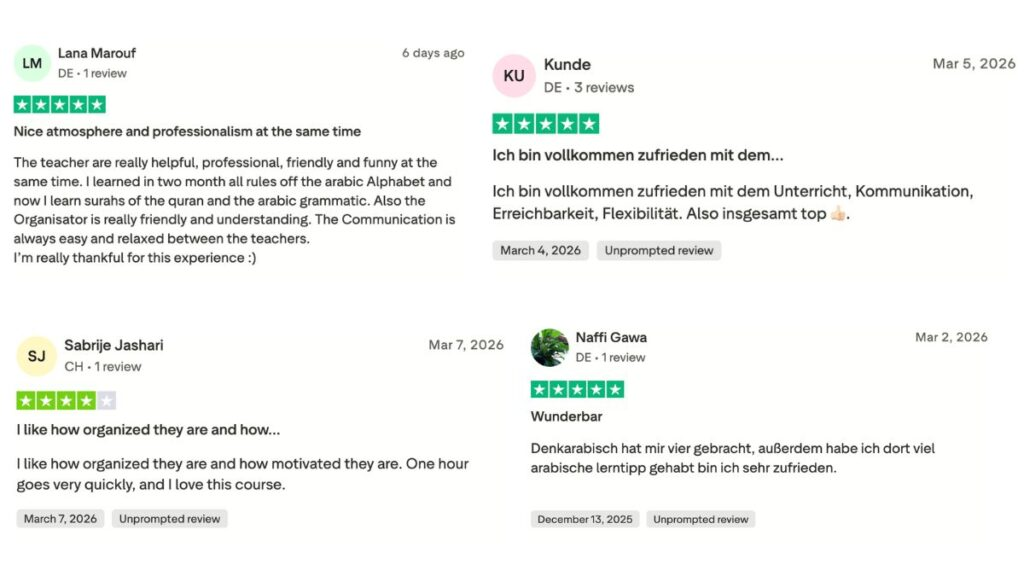
What Our Students Say About Denk Arabisch Academy
See what our students say about learning at Denk Arabisch Academy on Trustpilot. Read their experiences and check out more reviews to discover how our courses help improve Arabic.
Quran And Arabic Learning With Denk Arabisch
At Denk Arabisch, children can learn Arabic and the Quran through personalized online lessons designed according to their individual level. The goal is to provide structured learning while giving each child the attention needed to develop gradually and confidently.
The programs include:
- Quran Course for Kids
- Tajweed Course for Kids
- Quran Recitation Course
- Quran Tajweed Course
- Quran Memorization Course
- Quran Reading Course
- Islamic Studies Course
Learn the Quran with Denk Arabisch Academy
Master reading and understanding the Quran through structured and supportive learning
Try a Free TrialWhy One-to-One Lessons Can Help Children?
With one-to-one online lessons, the teacher can focus on the child’s individual strengths and areas that require additional practice. The lesson can be adapted according to the child’s current reading ability, memorization progress, and understanding of Tajweed.
For families in Freiburg, online lessons also make it possible to maintain regular Quran learning without adding travel time to the weekly schedule.
With a structured learning path and regular practice, children can gradually develop:
- Stronger Quran reading skills
- Better Arabic pronunciation
- More accurate recitation
- Greater confidence
- Stronger memorization and revision habits
- A deeper understanding of basic Islamic concepts
Book a free trial lesson at Denk Arabisch and give your child the opportunity to begin learning Arabic and the Quran with confidence.
Conclusion
Choosing Quran classes for children in Freiburg is an important decision for families who want to give their children a strong and structured Islamic education. When it comes to learning the Quran for children in Freiburg, a good program should go beyond memorization.
The most effective approach takes the child’s age, current level, language background, schedule, and learning needs into consideration.
With patient teaching and consistent support from parents, children can gradually become confident Quran readers and reciters.
For many families in Freiburg, online one-to-one lessons offer the most practical way to keep Quran learning consistent. Children learn from home, lessons fit around school and family routines, and the teacher can focus fully on each child’s reading, pronunciation, and memorization.
At Denk Arabisch, every lesson is built around your child’s level, so they can progress with confidence at their own pace.
FAQs
1. What Is The Best Age To Start Learning The Quran?
Children can begin becoming familiar with the Quran from a young age through listening, Arabic letters, short Surahs, simple Duas, and age-appropriate Islamic activities. More structured Quran reading, Tajweed, and memorization can be introduced as the child’s skills develop.
The important point is to match the learning method to the child’s developmental stage. Younger children can focus on familiarity and positive experiences, while older children can gradually move toward more structured learning.
2. How Often Should Children Practice The Quran?
Regular practice is generally more useful than occasional long study sessions. A short and consistent routine can help children remember what they have learned and gradually improve their reading and recitation.
Parents can include small activities such as:
Reading a few verses
Reviewing a memorized Surah
Listening to Quran recitation
Repeating difficult words
Practicing pronunciation
The exact amount of practice can depend on the child’s age, school schedule, and current learning goals. The most important factor is creating a routine that the child can maintain comfortably.
3. Can Children Learn The Quran Without Speaking Arabic?
Yes. Arabic does not need to be a child’s native language for them to learn Quran reading and recitation.
Children can gradually learn Arabic letters, pronunciation, Quranic vocabulary, and basic meanings while developing their ability to read and recite the Quran.
For children growing up in Germany, structured lessons can help them build the Arabic skills needed for Quran reading even when German is their main everyday language.
4. Is Online Quran Learning Suitable For Children In Freiburg?
Online Quran lessons can be a practical option for families looking for flexible schedules and individual attention.
Children can learn from home without commuting, while one-to-one instruction can allow the teacher to focus directly on their reading, pronunciation, Tajweed, memorization, and revision needs.
Online learning can also make it easier to maintain lessons when families have busy school schedules or limited access to suitable local classes.
5. What Should Parents Consider When Choosing A Quran Course?
Parents should look at the overall quality of the learning experience rather than focusing on one feature.
Important factors include:
Teacher’s Quran and Tajweed knowledge
Experience teaching children
Teaching approach
Individual attention
Lesson structure
Regular feedback
Opportunities for revision
Flexible scheduling
Compatibility with school and family life
Parents should also consider whether the course matches the child’s current level. A suitable program should be challenging enough to encourage progress while remaining understandable and manageable.
6. How Can Parents Keep Children Motivated To Learn The Quran?
Children are more likely to stay engaged when Quran learning is presented as a positive and achievable experience. Parents can encourage effort, celebrate progress, and avoid comparing their child with others.
The aim is to help children gradually build a lasting and positive relationship with Quran learning. When children feel supported rather than pressured, they can become more confident and willing to continue learning.