Growing up Muslim in Dortmund means navigating two worlds at once. Your child attends a German school — Grundschule, Gesamtschule, or Gymnasium — comes home with homework, joins a sports club, and somewhere in between, you want them to connect with their faith.
Learning the Quran should be part of that life. But between a full school week and the reality of finding qualified, structured Islamic education in Dortmund, many parents find themselves at a loss.
What most families in Dortmund discover is that local options are limited in specific ways. The mosque around the corner may offer some classes, but they run in large groups, often in Urdu or Turkish, and move at one fixed pace regardless of whether your child is ahead or behind.
A structured online Quran program changes that equation entirely. Children in Dortmund can now access qualified teachers, age-appropriate curricula, and one-to-one instruction without leaving home. The class fits around the school day, the homework, and the after-school routine — not the other way around.
When your child learns through a structured program that adjusts to their age, pace, and schedule, the Quran stops feeling like an obligation squeezed into a busy week — it becomes a natural part of growing up.
Table of Contents
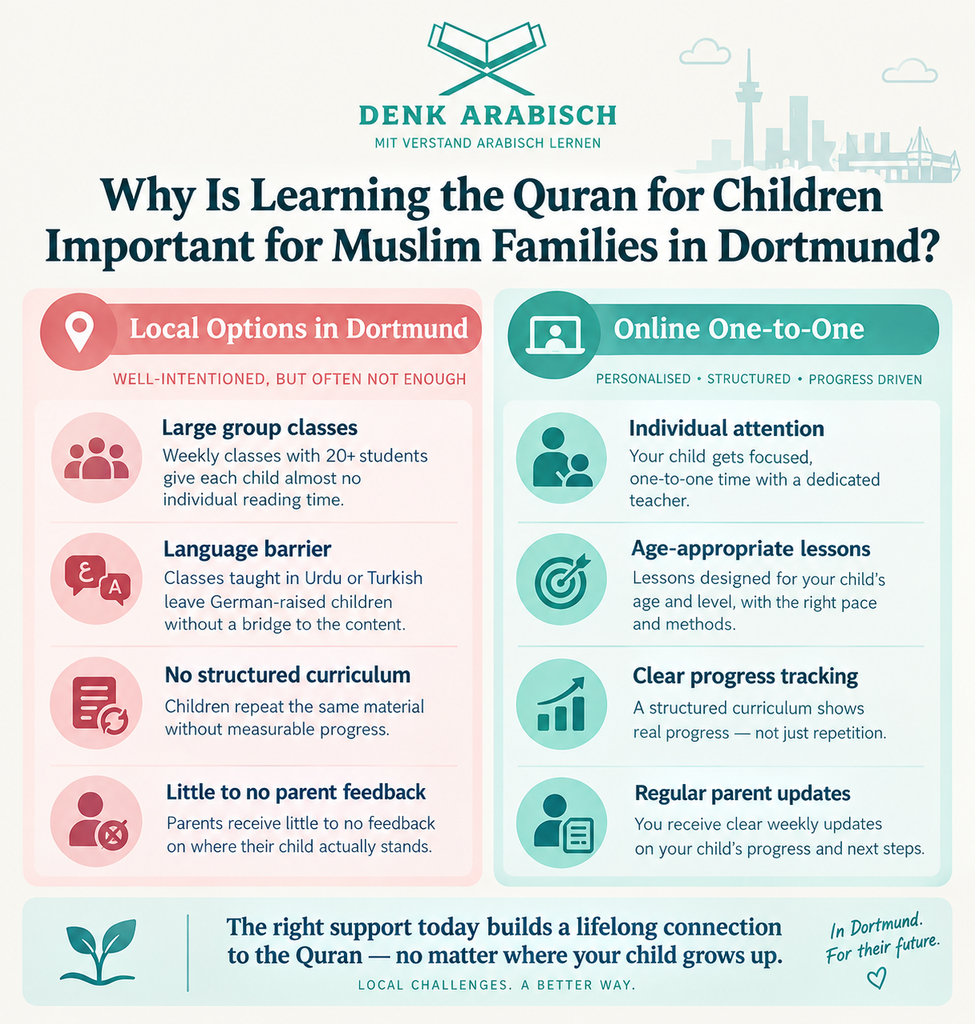
Why Is Learning the Quran for Children Important for Muslim Families in Dortmund?
Dortmund is home to one of the largest Muslim communities in North Rhine-Westphalia. Yet structured, individual Quranic education for children remains genuinely difficult to access here.
The Religionsunterricht offered in some German schools touches on religious themes broadly but does not teach a child to read or recite the Quran with correct Arabic pronunciation. That is a separate skill — and it requires proper instruction.
For Muslim families in Dortmund, learning the Quran carries weight beyond the educational. It is how children build a relationship with their faith in a country where they are a minority. It is how they connect to prayer, to family tradition, and to a community that spans far beyond Dortmund itself.
The earlier a child begins, the more naturally the Arabic sounds and letters settle in. But beyond the early start, what matters is consistency and the right structure. Existing local options often fall short in ways that are predictable and preventable:
- Weekly group classes with twenty or more students give each child almost no individual reading time.
- Classes taught in Urdu or Turkish leave German-raised children without a bridge to the content.
- No structured curriculum means children repeat the same material without measurable progress.
- Parents receive little to no feedback on where their child actually stands.
A child with a dedicated teacher, a lesson designed for their age and level, and a parent receiving clear weekly updates will move steadily forward — even within the constraints of a German school week.
Make Quran learning more engaging with Fun Quran Activities Through Games that help children learn, practice, and remember in an enjoyable way.
What Does Learning the Quran for Children Include?
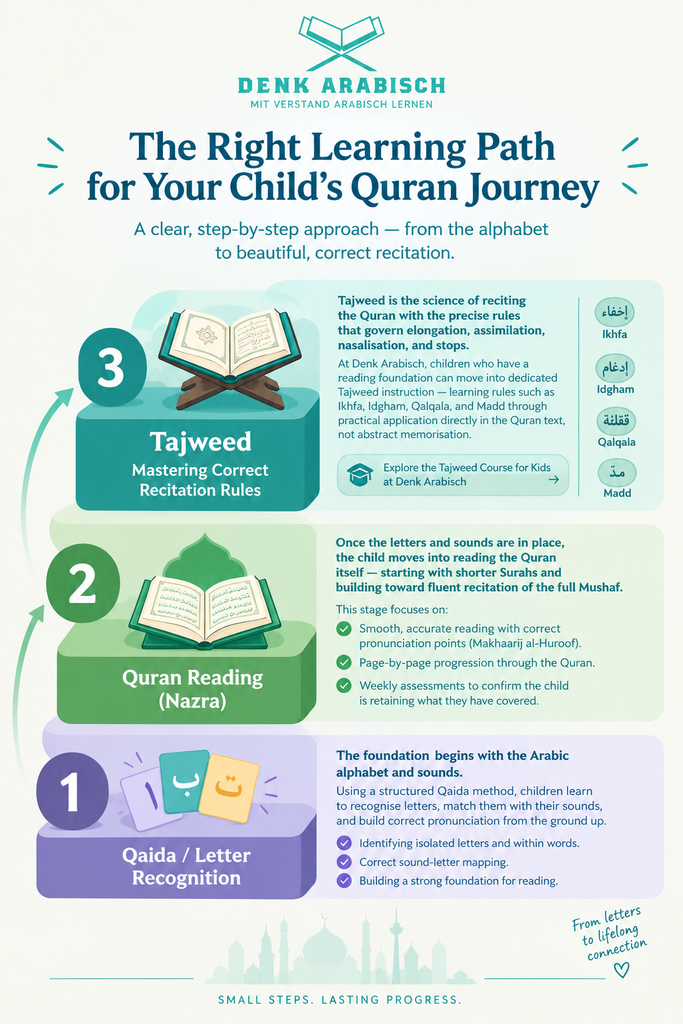
Quran education for children is not a single subject. It builds in stages, and each stage prepares the foundation for the next.
Understanding what is taught at each level helps parents choose the right starting point for their child.
a. Arabic Alphabet and Qaida Foundation
Before a child can read the Quran, they need to recognise Arabic letters, understand how they connect, and produce the correct sounds for each.
This foundational stage uses the Noorani Qaida — a structured approach that introduces the following in a logical sequence:
- Letter sounds (Huroof) and their correct pronunciation.
- Vowel marks (Harakat): Fatha, Kasra, Damma.
- Connecting letter forms and compound shapes.
- Soft vowels (Leen), Nunation (Tanween), Sukoon, and Tashdeed.
For young children in Dortmund, this stage uses short, engaging sessions so that early lessons feel manageable rather than overwhelming.
b. Quran Reading (Nazra)
Once the letters and sounds are in place, the child moves into reading the Quran itself — starting with shorter Surahs and building toward fluent recitation of the full Mushaf. This stage focuses on:
- Smooth, accurate reading with correct pronunciation points (Makhaarij al-Huroof).
- Page-by-page progression through the Quran.
- Weekly assessments to confirm the child is retaining what they have covered.
Learn the Key Quranic Vocabulary you need to better understand the Quran.
c. Tajweed — Mastering Correct Recitation Rules
Tajweed is the science of reciting the Quran with the precise rules that govern elongation, assimilation, nasalisation, and stops.
For children who can already read the Quran but want to recite it correctly and beautifully, the Tajweed Course for Kids at Denk Arabisch focuses on the rules that govern proper recitation.
Taught through direct application in the Quran — not abstract memorisation — children learn:
- Noon Sakin and Tanween rules: Ikhfa, Idgham, Iqlab, Izhar.
- Meem Sakin rules and Qalqala.
- Madd (elongation) types and their application.
- Waqf (stopping) rules for correct pauses.
- Practical recitation with live correction every session.
Sessions are structured around each child’s current level and move at a pace that builds confidence rather than pressure.
Parents who choose the Tajweed Course for Kids at Denk Arabisch can support their children’s recitation development.
Learning the Quran for Children Based on Age in Dortmund
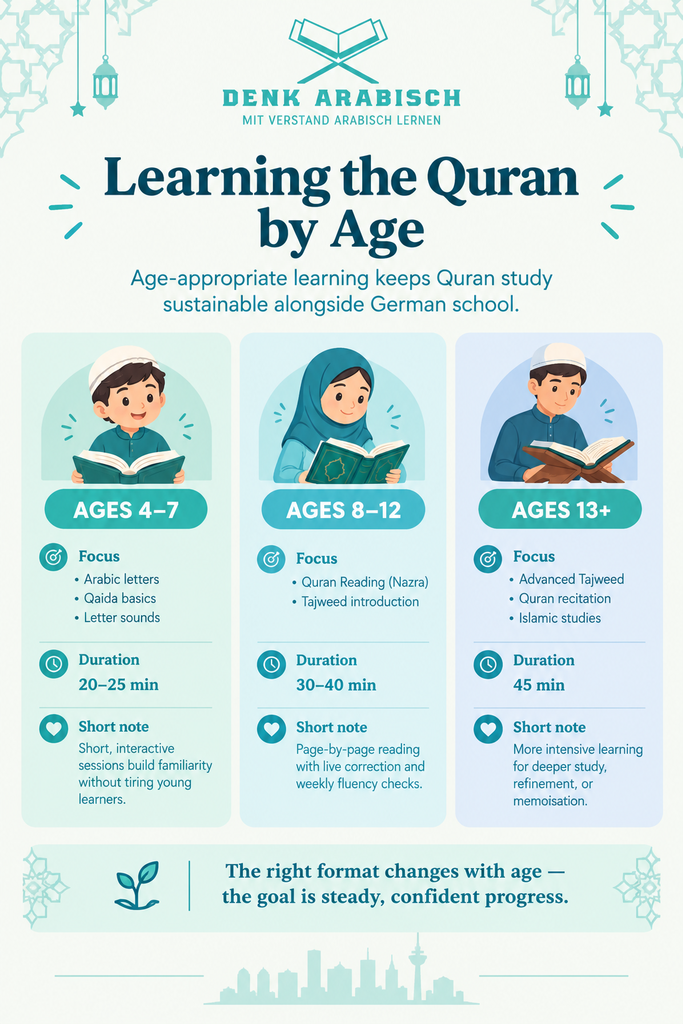
Children at different ages need different approaches. Matching the format to the child’s age is what keeps learning sustainable alongside the demands of German school.
The table below gives a quick overview of how programs are structured by age group in Dortmund.
| Age Group | Focus | Session Length |
| Ages 4–7 | Arabic letters, Qaida basics, letter sounds | 20–25 minutes |
| Ages 8–12 | Quran reading (Nazra), Tajweed introduction | 30–40 minutes |
| Ages 13+ | Advanced Tajweed, Quran recitation, Islamic studies | 45 minutes |
Ages 4–7: Building Strong Foundations
Children in Dortmund between four and seven do best with short, interactive sessions built around Noorani Qaida.
The goal at this stage is not speed — it is familiarity with the sounds and letters so that Arabic feels natural rather than foreign. Sessions of twenty minutes are enough to build that foundation without tiring a young child.
Ages 8–12: Learning to Read the Quran
From eight to twelve, children are ready to begin reading the Quran itself. This is the stage where the Quran Course at Denk Arabisch becomes the core focus — page-by-page progression with live correction and a weekly fluency check to track how much ground has been covered.
Learn the Quran with Denk Arabisch Academy
Master reading and understanding the Quran through structured and supportive learning
Try a Free TrialAges 13+: Tajweed, Deeper Study & Memorisation
At thirteen and above, children who already read can move into Tajweed refinement, deeper study, or begin working toward memorisation, depending on their goal and commitment.
Sessions at this level are more intensive and assume the child is ready to engage seriously with the material.
Discover practical ideas for Raising Muslim Kids In Germany while supporting their Islamic identity, values, and Quran learning in everyday life.
Read also: Learning The Quran For Children In Bochum
Online vs. In-Person Options in Dortmund
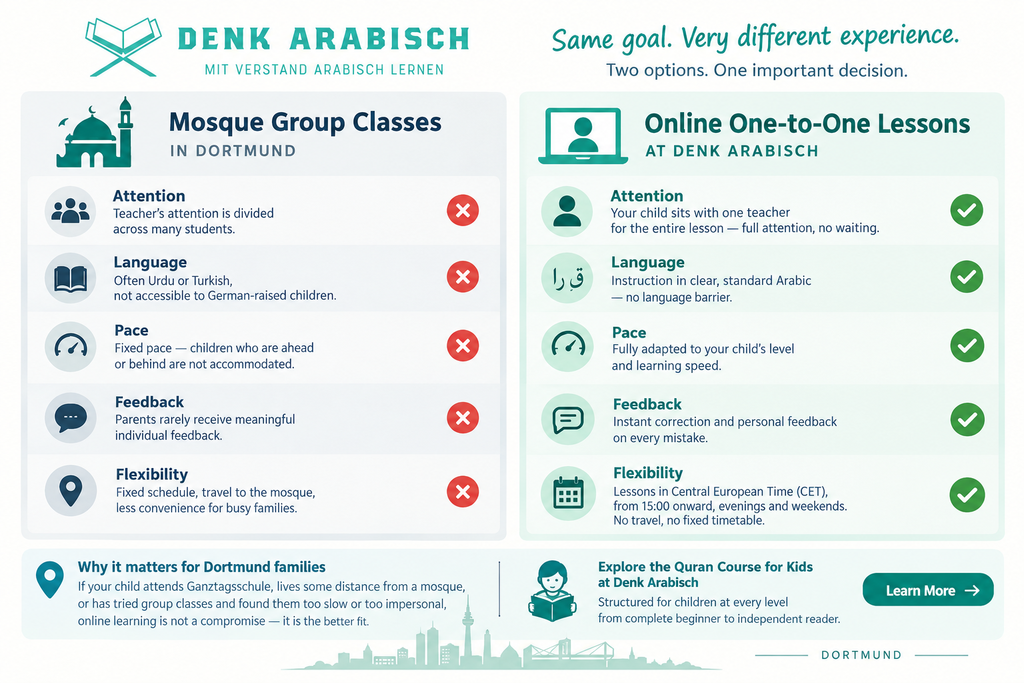
Parents in Dortmund do sometimes ask about in-person options first — whether a local mosque or Islamic centre might offer something comparable. The honest answer is that it depends on what you need.
Group classes at local mosques in Dortmund can offer community connection and a familiar environment.
For children who thrive in groups and whose learning pace aligns with the class, it can work. The limitations, however, are well-known:
- Large groups mean the teacher’s attention is divided across many students.
- The pace is fixed — children who are ahead or behind are not accommodated.
- Language of instruction is often Urdu or Turkish, not accessible to German-raised children.
- Parents rarely receive meaningful individual feedback on their child’s specific progress.
Online one-to-one instruction through Denk Arabisch fits Dortmund families differently:
- Your child sits with one teacher for the entire lesson — full attention, no waiting.
- The teacher hears every word your child reads and corrects every mistake in real time.
- Lesson times are set in Central European Time, scheduled around the German school day.
- Afternoon slots from around 15:00 onward, evening slots, and weekend options are available.
- No travel, no fixed timetable to conform to, and no friction with the school week.
For families in Dortmund whose children attend Ganztagsschule, who live at some distance from a mosque, or who have tried group classes and found them too slow or too impersonal, online learning is not a compromise — it is the better fit.
The Quran Course for Kids takes children from their current level — whether they are complete beginners or already know some letters — through structured Quran reading with correct pronunciation.
Sessions are one-to-one, lessons are planned week by week, and parents receive clear updates on their child’s progress. Children who complete this course read the Quran independently and accurately.
Explore the Quran Course for Kids at Denk Arabisch, built for children who want to read with confidence and fluency.
One-to-One Learning in Dortmund
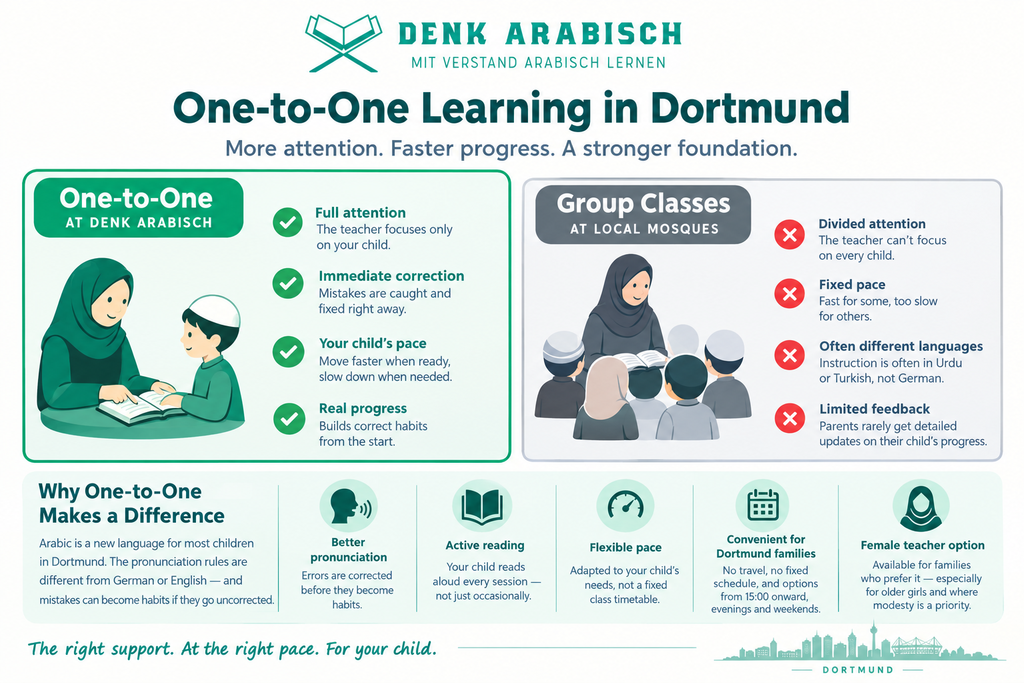
The one-to-one format is not just a convenience feature — it is what makes meaningful Quran learning possible for children in a context like Dortmund.
Arabic is a language most children in Dortmund have no exposure to outside the home or mosque. The pronunciation rules are genuinely different from German or English.
Mistakes that go uncorrected in a group setting tend to solidify into habits that are much harder to break later. When a teacher can hear only your child and nothing else, the impact is direct:
- Pronunciation errors are caught and corrected before they become habits.
- A mispronounced letter, a missed elongation, or a stop in the wrong place is addressed immediately.
- The child reads aloud every session — not once every few turns.
The one-to-one format also means the pace is entirely your child’s. A child who picks up Arabic sounds quickly can move faster. A child who needs more time on a particular rule gets that time without holding anyone else back.
For parents in Dortmund who have watched their child fall behind in a group class — or disengage because the class moved faster than they could manage — that individualised attention makes a visible difference within the first few weeks.
Discover the Rewards Of Reciting The Quran and learn how regular recitation can bring spiritual benefits, strengthen your connection with Allah, and enrich your daily life.
Read also: Learning The Quran For Children In Duisburg
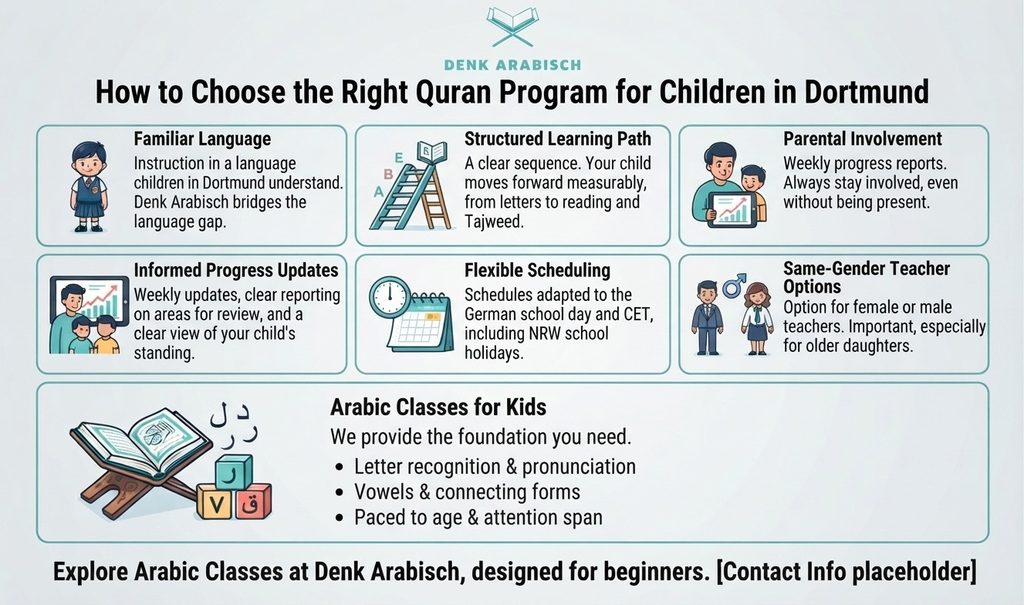
How to Choose the Right Quran Program for Children in Dortmund?
Choosing the right program comes down to a few practical questions that every parent in Dortmund should ask before enrolling their child.
Working through these questions will quickly separate programs that fit from those that merely promise.
1. Teaching Children in a Familiar Language
Many existing programs operate in Urdu, Turkish, or classical Arabic — languages a child raised in Dortmund may not speak comfortably.
Denk Arabisch teaches in a way that makes sense to children growing up in Germany, bridging the language gap rather than adding to it.
2. Following a Clear Learning Path
A structured program has a clear sequence — from letters to reading to Tajweed — and your child moves forward through it at a measurable pace.
If a program cannot show you what your child has covered and what comes next, that is a problem.
3. Keeping Parents Informed About Progress
Weekly progress updates, honest reporting on what needs revision, and a clear picture of where your child stands are not extras.
They are how you stay involved in your child’s learning even if you cannot sit in every session.
4. Scheduling Lessons Around Family Life
A program that only offers weekend morning slots or fixed evening times that clash with homework or family meals will create friction.
Denk Arabisch builds schedules around CET and the rhythms of the German school week, including awareness of NRW school holidays.
5. Offering Same-Gender Teacher Options
For many families in Dortmund, particularly for older daughters, this matters. Asking this question upfront saves complications later.
Before Quran reading comes Arabic — the letters, the sounds, the way they connect. The Arabic Classes for Kids at Denk Arabisch give children in Dortmund the foundation they need:
- Letter recognition and correct pronunciation from the very first session.
- Gradual introduction of vowel marks, connecting forms, and basic rules.
- A pace and format matched to the child’s age and attention span.
- Building blocks that every Quran lesson will depend on.
For a child who has never encountered Arabic before, this is the right entry point. For a child who knows some letters but reads inconsistently, it is the place to solidify what they know.
Explore Arabic Classes for Kids at Denk Arabisch, designed for children starting from the very beginning.
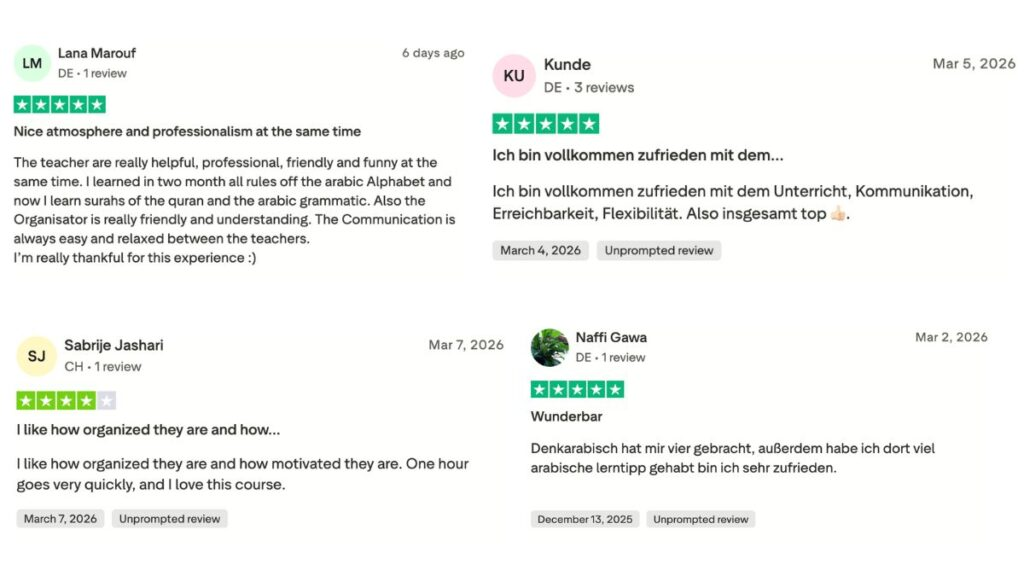
What Our Students Say About Denk Arabisch Academy
See what our students say about learning at Denk Arabisch Academy on Trustpilot. Read their experiences and check out more reviews to discover how our courses help improve Arabic.
Read also: Learning The Quran For Children In Gelsenkirchen
Helping Children Build a Strong Relationship with the Quran
Learning the Quran is a journey that develops gradually. At Denk Arabisch, children in Oberhausen can learn online with lessons adapted to their age, reading ability, and individual learning goals.
Instead of using the same approach for every child, lessons can begin with the basics and develop step by step.
Younger learners may focus on recognising Arabic letters and building correct pronunciation, while children who already read can work on fluency, Tajweed, or Quran memorisation.
What Can Children Learn?
Through regular online lessons, children can work on several important areas of Quran learning:
- Arabic foundations: Becoming familiar with Arabic letters, sounds, and basic reading.
- Quran reading: Developing accuracy and fluency through guided reading practice.
- Tajweed: Understanding and applying the rules of correct Quranic recitation.
- Memorisation: Learning selected Surahs while maintaining regular revision.
- Confident recitation: Practising consistently until reading becomes more natural and comfortable.
Courses Available at Denk Arabisch
Depending on the child’s starting point and learning goals, families can explore different courses, including:
- Quran Course for Kids
- Tajweed Course for Kids
- Quran Tajweed Course
- Arabic Course For Beginners
- Arabic Reading Course
- Quran Recitation Course
- Islamic Studies Course
Learn the Quran with Denk Arabisch Academy
Master reading and understanding the Quran through structured and supportive learning
Try a Free TrialWith online lessons, children can learn from home while receiving direct teacher guidance and regular correction.
This makes it easier for families in Oberhausen to create a consistent Quran-learning routine that fits naturally into everyday life.
Book a free trial lesson with Denk Arabisch.
Conclusion
Finding the right environment for learning the Quran for children in Dortmund takes more than good intentions — it takes a program that fits the actual shape of your family’s life.
The German school week is long. Homework is real. After-school activities compete for your child’s attention.
Denk Arabisch was designed around how Muslim families in Germany actually live — with structured, age-appropriate courses, one-to-one teaching, flexible scheduling in Central European Time, and clear weekly progress updates for parents.
Whether your child is four and just beginning to explore Arabic letters, or twelve and ready to refine their Quran reading with Tajweed, there is a course built for exactly that stage.
Learning the Quran for children in Dortmund does not have to happen in spite of your circumstances. With the right program, it happens because of the structure around it.
Visit Denk Arabisch to find the right course for your child and take the first step today.
Read also: Short Duas – 15 Simple Duas To Learn By Heart
FAQs
The questions below reflect what parents in Dortmund most commonly ask before enrolling their child — concerns about effectiveness, scheduling, language, and practical setup that are specific to life in Germany.
1. Can children in Dortmund learn the Quran effectively through online classes?
Yes — and for many children in Dortmund, online one-to-one lessons are more effective than group classes at a local mosque. The teacher hears only your child during the session, corrects mistakes immediately, and moves at a pace that matches their level.
Children who have previously been lost in a group class often make noticeably faster progress when they have a teacher’s full attention. Many families in Dortmund use both — the mosque for Friday prayer and community, and Denk Arabisch for structured, individual Quran progress.
2. How do online Quran classes fit around the NRW school schedule in Dortmund?
North Rhine-Westphalia has its own school holiday calendar, and Denk Arabisch accounts for that. Lesson times are set in Central European Time, with afternoon and evening slots that work around the typical school day in Dortmund.
If a class falls during a school holiday or half-term, sessions can be rescheduled. The aim is to keep Quran learning consistent without adding pressure to an already full school week.
3. My child attends Ganztagsschule and gets home late — is there a suitable time slot available?
Yes. Evening slots are available specifically for families in Dortmund whose children attend full-day school and are not home until 16:00 or later. Weekend options are also available. When you contact Denk Arabisch, the schedule is built around your child’s actual routine, not a fixed timetable that you have to fit into.
4. Is a female teacher available for my daughter in Dortmund?
Yes. Denk Arabisch offers the option of a female teacher for families who prefer it.
This is particularly important for older girls and for families where having a same-gender teacher is a priority. Simply mention your preference when you enquire and it will be arranged.
5. At what age should my child start learning the Quran in Dortmund?
Children as young as four can begin with Arabic letters and the Qaida foundation — sessions at this age are short (around 20 minutes) and designed to be engaging rather than intensive.
Most families find that starting between four and seven gives a child the best foundation before the school workload increases.
That said, children who begin later at eight, ten, or twelve can still make strong progress with the right structure. There is no wrong time to start — the right time is whenever your family is ready.