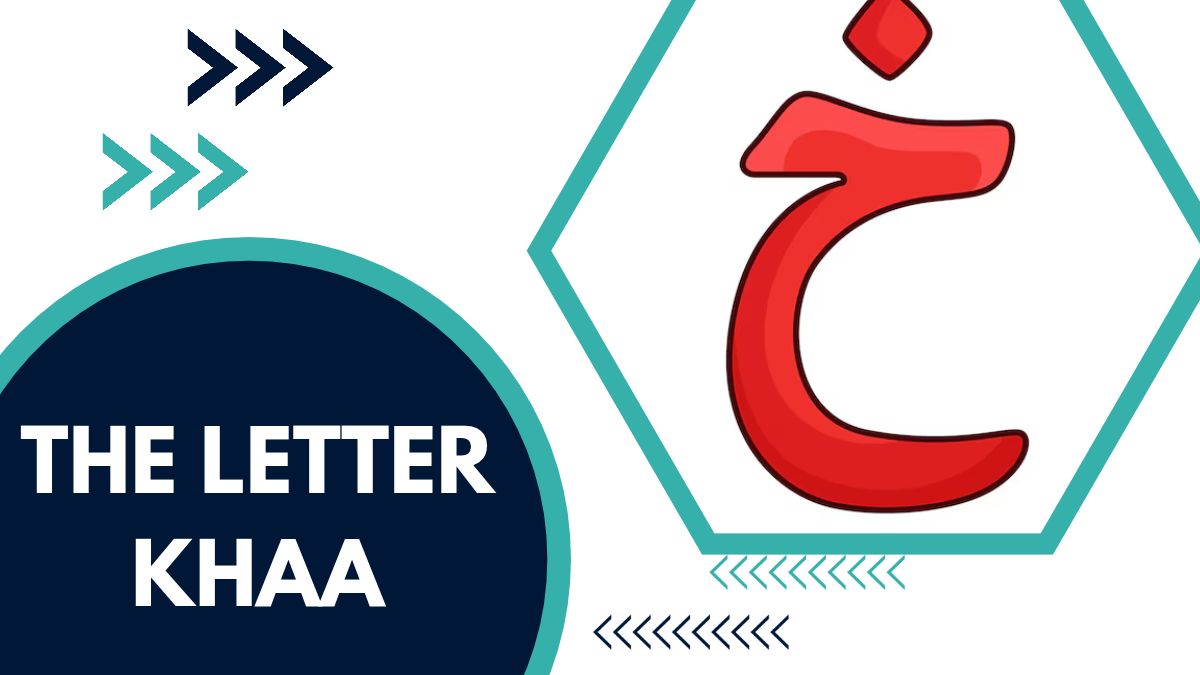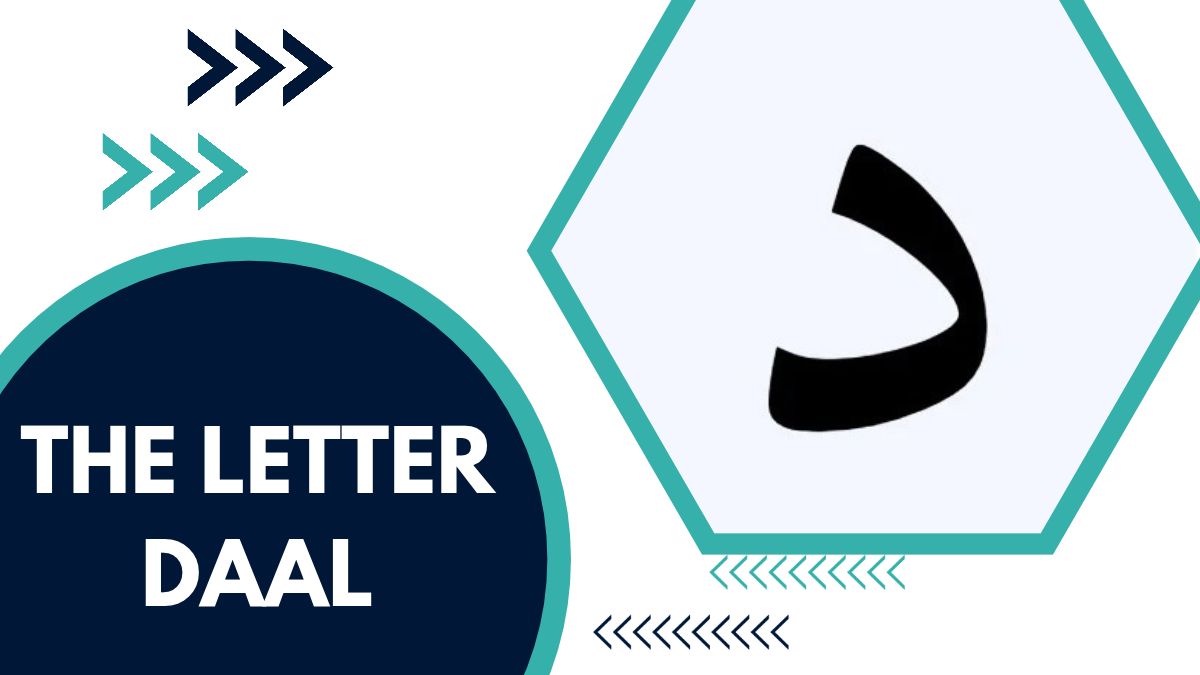
The letter Daal (د) is the 8th letter of the Arabic alphabet. Its full name is dāl (دَالْ). You make it with the tip of your tongue pressed just behind your upper front teeth. Linguists call it a voiced dental stop, written [d] in IPA.
German speakers have a head start. The d in Dach, dort and Danke is already very close. There is one German habit to unlearn, and this guide shows you exactly which one.
Short exercises at the end let you check what you learned.
| Property | Information |
| Letter | د (Daal) |
| Name | Dāl (دَالْ) |
| Sound | [d], voiced dental stop; like German d in Dach (never like the t-sound in Hund) |
| Alphabet Position | 8th letter (Hijāʾī order) |
| Abjad Value | 4 (4th letter in Abjad order) |
| Transliteration | Common: d | DIN 31635: d | Arabizi: d |
| Point of Articulation | Tip of the tongue against the gum roots of the upper front teeth |
| Sun / Moon Letter | Sun letter (e.g., الدِّينُ – ad-dīnu) |
| Heavy / Light | Always light (muraqqaq) |
| Dots | None (unlike ذ, which has one dot above) |
| Connection Rule | Non-connecting (joins only to the preceding letter, never to the following letter) |
Single words in this guide are written in pause form, so the last letter carries a sukūn (for example وَلَدْ, walad).
Is learning Arabic required for every Muslim? Discover the answer in Is Learning Arabic Mandatory In Islam? and explore the role of Arabic in understanding the Quran, Islamic knowledge, and worship.
Table of Contents
Daal’s Place in the Arabic Alphabet
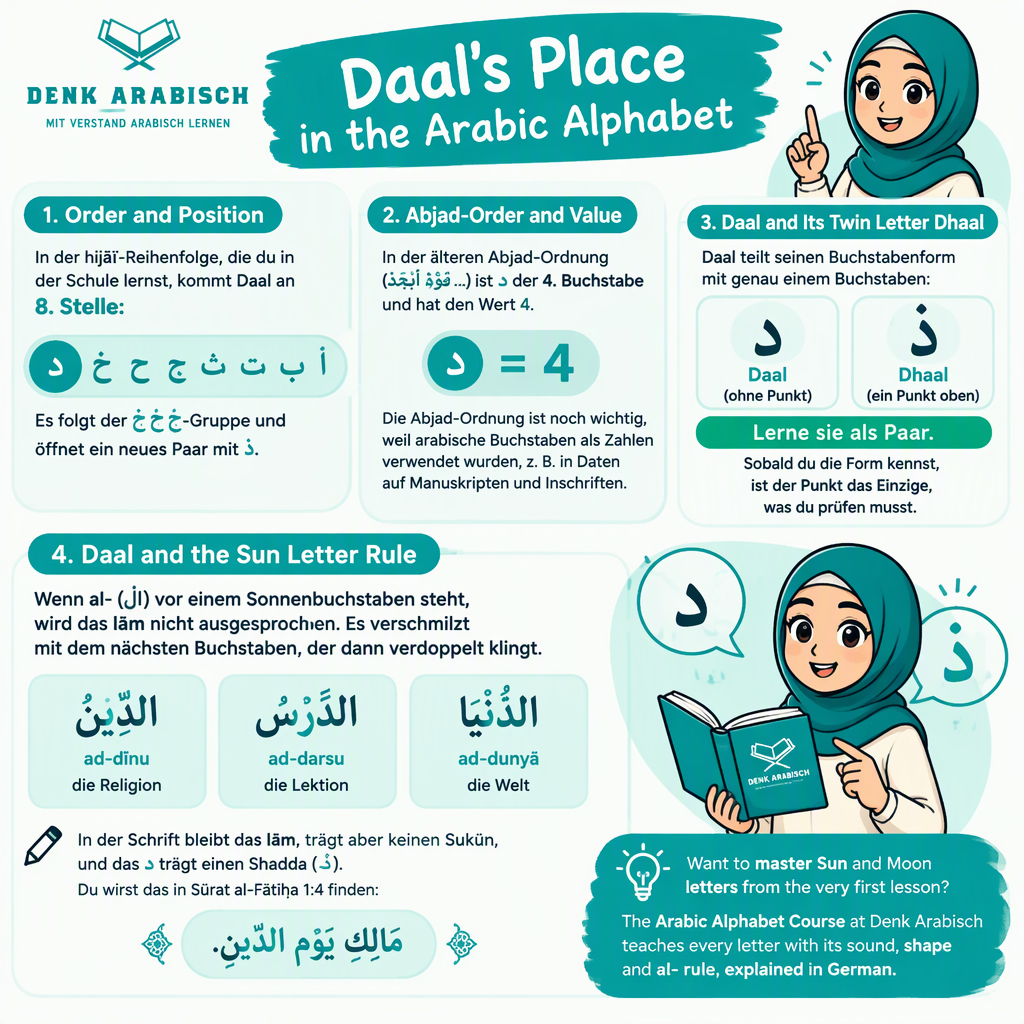
In the hijāʾī order you learn at school, Daal comes 8th: ا ب ت ث ج ح خ د. It follows the ج ح خ group and opens a new pair with ذ.
In the older Abjad order (أَبْجَدْ هَوَّزْ…), د is the 4th letter and has the value 4. The Abjad order still matters because Arabic letters were used as numbers, for example in dates on manuscripts and inscriptions.
Daal and Its Twin Letter Dhaal (ذ)
Daal shares its body with exactly one letter:
- د Daal: no dot
- ذ Dhaal: one dot above
Learn them as a pair. Once you know the shape, the dot is the only thing you have to check.
Daal and the Sun Letter Rule
When al- (الْـ) comes before a Sun letter, the lām is not pronounced. It merges into the next letter, which then sounds doubled.
- الدِّينُ (ad-dīnu): the religion
- الدَّرْسُ (ad-darsu): the lesson
- الدُّنْيَا (ad-dunyā): the world
In writing, the lām stays but carries no sukūn, and the د carries a shadda (ـدّ). You will meet this in Sūrat al-Fātiḥa 1:4: مَالِكِ يَوْمِ الدِّينِ.
Want to master Sun and Moon letters from the very first lesson? The Arabic Alphabet Course at Denk Arabisch teaches every letter with its sound, shape and al- rule, explained in German.
Saying Daal Correctly
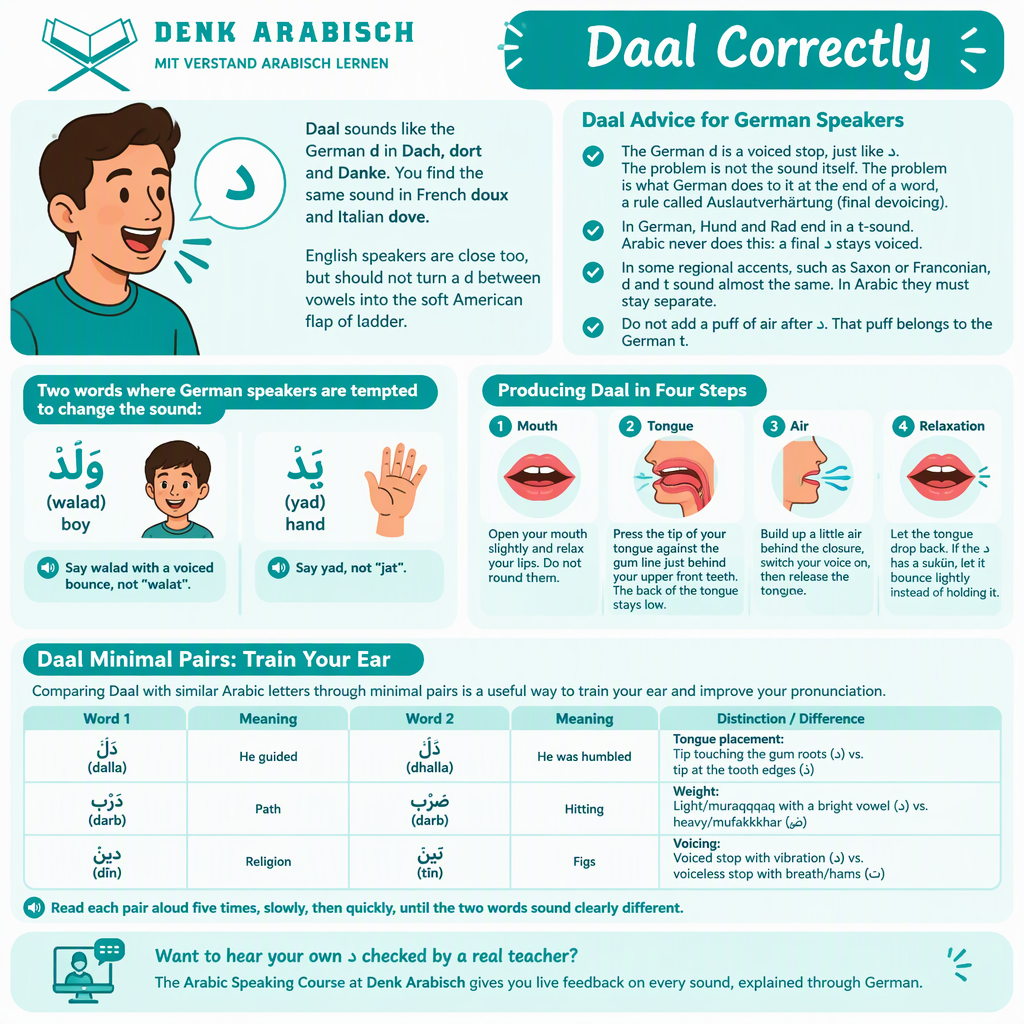
Daal sounds like the German d in Dach, dort and Danke. You find the same sound in French doux and Italian dove. English speakers are close too, but should not turn a d between vowels into the soft American flap of ladder.
Daal Advice for German Speakers
The German d is a voiced stop, just like د. The problem is not the sound itself. The problem is what German does to it at the end of a word, a rule called Auslautverhärtung (final devoicing).
- In German, Hund and Rad end in a t-sound. Arabic never does this: a final د stays voiced.
- In some regional accents, such as Saxon or Franconian, d and t sound almost the same. In Arabic they must stay separate.
- Do not add a puff of air after د. That puff belongs to the German t.
Two words where German speakers are tempted to change the sound:
- وَلَدْ (walad, boy): say walad with a voiced bounce, not “walat”
- يَدْ (yad, hand): say yad, not “jat”
Producing Daal in Four Steps
Here is the structured 4-step sequence for producing the letter Dāl (د):
- Mouth: open your mouth slightly and relax your lips. Do not round them.
- Tongue: press the tip of your tongue against the gum line just behind your upper front teeth. The back of the tongue stays low.
- Air: build up a little air behind the closure, switch your voice on, then release the tongue.
- Relaxation: let the tongue drop back. If the د has a sukūn, let it bounce lightly instead of holding it.
Daal Minimal Pairs: Train Your Ear
Comparing Daal with similar Arabic letters through minimal pairs is a useful way to train your ear and improve your pronunciation. The following examples highlight the key differences in articulation, weight, and voicing.
| Word 1 | Meaning | Word 2 | Meaning | Distinction / Difference |
| دَلَّ (dalla) | He guided | ذَلَّ (dhalla) | He was humbled | Tongue placement: Tip touching the gum roots (د) vs. tip at the tooth edges (ذ) |
| دَرْبْ (darb) | Path | ضَرْبْ (ḍarb) | Hitting | Weight: Light/muraqqaq with a bright vowel (د) vs. heavy/mufakhkham (ض) |
| دِينْ (dīn) | Religion | تِينْ (tīn) | Figs | Voicing: Voiced stop with vibration (د) vs. voiceless stop with breath/hams (ت) |
Read each pair aloud five times, slowly, then quickly, until the two words sound clearly different.
Want to hear your own د checked by a real teacher? The Arabic Speaking Course at Denk Arabisch gives you live feedback on every sound, explained through German.
Where Daal Is Made: Makhraj and Tajweed Basics
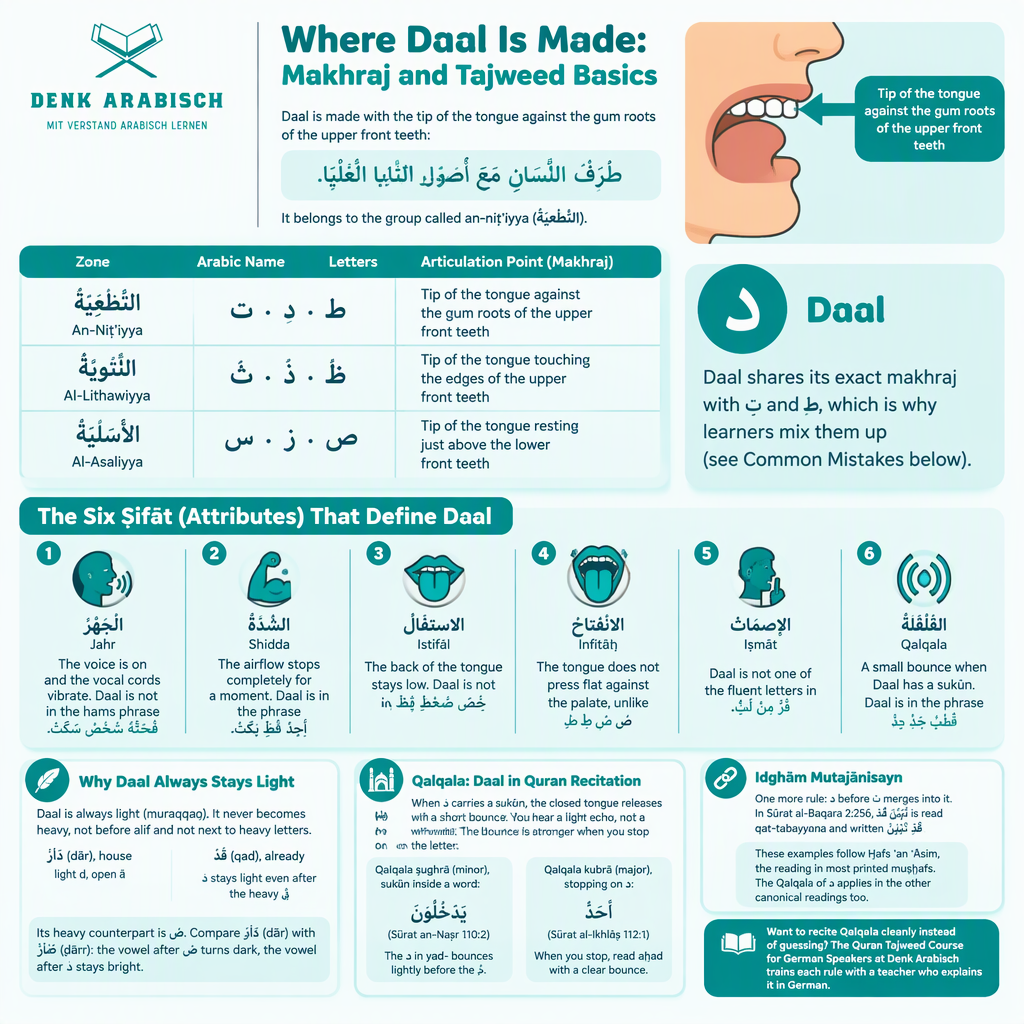
Daal is made with the tip of the tongue against the gum roots of the upper front teeth: طَرَفُ اللِّسَانِ مَعَ أُصُولِ الثَّنَايَا الْعُلْيَا. It belongs to the group called an-niṭʿiyya (النِّطْعِيَّةُ).
| Zone | Arabic Name | Letters | Articulation Point (Makhraj) |
| النِّطْعِيَّةُ | An-Niṭʿiyya | ط · د · ت | Tip of the tongue against the gum roots of the upper front teeth |
| اللِّثَوِيَّةُ | Al-Lithawiyya | ظ · ذ · ث | Tip of the tongue touching the edges of the upper front teeth |
| الْأَسَلِيَّةُ | Al-Asaliyya | ص · ز · س | Tip of the tongue resting just above the lower front teeth |
Daal shares its exact makhraj with ت and ط, which is why learners mix them up (see Common Mistakes below).
The Six Ṣifāt (Attributes) That Define Daal
Daal (د) is a voiced, explosive consonant (Jahr & Shidda) where both airflow and sound stop completely during pronunciation due to full closure at its articulation point.
- Jahr (الْجَهْرُ), audibility: the voice is on and the vocal cords vibrate. Daal is not in the hams phrase فَحَثَّهُ شَخْصٌ سَكَتْ.
- Shidda (الشِّدَّةُ), strength: the airflow stops completely for a moment. Daal is in the phrase أَجِدْ قَطٍ بَكَتْ.
- Istifāl (الِاسْتِفَالُ), lowering: the back of the tongue stays low. Daal is not in خُصَّ ضَغْطٍ قِظْ.
- Infitāḥ (الِانْفِتَاحُ), openness: the tongue does not press flat against the palate, unlike ص ض ط ظ.
- Iṣmāt (الْإِصْمَاتُ), restraint: Daal is not one of the fluent letters in فَرَّ مِنْ لُبّْ.
- Qalqala (الْقَلْقَلَةُ), echoing: a small bounce when Daal has a sukūn. Daal is in the phrase قُطْبُ جَدٍّ.
The first five come in opposite pairs. Qalqala has no opposite.
Discover Qalqalah Rules and learn how to apply them correctly for a clearer and more confident Quran recitation.
Why Daal Always Stays Light
Daal is always light (muraqqaq). It never becomes heavy, not before alif and not next to heavy letters.
- دَارْ (dār), house: light d, open ā
- قَدْ (qad), already: د stays light even after the heavy ق
Its heavy counterpart is ض. Compare دَارْ (dār, house) with ضَارّ (ḍārr, harmful): the vowel after ض turns dark, the vowel after د stays bright.
Qalqala: Daal in Quran Recitation
When د carries a sukūn, the closed tongue releases with a short bounce. You hear a light echo, not a new vowel. The bounce is stronger when you stop on the letter.
- Qalqala ṣughrā (minor), sukūn inside a word: يَدْخُلُونَ in Sūrat an-Naṣr 110:2, وَرَأَيْتَ النَّاسَ يَدْخُلُونَ فِي دِينِ اللَّهِ أَفْوَاجًا. The د in yad- bounces lightly before the خ.
- Qalqala kubrā (major), stopping on د: أَحَدٌ in Sūrat al-Ikhlāṣ 112:1, قُلْ هُوَ اللَّهُ أَحَدٌ. When you stop, you read aḥad with a clear bounce at the end.
One more rule: د before ت merges into it (idghām mutajānisayn). In Sūrat al-Baqara 2:256, قَدْ تَبَيَّنَ is read qat-tabayyana and written قَد تَّبَيَّنَ.
These examples follow Ḥafṣ ʿan ʿĀṣim, the reading in most printed muṣḥafs. The Qalqala of د applies in the other canonical readings too.
Want to recite Qalqala cleanly instead of guessing? The Quran Tajweed Course for German Speakers at Denk Arabisch trains each rule with a teacher who explains it in German.
Writing Daal: Isolated and Final Forms
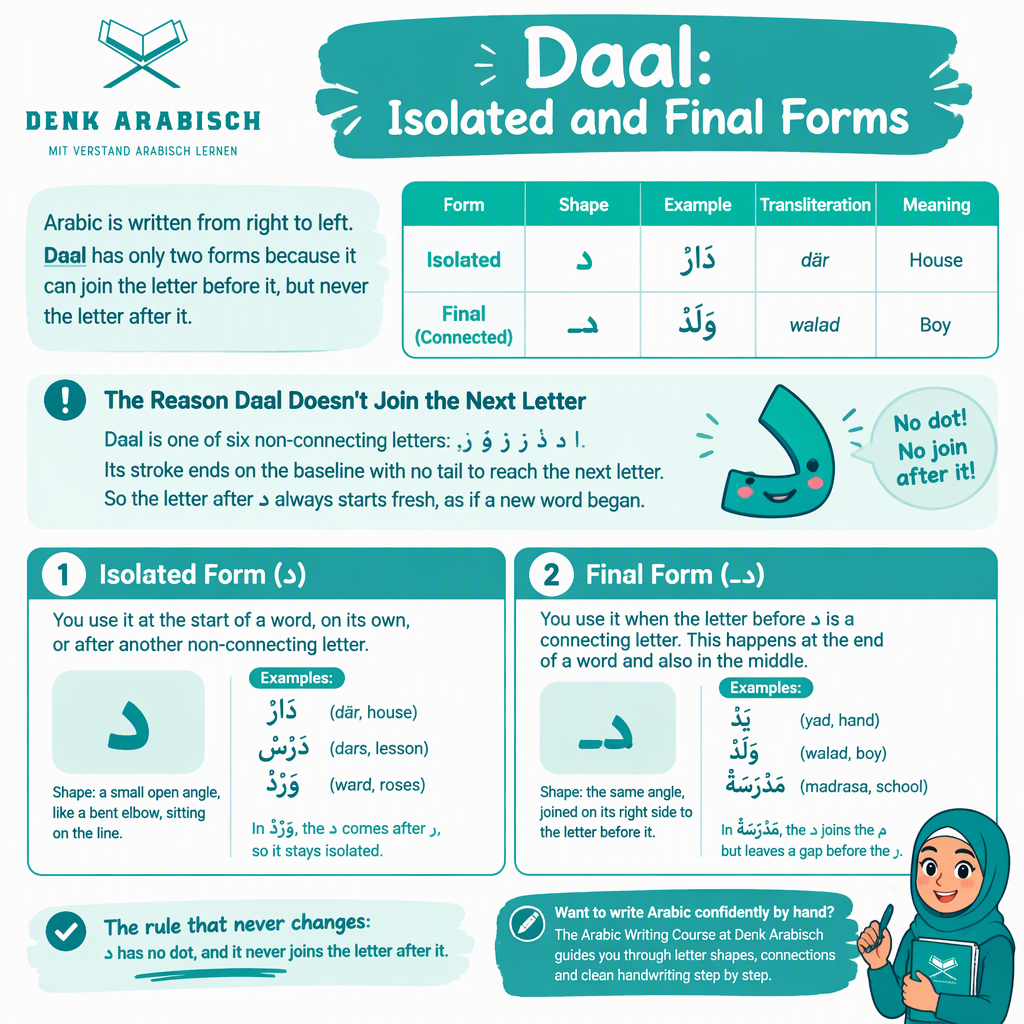
Arabic is written from right to left. Daal has only two forms because it can join the letter before it, but never the letter after it.
| Form | Shape | Example | Transliteration | Meaning |
| Isolated | د | دَارْ | dār | House |
| Final / Medial | ـد | وَلَدْ | walad | Boy |
The Reason Daal Doesn’t Join the Next Letter
Daal is one of six non-connecting letters: ا د ذ ر ز و. Its stroke ends on the baseline with no tail to reach the next letter. So the letter after د always starts fresh, as if a new word began.
1. Isolated Form (د)
You use it at the start of a word, on its own, or after another non-connecting letter.
Shape: a small open angle, like a bent elbow, sitting on the line.
Examples: دَارْ (dār, house), دَرْسْ (dars, lesson), وَرْدْ (ward, roses). In وَرْدْ, the د comes after ر, so it stays isolated.
2. Final Form (ـد)
You use it when the letter before د is a connecting letter. This happens at the end of a word and also in the middle.
Shape: the same angle, joined on its right side to the letter before it.
Examples: يَدْ (yad, hand), وَلَدْ (walad, boy), مَدْرَسَةْ (madrasa, school). In مَدْرَسَةْ, the د joins the م but leaves a gap before the ر.
The rule that never changes: د has no dot, and it never joins the letter after it.
Want to write Arabic confidently by hand? The Arabic Writing Course at Denk Arabisch guides you through letter shapes, connections and clean handwriting step by step.
Reading Daal with Ḥarakāt and Madd
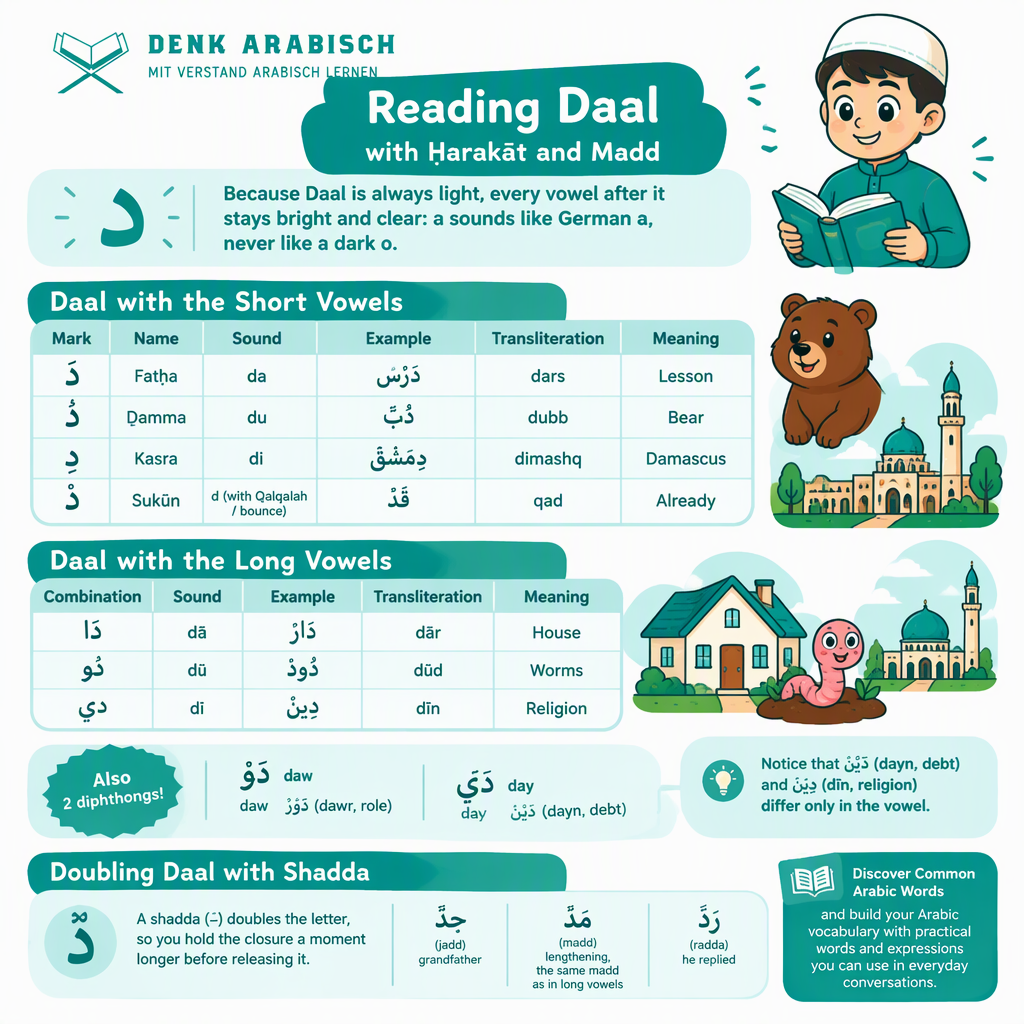
Because Daal is always light, every vowel after it stays bright and clear: a sounds like German a, never like a dark o.
Daal with the Short Vowels
When Daal (د) is combined with short vowels, its pronunciation changes according to the vowel mark used. The examples below show how each form is pronounced.
| Mark | Name | Sound | Example | Transliteration | Meaning |
| دَ | Fatḥa | da | دَرْسْ | dars | Lesson |
| دُ | Ḍamma | du | دُبّ | dubb | Bear |
| دِ | Kasra | di | دِمَشْقْ | dimashq | Damascus |
| دْ | Sukūn | d (with Qalqalah / bounce) | قَدْ | qad | Already |
Daal with the Long Vowels
The letter Daal (د) can also be combined with long vowels to produce longer sounds. The following examples show the three long-vowel combinations and how they are pronounced.
| Combination | Sound | Example | Transliteration | Meaning |
| دَا | dā | دَارْ | dār | House |
| دُو | dū | دُودْ | dūd | Worms |
| دِي | dī | دِينْ | dīn | Religion |
Daal also forms two diphthongs. دَوْ gives daw, as in دَوْرْ (dawr, role). دَيْ gives day, as in دَيْنْ (dayn, debt). Notice that دَيْنْ (dayn, debt) and دِينْ (dīn, religion) differ only in the vowel.
Learn Arabic with Denk Arabisch Academy
Speak and understand Arabic through a clear and effective learning system
Try a Free TrialDoubling Daal with Shadda
A shadda (ـّ) doubles the letter, so you hold the closure a moment longer before releasing it.
- جَدّ (jadd): grandfather
- مَدّ (madd): lengthening, the same madd as in long vowels
- رَدَّ (radda): he replied
Discover Common Arabic Words and build your Arabic vocabulary with practical words and expressions you can use in everyday conversations.
Key Root Families Containing Daal
Most Arabic words grow from a root of three consonants, so one root gives you a whole family of words. Here are 3 roots with د at the start, in the middle and at the end:
هـ د ى (Guide)
Below are key words and meanings derived from the root H-D-Y (هـ د ى).
| Word | Transliteration | Meaning |
| هَدَى | hadā | He guided |
| هُدًى | hudā | Guidance |
| هَدِيَّةْ | hadiyya | Gift |
| مُهْتَدِي | muhtadī | Rightly guided |
و ل د (birth)
The following table highlights essential vocabulary, transliterations, and meanings originating from the root W-L-D (و ل د).
| Word | Transliteration | Meaning |
| وَلَدْ | walad | Boy, child |
| وَالِدْ | wālid | Father |
| وَالِدَةْ | wālida | Mother |
| وِلَادَةْ | wilāda | Birth |
The same root appears in لَمْ يَلِدْ وَلَمْ يُولَدْ (Sūrat al-Ikhlāṣ 112:3), where the د of يَلِدْ carries a Qalqala bounce.
Want to read whole word families instead of single words? The Arabic Reading Course at Denk Arabisch builds your reading on roots and patterns, so every new word is easier than the last.
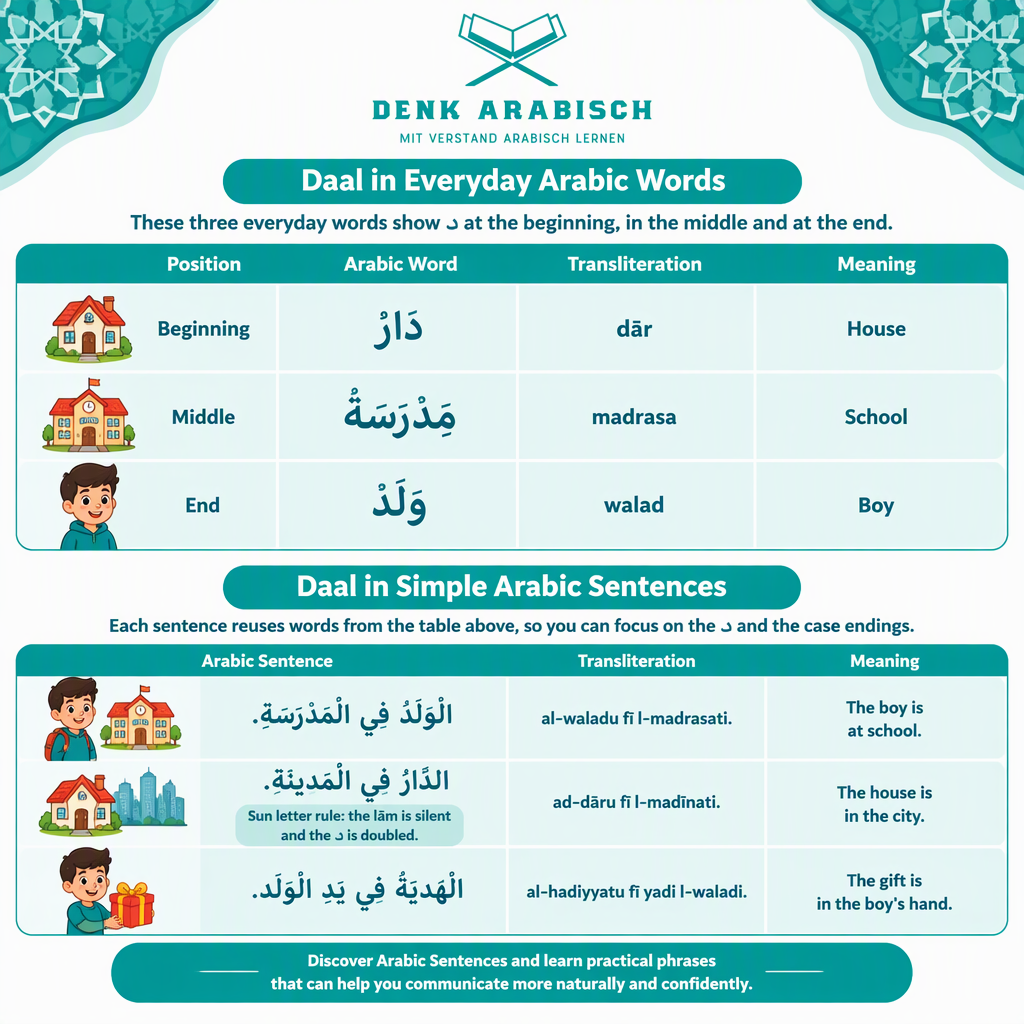
Daal in Everyday Arabic Words
These three everyday words show د at the beginning, in the middle and at the end.
| Position | Arabic Word | Transliteration | Meaning |
| Beginning | دَارْ | dār | House |
| Middle | مَدْرَسَةْ | madrasa | School |
| End | وَلَدْ | walad | Boy |
Daal in Simple Arabic Sentences
Each sentence reuses words from the table above, so you can focus on the د and the case endings.
| Arabic Sentence | Transliteration | Meaning |
| الْوَلَدُ فِي الْمَدْرَسَةِ. | al-waladu fī l-madrasati. | The boy is at school. |
| الدَّارُ فِي الْمَدِينَةِ. | ad-dāru fī l-madīnati. | The house is in the city. |
| الْهَدِيَّةُ فِي يَدِ الْوَلَدِ. | al-hadiyyatu fī yadi l-waladi. | The gift is in the boy’s hand. |
In the second sentence, الدَّارُ shows the Sun letter rule: the lām is silent and the د is doubled.
Discover Arabic Sentences and learn practical phrases that can help you communicate more naturally and confidently.
Daal Pitfalls and How to Fix Them
Most Daal pronunciation mistakes happen when learners confuse it with other Arabic letters that have similar sounds or articulation points. The following examples highlight the most common mistakes and simple ways to recognize and correct them.
1. Daal (د) vs. Dhaal (ذ): One Dot, Two Sounds
The two letters look the same apart from one dot. German has no dh-sound, so learners often say d for both.
Test: say دَلَّ (dalla) and ذَلَّ (dhalla) in front of a mirror. For ذ you see your tongue tip between your teeth. For د you should not see it at all.
2. Daal (د) vs. Daad (ض): Light or Heavy?
ض is the heavy partner of د. Learners either make د too heavy or make ض too light.
Test: say دَارْ (dār) with a slight smile. If your lips round or the a turns into a dark o, your د has become too heavy.
3. Daal (د) vs. Taa (ت): Voice On, Voice Off
Both come from the same makhraj. The only difference is the voice: د is voiced, ت is not.
Test: put your fingers on your throat and say دِينْ (dīn), then تِينْ (tīn). You should feel a buzz for د and none for ت.
4. Turning a Final Daal into T (German Final Devoicing)
German pronounces the d in Hund and Rad as t. Carried into Arabic, وَلَدْ becomes “walat” and بَلَدْ (balad, country) becomes “balat”.
Test: hold your fingers on your throat and say وَلَدْ. The buzz must last to the very end, followed by a small Qalqala bounce. Do not turn the bounce into a full vowel like “walada”.
5. Connecting Daal to the Next Letter
Because most letters connect both ways, learners often join د to the letter after it. Some also stretch its lower stroke below the line, so it looks like ر.
Test: write مَدْرَسَةْ and check for a clear gap after the د. Then check that the د sits on the line, while the ر dips below it.
Daal Practice Quiz: Check What You Learned
These exercises are designed to help you review the sound, shape, and different positions of Daal (د) while checking your ability to recognize and use the letter correctly in Arabic words.
Exercise 1: Pick the Right Word
Which word means “religion”?
- a) تِينْ
- b) دِينْ
- c) دَيْنْ
Answer: b) دِينْ (dīn). تِينْ (tīn) means figs, and دَيْنْ (dayn) means debt.
Exercise 2: Match the Word to Its Meaning
Match each word to its meaning: دَارْ, وَلَدْ, يَدْ, مَدْرَسَةْ → hand, school, house, boy.
Answer: دَارْ = house, وَلَدْ = boy, يَدْ = hand, مَدْرَسَةْ = school.
Exercise 3: Handwriting Drill
Write د five times on its own, then five times as ـد. Then copy these words and circle every د: دَرْسْ, وَرْدْ, وَلَدْ, مَدْرَسَةْ. Mark each د as isolated or final.
Exercise 4: Daal Facts – True or False?
- Daal is a Moon letter.
- Daal connects to the letter after it.
- Daal is a Qalqala letter.
- Daal has one dot above.
Answers: 1. False, it is a Sun letter (الدِّينُ). 2. False, it never connects to the left. 3. True, it is in قُطْبُ جَدٍّ. 4. False, that is ذ.
Exercise 5: Spot the Daal in a Verse
How many times does د appear in this verse from Sūrat an-Naṣr 110:2?
وَرَأَيْتَ النَّاسَ يَدْخُلُونَ فِي دِينِ اللَّهِ أَفْوَاجًا
Answer: 2 times, in يَدْخُلُونَ and دِينِ.
What Our Students Say About Denk Arabisch Academy
See what our students say about learning at Denk Arabisch Academy on Trustpilot. Read their experiences and check out more reviews to discover how our courses help improve Arabic.

Go Beyond Daal: Structured Arabic Learning with Denk Arabisch
Daal is one of 28 letters. Each one is easy on its own, but a clear order turns them into fluent reading.
Denk Arabisch is built for German-speaking learners and explains Arabic through German.
- Explanations in German, with German sounds as your reference point
- Live lessons with teachers who know the typical German mistakes
- A structured path from the alphabet to reading, writing and speaking
- Courses for adults and for children
Choose Your Specialized Course:
- Arabic Course For Beginners: your first complete step into Arabic
- Arabic Alphabet Course: every letter, its sound and its forms
- Arabic Reading Course: from single letters to fluent, vowelled text
- Arabic Writing Course: clean handwriting and correct connections
- Arabic Speaking Course: everyday conversation with live feedback
- Quranic Arabic Course for German Speakers: understand the vocabulary of the Quran
- Quran Tajweed Course for German Speakers: recite with correct rules, including Qalqala
Learn Arabic with Denk Arabisch Academy
Speak and understand Arabic through a clear and effective learning system
Try a Free TrialBook a free trial lesson at Denk Arabisch and find the course that fits your level.

Conclusion
The letter Daal (د) is one of the friendliest letters for German speakers, as long as you keep it voiced to the very end.
- Sound: a light, voiced [d] with the tongue behind the upper front teeth, and a small bounce on sukūn
- Writing: two forms, د and ـد, no dot, and never a connection to the left
- Recognition: a Sun letter with Qalqala, always light, and the dotless twin of ذ
Practise a little every day. Say دَارْ and وَلَدْ until the final d stays voiced. Write دَرْسْ and مَدْرَسَةْ until the gap after د feels natural. Contrast د with ذ, ض and ت using the minimal pairs, and review the roots د ر س, ه د ي and و ل د.
You already know most of this sound. Now you only need to train it.
Book a free trial lesson at Denk Arabisch and take your next letter with a teacher at your side.
FAQs
1. What is the difference between Daal (د) and Dhaal (ذ)?
They share the same shape, but ذ has one dot above and د has none. د is made with the tongue tip behind the upper front teeth. ذ is made with the tongue tip between the teeth, like English th in this.
2. What is the difference between Daal (د) and Taa (ت)?
Both come from the same point of articulation. د is voiced and you feel a buzz in your throat, while ت is voiceless with a puff of air. Compare دِينْ (dīn, religion) with تِينْ (tīn, figs).
3. Is Daal heavy like Daad (ض)?
No. Daal is always light (muraqqaq), so the vowels after it stay bright. ض is its heavy partner, with the back of the tongue raised and a darker vowel.
4. Is Daal a Sun letter or a Moon letter?
Daal is a Sun letter. The lām of al- is silent and the د takes a shadda, as in الدِّينُ (ad-dīnu).
5. Is Daal a Qalqala letter?
Yes. Daal is one of the five Qalqala letters in قُطْبُ جَدٍّ. With a sukūn it bounces lightly, as in يَدْخُلُونَ (Sūrat an-Naṣr 110:2), and more strongly when you stop on it, as in أَحَدٌ (Sūrat al-Ikhlāṣ 112:1).