Takeaway:
- Learning Arabic is not universally mandatory, but every Muslim must know enough to correctly recite Surah Al-Fatiha and the essential words of prayer—this is an individual obligation (fard ‘ayn).
- Mastery of Arabic for interpreting the Quran, Hadith, and Islamic law is a communal obligation (fard kifayah); if a sufficient number of scholars do not undertake it, the whole community bears the responsibility.
- Beyond the minimum, learning Arabic is highly recommended (mustahabb) because it deepens one’s connection to the Quran, improves concentration in prayer, and gives direct access to authentic Islamic texts without the filter of translation.
- Arabic becomes personally obligatory if a Muslim cannot otherwise understand the core teachings of the faith, but this can often be fulfilled through reliable translations without full fluency.
- Ibn Taymiyyah wrote: “The Arabic language itself is part of the religion, and knowing it is an obligation. This is because understanding the Book and the Sunnah is an obligation, and they cannot be understood except by understanding Arabic.”
- Start practically by mastering the alphabet, the pronunciation of Fatiha and short surahs, and the meanings of the words you use in worship; structured guidance helps avoid common early pitfalls.
Arabic is more than just a language; it is the spiritual vessel of Islam, the tongue of the Quran, and the medium of the Prophet Muhammad ﷺ. For Muslims—particularly those living in the West—the question often arises: Is mastering Arabic a religious duty or a recommended virtue?
The answer is nuanced: While complete fluency isn’t required for every believer, Arabic becomes mandatory in specific contexts where the correct practice of Islam depends on it. This guide breaks down the scholarly rulings and explores why Arabic remains the heartbeat of the faith.

Table of Contents
The Three Key Rulings of Learning Arabic in Islam
Islamic scholars generally categorize the study of Arabic into three levels of obligation, reflecting the religion’s practicality and accessibility:
1. Individual Obligation (Fard ‘Ayn)
This applies to the absolute essentials. Every Muslim must learn enough Arabic to perform their daily worship correctly. This includes the proper pronunciation of Surah Al-Fatiha and the essential adhkar (remembrances) required for a valid prayer (Salah).
2. Communal Obligation (Fard Kifayah)
The deeper mastery of Arabic—grammar, rhetoric, and linguistics—is a duty upon the community as a whole. It is mandatory for a segment of the Ummah (scholars, jurists, and researchers) to achieve mastery to interpret the Quran, preserve Islamic Law, and provide authentic religious guidance.
3. Recommended (Mustahabb)
For the average Muslim, pursuing Arabic beyond the basics is highly encouraged. It is a gateway to spiritual depth, allowing for a direct, personal connection to the Divine words without the barrier of translation.
This balanced approach ensures that while Islam remains accessible to people of all tongues, the authenticity of its primary sources is forever preserved.
Why Is Arabic So Important In Islam?
To fully understand the ruling, it’s essential to recognize why Arabic holds such a significant place in Islam.
1. The Language of the Quran
The Quran was revealed in Arabic, and its linguistic structure carries layers of meaning, eloquence, and precision that cannot be fully translated.
While translations provide general understanding, they are considered interpretations of meanings, not the Quran itself.
2. The Language of Worship
Muslims perform their daily prayers (Salah) in Arabic. Essential recitations—such as Surah Al-Fatiha—must be recited in Arabic for the prayer to be valid.
This makes learning at least basic Arabic pronunciation a necessity for every practicing Muslim.
3. Preservation of Islamic Teachings
Arabic serves as a safeguard for the original meanings of:
- The Quran
- Hadith (sayings of the Prophet ﷺ)
- Classical Islamic scholarship
Without Arabic, the risk of misunderstanding religious texts increases significantly.

When Knowing Arabic Becomes Mandatory (واجب)?
Although not required universally, there are clear situations where learning Arabic becomes obligatory.
1. To Perform Obligatory Acts of Worship
Every Muslim must learn enough Arabic to:
- Recite Surah Al-Fatiha correctly
- Perform essential parts of Salah
This level of Arabic is considered personally obligatory (fard ‘ayn) because prayer is invalid without it.
2. To Understand Core Religious Obligations
If a Muslim cannot understand the basic teachings of Islam—such as beliefs, rulings, and obligations—without Arabic, then learning enough to understand becomes required.
However, this can often be achieved through reliable translations, so full Arabic fluency is not always necessary.
3. For Scholars and Students of Knowledge
For those pursuing deeper Islamic studies, Arabic becomes a communal obligation (fard kifayah).
This includes learning Arabic to understand:
- Tafsir (Quranic interpretation)
- Hadith sciences
- Fiqh (Islamic jurisprudence)
If no one in the community fulfills this role, the entire community shares the responsibility.
Read also: Can You Pray Without Knowing Arabic? – A Full Guide For Muslims
Scholars’ Opinions about learning Arabic Ruling in Islam
Beyond the practical requirements of prayer, many prominent Islamic scholars have argued that learning Arabic is a fundamental duty for every Muslim because it is the “identity” of the faith.
1. Ibn Taymiyyah (d. 728 AH):
In his famous work Iqtida’ as-Sirat al-Mustaqim, he wrote:
“The Arabic language itself is part of the religion, and knowing it is an obligation. This is because understanding the Book and the Sunnah is an obligation, and they cannot be understood except by understanding Arabic.”
2. Imam ash-Shafi’i (d. 204 AH):
He held the view that learning Arabic is obligatory for every Muslim to the extent of their capacity. He emphasized that since the Quran and Sunnah are Arabic, one cannot fully understand the religion without knowing the language.
Learn Arabic with Denk Arabisch Academy
Speak and understand Arabic through a clear and effective learning system
Try a Free TrialWhen Knowing Arabic Is Highly Recommended (مستحب)?
Outside of obligatory cases, learning Arabic remains one of the most rewarding acts a Muslim can pursue.
1. Strengthening Your Connection with the Quran
Understanding the Quran directly—without relying solely on translation—creates a deeper spiritual connection and enhances reflection (tadabbur).
2. Improving Focus in Prayer
When you understand what you recite in Salah, your concentration (khushu‘) naturally improves, making your worship more meaningful.
3. Access to Authentic Knowledge
Learning Arabic allows you to:
- Access original Islamic texts
- Avoid misinterpretations
- Gain a clearer and more accurate understanding of Islam
Scholars’ Opinions
Many Islamic scholars agree that learning Arabic is not an absolute obligation on every Muslim, but rather a recommended act (mustahabb) that greatly enhances one’s understanding of Islam.
1. Imam Al-Nawawi
Imam Al-Nawawi (may Allah have mercy on him) stated that learning Arabic is a means to understand Islamic texts, not an end in itself. Therefore, it is considered recommended (mustahabb) for those who wish to deepen their understanding of the religion, but it is not obligatory upon all Muslims.
2. Imam Al-Shatibi
Imam Al-Shatibi (may Allah have mercy on him) clarified that Islamic law was revealed in the Arabic language, and a complete understanding of it depends on understanding this language. Despite that, he maintained that learning Arabic is not mandatory for every individual, but is required only as needed, and is recommended for those who seek deeper knowledge.

How to Start Learning Arabic Effectively?
Starting your Arabic journey does not have to be overwhelming. A structured approach can make the process smooth and enjoyable.
1. Begin with the Basics
Focus on:
- Arabic alphabet
- Proper pronunciation (Tajweed basics)
- Common Quranic words
2. Prioritize What You Need for Worship
Learn the meanings of:
- Surah Al-Fatiha
- Short surahs used in prayer
- Common supplications
3. Use Structured Learning Programs
Self-study can be helpful, but guided courses often provide:
- Clear progression
- Expert support
- Consistency and accountability
Many students struggle with “where to start.” Denk Arabisch provides Arabic Courses that simplify complex grammar, making the language of the Quran accessible to native German speakers.
Read also: Meem Sakinah Rules – A Complete Guide
Start Learning Arabic Today with Denk Arabisch
We founded Denk Arabisch to build a bridge between German Language and the rich Arabic heritage. We understand the specific challenges faced by Muslims living in non-Arabic speaking environments.
Our method is based on:
- Logic over Rote Memorization: We explain the “Why” so you truly comprehend the language’s structure.
- Flexibility: Our online courses are designed to fit into a busy modern lifestyle.
- Community: You learn alongside like-minded students who share your goals and values.
Ready for the first step? At Denk Arabisch, we provide the exact structure you need to finally see progress:
- [Quran Tajweed Course]: Perfect your recitation for a valid and more beautiful prayer.
- [Arabic Courses for German Speakers]: Learn the language from scratch with a system designed for logical thinkers.
- [Courses for Muslim Kids]: Ensure your children learn the language of their identity correctly and playfully.
- [Islamic Studies]: Deepen your knowledge of Fiqh, Aqida, and history.
Exercises on Is Learning Arabic Mandatory in Islam?
Exercise 1: Classifying Levels of Obligation
Match each study scope of the Arabic language with its correct legal Shariah ruling categorization:
— Select the correct ruling —
Individual Obligation (Fard ‘Ayn)
Communal Obligation (Fard Kifayah)
Highly Recommended (Mustahabb)
— Select the correct ruling —
Individual Obligation (Fard ‘Ayn)
Communal Obligation (Fard Kifayah)
Highly Recommended (Mustahabb)
Exercise 2: Identifying Critical Values of Arabic
Click on the cards that accurately outline the **core religious reasons and structural values** that make Arabic critical in Islam according to the text:
The Quranic structural layers, precision, and eloquence cannot be fully captured or preserved through translation filters alone.
Reciting the mandatory verses of prayer (Salah) such as Surah Al-Fatiha must be done in Arabic for the act of worship to be legally valid.
It functions as a vital safeguard to preserve the primary original meanings of Quranic text, Hadith sciences, and classical jurisprudence.
Every practicing Muslim living in non-Arabic speaking environments is universally required to achieve complete native linguistic fluency.
Exercise 3: Scholarly Authority Perspectives
Which classic jurist specifically wrote that because understanding the Book (Quran) and the Sunnah is a binding obligation, and they cannot be understood except through Arabic, then learning Arabic is itself an obligation?
Exercise 4: True or False?
While translations are critical tools for understanding general messages, Islamic scholarly consensus holds that foreign language translations are considered interpretations of meanings, not the literal Divine word itself.
Exercise 5: Practical Step Goals
To establish a stable, legally valid foundation for spiritual worship, beginners must first prioritize learning the proper pronunciation of Surah ““ along with common short surahs.
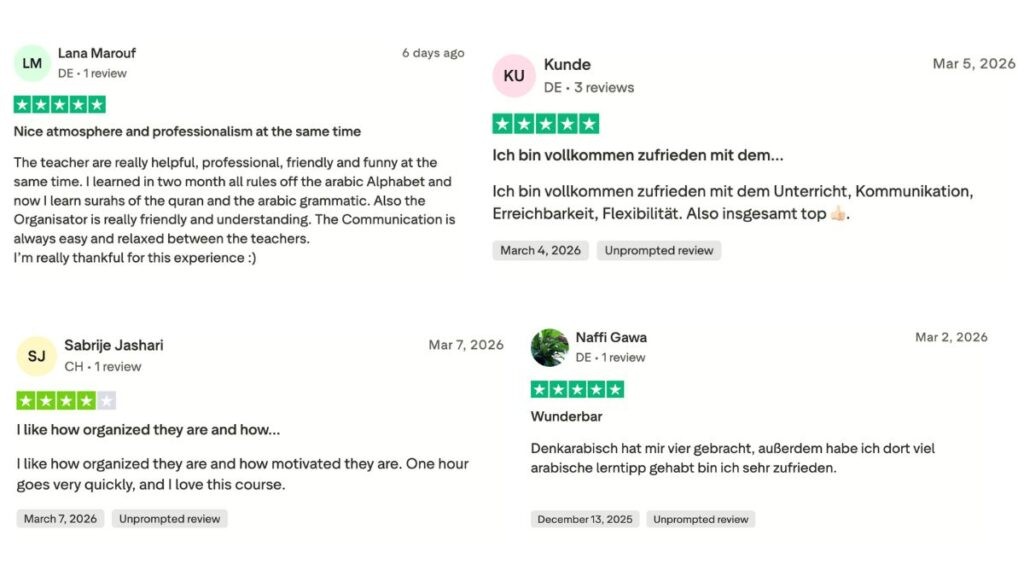
What Our Students Say About Denk Arabisch Academy
See what our students say about learning at Denk Arabisch Academy on Trustpilot. Read their experiences and check out more reviews to discover how our courses help improve Arabic.
Sign up for your Arabic Placement Test with Denk Arabisch!
Learn Arabic with Denk Arabisch Academy
Speak and understand Arabic through a clear and effective learning system
Try a Free TrialConclusion
Learning Arabic is not obligatory for every Muslim, but it becomes mandatory when it is necessary for performing acts of worship or understanding essential aspects of the religion.For scholars and students of knowledge, it is a communal obligation, while for others it remains a highly recommended and rewarding pursuit that deepens faith and strengthens the connection with the Quran.
FAQs
1. Can I pray in my native language if I don’t know Arabic yet?
The majority of scholars agree that the mandatory parts of Salah (like Surah Al-Fatiha) must be recited in Arabic. However, if you are a new Muslim, you are encouraged to use transliterations and learn the basics as quickly as possible. Personal supplications (Dua) outside of the formal prayer rituals can be made in any language.
2. Is it a sin if I never learn fluent Arabic?
No, it is not a sin to lack fluency. As long as you can perform your mandatory acts of worship correctly, you have fulfilled your individual duty. However, you miss out on the immense spiritual rewards and deeper understanding that scholars highly recommend.
3. Is reading a translation of the Quran the same as reading it in Arabic?
While translations are essential for understanding the message, they are considered interpretations of the meanings, not the Divine word itself. The spiritual reward and linguistic miracle are tied specifically to the Arabic text.
4. How much Arabic do I actually need to know?
At a minimum, you need to know the alphabet and the correct pronunciation of the verses used in prayer. For a fulfilling spiritual life, reaching an intermediate level (like B1) is often enough to understand a significant portion of Quranic vocabulary.