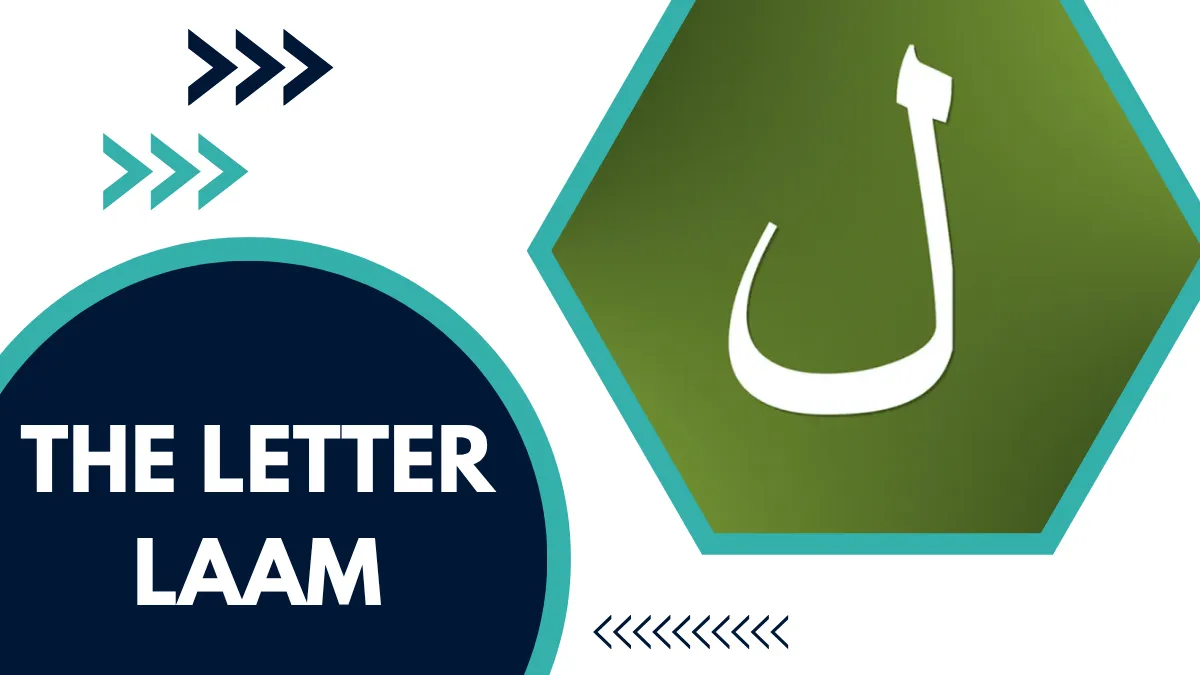
The letter Laam (لَام) is the 23rd letter of the Arabic alphabet. You make it with the tip and front edges of your tongue against the gum ridge behind your upper front teeth. Linguists call it a voiced alveolar lateral approximant, written [l] in the IPA.
German speakers have a head start. The German l in Lampe, Licht and Land is almost identical to the light Arabic Laam, so you already own the basic sound. Only one case needs new work: the heavy Laam in the word Allāh.
This table collects the ten core facts about Laam in one place. Scan the sound, position, transliteration and writing rules here before you read the details.
| Feature | Detail |
| Name | Laam (لَام) |
| Sound | [l], voiced alveolar lateral. Like German l in Lampe, Licht; English “light” |
| Position in the alphabet | 23rd of 28 (hijāʾī order) |
| Abjad value | 12th position, value 30 |
| Transliteration | Common: l. DIN 31635: l (letter name: lām). Variant: lam. Arabizi: l (no number) |
| Point of articulation | Edge of the tongue and gum ridge (حَافَّةُ اللِّسَانِ) |
| Sun or Moon letter | Sun letter |
| Heavy or light | Light. Heavy only in Allāh after fatḥa or ḍamma |
| Dots | None |
| Connection | Connects on both sides (4 forms) |
Ready to start your Arabic-learning journey? Explore our guide, Learning Arabic, and discover helpful tips and effective strategies to build your skills with confidence!
Table of Contents
Where Laam (ل) Sits in the Alphabet and the Abjad
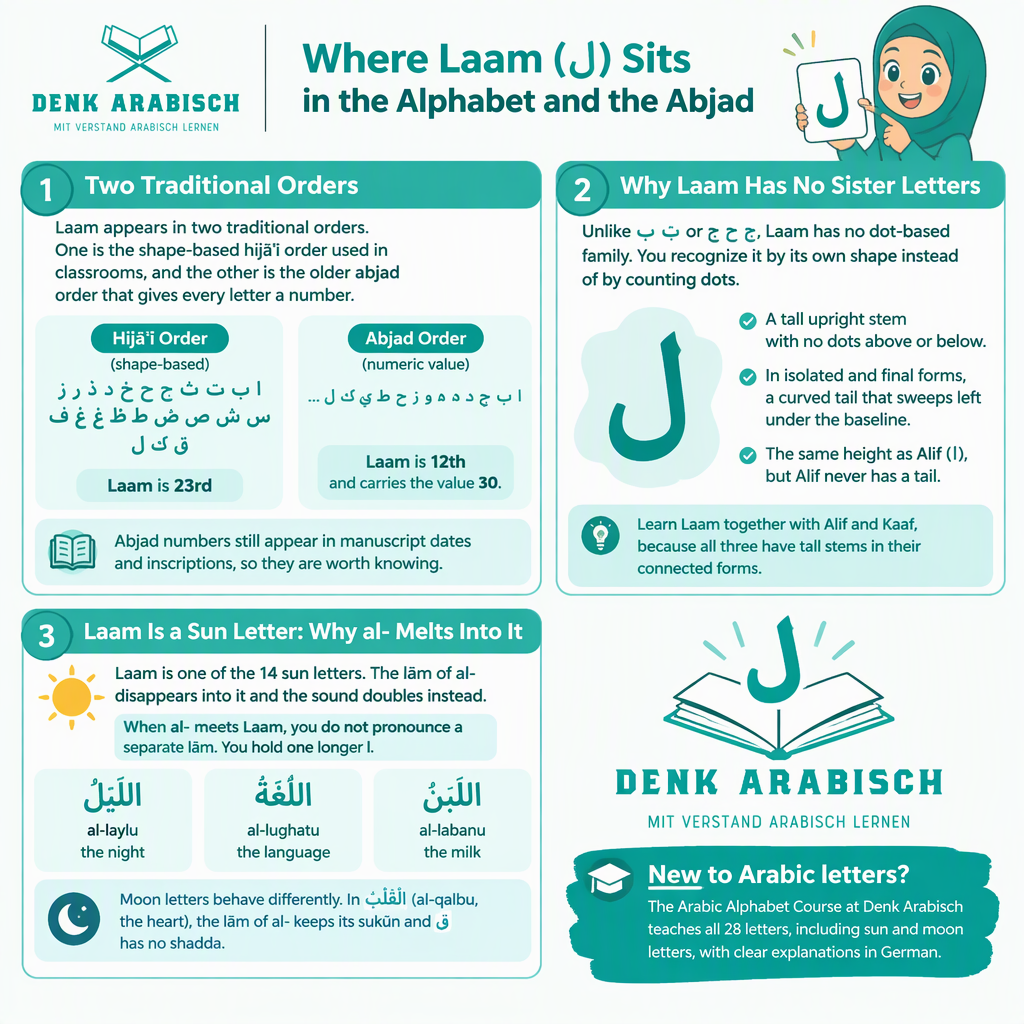
Laam appears in two traditional orders. One is the shape-based hijāʾī order used in classrooms, and the other is the older abjad order that gives every letter a number.
In the hijāʾī order, Laam comes 23rd: ا ب ت ث ج ح خ د ذ ر ز س ش ص ض ط ظ ع غ ف ق ك ل. In the abjad order (ا ب ج د ه و ز ح ط ي ك ل …), Laam is 12th and carries the value 30. Abjad numbers still appear in manuscript dates and inscriptions, so they are worth knowing.
Why Laam Has No Sister Letters
Unlike ب ت ث or ج ح خ, Laam has no dot-based family. You recognize it by its own shape instead of by counting dots.
- A tall upright stem with no dots above or below.
- In isolated and final forms, a curved tail that sweeps left under the baseline.
- The same height as Alif (ا), but Alif never has a tail.
Learn Laam together with Alif and Kaaf, because all three have tall stems in their connected forms.
Laam Is a Sun Letter: Why al- Melts Into It
Laam is one of the 14 sun letters. The lām of al- disappears into it and the sound doubles instead.
When al- meets Laam, you do not pronounce a separate lām. You hold one longer l. On the page, the lām of al- has no sukūn, and the Laam of the noun carries a shadda.
- اللَّيْلُ: al-laylu, the night
- اللُّغَةُ: al-lughatu, the language
- اللَّبَنُ: al-labanu, the milk
Moon letters behave differently. In الْقَلْبُ (al-qalbu, the heart), the lām of al- keeps its sukūn and ق has no shadda.
Want a teacher to check your Laam, Raa and Nuun live? The Arabic Course For Beginners at Denk Arabisch trains each sound with personal feedback, explained in German.
Laam (ل) and Its Makhraj: Where the Tongue Does the Work
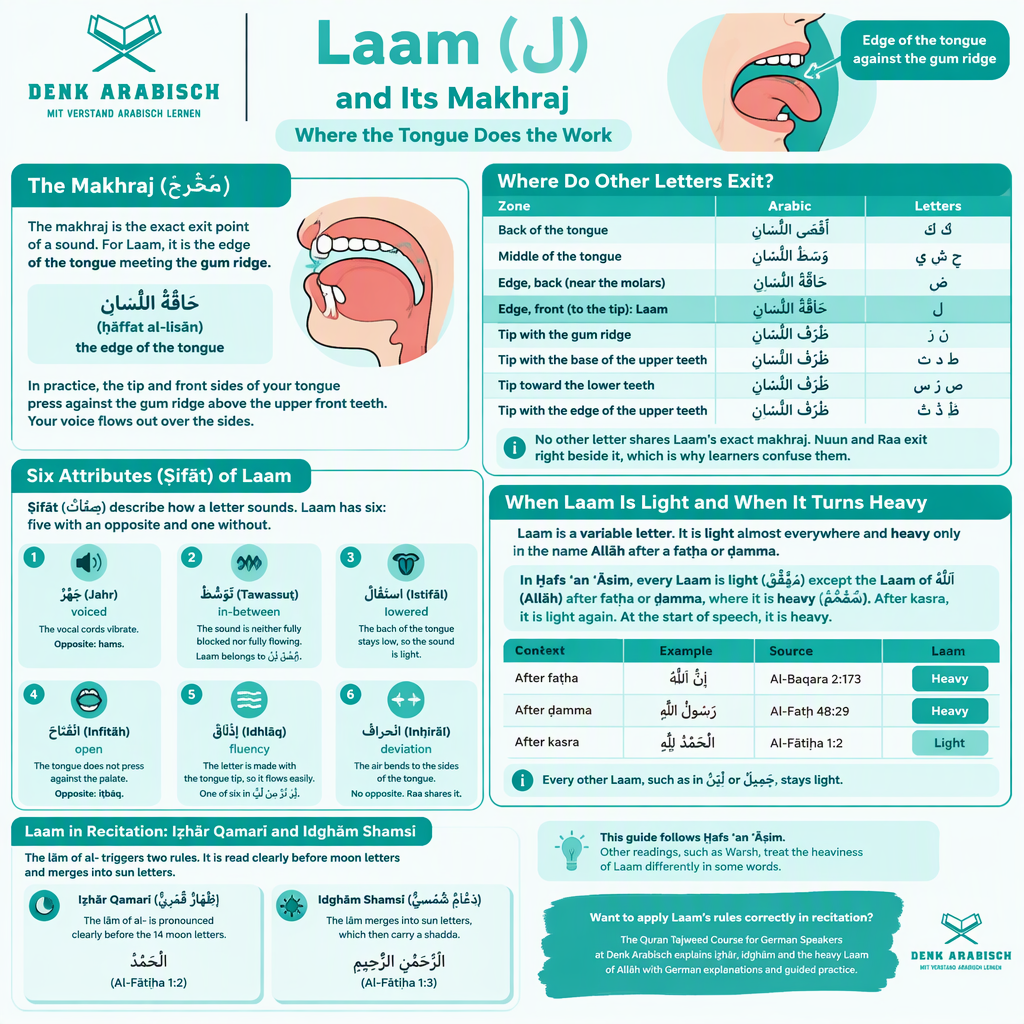
The makhraj (مَخْرَجٌ) is the exact exit point of a sound. For Laam, it is the edge of the tongue meeting the gum ridge.
Tajweed calls Laam’s exit point حَافَّةُ اللِّسَانِ (ḥāffat al-lisān), the edge of the tongue. In practice, the tip and front sides of your tongue press against the gum ridge above the upper front teeth. Your voice flows out over the sides.
| Zone | Arabic | Letters |
| Back of the tongue | أَقْصَى اللِّسَانِ | ق ك |
| Middle of the tongue | وَسَطُ اللِّسَانِ | ج ش ي |
| Edge, back (near the molars) | حَافَّةُ اللِّسَانِ | ض |
| Edge, front (to the tip): Laam | حَافَّةُ اللِّسَانِ | ل |
| Tip with the gum ridge | طَرَفُ اللِّسَانِ | ن ر |
| Tip with the base of the upper teeth | طَرَفُ اللِّسَانِ | ط د ت |
| Tip toward the lower teeth | طَرَفُ اللِّسَانِ | ص ز س |
| Tip with the edge of the upper teeth | طَرَفُ اللِّسَانِ | ظ ذ ث |
No other letter shares Laam’s exact makhraj. Nuun and Raa exit right beside it, which is why learners confuse them (see the mistakes section).
Six Attributes (Ṣifāt) of Laam
Ṣifāt (صِفَاتٌ) describe how a letter sounds. Laam has six: five with an opposite and one without.
- Jahr (جَهْرٌ), voiced: the vocal cords vibrate. The opposite is hams.
- Tawassuṭ (تَوَسُّطٌ), in-between: the sound is neither fully blocked nor fully flowing. Laam belongs to the group لِنْ عُمَرْ.
- Istifāl (اسْتِفَالٌ), lowered: the back of the tongue stays low, so the sound is light.
- Infitāḥ (انْفِتَاحٌ), open: the tongue does not press against the palate. The opposite is iṭbāq.
- Idhlāq (إِذْلَاقٌ), fluency: the letter is made with the tongue tip, so it flows easily. Laam is one of the six letters in the phrase فَرَّ مِنْ لُبٍّ.
- Inḥirāf (انْحِرَافٌ), deviation: the air bends to the sides of the tongue. This attribute has no opposite, and Raa shares it.
When Laam Is Light and When It Turns Heavy
Laam is a variable letter. It is light almost everywhere and heavy only in the name Allāh after a fatḥa or ḍamma.
In Ḥafṣ ʿan ʿĀṣim, every Laam is light (مُرَقَّقٌ) except the Laam of اللَّهُ (Allāh) after fatḥa or ḍamma, where it is heavy (مُفَخَّمٌ). After kasra, it is light again. At the start of speech, it is heavy.
| Context | Example | Source | Laam |
| After fatḥa | إِنَّ اللَّهَ | Al-Baqara 2:173 | Heavy |
| After ḍamma | رَسُولُ اللَّهِ | Al-Fatḥ 48:29 | Heavy |
| After kasra | الْحَمْدُ لِلَّهِ | Al-Fātiḥa 1:2 | Light |
Every other Laam, such as in لَبَنٌ or جَمِيلٌ, stays light.
The same rule applies to اللَّهُمَّ (Allāhumma): its Laam is heavy, because it follows a fatḥa.
Laam in Recitation: Iẓhār Qamarī and Idghām Shamsī
The lām of al- triggers two rules. It is read clearly before moon letters and merges into sun letters.
Iẓhār Qamarī (إِظْهَارٌ قَمَرِيٌّ) means the lām of al- is pronounced clearly before the 14 moon letters. Idghām Shamsī (إِدْغَامٌ شَمْسِيٌّ) means it merges into the 14 sun letters, which then carry a shadda.
- الْحَمْدُ (Al-Fātiḥa 1:2): the lām is pronounced clearly before ḥāʾ.
- الرَّحْمَٰنِ الرَّحِيمِ (Al-Fātiḥa 1:3): the lām merges into rāʾ, and you hear a doubled r.
This guide follows Ḥafṣ ʿan ʿĀṣim. Other readings, such as Warsh, treat the heaviness of Laam differently in some words.
When a Silent Laam Merges into Raa or Laam
The lām of al- is not the only Laam that merges. A Laam with sukūn in a verb or a particle, such as قُلْ (qul, say) or بَلْ (bal, rather), also merges into the next letter in two cases.
- Before Raa (ر): the Laam disappears, and you hear a doubled r.
وَقُل رَّبِّ ارْحَمْهُمَا (Al-Isra 17:24): read wa qur-rabbi-rḥamhumā, not wa qul rabbi. - Before another Laam (ل): the two Laams become one doubled l.
قُل لَّا أَمْلِكُ (Al-A’raf 7:188): read qul-lā amliku, with one long l.
In the Mushaf, you can spot both cases easily: the silent Laam has no sukūn, and the next letter carries a shadda.
One well-known exception in Ḥafṣ is بَلْ ۜ رَانَ (Al-Mutaffifin 83:14). Here you make a short pause without breathing (sakt) after بَلْ, so the Laam stays clear and does not merge into Raa.
Want to apply Laam’s rules correctly in recitation? The Quran Tajweed Course for German Speakers at Denk Arabisch explains iẓhār, idghām and the heavy Laam of Allāh with German explanations and guided practice.
Pronouncing Laam (ل) Like a Native: Sound Guide
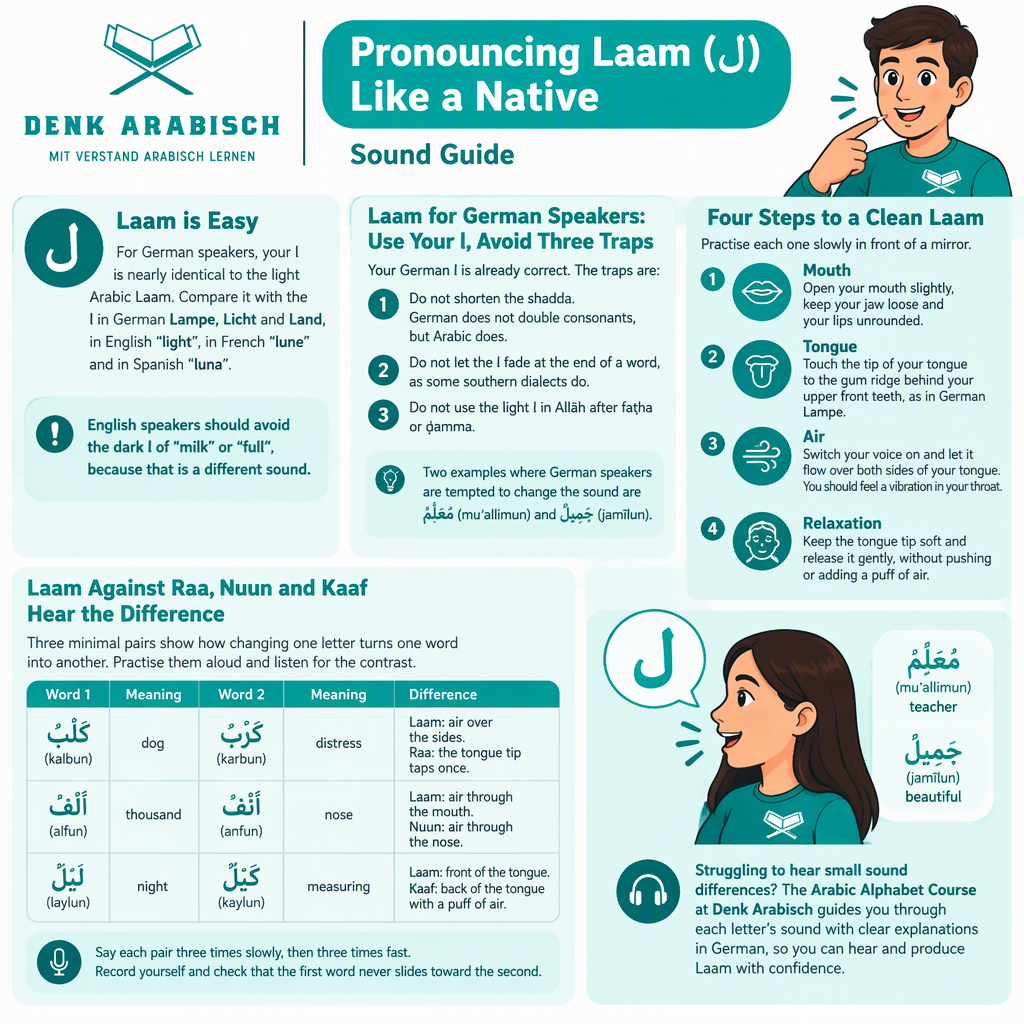
Laam is one of the easiest Arabic sounds for German speakers. Your own l is nearly identical to the light Arabic Laam.
Compare it with the l in German Lampe, Licht and Land, in English “light”, in French “lune” and in Spanish “luna”. English speakers should avoid the dark l of “milk” or “full”, because that is a different sound.
Laam for German Speakers: Use Your l, Avoid Three Traps
Your German l is already correct. The traps are shortening the doubled l, fading at the end of a word, and the heavy Laam of Allāh.
German has a clear l made with the tongue tip at the gum ridge, just like Arabic Laam. Avoid these changes:
- Do not shorten the shadda. German writes double consonants, as in alle, but pronounces them short. Arabic really holds them longer.
- Do not let the l fade at the end of a word, as some southern dialects do.
- Do not use the light l in Allāh after fatḥa or ḍamma.
Two examples where German speakers are tempted to change the sound are مُعَلِّمٌ (muʿallimun), where the l must be held double, and جَمِيلٌ (jamīlun), where the final l must stay clear.
Four Steps to a Clean Laam
These four steps train mouth, tongue, air and relaxation in the right order. Practise each one slowly in front of a mirror.
- Mouth: open your mouth slightly, keep your jaw loose and your lips unrounded.
- Tongue: touch the tip of your tongue to the gum ridge behind your upper front teeth, as in German Lampe.
- Air: switch your voice on and let it flow over both sides of your tongue. You should feel a vibration in your throat.
- Relaxation: keep the tongue tip soft and release it gently, without pushing or adding a puff of air.
Laam Against Raa, Nuun and Kaaf: Hear the Difference
Three minimal pairs show how changing one letter turns one word into another. Practise them aloud and listen for the contrast.
| Word 1 | Meaning | Word 2 | Meaning | Difference |
| كَلْبٌ (kalbun) | dog | كَرْبٌ (karbun) | distress | Laam: air over the sides. Raa: the tongue tip taps once |
| أَلْفٌ (alfun) | thousand | أَنْفٌ (anfun) | nose | Laam: air through the mouth. Nuun: air through the nose |
| لَيْلٌ (laylun) | night | كَيْلٌ (kaylun) | measuring | Laam: front of the tongue. Kaaf: back of the tongue with a puff of air |
Say each pair three times slowly, then three times fast. Record yourself and check that the first word never slides toward the second.
Struggling to hear small sound differences? The Arabic Alphabet Course at Denk Arabisch guides you through each letter’s sound with clear explanations in German, so you can hear and produce Laam with confidence.
Writing Laam (ل): The Four Forms
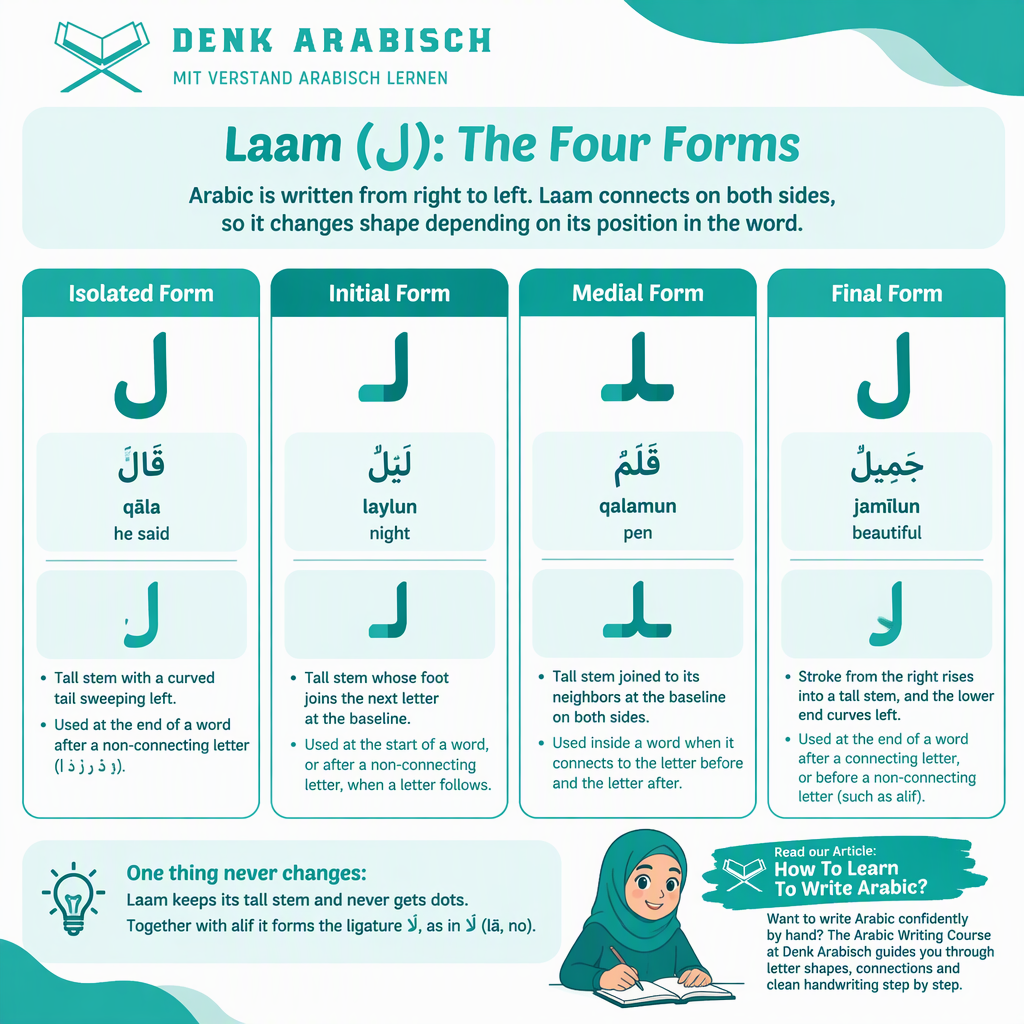
Arabic is written from right to left. Laam connects on both sides, so it changes shape depending on its position in the word.
| Form | Shape | Example | Transliteration | Meaning |
| Isolated | ل | قَالَ | qāla | he said |
| Initial | لـ | لَيْلٌ | laylun | night |
| Medial | ـلـ | قَلَمٌ | qalamun | pen |
| Final | ـل | جَمِيلٌ | jamīlun | beautiful |
1. Isolated Form (ل)
Laam takes its isolated form when it stands alone. It also takes it at the end of a word after a non-connecting letter (ا د ذ ر ز و).
- Shape: a tall upright stem with a curved tail sweeping left below the baseline.
- Examples: قَالَ (qāla, he said); هِلَالٌ (hilālun, crescent), where the last Laam follows alif.
2. Initial Form (لـ)
Laam takes its initial form at the start of a word, or right after a non-connecting letter, when a letter follows it.
- Shape: a tall upright stem whose foot joins the next letter at the baseline.
- Examples: لَيْلٌ (laylun, night); لُغَةٌ (lughatun, language); اللُّغَةُ (al-lughatu, the language), where Laam follows alif.
3. Medial Form (ـلـ)
Laam takes its medial form inside a word when it connects to the letter before it and the letter after it.
- Shape: a tall upright stem joined to its neighbors at the baseline on both sides.
- Examples: قَلَمٌ (qalamun, pen); قَلْبٌ (qalbun, heart).
Learn Arabic with Denk Arabisch Academy
Speak and understand Arabic through a clear and effective learning system
Try a Free Trial4. Final Form (ـل)
Laam takes its final form at the end of a word after a connecting letter. Laam takes its final form at the end of a word after a connecting letter.
- Shape: a stroke from the right rises into a tall stem, and the lower end curves left.
- Examples: Examples: جَمِيلٌ (jamīlun, beautiful); رَجُلٌ (rajulun, man), where Laam sits in the middle of the word but takes the final form because alif never connects forward.
One thing never changes: Laam keeps its tall stem and never gets dots. When Laam is followed by alif, the two always join into a special ligature: لا on its own, as in لَا (lā, no), and ـلا after a connecting letter, as in سَلَامٌ (salāmun, peace).
Read our Article: How To Learn To Write Arabic?
Want to write Arabic confidently by hand? The Arabic Writing Course at Denk Arabisch guides you through letter shapes, connections and clean handwriting step by step.
Laam (ل) with Vowels: Short, Long and Doubled
Because Laam is light, every vowel on it sounds bright and clear. Only in Allāh does the Laam turn heavy and darken the vowel.
Short Vowels on Laam (Ḥarakāt)
Four marks change the vowel on Laam: fatḥa, ḍamma, kasra and sukūn. The table shows each one on a real word.
| Mark | Name | Sound | Example | Meaning |
| لَ | فَتْحَةٌ (fatḥa) | la | لَبَنٌ (labanun) | milk |
| لُ | ضَمَّةٌ (ḍamma) | lu | لُغَةٌ (lughatun) | language |
| لِ | كَسْرَةٌ (kasra) | li | لِسَانٌ (lisānun) | tongue |
| لْ | سُكُونٌ (sukūn) | l (no vowel) | قَلْبٌ (qalbun) | heart |
Long Vowels and Diphthongs with Laam
Long vowels last about twice as long as short ones. The table shows ā, ū and ī after Laam.
| Combination | Sound | Example | Meaning |
| لَا | lā | لَا (lā) | no |
| لُو | lū | قُلُوبٌ (qulūbun) | hearts |
| لِي | lī | لِي (lī) | to me, for me |
Laam also forms two diphthongs: aw in لَوْنٌ (lawnun, color) and ay in لَيْلٌ (laylun, night).
Doubled Laam: The Shadda
The shadda (شَدَّةٌ) doubles a letter. On Laam, you hold the tongue contact for about twice as long as for a single l.
- اللَّيْلُ (al-laylu): the night
- مُعَلِّمٌ (muʿallimun): teacher
- اللَّهُ (Allāhu): God, with the heavy Laam
Three Root Families Built on Laam (ل)
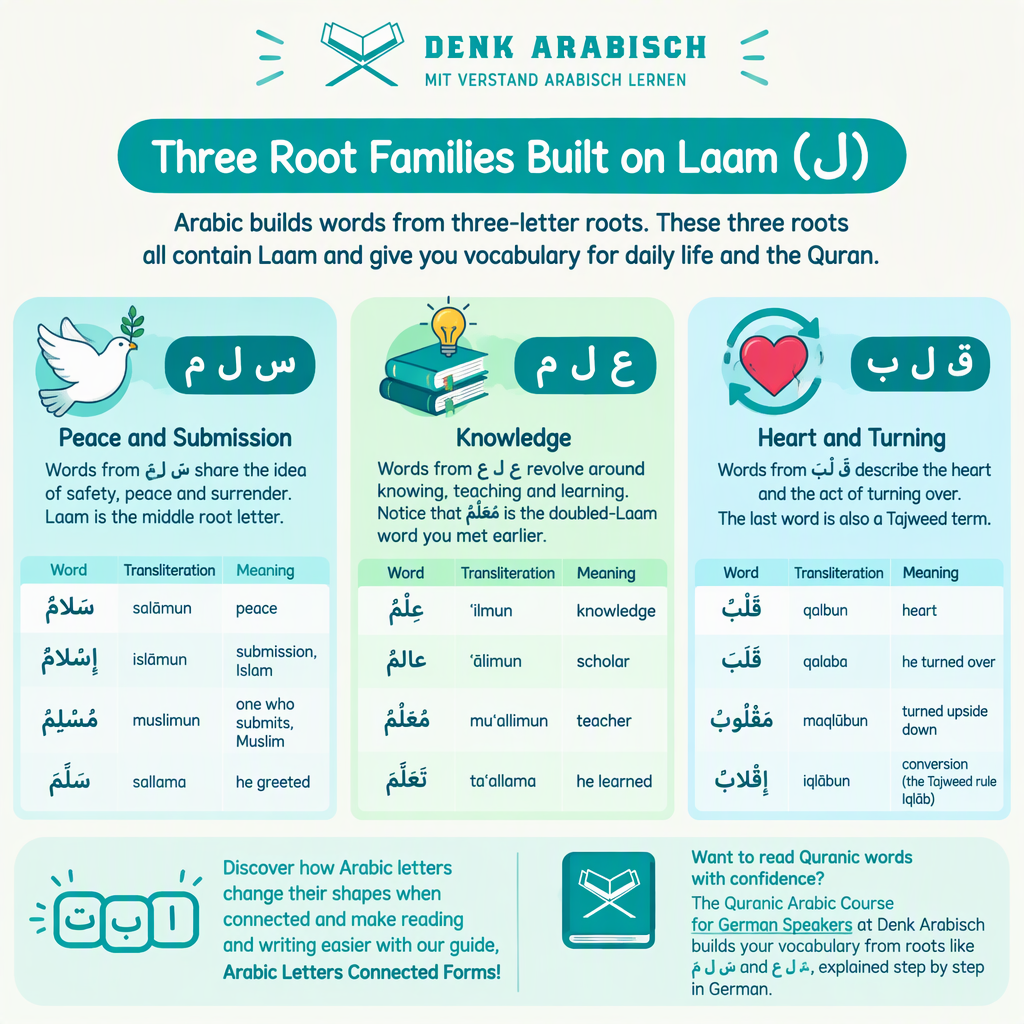
Arabic builds words from three-letter roots. These three roots all contain Laam and give you vocabulary for daily life and the Quran.
Root س ل م: Peace and Submission
Words from س ل م share the idea of safety, peace and surrender. Laam is the middle root letter.
| Word | Transliteration | Meaning |
| سَلَامٌ | salāmun | peace |
| إِسْلَامٌ | islāmun | submission, Islam |
| مُسْلِمٌ | muslimun | one who submits, Muslim |
| سَلَّمَ | sallama | he greeted |
Root ع ل م: Knowledge
Words from ع ل م revolve around knowing, teaching and learning. Notice that مُعَلِّمٌ is the doubled-Laam word you met earlier.
| Word | Transliteration | Meaning |
| عِلْمٌ | ʿilmun | knowledge |
| عَالِمٌ | ʿālimun | scholar |
| مُعَلِّمٌ | muʿallimun | teacher |
| تَعَلَّمَ | taʿallama | he learned |
Root ق ل ب: Heart and Turning
Words from ق ل ب describe the heart and the act of turning over. The last word is also a Tajweed term.
| Word | Transliteration | Meaning |
| قَلْبٌ | qalbun | heart |
| قَلَبَ | qalaba | he turned over |
| مَقْلُوبٌ | maqlūbun | turned upside down |
| إِقْلَابٌ | iqlābun | conversion (the Tajweed rule Iqlāb) |
Want to read Quranic words with confidence? The Quranic Arabic Course for German Speakers at Denk Arabisch builds your vocabulary from roots like س ل م and ع ل م, explained step by step in German.
Laam (ل) in Full Sentences
Three short sentences put Laam to work in real grammar. Full case endings let you read every vowel aloud.
| Arabic Sentence | Transliteration | Meaning |
| اللَّيْلُ جَمِيلٌ. | al-laylu jamīlun. | The night is beautiful. |
| فِي الْقَلْبِ سَلَامٌ. | fī l-qalbi salāmun. | There is peace in the heart. |
| هَذَا قَلَمٌ جَمِيلٌ. | hādhā qalamun jamīlun. | This is a beautiful pen. |
In the first sentence, listen for the doubled l. In the second, the lām of al- keeps its sukūn because ق is a moon letter.
Read our guide, How Many Letters in Arabic?, and discover how many letters Arabic has and how to start learning them with confidence!
Four Common Mistakes with Laam (ل) and How to Fix Them
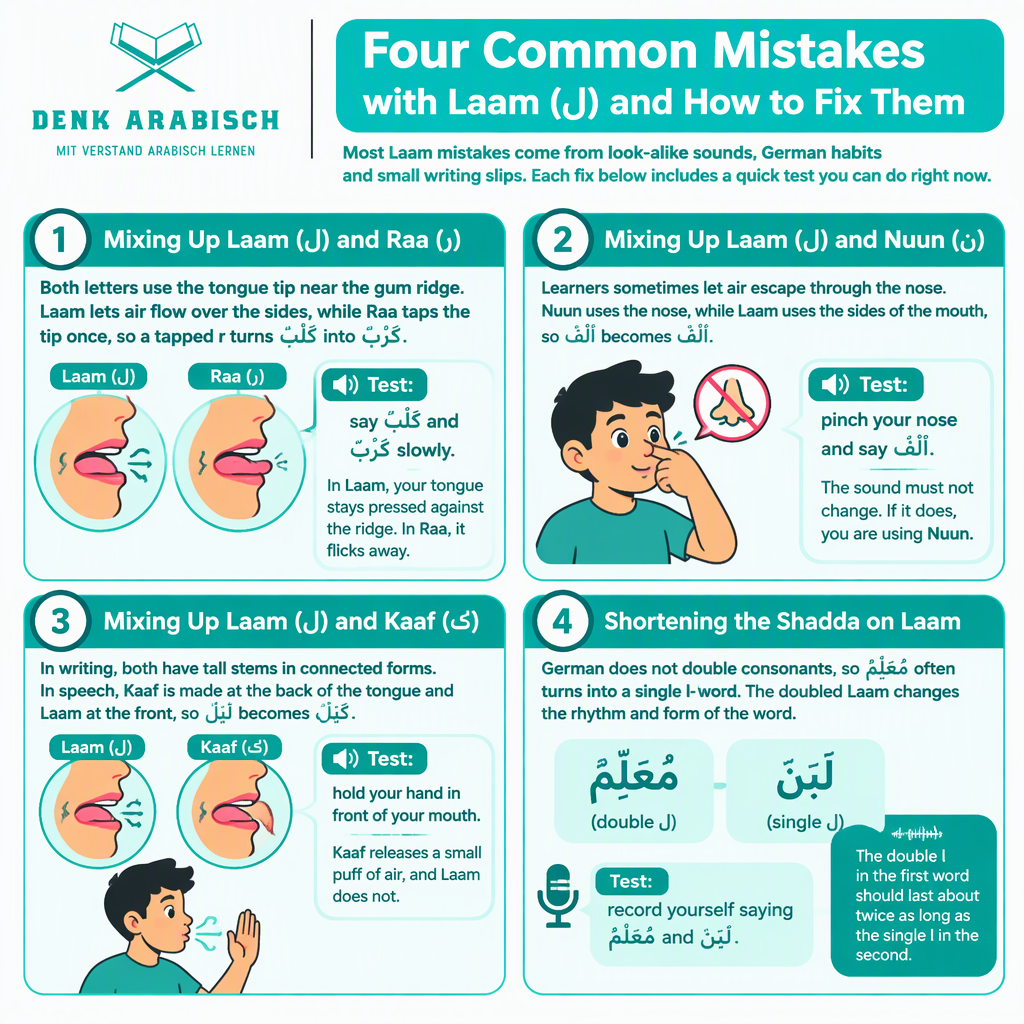
Most Laam mistakes come from look-alike sounds, German habits and small writing slips. Each fix below includes a quick test you can do right now.
1. Mixing Up Laam (ل) and Raa (ر)
Both letters use the tongue tip near the gum ridge. Laam lets air flow over the sides, while Raa taps the tip once, so a tapped r turns كَلْبٌ into كَرْبٌ.
Test: say كَلْبٌ and كَرْبٌ slowly. In Laam, your tongue stays pressed against the ridge. In Raa, it flicks away.
2. Mixing Up Laam (ل) and Nuun (ن)
Learners sometimes let air escape through the nose. Nuun uses the nose, while Laam uses the sides of the mouth, so أَلْفٌ becomes أَنْفٌ.
Test: pinch your nose and say أَلْفٌ. The sound must not change. If it does, you are using Nuun.
3. Mixing Up Laam (ل) and Kaaf (ك)
In writing, both have tall stems in connected forms. In speech, Kaaf is made at the back of the tongue and Laam at the front, so لَيْلٌ becomes كَيْلٌ.
Test: hold your hand in front of your mouth. Kaaf releases a small puff of air, and Laam does not.
4. Shortening the Shadda on Laam
German writes double l in words like alle but says it short, so مُعَلِّمٌ often turns into a single-l word.
Test: record yourself saying مُعَلِّمٌ and لَبَنٌ. The double l in the first word should last about twice as long as the single l in the second.
Practice Lab: Four Exercises to Test Your Laam (ل) Knowledge
These four exercises use only words from this guide. Try each one before you read the answer.
Exercise 1: Multiple Choice
This question checks that you remember where Laam is produced.
Where is the makhraj of Laam?
A) the throat
B) the edge of the tongue
C) the lips
D) the nose
Answer: B.
Exercise 2: Matching
This exercise links four Laam words to their meanings.
Match 1) لَيْلٌ, 2) قَلَمٌ, 3) قَلْبٌ, 4) سَلَامٌ with a) heart, b) night, c) peace, d) pen.
Answer: 1-b, 2-d, 3-a, 4-c.
Exercise 3: True or False
These four statements test the sun and moon rule, the heavy Laam and the forms.
- Laam is a moon letter.
- In الْقَلْبِ, the lām of al- carries a sukūn.
- The Laam of Allāh is heavy after a fatḥa.
- In قَالَ, Laam appears in its medial form.
Answers: 1) False, it is a sun letter. 2) True. 3) True. 4) False, it is isolated because it follows alif.
Exercise 4: Find the Letter
This exercise trains your eye to spot Laam inside connected writing.
Count every Laam in اللَّيْلُ جَمِيلٌ.
Answer: 4. There are three in اللَّيْلُ and one in جَمِيلٌ.
What Our Students Say About Denk Arabisch Academy
See what our students say about learning at Denk Arabisch Academy on Trustpilot. Read their experiences and check out more reviews to discover how our courses help improve Arabic.

Join Denk Arabisch to Start Learning Arabic!
Laam is one of 28 letters. A clear learning path turns each letter into a building block instead of a separate challenge.
Denk Arabisch is built for German-speaking learners and explains Arabic through German.
- German-based explanations for every sound
- A clear path from the alphabet to reading, writing and speaking
- Separate courses for Quranic Arabic and Tajweed
- Suitable for adults and for parents learning alongside their children
Choose Your Specialized Course:
- Arabic Course For Beginners: start from zero with a clear first path.
- Quranic Arabic Course for German Speakers: understand Quranic words and roots.
- Quran Tajweed Course for German Speakers: apply recitation rules correctly.
- Arabic Alphabet Course: master all 28 letters and their sounds.
- Arabic Reading Course: read connected words with confidence.
- Arabic Writing Course: write clean, correctly connected letters.
- Arabic Speaking Course: turn what you know into conversation.
Learn Arabic with Denk Arabisch Academy
Speak and understand Arabic through a clear and effective learning system
Try a Free TrialBook your free trial lesson with Denk Arabisch and discover the best course to help you achieve your Arabic learning goals.
You can read what our students say on Trustpilot.

Conclusion
The letter Laam (ل) is an easy win for German speakers. It has a familiar sound, a clear shape and only a few precise rules.
- Sound: a light [l] made with the tongue tip at the gum ridge, heavy only in Allāh after fatḥa or ḍamma.
- Writing: four forms with one constant tall stem and no dots.
- Recognition: a sun letter, so al- merges into it and you hear a doubled l.
Start with the sound: say كَلْبٌ, أَلْفٌ and لَيْلٌ against their pairs. Then write the four forms and copy قَالَ, قَلَمٌ and جَمِيلٌ. Finish by reading the roots س ل م, ع ل م and ق ل ب aloud.
Every letter you master makes the next one easier. Laam is a great place to build momentum.
Ready for the next step? Book a free trial lesson at Denk Arabisch and keep learning Arabic with structure and German explanations.
FAQs
These four answers cover the questions learners ask most about Laam. Each one is specific to this letter.
1. Is Laam heavy or light?
Laam is light in almost every word. It becomes heavy only in the name Allāh after a fatḥa or ḍamma, and it stays light after a kasra.
2. How is Laam different from Raa (ر)?
Both use the tongue tip near the gum ridge. Laam keeps the tongue pressed while air flows over the sides, and Raa taps the tip once.
3. How is Laam different from Nuun (ن)?
Both are made at nearly the same spot. Nuun sends air through the nose, and Laam sends it through the sides of the mouth.
4. Which Tajweed rules involve Laam?
The lām of al- follows Iẓhār Qamarī before moon letters and Idghām Shamsī before sun letters. The Laam of Allāh is heavy after a fatḥa or ḍamma and light after a kasra. A silent Laam in words like قُلْ and بَلْ also merges into a following Raa or Laam, as in وَقُل رَّبِّ (Al-Isra 17:24).