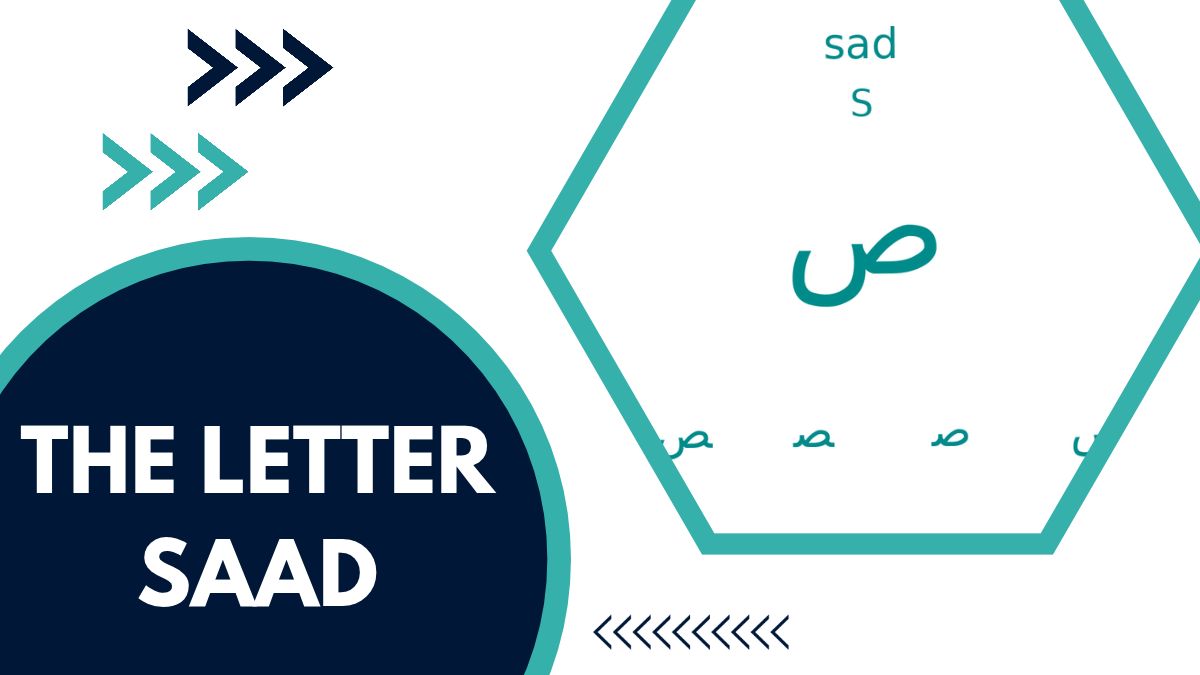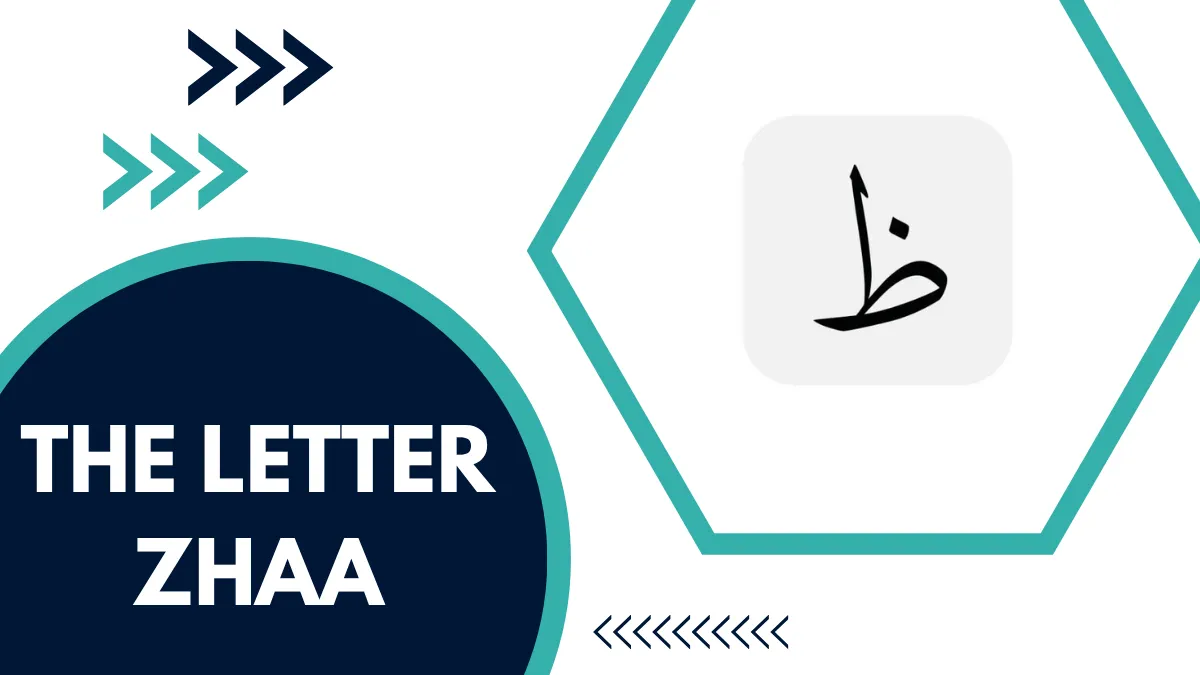
The Letter Zhaa (ظ), called ظَاء (ẓāʾ), is the 17th letter of the Arabic alphabet. You make it with the tip of your tongue at the edges of your upper front teeth, while the back of your tongue lifts toward the roof of your mouth. Linguists call it a voiced emphatic dental fricative, written [ðˤ].
This sound doesn’t exist in German, but you can get it. Start from English “this” or Spanish “nada”, then make it deeper and heavier. German has no [ð] at all, so you will build it step by step.
This guide covers everything you need to know about Zhaa:
- Pronunciation, with a German-speaker’s strategy
- Writing forms: all four shapes of ظ
- Vowels: short, long and shadda
- Tajweed: heaviness and the rules in the Quran
- Words and roots you can use right away
Short exercises at the end let you check what you learned.
| Fact | Details |
| Name | ظَاء (Zhaa) |
| Sound | [ðˤ], emphatic version of English “this”; similar to Greek δ in δέκα, but heavy |
| Position in the alphabet | 17th (hijāʾī order) |
| Abjad value | 27th in Abjad order, value 900 |
| Transliteration | Common: Zhaa / Dhaa. DIN 31635: ẓ. Other: emphatic dh. Arabizi: 6′ (not standardized) |
| Point of articulation | Tongue tip and edges of the upper front teeth |
| Sun or Moon letter | Sun letter |
| Heavy or light | Heavy (mufakhkham) |
| Dots | One dot above |
| Connection | Connects to the letter after it (4 forms) |
Read “How Many Letters in Arabic?” and discover the Arabic alphabet in a simple and easy way.
Table of Contents
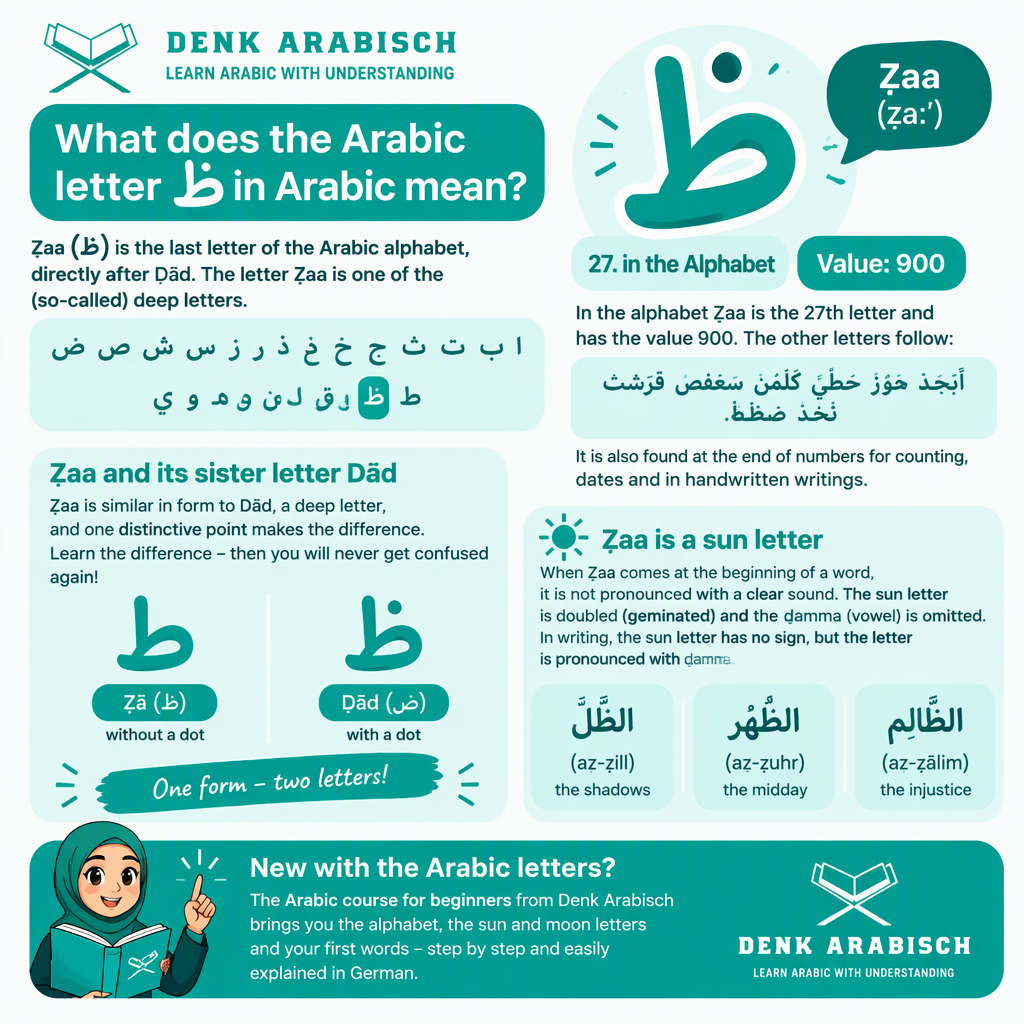
Where the Letter Zhaa (ظ) Fits in the Arabic Alphabet
Zhaa sits near the end of the hijāʾī alphabet, right after ط. The letters up to it are:
ا ب ت ث ج ح خ د ذ ر ز س ش ص ض ط ظ
In the Abjad order, Zhaa is 27th and has the value 900. The Abjad order is the old sequence: أَبْجَدْ هَوَّزْ حُطِّي كَلَمُنْ سَعْفَصْ قَرَشَتْ ثَخَذْ ضَظَغْ. It still matters for numbering, dates on manuscripts and inscriptions.
Zhaa and Its Sister Letters
Zhaa shares its body shape with one sister letter, and a single dot tells them apart. Learn them as a pair and you will never confuse the shapes.
- ط (Ṭāʾ): no dot
- ظ (Ẓāʾ): one dot above
Learning them together means one shape gives you two letters.
Zhaa Is a Sun Letter
When ال comes before a sun letter, the lām is not pronounced. The sun letter takes a shadda and is pronounced doubled. In writing, the lām has no mark and the letter carries the shadda.
- الظِّلّ (aẓ-ẓill): the shadow
- الظُّهْر (aẓ-ẓuhr): noon
- الظَّالِم (aẓ-ẓālim): the wrongdoer
New to Arabic letters? The Arabic Course For Beginners at Denk Arabisch teaches you the alphabet, sun and moon letters and your first words step by step, explained through German.
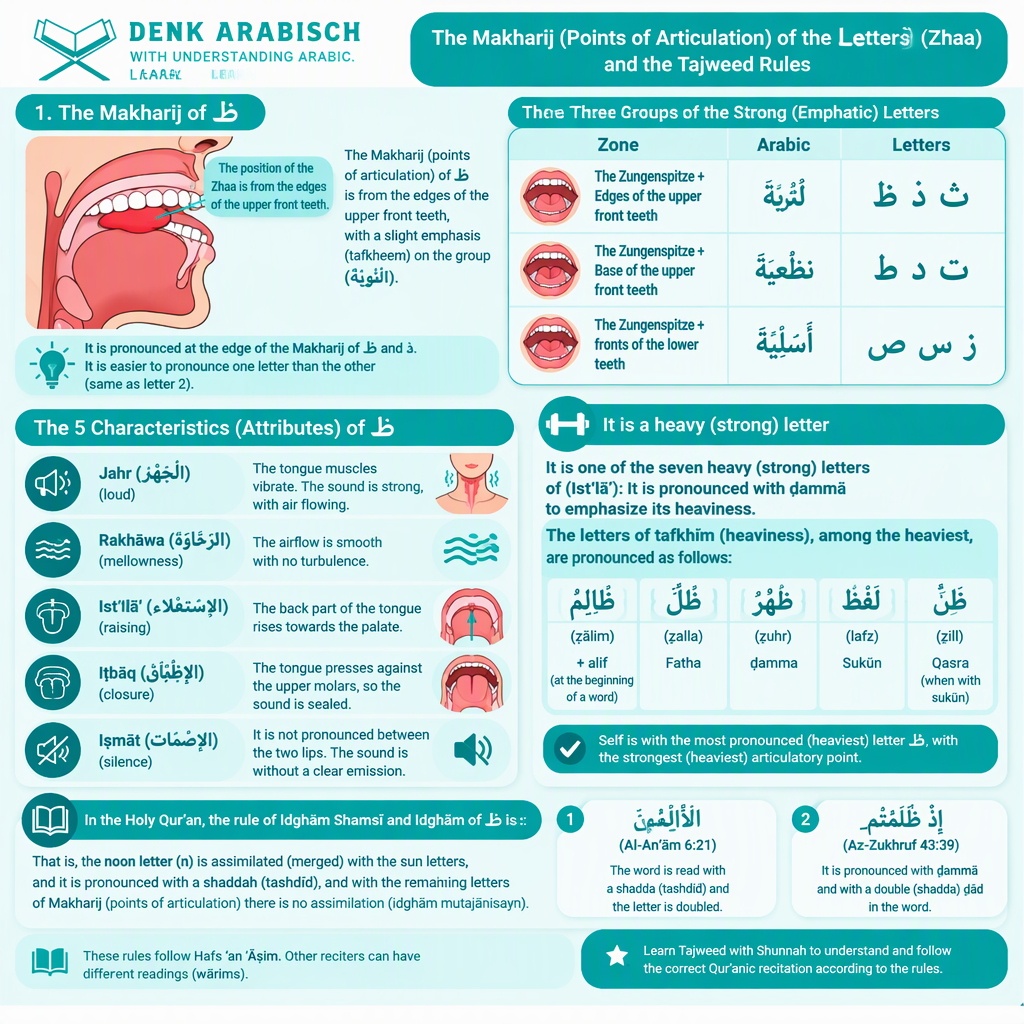
Point of Articulation (Makhraj) of Zhaa and Tajweed
The makhraj (الْمَخْرَج) of Zhaa is the tip of the tongue with the edges of the upper front teeth. It belongs to the lithawiyya group (اللِّثَوِيَّة), the letters made at the edges of the front teeth. The table shows it next to its two neighbouring tongue-tip groups.
| Zone | Arabic | Letters |
| Tongue tip + edges of the upper front teeth | لِثَوِيَّة | ث ذ ظ |
| Tongue tip + base of the upper front teeth | نِطْعِيَّة | ت د ط |
| Tongue tip + near the lower front teeth | أَسَلِيَّة | ز س ص |
Zhaa shares its makhraj with ث and ذ, which is why ذ becomes a common source of mistakes (see Mistake 2).
The 5 Attributes (Ṣifāt) of Zhaa
Zhaa has five attributes, all of which have an opposite. None of the seven attributes without opposites, such as Qalqalah or Ṣafīr, applies to it.
- Jahr (الْجَهْر), voiced: Your vocal cords vibrate. Touch your throat to feel it.
- Rakhāwa (الرَّخَاوَة), flowing: The sound continues like a stream of air.
- Istiʿlāʾ (الِاسْتِعْلَاء), elevation: The back of the tongue rises toward the palate.
- Iṭbāq (الْإِطْبَاق), covering: The tongue presses against the palate, as for ص ض ط ظ.
- Iṣmāt (الْإِصْمَات), restraint: Zhaa is not among the Idhlāq letters فَرَّ مِنْ لُبّ, so it is muṣmata.
Zhaa Is a Heavy Letter
Zhaa is one of the seven heavy letters of Istiʿlāʾ. They are gathered in the phrase خُصَّ ضَغْطٍ قِظْ. The levels of tafkhīm (heaviness), from heaviest to lightest, are:
- ظَ + alif: ظَالِم (ẓālim)
- Fatḥa: ظَلَّ (ẓalla)
- Ḍamma: ظُهْر (ẓuhr)
- Sukūn: لَفْظ (lafẓ)
- Kasra: ظِلّ (ẓill)
Even at the lightest level, with kasra, Zhaa stays heavy.
Zhaa in Quranic Recitation: Idghām Shamsī and Idghām of ذ into ظ
Because Zhaa is a sun letter, the lām of ال merges into it. Also, when ذ is followed by ظ, the two merge because they share a makhraj (idghām mutajānisayn). These two examples show both rules.
- الظَّالِمُونَ (Al-Anʿām 6:21): the lām disappears and ظ is doubled.
- إِذْ ظَّلَمْتُمْ (Az-Zukhruf 43:39): ذ merges into ظ and you pronounce one doubled ẓẓ.
This guide follows Ḥafṣ ʿan ʿĀṣim. Other readings may differ in some words.
Want to apply Tajweed rules confidently when you recite? The Quran Tajweed Course for German Speakers at Denk Arabisch explains makhraj, attributes and idghām with clear German examples.
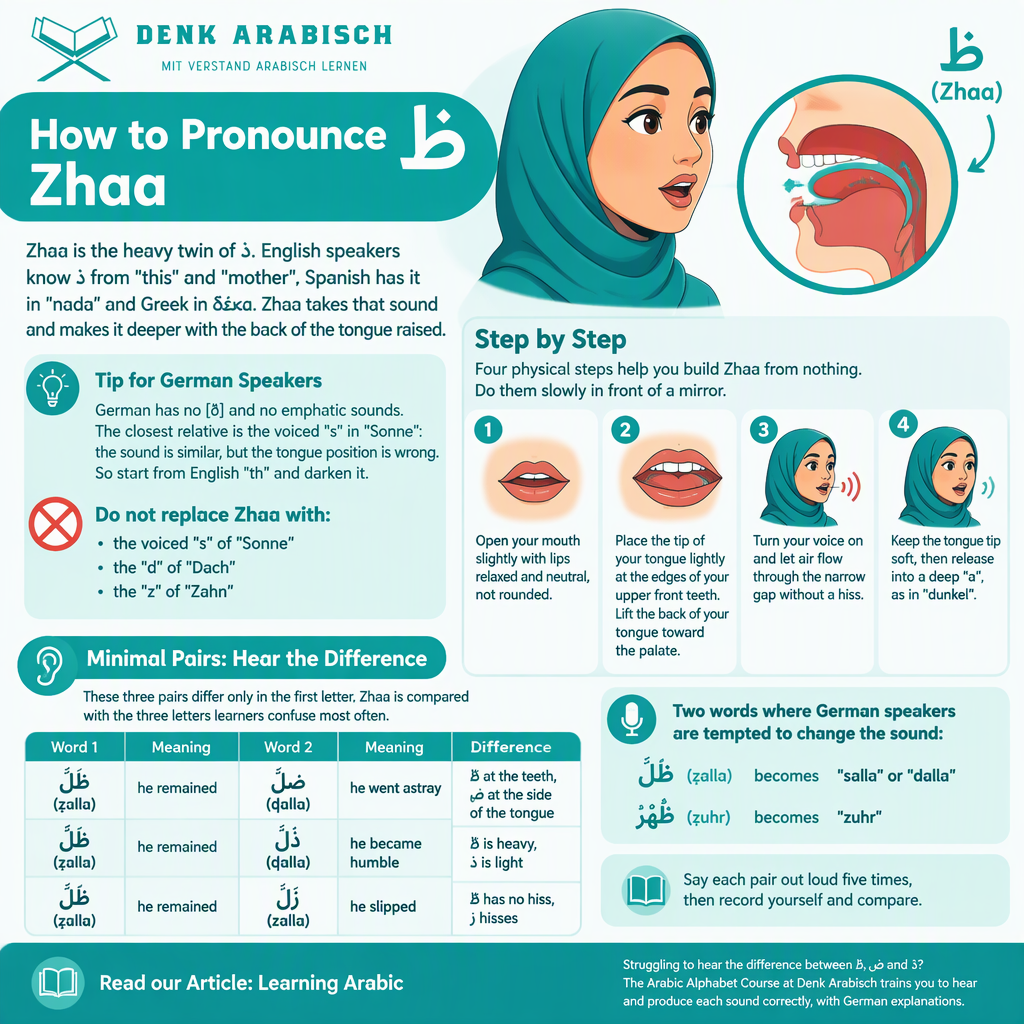
How to Pronounce Zhaa
Zhaa is the heavy twin of ذ. English speakers know ذ from “this” and “mother”. Spanish has it in “nada” and Greek in δέκα. Zhaa takes that sound and makes it deeper with the back of the tongue raised.
Tip for German Speakers
German has no [ð] and no emphatic sounds. The closest relative is the voiced “s” in “Sonne”: the sound is similar, but the tongue position is wrong. So start from English “th” and darken it.
Do not replace Zhaa with:
- the voiced “s” of “Sonne”
- the “d” of “Dach”
- the “z” of “Zahn”
Two words where German speakers are tempted to change the sound:
- ظَلَّ becomes “salla” or “dalla”
- ظُهْر becomes “zuhr”
Step by Step
Four physical steps help you build Zhaa from nothing. Do them slowly in front of a mirror.
- Open your mouth slightly with lips relaxed and neutral, not rounded.
- Place the tip of your tongue lightly at the edges of your upper front teeth. Lift the back of your tongue toward the palate.
- Turn your voice on and let air flow through the narrow gap without a hiss.
- Keep the tongue tip soft, then release into a deep “a”, as in “dunkel”.
Minimal Pairs: Hear the Difference
These three pairs differ only in the first letter. Zhaa is compared with the three letters learners confuse most often.
| Word 1 | Meaning | Word 2 | Meaning | Difference |
| ظَلَّ (ẓalla) | he remained | ضَلَّ (ḍalla) | he went astray | ظ at the teeth, ض at the side of the tongue |
| ظَلَّ (ẓalla) | he remained | ذَلَّ (ḏalla) | he became humble | ظ is heavy, ذ is light |
| ظَلَّ (ẓalla) | he remained | زَلَّ (zalla) | he slipped | ظ has no hiss, ز hisses |
Say each pair out loud five times, then record yourself and compare.
Struggling to hear the difference between ظ, ض and ذ? The Arabic Alphabet Course at Denk Arabisch trains you to hear and produce each sound correctly, with German explanations.
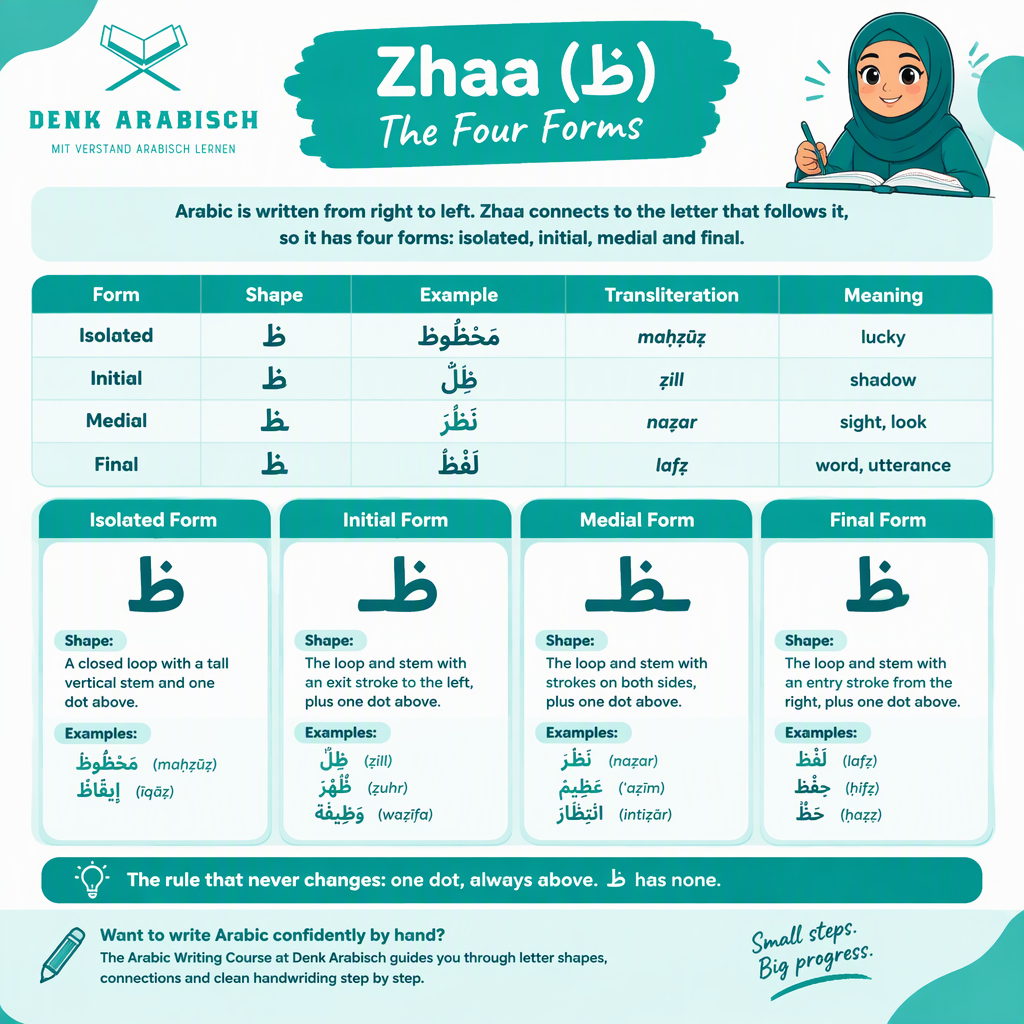
How to Write Zhaa (ظ): The Four Forms
Arabic is written from right to left. Zhaa connects to the letter that follows it, so it has four forms: isolated, initial, medial and final.
| Form | Shape | Example | Transliteration | Meaning |
| Isolated | ظ | مَحْظُوظ | maḥẓūẓ | lucky |
| Initial | ظـ | ظِلّ | ẓill | shadow |
| Medial | ـظـ | نَظَر | naẓar | sight, look |
| Final | ـظ | لَفْظ | lafẓ | word, utterance |
1. Isolated Form (ظ)
You use this form when ظ stands alone, or at the end of a word after a non-connecting letter such as و.
Shape: a closed loop with a tall vertical stem and one dot above.
Examples: مَحْظُوظ (maḥẓūẓ), إِيقَاظ (īqāẓ, waking up)
2. Initial Form (ظـ)
You use this form at the start of a word. It also appears after a non-connecting letter inside a word.
Shape: the loop and stem with an exit stroke to the left, plus one dot above.
Examples: ظِلّ (ẓill), ظُهْر (ẓuhr), وَظِيفَة (waẓīfa, job)
Learn Arabic with Denk Arabisch Academy
Speak and understand Arabic through a clear and effective learning system
Try a Free Trial3. Medial Form (ـظـ)
You use this form in the middle of a word, between two connecting letters.
Shape: the loop and stem with strokes on both sides, plus one dot above.
Examples: نَظَر (naẓar), عَظِيم (ʿaẓīm), انْتِظَار (intiẓār)
4. Final Form (ـظ)
You use this form at the end of a word, after a connecting letter.
Shape: the loop and stem with an entry stroke from the right, plus one dot above.
Examples: لَفْظ (lafẓ), حِفْظ (ḥifẓ), حَظّ (ḥaẓẓ)
The rule that never changes: one dot, always above. ط has none.
Want to write Arabic confidently by hand? The Arabic Writing Course at Denk Arabisch guides you through letter shapes, connections and clean handwriting step by step.
Zhaa with Vowels
Zhaa is heavy, so the vowel after it sounds darker. The “a” becomes deeper and the “i” is less bright.
Short Vowels (Ḥarakāt)
Each short vowel changes the sound of ظ slightly. The table shows all four marks on Zhaa.
| Mark | Name | Sound | Example | Meaning |
| ـَ | Fatḥa | ẓa | ظَرْف (ẓarf) | envelope |
| ـُ | Ḍamma | ẓu | ظُهْر (ẓuhr) | noon |
| ـِ | Kasra | ẓi | ظِلّ (ẓill) | shadow |
| ـْ | Sukūn | ẓ | لَفْظ (lafẓ) | word, utterance |
Long Vowels (Madd)
Long vowels make the sound twice as long. The table shows ظ with ā, ū and ī.
| Combination | Sound | Example | Meaning |
| ظَا | ẓā | ظَالِم (ẓālim) | wrongdoer |
| ظُو | ẓū | مَحْظُور (maḥẓūr) | forbidden |
| ظِي | ẓī | عَظِيم (ʿaẓīm) | great |
Zhaa with Shadda
Shadda doubles the sound, so you hold the tongue position a moment longer. Here are three examples.
- الظَّالِمُونَ (aẓ-ẓālimūna): the wrongdoers (the shadda comes from the sun letter rule)
- حَظّ (ḥaẓẓ): luck
- عَظَّمَ (ʿaẓẓama): he glorified
Learn “Harakat In Arabic” and understand how Arabic vowel marks make reading and pronunciation easier.
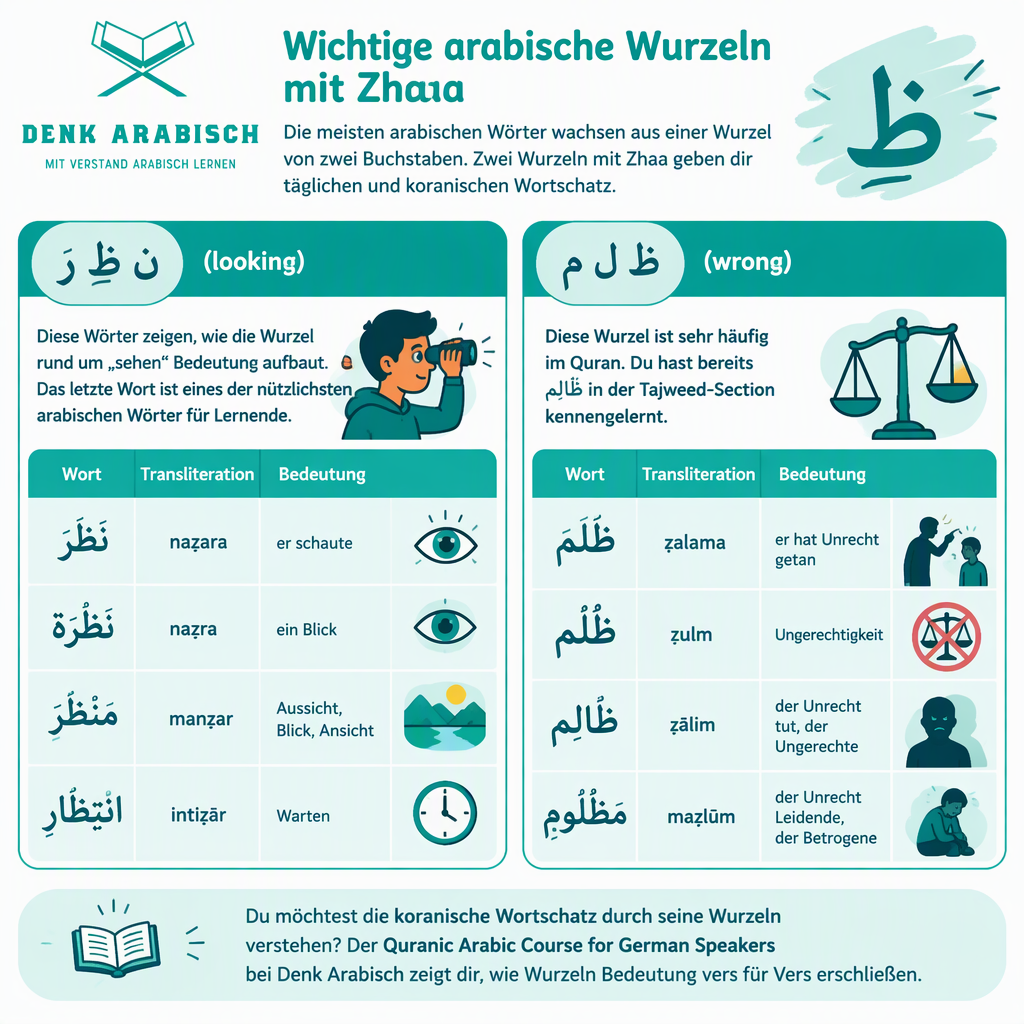
Important Arabic Roots with Zhaa
Most Arabic words grow from a root of three letters. These three roots with Zhaa give you daily and Quranic vocabulary.
1. ن ظ ر (looking)
These words show how the root builds meaning around “to see”. The last word is among the most useful Arabic words for a learner.
| Word | Transliteration | Meaning |
| نَظَرَ | naẓara | he looked |
| نَظْرَة | naẓra | a glance |
| مَنْظَر | manẓar | view |
| انْتِظَار | intiẓār | waiting |
2. ظ ل م (wrong)
This root is very frequent in the Quran. You already met ظَالِم in the Tajweed section.
| Word | Transliteration | Meaning |
| ظَلَمَ | ẓalama | he wronged |
| ظُلْم | ẓulm | injustice |
| ظَالِم | ẓālim | wrongdoer |
| مَظْلُوم | maẓlūm | wronged person |
3. ح ف ظ (preserving, memorizing)
This root covers protecting and memorizing, and it is central to Quran learning. Allah says: إِنَّا نَحْنُ نَزَّلْنَا الذِّكْرَ وَإِنَّا لَهُ لَحَافِظُونَ, “Indeed, We sent down the Reminder, and indeed, We will be its guardians” (Al-Ḥijr 15:9).
| Word | Transliteration | Meaning |
| حَفِظَ | ḥafiẓa | he memorized, he protected |
| حِفْظ | ḥifẓ | memorization |
| حَافِظ | ḥāfiẓ | one who has memorized the Quran |
| مَحْفُوظ | maḥfūẓ | preserved |
Want to understand Quranic vocabulary through its roots? The Quranic Arabic Course for German Speakers at Denk Arabisch shows you how roots unlock meaning verse by verse.
Examples of Zhaa in Words
Zhaa appears at the beginning, middle and end of words. The table lists common words for each position.
| Position | Arabic Word | Transliteration | Meaning |
| Beginning | ظِلّ | ẓill | shadow |
| Middle | نَظَر | naẓar | sight, look |
| End | لَفْظ | lafẓ | word, utterance |
Examples of Zhaa in Sentences
These three short sentences use the words you just learned, with full case endings.
| Arabic Sentence | Transliteration | Meaning |
| نَظَرَ الطِّفْلُ إِلَى الظِّلِّ. | naẓara aṭ-ṭiflu ilā aẓ-ẓilli. | The child looked at the shadow. |
| أَنْتَظِرُ صَدِيقِي بَعْدَ الظُّهْرِ. | antaẓiru ṣadīqī baʿda aẓ-ẓuhri. | I wait for my friend after noon. |
| الْحِفْظُ مُهِمٌّ لِلطُّلَّابِ. | al-ḥifẓu muhimmun liṭ-ṭullābi. | Memorization is important for students. |
Read “Daily Arabic Phrases” and learn useful Arabic expressions you can use in everyday conversations.
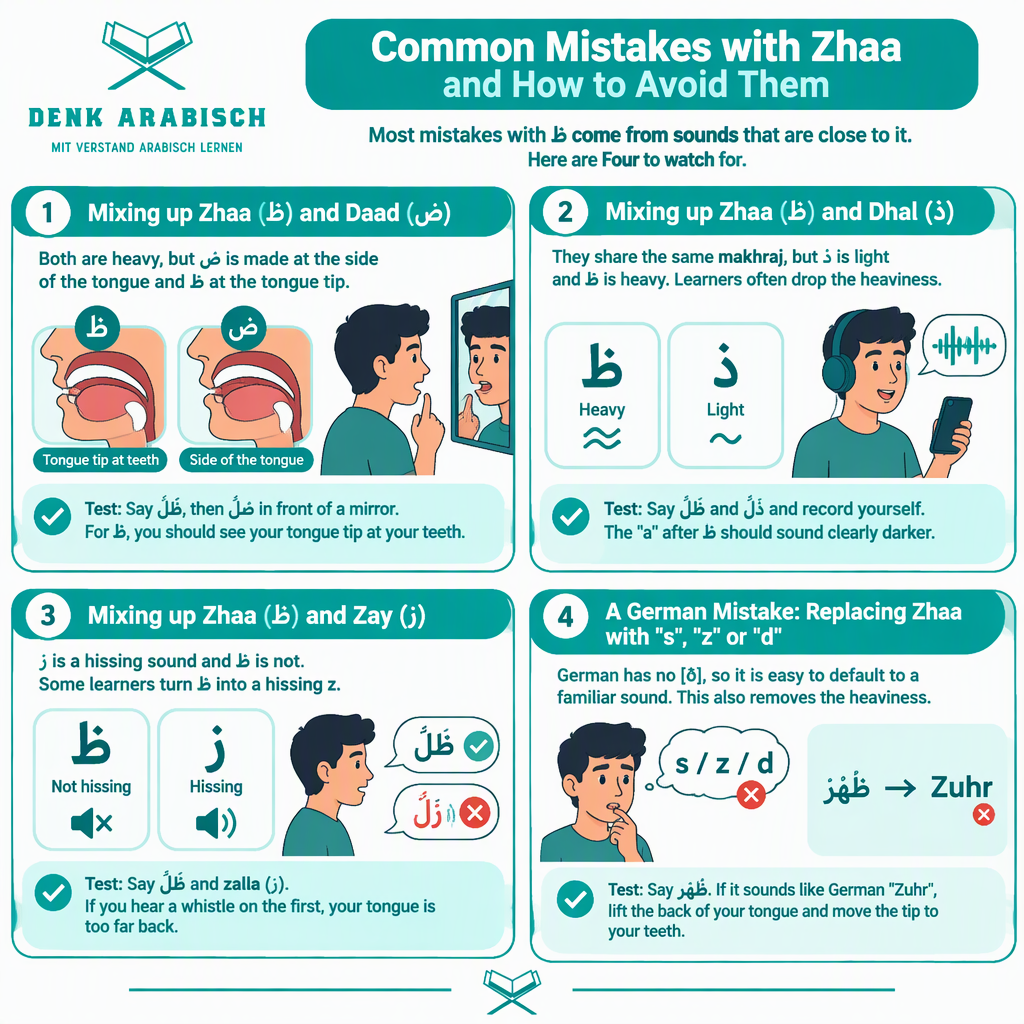
Common Mistakes with Zhaa and How to Avoid Them
Most mistakes with ظ come from sounds that are close to it. Here are Four to watch for:
1. Mixing up Zhaa (ظ) and Daad (ض)
Both are heavy, but ض is made at the side of the tongue and ظ at the tongue tip.
Test: Say ظَلَّ, then ضَلَّ in front of a mirror. For ظ, you should see your tongue tip at your teeth.
2. Mixing up Zhaa (ظ) and Dhal (ذ)
They share the same makhraj, but ذ is light and ظ is heavy. Learners often drop the heaviness.
Test: Say ظَلَّ and ذَلَّ and record yourself. The “a” after ظ should sound clearly darker.
3. Mixing up Zhaa (ظ) and Zay (ز)
ز is a hissing sound and ظ is not. Some learners turn ظ into a hissing z.
Test: Say ظَلَّ and zalla (ز). If you hear a whistle on the first, your tongue is too far back.
4. A German Mistake: Replacing Zhaa with “s”, “z” or “d”
German has no [ð], so it is easy to default to a familiar sound. This also removes the heaviness.
Test: Say ظُهْر. If it sounds like German “Zuhr”, lift the back of your tongue and move the tip to your teeth.
Exercises: Test Your Zhaa Knowledge
Five short exercises use only words from this article. Answers follow each one, except the writing practice.
Exercise 1: Multiple Choice
Where is Zhaa produced?
a) the throat
b) tongue tip and edges of the upper front teeth
c) the lips
d) the side of the tongue
Answer: b
Exercise 2: Matching
Match each word with its meaning.
- ظَلَّ
- ضَلَّ
- ذَلَّ
- زَلَّ
a) he slipped
b) he went astray
c) he remained
d) he became humble
Answer: 1-c, 2-b, 3-d, 4-a
Exercise 3: Writing Practice
Write ظ in its four forms. Then write: ظِلّ, حِفْظ, وَظِيفَة.
Exercise 4: True or False
- Zhaa is a moon letter.
- Zhaa has one dot above.
- Zhaa is a heavy letter.
- Zhaa is produced in the throat.
Answers: 1 false, 2 true, 3 true, 4 false
Exercise 5: Spot the Zhaa
Which words contain ظ? ظِلّ، ضَلَّ، نَظَر، ذَلَّ، حِفْظ
Answer: ظِلّ، نَظَر، حِفْظ.
What Our Students Say About Denk Arabisch Academy
See what our students say about learning at Denk Arabisch Academy on Trustpilot. Read their experiences and check out more reviews to discover how our courses help improve Arabic.

Learn Arabic Step by Step with Denk Arabisch
Zhaa is one of 28 letters, and learning them in a clear order saves you months of confusion. Structure turns scattered knowledge into real progress.
Denk Arabisch is built for German-speaking learners and explains Arabic through German.
- Explanations that start from German, not from English
- Structured courses from the alphabet to Quranic Arabic
- Pronunciation training with a focus on sounds German lacks
- Courses for both adults and children
Choose Your Specialized Course:
- Arabic Course For Beginners: your first words, letters and sentences.
- Quranic Arabic Course for German Speakers: understand Quranic vocabulary and grammar.
- Quran Tajweed Course for German Speakers: recite with correct rules.
- Arabic Alphabet Course: letters, sounds and shapes.
- Arabic Reading Course: read Arabic fluently with tashkeel.
- Arabic Writing Course: write letters by hand with confidence.
- Arabic Speaking Course: speak with real structure.
Learn Arabic with Denk Arabisch Academy
Speak and understand Arabic through a clear and effective learning system
Try a Free TrialReady to start? Book a free trial at Denk Arabisch.
See what students and parents say about Denk Arabisch on Trustpilot

Conclusion
The Letter Zhaa (ظ) is a heavy tongue-tip sound that German lacks, but it is easy to learn with the right steps. Knowing its makhraj, its four forms and its roots makes it a letter you can use every day.
- Sound: a voiced, emphatic [ðˤ] made at the tongue tip and upper front teeth.
- Writing: one dot above, four forms, connects to the next letter.
- Recognition: heavy, a sun letter, and often confused with ض, ذ and ز.
Practice the sound daily with ظَلَّ, ضَلَّ, ذَلَّ and زَلَّ. Write ظ in all four forms, then add the roots ن ظ ر, ظ ل م and ح ف ظ. You are closer than you think.
Book a free trial lesson at Denk Arabisch and take your next step.
FAQs
1. What is the difference between ظ and ض?
ض is made at the side of the tongue, while ظ is made at the tongue tip and teeth. They are both heavy, but ظ has a clear flow of air.
2. What is the difference between ظ and ذ?
They share a makhraj, but ذ is light and ظ is heavy. ظ also has Iṭbāq (tongue covers the palate).
3. Is Zhaa a sun or moon letter?
It is a sun letter. The lām of ال merges into it, and ظ takes a shadda, as in الظِّلّ.
4. Is Zhaa heavy or light?
It is always heavy. It is one of the seven letters of خُصَّ ضَغْطٍ قِظْ and stays heavy even with kasra.
5. Which Tajweed rules involve Zhaa?
Idghām Shamsī applies because it is a sun letter. Also, ذ merges into ظ in إِذْ ظَّلَمْتُمْ (Az-Zukhruf 43:39).