Arabic learning books for beginners
An Arabic learning books for beginners can make the first stage much easier when it teaches script, pronunciation, and basic structure in the right order. This matters especially for German speakers because Arabic sounds, letter connections, and sentence patterns work differently from German. Choosing the right book saves time, prevents common beginner mistakes, and creates a more structured start.
Inhaltsverzeichnis
What a good Arabic learning books for beginners should do
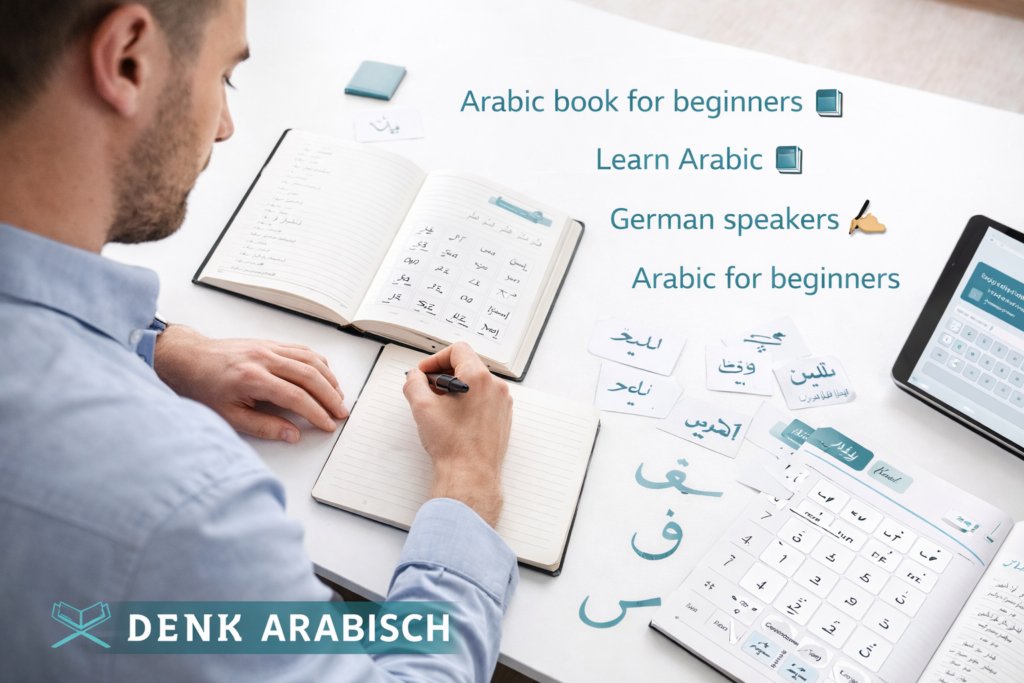
A good Arabic learning books for beginners does not only teach words. It builds a stable foundation so that reading, listening, writing, and first sentences grow together. This is where useful books differ from attractive but shallow introductions.
A. Which goals a beginner book should cover
A beginner book should combine three goals: reading the script confidently, building basic vocabulary, and understanding simple sentences. When one of these areas is missing, the start often becomes uneven.
B. Why German speakers need different explanations
German-speaking beginners benefit from clear explanations of sounds, sentence structure, and connected script. The challenge is not only new vocabulary, but also a different language system with a different reading direction and different sound habits.
C. When a book is not enough on its own
A book can explain many things, but it does not correct pronunciation. Sounds such as ح, خ, and ع often become fixed incorrectly if nobody corrects them early. That is why a structured learning setting is often the safer next step.
By the end of this first stage, it usually becomes clear why Denk Arabisch with Arabic courses and qualified teachers can effectively extend what a book alone can only provide to a limited degree.
Which types of Arabic books for beginners exist
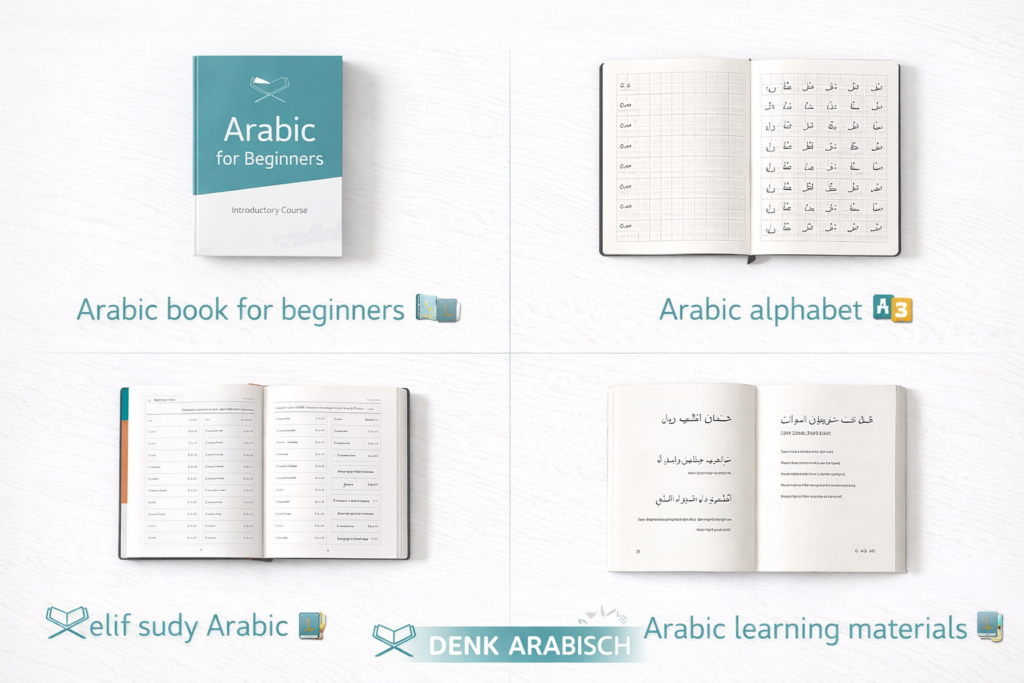
Not every Arabic Learning Books serves the same purpose. Some are full coursebooks, while others train only script, vocabulary, or early reading texts. Once you understand the type, choosing becomes easier.
A. Coursebooks for a structured start
These books guide the learner lesson by lesson through the alphabet, core structures, and simple dialogues. They are useful when a beginner needs a clear path.
B. Writing books for alphabet and letter connection
These books focus on shapes, writing direction, and joining letters. They are especially helpful at the beginning, but they are not enough by themselves for language growth.
C. Vocabulary books for first exposure
Vocabulary books introduce many themes quickly. Without sentence training and audio, however, the words often stay passive and are rarely used spontaneously.
D. Easy readers for first reading confidence
Short texts in simple language support recognition and reading flow. They become useful once the learner already has a basic grasp of the alphabet.
Which book fits which learning goal
The right choice does not depend on the nicest cover, but on the real goal. Learners who separate goal from book type usually progress more efficiently.
A. For script and reading
Anyone who wants to recognize Arabic letters securely should begin with a script-focused book. This creates calm and confidence for later reading of words and short sentences.
B. For speaking in daily situations
Anyone who wants to speak early needs dialogues, audio material, and sentence patterns. A book without audio usually remains too theoretical for active speaking.
C. For Modern Standard Arabic
For a broad entry into the language, Modern Standard Arabic is a sensible choice. It creates a clean base for reading, basic grammar, and formal communication.
D. For introductory Quranic Arabic
A Quran-focused start can be motivating, but it usually needs methodical guidance. Vocabulary, morphology, and pronunciation often follow different priorities than everyday language learning.
Learn Arabic with Denk Arabisch Academy
Speak and understand Arabic through a clear and effective learning system
Join nowHow German speakers should choose the right book
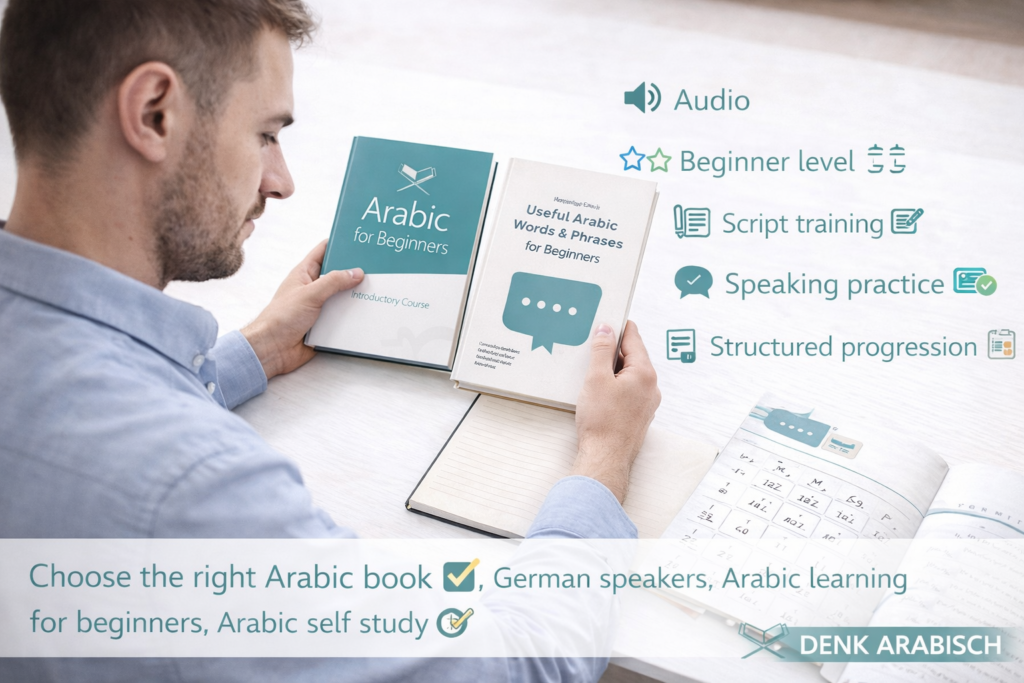
Selection becomes easier when clear criteria are used. This helps avoid buying a book that looks attractive but does not match the learner’s actual level.
1. Define the learning goal before buying
Someone who wants to read, speak, or begin Quranic Arabic needs a different focus in each case. The goal determines the book type, pace, and exercise style.
2. Check the explanation language
For complete beginners, German as the explanation language is helpful. Grammar, sound production, and task instructions become easier to understand.
3. Check audio and exercises
A good beginner book should include audio and exercises with answers. Without these two elements, self-correction often remains unreliable.
4. Evaluate structure and progression
A good book moves from simple to more complex content. It does not begin with too much theory, but with readable units that expand step by step.
Which problems a book often cannot solve alone
Even a good textbook has limits. Learners who understand these limits use the book more realistically and add support in time.
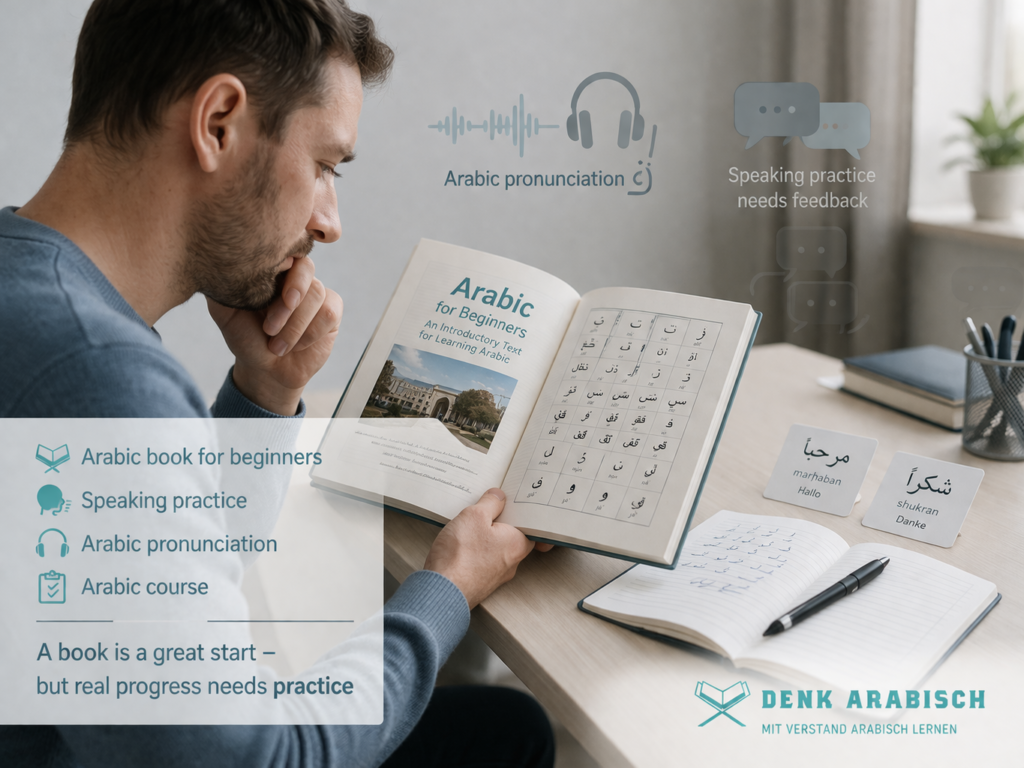
A. Difficult sounds for German native speakers
The letters ح and خ are both produced in the throat, but not at exactly the same articulation point. ح is softer and deeper, while خ is more friction-based and audibly rougher. Reading this is possible; mastering it automatically is not.
B. Unstable pronunciation without correction
Many beginners cannot hear their own errors clearly. A wrong sound or an inaccurate vowel length can become permanent through repetition.
C. Too little active language production
Many books train recognition more than production. The learner understands lessons, but cannot yet speak independently.
This is where the practical value of Denk Arabisch becomes especially clear: native Arab teachers, flexible learning times, and individual feedback close exactly the gap between knowing and using the language.
How to learn effectively with a beginner book
A good book only works well when the study routine works well. Small and consistent study units are more valuable for beginners than rare long sessions.
1. Begin with script and sounds
Anyone who learns the alphabet only visually builds an unstable base. Letter and sound should be trained together from the beginning.
2. Study daily in short sessions
Fifteen to twenty minutes every day often leads further than one long weekly session. Repetition is especially important for script and basic vocabulary.
3. Say new words aloud immediately
Speaking aloud connects the ear, tongue, and memory. This makes words available more quickly for active use.
4. Write and read after every lesson
Writing slows learning down in a useful way. That is exactly why letter forms, vowel signs, and word patterns become more secure.
5. Get feedback regularly
A beginner notices progress faster when mistakes are corrected early. This saves a great deal of relearning later.
Which mistakes beginners should avoid
Many problems do not come from weak motivation, but from weak learning strategy. Some common mistakes are easy to avoid.
A. Starting several books at the same time
Too many materials create confusion. One main book with a clear order and only a few additions works better.
B. Learning only passively
Learners who only look and highlight progress more slowly. Language becomes more stable when it is read, spoken, and written.
C. Mixing Modern Standard Arabic and dialect without a plan
A beginner should first build one clear base. Otherwise forms, vocabulary, and sentence patterns become unnecessarily blurred.
Comparison of the main beginner book types
| Book type | Main strength | Main weakness | Best for |
| Coursebook | Structured progression | Sometimes slow pace | Complete beginners |
| Writing book | Strong script foundation | Little language practice | Alphabet and connection |
| Vocabulary book | Fast thematic overview | Little sentence training | Supplementary learning |
| Reader | Better reading flow | Not ideal as a first start | Learners with script basics |
Learn Arabic with Denk Arabisch Academy
Speak and understand Arabic through a clear and effective learning system
Join nowStart your journey with Denk Arabisch
A good book can be the beginning. Faster progress usually comes when structure, correction, and regular use are combined.
Denk Arabisch gives German-speaking learners exactly this combination: native Arab teachers, flexible learning times, personal study plans, and clear guidance from the first letter to first real conversations. Arabic courses are especially helpful when a book creates motivation but not yet confidence.
❌ Learning without a plan often leads to stalled progress, uncertain pronunciation, and long breaks.
✅ Learning with Denk Arabisch connects book, explanation, feedback, and clear next steps.
Sign up now for a free trial lesson with Denk Arabisch and turn a good start into a dependable learning path.
Our Courses Include:
- Arabic Courses for German Speakers
- Arabic Levels for German Speakers
- Arabic Dialect Courses for German Speakers
- Qur’an Learning Courses for German Speakers
- Islamic Studies Courses for German Speakers
- Courses for Muslim Kids for German Speakers
(FAQs)
1. Is a beginner book enough for a complete start
For a first start, often yes. For accurate pronunciation and active speaking, usually not fully.
2. Should you learn reading or speaking first
It is best to learn both together. Script without sound stays abstract, and speaking without script stays unstable.
3. Is such a book enough for Quran reading
It may be enough for basic orientation. For accurate pronunciation and controlled Quran reading, additional guidance is usually necessary.
Conclusion
The right beginner book makes the start easier, but it rarely replaces guidance, pronunciation correction, and speaking practice. Learners who combine a book with structured support usually learn more clearly, more confidently, and faster.