Arabic Script
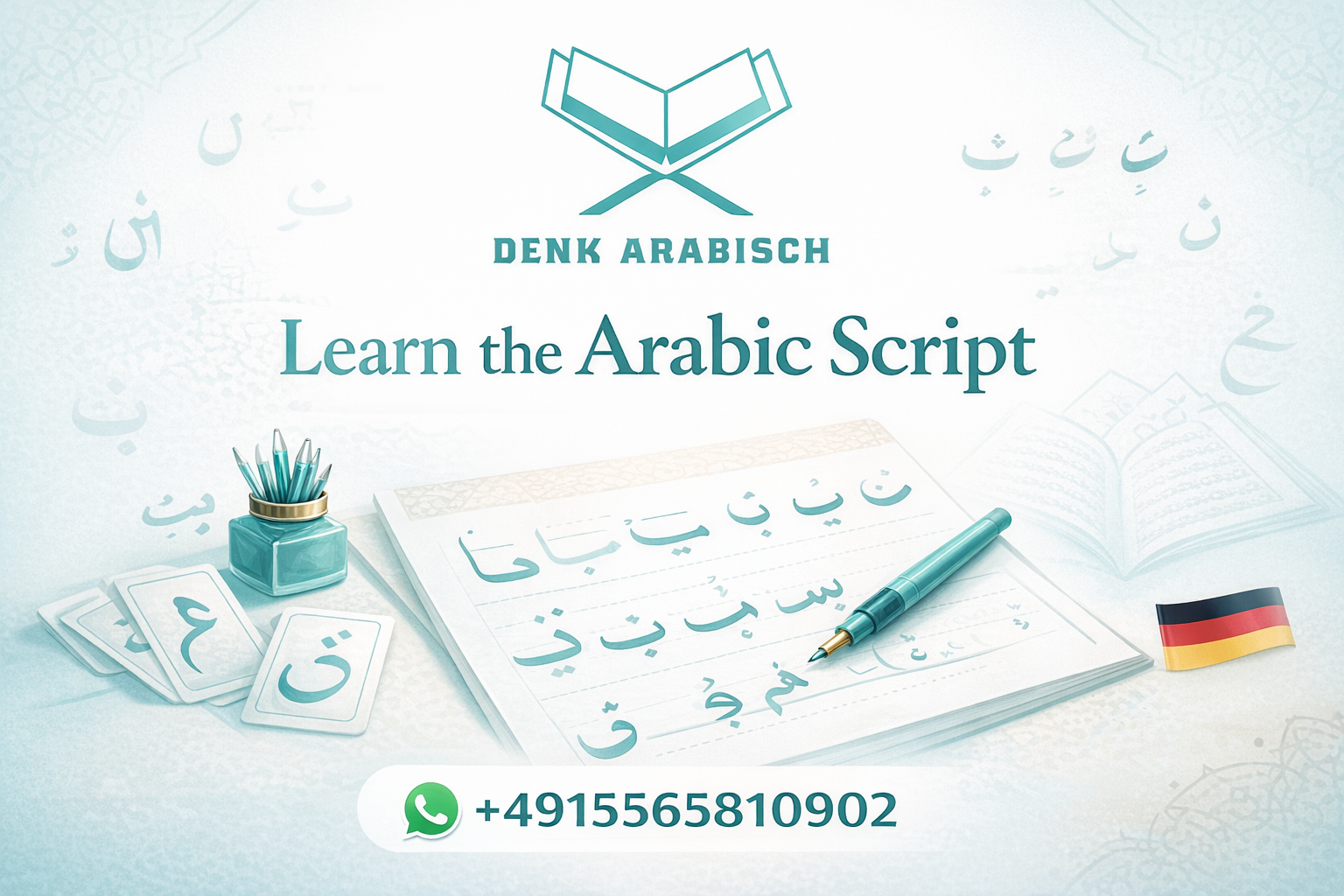
The Arabic script is often the first real challenge for German learners starting Arabic. It looks unfamiliar at first because it is written from right to left and uses a completely different sound system. At the same time, it is the foundation for reading, speaking, and understanding Arabic—especially when it comes to accessing the Quran.
Inhaltsverzeichnis
What is the Arabic script and why does it matter?

The Arabic script consists of 28 letters and is written from right to left. Unlike German, many letters change their shape depending on their position within a word.
For learners in Germany, this means:
You are not just learning new letters—you are learning a new reading system.
Once you understand the Arabic script, you can:
- Read words correctly
- Improve pronunciation
- Access the Quran in its original form
How is the Arabic script structured?
The Arabic script is based on a consonant-focused system. This means that most letters represent consonants, while short vowels are often not written.
Key features include:
- 28 letters in total
- Letters are connected within words
- Each letter has up to 4 forms:
- Isolated
- Initial
- Medial
- Final
Example:
The letter ب (ba) changes its shape depending on where it appears.
Why is Arabic script difficult for German speakers?
One of the main challenges is pronunciation.
There are sounds in Arabic that do not exist in German, such as:
- ح (ḥa) – a soft throat sound
- خ (kha) – similar to “ch,” but deeper
- ع (‘ayn) – a deep throat sound
These differences make the Arabic script feel complex—but also highly systematic once understood.
👉 This is exactly where structured lessons with native teachers—like at Denk Arabisch—make a real difference.
Read also: Arabic learning app
Learn Arabic with Denk Arabisch Academy
Speak and understand Arabic through a clear and effective learning system
Join nowHow to learn the Arabic script step by step

The most effective approach is structured learning:
1. Learn the letters and their sounds
Start with:
- recognizing each letter
- correct pronunciation
- basic writing practice
2. Understand letter connections
Learn:
- how letters connect
- which letters do not connect
3. Learn short vowels (harakat)
These help you:
- read correctly
- pronounce words accurately
4. Read simple words
For example:
- بيت (house)
- كتاب (book)
Read also: How many letter in arabic
Common mistakes German learners make

Typical issues include:
Confusing similar letters
Example:
- ب / ت / ث
Ignoring dots
Dots completely change the meaning.
Reading like German
Arabic follows different reading patterns.
Skipping the basics
Many learners try to speak before mastering the script.
👉 A structured learning path helps avoid these problems.
How to practice Arabic script daily
Consistency is key:
- Practice reading 10–15 minutes daily
- Read simple words out loud
- Repeat short texts
- Switch your phone to Arabic
Also:
- Listen and read at the same time
- Write simple words daily
Read also: Arabic Letters
Why is Arabic script essential for the Quran?
The Arabic script is not just a writing system—it is the foundation of Quran reading.
Without proper reading:
- meanings can change
- important nuances are lost
That’s why combining script + pronunciation is essential.
👉 Denk Arabisch focuses exactly on this combination, especially for learners in Germany.
How structured courses accelerate your progress
Many learners struggle not because Arabic is difficult—but because they lack structure.
A good course provides:
- clear steps
- teacher feedback
- guided practice
- real application from day one
For people in Germany, online learning offers maximum flexibility.
Learn Arabic with Denk Arabisch Academy
Speak and understand Arabic through a clear and effective learning system
Join nowStart Your Journey with Denk Arabisch
If you want to truly master the Arabic script, you need more than apps.
With Denk Arabisch, you get:
- Structured Arabic courses (A1–C2)
- Quran and Tajweed courses
- Native Arabic teachers
- Flexible online schedules
- Personalized learning plans
Our Courses Include:
- Arabic Courses for German Speakers
- Arabic Levels for German Speakers
- Arabic Dialect Courses for German Speakers
- Qur’an Learning Courses for German Speakers
- Islamic Studies Courses for German Speakers
- Courses for Muslim Kids for German Speakers
Frequently Asked Questions
How long does it take to learn the Arabic script?
For most beginners, learning to recognize the Arabic letters can happen relatively quickly, but reading fluently takes more time and regular practice. Learners often find that the real challenge is not only memorizing the letters, but also understanding how they connect and how their sounds work in real words.
Can German speakers learn the Arabic script on their own?
Yes, many German speakers can begin learning the Arabic script independently, especially when they start with the alphabet, letter forms, and pronunciation. However, self-study often becomes difficult when it comes to distinguishing similar letters, mastering connected forms, and producing unfamiliar Arabic sounds correctly.
Do I need to learn short vowels to read Arabic properly?
Yes. Short vowels are essential for accurate pronunciation, especially in the early stages of learning. Since Arabic script often does not show short vowels in normal writing, beginners rely on them to read correctly and avoid mistakes—particularly when reading the Quran.
Conclusion
Learning the Arabic script is the first and most important step in your Arabic journey. While it may seem unfamiliar at first, it follows a clear and logical system.
What matters most is not talent—but:
- consistency
- structured learning
- daily practice
Once you master the script, you unlock the full world of Arabic—from everyday communication to the Quran.