Takeaway:
- Arabic is the language of the Qur’an; learning it deepens your understanding of prayer and Islamic teachings beyond translation.
- Online study gives Muslims in Germany flexible scheduling, native teacher access, and affordable lessons without commuting.
- Start with Qur’anic Arabic if your main goal is connecting with the Qur’an; this builds a strong spiritual foundation.
- Master the alphabet and pronunciation first, then learn frequently repeated Qur’anic vocabulary before heavy grammar.
- Combine reading, listening, and speaking daily—even 20–30 minutes—to build lasting language habits.
- Stick to one structured course to avoid information overload; jumping between apps slows progress.
- Keep your intention (niyyah) clear—learning Arabic is an act of worship that sustains motivation during difficulties.
- A step‑by‑step programme designed for German speakers, like Denk Arabisch, guides you from basics to confident comprehension.
In today’s connected world, learning Arabic has become more accessible than ever—especially for Muslims in Germany who want to deepen their understanding of the Qur’an, strengthen their faith, or connect with the global Muslim community. Online Arabic learning offers flexibility, affordability, and access to qualified teachers from around the world.
Table of Contents
Why Learn Arabic as a Muslim?
Arabic holds a special place in Islam. It is the language of the Qur’an, the daily prayers (Salah), and many essential supplications. While translations help, they cannot fully capture the depth and beauty of the original text.
For Muslims living in Germany, learning Arabic can:
- Enhance understanding of Islamic teachings
- Improve focus and connection during الصلاة (Salah)
- Enable direct engagement with Islamic texts
- Strengthen cultural and religious identity
👉 And instead of struggling alone, Denk Arabisch guides you through Arabic Courses step by step—specifically designed for Muslims like you in Germany.
Benefits of Learning Arabic Online in Germany
Learning Arabic online in Germany offers flexibility, accessibility, and cost efficiency, allowing learners to study anytime, from anywhere, without disrupting daily commitments.
It also provides direct access to native teachers and authentic language exposure, enhancing pronunciation, understanding, and overall learning experience.
1. Flexible Scheduling
Many Muslims in Germany balance work, studies, and family life. Online Arabic courses allow you to learn at your own pace, whether early in the morning or late at night.
2. Access to Native Teachers
Online platforms connect you with qualified native Arabic speakers from countries like Egypt, Jordan, and Saudi Arabia, offering authentic pronunciation and cultural insights.
3. Affordable Options
Compared to in-person classes, online learning is often more budget-friendly, with various pricing plans and even free resources available.
4. Learn from Anywhere
Whether you live in Berlin, Hamburg, Munich, or a smaller town, you can access high-quality Arabic education without commuting.
Don’t guess where you belong. Take our Arabic Placement Test For German Speakers today and get a personalized learning path.
What Type of Arabic Should You Learn?
There are different forms of Arabic, and your choice depends on your goals:
- Qur’anic Arabic: Ideal for understanding the Qur’an and religious texts
- Modern Standard Arabic (MSA): Useful for reading, writing, and formal communication
- Colloquial Arabic: Helpful for everyday conversations, depending on the region
For most Muslims, starting with Qur’anic Arabic is highly recommended.
That’s why Denk Arabisch focuses first on Qur’anic Arabic by Quran Courses, then builds your understanding step by step—without confusion.
How to Learn Arabic Effectively (Step-by-Step)?
Learning Arabic is not about studying harder—it’s about studying smarter. Here’s a practical roadmap:
1. Start with the Arabic Alphabet
Before anything else, you need to:
- Recognize letters
- Learn correct pronunciation (Makharij)
- Practice reading simple words
Tip: Focus on sound + shape together, not memorization alone.
2. Learn Basic Vocabulary First
Instead of diving into grammar immediately:
- Start with common Qur’anic words
- Learn frequently repeated vocabulary
This helps you understand faster and stay motivated.
3. Combine Reading, Listening, and Speaking
Effective learning requires balance:
- القراءة (Reading): Recognize words and verses
- الاستماع (Listening): Hear correct pronunciation
- التكرار (Repetition): Repeat what you hear
This combination builds strong language retention.
4. Study with Structure
Jumping between apps and videos can slow your progress.
Instead:
- Follow one structured course
- Progress step by step
- Avoid overload
👉 This is exactly how Denk Arabisch designs its programs—clear, guided, and beginner-friendly.
Learn Arabic with Denk Arabisch Academy
Speak and understand Arabic through a clear and effective learning system
Try a Free TrialEssential Tools for Learning Arabic
Learning Arabic effectively requires a structured course, consistent listening practice, vocabulary tools, and guidance from a qualified teacher. So to succeed, you need the following:
1. Structured Course Platform
A guided program (like Denk Arabisch) gives you:
- Clear roadmap
- Organized lessons
- Step-by-step progress
2. Audio Resources
Listening is key for pronunciation.
Use:
- Qur’an recitations
- Arabic listening exercises
- Repetition practice
3. Flashcards & Vocabulary Tools
Apps or notebooks help you:
- Memorize words faster
- Review daily
4. Qualified Teacher
A teacher helps you:
- Avoid mistakes early
- Improve Tajweed
- Stay consistent
Are you already past the basics? Challenge yourself with our Arabic Levels Courses specifically designed for German-speaking advanced learners.
Teacher Excellence & Student Feedback
Our platform is built on the quality of our teachers and the success of our students. We believe that great teaching creates great results.
- Experienced and certified instructors
- Personalized guidance for every student
- Continuous feedback to ensure steady improvement
- Interactive teaching methods that keep learners engaged
We also value student feedback highly, as it helps us maintain excellence and continuously improve our courses and teaching experience.
Join us and learn with teachers who truly care about your progress and success.
Tips for Success In Learning Arabic Journey:
- Set Clear Goals: Decide if you want to understand the Qur’an, speak fluently, or both
- Be Consistent: Even 20–30 minutes daily can make a big difference
- Practice Regularly: القراءة (reading), الكتابة (writing), and listening all matter
- Use Islamic Content: Learn through Qur’anic verses and Hadith for deeper engagement
- Stay Motivated: Remember your spiritual purpose
Common Challenges In Arabic Learning and How to Overcome Them
Learning Arabic often comes with challenges like inconsistency, difficulty with the script, loss of motivation, and overwhelming resources.
However, with a structured routine, focused practice, strong intention, and a single clear learning path, these obstacles can be effectively overcome.
1. Lack of Consistency
Problem: Busy schedules can interrupt learning.
Solution: Set a fixed daily or weekly schedule, even if it’s just 20 minutes.
2. Difficulty with Arabic Script
Problem: Arabic letters and pronunciation may feel challenging.
Solution: Start with the basics and practice daily. Focus on repetition.
3. Motivation Drops Over Time
Problem: Initial excitement fades.
Solution: Remind yourself of your intention (niyyah). Learning Arabic is an act of worship.
4. Information Overload
Problem: Too many resources can be overwhelming.
Solution: Stick to one structured course and avoid jumping between platforms.
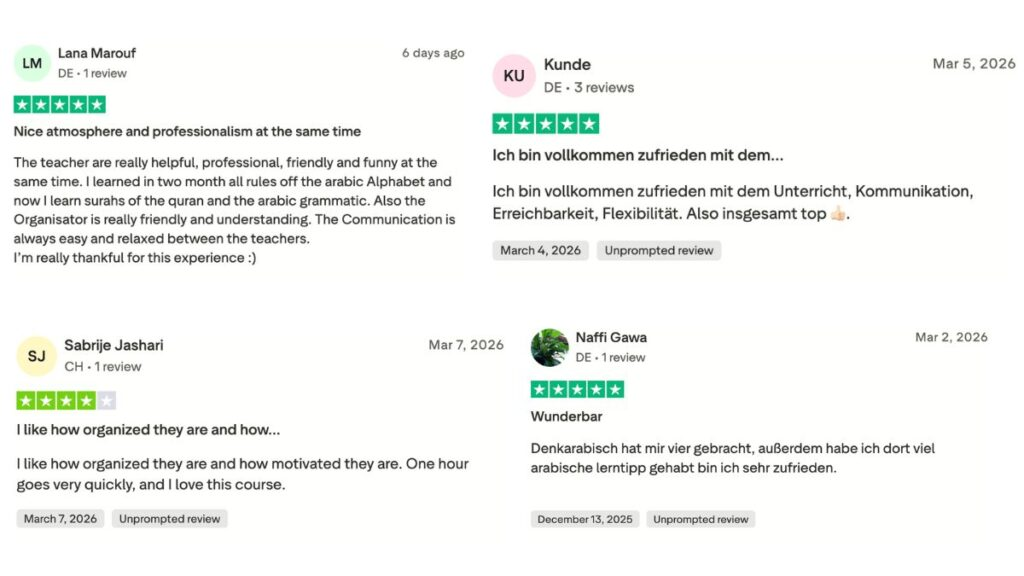
What Our Students Say About Denk Arabisch Academy
See what our students say about learning at Denk Arabisch Academy on Trustpilot. Read their experiences and check out more reviews to discover how our courses help improve Arabic.
Let’s be real…
You’ve been thinking about learning Arabic for a while.
- Waiting won’t make it easier
- Random apps won’t get you fluent
- And time keeps passing
The difference between wanting and actually understanding the Qur’an is taking action.
Join Denk Arabisch Today
At Denk Arabisch, learning Arabic becomes a clear and structured journey that takes you step by step from the basics to confident communication.
Our courses are designed to help you not only understand the language but also use it naturally in real-life situations and when engaging with the Qur’an. With Denk Arabisch, you get:
- Arabic Verb Conjugation: Master the patterns.
- Personal Pronouns & Prepositions: The building blocks of every sentence.
- Writing & Speaking: Transition from theory to real-life conversation.
Don’t delay your connection with the Qur’an.
Our Courses Include:
- Arabic Courses for German Speakers
- Arabic Levels for German Speakers
- Arabic Dialect Courses for German Speakers
- Qur’an Learning Courses for German Speakers
- Islamic Studies Courses for German Speakers
- Courses for Muslim Kids for German Speakers
Start your journey now with Denk Arabisch.
Spots are limited. The sooner you start, the faster you progress.
Learn Arabic with Denk Arabisch Academy
Speak and understand Arabic through a clear and effective learning system
Try a Free TrialConclusion
Learning Arabic online is a powerful opportunity for Muslims in Germany to strengthen their connection with Islam and gain a deeper understanding of their faith. With flexible options, access to expert teachers, and a wide range of resources, anyone can begin this rewarding journey today.
Start small, stay consistent, and remember: every word you learn brings you closer to understanding the Qur’an in its original language.
FAQs
1. How long does it take to learn Arabic for understanding the Qur’an?
The time required depends on your consistency and learning method. With regular study (20–30 minutes daily), beginners can start understanding basic Qur’anic vocabulary within 3–6 months. Achieving deeper comprehension may take 1–2 years of consistent effort.
2. Do I need to learn Modern Standard Arabic (MSA) before Qur’anic Arabic?
No, you don’t have to. Many Muslims choose to start directly with Qur’anic Arabic since their main goal is to understand the Qur’an. However, learning some basics of MSA can help with grammar and overall language structure.
3. Can I learn Arabic online without a teacher?
Yes, it is possible using apps, videos, and self-paced courses. However, having a teacher—especially for pronunciation and Tajweed—can significantly improve your progress and prevent mistakes.
4. What is the best age to start learning Arabic?
There is no “perfect” age. Children may learn faster, but adults often have better discipline and clear goals. Many Muslims in Germany successfully start learning Arabic in their 20s, 30s, or even later.
5. How much does it cost to learn Arabic online?
Costs vary widely depending on the platform and teaching style. You can find:
Free resources (YouTube, apps)
Affordable group classes
Premium one-on-one tutoring
On average, online lessons are more affordable than in-person classes in Germany.
6. Is it difficult to learn the Arabic alphabet?
At first, the Arabic script may seem challenging, but with consistent practice, most learners can read basic Arabic within a few weeks. The key is repetition and daily exposure.
7. Can I learn Arabic while working full-time?
Yes, online learning is ideal for busy professionals. Even short daily sessions (20–30 minutes) can lead to steady progress over time.