Takeaway:
- Quran learning apps for children bridge the gap between traditional Islamic education and modern digital life, offering flexible, structured, and engaging access to the Holy Quran anytime, anywhere.
- Interactive recitation, step-by-step simplified Tajweed, structured Hifz (memorization) plans, gamification with rewards, parent monitoring dashboards, and offline access are core features that make learning effective and enjoyable.
- Proven educational methods such as multi-sensory audio-visual learning, smart repetition, chunking of Surahs into small parts, instant recitation feedback, and story-based understanding help children memorize accurately and stay motivated.
- Selecting the right app requires age-appropriate content, authentic material reviewed by scholars, a child-friendly and intuitive interface, high-quality audio recitation, and a safe, ad-free environment.
- Parental involvement remains critical: a consistent daily routine, learning together, positive reinforcement, and leading by example transform app usage into lasting spiritual development.
- The ultimate goal goes beyond memorization — it’s about nurturing a deep, lifelong connection with the Quran through a balanced blend of technology and parental guidance.
In today’s fast-paced digital world, children are growing up surrounded by smartphones, tablets, and interactive apps. While this technology is often associated with entertainment, it also offers powerful educational opportunities — and one of the most meaningful uses of technology today is supporting Quran learning for children through dedicated mobile apps.
A well-designed Quran learning app for children can transform how kids connect with the Holy Quran. Instead of relying on traditional methods alone, children can now learn to read, recite, and memorize the Quran in a fun, engaging, and highly structured way — anytime, anywhere.
This comprehensive guide explores everything parents need to know about Quran learning apps for children, including their benefits, core features, proven teaching methods, common challenges, and how to choose the best app for your child’s age and learning level.

Table of Contents
Why Every Muslim Family Needs a Quran Learning App for Their Child?
Teaching children the Quran has always been a core responsibility in Muslim families. It is not just an educational goal — it is a spiritual investment in your child’s future.
However, modern lifestyles often make it difficult for parents to maintain consistent, structured learning at home or in Islamic centers. Work schedules, distance from mosques, and the shortage of qualified local teachers can all create real barriers.
This is exactly where Quran learning apps for children step in as a practical, reliable, and accessible solution.
1. Bridging the Gap Between Traditional and Digital Education for Children
Quran learning apps for children do not replace traditional methods like learning in mosques or with teachers. Instead, they enhance and support them by extending the learning experience beyond fixed settings.
- Help children revise lessons learned in school or with a teacher
- Allow continuous learning at home and during free time
- Strengthen memorization through repetition and practice
- Enable parents to follow their child’s progress more easily
- Combine structured education with flexible digital tools
2. Providing a Familiar and Engaging Environment for Kids
Since children are already used to using digital devices, learning through apps feels natural and enjoyable. This increases their motivation and makes them more willing to engage with Quran learning regularly.
- Use interactive features like audio, visuals, and simple activities
- Make learning feel like a fun and engaging experience
- Reduce boredom compared to traditional methods alone
- Encourage consistency through enjoyable content
- Build a positive emotional connection with the Quran
3. Supporting Non-Arabic Speaking Children and Families
For families who do not speak Arabic fluently, Quran learning can be challenging. Apps make this process easier by offering tools that support both reading and understanding.
- Provide correct pronunciation and Tajweed guidance
- Offer translations in different languages
- Help children understand meanings, not just recite
- Support parents who may not be confident in Arabic
- Make Quran learning accessible for global Muslim families
Unlock your child’s potential with specialized Arabic Lessons designed specifically for German-speaking children at Denk Arabisch!
4. Flexible Learning Schedules in Quran Learning Apps for Children
One of the biggest advantages of Quran learning apps is flexibility. Children can learn anytime, without being restricted to fixed schedules.
- Allow learning at any time of the day
- Fit easily into busy family routines
- Let children learn at their own pace
- Reduce pressure compared to strict class timings
- Support consistency through short, regular sessions
Is your child ready to recite the Quran with beauty and precision? Our Tajweed Course for German-Speaking Children at Denk Arabisch is specifically designed to simplify complex rules through engaging, easy-to-follow lessons.
Key Features of a Good Quran Learning App for Children
Not all Quran apps are the same. A truly effective application for children must be carefully designed to combine Islamic authenticity with child-friendly design.
1. Interactive Quran Recitation System for Children
A high-quality Quran learning app should include a strong and interactive recitation system that allows children to actively engage with the Quran rather than just passively listen.
This system helps children develop correct pronunciation (Makharij) and improves their listening and speaking skills step by step. Using professional Qaris with clear, slow, and accurate recitation is essential, especially for beginners.
Children should be able to:
- Listen to verses with clear and high-quality recitation
- Repeat verses multiple times for better memorization and fluency
- Record their own voice and identify pronunciation mistakes
- Compare their recitation with expert Qaris
- Control playback speed to match their learning level
- Focus on specific words or verses for detailed practice
This interactive approach not only improves accuracy but also builds confidence and encourages independent learning. Over time, children become more comfortable reciting on their own and less dependent on guidance.
2. Step-by-Step Tajweed Learning in Quran Learning Apps for Children
Tajweed is essential for correct Quran recitation, but it can feel complex and overwhelming for children if taught in a traditional, theory-heavy way.
A well-designed Quran learning app simplifies Tajweed by breaking it down into small, easy-to-understand steps that children can absorb gradually.
Effective apps usually include:
- Color-coded Mushaf to visually highlight Tajweed rules
- Simple and child-friendly explanations of each rule
- Audio demonstrations to model correct pronunciation
- Interactive exercises to practice each rule
- Gradual lessons that move from basic to advanced levels
- Repetition tools to reinforce learning over time
Some apps also connect Tajweed rules directly to real Quran verses, helping children apply what they learn immediately.
This structured and practical approach prevents confusion, reduces pressure, and helps children master Tajweed naturally and confidently.
3. Structured Quran Memorization Plans for Children
Memorizing the Quran (Hifz) becomes much easier and more effective when it is organized into clear, manageable steps.
A well-designed Quran learning app provides a structured memorization plan that guides children through their journey in a consistent and motivating way.
Common features include:
- Daily memorization goals tailored to the child’s level
- Smart repetition systems to strengthen long-term memory
- Spaced revision schedules to prevent forgetting previously memorized verses
- Progress tracking to visually show improvement and milestones
- Reminders to maintain consistency and avoid long gaps
- Divide the Surahs into small parts to facilitate preservation
Some apps also adapt the memorization plan based on the child’s progress, making the experience more personalized. This system builds discipline, improves retention, and helps children stay committed to their Hifz journey without feeling overwhelmed.
4. Gamification and Reward Systems for Children
Children are naturally motivated by rewards and achievements, which is why gamification plays a powerful role in Quran learning apps. By turning lessons into interactive challenges, apps help children stay excited and committed to learning.
Many apps include:
- Points, stars, or coins earned after completing lessons or tasks
- Achievement badges for milestones like finishing a Surah or mastering a rule
- Level progression systems that unlock new content gradually
- Certificates of completion to celebrate progress and effort
- Daily streaks that encourage consistent learning habits
- Mini challenges or quizzes that reinforce understanding in a fun way
This approach transforms Quran learning into a rewarding journey rather than a routine task. It also helps children develop discipline, as they become motivated to maintain their progress and achieve higher levels.
5. Engaging and Child-Friendly Visual Design
The design of a Quran learning app is not just about appearance—it directly impacts how well children stay focused and engaged. A child-friendly interface makes it easier for kids to navigate the app independently and enjoy the learning process.
Key design elements include:
- Bright, attractive colors that capture children’s attention
- Simple and intuitive navigation suitable for different age groups
- Animated characters that guide and encourage children
- Visual storytelling to explain lessons in an engaging way
- Icons and illustrations that make content easier to understand
- Distraction-free layouts that keep the focus on learning
A well-designed app reduces confusion and frustration, allowing children to spend more time learning and less time figuring out how to use the app.
Read also: Benefits Of Reading Quran At Night
6. Parent Monitoring Dashboard for Children’s Quran Learning
Parental involvement is essential in a child’s Quran learning journey. A good app includes a dedicated dashboard that allows parents to actively support and guide their children.
Parents can usually monitor:
- Daily, weekly, or monthly learning time
- Completed Surahs, lessons, and memorization progress
- Recitation accuracy and areas that need improvement
- Mistakes in pronunciation or Tajweed
- Consistency through activity reports and streak tracking
Additional useful features may include:
- Notifications or reminders for missed lessons
- Personalized feedback or performance summaries
- The possibility of setting educational goals for the child
This level of involvement helps parents stay informed and encourages children to stay committed, as they feel supported and guided throughout their learning journey.
7. Offline Learning Feature for Kids
Offline access is a highly practical feature that ensures learning continues without interruption, regardless of internet availability. This is especially important for families who travel frequently or have limited connectivity.
Benefits include:
- Ability to access lessons, recitations, and memorization tools without internet
- Continuous learning during travel or in low-connectivity areas
- Reduced distractions since no online interruptions occur
- Faster app performance without relying on network speed
Some apps also allow:
- Downloading specific Surahs or lessons in advance
- Saving progress locally and syncing it later when online
- Access to previously completed content for revision anytime
This feature makes Quran learning more flexible and reliable, ensuring that children can maintain consistency no matter their environment.
From basic alphabets to full Surah memorization, our Quran Course for German-Speaking Children at Denk Arabisch provides a structured environment that fosters a deep love for the Holy Book.
Learn the Quran with Denk Arabisch Academy
Master reading and understanding the Quran through structured and supportive learning
Try a Free TrialHow Quran Learning Apps Improve Children’s Education?
The effectiveness of Quran learning apps for children is not random—it is based on proven principles from educational psychology and modern teaching methods. These apps are designed to match how children naturally learn, making the process more effective, engaging, and long-lasting.
1. Audio-Visual Learning Techniques in Quran Learning Apps for Children
Children learn more effectively when multiple senses are involved at the same time. Quran learning apps combine visual and auditory elements to create a richer and more engaging learning experience.
Apps typically combine:
- Clear Arabic text displayed on the screen
- High-quality audio recitation by professional Qaris
- Word-by-word highlighting synchronized with recitation
- Visual cues that guide children through each verse
This multi-sensory approach helps children connect what they see with what they hear, improving focus and comprehension. It also strengthens memory retention, making it easier for children to recall verses later.
2. Repetition-Based Memorization for Kids
Repetition is one of the most powerful techniques for memorizing the Quran, especially for children. Quran learning apps use smart repetition systems that automatically repeat verses until the child becomes familiar with them.
Key benefits include:
- Reinforcing memorization through consistent repetition
- Helping children correct mistakes naturally over time
- Building fluency in recitation
- Allowing children to practice without feeling rushed
Some apps also allow customized repetition settings, so children can repeat difficult verses more frequently. This method ensures that memorization is not temporary but deeply rooted.
3. Chunking Method for Easier Learning for Kids
Memorizing long Surahs can feel overwhelming for children if presented all at once. Quran learning apps solve this by using the “chunking” method—breaking content into smaller, manageable sections.
Apps often:
- Divide Surahs into short verses or small groups of Ayat
- Focus on one section at a time before moving forward
- Combine memorization with revision of previous sections
- Provide clear progression steps to maintain motivation
This approach reduces pressure and makes learning feel achievable. It also helps children build confidence as they complete small goals step by step.
4. Immediate Feedback System
One of the biggest advantages of digital learning is instant feedback. Advanced Quran learning apps use technology to analyze children’s recitation and provide corrections in real time.
These systems can:
- Detect pronunciation mistakes
- Highlight incorrect words or sounds
- Provide correct recitation for comparison
- Guide children to repeat specific parts
Immediate feedback helps children learn faster by correcting errors before they become habits. It also reduces dependence on constant supervision, allowing for more independent learning.
5. Story-Based Learning Approach for Kids
Understanding the Quran is just as important as memorizing it. Many Quran learning apps include story-based learning to help children connect with meanings and values in an engaging way.
These features may include:
- Stories from the Quran presented in a simple, child-friendly way
- Lessons from the Seerah (life of the Prophet ﷺ)
- Moral values explained through relatable examples
- Visual storytelling using animations and illustrations
This approach helps children develop a deeper emotional and spiritual connection with the Quran. It also makes learning more meaningful, as children understand the lessons behind what they memorize.

How to Choose the Best Quran Learning App for Children
Parents should carefully evaluate Quran learning apps before choosing one for their children, as the quality of the app directly affects the child’s learning experience, understanding, and long-term connection with the Quran.
1. Age-Appropriate Content for Children’s Quran Learning
Different age groups require different learning approaches. A good Quran learning app should be designed to match the child’s cognitive level and learning ability.
- Younger children need simple lessons with basic Arabic letters and short Surahs
- Older children require more advanced features like Tajweed rules and structured memorization (Hifz) plans
- Content should be gradually progressive to avoid overwhelming the child
- Lessons should be short, clear, and easy to follow
- The app should adapt to the child’s learning pace
Age-appropriate content ensures that children stay motivated and do not feel frustrated or bored during their learning journey.
2. Authentic Islamic Content in Quran Learning Apps
Authenticity is one of the most important factors when selecting a Quran learning app. Parents must ensure that the content is accurate and follows correct Islamic teachings.
- Content should be reviewed or supervised by qualified Islamic scholars
- Recitations must follow proper Tajweed rules
- Translations and explanations should be reliable and accurate
- The Mushaf text should be authentic and error-free
- Educational material should align with trusted Islamic sources
This ensures that children learn the Quran correctly without misunderstandings or incorrect interpretations.
3. User-Friendly Interface for Children
A simple and intuitive interface is essential to help children use the app independently without constant assistance from parents.
- Easy navigation with clear buttons and menus
- Simple layout suitable for different age groups
- Large icons and readable text for better accessibility
- Minimal complexity to avoid confusion
- Smooth performance for uninterrupted learning
A user-friendly design encourages independence and makes children more confident in using the app regularly.
4. High-Quality Audio Recitation in Quran Learning Apps
Clear and accurate audio is essential for correct Quran learning, especially for pronunciation and Tajweed.
- Professional Qaris with clear and slow recitation
- High-quality audio without distortion or noise
- Option to repeat verses multiple times
- Adjustable playback speed for different learning levels
- Accurate synchronization between text and audio
Good audio quality helps children develop correct pronunciation and improves memorization efficiency.
5. Safe Learning Environment for Kids Without Ads
Safety is a major concern for parents when choosing digital learning tools for children. A good Quran learning app should provide a distraction-free and secure environment.
- No inappropriate or distracting advertisements
- Child-safe interface designed specifically for young learners
- No external links that may lead to unsafe content
- Focus on learning without interruptions
- Privacy protection for children’s data
A safe environment allows children to focus fully on learning the Quran without exposure to unsuitable content.
Read also: Benefits of Reading Quran at Fajr
Role of Parents in Quran Learning Apps
Even though Quran learning apps are powerful educational tools, parental involvement remains a key factor in ensuring a child’s success, consistency, and emotional connection with the Quran. Technology alone is not enough—support, guidance, and encouragement from parents make a significant difference in the learning journey.
1. Establishing a Daily Routine for Quran Learning
Consistency plays a much more important role than the length of study sessions. A well-structured daily routine helps children build a strong and sustainable learning habit.
- Setting a fixed time each day for Quran learning
- Even short sessions (10–20 minutes) can produce strong long-term results
- Integrating learning into daily routines (after school, before bedtime, etc.)
- Helping children stay disciplined without feeling pressured
- Reducing inconsistency and learning gaps
A stable routine ensures that Quran learning becomes a natural part of the child’s daily life rather than a temporary activity.
2. Learning Together with Children Using Quran Apps
When parents actively participate in the learning process, children feel more supported, confident, and motivated to continue.
- Parents can listen to recitation with their children
- Practicing together improves bonding and engagement
- Children feel that learning the Quran is a shared family activity
- Parents can gently correct mistakes or guide pronunciation
- Encourages a positive and encouraging learning environment
This shared experience strengthens both learning outcomes and emotional connection to the Quran.
3. Encouragement and Positive Reinforcement in Quran Learning
Children respond strongly to encouragement, appreciation, and positive feedback. Motivation plays a crucial role in maintaining consistency.
- Praising effort, not just results
- Celebrating small achievements (like memorizing a short Surah)
- Using small rewards to encourage progress
- Providing emotional support during difficult lessons
- Avoiding pressure or negative criticism
Positive reinforcement builds confidence and helps children develop a healthy and lasting relationship with learning.
4. Parents as Role Models in Quran Learning
Children learn a lot through observation and imitation. When parents actively engage with the Quran, children naturally follow their example.
- Reading or listening to the Quran regularly in front of children
- Showing interest in Islamic learning and recitation
- Demonstrating consistency in worship and learning habits
- Creating a home environment connected to the Quran
- Encouraging curiosity and questions about Islamic teachings
Being a role model is one of the most powerful ways to inspire children, as actions often influence more than words.
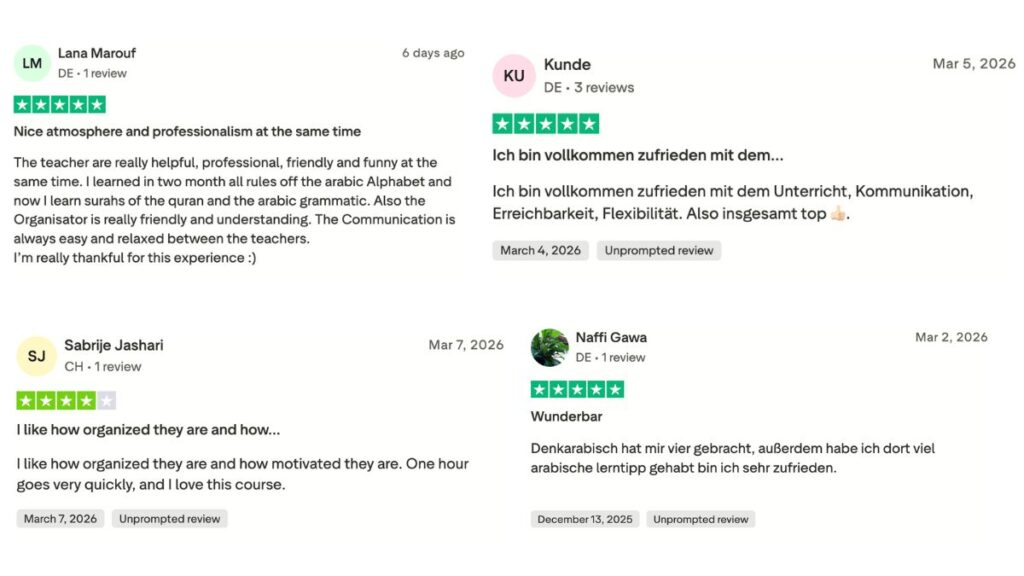
What Our Students Say About Denk Arabisch Academy
See what our students say about learning at Denk Arabisch Academy on Trustpilot. Read their experiences and check out more reviews to discover how our courses help improve Arabic.
Join Denk Arabisch Today!
Are you tired of inconsistent progress and unorganized learning materials? Your child deserves an education that is professional, authentic, and tailored to their needs as a German speaker. At Denk Arabisch, we don’t just teach—we inspire.
Why choose us right now?
- Expert Tutors: Learn from the best native speakers and educators.
- Tailored for You: Specialized courses for German speakers that bridge the language gap perfectly.
- Guaranteed Progress: Our structured levels ensure your child moves from beginner to advanced with confidence.
Explore Our Specialized Courses
We offer a comprehensive range of programs designed specifically for German speakers:
Programs for Muslim Kids:
- Arabic Lessons For German-Speaking Children.
- Tajweed Course For German-Speaking Children.
- Quran Course For German-Speaking Children.
Don’t wait for “tomorrow.” Every day is an opportunity for your child to grow closer to the Quran and their language heritage. Register for our courses today and watch your child excel!
Learn the Quran with Denk Arabisch Academy
Master reading and understanding the Quran through structured and supportive learning
Try a Free TrialConclusion
A Quran learning for children app is more than just a digital tool—it is a modern bridge connecting children to the Holy Quran in a way that is engaging, structured, and meaningful. When used correctly, it helps children develop correct recitation, strong memorization skills, and a lifelong love for the Quran.
However, the most effective results come from combining technology with parental guidance and consistent practice. Parents who actively participate in their child’s learning journey can significantly enhance the benefits of these apps.
In the end, the goal is not just learning the Quran, but building a deep spiritual connection that lasts a lifetime.
FAQs
1. What is a Quran learning for children app?
A Quran learning for children app is a mobile or tablet application designed to help kids learn how to read, recite, and memorize the Holy Quran in an interactive and engaging way. It often includes audio recitation, Tajweed guidance, and memorization tools tailored for young learners.
2. At what age can children start using a Quran learning app?
Children can start as early as 4 to 6 years old, depending on their ability to recognize Arabic letters and focus for short periods. At this stage, they usually begin with listening, basic Surahs, and learning Arabic letters before moving to full recitation.
3. Can a Quran app replace a Quran teacher?
No, a Quran app should not replace a qualified teacher. It is best used as a supportive learning tool. Teachers provide correction, spiritual guidance, and personalized feedback that apps cannot fully replace.
4. How much time should children spend on a Quran learning app daily?
For young children, 10 to 20 minutes per day is ideal. Consistency is more important than long study sessions. Regular short practice helps improve memorization and prevents fatigue.
5. Do Quran learning apps teach Tajweed correctly?
High-quality Quran apps include Tajweed rules explained in a simple and visual way, along with audio examples from professional reciters. However, parental supervision or teacher guidance is still recommended to ensure correct application.
6. Can children memorize the Quran using an app?
Yes, many Quran learning apps include structured Hifz (memorization) programs. These break Surahs into small sections, provide repetition tools, and track progress, making memorization easier for children.