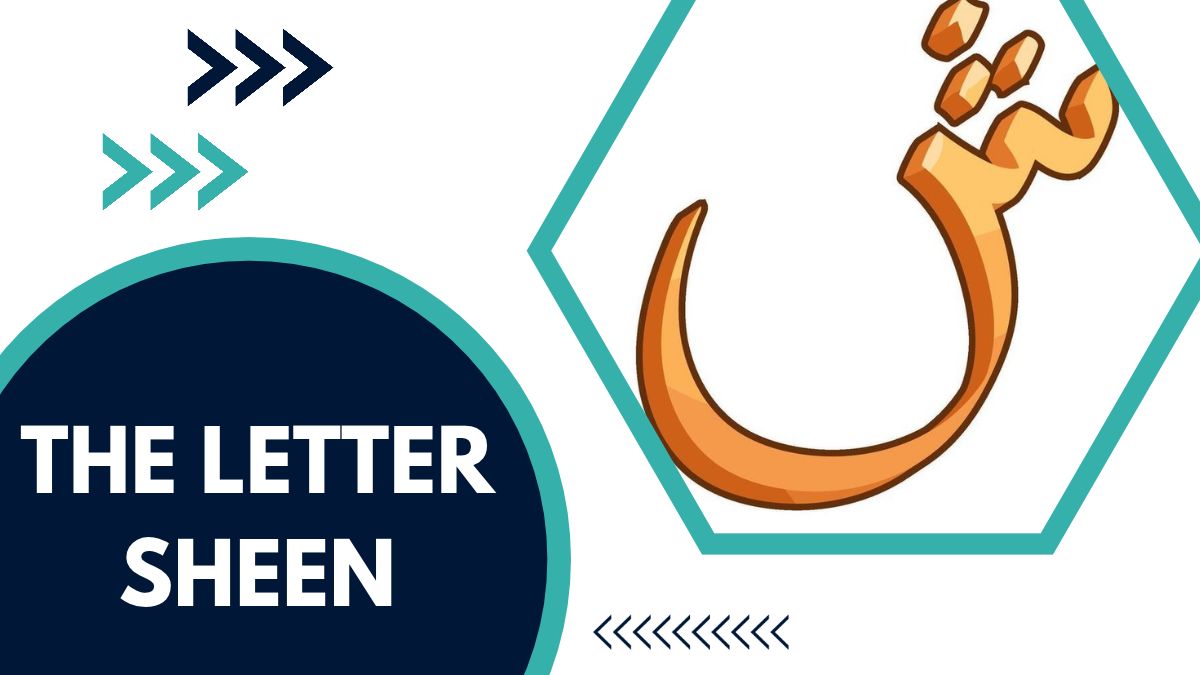
Three dots crowning three small teeth: that is the Letter Sheen (ش), the 13th letter of the Arabic alphabet. You produce it by lifting the middle of your tongue toward the roof of your mouth and letting the air rush out in a soft hiss. Phoneticians call it a voiceless postalveolar fricative, [ʃ] in IPA.
If you speak German, this is one of the easiest letters you will ever learn. Sheen is practically the German “sch” in Schnee, waschen and Tasche. The real work lies in recognizing it on the page and handling it correctly inside words.
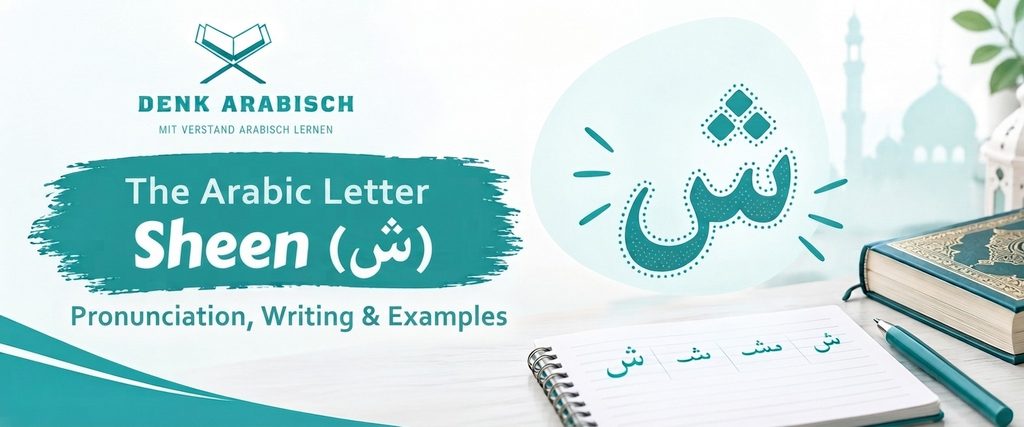
This guide covers everything you need to know about Sheen:
- The exact pronunciation and how it differs from similar sounds
- The four shapes Sheen takes in a word
- Reading Sheen with every vowel mark
- The Tajweed rules Sheen triggers in the Quran
- Useful words, sentences and roots built on Sheen
At the end, a few quick exercises show you how much you have already picked up.
| Feature | Information |
| Name | شِين (Shīn), also spelled Sheen |
| Sound | [ʃ], German “sch” in Schnee, English “sh” in shoe |
| Position in the alphabet | 13th in the hijāʾī order |
| Abjad value | 300 (21st position) |
| Transliteration | sh (common), š (DIN 31635), “ch” in French-influenced Arabizi; no Arabizi number |
| Point of articulation | Middle of the tongue and the hard palate |
| Sun or Moon letter | Sun letter |
| Heavy or light | Light (muraqqaq) |
| Dots | Three, above the letter |
| Connection | Joins letters on both sides |
Table of Contents
Alphabetical Position and Order of Letter Sheen
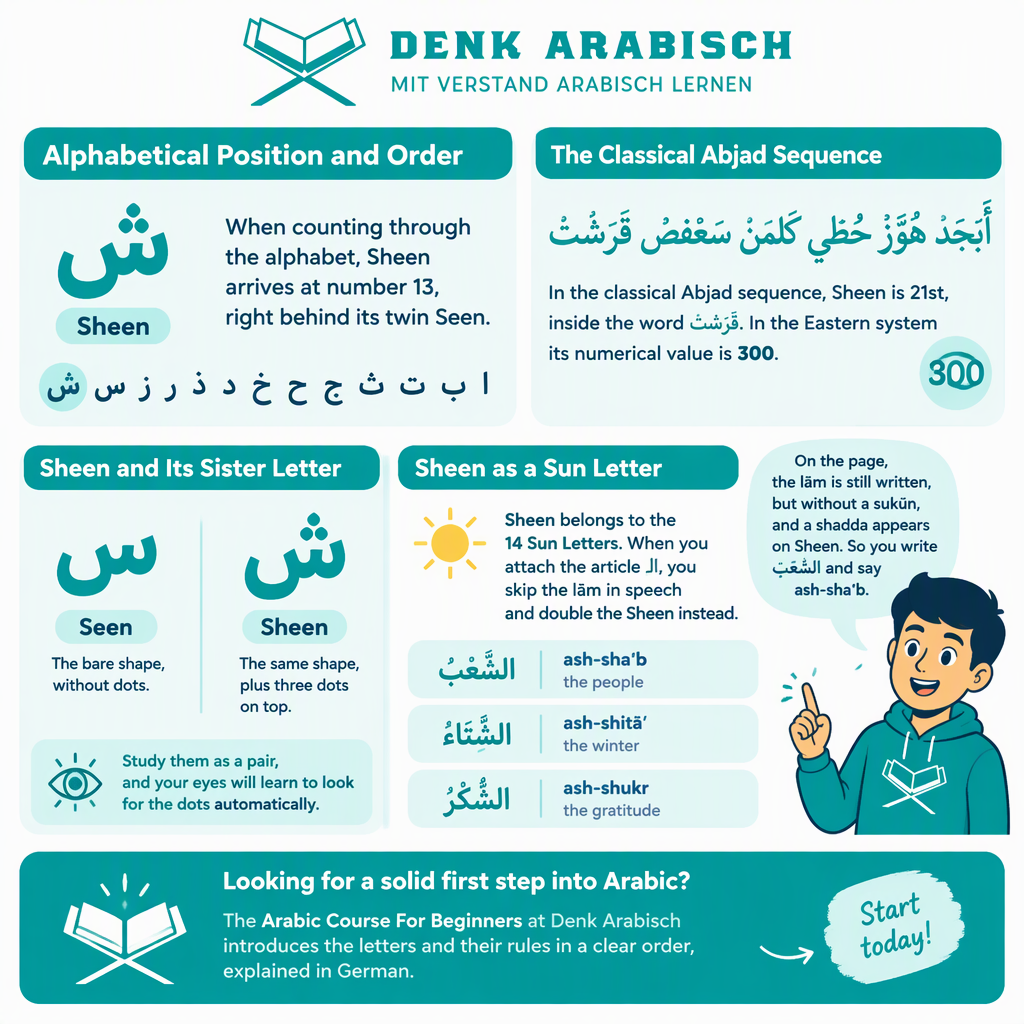
Count through the alphabet and Sheen arrives at number 13, right behind its twin Seen:
ا ب ت ث ج ح خ د ذ ر ز س ش
The classical Abjad sequence (أَبْجَدْ هَوَّزْ حُطِّي كَلَمَنْ سَعْفَصْ قَرَشَتْ) places Sheen 21st, inside the word قَرَشَتْ. In the Eastern system its numerical value is 300.
This order is still useful today: before Arabic numerals spread, letters served as numbers, and you will meet them in dated manuscripts and on old inscriptions.
Comparison: Sheen and Its Sister Letter
Only one other letter uses exactly the same skeleton:
- Seen (س): the bare shape, without dots
- Sheen (ش): the same shape, plus three dots on top
Study them as a pair, and your eyes will learn to look for the dots automatically.
Sheen as a Sun Letter
Sheen belongs to the 14 Sun Letters. When you attach the article الْـ, you skip the lām in speech and double the Sheen instead.
- الشَّعْب — ash-shaʿb — the people
- الشِّتَاء — ash-shitāʾ — the winter
- الشُّكْر — ash-shukr — the gratitude
On the page, the lām is still written, but without a sukūn, and a shadda appears on Sheen. So you write الشَّعْب and say ash-shaʿb.
Looking for a solid first step into Arabic? The Arabic Course For Beginners at Denk Arabisch introduces the letters and their rules in a clear order, explained in German.
Articulation Point (Makhraj) & Phonetics of Sheen and Tajweed
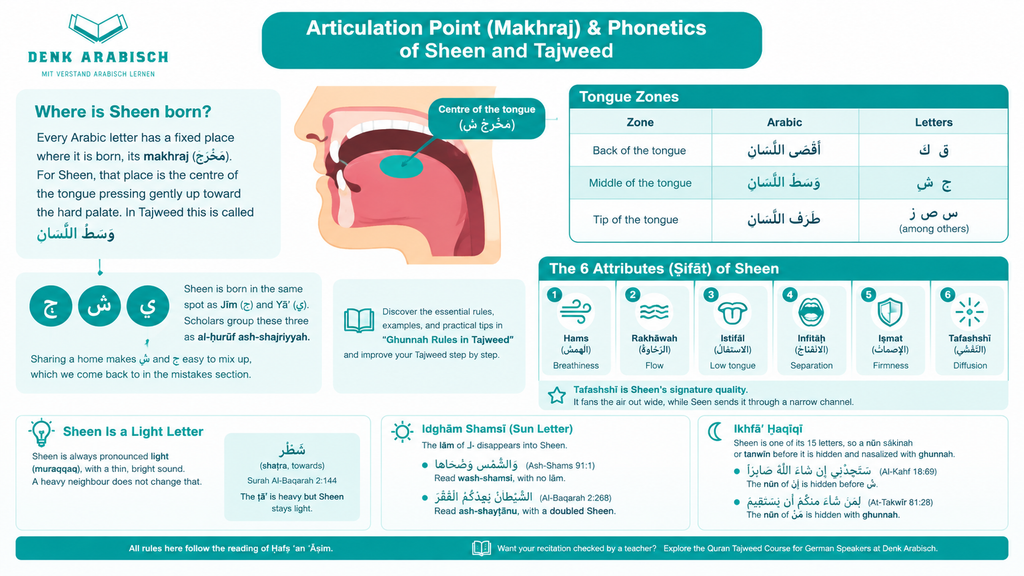
Every Arabic letter has a fixed place where it is born, its makhraj (مَخْرَج). For Sheen, that place is the centre of the tongue pressing gently up toward the hard palate. In Tajweed this is called وَسَطُ اللِّسَانِ.
| Zone | Arabic | Letters |
| Back of the tongue | أَقْصَى اللِّسَانِ | ق ك |
| Middle of the tongue | وَسَطُ اللِّسَانِ | ج ش ي |
| Tip of the tongue | طَرَفُ اللِّسَانِ | س ص ز (among others) |
Sheen is born in the same spot as Jīm (ج) and the consonant Yāʾ (ي). Scholars group these three as al-ḥurūf ash-shajriyyah. Sharing a home makes ش and ج easy to mix up, which we come back to in the mistakes section.
The 6 Attributes (Ṣifāt) of Sheen
The letter Sheen (ش) has six distinct Ṣifāt that shape its sound and explain its characteristic breathy, flowing, and diffused pronunciation.
- Hams (الْهَمْسُ) — breathiness: your vocal cords stay still while the breath escapes. The Hams letters are collected in فَحَثَّهُ شَخْصٌ سَكَتْ.
- Rakhāwah (الرَّخَاوَةُ) — flow: the sound runs on as long as you have breath.
- Istifāl (الِاسْتِفَالُ) — low tongue: the back of the tongue does not rise. The opposite letters are خُصَّ ضَغْطٍ قِظْ.
- Infitāḥ (الِانْفِتَاحُ) — separation: a gap remains between tongue and palate, unlike in ص ض ط ظ.
- Iṣmāt (الْإِصْمَاتُ) — firmness: Sheen is not one of the easy-flowing letters of فَرَّ مِنْ لُبٍّ.
- Tafashshī (التَّفَشِّي) — diffusion: the breath fans out through the whole mouth. This is Sheen’s signature quality.
Tafashshī is exactly what separates Sheen from Seen. Sheen fans the air out wide, while Seen sends it through a narrow channel.
Sheen Is a Light Letter
Sheen is always pronounced light (muraqqaq), with a thin, bright sound. A heavy neighbour does not change that. In شَطْرَ (shaṭra, towards), Surah Al-Baqarah 2:144, the ṭāʾ is heavy but Sheen stays light.
Sheen in Quranic Recitation: Idghām Shamsī and Ikhfāʾ
The first rule is Idghām Shamsī. Because Sheen is a Sun Letter, the lām of الْـ disappears into it.
- وَالشَّمْسِ وَضُحَاهَا — Surah Ash-Shams 91:1. Read wash-shamsi, with no lām.
- الشَّيْطَانُ يَعِدُكُمُ الْفَقْرَ — Surah Al-Baqarah 2:268. Read ash-shayṭānu, with a doubled Sheen.
The second rule is Ikhfāʾ Ḥaqīqī. Sheen is one of its 15 letters, so a nūn sākinah or tanwīn before it is hidden and nasalized with ghunnah.
- سَتَجِدُنِي إِن شَاءَ اللَّهُ صَابِرًا — Surah Al-Kahf 18:69. The nūn of إِن is hidden before ش.
- لِمَن شَاءَ مِنكُمْ أَن يَسْتَقِيمَ — Surah At-Takwīr 81:28. The nūn of مَن is hidden with ghunnah.
All rules here follow the reading of Ḥafṣ ʿan ʿĀṣim.
Discover the essential rules, examples, and practical tips in “Ghunnah Rules in Tajweed” and improve your Tajweed step by step.
Pronunciation Guide and Mechanics of Letter Sheen
Think of the sound you make when you ask someone to be quiet: “shhh”. That is Sheen. It is the “sch” of German Schnee and waschen, the “sh” of English shoe, and the “ch” of French chaise.
English speakers share the sound too, but the Arabic version needs a relaxed articulation centred on the tongue.
Tip for German Speakers
Your German “sch” already does most of the job. Watch out for three small habits:
- Keep Sheen apart from the ich-Laut. In some regions “ich” turns into “isch”, but in Arabic the soft “ch” sound never replaces ش. Test: say Kirche, then Kirsche. Only the sound in Kirsche is Arabic Sheen.
- Keep your lips calm. Many German speakers push the lips into a strong pout for “sch”, but Arabic Sheen comes mainly from the tongue.
- Keep “sch” out of your notes. Transliterate with sh, or š in the DIN 31635 system.
Two words to test yourself:
- شَاي (shāy, tea): a clean, bright “sh”, lips relaxed.
- شِفَاء (shifāʾ, healing): the “shi” must not slide toward the “ch” of ich.
Step-by-Step Pronunciation Instructions
Follow these clear guidelines to position your mouth, tongue, and airflow to articulate the sound smoothly and accurately:
- Mouth: part your lips slightly, without rounding them.
- Tongue: lift the centre of your tongue close to the hard palate.
- Air: push the breath out and let it fan across the tongue.
- Relaxation: keep your throat and vocal cords loose, and end the sound cleanly with no extra vowel.
Then add the short vowels: شَ (sha), شِ (shi), شُ (shu).
Minimal Pairs: Hear the Difference
Train your ear to recognize subtle phonetic contrasts by comparing the letter Sheen (ش) with similar Arabic sounds.
| Word 1 | Meaning | Word 2 | Meaning | Difference |
| شَهْر (shahr) | month | سَهْر (sahr) | staying up late | ش spread air, س narrow hiss |
| شَرَى (sharā) | he bought | جَرَى (jarā) | he ran | ش no voice, ج voiced |
| شَدَّ (shadda) | he pulled | صَدَّ (ṣadda) | he blocked | ش light, ص heavy |
Record yourself reading the three pairs, then listen back and check every contrast.
Would you like to speak Arabic with natural pronunciation? The Arabic Speaking Course at Denk Arabisch gives you guided practice with real sounds and real conversations.
The Four Written Forms of Sheen
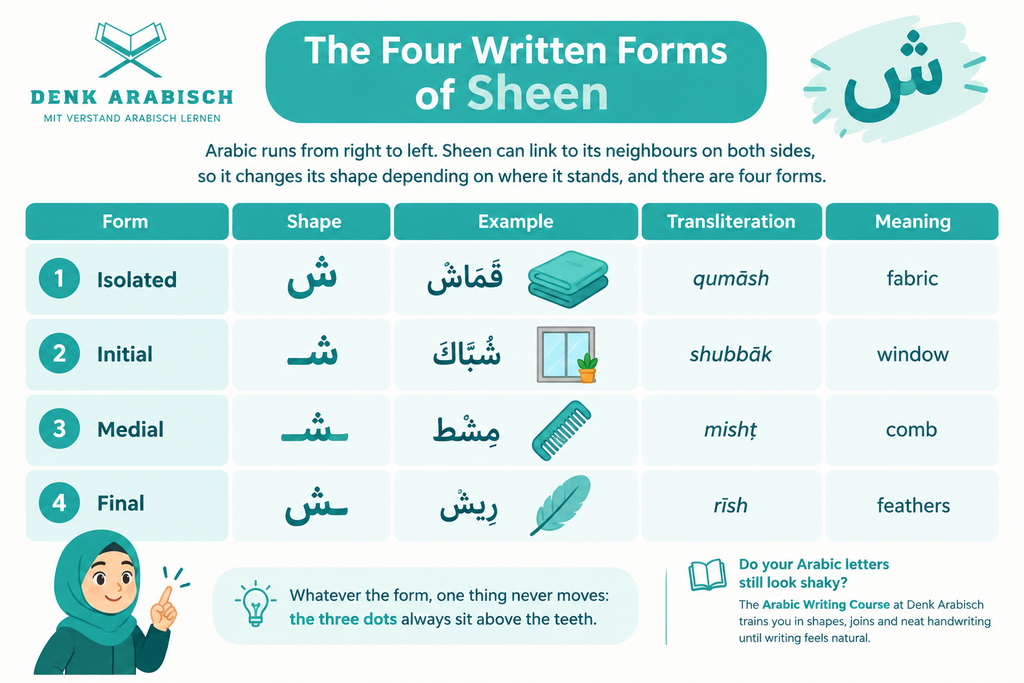
Arabic runs from right to left. Sheen can link to its neighbours on both sides, so it changes its shape depending on where it stands, and there are four forms.
| Form | Shape | Example | Transliteration | Meaning |
| Isolated | ش | قُمَاش | qumāsh | fabric |
| Initial | شـ | شُبَّاك | shubbāk | window |
| Medial | ـشـ | مِشْط | mishṭ | comb |
| Final | ـش | رِيش | rīsh | feathers |
1. Isolated Form (ش)
You use it when Sheen stands on its own, or when it ends a word right after a letter that never connects forward (ا د ذ ر ز و).
Shape: the complete letter, with three teeth, a rounded tail and three dots on top.
Examples: قُمَاش (qumāsh, fabric) and عَرْش (ʿarsh, throne). The alif and the rāʾ cannot reach forward, so Sheen stands alone.
2. Initial Form (شـ)
This form opens a word. It also appears mid-word when the letter before it is non-connecting.
Shape: three short teeth with no tail, reaching out to the next letter.
Examples: شُبَّاك (shubbāk, window), شَجَرَة (shajarah, tree), and وَرْشَة (warshah, workshop), where Sheen starts fresh after rāʾ.
3. Medial Form (ـشـ)
This form sits inside a word, joined on both sides.
Shape: three small teeth on a straight line, linked right and left.
Examples: مِشْط (mishṭ, comb) and مَشْغُول (mashghūl, busy).
Learn Arabic with Denk Arabisch Academy
Speak and understand Arabic through a clear and effective learning system
Try a Free Trial4. Final Form (ـش)
This form closes a word after a letter that connects.
Shape: linked from the right, then finishing with the full rounded tail.
Examples: رِيش (rīsh, feathers) and عَيْش (ʿaysh, life; bread in Egypt).
Whatever the form, one thing never moves: the three dots always sit above the teeth.
Do your Arabic letters still look shaky? The Arabic Writing Course at Denk Arabisch trains you in shapes, joins and neat handwriting until writing feels natural.
Vowel Vocalization of Sheen (Harakāt and Madd)
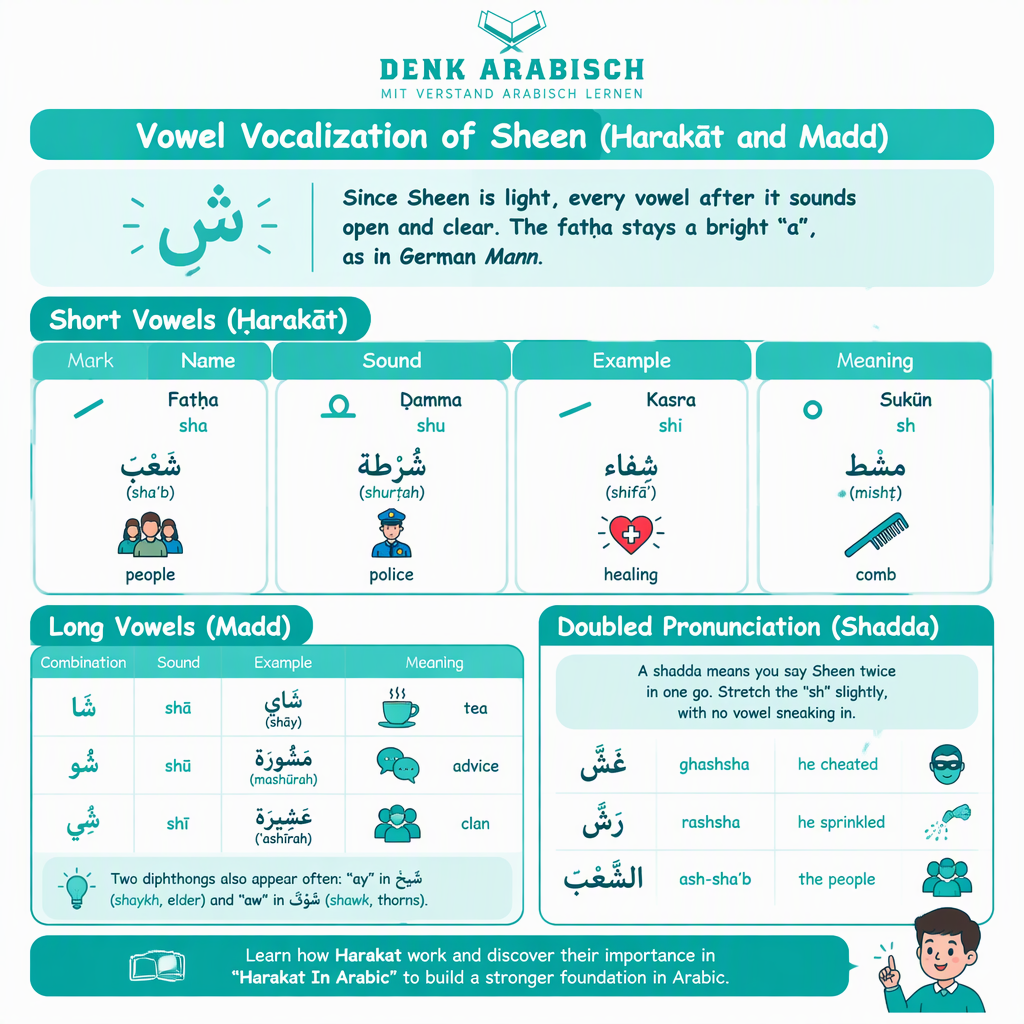
Since Sheen is light, every vowel after it sounds open and clear. The fatḥa stays a bright “a”, as in German Mann.
Short Vowels (Ḥarakāt)
Master the core Arabic short vowel marks (Ḥarakāt) and see how they modify the sound of the letter Sheen in everyday vocabulary.
| Mark | Name | Sound | Example | Meaning |
| شَ | Fatḥa | sha | شَعْب (shaʿb) | people |
| شُ | Ḍamma | shu | شُرْطَة (shurṭah) | police |
| شِ | Kasra | shi | شِفَاء (shifāʾ) | healing |
| شْ | Sukūn | sh | مِشْط (mishṭ) | comb |
With sukūn, Sheen carries no vowel at all and glides straight into the next consonant, as in mishṭ.
Long Vowels (Madd)
Learn how long vowel extensions (Madd) stretch the sound of the letter Sheen to build distinct words in Arabic.
| Combination | Sound | Example | Meaning |
| شَا | shā | شَاي (shāy) | tea |
| شُو | shū | مَشُورَة (mashūrah) | advice |
| شِي | shī | عَشِيرَة (ʿashīrah) | clan |
Two diphthongs also appear often: “ay” in شَيْخ (shaykh, elder) and “aw” in شَوْك (shawk, thorns).
Sheen with Doubled Pronunciation (Shadda)
A shadda means you say Sheen twice in one go. Stretch the “sh” slightly, with no vowel sneaking in.
- غَشَّ — ghashsha — he cheated
- رَشَّ — rashsha — he sprinkled
- الشَّعْب — ash-shaʿb — the people
Learn how Harakat work and discover their importance in “Harakat In Arabic” to build a stronger foundation in Arabic.
Essential Root Families Featuring Sheen
Arabic builds most of its vocabulary from three-letter roots, so learning one root gives you several words at once. These three roots with Sheen are worth knowing early.
1. Root (ش ر ق) — East, Rising
Discover essential Arabic words derived from the root ش – ر – ق, which carries the core concept of light, rising, and the eastern horizon.
| Word | Transliteration | Meaning |
| شَرْق | sharq | east |
| شُرُوق | shurūq | sunrise |
| مَشْرِق | mashriq | place of sunrise, the East |
| مُشْرِق | mushriq | shining |
You will hear مَشْرِق in the Quran: رَبُّ الْمَشْرِقِ وَالْمَغْرِبِ (Surah Al-Muzzammil 73:9).
2. Root (ش ع ر) — Feeling, Poetry
Explore key Arabic vocabulary derived from the root ش – ع – ر, centered around perception, deep awareness, emotion, and poetic expression.
| Word | Transliteration | Meaning |
| شِعْر | shiʿr | poetry |
| شَاعِر | shāʿir | poet |
| شُعُور | shuʿūr | feeling |
| شَعْر | shaʿr | hair |
3. Root (ش غ ل) — Work, Being Busy
Discover essential Arabic vocabulary built from the root ش – غ – ل, which revolves around the core concept of labor, occupation, and remaining busy.
| Word | Transliteration | Meaning |
| شَغَلَ | shaghala | he occupied, he kept busy |
| شُغْل | shughl | work |
| مَشْغُول | mashghūl | busy |
| اِشْتَغَلَ | ishtaghala | he worked |
Want to understand Quranic words at their roots? The Quranic Arabic Course for German Speakers at Denk Arabisch connects roots, vocabulary and meaning in the Quran.
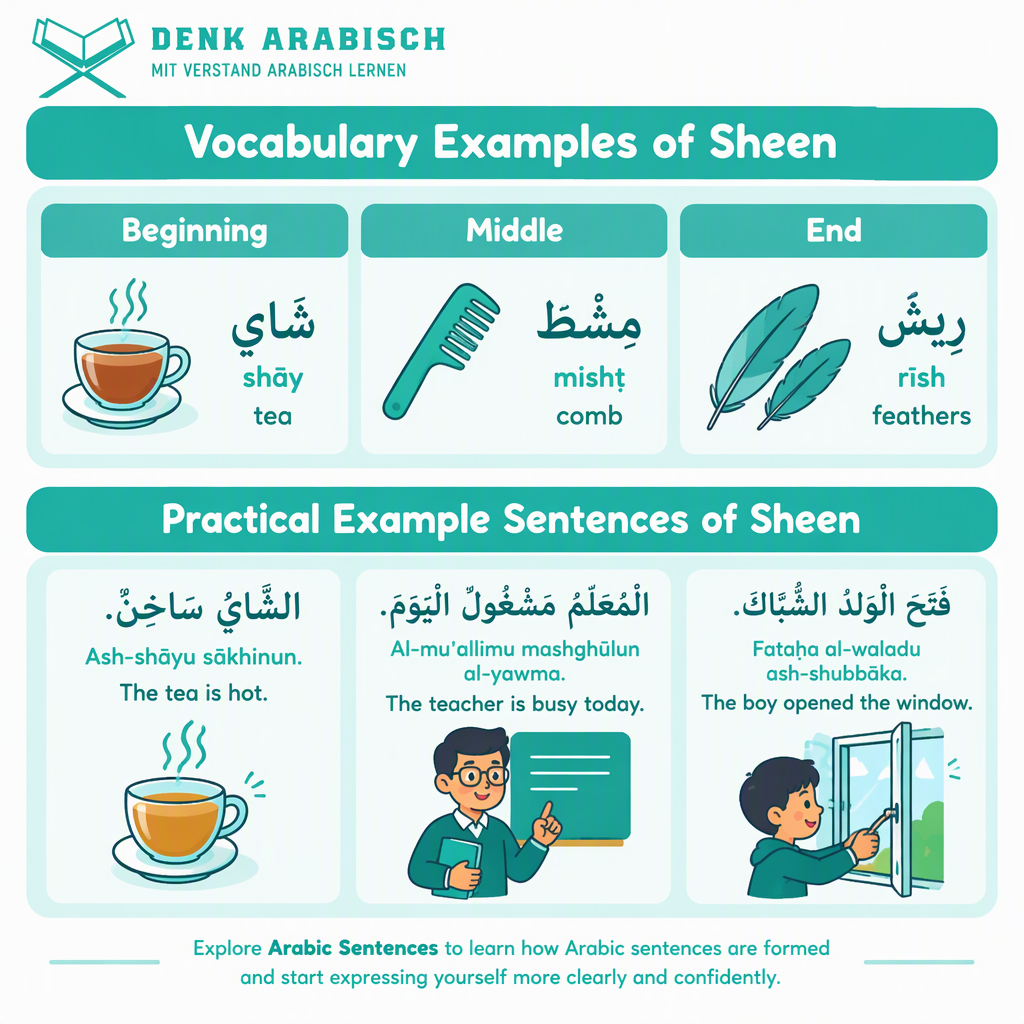
Vocabulary Examples of Sheen
The table shows Sheen in three different positions, with one example for each form in a real word.
| Position | Arabic Word | Transliteration | Meaning |
| Beginning | شَاي | shāy | tea |
| Middle | مِشْط | mishṭ | comb |
| End | رِيش | rīsh | feathers |
Practical Example Sentences of Sheen
Here, words from the table above appear in short everyday sentences.
| Arabic Sentence | Transliteration | Meaning |
| الشَّايُ سَاخِنٌ. | Ash-shāyu sākhinun. | The tea is hot. |
| الْمُعَلِّمُ مَشْغُولٌ الْيَوْمَ. | Al-muʿallimu mashghūlun l-yawma. | The teacher is busy today. |
| فَتَحَ الْوَلَدُ الشُّبَّاكَ. | Fataḥa l-waladu sh-shubbāka. | The boy opened the window. |
Explore “Arabic Sentences” to learn how Arabic sentences are formed and start expressing yourself more clearly and confidently.
Common Mistakes and Correction Strategies
Understanding these four common pitfalls will help you pronounce and write the letter Sheen accurately every time.
1. Reading Sheen (ش) as Seen (س)
Same body, different dots. When you read quickly, the dots are easy to overlook.
Test: hold your palm in front of your mouth and say شَهْر, then سَهْر. Sheen gives a wide, warm breath; Seen gives a thin, cool stream.
2. Blurring Sheen (ش) and Jīm (ج)
They come from the same spot on the tongue. Some dialects even pronounce ج as a voiced “sh”, which brings the two very close.
Test: cover your ears and say شَرَى, then جَرَى. You hear a buzz in your head only with ج.
3 Dot Mistakes in Writing
Leave out the dots and Sheen becomes Seen. Put three dots on a single tooth and you have written Thāʾ (ث) instead.
Test: write شُبَّاك without dots, then add them. Notice how the word only becomes readable once all three dots sit above the teeth.
4. Sneaking a Vowel into Sukūn
Learners sometimes say “mi-sha-ṭ” instead of mishṭ, adding a vowel where sukūn forbids one.
Test: say مِشْط in a single breath. If you hear an “a” between sh and ṭ, slow down and try again.
Read Arabic Letters Connected Forms to learn how every letter changes when it joins a word.
Practice Exercises and Knowledge Checks
Practice and check your understanding of the letter Sheen with these interactive exercises and complete answers.
Exercise 1: Multiple Choice
Which reading of الشُّكْر is correct?
- al-shukr
- as-sukr
- ash-shukr
Answer: 3. Sheen is a Sun Letter, so the lām is silent and Sheen is doubled.
Exercise 2: Matching
Match the words شَاي, مِشْط, رِيش and شُرُوق to their meanings:
- comb
- sunrise
- tea
- feathers
Answer: شَاي = tea, مِشْط = comb, رِيش = feathers, شُرُوق = sunrise.
Exercise 3: Writing Practice
Copy each form of Sheen five times: ش — شـ — ـشـ — ـش. Then write قُمَاش, شُبَّاك, مِشْط and رِيش, and note which form Sheen takes in each.
Exercise 4: True or False
- Sheen has the Abjad value 300.
- Sheen becomes heavy before ṭāʾ.
- The nūn in إِن شَاءَ اللَّهُ is hidden with ghunnah.
- In قُمَاش, Sheen is written in its isolated form.
Answers: 1. True. 2. False, it always stays light. 3. True, through Ikhfāʾ. 4. True, because alif does not connect forward.
Exercise 5: Find the Letter
How many times is ش written in each word: شَمْس, مِشْمِش, شَاي, عُشْب?
Answers: شَمْس = 1, مِشْمِش = 2, شَاي = 1, عُشْب = 1.
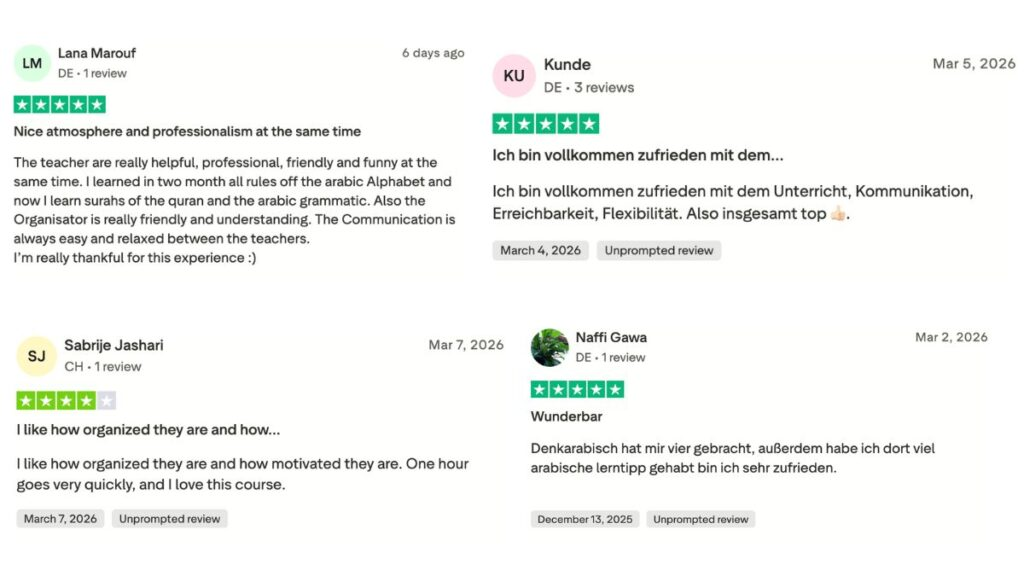
What Our Students Say About Denk Arabisch Academy
See what our students say about learning at Denk Arabisch Academy on Trustpilot. Read their experiences and check out more reviews to discover how our courses help improve Arabic.
Start Learning Arabic with Denk Arabisch!
Sheen is just one of 28 letters. With a clear plan and steady practice, those letters quickly turn into words, sentences and real reading.
Denk Arabisch is made for German-speaking learners and teaches Arabic through German, for adults and children alike.
- Lessons that move from letters to words to texts in a logical order
- Personal feedback on your pronunciation and handwriting
- Explanations that use German sounds as reference points
- A learning pace that fits your level and schedule
See what students and parents say about Denk Arabisch on Trustpilot
Learn Arabic with Denk Arabisch Academy
Speak and understand Arabic through a clear and effective learning system
Try a Free TrialChoose Your Specialized Course:
- Arabic Course For Beginners
- Arabic Alphabet Course
- Arabic Reading Course
- Arabic Writing Course
- Arabic Speaking Course
- Quranic Arabic Course for German Speakers
- Quran Tajweed Course for German Speakers
Book your free trial at Denk Arabisch and see how easy the next step can be.

Conclusion
Once you know the Letter Sheen (ش), you can read a sound German speakers already use every day.
- Sound: a light, wide “sh”, close to German “sch”, without lip pouting.
- Writing: four forms, with three dots above the teeth every time.
- Recognition: Seen’s body with three dots, and a Sun Letter that doubles after الْـ.
Keep practising the vowels شَ — شِ — شُ, write the four forms daily, and repeat the pairs ش/س, ش/ج and ش/ص. Then expand your vocabulary with the roots ش غ ل, ش ر ق and ش ع ر.
Every letter you master makes the next one easier. Book a free trial lesson at Denk Arabisch and keep the momentum going.
FAQs
1. How can I tell Sheen (ش) from Seen (س)?
Look at the dots: Sheen has three on top, Seen has none. In speech, Sheen spreads the air wide (“sh”), while Seen pushes it through a narrow gap at the front teeth (“s”).
2. How is Sheen (ش) different from Jīm (ج)?
Both are made with the middle of the tongue. However, Sheen is voiceless and flowing, while Jīm is voiced and has one dot below a different body. Jīm is also a Moon Letter, while Sheen is a Sun Letter.
3. Does Sheen count as a Sun Letter or a Moon Letter?
Sheen is a Sun Letter. The lām of الْـ is silent before it, and Sheen takes a shadda, as in الشَّعْب (ash-shaʿb).
4. Can Sheen ever be pronounced heavy?
No. Sheen is a letter of istifāl and stays light (muraqqaq) in every position, even next to heavy letters like ط.
5. Which Tajweed rules apply to Sheen?
After الْـ, Sheen causes Idghām Shamsī, as in وَالشَّمْسِ (Ash-Shams 91:1). It is also a letter of Ikhfāʾ Ḥaqīqī, so nūn sākinah or tanwīn before it is hidden with ghunnah, as in إِن شَاءَ اللَّهُ (Al-Kahf 18:69).