Taa (ط), whose full name is Ṭāʾ (طَاء), is the 16th letter of the Arabic alphabet. You make it with the tip of your tongue against the base of your upper front teeth, while the back of your tongue rises toward the roof of your mouth. Linguists call it an emphatic (pharyngealized) alveolar plosive, written [tˤ] in IPA.
This sound doesn’t exist in German, but you can get close to it. Start with the German t in “Stein” or “Stadt”, where the tongue is already in the right place and no puff of air follows. Then make it deeper and heavier. In this guide, Taa means ط and the plain Tāʾ means ت.
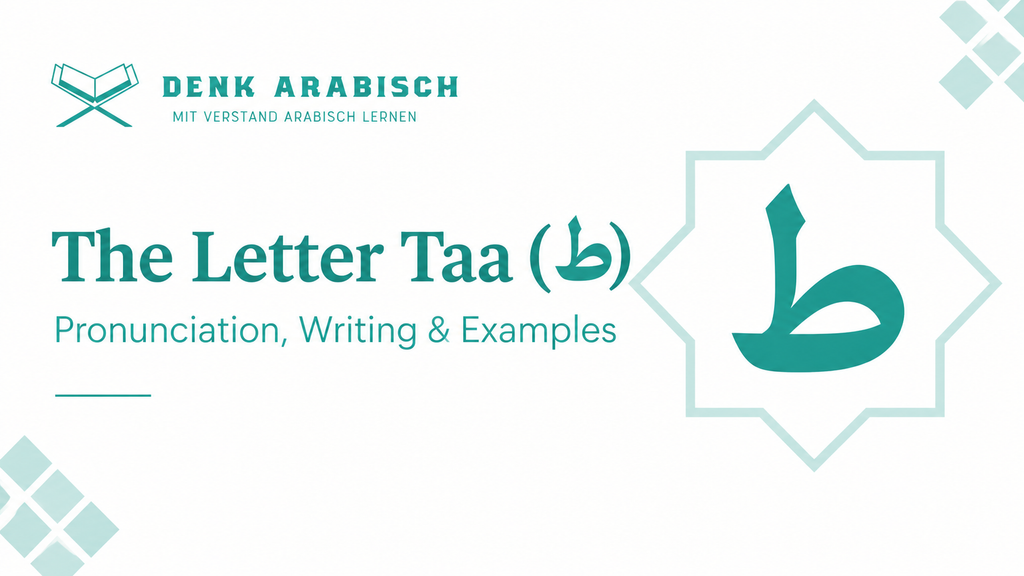
This guide covers everything you need to know about Taa:
- Pronunciation: where to place your tongue and what to avoid
- Writing: the four forms and how they connect
- Vowels: how Taa sounds with fatḥa, ḍamma, kasra, sukūn and shadda
- Tajweed: makhraj, attributes, heaviness and Qalqalah
- Words and roots: vocabulary you can use right away
Short exercises at the end let you check what you learned.
| act | Value |
| Name | Ṭāʾ (طَاء) |
| Sound | [tˤ], a heavy, deep t. No exact German equivalent; closest is the t in “Stein”, made heavier |
| Position in the alphabet | 16th (hijāʾī order) |
| Abjad value | 9th in Abjad order, value 9 |
| Transliteration | Common: Taa or T. DIN 31635: ṭ (used in this guide). Other variants: Ta, Tah. Arabizi: 6 |
| Point of articulation | Tip of the tongue with the base of the upper front teeth |
| Sun or Moon letter | Sun letter |
| Heavy or light | Heavy (mufakhkham) |
| Dots | None |
| Connection | Connects on both sides (four forms) |
Table of Contents
Taa in the Arabic Alphabet
In the hijāʾī order, the order of the letters as we learn them today, Taa comes 16th:
ا ب ت ث ج ح خ د ذ ر ز س ش ص ض ط.
In the older Abjad order (أَبْجَد هَوَّز حُطِّي…), Taa is the 9th letter with the value 9. This order still matters because letters stand for numbers, which is how dates were written on manuscripts and inscriptions.
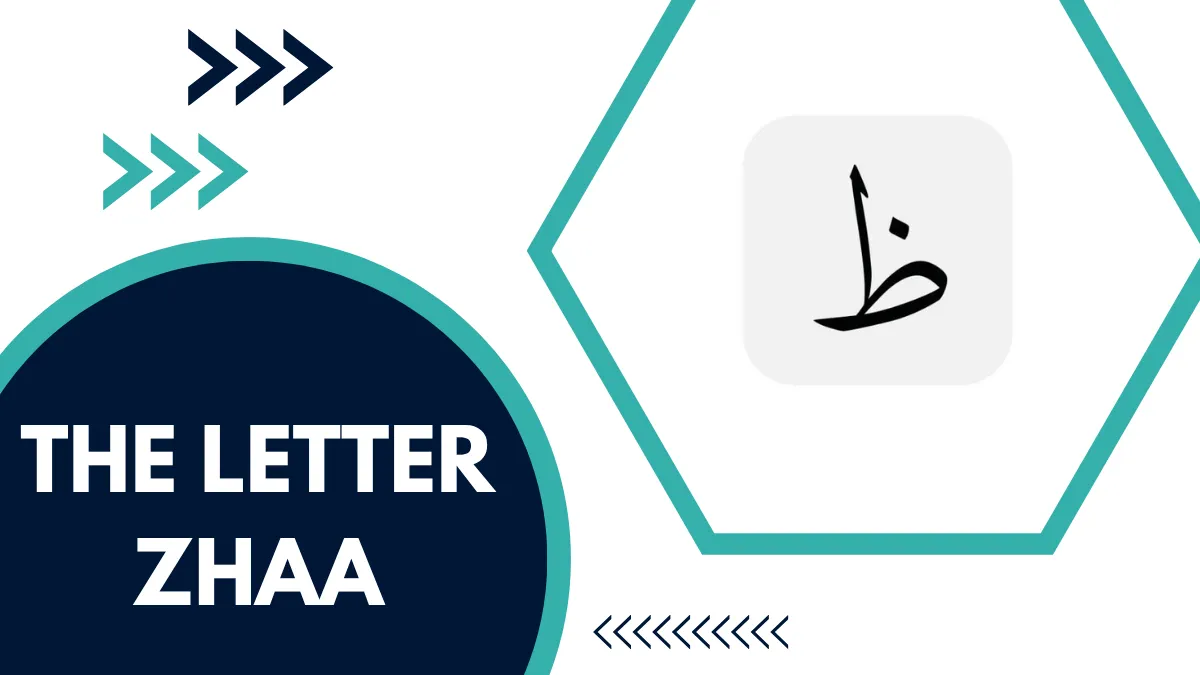
Taa and Its Related Letter ظ
Sister letters share one body shape and differ only in their dots. Taa has one sister:
- ط: no dots
- ظ: one dot above
Learn them together. You only memorize one shape, and the dot tells you which letter you are reading.
Why Taa Is a Sun Letter
When a word starts with a sun letter, the lām of al- is not pronounced. It merges into the next letter, and that letter is doubled. In writing, the lām carries no sukūn, and Taa carries a shadda.
| Word | Transliteration | Meaning |
| اَلطَّبِيبُ | aṭ-ṭabību | the doctor |
| اَلطَّرِيقُ | aṭ-ṭarīqu | the road |
| اَلطِّفْلُ | aṭ-ṭiflu | the child |
Starting from zero? The Arabic Alphabet Course at Denk Arabisch takes you through all 28 letters with German explanations for every sound and shape.
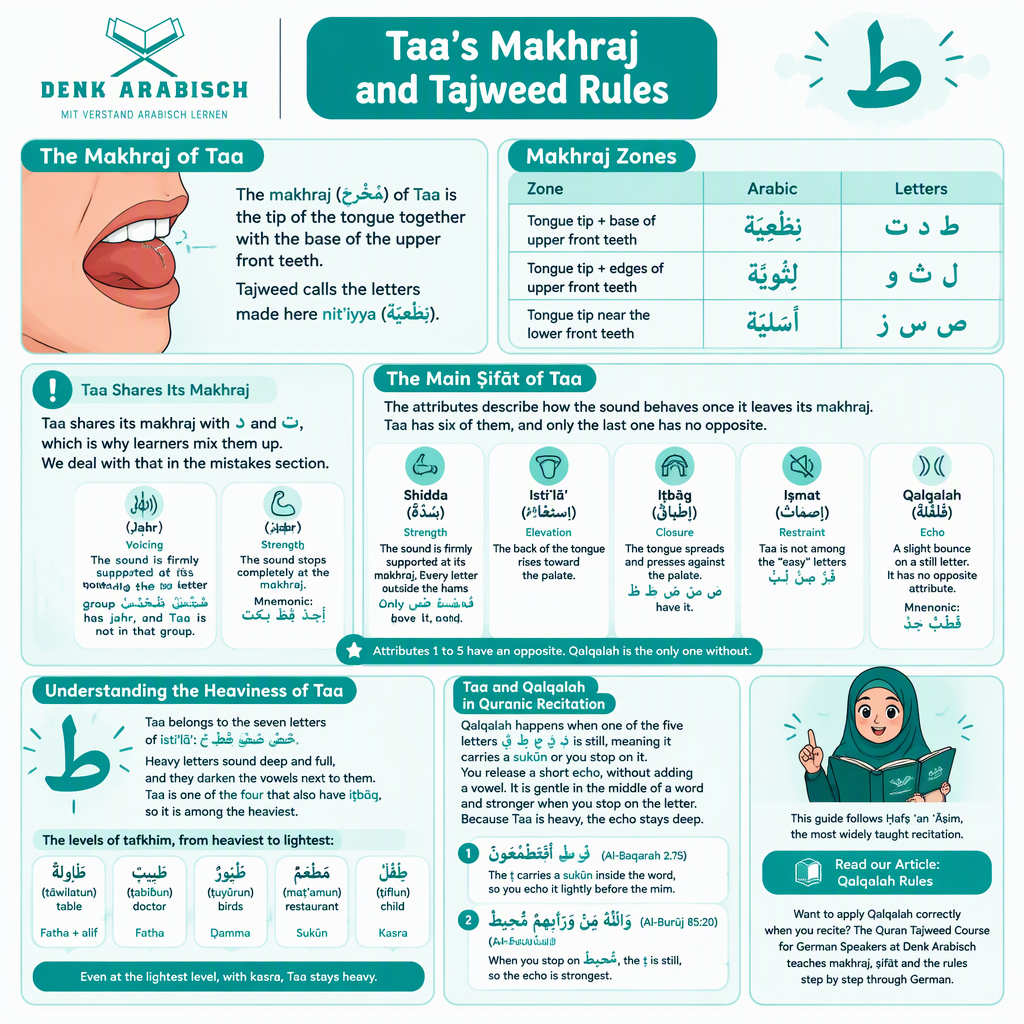
Taa’s Makhraj and Tajweed Rules
The makhraj (مَخْرَج) of Taa is the tip of the tongue together with the base of the upper front teeth. Tajweed calls the letters made here nitʿiyya (نِطْعِيَّة).
| Zone | Arabic | Letters |
| Tongue tip + base of upper front teeth | نِطْعِيَّة | ط د ت |
| Tongue tip + edges of upper front teeth | لِثَوِيَّة | ظ ذ ث |
| Tongue tip near the lower front teeth | أَسَلِيَّة | ص س ز |
Taa shares its makhraj with د and ت, which is why learners mix them up. We deal with that in the mistakes section.
The Main Ṣifāt of Taa
The attributes describe how the sound behaves once it leaves its makhraj. Taa has six of them, and only the last one has no opposite.
- Jahr (جَهْرٌ), voicing: The sound is firmly supported at its makhraj. Every letter outside the hams group فَحَثَّهُ شَخْصٌ سَكَتَ has jahr, and Taa is not in that group.
- Shidda (شِدَّةٌ), strength: The sound stops completely at the makhraj. The mnemonic is أَجِدُ قَطٍّ بَكَتْ.
- Istiʿlāʾ (اِسْتِعْلَاءٌ), elevation: The back of the tongue rises toward the palate.
- Iṭbāq (إِطْبَاقٌ), closure: The tongue spreads and presses against the palate. Only ص ض ط ظ have it.
- Iṣmāt (إِصْمَاتٌ), restraint: Taa is not among the “easy” letters of فَرَّ مِنْ لُبّ.
- Qalqalah (قَلْقَلَةٌ), echo: A slight bounce on a still letter. It has no opposite attribute. The mnemonic is قُطْبُ جَدٍّ.
Attributes 1 to 5 have an opposite. Qalqalah is the only one without.
Understanding the Heaviness of Taa
Taa belongs to the seven letters of istiʿlāʾ: خُصَّ ضَغْطٍ قِظْ. Heavy letters sound deep and full, and they darken the vowels next to them. Taa is one of the four that also have iṭbāq, so it is among the heaviest.
The levels of tafkhīm, from heaviest to lightest:
- Fatḥa followed by alif: طَاوِلَةٌ (ṭāwilatun), table
- Fatḥa: طَبِيبٌ (ṭabībun), doctor
- Ḍamma: طُيُورٌ (ṭuyūrun), birds
- Sukūn: مَطْعَمٌ (maṭʿamun), restaurant
- Kasra: طِفْلٌ (ṭiflun), child
Even at the lightest level, with kasra, Taa stays heavy.
Taa and Qalqalah in Quranic Recitation
Qalqalah happens when one of the five letters ق ط ب ج د is still, meaning it carries a sukūn or you stop on it. You release a short echo, without adding a vowel. It is gentle in the middle of a word and stronger when you stop on the letter. Because Taa is heavy, the echo stays deep.
- أَفَتَطْمَعُونَ (Al-Baqarah 2:75): The ṭ carries a sukūn inside the word, so you echo it lightly before the mīm.
- وَاللَّهُ مِنْ وَرَائِهِمْ مُحِيطٌ (Al-Burūj 85:20): When you stop on مُحِيطٌ, the ṭ is still, so the echo is strongest.
This guide follows Ḥafṣ ʿan ʿĀṣim, the most widely taught recitation.
Read our Article: Qalqalah Rules
Want to apply Qalqalah correctly when you recite? The Quran Tajweed Course for German Speakers at Denk Arabisch teaches makhraj, ṣifāt and the rules step by step through German.
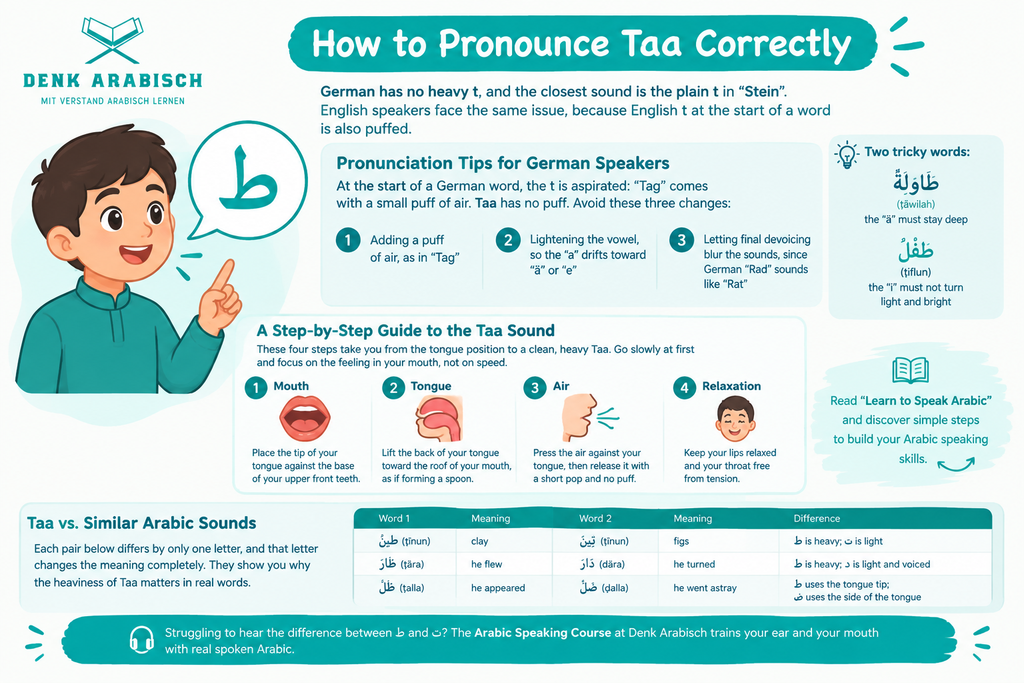
How to Pronounce Taa Correctly
German has no heavy t, and the closest sound is the plain t in “Stein”. English speakers face the same issue, because English t at the start of a word is also puffed.
Pronunciation Tips for German Speakers
At the start of a German word, the t is aspirated: “Tag” comes with a small puff of air. Taa has no puff. Avoid these three changes:
- Adding a puff of air, as in “Tag”
- Lightening the vowel, so the “a” drifts toward “ä” or “e”
- Letting final devoicing blur the sounds, since German “Rad” sounds like “Rat”
Two words where you will be tempted: طَاوِلَةٌ, where the “ā” must stay deep, and طِفْلٌ, where the “i” must not turn light and bright.
A Step-by-Step Guide to the Taa Sound
These four steps take you from the tongue position to a clean, heavy Taa. Go slowly at first and focus on the feeling in your mouth, not on speed.
- Mouth: Place the tip of your tongue against the base of your upper front teeth.
- Tongue: Lift the back of your tongue toward the roof of your mouth, as if forming a spoon.
- Air: Press the air against your tongue, then release it with a short pop and no puff.
- Relaxation: Keep your lips relaxed and your throat free from tension.
Taa vs. Similar Arabic Sounds
Each pair below differs by only one letter, and that letter changes the meaning completely. They show you why the heaviness of Taa matters in real words.
| Word 1 | Meaning | Word 2 | Meaning | Difference |
| طِينٌ (ṭīnun) | clay | تِينٌ (tīnun) | figs | ط is heavy; ت is light |
| طَارَ (ṭāra) | he flew | دَارَ (dāra) | he turned | ط is heavy; د is light |
| طَيْفٌ (ṭayfun) | apparition, spectrum | ضَيْفٌ (ḍayfun) | guest | ط uses the tongue tip; ض uses the side of the tongue |
Say each pair aloud three times and record yourself. Compare your recording with a teacher’s.
Struggling to hear the difference between ط and ت? The Arabic Speaking Course at Denk Arabisch trains your ear and your mouth with real spoken Arabic.
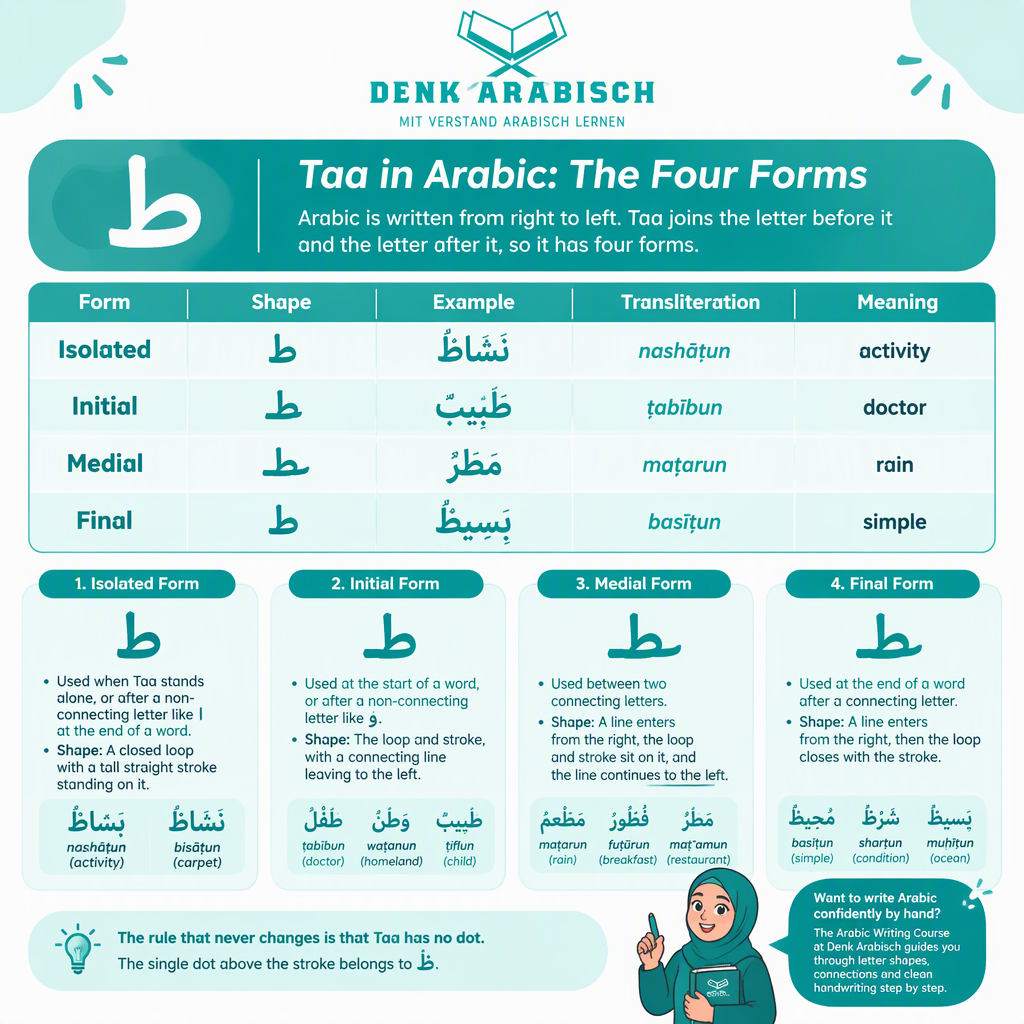
Writing Taa in Arabic: The Four Forms
Arabic is written from right to left. Taa joins the letter before it and the letter after it, so it has four forms.
| Form | Shape | Example | Transliteration | Meaning |
| Isolated | ط | نَشَاطٌ | nashāṭun | activity |
| Initial | طـ | طَبِيبٌ | ṭabībun | doctor |
| Medial | ـطـ | مَطَرٌ | maṭarun | rain |
| Final | ـط | بَسِيطٌ | basīṭun | simple |
1. Isolated Form (ط)
You use it when Taa stands alone, or after a non-connecting letter like ا at the end of a word.
Shape: A closed loop with a tall straight stroke standing on it.
Examples: نَشَاطٌ (nashāṭun, activity), بِسَاطٌ (bisāṭun, carpet).
2. Initial Form (طـ)
You use it at the start of a word, or after a non-connecting letter like و.
Shape: The loop and stroke, with a connecting line leaving to the left.
Examples: طَبِيبٌ (ṭabībun, doctor), وَطَنٌ (waṭanun, homeland), طِفْلٌ (ṭiflun, child).
3. Medial Form (ـطـ)
You use it between two connecting letters.
Shape: A line enters from the right, the loop and stroke sit on it, and the line continues to the left.
Examples: مَطَرٌ (maṭarun, rain), فُطُورٌ (fuṭūrun, breakfast), مَطْعَمٌ (maṭʿamun, restaurant).
4. Final Form (ـط)
You use it at the end of a word after a connecting letter.
Shape: A line enters from the right, then the loop closes with the stroke.
Examples: بَسِيطٌ (basīṭun, simple), مُشْطٌ (mushṭun, comb), مُحِيطٌ (muḥīṭun, ocean).
The rule that never changes is that Taa has no dot. The single dot above the stroke belongs to ظ.
Want to write Arabic confidently by hand? The Arabic Writing Course at Denk Arabisch guides you through letter shapes, connections and clean handwriting step by step.
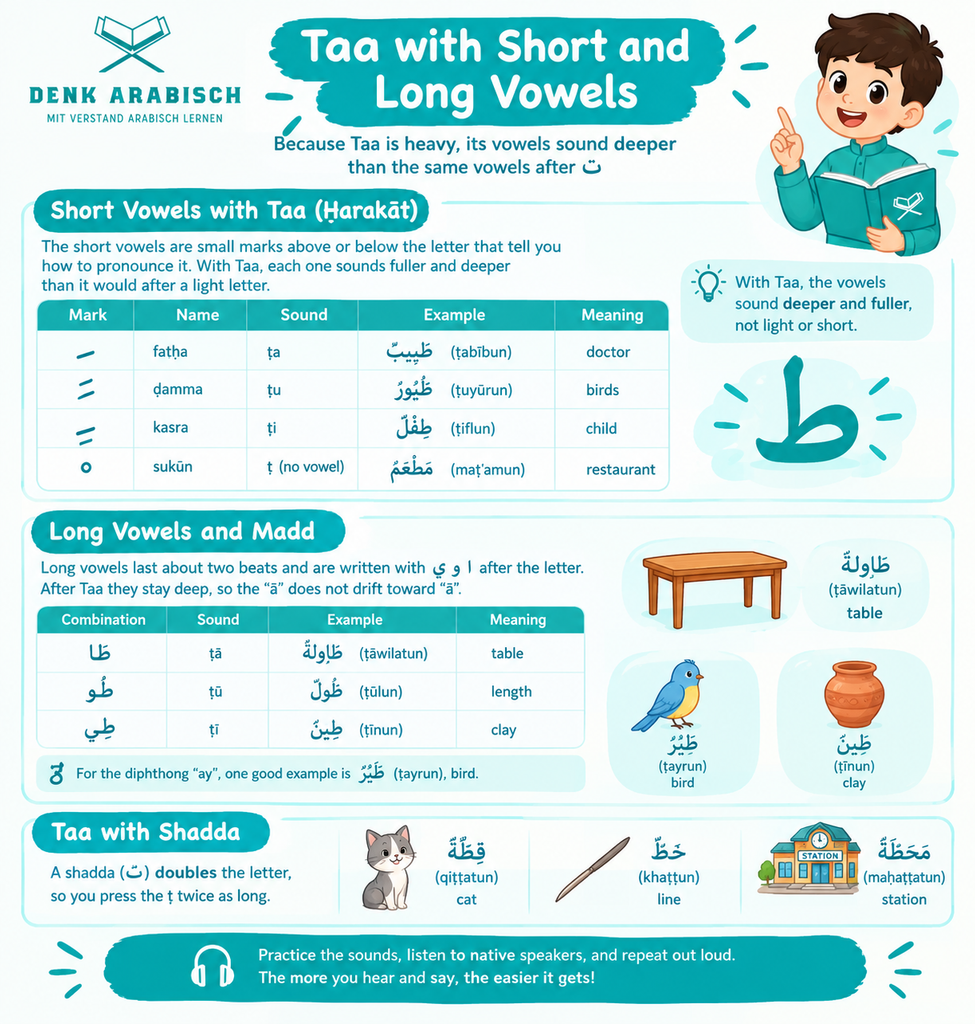
Taa with Short and Long Vowels
Because Taa is heavy, its vowels sound deeper than the same vowels after ت.
Short Vowels with Taa (Ḥarakāt)
The short vowels are small marks above or below the letter that tell you how to pronounce it. With Taa, each one sounds fuller and deeper than it would after a light letter.
| Mark | Name | Sound | Example | Meaning |
| ـَ | fatḥa | ṭa | طَبِيبٌ (ṭabībun) | doctor |
| ـُ | ḍamma | ṭu | طُيُورٌ (ṭuyūrun) | birds |
| ـِ | kasra | ṭi | طِفْلٌ (ṭiflun) | child |
| ـْ | sukūn | ṭ (no vowel) | مَطْعَمٌ (maṭʿamun) | restaurant |
Long Vowels and Madd
Long vowels last about two beats and are written with ا و ي after the letter. After Taa they stay deep, so the “ā” does not drift toward “ä”.
| Combination | Sound | Example | Meaning |
| طَا | ṭā | طَاوِلَةٌ (ṭāwilatun) | table |
| طُو | ṭū | طُولٌ (ṭūlun) | length |
| طِي | ṭī | طِينٌ (ṭīnun) | clay |
For the diphthong “ay”, one good example is طَيْرٌ (ṭayrun), bird.
Learn Arabic with Denk Arabisch Academy
Speak and understand Arabic through a clear and effective learning system
Try a Free TrialTaa with Shadda
A shadda (ـّ) doubles the letter, so you press the ṭ twice as long.
- قِطَّةٌ (qiṭṭatun): cat
- خَطٌّ (khaṭṭun): line
- مَحَطَّةٌ (maḥaṭṭatun): station
Arabic Words Built Around Taa
Most Arabic words grow from a root of three letters. If you know the root, you can guess the meaning of many related words. Here are three roots with Taa.
ط ل ب (asking, requesting)
This root covers asking, requesting and studying. You will meet it every day in words like “student” and “required”.
| Word | Transliteration | Meaning |
| طَلَبَ | ṭalaba | he asked for |
| طَالِبٌ | ṭālibun | student |
| طَلَبٌ | ṭalabun | request |
| مَطْلُوبٌ | maṭlūbun | required |
ط ع م (food, taste)
This root belongs to everything about food and taste. It also appears often in Quranic vocabulary.
| Word | Transliteration | Meaning |
| طَعَامٌ | ṭaʿāmun | food |
| طَعْمٌ | ṭaʿmun | taste |
| مَطْعَمٌ | maṭʿamun | restaurant |
| أَطْعَمَ | ʾaṭʿama | he fed |
This root covers layers, plates and applying something exactly. In the Quran, Allah describes the heavens as سَبْعَ سَمَاوَاتٍ طِبَاقًا, “seven heavens in layers” (Al-Mulk 67:3).
| Word | Transliteration | Meaning |
| طَبَقٌ | ṭabaqun | plate, layer |
| طَبَّقَ | ṭabbaqa | he applied |
| تَطْبِيقٌ | taṭbīqun | application, app |
| مُطَابِقٌ | muṭābiqun | matching |
Want to turn roots into reading skills? The Arabic Reading Course at Denk Arabisch trains you to recognize patterns and read new words with confidence.
Examples of Taa in Words
Taa can stand anywhere in a word, and these examples show all three positions.
| Position | Arabic Word | Transliteration | Meaning |
| Beginning | طَاوِلَةٌ | ṭāwilatun | table |
| Middle | مَطَرٌ | maṭarun | rain |
| End | نَشَاطٌ | nashāṭun | activity |
Examples of Taa in Sentences
These three sentences show Taa in everyday Arabic, after the article and inside words:
| Arabic Sentence | Transliteration | Meaning |
| اَلطَّبِيبُ فِي الْمَطْعَمِ. | aṭ-ṭabību fī l-maṭʿami. | The doctor is in the restaurant. |
| اَلطِّفْلُ يَأْكُلُ الْفُطُورَ. | aṭ-ṭiflu yaʾkulu l-fuṭūra. | The child eats the breakfast |
| هَذَا شَرْطٌ بَسِيطٌ. | hādhā sharṭun basīṭun. | This is a simple condition. |
Explore “Arabic Sentences” and learn how to understand and use Arabic sentences with greater confidence.
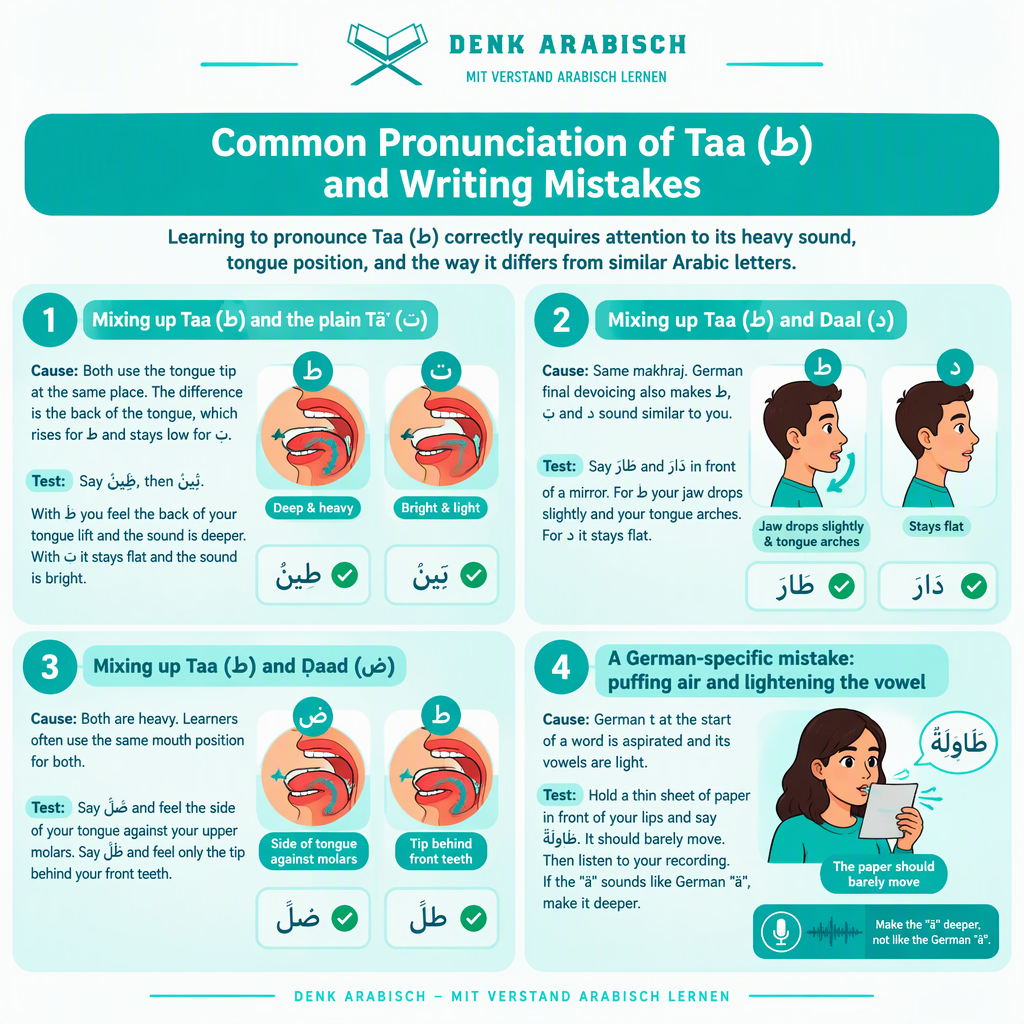
Common Taa Pronunciation Mistakes
Learning to pronounce Taa (ط) correctly requires attention to its heavy sound, tongue position, and the way it differs from similar Arabic letters.
1. Mixing up Taa (ط) and the plain Tāʾ (ت)
Cause: Both use the tongue tip at the same place. The difference is the back of the tongue, which rises for ط and stays low for ت.
Test: Say طِينٌ, then تِينٌ. With ط you feel the back of your tongue lift and the sound is deeper. With ت it stays flat and the sound is bright.
2. Mixing up Taa (ط) and Daal (د)
Cause: Same makhraj. German final devoicing also makes ط, ت and د sound similar to you.
Test: Say طَارَ and دَارَ in front of a mirror. For ط your jaw drops slightly and your tongue arches. For د it stays flat.
3. Mixing up Taa (ط) and Ḍaad (ض)
Cause: Both are heavy. Learners often use the same mouth position for both.
Test: Say ضَيْفٌ and feel the side of your tongue against your upper molars. Say طَيْفٌ and feel only the tip behind your front teeth.
4. A German-specific mistake: puffing air and lightening the vowel
Cause: German t at the start of a word is aspirated and its vowels are light.
Test: Hold a thin sheet of paper in front of your lips and say طَاوِلَةٌ. It should barely move. Then listen to your recording. If the “ā” sounds like German “ä”, make it deeper.
Practice Exercises for the Letter Taa
These Four short exercises use only words and rules from this guide. Try each one before you look at the answer.
Exercise 1: Identify the Makhraj
Where is Taa made?
- a) In the throat
- b) With the tip of the tongue at the base of the upper front teeth
- c) With the lips
- d) With the side of the tongue
Answer: b
Exercise 2: Match the Words and Meanings
Match each word to its meaning: طِفْلٌ, مَطَرٌ, طَبِيبٌ, فُطُورٌ.
Meanings: rain, breakfast, child, doctor.
Answers: طِفْلٌ = child, مَطَرٌ = rain, طَبِيبٌ = doctor, فُطُورٌ = breakfast.
Exercise 3: Practice Writing Taa
Write ط in all four forms. Then copy the word مَطْعَمٌ three times.
Exercise 4: True or False
- Taa is a moon letter.
- Taa has one dot above it.
- Taa is a heavy letter.
- When you stop on مُحِيطٌ, Qalqalah applies to the ṭ.
Answers: 1 False (it is a sun letter). 2 False (the dot belongs to ظ). 3 True. 4 True.
Exercise 5: Spot the Taa
Which words contain ط? طِينٌ، تِينٌ، مَطَرٌ، دَارٌ، قِطَّةٌ
Answer: طِينٌ، مَطَرٌ، قِطَّةٌ.
What Our Students Say About Denk Arabisch Academy
See what our students say about learning at Denk Arabisch Academy on Trustpilot. Read their experiences and check out more reviews to discover how our courses help improve Arabic.

Continue Learning Arabic with Denk Arabisch
Taa is one of 28 letters. Learning them in a clear order helps you move from single sounds to reading, writing and speaking without gaps.
Denk Arabisch is built for German-speaking learners and explains Arabic through German. Here is what that gives you:
- Explanations that use German sounds as a starting point
- A clear path from letters to words to sentences
- Courses matched to your goal, from Quranic reading to everyday conversation
- Content for adults and for parents who learn alongside their children
Choose Your Specialized Course:
Each course below focuses on one skill, so you can pick the one that matches your goal. You can start with a single course and add others as you grow.
- Arabic Course For Beginners: Your first steps in Arabic, from zero.
- Quranic Arabic Course for German Speakers: Understand Quranic vocabulary and structures.
- Quran Tajweed Course for German Speakers: Learn makhraj, ṣifāt and the rules of recitation.
- Arabic Alphabet Course: Master all 28 letters, their sounds and shapes.
- Arabic Reading Course: Read words and sentences smoothly.
- Arabic Writing Course: Write letters, connections and words by hand.
- Arabic Speaking Course: Speak with confidence in everyday situations.
Learn Arabic with Denk Arabisch Academy
Speak and understand Arabic through a clear and effective learning system
Try a Free TrialSee what students and parents say about Denk Arabisch on Trustpilot
Ready to start? Book a free trial at Denk Arabisch.

Conclusion
The Letter Taa (ط) is a heavy sun letter, made with the tongue tip at the base of the upper front teeth. It has four forms and no dots.
Key takeaways:
- Sound: Taa is a deep, unaspirated t, made heavier than the German t in “Stein”.
- Writing: A loop with a straight stroke and no dot, in four forms.
- Recognition: Without a dot it is ط. With one dot above it is ظ.
Practice the sound with طِينٌ against تِينٌ and طَارَ against دَارَ. Write ط in its four forms, then copy مَطْعَمٌ. Finally, read the roots ط ل ب, ط ع م and ط ب ق aloud. With a little practice, Taa will feel natural.
Book a free trial lesson at Denk Arabisch and take your next step in Arabic.
FAQs
These five questions cover the points learners ask about most: confusable letters, sun and moon, heaviness and Qalqalah. Each answer is short enough to remember.
1. What is the difference between ط and ت?
Both are made at the same place with the tongue tip. ط is heavy, with the back of the tongue raised and a deep vowel after it. ت is light and clear.
2. What is the difference between ط and ض?
Both are heavy letters. ط uses the tip of the tongue, while ض uses the side of the tongue against the upper molars.
3. Is Taa a sun letter or a moon letter?
Taa is a sun letter. The lām of al- is silent, and Taa carries a shadda, as in اَلطَّبِيبُ.
4. Is Taa heavy or light?
Taa is heavy. It belongs to the istiʿlāʾ letters خُصَّ ضَغْطٍ قِظْ and stays heavy with every vowel.
5. Which Tajweed rule does Taa trigger?
Taa is a Qalqalah letter, one of ق ط ب ج د (قُطْبُ جَدٍّ). When it is still, you add a slight echo, as in أَفَتَطْمَعُونَ.