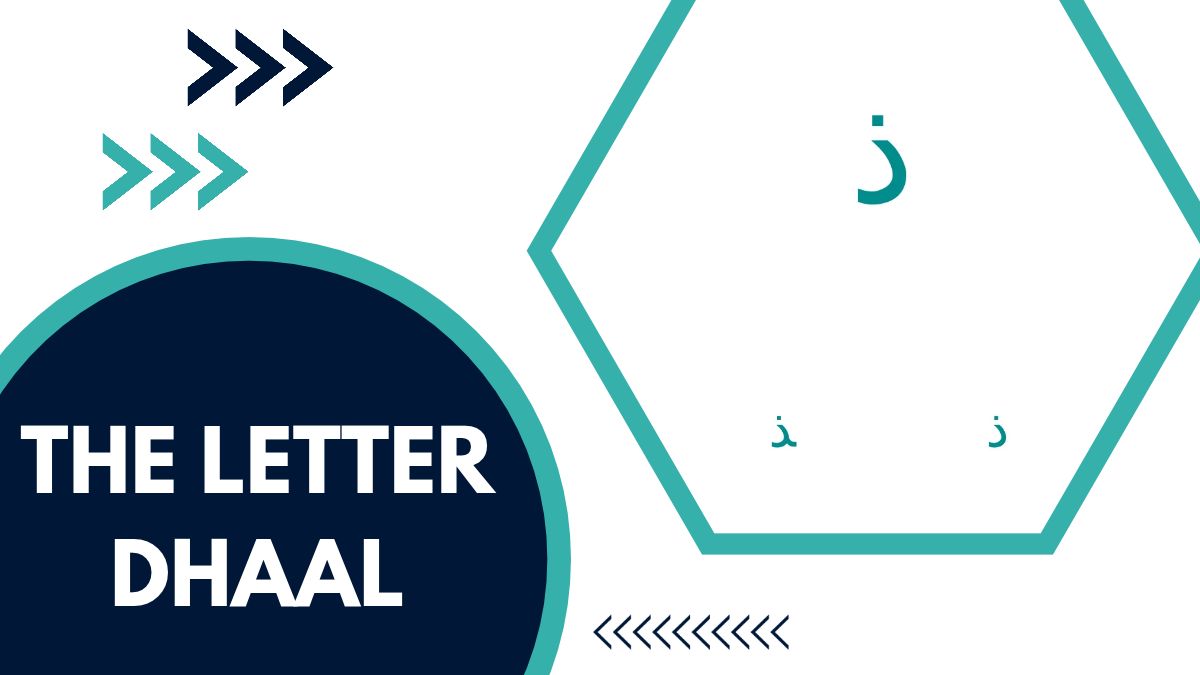
The letter Dhaal (ذ), in Arabic ذَال, is the 9th letter of the Arabic alphabet. You make it with the tip of your tongue touching the edges of your upper front teeth while your voice keeps buzzing. Linguists call it a voiced dental fricative, written [ð] in IPA.
Here is the honest part: German has no Dhaal. But you almost certainly know it already from English. The “th” in this, that and mother is exactly the Arabic ذ. If you can say “this” without turning it into “dis” or “sis”, you can say Dhaal.
Short exercises at the end let you check what you have learned.
| Fact | Dhaal (ذ) |
| Name | ذَال (Dhāl) |
| Sound | [ð], voiced dental fricative; English “this”, Modern Greek δ in δέκα |
| Position in the alphabet | 9th letter (hijāʾī order) |
| Abjad value | 25th position, value 700 |
| Transliteration | Common: dh · DIN 31635: ḏ · Variant: ð, informally th · Arabizi: no fixed digit (usually dh, th or z) |
| Point of articulation | Tip of the tongue with the edges of the upper front teeth |
| Sun or Moon letter | Sun letter |
| Heavy or light | Always light (muraqqaq) |
| Dots | One dot above |
| Connection | Non-connecting: joins only from the right |
A note on transliteration: single words are shown in their pausal form, the way they sound when you stop on them. Full sentences show every case ending.
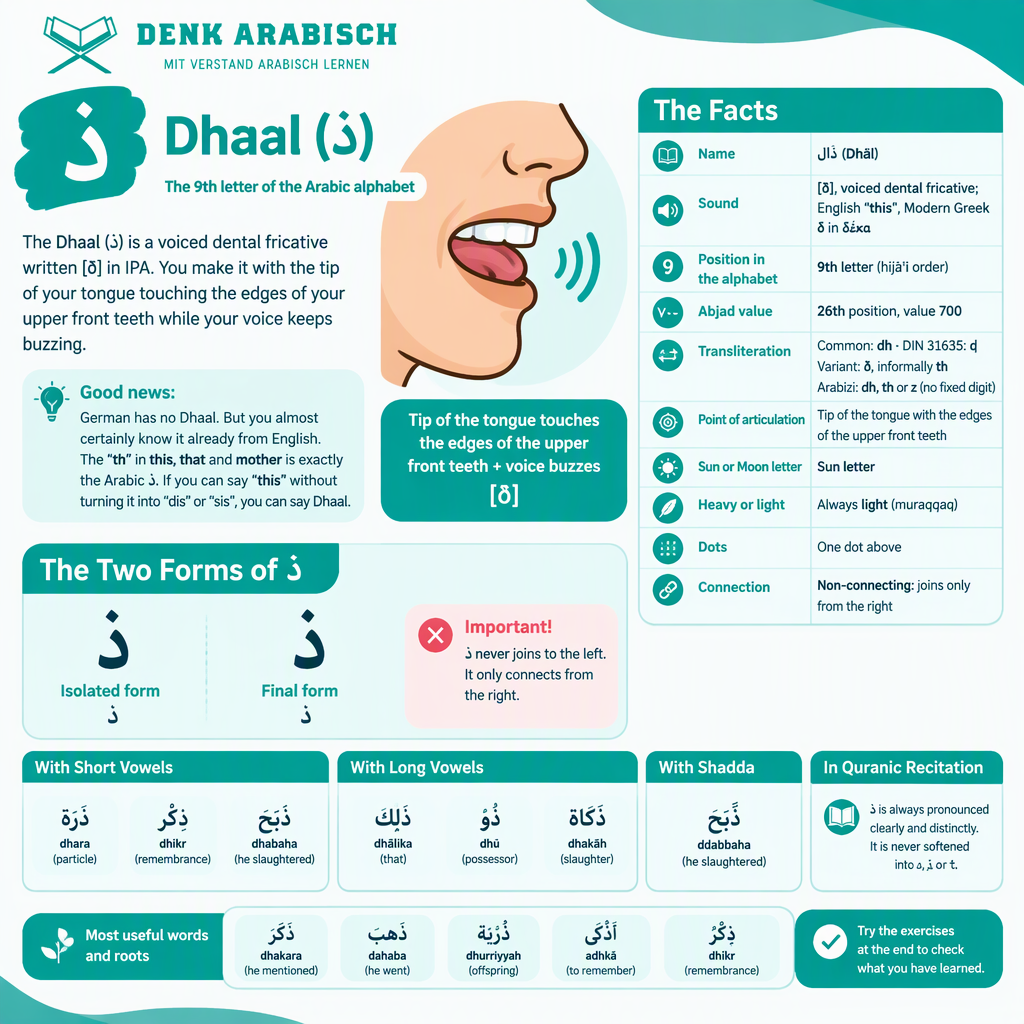
Table of Contents
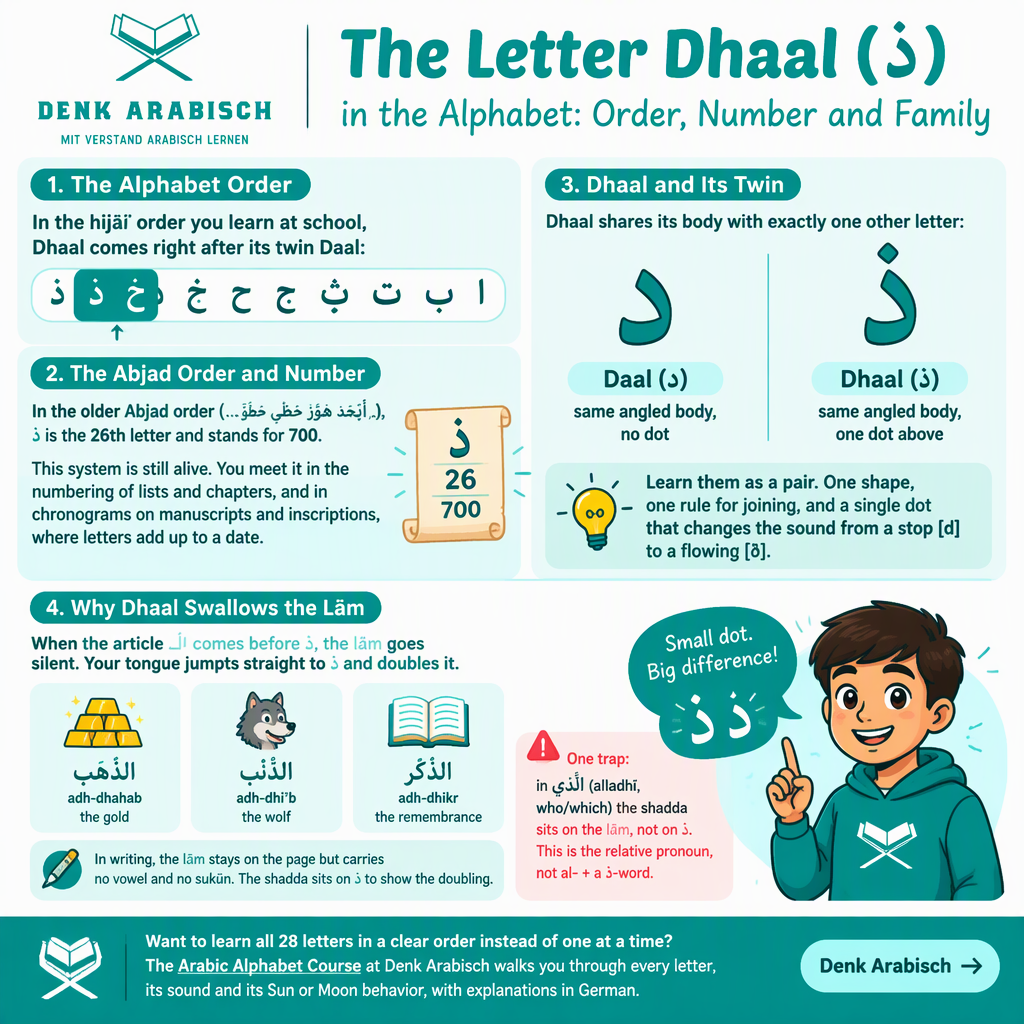
The Letter Dhaal (ذ) in the Alphabet: Order, Number and Family
In the hijāʾī order you learn at school, Dhaal comes right after its twin Daal:
ا ب ت ث ج ح خ د ذ
In the older Abjad order (أَبْجَد هَوَّز حُطِّي…), ذ is the 25th letter and stands for 700. This system is still alive. You meet it in the numbering of lists and chapters, and in chronograms on manuscripts and inscriptions, where letters add up to a date.
Dhaal and Its Twin, Daal
Dhaal shares its body with exactly one other letter:
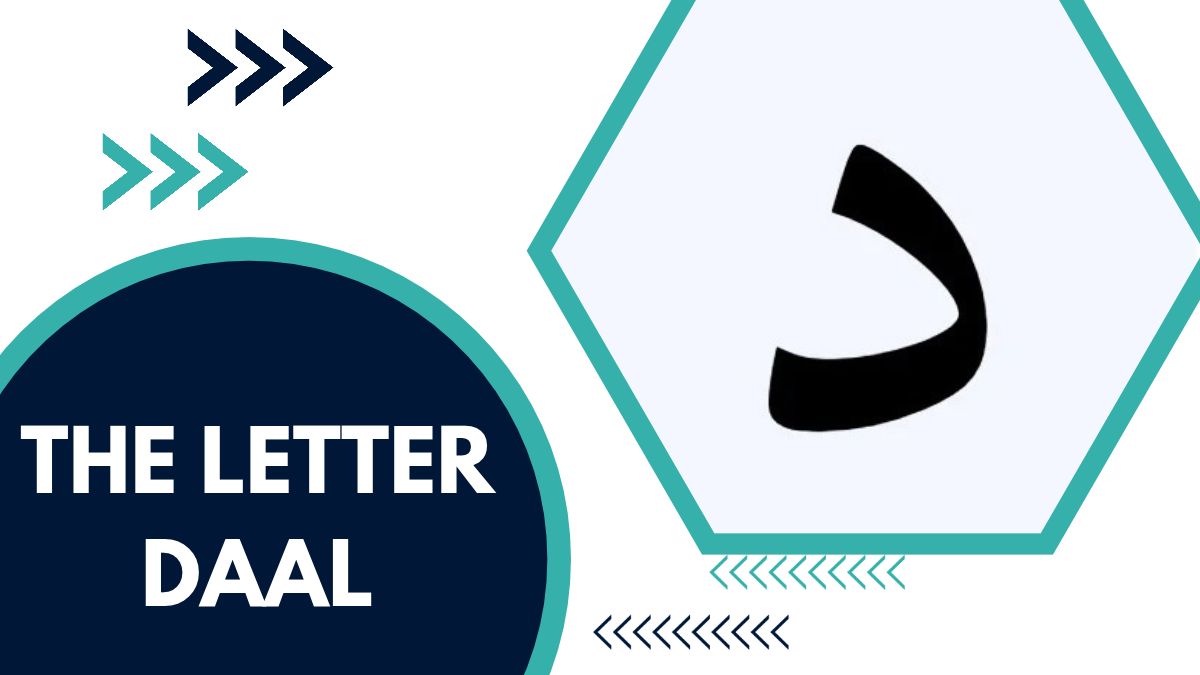
- د (Daal): the same angled body, no dot
- ذ (Dhaal): the same angled body, one dot above
Learn them as a pair. One shape, one rule for joining, and a single dot that changes the sound from a stop [d] to a flowing [ð].
Why Dhaal Swallows the Lām: It Is a Sun Letter
When the article الْـ comes before ذ, the lām goes silent. Your tongue jumps straight to ذ and doubles it.
- الذَّهَب (adh-dhahab): the gold
- الذِّئْب (adh-dhiʾb): the wolf
- الذِّكْر (adh-dhikr): the remembrance
In writing, the lām stays on the page but carries no vowel and no sukūn. The shadda sits on ذ to show the doubling.
One trap: in الَّذِي (alladhī, who/which) the shadda sits on the lām, not on ذ. This is the relative pronoun, not al- + a ذ-word.
Want to learn all 28 letters in a clear order instead of one at a time? The Arabic Alphabet Course at Denk Arabisch walks you through every letter, its sound and its Sun or Moon behavior, with explanations in German.
Where Dhaal Is Born: Makhraj and Tajweed
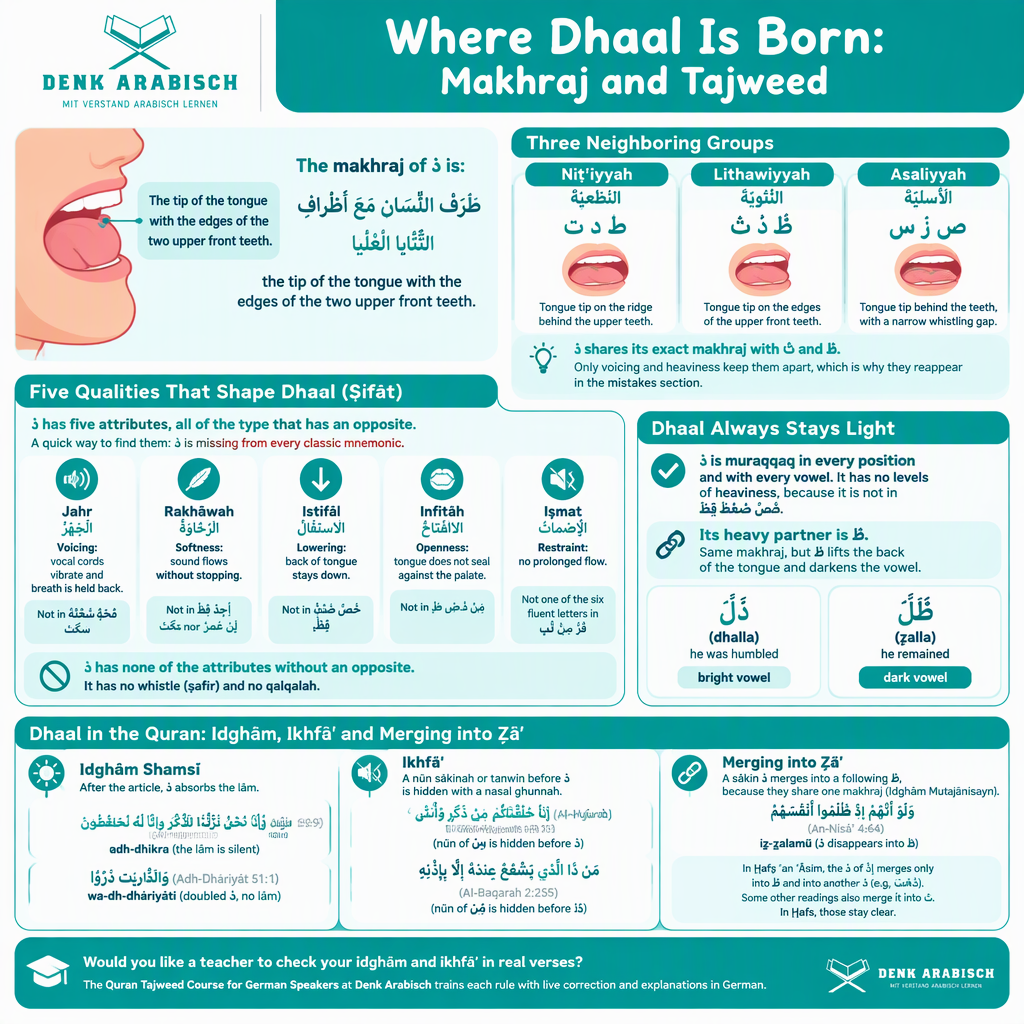
The makhraj of ذ is طَرَفُ اللِّسَانِ مَعَ أَطْرَافِ الثَّنَايَا الْعُلْيَا: the tip of the tongue with the edges of the two upper front teeth. Three neighboring groups are made with the tongue tip, and mixing them up explains most Dhaal errors.
| Group | Arabic | Letters | Contact point |
| Niṭʿiyyah | النِّطْعِيَّة | ط د ت | Tongue tip on the ridge behind the upper teeth |
| Lithawiyyah | اللِّثَوِيَّة | ظ ذ ث | Tongue tip on the edges of the upper front teeth |
| Asaliyyah | الْأَسَلِيَّة | ص ز س | Tongue tip behind the teeth, with a narrow whistling gap |
ذ shares its exact makhraj with ث and ظ. Only voicing and heaviness keep them apart, which is why they reappear in the mistakes section.
Five Qualities That Shape Dhaal (Ṣifāt)
ذ has five attributes, all of the type that has an opposite. A quick way to find them: ذ is missing from every classic mnemonic.
- Jahr (الْجَهْرُ), voicing: your vocal cords vibrate and the breath is held back. ذ is not in فَحَثَّهُ شَخْصٌ سَكَتْ, the list of whispered letters.
- Rakhāwah (الرَّخَاوَةُ), softness: the sound flows without stopping. ذ is neither in أَجِدْ قَطٍ بَكَتْ nor in لِنْ عُمَرْ.
- Istifāl (الِاسْتِفَالُ), lowering: the back of the tongue stays down. ذ is not in خُصَّ ضَغْطٍ قِظْ.
- Infitāḥ (الِانْفِتَاحُ), openness: the tongue does not seal against the palate. ذ is not one of ص ض ط ظ.
- Iṣmāt (الْإِصْمَاتُ), restraint: ذ is not one of the six fluent letters in فَرَّ مِنْ لُبٍّ.
ذ has none of the attributes without an opposite. It has no whistle (ṣafīr) and no qalqalah.
Dhaal Always Stays Light
ذ is muraqqaq in every position and with every vowel. It has no levels of heaviness, because it is not in خُصَّ ضَغْطٍ قِظْ.
Its heavy partner is ظ. Same makhraj, but ظ lifts the back of the tongue and darkens the vowel. Compare ذَلَّ (dhalla, he was humbled) with ظَلَّ (ẓalla, he remained): the first a is bright, the second is dark.
Dhaal in the Quran: Idghām, Ikhfāʾ and Merging into Ẓāʾ
The main rule is Idghām Shamsī: after the article, ذ absorbs the lām.
- إِنَّا نَحْنُ نَزَّلْنَا الذِّكْرَ وَإِنَّا لَهُ لَحَافِظُونَ (Surah Al-Ḥijr 15:9): the lām of الذِّكْرَ is silent, and you read adh-dhikra.
- وَالذَّارِيَاتِ ذَرْوًا (Surah Adh-Dhāriyāt 51:1): wa-dh-dhāriyāti, with a doubled ذ and no lām.
ذ is also one of the 15 letters of Ikhfāʾ. A nūn sākinah or tanwīn before it is hidden with a nasal ghunnah.
- إِنَّا خَلَقْنَاكُم مِّن ذَكَرٍ وَأُنثَىٰ (Surah Al-Ḥujurāt 49:13): the nūn of مِّن is hidden before ذ.
- مَن ذَا الَّذِي يَشْفَعُ عِندَهُ إِلَّا بِإِذْنِهِ (Surah Al-Baqarah 2:255): the nūn of مَن is hidden before ذَا.
Finally, a sākin ذ merges into a following ظ, because they share one makhraj (Idghām Mutajānisayn).
- وَلَوْ أَنَّهُمْ إِذ ظَّلَمُوا أَنفُسَهُمْ (Surah An-Nisāʾ 4:64): you read iẓ-ẓalamū; the ذ disappears into ظ.
In Ḥafṣ ʿan ʿĀṣim, the ذ of إِذْ merges only into ظ and into another ذ, as in إِذ ذَّهَبَ (Surah Al-Anbiyāʾ 21:87). Some other readings also merge it into letters such as ت. In Ḥafṣ, those stay clear.
Learn how to apply the correct pronunciation with our guide to “Ikhfa Rules With Examples” and recite the Quran with greater accuracy and confidence.
Would you like a teacher to check your idghām and ikhfāʾ in real verses? The Quran Tajweed Course for German Speakers at Denk Arabisch trains each rule with live correction and explanations in German.
Saying Dhaal Right: From English “this” to Arabic ذ
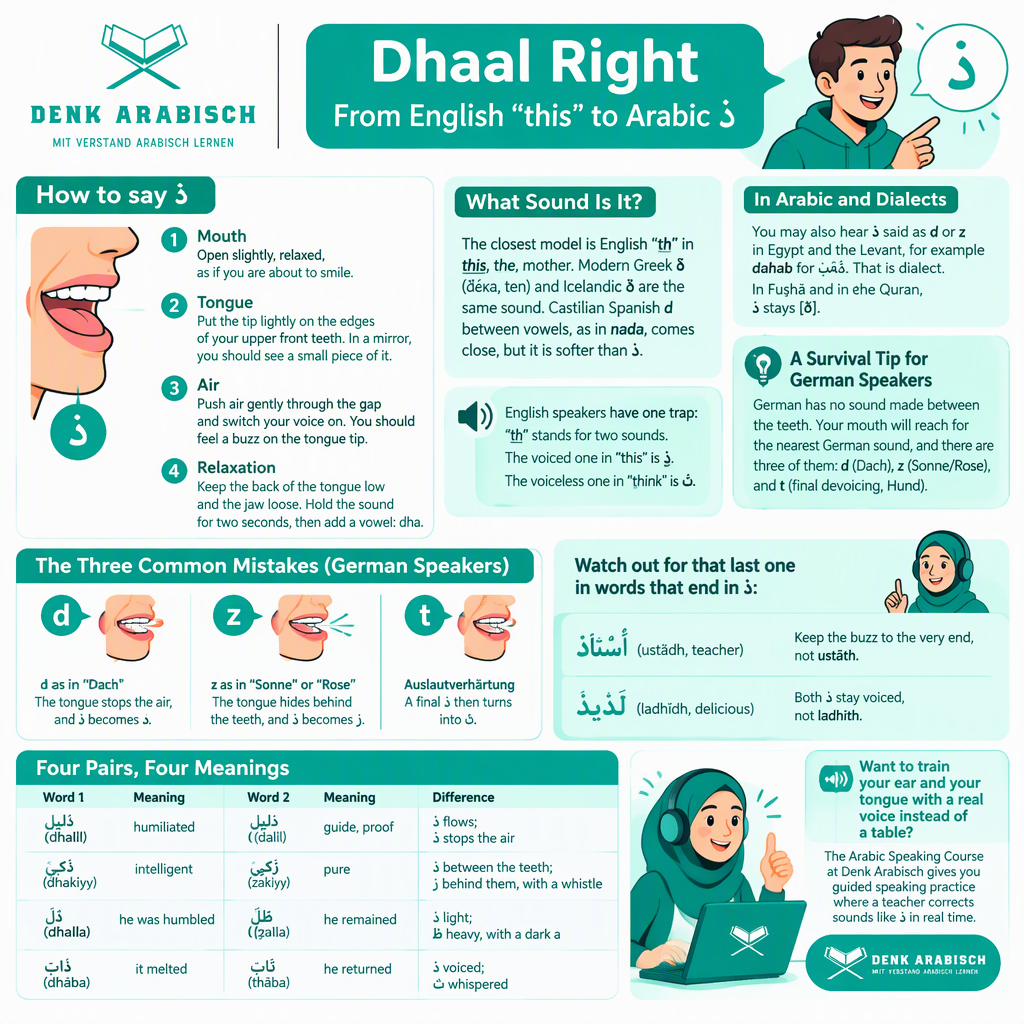
The closest model is English “th” in this, the, mother. Modern Greek δ (δέκα, ten) and Icelandic ð are the same sound. Castilian Spanish d between vowels, as in nada, comes close, but it is softer than ذ.
English speakers have one trap: “th” stands for two sounds. The voiced one in “this” is ذ. The voiceless one in “think” is ث.
You may also hear ذ said as d or z in Egypt and the Levant, for example dahab for ذَهَب. That is dialect. In Fuṣḥā and in the Quran, ذ stays [ð].
A Survival Tip for German Speakers
German has no sound made between the teeth. Your mouth will reach for the nearest German sound, and there are three of them:
- d as in “Dach”: the tongue stops the air, and ذ becomes د
- the voiced s as in “Sonne” or “Rose”: the tongue hides behind the teeth, and ذ becomes ز
- Auslautverhärtung, final devoicing: German turns a voiced final consonant voiceless, as in “Hund” said with t. A final ذ then turns into ث.
Watch out for that last one in words that end in ذ:
- أُسْتَاذ (ustādh, teacher): keep the buzz to the very end, not ustāth
- لَذِيذ (ladhīdh, delicious): both ذ stay voiced, not ladhīth
Four Steps to a Clean Dhaal
- Mouth: open slightly, relaxed, as if you are about to smile.
- Tongue: put the tip lightly on the edges of your upper front teeth. In a mirror, you should see a small piece of it.
- Air: push air gently through the gap and switch your voice on. You should feel a buzz on the tongue tip.
- Relaxation: keep the back of the tongue low and the jaw loose. Hold the sound for two seconds, then add a vowel: dha.
Dhaal Against Its Look-Alike Sounds
Each pair changes only one letter, and the meaning changes completely.
| Word 1 | Meaning | Word 2 | Meaning | Difference |
| ذَلِيل (dhalīl) | humiliated | دَلِيل (dalīl) | guide, proof | ذ flows; د stops the air |
| ذَكِيّ (dhakiyy) | intelligent | زَكِيّ (zakiyy) | pure | ذ between the teeth; ز behind them, with a whistle |
| ذَلَّ (dhalla) | he was humbled | ظَلَّ (ẓalla) | he remained | ذ light; ظ heavy, with a dark a |
| ذَابَ (dhāba) | it melted | ثَابَ (thāba) | he returned | ذ voiced; ث whispered |
Read each pair aloud five times, then ask someone to say one word while you guess which it was.
Want to train your ear and your tongue with a real voice instead of a table? The Arabic Speaking Course at Denk Arabisch gives you guided speaking practice where a teacher corrects sounds like ذ in real time.
Writing Dhaal by Hand: Only Two Shapes to Learn
Arabic runs from right to left, and most letters have four forms. ذ has only two, because it is one of the six non-connecting letters: ا د ذ ر ز و.
Why? Its stroke ends at the bottom left with no tail running along the baseline. There is nothing to link to the next letter, so the next letter always starts fresh, in its initial or isolated form.
| Form | Shape | Example | Transliteration | Meaning |
| Isolated | ذ | ذَهَب | dhahab | gold |
| Final | ـذ | تِلْمِيذ | tilmīdh | pupil |
1. Isolated Form (ذ)
You use it at the start of a word, and whenever ذ follows another non-connecting letter. Because ذ never joins to the left, even a word that begins with ذ uses this form.
Shape: a small angled stroke, like an open corner, sitting on the line, with one dot above.
Examples:
- ذَهَب (dhahab): gold
- أَذَان (adhān): call to prayer, where ذ follows the non-connecting أ
- رَذَاذ (radhādh): drizzle, where the first ذ follows ر and the second follows ا
2. Final Form (ـذ)
You use it when the letter before ذ connects to it. The “final” form also appears in the middle of a word, because whatever follows ذ has to start a new group.
Shape: the same corner, with a short joining stroke coming in from the right.
Examples:
- أَخَذَ (akhadha): he took
- لَذِيذ (ladhīdh): delicious, with ذ connected twice
- نَافِذَة (nāfidhah): window, where ة after ذ stands alone
The one rule that never changes: ذ always carries exactly one dot, above the letter, and the letter itself sits on the line. Without the dot it is د; with a body that dips below the line it is ز.
Want clean, confident handwriting from the first letter? The Arabic Writing Course at Denk Arabisch guides you through letter shapes, connections and spacing step by step.
Learn Arabic with Denk Arabisch Academy
Speak and understand Arabic through a clear and effective learning system
Try a Free TrialDhaal Meets the Vowels
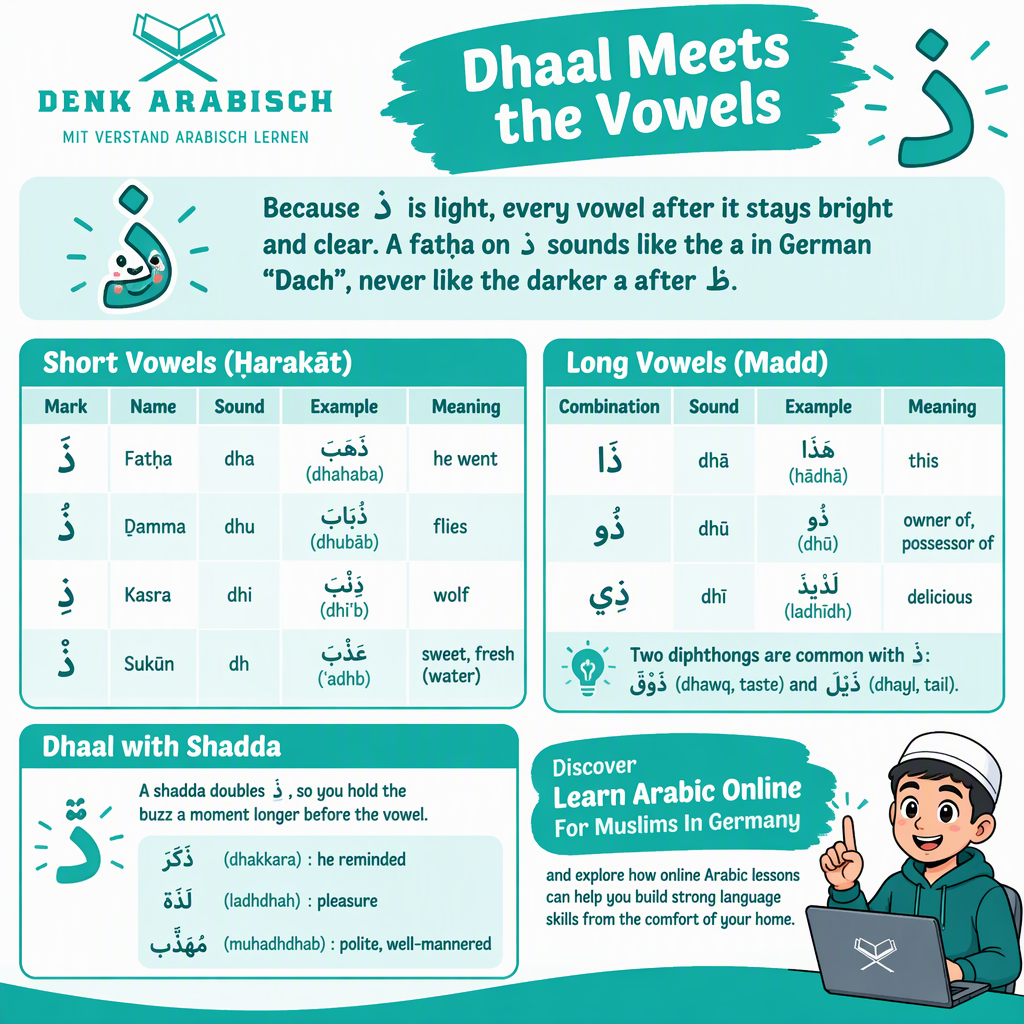
Because ذ is light, every vowel after it stays bright and clear. A fatḥa on ذ sounds like the a in German “Dach”, never like the darker a after ظ.
Short Vowels (Ḥarakāt)
Below is an overview of the short vowels (Ḥarakāt) using the letter Dhal (ذ) as an example.
| Mark | Name | Sound | Example | Meaning |
| ذَ | Fatḥa | dha | ذَهَبَ (dhahaba) | he went |
| ذُ | Ḍamma | dhu | ذُبَاب (dhubāb) | flies |
| ذِ | Kasra | dhi | ذِئْب (dhiʾb) | wolf |
| ذْ | Sukūn | dh | عَذْب (ʿadhb) | sweet, fresh (water) |
Long Vowels (Madd)
The following table details the main Madd (long vowel) combinations, their pronunciations, and example words.
| Combination | Sound | Example | Meaning |
| ذَا | dhā | هَٰذَا (hādhā) | this |
| ذُو | dhū | ذُو (dhū) | owner of, possessor of |
| ذِي | dhī | لَذِيذ (ladhīdh) | delicious |
Two diphthongs are common with ذ: ذَوْق (dhawq, taste) and ذَيْل (dhayl, tail).
Dhaal with Shadda
A shadda doubles ذ, so you hold the buzz a moment longer before the vowel.
- ذَكَّرَ (dhakkara): he reminded
- لَذَّة (ladhdhah): pleasure
- مُهَذَّب (muhadhdhab): polite, well-mannered
Three Root Families Built on Dhaal
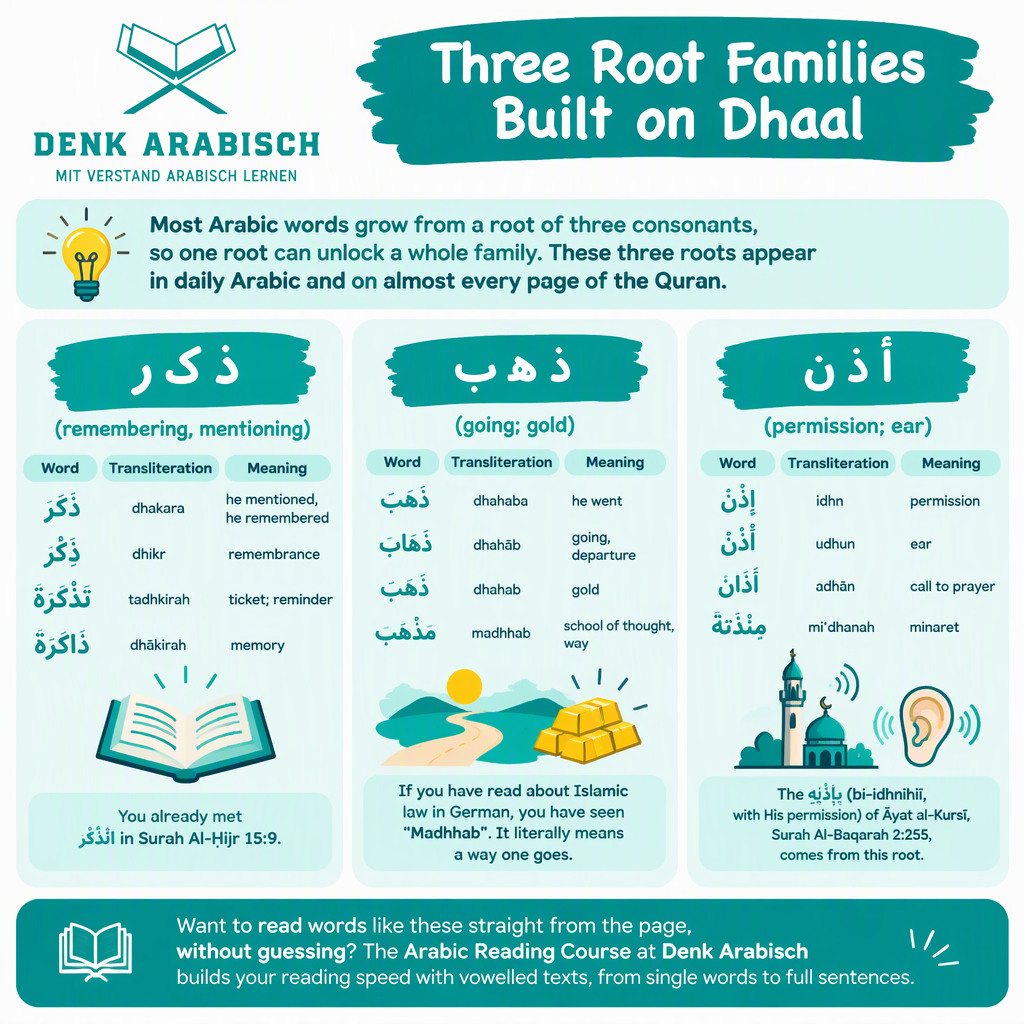
Most Arabic words grow from a root of three consonants, so one root can unlock a whole family. These three roots appear in daily Arabic and on almost every page of the Quran.
ذ ك ر (remembering, mentioning)
From everyday memory to official reminders, see how the root Dh-K-R (ذ ك ر) expands across different contexts.
| Word | Transliteration | Meaning |
| ذَكَرَ | dhakara | he mentioned, he remembered |
| ذِكْر | dhikr | remembrance |
| تَذْكِرَة | tadhkirah | ticket; reminder |
| ذَاكِرَة | dhākirah | memory |
You already met الذِّكْرَ in Surah Al-Ḥijr 15:9.
ذ ه ب (going; gold)
The root ذ-ه-ب (dh-h-b) connects the act of moving forward with the intrinsic value of precious metals, giving rise to terms for going, gold, and philosophical paths.
| Word | Transliteration | Meaning |
| ذَهَبَ | dhahaba | he went |
| ذَهَاب | dhahāb | going, departure |
| ذَهَب | dhahab | gold |
| مَذْهَب | madhhab | school of thought, way |
If you have read about Islamic law in German, you have seen “Madhhab”. It literally means “a way one goes”.
أ ذ ن (permission; ear)
The root أ-ذ-ن (ʾ-dh-n) revolves around hearing and listening—linking the physical ear to acts of permission, the call to prayer, and the minarets from which it rings.
| Word | Transliteration | Meaning |
| إِذْن | idhn | permission |
| أُذُن | udhun | ear |
| أَذَان | adhān | call to prayer |
| مِئْذَنَة | miʾdhanah | minaret |
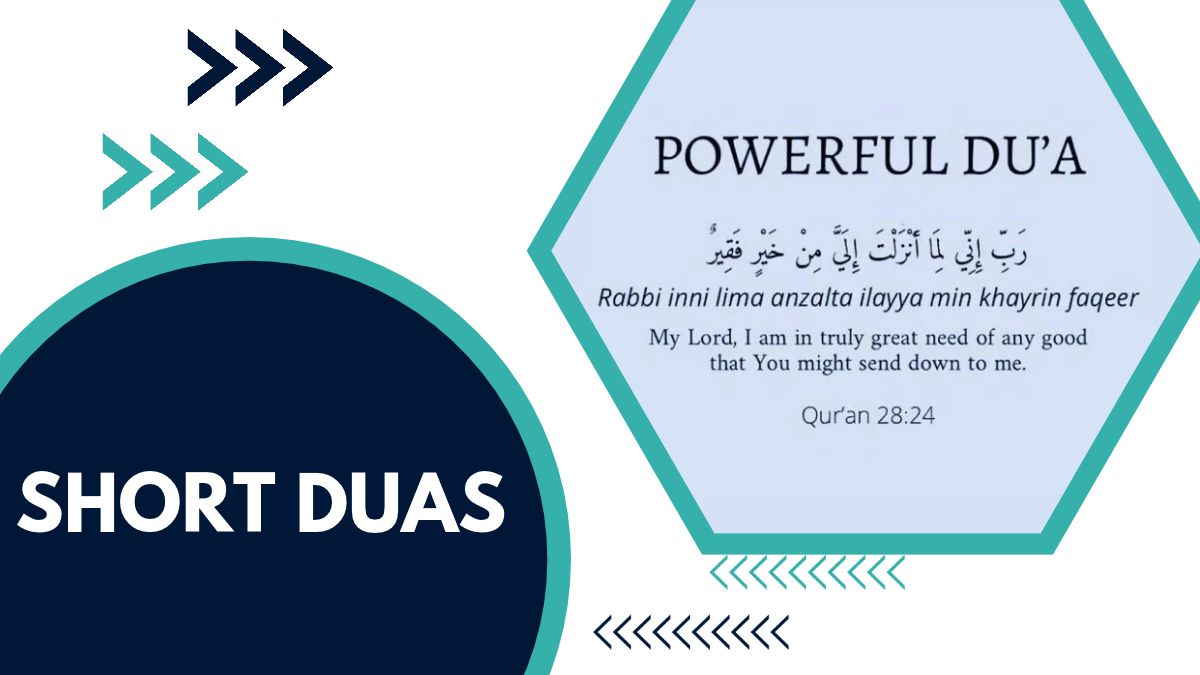
The بِإِذْنِهِ (bi-idhnihī, with His permission) of Āyat al-Kursī, Surah Al-Baqarah 2:255, comes from this root.
Want to read words like these straight from the page, without guessing? The Arabic Reading Course at Denk Arabisch builds your reading speed with vowelled texts, from single words to full sentences.
Dhaal at the Start, Middle and End of Words
These everyday words show ذ in all three positions; the end position is where German speakers devoice it most.
| Position | Word | Transliteration | Meaning |
| Beginning | ذَهَبٌ | dhahab | gold |
| Middle | نَافِذَةٌ | nāfidhah | window |
| End | تِلْمِيذٌ | tilmīdh | pupil |
Dhaal in Everyday Arabic Sentences
Each sentence reuses words from the table above, so you only need to focus on reading ذ in context.
| Arabic Sentence | Transliteration | Meaning |
| هَٰذَا ذَهَبٌ. | hādhā dhahabun. | This is gold. |
| الْأُسْتَاذُ ذَكِيٌّ. | al-ustādhu dhakiyyun. | The teacher is intelligent. |
| التِّلْمِيذُ يَفْتَحُ النَّافِذَةَ. | at-tilmīdhu yaftaḥu n-nāfidhata. | The pupil opens the window. |
In the first sentence, ذ appears twice in a row across two words: keep the buzz going from hādhā into dhahabun.
Discover Daily Arabic Phrases and learn simple, useful Arabic expressions that you can use naturally in everyday conversations.
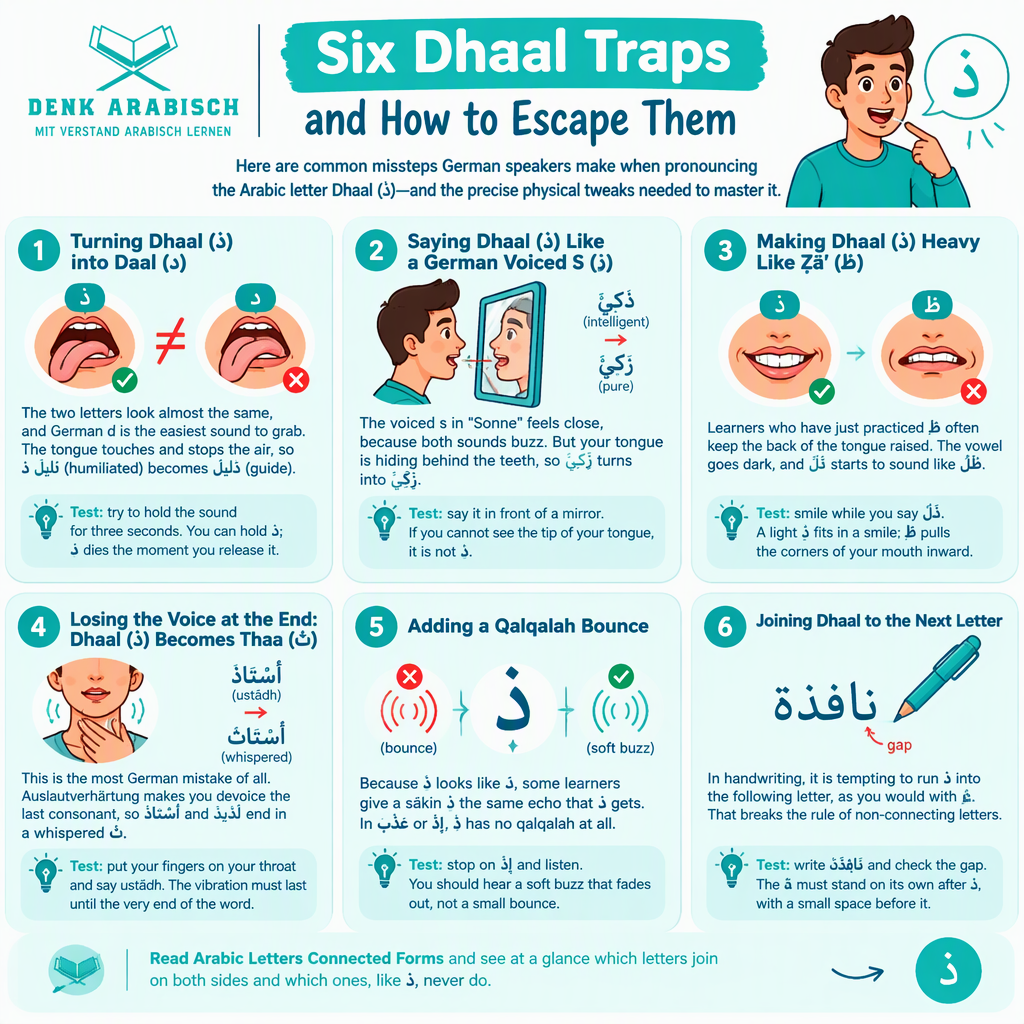
Six Dhaal Traps and How to Escape Them
Here are common missteps German speakers make when pronouncing the Arabic letter Dhaal (ذ)—and the precise physical tweaks needed to master it.
1. Turning Dhaal (ذ) into Daal (د)
The two letters look almost the same, and German d is the easiest sound to grab. The tongue touches and stops the air, so ذَلِيل (humiliated) becomes دَلِيل (guide).
Test: try to hold the sound for three seconds. You can hold ذ; د dies the moment you release it.
2. Saying Dhaal (ذ) Like a German Voiced S (ز)
The voiced s in “Sonne” feels close, because both sounds buzz. But your tongue is hiding behind the teeth, so ذَكِيّ (intelligent) turns into زَكِيّ (pure).
Test: say it in front of a mirror. If you cannot see the tip of your tongue, it is not ذ.
3. Making Dhaal (ذ) Heavy Like Ẓāʾ (ظ)
Learners who have just practiced ظ often keep the back of the tongue raised. The vowel goes dark, and ذَلَّ starts to sound like ظَلَّ.
Test: smile while you say ذَلَّ. A light ذ fits in a smile; ظ pulls the corners of your mouth inward.
4. Losing the Voice at the End: Dhaal (ذ) Becomes Thaa (ث)
This is the most German mistake of all. Auslautverhärtung makes you devoice the last consonant, so أُسْتَاذ and لَذِيذ end in a whispered ث.
Test: put your fingers on your throat and say ustādh. The vibration must last until the very end of the word.
5. Adding a Qalqalah Bounce
Because ذ looks like د, some learners give a sākin ذ the same echo that د gets. In عَذْب or إِذْ, ذ has no qalqalah at all.
Test: stop on إِذْ and listen. You should hear a soft buzz that fades out, not a small bounce.
6. Joining Dhaal to the Next Letter
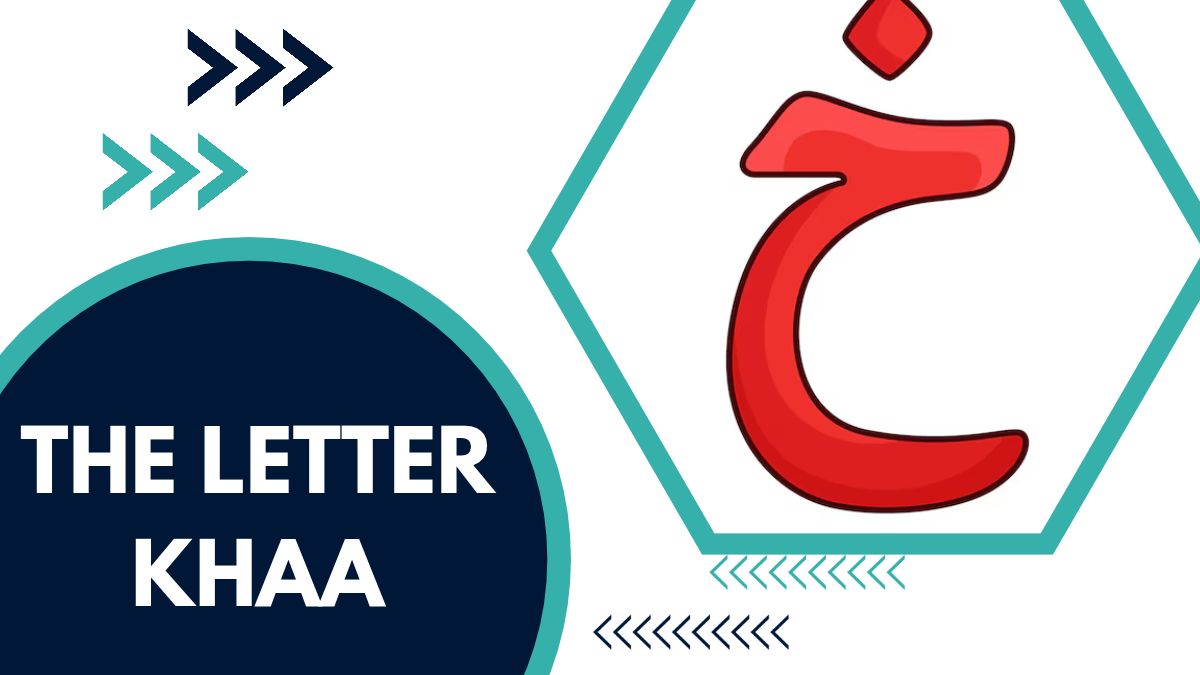
In handwriting, it is tempting to run ذ into the following letter, as you would with خ. That breaks the rule of non-connecting letters.
Test: write نَافِذَة and check the gap. The ة must stand on its own after ذ, with a small space before it.
Read Arabic Letters Connected Forms and see at a glance which letters join on both sides and which ones, like ذ, never do.
Practice Corner: Check Your Dhaal Skills
Mastering the letter Dhaal (ذ) requires developing a clear sense of how it differs in both position and sound from similar letters that often confuse learners.
Exercise 1: Multiple Choice
Which English word contains the sound of ذ?
- think
- this
- zoo
Answer: 2. this. The “th” in think is ث, and the z in zoo is ز.
Exercise 2: Matching
Match each word with its meaning.
- أُسْتَاذ · أُذُن · ذِئْب · نَافِذَة
- window · wolf · teacher · ear
Answer: أُسْتَاذ = teacher, أُذُن = ear, ذِئْب = wolf, نَافِذَة = window.
Exercise 3: Writing Practice
Write each word three times: ذَهَب, أَخَذَ, لَذِيذ, رَذَاذ. Check that ذ never joins the letter after it, and that every ذ has its dot.
Exercise 4: True or False
- ذ is a Moon letter.
- ذ is always light.
- ذ has four written forms.
- ذ and ظ share the same makhraj.
Answers: 1. False, it is a Sun letter (الذَّهَب). 2. True. 3. False, it has two. 4. True; only heaviness separates them.
Exercise 5: Find the Letter
How many times does ذ appear in each word: لَذِيذ, مُهَذَّب, تَذْكِرَة, رَذَاذ?
Answer: لَذِيذ = 2, مُهَذَّب = 1 (written once, pronounced double), تَذْكِرَة = 1, رَذَاذ = 2.
What Our Students Say About Denk Arabisch Academy
See what our students say about learning at Denk Arabisch Academy on Trustpilot. Read their experiences and check out more reviews to discover how our courses help improve Arabic.

Your Next Step After Dhaal: Learning with Denk Arabisch
Dhaal is one of 28 letters. Each one is easy on its own; the progress comes from learning them in a sensible order and practicing them in real words.
Denk Arabisch is built for German-speaking learners and explains Arabic through German, from the ach-Laut to Auslautverhärtung.
- Explanations in German, with German sounds as reference points
- Live teachers who hear and correct your pronunciation
- A clear path from letters to reading, writing and speaking
- Lessons for adults and for children, with parents in the loop
Choose Your Specialized Course:
- Arabic Course For Beginners: a complete start, from letters to first conversations
- Arabic Alphabet Course: all 28 letters, their sounds and their forms
- Arabic Reading Course: fluent reading of vowelled texts
- Arabic Writing Course: clean handwriting and correct connections
- Arabic Speaking Course: guided speaking practice for everyday Arabic
- Quranic Arabic Course for German Speakers: understand the vocabulary and grammar of the Quran
- Quran Tajweed Course for German Speakers: recite with correct makhārij and rules
Learn Arabic with Denk Arabisch Academy
Speak and understand Arabic through a clear and effective learning system
Try a Free TrialBook a free trial lesson with Denk Arabisch and hear your own ذ checked by a teacher.

Conclusion
The letter Dhaal (ذ) is one of the friendliest Arabic sounds for German speakers, because you already own it through English “this”.
- Sound: tongue tip on the upper teeth, voice on, air flowing, always light.
- Writing: two forms only, one dot above, never joined to the left.
- Recognition: a Sun letter with a shadda after الْـ, and the twin of د.
Practice a few minutes a day. Hold a long ذ in front of the mirror, write ذَهَب and لَذِيذ until the gap after ذ feels natural, and run through the four minimal pairs against د, ز, ظ and ث. Then read the families of ذ ك ر, ذ ه ب and أ ذ ن aloud.
One dot and one small tongue movement, and you have a letter you will meet in almost every verse and every conversation.
Ready to put it into practice? Book a free trial lesson at Denk Arabisch.
FAQs
1. What is the difference between Dhaal (ذ) and Zaay (ز)?
For ذ, the tongue tip touches the edges of the upper front teeth and you can see it. For ز, the tongue stays behind the teeth and the air makes a whistle. In writing, ز dips below the line while ذ sits on it.
2. What is the difference between Dhaal (ذ) and Ẓāʾ (ظ)?
They share one makhraj, so the tongue tip is in the same place. ظ is heavy: the back of the tongue rises and the vowel turns dark. ذ is light, as in ذَلَّ versus ظَلَّ.
3. Is Dhaal a Sun letter or a Moon letter?
ذ is a Sun letter. The lām of الْـ is silent before it, and ذ takes a shadda, as in الذَّهَب (adh-dhahab).
4. Is Dhaal ever heavy?
No. ذ is muraqqaq in every position, because it is not one of the letters of خُصَّ ضَغْطٍ قِظْ. If your ذ sounds dark, you are drifting toward ظ.
5. Which Tajweed rules involve Dhaal?
The main one is Idghām Shamsī after الْـ, as in الذِّكْرَ (Al-Ḥijr 15:9). ذ also triggers Ikhfāʾ after a nūn sākinah, as in مِّن ذَكَرٍ (Al-Ḥujurāt 49:13), and a sākin ذ merges into ظ, as in إِذ ظَّلَمُوا (An-Nisāʾ 4:64). Unlike د, ذ has no qalqalah.