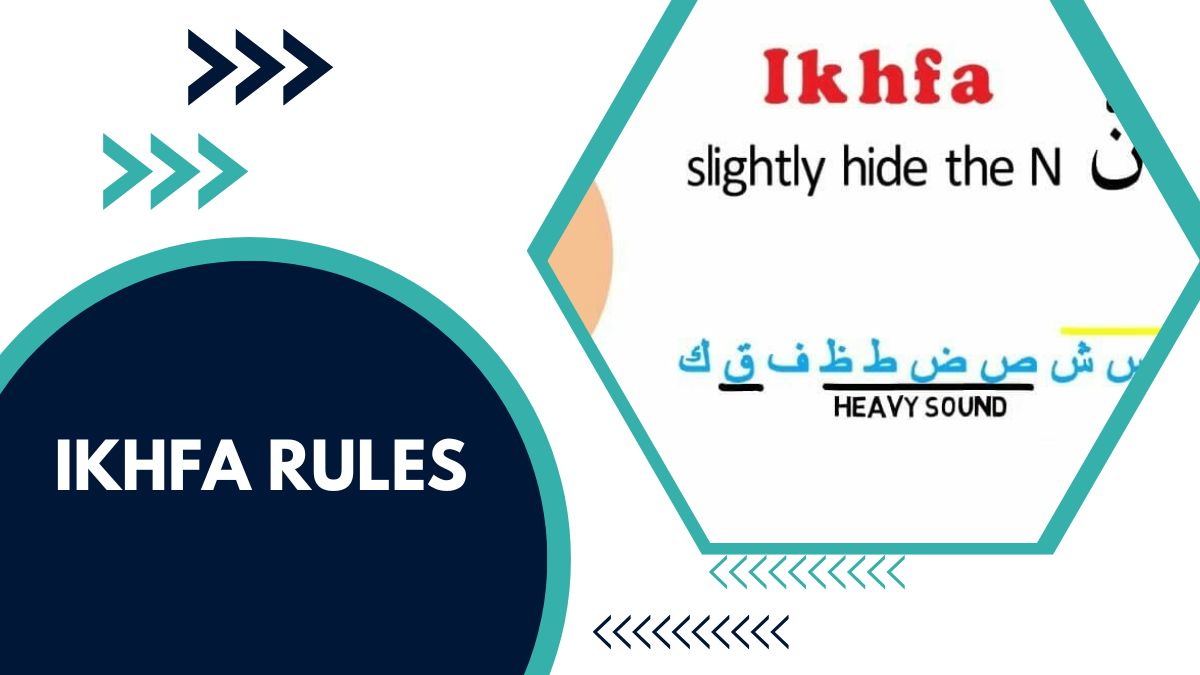
Takeaway:
- Ikhfa means “hiding” the sound of Noon Sakinah or Tanween, neither pronouncing it clearly nor merging it fully.
- It applies when any of 15 specific letters follow the Noon/Tanween: ت, ث, ج, د, ذ, ز, س, ش, ص, ض, ط, ظ, ف, ق, ك.
- The tongue hovers near the articulation point of the next letter without touching the palate, while a nasal sound (Ghunnah) resonates for exactly two counts.
- The Ghunnah adapts to the upcoming letter: deep and full (Tafkhim) before heavy letters (ص, ض, ط, ظ, ق); light and thin (Tarqiq) before all others.
- Ikhfa has three intensity levels: highest near ت, د, ط; lowest near ق, ك; middle for the remaining letters.
- Common errors to avoid: letting the tongue touch the palate (turning it into Izhar), rushing the Ghunnah, using a flat sound before heavy letters, pausing artificially, or over-stretching the vowel before the hidden Noon.
- The Mus-haf signals Ikhfa by an empty Noon (no Sukun) or staggered/paired Tanween marks to alert the reader.
In the world of Tajweed, some rules are like bold, clear lines (Izhar), while others are like colors blending seamlessly into one another (Idgham). However, Ikhfa (الإخفاء) is the play of light and shadow. It is the “hidden” rule that gives Quranic recitation its characteristic depth, soul, and elegance.
In this detailed guide from Denk Arabisch, we dive deep into the mechanics of Ikhfa. We will explain not only the 15 letters but also the physical processes within the mouth and the secret behind the variable Ghunnah.

Table of Contents
What is Ikhfa In Tajweed?
The word Ikhfa means much more linguistically and technically than a simple “omission” of a sound.
1. Meaning of Ikhfa in Arabic (Lughatan)
The word Ikhfa (إخفاء) comes from the root KH-F-Y, meaning “to hide,” “to conceal,” or “to cover.” In everyday Arabic, it is used when something is tucked away from view but its presence is still sensed.
2. Meaning of Ikhfa in Tajweed (Istilahan)
In Tajweed, Ikhfa refers to the concealment of the Noon Sakinah (نْ) or Tanween (ـًـٍـٌ) when followed by any of the 15 “Ikhfa letters.”
It is a state between Izhar (clarity) and Idgham (merging). You do not pronounce the Noon fully with the tip of your tongue, nor do you fully merge it into the next letter. Instead, you “hide” the Noon at the point of articulation (Makhraj) of the upcoming letter while maintaining a Ghunnah (nasal sound) for two counts.
Understanding the theory is just the beginning. With Denk Arabisch, you’ll actually hear, practice, and perfect every rule with expert guidance.
The Fifteen Ikhfa Letters
Ikhfa applies to almost half of the Arabic alphabet! If a letter is not an Izhar letter (throat), an Idgham letter (Yarmaloon), or the letter Baa (Iqlab), it is an Ikhfa letter.
The Letters: ت (Ta), ث (Tha), ج (Jeem), د (Dal), ذ (Dhal), ز (Zay), س (Seen), ش (Sheen), ص (Saad), ض (Daad), ط (Taa), ظ (Zaa), ف (Fa), ق (Qaf), ك (Kaf).
A Helpful Mnemonic:
To memorize these 15 letters, scholars composed a famous poem. The first letter of each word in this verse represents an Ikhfa letter:
صِفْ ذَا ثَـنَا كَـمْ جَـادَ شَـخْصٌ قَـدْ سَـمَا … دُمْ طَـيِّبًا زِدْ فِـي تُـقًى ضَـعْ ظَـالِمًا
(Describe the possessor of praise! How generous is a person who has attained such heights… Always be good, increase in piety, and leave the oppressor behind.)
- The first letter of each word represents the fifteen Ikhfa letters.
The Sign of Ikhfa in Mus-haf
In the Quranic script (the Mus-haf), Allah has provided subtle visual cues to help the reader identify Tajweed rules without needing to memorize every letter. For Ikhfa, these signs indicate that the sound is “hidden” or “incomplete.”
1. The Sign for Noon Sakinah (ن)
When the Noon Sakinah is followed by one of the 15 Ikhfa letters, it appears “empty.”
- The “Naked” Noon: The Noon is written without any symbol (no Sukun) on top of it.
- The Meaning: The lack of a sign tells the reader: “Do not pronounce this ‘N’ clearly with the tip of your tongue. Instead, keep the tongue hovering and prepare for the next letter.”
2. The Sign for Tanween (ـًـٍـٌ)
The Tanween (double vowels) symbols are written in a specific “staggered” style to signal that the sound is hidden and requires a nasal pull.
A. Tanween Fatha (ً) and Kasra (ٍ)
- The Succession Sign: Instead of the two strokes being perfectly aligned on top of one another, they are shifted or offset. The top stroke starts slightly after the bottom stroke.
- The Visual Logic: This staggered appearance indicates a continuous flow into the next letter, where the “N” sound is concealed within the nose.
B. Tanween Damma (ٌ)
- The Double Damma: You will see two small Dammas written side-by-side (looking like two 9s). This is different from other rules where the Damma is written as a single symbol with a small “cap” or loop over it.
Imagine reading the Quran and instantly recognizing every Tajweed rule. That’s exactly what we train you to do at Denk Arabisch with our Quran Tajweed Course.

The Types of Ikhfa
Mastering the types of Ikhfa helps you control pronunciation and flow in Quran recitation. Each type follows a distinct pattern that shapes how the sound is concealed and how the Ghunnah is applied.
1. Ikhfa Haqiqi (The True Concealment)
This is the most common type and refers specifically to the Noon Sakinah (نْ) and Tanween (ً ٍ ٌ).
- The Trigger: Any of the 15 Ikhfa letters (ص، ذ، ث، ك، ج، ش، ق، س، د، ط، ز، ف، ت، ض، ظ).
- The Mechanism: The sound of the “N” is hidden by not touching the tip of the tongue to the roof of the mouth. Instead, the tongue “hovers” near the exit point of the next letter.
- The Ghunnah: It is held for two counts and matches the weight of the following letter (Heavy or Light).
- Location: It can occur within a single word (e.g., أَنْتُمْ) or between two separate words (e.g., مِنْ قَبْلُ).
2. Ikhfa Shafawi (The Labial Concealment)
This type involves the Meem Sakinah (مْ) rather than the Noon. It is called Shafawi (Labial) because the Meem is produced using the lips (Shafatain).
- The Trigger: Only one letter: Baa (ب).
- The Rule: When a Meem Sakinah (a Meem with no vowel) is followed by the letter Baa, the Meem is concealed.
- The Mechanism: You close your lips for the Meem, but you do not press them together as firmly as you would for a normal Meem. You hold the sound in the nose (Ghunnah) for two counts before releasing into the Baa.
- Location: This rule only happens between two separate words. It never occurs within a single word.
Example:
- تَرْمِيهِم بِحِجَارَةٍ (Tarmeehim bihijarah)
- Observation: The Meem at the end of Tarmeehim meets the Baa of bihijarah. You hold the nasal sound at the lips.
Read also: Izhar Rules – The Complete Guide With Examples
Examples of Ikhfa from the Holy Quran
To master the art of Ikhfa, one must practice with diverse examples. Below are comprehensive examples for six of the Ikhfa letters, showcasing how the sound is hidden both within a single word and between two separate words.
Here are the full Quranic verses for the six Ikhfa letters we discussed, provided with the Arabic text, English translation, transliteration, and a detailed explanation of the rule.
1. The Letter: س (Seen)
لَقَدْ خَلَقْنَا الْإِنسَانَ فِي كَبَدٍ
“We have certainly created man in exertion.”
- Transliteration: Laqad khalaqnal-insāna fī kabad.
- Explanation: In the word al-insāna, the Noon Sakinah is followed by the letter Seen (which is also an Ikhfa letter). The tongue hovers near the teeth, and a light nasal sound (Ghunnah) is held for two counts.
2. The Letter: ق (Qaf)
مِن قَبْلُ أَن يَأْتِيَ يَوْمٌ لَّا بَيْعٌ فِيهِ
“Let a man of wealth spend from his wealth.”
- Transliteration: Min qablu an ya’tiya yawmun…
- Explanation: In Min qabl, the Noon meets the letter Qaf. Because Qaf is a heavy letter, the Ikhfa is “Heavy.” You should feel the back of your tongue rising, making the nasal sound thick and deep.
3. The Letter: ذ (Dhal)
سَيَصْلَىٰ نَارًا ذَاتَ لَهَبٍ
“He will [enter to] burn in a Fire of [blazing] flame.”
- Transliteration: Sayaslā nāran dhāta lahab.
- Explanation: Here, the Tanween (ً) at the end of nāran is followed by the letter Dhal. The “N” sound of the Tanween is hidden. The tongue should be placed near the tip of the upper teeth (the home of Dhal) while the Ghunnah comes from the nose.
4. The Letter: ص (Saad)
وَلَمَن صَبَرَ وَغَفَرَ إِنَّ ذَٰلِكَ لَمِنْ عَزْمِ الْأُمُورِ
“And whoever is patient and forgives – indeed, that is of the matters [requiring] determination.”
- Transliteration: Wa laman sabara wa ghafara…
- Explanation: The Noon Sakinah in man meets the letter Saad. This is a “Heavy” Ikhfa. You must make the nasal sound full and powerful to match the strength of the Saad, without letting your tongue touch the roof of the mouth.
5. The Letter: ك (Kaf)
مَن كَانَ يَرْجُو لِقَاءَ اللَّهِ فَإِنَّ أَجَلَ اللَّهِ لَآتٍ
“Whoever should hope for the meeting with Allah – indeed, the term decreed by Allah is coming.”
- Transliteration: Man kāna yarjū liqā’allāhi…
- Explanation: This is a classic example. The Noon in man meets the Kaf. The Ikhfa is “Light.” The sound is thin and soft as the mouth prepares to transition from the hidden Noon to the Kaf.
6. The Letter: ج (Jeem)
وَأَمَّا مَن جَاءَكَ يَسْعَىٰ
“But as for he who came to you striving [for knowledge].”
- Transliteration: Wa ammā man jā’aka yas‘ā.
- Explanation: The Noon in man meets the Jeem. The tongue moves toward the middle of the palate (the exit point of Jeem) but stays slightly away to allow the nasal Ghunnah to flow for two beats before pronouncing the “J” sound.
Learn the Quran with Denk Arabisch Academy
Master reading and understanding the Quran through structured and supportive learning
Try a Free Trial
The Secret of the Ghunnah with Tafkhim & Tarqiq
This is the deciding factor for professional recitation. The Ghunnah in Ikhfa is like a chameleon—it adapts to its surroundings:
1. The “Heavy” Ghunnah (Tafkhim)
If the Noon Sakinah is followed by one of the five “heavy” Ikhfa letters (ص، ض، ط، ظ، ق), the Ghunnah must sound deep, full, and dark. The mouth cavity is slightly hollowed to create resonance.
- Example: مَنْ صَبَرَ (Man sabara) – The Ghunnah sounds heavy and voluminous.
2. The “Light” Ghunnah (Tarqiq)
If followed by one of the remaining 10 “light” letters (such as ت، د، س), the Ghunnah sounds bright, flat, and thin.
- Example: مِنْ تَحْتِهَا (Min tahtiha) – The Ghunnah sounds light and airy.
Read also: Iqlab Rules With Examples
The Three Levels of Ikhfa
Not all Ikhfa sounds the same. Experts at Denk Arabisch teach three levels of intensity:
1. The Highest Level (Al-Ulya)
With the letters ط، د، ت. Since these are closest to the Noon, the “hiding” effect is most pronounced.
2. The Lowest Level (Ad-Dunya)
With ق، ك. Because these are far back in the mouth, the Ikhfa here sounds closer to Izhar (the “N” is more detectable).
3. The Middle Level (Al-Wusta)
With the remaining 10 letters.
Common Mistakes to Avoid About Ikhfa rulings
Avoiding common mistakes in Ikhfa rules is essential for accurate and beautiful Quran recitation. Many learners struggle with tongue placement, Ghunnah timing, and sound continuity—here’s how to fix them effectively.
1. Touching the Palate (Turning Ikhfa into Izhar)
This is the most frequent mistake. Students often accidentally let the tip of their tongue touch the roof of the mouth (the gum line) while making the Ghunnah.
- The Mistake: If the tongue touches, you have pronounced a clear “N” sound.
- The Fix: Keep a small “air gap” between the tongue and the palate. The tongue should be hovering in anticipation of the next letter, not resting on the “N” position.
2. Shortening the Ghunnah
Ikhfa is a melodic rule that requires time.
- The Mistake: Rushing through the hidden Noon and moving immediately to the next letter.
- The Fix: You must hold the nasal sound (Ghunnah) for exactly two counts (approximately the time it takes to open or close a finger). It should feel like a rhythmic pulse in your recitation.
3. “Flat” Ghunnah for Heavy Letters
As we discussed with the letter Qaf, the weight of the Ghunnah must match the letter that follows it.
- The Mistake: Using a thin, light nasal sound before heavy letters like Saad (ص), Daad (ض), Taa (ط), Zaa (ظ), or Qaf (ق).
- The Fix: If a heavy letter is coming up, raise the back of your tongue during the Ghunnah. This makes the sound “round” and deep, filling the mouth.
4. Making a “Sakt” (Artificial Pause)
Some readers stop the breath entirely between the hidden Noon and the next letter.
- The Mistake: Pronouncing the Ghunnah, stopping the sound, and then starting the next letter (e.g., Man… Kaana).
- The Fix: The sound must be continuous. The Ghunnah should flow directly and seamlessly into the articulation of the next letter without any break in the breath.
5. Prolonging the Vowel Before the Noon
This is common when Ikhfa occurs after a Fatha, Kasra, or Damma.
- The Mistake: Stretching the vowel so much that it sounds like you’ve added an extra letter (e.g., saying Ku-un-tum instead of Kuntum).
- The Fix: Transition immediately from the vowel to the Ghunnah. Do not let the vowel “hang” in the air.
How to Recite The Quran With Ikhfa Perfectly?
Unlike Izhar, where your tongue touches the upper palate firmly, Ikhfa requires a “hovering” technique.
1. Preparation: Move your tongue toward the exit point (Makhraj) of the next letter, but do not touch it yet.
2. The Gap: Leave a tiny space between your tongue and the roof of your mouth. If the tongue touches, it becomes Izhar (wrong).
3. The Ghunnah: While your tongue is “ready” for the next letter, release a nasal sound from the nose for two counts.
4. Heavy vs. Light:
- If the Ikhfa letter is Heavy (ص, ض, ط, ظ, ق), the Ghunnah must also sound heavy/thick.
- If the Ikhfa letter is Light (the rest), the Ghunnah must sound light/thin.
Learn the Quran with Denk Arabisch Academy
Master reading and understanding the Quran through structured and supportive learning
Try a Free TrialMaster Ikhfa with Denk Arabisch
If you’re serious about perfecting your Tajweed, Denk Arabisch is not just another learning platform—it’s where real transformation happens.
At Denk Arabisch, you don’t just read about rules—you master them with:
- Expert-led Tajweed lessons that break down complex rules into clear, practical steps
- Real Quranic examples with guided pronunciation
- Structured programs designed to take you from beginner to confident reciter
- All Arabic Levels so you know where to start
Whether you’re struggling with Ikhfa, Ghunnah, or overall fluency, Denk Arabisch gives you the tools, guidance, and confidence to recite the Quran beautifully and correctly.
👉 Don’t settle for average recitation.
👉 Don’t leave your Tajweed to guesswork.
Start your journey with Denk Arabisch today—and recite the Quran the way it was meant to be recited.
Exercises on Ikhfa Rules with Examples
Exercise 1: Levels of Ikhfa Intensity
Match each group of letters with its corresponding technical intensity level (proximity level to Noon) as taught in the guide:
— Select the intensity level —
The Highest Level (Al-Ulya)
The Middle Level (Al-Wusta)
The Lowest Level (Ad-Dunya)
— Select the intensity level —
The Highest Level (Al-Ulya)
The Middle Level (Al-Wusta)
The Lowest Level (Ad-Dunya)
Exercise 2: Identifying Common Recitation Pitfalls
Click on the cards that accurately highlight common execution errors or bad habits to avoid during Ikhfa execution according to the text:
Letting the tip of the tongue touch the upper palate, accidentally creating a clear “N” sound (Izhar).
Keeping the tongue hovering smoothly with an air gap near the upcoming letter’s exit point.
Using a thin, flat nasal sound before heavy letters like Saad (ص) or Qaf (ق) instead of making it thick.
Prolonging or stretching the vowel right before the hidden Noon, adding an unwanted extra vowel sound.
Exercise 3: The Chameleon Ghunnah (Tafkhim vs. Tarqiq)
When the Noon Sakinah or Tanween is followed by any of the heavy Ikhfa letters (ص, ض, ط, ظ, ق), how must the nasalized hum (Ghunnah) adapt acoustically?
Exercise 4: True or False?
Unlike Ikhfa Haqiqi (True Concealment), which can occur inside a single word or across two words, Ikhfa Shafawi (Labial Concealment of Meem Sakinah) can only ever happen between two separate words.
Exercise 5: Rhythmic Timing Rule
To execute the hidden sound of Ikhfa perfectly, you must release and sustain the nasal sound (Ghunnah) from the nose for a rhythmic pulse duration of exactly ““ counts.
What Our Students Say About Denk Arabisch Academy
See what our students say about learning at Denk Arabisch Academy on Trustpilot. Read their experiences and check out more reviews to discover how our courses help improve Arabic.

Conclusion
Ikhfa (الإخفاء) is a subtle yet powerful Tajweed rule that adds depth and smoothness to Quranic recitation. By properly “hiding” the Noon or Tanween with a controlled Ghunnah, the reciter creates a seamless flow between letters.
Mastering Ikhfa comes through practice and attention to detail—especially in balancing heavy and light sounds. When applied correctly, it enhances both the beauty and precision of recitation.
FAQs
1. How long should the Ghunnah (nasal sound) last?
The standard duration for the Ghunnah in Ikhfa is two counts (harakatain). A “count” is approximately the time it takes to slowly open or close a finger. Consistency is key; make sure all your Ikhfa sounds have the same rhythmic length throughout your recitation.
2. Can Ikhfa occur within a single word?
Yes. Unlike some other Tajweed rules (like Idgham or Ikhfa Shafawi), Ikhfa Haqiqi can occur:
Within one word: Such as أَنْتُمْ (Antum) or الإِنْسَانُ (Al-Insan).
Between two words: Such as مِنْ قَبْلُ (Min qabl).
3. Why does the sound of Ikhfa change depending on the next letter?
Ikhfa is a “preparatory” rule. Because your mouth is moving toward the exit point (Makhraj) of the next letter while you are still making the nasal sound, the shape of your mouth changes the “tone” of the Ghunnah. This is why it sounds Heavy before letters like Qaf and Light before letters like Seen.
4. What is the difference between Ikhfa and Idgham?
Ikhfa: You hide the Noon but its sound (the Ghunnah) remains present. The following letter does not have a Shaddah (w-shaped sign).
Idgham: You fully or partially merge the Noon into the next letter. The following letter often carries a Shaddah, indicating a stronger connection or “doubling.”
5. Is there a difference between Ikhfa and Ikhfa Shafawi?
Yes, the primary difference is the letter involved:
Ikhfa (Haqiqi): Hiding a Noon Sakinah or Tanween before 15 letters.
Ikhfa Shafawi: Hiding a Meem Sakinah before the letter Baa only.
6. How can I tell if I am making the Ghunnah correctly?
A simple test is to pinch your nose while reciting the Ikhfa. If the sound stops or changes significantly, you are correctly using your nasal passage. If the sound continues normally, you are likely using only your mouth, which means your Ghunnah is missing.
7. Why is it called “Haqiqi” (True)?
It is called Ikhfa Haqiqi because the “body” of the letter Noon is more hidden in this rule than in any other. The tongue completely leaves its home at the upper palate, making the concealment “true” or “complete.”