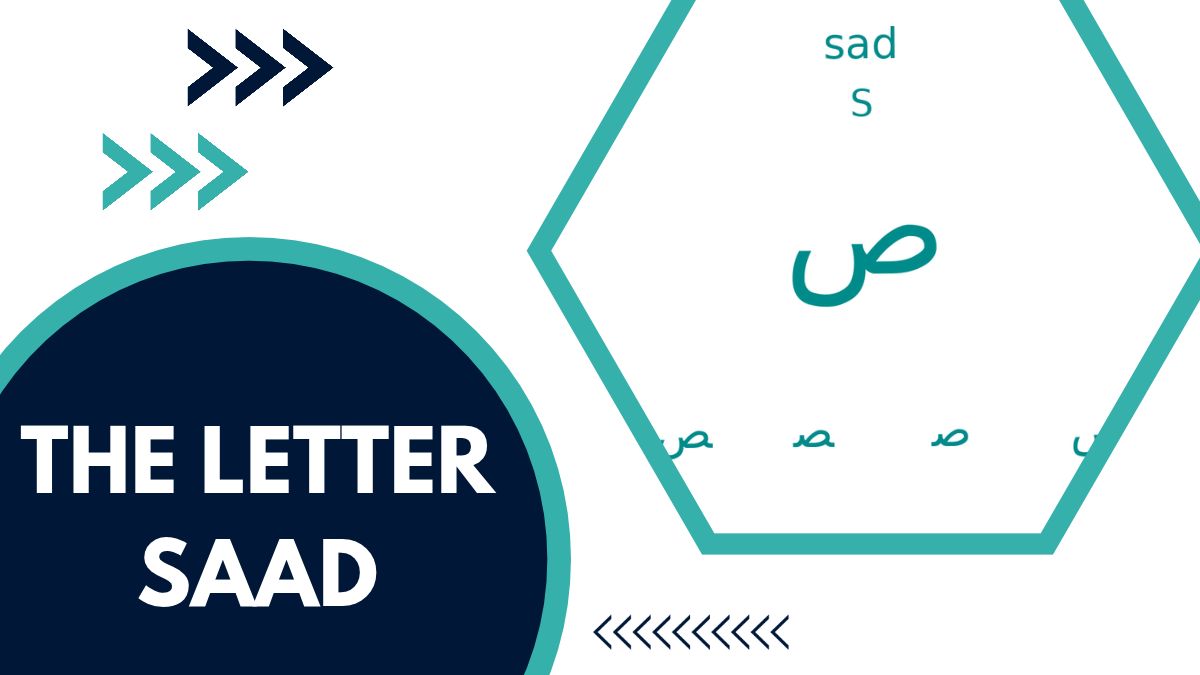
The Letter Saad (ص) is the 14th letter of the Arabic alphabet. It sounds like a strong, deep “s”. You make it at the tip of the tongue while the back of the tongue rises toward the palate. Linguists call it a voiceless emphatic (pharyngealized) alveolar fricative, written [sˤ] in IPA.
This sound doesn’t exist in German, but you already have half of it. The German “ss” in “Wasser” or “ß” in “Fuß” is the starting point. Add a raised back of the tongue and a deeper resonance, and you have ص.
This guide covers everything you need to know about Saad:
- How to pronounce ص correctly
- How to write its four forms
- How it sounds with short and long vowels
- Its role in Tajweed and Quranic recitation
- Common words and roots with ص
Short exercises at the end let you check what you have learned.
| Fact | Saad (ص) |
| Name | Saad (صَاد) |
| Sound | [sˤ], a heavy “s”. No German equivalent; closest: “ss” in “Wasser”, spoken deeper |
| Position in the alphabet | 14th (hijāʾī order) |
| Abjad value | 18th position, value 90 |
| Transliteration | Common: ṣ / s; DIN 31635: ṣ; variant: ş; Arabizi: 9 |
| Point of articulation | Tip of the tongue with the lower front teeth |
| Sun or Moon letter | Sun letter |
| Heavy or light | Always heavy (mufakhkham) |
| Dots | None |
| Connection | Connects on both sides |
Discover Learning Arabic and explore simple ways to build your Arabic skills, improve pronunciation, and communicate with confidence.
Table of Contents
Saad’s Place in the Alphabet and the Abjad Order
In the standard hijāʾī order, Saad comes 14th:
ا ب ت ث ج ح خ د ذ ر ز س ش ص
It comes right after Shīn (ش). In the older Abjad order, ص is the 18th letter and has the numerical value 90. It ends the word group سَعْفَصْ in the mnemonic أَبْجَدْ هَوَّزْ حُطِّي كَلَمُنْ سَعْفَصْ قَرَشَتْ ثَخَذْ ضَظَغْ.
The Abjad order still matters because Arabic letters were used as numbers, especially for dates on manuscripts and inscriptions.
One Shape, Two Letters: Saad and Ḍād
Saad shares its body shape with one letter only:
- ص (Saad): no dot
- ض (Ḍād): one dot above
When you learn them together, you only need to learn one shape and remember one dot.
Saad and the Article الْـ: A Sun Letter
When the article الْـ comes before a sun letter, the lām is not pronounced. It merges into the next letter, which is then doubled.
- الصَّبْر (aṣ-ṣabr): patience
- الصَّبَاح (aṣ-ṣabāḥ): the morning
- الصَّوْت (aṣ-ṣawt): the voice
In writing, the lām stays visible but carries no sukūn. Instead, the ص carries a shadda (ّ) to show the doubled sound.
Starting with the alphabet from zero? The Arabic Alphabet Course at Denk Arabisch teaches you every letter, its sound and its rules in clear German explanations.
Where Saad Comes From: Its Makhraj
Saad is produced from the tip of the tongue (طَرَفُ اللِّسَانِ) with the area just above the lower front teeth (فُوَيْقَ الثَّنَايَا السُّفْلَى). The air escapes through a narrow gap between the tip of the tongue and the upper front teeth, which creates the hiss.
| Zone | Arabic | Letters |
| Tip of the tongue with the gum ridge behind the upper front teeth | النِّطْعِيَّة | ط د ت |
| Tip of the tongue with the lower front teeth | الْأَسَلِيَّة | ص س ز |
| Tip of the tongue with the edges of the upper front teeth | اللِّثَوِيَّة | ظ ذ ث |
Saad shares its makhraj with س and ز, so the difference lies in the attributes, as you will see in the mistakes section.
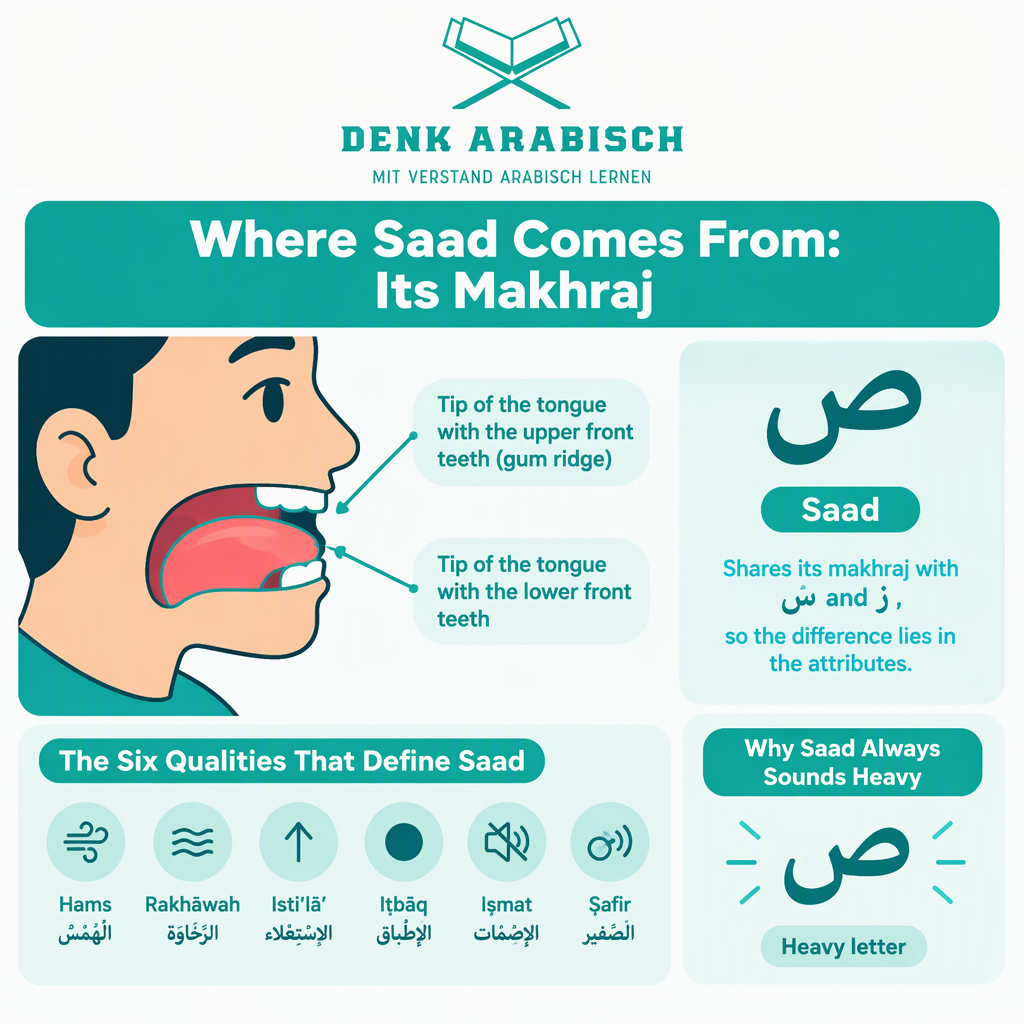
The Six Qualities That Define Saad
Understand the defining phonetic traits (Sifāt) that give the letter Sad (ص) its distinctive heavy and emphatic sound in Arabic recitation and pronunciation.
- Hams (الْهَمْس), whispering: the voice does not vibrate, and the breath flows freely. Its letters are gathered in فَحَثَّهُ شَخْصٌ سَكَتَ.
- Rakhāwah (الرَّخَاوَة), softness: the sound continues and can be stretched. ص is not among the strong letters أَجِدْ قَطٍ بَكَتْ or the middle letters لِنْ عُمَرْ.
- Istiʿlāʾ (الِاسْتِعْلَاء), elevation: the back of the tongue rises toward the palate. Its letters are gathered in خُصَّ ضَغْطٍ قِظْ.
- Iṭbāq (الْإِطْبَاق), closing: the tongue presses against the palate like a lid. Only four letters have it: ص ض ط ظ.
- Iṣmāt (الْإِصْمَات), restraint: the letter is not produced lightly from the lips or tongue tip. It is not among the letters of Idhlāq, gathered in فَرَّ مِنْ لُبٍّ.
- Ṣafīr (الصَّفِير), whistling: a sharp, whistle-like hiss. Only three letters have it: ص س ز.
Why Saad Always Sounds Heavy
Saad belongs to the heavy letters of Istiʿlāʾ, gathered in the phrase خُصَّ ضَغْطٍ قِظْ. Because it also has Iṭbāq, it is among the heaviest letters in Arabic.
Its heaviness changes slightly with the vowel. One common classification gives five levels, from heaviest to lightest:
- Fatḥa followed by alif: صَابِر (ṣābir), patient
- Fatḥa: صَبْر (ṣabr), patience
- Ḍamma: صُورَة (ṣūrah), picture
- Sukūn: يَصْبِرُ (yaṣbiru), he is patient
- Kasra: صِرَاط (ṣirāṭ), path
Even at the lightest level, with kasra, ص stays heavy and never sounds like س.
Reciting Saad in the Quran: Idghām Shamsī and Ikhfāʾ
Idghām Shamsī means that the lām of الْـ disappears in pronunciation and merges into the sun letter. With ص, you jump directly from the vowel before to a doubled, heavy ṣ.
- اهْدِنَا الصِّرَاطَ الْمُسْتَقِيمَ, “Guide us to the Straight Path.” [Surah Al-Fātiḥah: 6] The lām is silent, and you read ihdinā ṣ-ṣirāṭ with a doubled ص.
- اللَّهُ الصَّمَدُ, “Allah, the Eternal Refuge.” [Surah Al-Ikhlāṣ: 2] Again, the lām is dropped, and you read Allāhu ṣ-ṣamad.
In the reading of Ḥafṣ ʿan ʿĀṣim, the word الصِّرَاط is read with ص. Some other readings differ in this word, so if you hear it with a different sound, that is not a mistake by the reciter.
ص is also one of the 15 letters of Ikhfāʾ. When nūn sākinah or tanwīn comes before it, as in مَنْ صَبَرَ, the nūn is hidden with a nasal sound, and that nasal sound becomes heavy too.
Master the Language of the Quran with the Quranic Arabic Course for German Speakers at Denk Arabisch — understand Quranic words, meanings, and expressions with confidence.
Producing the Sound of Saad
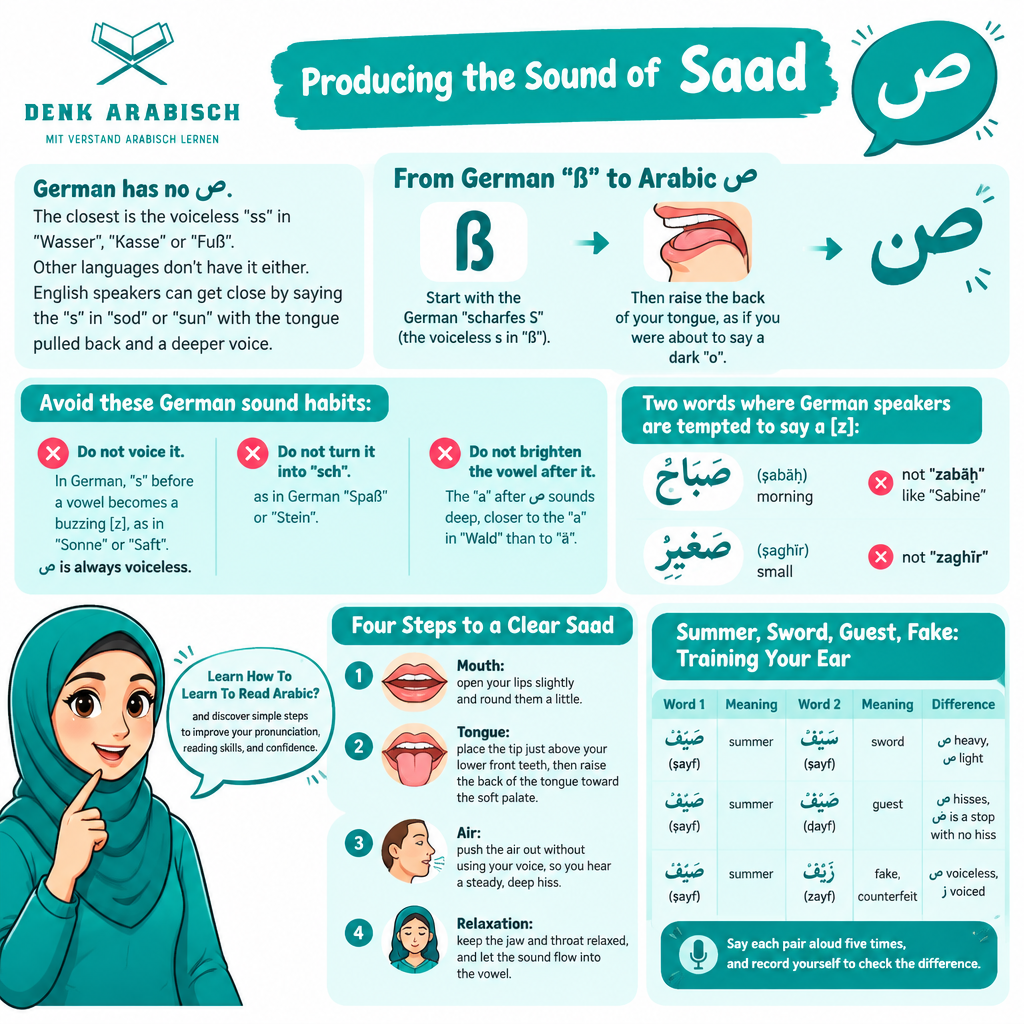
German has no ص. The closest is the voiceless “ss” in “Wasser”, “Kasse” or “Fuß”. Other languages don’t have it either. English speakers can get close by saying the “s” in “sod” or “sun” with the tongue pulled back and a deeper voice.
From German “ß” to Arabic ص
Start with the German “scharfes S” (the voiceless s in “ß”). Then raise the back of your tongue, as if you were about to say a dark “o”.
Avoid these German sound habits:
- Do not voice it. In German, “s” before a vowel becomes a buzzing [z], as in “Sonne” or “Saft”. ص is always voiceless.
- Do not turn it into “sch”, as in German “Spaß” or “Stein”.
- Do not brighten the vowel after it. The “a” after ص sounds deep, closer to the “a” in “Wald” than to “ä”.
Two words where German speakers are tempted to say a [z]:
- صَبَاح (ṣabāḥ), morning: not “zabāḥ” like “Sabine”
- صَغِير (ṣaghīr), small: not “zaghīr”
Four Steps to a Clear Saad
Follow these straightforward steps to align your mouth, tongue, and airflow to pronounce the emphatic sound of Sad (ص) smoothly and accurately:
- Mouth: open your lips slightly and round them a little.
- Tongue: place the tip just above your lower front teeth, then raise the back of the tongue toward the soft palate.
- Air: push the air out without using your voice, so you hear a steady, deep hiss.
- Relaxation: keep the jaw and throat relaxed, and let the sound flow into the vowel.
Summer, Sword, Guest, Fake: Training Your Ear
Train your ear to recognize critical phonetic contrasts by comparing Sad (ص) with similar-sounding Arabic letters through minimal word pairs.
| Word 1 | Meaning | Word 2 | Meaning | Difference |
| صَيْف | summer | سَيْف | sword | ص heavy, س light |
| صَيْف | summer | ضَيْف | guest | ص voiceless with a whistle; ض voiced, from the side of the tongue |
| صَيْف | summer | زَيْف | fake, counterfeit | ص voiceless, ز voiced |
Say each pair aloud five times, and record yourself to check the difference.
Writing Saad in Every Position
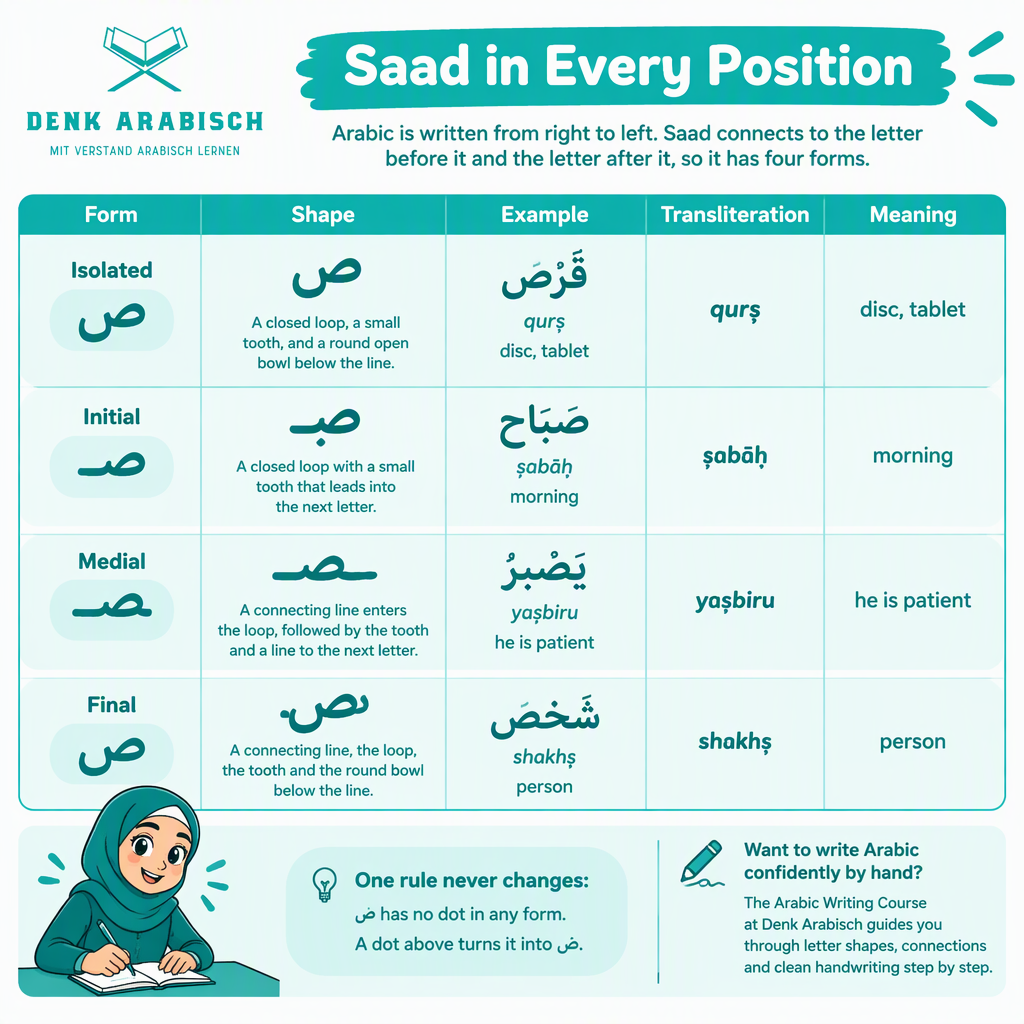
Arabic is written from right to left. Saad connects to the letter before it and the letter after it, so it has four forms.
| Form | Shape | Example | Transliteration | Meaning |
| Isolated | ص | قُرْص | qurṣ | disc, tablet |
| Initial | صـ | صَبَاح | ṣabāḥ | morning |
| Medial | ـصـ | يَصْبِرُ | yaṣbiru | he is patient |
| Final | ـص | شَخْص | shakhṣ | person |
1. Isolated Form (ص)
Used when ص stands alone or comes at the end of a word after a non-connecting letter.
Shape: a closed loop, a small tooth, and a round open bowl below the line.
Examples: قُرْص (qurṣ), disc; رَصَاص (raṣāṣ), lead (the metal).
2. Initial Form (صـ)
Used at the start of a word, or after a non-connecting letter inside a word.
Shape: a closed loop with a small tooth that leads into the next letter.
Examples: صَبَاح (ṣabāḥ), morning; وَصَلَ (waṣala), he arrived.
Learn Arabic with Denk Arabisch Academy
Speak and understand Arabic through a clear and effective learning system
Try a Free Trial3. Medial Form (ـصـ)
Used between two connecting letters.
Shape: a connecting line enters the loop, followed by the tooth and a line to the next letter.
Examples: يَصْبِرُ (yaṣbiru), he is patient; بَصَل (baṣal), onion; مِصْر (Miṣr), Egypt.
4. Final Form (ـص)
Used at the end of a word after a connecting letter.
Shape: a connecting line, the loop, the tooth and the round bowl below the line.
Examples: شَخْص (shakhṣ), person; قَصَص (qaṣaṣ), stories.
One rule never changes: ص has no dot in any form. A dot above turns it into ض.
Want to write Arabic confidently by hand? The Arabic Writing Course at Denk Arabisch guides you through letter shapes, connections and clean handwriting step by step.
How Vowels Sound After Saad
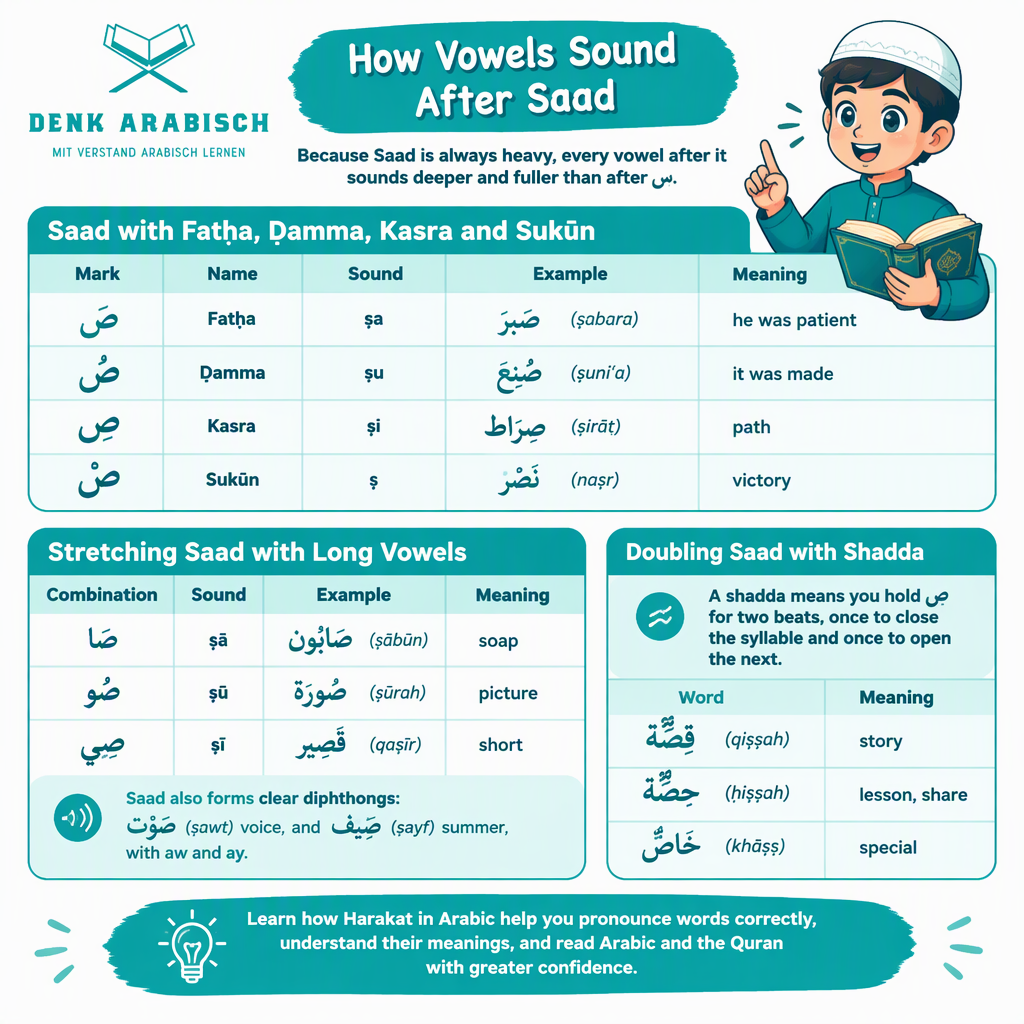
Because Saad is always heavy, every vowel after it sounds deeper and fuller than after س.
Saad with Fatḥa, Ḍamma, Kasra and Sukūn
Master how the four primary short vowel marks (Ḥarakāt) and zero-vowel mark (Sukūn) modify the emphatic sound of Saad (ص).
| Mark | Name | Sound | Example | Meaning |
| صَ | Fatḥa | ṣa | صَبَرَ (ṣabara) | he was patient |
| صُ | Ḍamma | ṣu | صُنِعَ (ṣuniʿa) | it was made |
| صِ | Kasra | ṣi | صِرَاط (ṣirāṭ) | path |
| صْ | Sukūn | ṣ | نَصْر (naṣr) | victory |
Stretching Saad with Long Vowels
Learn how long vowel extensions (Madd) sustain the heavy sound of Saad (ص) across different words in Arabic.
| Combination | Sound | Example | Meaning |
| صَا | ṣā | صَابُون (ṣābūn) | soap |
| صُو | ṣū | صُورَة (ṣūrah) | picture |
| صِي | ṣī | قَصِير (qaṣīr) | short |
Saad also forms clear diphthongs: صَوْت (ṣawt), voice, with aw, and صَيْف (ṣayf), summer, with ay.
Doubling Saad with Shadda
A shadda means you hold ص for two beats, once to close the syllable and once to open the next.
- قِصَّة (qiṣṣah): story
- حِصَّة (ḥiṣṣah): lesson, share
- خَاصّ (khāṣṣ): special
Learn how Harakat in Arabic help you pronounce words correctly, understand their meanings, and read Arabic and the Quran with greater confidence.
Key Word Families Built on Saad
Most Arabic words grow from a root of three letters, and each root carries a core meaning. Here are three high-frequency roots with ص.
The Root of Patience: ص ب ر
Explore foundational Arabic vocabulary derived from the root ص – ب – ر, which embodies the core concept of endurance, perseverance, and patience.
| Word | Transliteration | Meaning |
| صَبْر | ṣabr | patience |
| صَبَرَ | ṣabara | he was patient |
| صَابِر | ṣābir | patient |
| اِصْبِرْ | iṣbir | be patient! |
This root appears in the Quran in many verses, including:
وَاصْبِرْ وَمَا صَبْرُكَ إِلَّا بِاللَّهِ
“And be patient, and your patience is only through Allah.” [Surah An-Naḥl: 127]
The Root of Truth and Friendship: ص د ق
Discover key Arabic vocabulary built from the root ص – د – ق, which carries the foundational concept of truthfulness, sincerity, and trust.
| Word | Transliteration | Meaning |
| صِدْق | ṣidq | truth, honesty |
| صَادِق | ṣādiq | truthful |
| صَدِيق | ṣadīq | friend |
| صَدَقَة | ṣadaqah | charity |
Notice how صَدِيق (friend) comes from the same root as truth: a friend is someone who is true to you.
The Root of Help and Victory: ن ص ر
Explore essential Arabic vocabulary derived from the root ن – ص – ر, centered around the core concept of assistance, support, and triumphant victory.
| Word | Transliteration | Meaning |
| نَصْر | naṣr | victory |
| نَصَرَ | naṣara | he helped |
| نَاصِر | nāṣir | helper |
| اِنْتِصَار | intiṣār | triumph |
Want to recognize these roots when you read? The Arabic Reading Course at Denk Arabisch builds your reading fluency with real words and texts from the start.
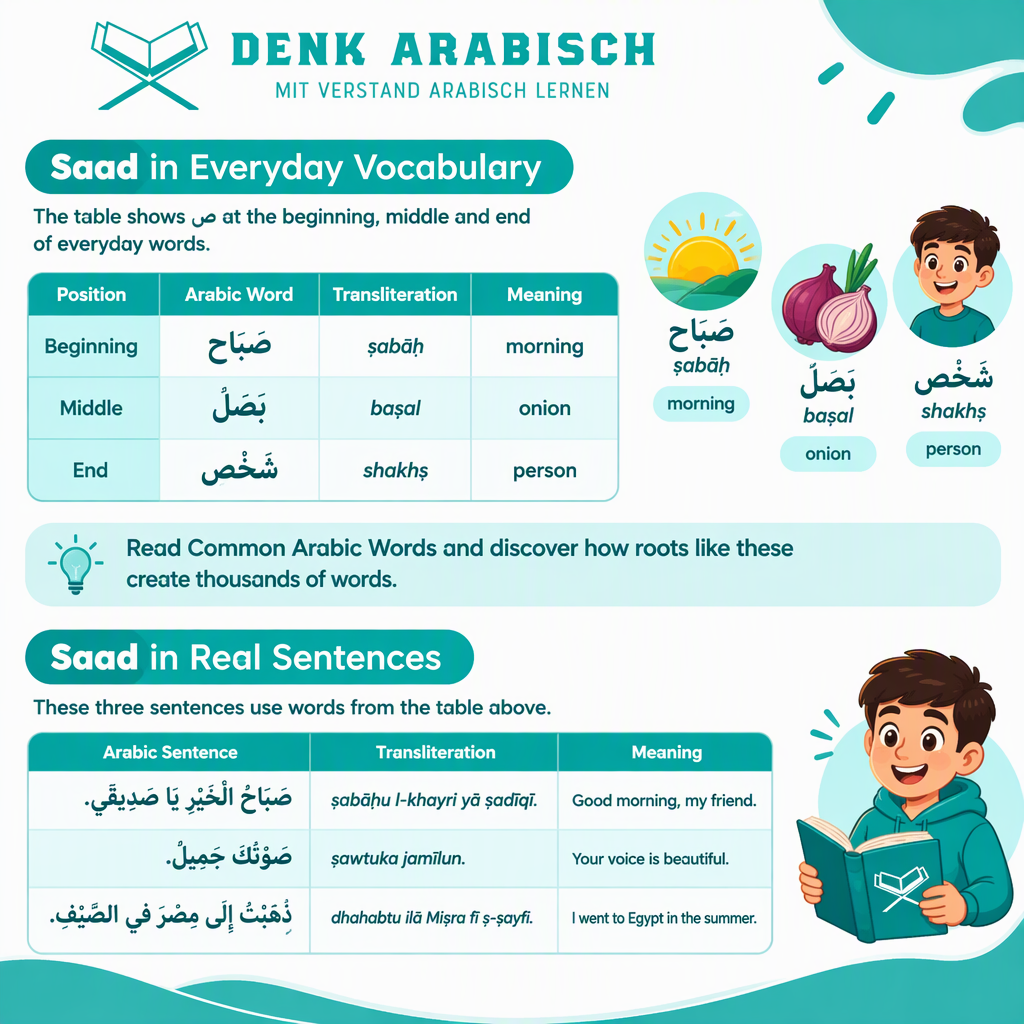
Saad in Everyday Vocabulary
The table shows ص at the beginning, middle and end of everyday words.
| Position | Arabic Word | Transliteration | Meaning |
| Beginning | صَبَاح | ṣabāḥ | morning |
| Middle | بَصَل | baṣal | onion |
| End | شَخْص | shakhṣ | person |
Read Common Arabic Words and discover how roots like these create thousands of words.
Saad in Real Sentences
These three sentences show ص in everyday Arabic, at the start of a word and after the article:
| Arabic Sentence | Transliteration | Meaning |
| صَبَاحُ الْخَيْرِ يَا صَدِيقِي. | ṣabāḥu l-khayri yā ṣadīqī. | Good morning, my friend. |
| صَوْتُكَ جَمِيلٌ. | ṣawtuka jamīlun. | Your voice is beautiful. |
| ذَهَبْتُ إِلَى مِصْرَ فِي الصَّيْفِ. | dhahabtu ilā Miṣra fī ṣ-ṣayfi. | I went to Egypt in the summer. |
Typical Saad Errors and Quick Fixes
Here are the common mistakes when learning the letter Saad (ص) and how to avoid them:
1. Heavy vs. Light: ص or س?
Both letters share the same makhraj, so learners often say ص with a flat tongue. The result is a light s that can change the word, as in صَيْف (summer) becoming سَيْف (sword).
Test: say “sss”, then lift the back of your tongue while keeping the hiss. If the sound drops deeper and the vowel after it darkens, you have ص.
2. Hiss vs. Stop: ص or ض?
Both are heavy and share one shape, so learners confuse them in reading and speaking. But ص is voiceless and whistles at the tip of the tongue, while ض is voiced and comes from the side of the tongue, with no whistle.
Test: put your fingers on your throat. For ص you feel nothing; for ض you feel a buzz.
3. Keeping the Vowel Deep
Learners often pronounce ص correctly but then say a bright German “ä” or a thin “i”. This weakens the heaviness of the whole syllable.
Test: compare صِرَاط and سِرَاج slowly. The “i” after ص should sound fuller and slightly darker.
4. Don’t Forget the Tooth
Many beginners draw only the loop. Without the small tooth after it, ص can look like ط without its upright stroke, or simply unclear.
Test: write صَبَاح and شَخْص, then check that every ص has a closed loop and a small tooth before it continues.
Read Arabic Letters Connected Forms and practise how every letter changes inside a word.
Practice Time: Check Your Progress
Here are four quick exercises to test your understanding of the letter Saad (ص) and reinforce your reading, writing, and vocabulary skills:
Exercise 1: Pick the Right Word
Which word means “summer”?
a) سَيْف b) صَيْف c) ضَيْف
Answer: b) صَيْف
Exercise 2: Match the Meaning
Match each word with its meaning: صَبْر, صَدِيق, صَوْت, قَصِير / short, friend, patience, voice.
Answer: صَبْر = patience, صَدِيق = friend, صَوْت = voice, قَصِير = short
Exercise 3: Practise Your Handwriting
Write ص in its four forms. Then copy these words three times each: صَبَاح, يَصْبِرُ, شَخْص, قُرْص.
Exercise 4: Fact or Myth?
- ص is a Moon letter.
- ص has no dots.
- ص is voiced like ز.
- ص stays heavy even with kasra.
Answers: 1. False 2. True 3. False 4. True
What Our Students Say About Denk Arabisch Academy
See what our students say about learning at Denk Arabisch Academy on Trustpilot. Read their experiences and check out more reviews to discover how our courses help improve Arabic.

Learn Arabic the Right Way with Denk Arabisch
Saad is one of 28 letters. Learning them in a clear order, with the right sounds from day one, saves you months of correcting bad habits later.
Denk Arabisch is built for German-speaking learners and explains Arabic through German, including the sounds German doesn’t have.
- Lessons designed for German speakers, adults and children
- Live teachers who correct your pronunciation in real time
- A clear path from the alphabet to reading, writing and Quran
- Flexible online lessons that fit your schedule
See what students and parents say about Denk Arabisch on Trustpilot
Learn Arabic with Denk Arabisch Academy
Speak and understand Arabic through a clear and effective learning system
Try a Free TrialFind the Course That Fits You:
- Arabic Course For Beginners
- Arabic Alphabet Course
- Arabic Reading Course
- Arabic Writing Course
- Arabic Speaking Course
- Quranic Arabic Course for German Speakers
- Quran Tajweed Course for German Speakers
Book a free trial lesson with Denk Arabisch and start learning with a teacher who speaks your language.

Conclusion
The Letter Saad (ص) becomes easy once you understand what makes it different: a deep, voiceless hiss with a raised tongue.
- Sound: ص is a heavy, voiceless s, never a German [z] and never a light س.
- Writing: ص has four forms, connects on both sides, and never has a dot.
- Recognition: a closed loop with a small tooth, shared in shape only with ض.
Practise a few minutes every day. Say the sound alone, then with vowels, and write all four forms. Train the pairs صَيْف, سَيْف, ضَيْف and زَيْف, and review the roots ص ب ر, ص د ق and ن ص ر until they feel familiar.
With steady practice, ص will soon sound natural in your Arabic.
Book a free trial lesson at Denk Arabisch and take your next step today.
FAQs
1. How Does Saad Differ from Seen?
Both are voiceless hissing sounds from the same makhraj. ص is heavy because the back of the tongue rises and presses toward the palate, while س is light with a flat tongue. Mixing them up can change the meaning, as in صَيْف (summer) and سَيْف (sword).
2. How Does Saad Differ from Ḍād?
They share the same shape, but ض has one dot above. In sound, ص is voiceless, with a whistle at the tip of the tongue. ض is voiced and made with the side of the tongue, with no whistle.
3. Does Saad Belong to the Sun or Moon Letters?
Saad is a Sun letter. After الْـ, the lām is silent and the ص takes a shadda, as in الصَّبْر (aṣ-ṣabr).
4. Is Saad Ever Pronounced Light?
Saad is always heavy. It has both Istiʿlāʾ and Iṭbāq, and it stays heavy even with kasra, as in صِرَاط.
5. Which Tajweed Rules Involve Saad?
After الْـ, Saad causes Idghām Shamsī, as in