Takeaway:
- Arabic was chosen by Allah’s wisdom — a matter of faith beyond human questioning.
- Revelation had to be understood by its first audience, the Arabs, to spread the message effectively.
- One Arabic word can carry layers of meaning that require full sentences in other languages.
- The trilateral root system links key Islamic concepts (e.g., Islam, Salam, Salama) into a web of meaning.
- The Quran’s unmatched eloquence challenged Arabia’s greatest poets; none could produce a single chapter like it.
- Preserving the text in Arabic prevents the “meaning drift” that translations cause over time.
- Arabic serves as a unifying tongue: Muslims worldwide recite the same words in daily prayers.
- The rhythmic, melodic nature of Quranic Arabic makes it the most memorized book in history.
- Precise grammar and verb forms allow exact derivation of legal rulings (fiqh).
- The sound and rhythm of recitation create a deep emotional and spiritual impact, often moving listeners to faith.
The Quran is not merely a book of guidance but an eternal linguistic miracle. For over 1,400 years, its original Arabic text has remained the heart of Islamic faith and practice. While the message is universal, the choice of Arabic as its linguistic vessel was a deliberate act of Allah’s wisdom. Here are ten comprehensive reasons why Arabic was chosen as the vessel for the final revelation.
Table of Contents
1. Allah Chose Arabic — And His Wisdom Is Beyond Question
The foremost reason for the Quran being in Arabic is rooted in Allah’s Wisdom (Hikmah). As humans, we cannot fully grasp the depths of why Allah chooses specific mediums for His message. It is a matter of faith and submission to the will of the All-Knowing, whose choices are never arbitrary but based on a perfect knowledge that transcends our limited perception.
This is why belief in Allah’s wisdom is closely tied to faith and submission. A true believer trusts that even when something is not entirely clear, it is still part of a greater, flawless plan designed by the All-Knowing. Allah Himself reminds us of this reality in the Quran:
لَا يُسْأَلُ عَمَّا يَفْعَلُ وَهُمْ يُسْأَلُونَ (سورة الأنبياء الآية 23)
“He is not questioned about what He does, but they will be questioned.” (Al-Anbyia 21:23)
This powerful verse establishes a fundamental principle: Allah’s actions are not subject to human judgment or questioning in the sense of objection or doubt.
While we are encouraged to reflect, learn, and seek understanding, we must also recognize the limits of our knowledge. In contrast, we—as His creation—are the ones who will be questioned about our actions, choices, and how we respond to His guidance.
Refine your recitation and master the rules of Tajweed with precision. Our Quran Recitation Courses at Denk Arabisch help you pronounce every letter perfectly, just as it was revealed.
2. Arabic Was the Language of the First Muslims — Revelation Had to Speak to Them First
The Quran was revealed to the Prophet Muhammad (Peace BE Upon Him) in 7th-century Mecca. For a message to be effective, it must be understood by its initial recipients so they can live by it and spread it. If the Quran had been revealed in a foreign tongue, it would have been an obstacle to the very people tasked with carrying its light to the rest of the world.
وَمَا أَرْسَلْنَا مِن رَّسُولٍ إِلَّا بِلِسَانِ قَوْمِهِ لِيُبَيِّنَ لَهُمْ (سورة إبراهيم الآية 4)
“And We did not send any messenger except [speaking] in the language of his people to state clearly for them.” (Ibrahim 14:4)
Just as the first Muslims understood every nuance, our Arabic Speaking and Writing Courses are designed to make the language feel natural to you, bridging the gap between the 7th century and your modern life.
3. One Arabic Word Can Say What Takes English a Whole Sentence to Explain
At the time of revelation, the Arabs were masters of poetry and oratory. Arabic is uniquely suited for Allah’s speech due to its vast vocabulary and “semantic density.”
A single word in Arabic can carry layers of spiritual, legal, and emotional meaning that would require several sentences to explain in any other language. This richness allows the Quran to remain eternally fresh, offering new depths of meaning to every generation.
4. Arabic’s Trilateral Root System Connects Islamic Concepts in Ways No Translation Can
The structural beauty of Arabic lies in its trilateral root system. Most words are derived from a three-letter root, creating a logical skeleton for the language.
This mathematical-like structure allows the Quran to connect seemingly different concepts through a shared root, creating a “web of meaning.” For example, the root S-L-M connects “Islam” (submission), “Salam” (peace), and “Salama” (safety), a connection that is often lost in translation.
5. The Quran Challenged Arabia’s Greatest Poets — And No One Could Match It
The Quran issued a famous challenge to the greatest poets of Arabia—who were at the peak of their literary prowess—to produce even a single chapter (Surah) that could match its eloquence, wisdom, and structure.
Despite their mastery of the language, they were unable to meet this challenge. This Inimitability (I’jaz) serves as a permanent proof of the Quran’s divine origin.
فَأْتُواْ بِسُورَةٍ مِّن مِّثْلِهِ (سورة البقرة الآية 23)
“…then produce a surah the like thereof…” (Al-Baqarah 2:23)
Learn the Quran with Denk Arabisch Academy
Master reading and understanding the Quran through structured and supportive learning
Try a Free Trial
6. The Arabic Culture Was Most Suitable To Preservation Of The Holy Text
Translations are, by nature, human interpretations and are subject to change, bias, and the limitations of the target language.
By keeping the Quran in its original Arabic, Allah ensured the message remains pure and unaltered. This prevents the “meaning drift” seen in other ancient scriptures, where centuries of translations have led to the loss of original intent.
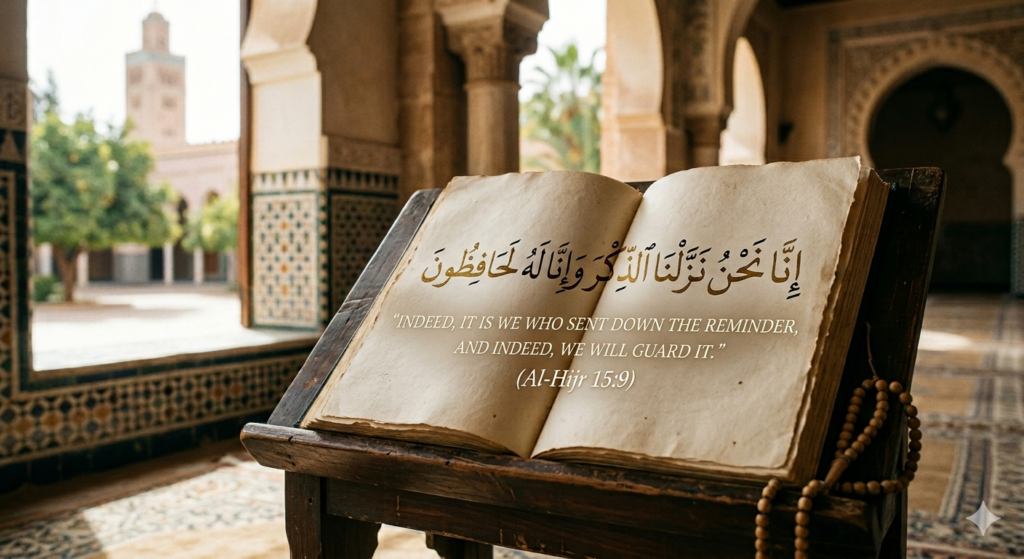
إِنَّا نَحْنُ نَزَّلْنَا الذِّكْرَ وَإِنَّا لَهُ لَحَافِظُونَ (سورة الحِجر الآية 9)
“Indeed, it is We who sent down the Reminder, and indeed, We will guard it.” (Al-Hijr 15:9)
Read also: Arabic Basics for Children – A Fun & Practical Guide
7. Muslim Unity: From Cairo to Jakarta, Every Muslim Prays the Same Words — Arabic Is What Unites Them
Arabic acts as a spiritual “lingua franca” for the Muslim world. Regardless of whether a believer is in Cairo, London, or Jakarta, they recite the same words in their daily prayers (Salah).
This shared sacred language fosters an incredible sense of unity and equality, breaking down ethnic and national barriers to create one global community (Ummah) under one message.
8. Arabic Is Easer of Memorization (Hifz)
The phonetic and melodic nature of Quranic Arabic makes it the most memorized book in human history. The rhythmic flow and the specific rules of recitation (Tajweed) facilitate long-term memory. This is why millions of people, including young children who do not speak a word of Arabic, are able to memorize the entire 600-plus page text word-for-word.
Don’t just memorize; recite with beauty. Our Quran Tajweed Courses are specifically tailored for German speakers to master the difficult phonetics of Arabic with ease and precision.
9. Arabic Provides A Space For Legal and Jurisprudential Precision
Arabic grammar is exceptionally precise, which is vital for a book that serves as a source of law. In Islamic Jurisprudence (Shariah), the specific verb forms, particles, and gender agreements used in the Arabic text provide the clarity needed to derive legal rulings. This exactness ensures that the core pillars of the faith remain standardized across different cultures and eras.
10. The Emotional and Spiritual Impact Of Arabic Language
The sound and rhythm of the Arabic Quran have a profound effect on the human soul. The “Saj’” (rhythmic prose) combined with the vibration of specific Arabic letters creates a spiritual experience that moves the heart. Many people throughout history have embraced Islam simply by hearing the recitation of the Quran, experiencing a resonance that transcends intellectual understanding.
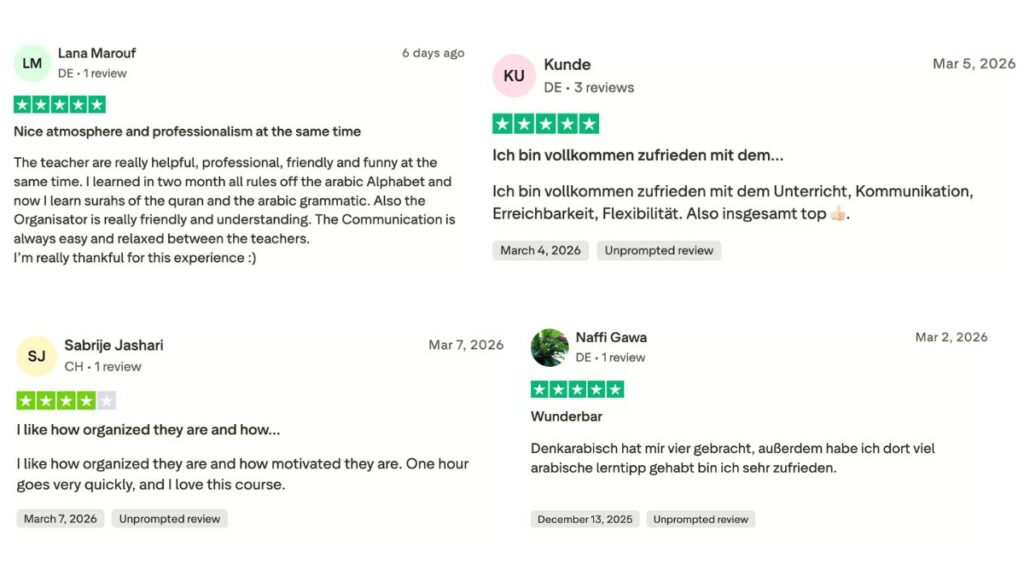
What Our Students Say About Denk Arabisch Academy
See what our students say about learning at Denk Arabisch Academy on Trustpilot. Read their experiences and check out more reviews to discover how our courses help improve Arabic.
Read also: Please, Excuse Me, And I’m Sorry In Arabic
Learn Quranic Arabic with Denk Arabisch
If you truly want to experience the depth of the Quran beyond translation, learning Arabic is the key.
At Denk Arabisch, we help students:
- Understand Quranic Arabic step by step
- Connect directly with the meaning of Allah’s words
- Improve recitation and Tajweed
- Build confidence in understanding Islamic texts
👉 Start your journey today with Denk Arabisch by getting you Arabic Courses and move from translation to true understanding of the Quran.
Our Courses Include:
- Arabic Courses for German Speakers
- Arabic Levels for German Speakers
- Arabic Dialect Courses for German Speakers
- Qur’an Learning Courses for German Speakers
- Islamic Studies Courses for German Speakers
- Courses for Muslim Kids for German Speakers
Because the closer you get to Arabic, the closer you get to the heart of the Quran.
Learn the Quran with Denk Arabisch Academy
Master reading and understanding the Quran through structured and supportive learning
Try a Free TrialConclusion
The Quran being revealed in Arabic reflects a profound divine purpose. It was chosen to ensure immediate clarity for its first audience, preserve the message in its purest form, and deliver a level of linguistic beauty that remains unmatched in human history. Arabic’s unique structure, precision, and rhythm allow the Quran to function not only as a book of guidance but also as a living miracle.
While translations are essential tools for understanding the general meaning, they are like a “translation of the meaning” rather than the Quran itself. They can never fully capture the depth, emotion, and rhetorical power of the original text. Ultimately, the Quran in Arabic stands as a timeless message from Allah—unified, preserved, and universally impactful for all of time.
FAQs
1. Is it possible to fully understand the Quran through translation alone?
While translations (Interpretations of the Meaning) are excellent tools for grasping the general message and guidance of the Quran, they cannot capture the full linguistic depth, wordplay, and rhythmic miracle of the original Arabic. Many Arabic words have multiple layers of meaning that a single English or German word simply cannot replicate.
2. Why do Muslims pray in Arabic if they don’t speak the language?
Praying in Arabic provides a unified experience for the global Ummah. Whether you are in Berlin, Cairo, or Tokyo, the words of the Salah remain the same. This preserves the original integrity of the worship and ensures that the divine revelation remains unchanged across all cultures and generations.
3. Is Quranic Arabic different from Modern Standard Arabic (MSA)?
Quranic Arabic (Classical Arabic) is the foundation of the modern language. While the vocabulary used in daily news or business has evolved, the core grammar and “logical skeleton” remain the same. Learning Quranic Arabic actually gives you a superior grasp of the language’s roots, making it easier to understand MSA later.
4. I am a complete beginner; is Quranic Arabic too difficult to learn?
Not at all! One of the miracles of the Quran mentioned in the text itself is that it has been made “easy to remember.” At Denk Arabisch, we break down the language into its trilateral roots and logical structures, making it much more accessible for non-native speakers than traditional methods might suggest.
5. How long does it take to start understanding Quranic verses?
With a structured approach like our curriculum at Denk Arabisch, students often begin recognizing common roots and high-frequency vocabulary within the first few months. Because the Quran uses a repetitive and rhythmic structure, once you master the core “skeleton,” your understanding grows exponentially.
6. Do I need to learn the Arabic alphabet before starting a course?
While it helps, many of our introductory modules at Denk Arabisch guide you through phonology and the alphabet specifically tailored to Quranic pronunciation (Tajweed), ensuring you build a solid foundation from day one.