Takeaway:
- I‘tikaf is a Sunnah spiritual retreat in the last ten days of Ramadan to disconnect from worldly distractions and dedicate yourself entirely to worship, especially seeking Laylat al-Qadr.
- Enter the mosque before sunset on the 20th of Ramadan and exit at sunset on the last day; some scholars recommend staying until the Eid prayer.
- Pack only essentials: a Qur’an (physical or offline digital), prayer rug, hygiene items, clean clothes, and an alarm clock; avoid smartphones for entertainment.
- Structure your day around worship cycles: Qur’an after Fajr, a nap, a lesson after Dhuhr, supplication after Asr, and night prayer in the last third of the night.
- On the odd nights (21st, 23rd, 25th, 27th, 29th), intensify Tahajjud, istighfar, and repeat the du’a: “Allahumma innaka ‘afuwwun tuhibbul ‘afwa fa’fu ‘anni.”
- I‘tikaf is valid with Islam, sanity, intention (niyyah), and purity from major impurity, menstruation, and postpartum bleeding; a congregational mosque is required by most scholars.
- Leaving the mosque without a valid necessity (e.g., shopping, visiting) or engaging in sexual intercourse invalidates I‘tikaf; using phones for entertainment spoils its spiritual fruit.
- Permissible exits are only for essential needs like relieving oneself, ritual bath, or eating if no one brings food—limited strictly to the necessity.
- I‘tikaf is a confirmed Sunnah, not an obligation, but becomes obligatory if vowed (nadhr). Its core purpose is to free the heart, seek Laylat al-Qadr, and gain Allah’s forgiveness.
Itikaf in Ramadan is a profound prophetic tradition that offers you a unique opportunity to disconnect from daily distractions and dedicate yourself entirely to worship during the last ten days.
It is a spiritual journey designed to free the heart from worldly concerns and focus on what brings you closer to Allah, especially in seeking Laylat al-Qadr, the Night of Decree, which is better than a thousand months.
In this guide, we provide everything you need to know about the rulings, conditions, and practical steps for Itikaf, enabling you to experience this spiritual retreat with ease and understanding.
Table of Contents
1. How to Begin Your Itikaf in the Last Ten Days of Ramadan?
If you are planning to observe Itikaf this year, you need to understand four practical steps: when to enter and exit, what to pack, how to structure your time, and how to prepare for Laylat al-Qadr.
These elements form the core of practical preparation for Itikaf, and in the following sections, we explain each in detail.

a. When to Enter and Exit Your Itikaf?
The time of entry: According to the Sunnah of the Prophet ﷺ, the one observing Itikaf should enter the mosque before sunset on the night of the twenty-first of Ramadan, meaning at sunset on the twentieth day. This is the relied-upon opinion of the majority of scholars from the Hanafi, Shafi’i, and Hanbali schools.
The time of exit: Itikaf ends at sunset on the last day of Ramadan. Some scholars, like Imam Malik, recommended staying until the Eid prayer, but exiting after sunset is the original ruling.
For calculation: You can use your German city’s calendar to determine the exact sunset times for the 20th and 30th days of Ramadan.
b. What to Pack in Your Itikaf Bag?
For men: A physical or digital Quran (without internet), a prayer rug, a toothbrush and toothpaste, clean clothes for the five daily prayers, a small towel for ablution, and an alarm clock for night prayer. Avoid bringing too many books that might distract you.
For women: In addition to the above, make sure to bring necessary personal hygiene items, keeping in mind that Itikaf is not valid during menstruation or postpartum bleeding.
Important note: Avoid bringing a smartphone for entertainment. If it is absolutely necessary (e.g., for contacting family), put it on airplane mode and use it only for essential needs.
Qualified teachers at Denk Arabisch, who specialize in teaching Muslims in German-speaking countries, recommend replacing screen time with a daily Quran program.
c. How to Organize Your Time During Itikaf?
After Fajr: A portion of Quran recitation until sunrise, then Duha prayer, followed by a one-hour nap for rest.
After Dhuhr: A short lesson on Islamic jurisprudence (on the rulings of Itikaf or the virtues of Ramadan) with fellow participants, then a second portion of Quran.
After Asr: Supplication and remembrance until Maghrib, preparing for iftar.
After Isha: Night prayer during the last third of the night, with frequent supplication, especially the dua: “Allahumma innaka ‘afuwwun tuhibbul ‘afwa fa’fu ‘anni” (O Allah, You are Forgiving and love forgiveness, so forgive me).
This schedule is flexible; you can adjust it according to your energy levels, but the key is to invest every hour in beneficial worship.
d. How to Prepare for Laylat al-Qadr in the Odd Nights?
The odd nights of the last ten days are: 21st, 23rd, 25th, 27th, and 29th. During these nights, Muslims seek Laylat al-Qadr, which is better than a thousand months (83 years and 4 months).
Focus on these during those nights: Tahajjud prayer (the minimum is two rak’ahs, and the best is eleven rak’ahs), frequent istighfar (seeking forgiveness), and repeating the dua for forgiveness.
Imam al-Nawawi said in al-Majmu’: “It is recommended to make abundant supplication on this night, and the best thing to say is: Allahumma innaka ‘afuwwun tuhibbul ‘afwa fa’fu ‘anni.”
Be careful not to waste these nights in casual conversations with others; the essence of Itikaf is seclusion with Allah.
Read also: How to Pray Tahajjud and Its Benefits?
2. What Is Itikaf in Ramadan?
Before you begin the practical application, it is important to understand the nature of Itikaf: its linguistic and legal definition, its ruling in Islam, and the wisdom behind the Prophet’s ﷺ consistent practice. This theoretical foundation helps you grasp the spirit of this act of worship.
a. What Does Itikaf Mean in Arabic and Islamic Terminology?
In language: Al-‘Ukuf means adherence and constancy. It is said, “ʿakafa ʿala al-shay'” meaning he adhered to it and did not leave it. Ibn Faris said in Mu’jam Maqayis al-Lughah: “The letters ‘ayn, kaf, and fa’ form a root that indicates turning towards something and adhering to it.”
In Islamic law: The Hanafis define it as: “Staying in a congregational mosque with the intention (niyyah) by a sane Muslim.” The Malikis define it as: “Remaining in a mosque for the obedience of Allah, even for a moment.” The difference between the two definitions is that the Hanafis require the mosque to be a congregational one (where Friday prayers are held), while the Malikis permit any mosque.
This scholarly difference is natural and a mercy, and a Muslim should follow the school of thought he trusts in his country or consult a reliable scholar.
b. Is Itikaf a Confirmed Sunnah or an Obligation on Muslims
Itikaf during Ramadan is a confirmed Sunnah (Sunnah Mu’akkadah), not an obligation. The evidence is that the Prophet ﷺ practiced it consistently but did not command all Muslims to do it as an obligation. Imam Ibn Qudamah said in al-Mughni: “Itikaf is a Sunnah; it is not obligatory upon a person unless he makes it obligatory upon himself by a vow (nadhr).”
However, if a Muslim vows to observe Itikaf (e.g., he says, “I vow to Allah to observe Itikaf for three days if He cures me”), then Itikaf becomes obligatory upon him and he must fulfill it.
Its virtue is great: In the two Sahih collections, it is narrated that the Prophet ﷺ used to observe Itikaf during the last ten days until Allah took his soul, and then his wives observed Itikaf after him.
c. Why Did Prophet Muhammad ﷺ Consistently Observe Itikaf in the Last Ten Days?
The Prophet ﷺ used to observe Itikaf during the last ten days of Ramadan seeking Laylat al-Qadr. Imam al-Bukhari narrated in his Sahih: “The Prophet ﷺ used to observe Itikaf during the last ten days of Ramadan.”
The wisdom: In these ten days lies Laylat al-Qadr, a great night in which the Quran was revealed. The Prophet ﷺ wanted to detach his heart from worldly matters and devote himself to worship in order to attain this night and teach his nation how to seek it.
Also, Itikaf purifies the soul and cleanses the heart from the filth of sins. It is a spiritual school where a Muslim learns patience and detachment from desires.
Read also: Qiyam Prayer (Qiyam Al Layl)
Study Islamic knowledge with Denk Arabisch Academy
Deepen your understanding of Islam through authentic and structured learning
Join now3. What Are the Conditions for Itikaf in Ramadan?
Like any act of worship, Itikaf has conditions and pillars that must be fulfilled for it to be valid. Here we discuss the conditions related to the person observing Itikaf, the conditions of the place (the mosque), and the specific guidelines for Muslim women.
a. Who Is Eligible to Observe Itikaf?
Intention (Niyyah): It is a fundamental condition according to all scholars. The Messenger of Allah ﷺ said: “Actions are but by intentions.” Itikaf is not valid without an intention, whether it is made the night before or at the time of entering the mosque.
Islam: Itikaf is not valid for a non-Muslim, as acts of worship are only accepted from a Muslim.
Sanity and Discernment: Itikaf is not valid for an insane person, nor for a child who lacks discernment (generally under the age of seven). A discerning child’s Itikaf is valid according to the majority but is considered voluntary, not obligatory.
Purity from Major Ritual Impurity (Janabah), Menstruation, and Postpartum Bleeding: This is obligatory because remaining in the mosque is forbidden for a person in a state of major impurity, as per the verse: {وَلَا جُنُبًا إِلَّا عَابِرِي سَبِيلٍ} “…nor while you are in a state of major impurity, except when passing through [a place of prayer]…”
b. Can Itikaf Be Observed in Any Mosque?
The majority of scholars (Hanafis, Shafi’is, and Hanbalis) require the mosque to be a congregational mosque (jami’), meaning that the five daily prayers and Friday prayers are held there. This is to prevent the person observing Itikaf from having to leave for Friday prayers, which would break their Itikaf.
The Malikis permit Itikaf in any mosque, even a small neighborhood mosque, but they consider it disapproved in a mosque where congregational prayers are not held, as it leads to missing the virtue of praying in congregation.
In Germany: Congregational mosques are available, and they often designate specific areas for Itikaf. If you are a woman wishing to observe Itikaf, ensure that a safe and appropriate space for women is available.
c. What Are the Guidelines for Women Observing Itikaf in Ramadan?
A woman’s Itikaf is valid just like a man’s, with the same conditions: Islam, sanity, intention, and purity from menstruation and postpartum bleeding.
Does a woman need a mahram (male guardian)? The Hanafis and Shafi’is state that a mahram is not required for a woman’s Itikaf if the mosque is safe and she is in trustworthy company. However, as a precaution, she should have her husband’s permission if married, and her guardian’s approval if unmarried, especially in Western countries due to security and social considerations.
Place of Itikaf: It is best for a woman to observe Itikaf in the mosque where she usually prays. If a safe space separate from men is not available, there is no harm in her observing Itikaf at home in a designated prayer area. This is a weaker opinion within the Hanbali school.

4. What Invalidates Itikaf in Ramadan?
Itikaf is an act of worship with boundaries; crossing them may either nullify it completely or diminish its reward. It is essential to understand the difference between what outright invalidates Itikaf and what only spoils its spiritual fruit. In this section, we clarify: the nullifiers agreed upon by scholars, permissible reasons for leaving the mosque, the ruling on using phones and the internet, and a table summarizing the types of exit.
a. What Are the Things That Invalidate Itikaf According to Scholarly Consensus?
Leaving the mosque without a valid necessity: Such as going out for shopping, visiting, or work. If one leaves without a legitimate excuse, their Itikaf is invalidated.
Sexual Intercourse: Based on the verse: {وَلَا تُبَاشِرُوهُنَّ وَأَنتُمْ عَاكِفُونَ فِي الْمَسَاجِدِ} “And do not have sexual relations with them while you are staying for worship in the mosques.” Intercourse invalidates Itikaf whether it occurs during the day or night and requires making up for it according to the majority.
Loss of Sanity: Due to fainting or intoxication that removes consciousness, as it eliminates legal capacity.
Apostasy from Islam: May Allah protect us, this nullifies all deeds.
b. When Is a Person Observing Itikaf Permitted to Leave the Mosque?
It is permissible to leave for essential matters that cannot be fulfilled inside the mosque, such as:
- Relieving oneself (urination and defecation).
- Performing Ghusl (ritual bath) from Janabah if there is no place for it inside the mosque.
- Eating and drinking if no one can bring food to the person observing Itikaf.
- Buying food if no one can bring it, provided the trip is short and one does not shop for non-essential items.
Imam al-Nawawi said: “It is required that his exit be only to the extent of need. If he goes out to buy food and prolongs his stay in the market, his Itikaf is invalidated.”
Visiting the sick or attending a funeral that is not obligatory: This is not permissible according to the majority, as it is not a necessity pertaining to the person observing Itikaf themselves.

c. What Is the Rule on Using Phones and the Internet During Itikaf?
Using a phone for personal conversations or browsing social media disrupts the spirit of Itikaf, even if your body remains in the mosque.
The juristic ruling: If the phone is used out of necessity (e.g., contacting a doctor or family for an urgent need), it is permissible to the extent of the need. However, if it is used for entertainment, work, or lengthy calls unrelated to worship, it is severely disliked (makruh tahriman) and may nullify the reward of Itikaf.
Sheikh Ibn ‘Uthaymin (may Allah have mercy on him) said: “The one observing Itikaf should detach his heart from the world, and the phone disrupts this seclusion. It is best to avoid it except in cases of necessity.”
Practical advice: Turn off your phone completely, or use a phone without internet access during your Itikaf.
d. Table Illustrating the Differences Between Types of Exit from the Mosque During Itikaf
| Type of Exit | Legal Ruling | Reason | Example |
| Exit for absolute necessity | Permissible (does not invalidate Itikaf) | A fundamental human need | Using the restroom, buying essential food |
| Exit without necessity | Invalidates Itikaf | Contradicts the condition of staying in the mosque | Going for a walk, visiting a friend |
| Exit for an act of worship (non-obligatory) | Not permissible (invalidates) | Can be performed inside the mosque | Praying a funeral prayer outside the mosque |
| Digital exit (browsing) | Spoils the spiritual fruit | Contradicts the presence of the heart | Using social media |

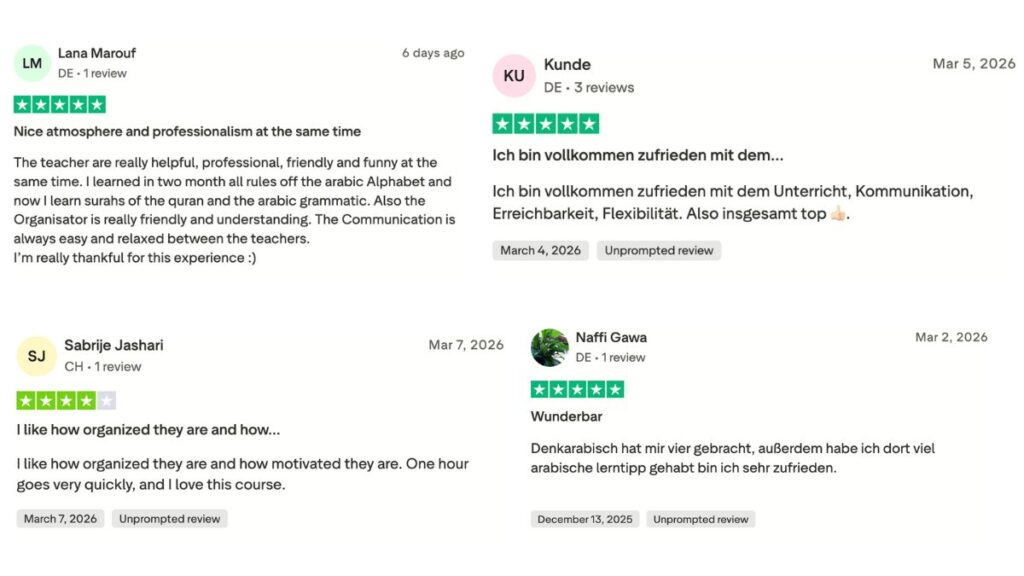
What Our Students Say About Denk Arabisch Academy
See what our students say about learning at Denk Arabisch Academy on Trustpilot. Read their experiences and check out more reviews to discover how our courses help improve Arabic.
Study Islamic knowledge with Denk Arabisch Academy
Deepen your understanding of Islam through authentic and structured learning
Join nowStart Your Journey with Denk Arabisch to Learn the Quran and Proper Worship
Now that you have learned about the rulings of Itikaf, you may wish to deepen your understanding of the Quran and the Arabic language to benefit more from your spiritual retreat. At Denk Arabisch, we offer you an integrated educational environment tailored to your needs in Western countries. Here we highlight the features of our courses and how you can begin with a free trial lesson.
What Makes Our Courses Unique?
Native Arab Teachers: They hold certifications from Al-Azhar Al-Sharif and have extensive experience teaching English-speaking students. They understand the specific challenges you face in pronouncing Arabic letters and understanding meanings.
Flexible Online Schedule: We have designed our courses to accommodate your daily commitments, whether you are a student or a professional. No commuting required; connect with your teacher from home at a time that suits you.
Personalized Individual Lesson Plans: Every student has their own level and goals. We create a customized learning plan with you, whether you wish to:
- Arabic Courses for German Speakers
- Arabic Levels for German Speakers
- Arabic Dialect Courses for German Speakers
- Qur’an Learning Courses for German Speakers
- Islamic Studies Courses for German Speakers
- Courses for Muslim Kids for German Speakers
Do not let the opportunity to learn your religion pass you by. Sign up for a free trial lesson and meet your first teacher. With Denk Arabisch, your spiritual journey becomes easier and more precise.
[✅ Start Your Free Tajweed Trial Now]
[✅ Begin Memorization with Expert Guidance]
Conclusion
Itikaf in Ramadan is not merely staying in the mosque; it is a spiritual school that recalibrates your life’s compass towards Allah. By applying the correct rulings and a structured practical program, you can transform the last ten days into a spiritual launch that lasts throughout the year. Seize this opportunity, and free your heart from worldly concerns, even for a few days, hoping to attain Laylat al-Qadr and receive Allah’s mercy and forgiveness.
FAQs
What Is the Minimum Duration for Itikaf in Islam?
The majority (Hanafis, Shafi’is, and Hanbalis): There is no minimum duration; Itikaf is valid even for an hour or a moment with the intention. Imam Ahmad said: “He may observe Itikaf for an hour, a day, a night; there is no minimum limit for it.”
The Malikis: They require a minimum duration of a day and a night, based on their understanding that Itikaf is a time-bound act of worship that should not be less than that.
The preferred opinion for a Muslim in the West: One can intend Itikaf for any duration they are able to, even if it is an hour between Maghrib and Isha, and they will receive the reward for their intention.
How Do I Organize My Time Between Worship and Sleep During Itikaf?
Sleep early after Isha prayer, and wake up in the last third of the night for Tahajjud.
Take a short nap (one hour) after Duha prayer to recharge.
Do not sleep more than 5-6 hours a day, as excessive sleep wastes the opportunity for worship.
Use an alarm clock to manage your prayer and night vigil timings.
What Should I Do If I Feel Bored or Lonely During Itikaf?
Boredom is natural, but remember that you are a guest of Allah. Transform this feeling into a motivation for worship.
Change your activity: Move from recitation to dhikr (remembrance), from dhikr to supplication, and from supplication to reflection on Allah’s creation.
Remember that you are seeking Laylat al-Qadr, which is better than the world and everything in it. Contemplating this virtue dispels feelings of isolation.
If permissible, you can exchange brief, kind words with another person observing Itikaf about a verse you read or a hadith, without engaging in lengthy conversations.