Takeaway:
- Teaching kids Islamic beliefs early builds a strong sense of identity, emotional strength, and natural good character.
- The core of faith is Tawheed: Allah is the loving Creator who is always with them, which brings peace and trust.
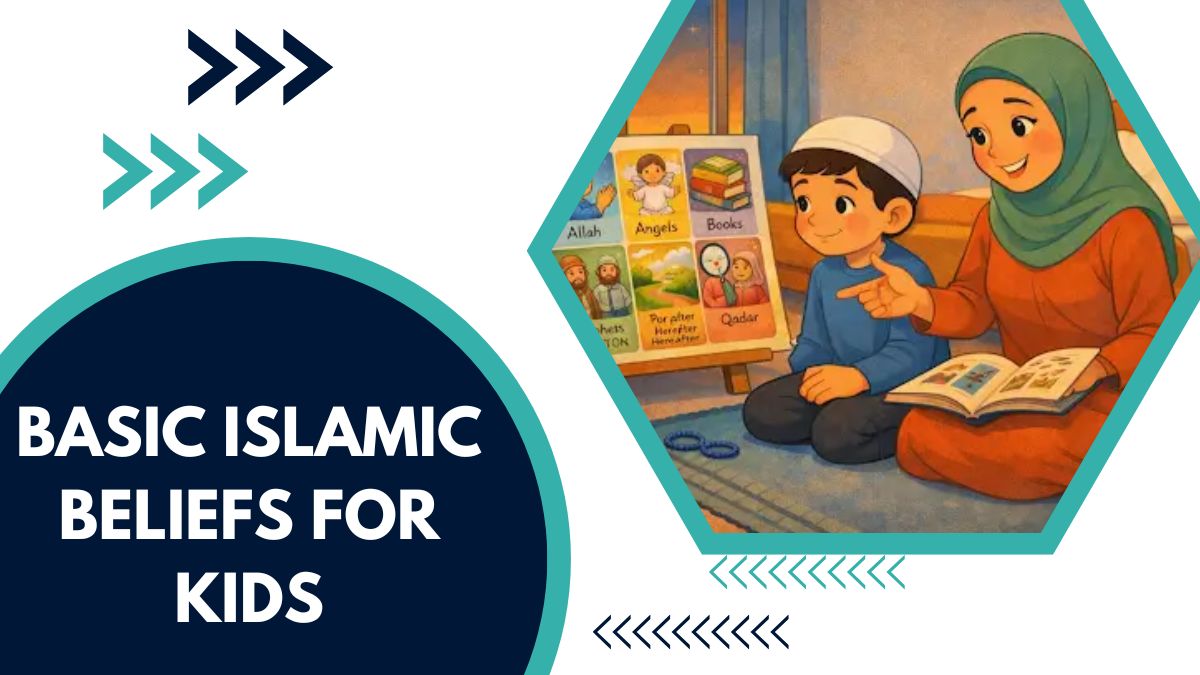
- The six beliefs (Allah, angels, holy books, prophets, Day of Judgment, Qadar) can be taught simply using everyday examples, stories, and positive language.
- Belief in angels and the Day of Judgment encourages self-discipline, while Qadar teaches patience and acceptance.
- Prophets serve as perfect role models, each teaching a key life lesson like honesty, courage, or kindness.
- Effective teaching methods include storytelling, linking faith to daily moments, games, short lessons, and parents leading by example.
- Parents are the first and most influential teachers; consistent small habits like saying “Bismillah” make faith a natural part of life.
- Early Islamic education creates children who are confident, respectful, emotionally resilient, and grounded in a clear Muslim identity.
Teaching children about Islam is one of the most important and meaningful things parents, teachers, and caregivers can do. When children grow up with a simple and loving understanding of their faith, it helps shape their personality in a positive way and gives them a strong sense of identity, confidence, and purpose in life.
Learning Islamic beliefs early also helps children understand the world in a clearer and calmer way. They start to know that Allah is always with them, which gives them comfort and emotional strength in different situations. This makes them more patient and better able to handle challenges as they grow.
It also helps children develop good behavior naturally. Instead of just being told what is right or wrong, they begin to understand the value of honesty, kindness, and respect. These values become part of their daily life and how they treat others.
Another important benefit is building a strong identity. When children understand their religion from an early age, they feel more confident about who they are and what they believe in. This helps protect them from confusion or negative influence later on.
This guide is designed to make Islamic beliefs easy and clear for children, while also helping parents and teachers explain them in a simple and practical way.
Table of Contents
What Does It Mean to Be a Muslim?
Islam is a religion that teaches us how to believe in Allah, worship Him, and live a good and meaningful life. The word Islam means “submission to Allah,” which means we trust Allah, follow His guidance, and try to do what is right.
A Muslim is someone who believes in Allah and follows the teachings of Prophet Muhammad ﷺ.
For children, Islam can be understood in a very simple way:
- Loving Allah and thanking Him every day
- Following the Prophet Muhammad ﷺ as a role model
- Being kind, honest, and respectful
- Doing good deeds and avoiding harm
Islam is not only about prayer—it is a complete way of life that teaches us how to behave at home, school, with friends, and even when we are alone.
Understanding faith is the first step, but expressing it through language is where the connection deepens. At Denk Arabisch, our Islamic Studies for German Speakers are designed to help your child articulate these beautiful concepts in both German and Arabic, ensuring their faith has a voice.
1. Belief in Allah (Tawheed) – The Most Important Belief
Believing in One God, Allah, is the very foundation of Islam. It is the first and most important concept children should learn because it shapes how they see everything in life. Tawheed means that Allah is the only Creator, the only One who controls the universe, and the only One worthy of worship.
Teaching this to children should be done in a simple, loving way so they feel a natural connection with Allah, not fear or confusion.
For children, Allah should be introduced as the One who loves them, takes care of them, and is always aware of everything they do and feel. He is not like anything in creation, and there is nothing similar to Him.
This helps children understand that Allah is unique, powerful, and at the same time merciful and close to them in a way they can trust and feel safe with.
Children can easily understand Allah when they connect Him to things they see every day. Instead of giving abstract explanations, we link belief to real-life experiences so it becomes meaningful and memorable for them.
Who is Allah for kids?
Allah is:
- The Creator of everything
- The One who gives us life
- The One who takes care of us
- The One who hears every prayer
- He has no partner, no family, and no one is like Him.
How can children understand Allah?
Children can learn about Allah through everyday life:
- The sun gives light → Allah created it
- The rain helps plants grow → Allah sends the rain
- Our hearts beat → Allah keeps us alive
- We feel happiness and love → Allah created emotions
What does belief in Allah teach children?
It teaches them:
- To feel safe because Allah is always with them
- To be thankful for everything they have
- To trust Allah even when things are difficult
- To pray and ask Allah for help
A child who knows Allah grows up with peace in their heart.
To truly know Allah, children must read His words. Our Quran Course For Kids focuses on more than just pronunciation—we help kids connect their hearts to the Creator through the beauty of the Quranic text.
2. Belief in Angels – Invisible Helpers of Allah
Belief in angels is an important part of Islamic faith because it helps children understand that there are creations of Allah that we cannot see, but they still exist and carry out important roles in the world.
Angels are part of the unseen world, and believing in them teaches children that Allah’s creation is much greater than what we can physically see or imagine. This builds a sense of wonder, awareness, and respect for the unseen reality created by Allah.
Muslims believe that angels are special beings created by Allah from light. They do not have free will like humans; instead, they always obey Allah perfectly and never disobey Him. They are pure, always doing good, and they carry out the tasks that Allah commands them without delay or mistake.
For children, it is important to present angels in a simple and positive way so they understand that they are part of Allah’s perfect system of care and organization for the world.
What are angels like?
Angels:
- Cannot be seen by humans
- Always obey Allah
- Never do wrong
- Do important tasks assigned by Allah
What do angels do?
For kids, angels can be understood as Allah’s helpers. Their tasks include:
- Writing down every good and bad deed we do
- Protecting people from harm
- Delivering messages from Allah
- Taking care of nature and the world
Why is this belief important for children?
It helps children understand:
- Allah sees everything we do
- Good behavior is always recorded
- We should try to do good even when no one is watching
This belief builds self-discipline and responsibility in a child’s heart.
3. Belief in the Holy Books – Guidance from Allah
Belief in the holy books is an important part of the Islamic faith because it shows children that Allah has not left humanity without guidance. Instead, Allah has sent revelations and books through His prophets that explain to people the right path in life. These books are a source of knowledge, wisdom, and clear guidance, helping people understand how to live right and make good decisions.
This belief is especially important for children because it teaches them that Islam is based on clear leadership and not on uncertainty or conjecture. He shows them that Allah is loving and wants to help people find the right path. The most important and final of these books is the Qur’an, which was revealed to the Prophet Muhammad صلى الله عليه وسلم and represents the complete and final message of Allah to humanity.
The most important book: The Qur’an
The Qur’an is the final and most complete book from Allah, revealed to Prophet Muhammad ﷺ.
What is the Qur’an for children?
The Qur’an is:
- A guide for life
- A book full of wisdom and stories
- A source of peace and comfort
- A book we recite in prayer
Why is the Qur’an special?
It teaches:
- How to worship Allah
- How to behave kindly with others
- How to make good decisions
- How to live a successful life
How can kids connect with the Qur’an?
Children can:
- Listen to Qur’an recitation daily
- Memorize short surahs
- Learn simple meanings
- Respect the Qur’an as Allah’s words
This builds love for the Qur’an from an early age.
Is your child ready to move beyond basic reading? Our Tajweed Course For Children ensures they recite the Holy Books with the precision and beauty they deserve, guided by expert tutors who specialize in teaching German-speaking children.
4. Belief in the Prophets – Role Models for Life
Belief in the prophets is a central part of the Islamic faith because it shows children that Allah has chosen people from their own community to guide them and show them the right path.
These prophets were not superhuman beings, but people of extraordinary strength of character, honesty and patience who served as role models for all of humanity.
For children, this belief is very valuable because it gives them real examples of good behavior in everyday life. They learn how to be honest, patient, courageous and kind through the stories of the prophets.
At the same time, they understand that even difficult situations can be dealt with with trust in Allah and good strength of character. As a result, prophets become living role models who inspire children in their own behavior.
Who are prophets?
Prophets are chosen by Allah to:
- Teach people about Allah
- Show how to live a good life
- Help people stay away from bad actions
Some important prophets in Islam:
- Prophet Adam (AS) – the first human
- Prophet Nuh (AS) – built the ark
- Prophet Ibrahim (AS) – known for strong faith and trust in Allah
- Prophet Musa (AS) – stood up to Pharaoh and led his people to freedom
- Prophet Isa (AS) – taught kindness and worship of Allah
- Prophet Muhammad ﷺ – the final prophet and best example for humanity
What do prophets teach children?
Each prophet teaches a lesson:
- Honesty
- Patience
- Courage
- Trust in Allah
- Kindness to others
Prophets are like perfect role models that children can learn from in daily life.
Read also: Islamic Games For Kids – Fun And Faith-Based Learning Activities
5. Belief in the Day of Judgment – Life After This World
Belief in the Last Day is an important part of the Islamic faith because it helps children understand that life in this world is only temporary and that there is an afterlife in which every person is held accountable for their actions.
This belief gives a deep sense of responsibility and justice, since nothing in life is meaningless and every action is seen by Allah.
This belief is especially important for children because it shows them that good deeds always have value, even if they seem small. He teaches them to be honest and kind, even when no one is watching, because Allah sees everything and will judge everything justly.
At the same time, he gives them hope and comfort because they know that Allah is full of mercy and rewards good deeds.
What is the Day of Judgment?
It is a day when:
- Everyone will be raised again
- Allah will judge people fairly
- Good deeds will be rewarded
- Wrong actions will be judged
And to Explain it for Kids, You can say: “Everything you do matters, even small actions. Allah sees everything, and one day He will reward kindness and honesty.”
What does this belief teach children?
It teaches:
- Responsibility for actions
- Honesty even when no one is watching
- Fairness and justice
- Hope in Allah’s mercy
This belief helps children grow into responsible and caring adults.
Learning the stories of the Prophets is easier when you understand the language they spoke. Explore our Arabic Lessons For German-Speaking Children to help your kids access these stories from their original sources!
Study Islamic knowledge with Denk Arabisch Academy
Deepen your understanding of Islam through authentic and structured learning
Try a Free Trial6. Belief in Qadar (Allah’s Decree)
Belief in Qadar is an important part of the Islamic faith because it helps children understand that nothing in life happens by chance, but everything happens according to the knowledge and wisdom of Allah.
Allah already knows all that will happen, and every event in a person’s life happens only with His permission and according to His perfect plan.
For children, this belief is very reassuring because it helps them cope better with different situations in life. They learn that both beautiful and difficult events have meaning, even if sometimes they don’t understand it immediately.
This belief strengthens trust, patience and inner peace because children know that Allah always wants the best for them, even if it does not meet their expectations.
What does Qadar mean?
It means:
- Allah knows everything that will happen
- Nothing happens without His permission
- Allah’s plan is always wise, even if we don’t understand it
How can children understand Qadar?
Children can think of it like this:
- Sometimes things go our way
- Sometimes they don’t
- But Allah always knows what is best for us
What does this teach kids?
It helps children:
- Be patient during hard times
- Avoid anger or sadness over things they cannot control
- Trust Allah’s wisdom
- Stay calm and hopeful
How to Teach Islamic Beliefs to Kids Effectively
Teaching Islam should never feel forced or boring. Children learn best when learning is fun, simple, and connected to their daily life.
1. Storytelling
Storytelling is one of the most powerful ways to teach children because it captures their imagination and emotions. Instead of giving direct instructions, stories help children understand Islamic values in a natural and memorable way.
When children hear stories about prophets like Prophet Muhammad, Prophet Ibrahim, and Prophet Musa, they learn lessons such as patience, trust in Allah, courage, and kindness without feeling like they are being “taught.”
You can make storytelling more effective by:
- Using an expressive tone and facial expressions
- Asking questions like “What would you do?”
- Letting the child retell the story in their own words
- Connecting the story to real-life situations
2. Daily life examples
Children learn best when they see how Islam fits into their everyday life. Instead of separating religion from daily activities, it’s important to show them that Islam is part of everything they do. Simple reminders and phrases can build a strong connection between the child and their faith over time.
You can apply this through:
- Saying “Alhamdulillah” after eating and encouraging them to repeat it
- Reminding them that Allah loves kindness, sharing, and honesty
- Saying “Bismillah” before starting anything
- Turning everyday moments into small teaching opportunities
3. Games and activities
Children naturally love to play, so using games makes learning enjoyable and engaging. When Islamic education is fun, children become more interested and willing to participate. It also helps them remember information more easily because they associate it with positive experiences.
Some useful ideas include:
- Simple Islamic quizzes with easy questions
- Matching games (prophets with their stories)
- Coloring pages of mosques or Arabic letters
- Role-playing good behavior like helping others
- Using rewards like stickers or stars for motivation
4. Short and simple lessons
Children have short attention spans, so long explanations can make them lose interest quickly. Teaching should be broken down into small, simple ideas that are easy to understand and repeat. Consistency is more important than length.
To make lessons effective:
- Focus on one idea at a time
- Keep lessons short (5–15 minutes depending on age)
- Repeat concepts regularly in different ways
- Use visuals, questions, and simple examples
- Apply the lesson immediately in real life
5. Leading by example
Children learn more from what they see than what they are told. Parents and caregivers are the biggest influence on a child’s behavior. If a child sees Islamic values being practiced daily, they will naturally copy them.
You can lead by example through:
- Praying regularly and calmly
- Speaking honestly and avoiding lying
- Showing patience in difficult situations
- Treating others with kindness and respect
- Practicing Islamic manners consistently
Read also: How To Teach Kids About Islam? – A Complete Guide
The Role of Parents in Building Faith For Kids
Parents are the first teachers in a child’s life. A loving home creates a strong foundation of faith.
Parents can:
- Pray with their children
- Answer questions with patience
- Encourage curiosity about Islam
- Make Islamic learning part of daily routine
Even small habits like saying “Bismillah” before eating can make a big difference.
Benefits of Teaching Islamic Beliefs For Kids
When children are introduced to Islamic beliefs at a young age, it has a deep and long-lasting impact on their personality, behavior, and emotional development. Early learning shapes how they see themselves, others, and their purpose in life, making faith a natural part of who they are rather than something they learn later with difficulty.
Children who grow up learning Islam early usually develop:
A strong connection with Allah: They grow up understanding that Allah is always with them, which builds trust, love, and reliance on Him in every situation. This connection becomes a source of comfort and guidance throughout their life.
Good manners and behavior: Early Islamic teaching encourages honesty, kindness, respect, and responsibility. Children begin to naturally apply these values in their daily interactions with family, friends, and society.
Emotional strength and patience: Learning about faith helps children understand that challenges are part of life and that patience is rewarded. This builds resilience and helps them handle stress, frustration, and disappointment in a healthier way.
Respect for others: Islam teaches children to treat everyone with dignity regardless of differences. This helps them grow into respectful individuals who value kindness, tolerance, and peaceful relationships.
A clear sense of identity: Knowing their beliefs from an early age gives children confidence in who they are. It helps them feel grounded, proud of their faith, and less easily influenced by negative external pressures.
Overall, these qualities don’t only benefit the child spiritually, but also help them succeed in school, relationships, and life in general, by building a balanced and strong personality rooted in values and purpose.
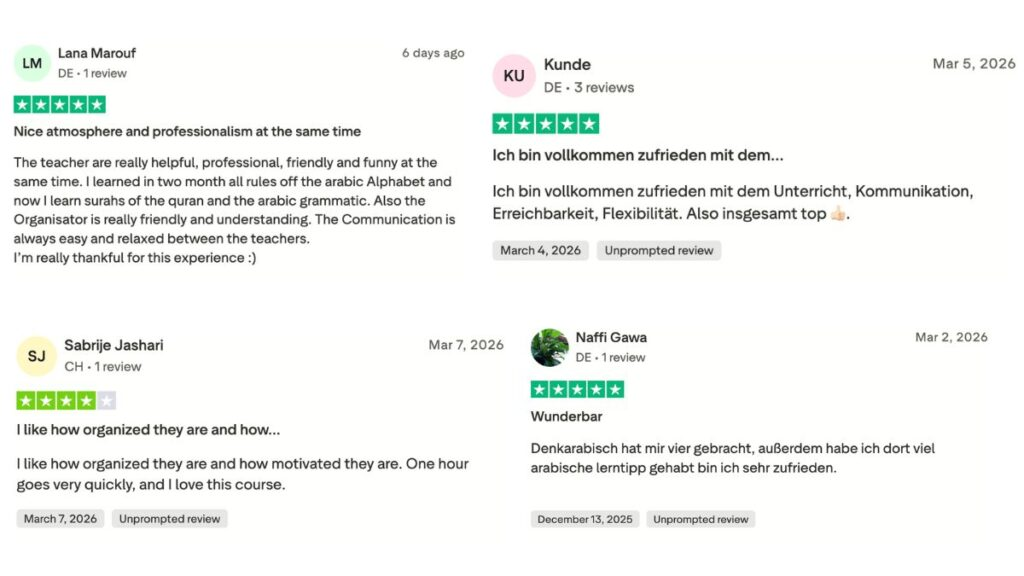
What Our Students Say About Denk Arabisch Academy
See what our students say about learning at Denk Arabisch Academy on Trustpilot. Read their experiences and check out more reviews to discover how our courses help improve Arabic.
Ready to Give Your Child a Future Rooted in Faith?
Knowledge is the foundation of a strong Muslim identity, but in a fast-paced world, finding the right teachers can be difficult. Denk Arabisch is here to bridge that gap for your family.
We don’t just teach “lessons”—we provide a structured, loving environment where your child can thrive. Whether you are looking for Arabic Fluency, Quran Memorization, or Islamic Studies, we have a specialized path for your child.
Specialized Courses for Muslim Kids:
Our curriculum is specifically designed to engage young minds and build a lasting connection to their heritage:
- Arabic Lessons For German-Speaking Children: Building a strong linguistic foundation from the ground up.
- Quran Course For German-Speaking Children: Guided memorization and recitation tailored for young learners.
- Tajweed Course For German-Speaking Children: Mastering the beautiful art of recitation with correct pronunciation.
- Islamic Studies for Kids: Age-appropriate lessons on faith, manners, and the lives of the Prophets.
Why Choose Denk Arabisch?
- Tailored for German Speakers: We understand the unique linguistic needs of Muslims in Germany.
- Expert Tutors: Highly qualified teachers who make learning fun and engaging.
- Flexible Online Learning: Fits perfectly into your family’s busy schedule.
- Comprehensive Curriculum: From Arabic dialects to advanced Tajweed.
Don’t wait for “someday.”
The best time to plant the seeds of faith is now. Join hundreds of families who have chosen Denk Arabic to raise the next generation of confident, educated Muslims.
👉 [BOOK A LESSON TODAY] Limited spots available for our upcoming semester!
Study Islamic knowledge with Denk Arabisch Academy
Deepen your understanding of Islam through authentic and structured learning
Try a Free Trial
Conclusion
Teaching Islamic beliefs to children is not a one-time lesson—it is a continuous journey of nurturing faith, character, and understanding. When children grow up learning about Allah, His guidance, and the values of Islam in a positive and engaging way, they carry these teachings with them for life.
By focusing on simplicity, consistency, and love, parents and educators can help children build a strong spiritual foundation. These early lessons shape not only how children practice their religion, but also how they treat others, face challenges, and find purpose in their lives.
With patience and care, raising children upon the principles of Islam becomes a beautiful and rewarding journey—one that leads to confident, compassionate, and faithful individuals.
FAQs
1. At what age should children start learning Islamic beliefs?
Children can start learning basic Islamic beliefs as early as 3–5 years old. At this age, they understand simple ideas like “Allah created everything” and “we should be kind.” As they grow older, the lessons can become deeper and more detailed.
2. How do I explain Allah to a young child?
You can explain Allah in a very simple way:
“Allah is the One who created everything we see and don’t see. He loves us, takes care of us, and always hears our prayers.”
Using examples from nature (sun, moon, rain, animals) helps children understand easily.
3. Is it important for kids to memorize the Five Pillars of Islam?
Yes, but it should be done step by step. Young children do not need to fully understand everything at once. Start by introducing each pillar in a simple way, like:
Shahada: Believing in Allah
Salah: Praying
Zakat: Helping others
Sawm: Fasting
Hajj: Visiting Makkah
Understanding comes gradually with age.
4. How can I make Islamic learning fun for children?
You can make learning fun by using:
Stories of prophets
Islamic songs (nasheeds)
Coloring books and crafts
Games and quizzes
Role-playing activities like “going to Hajj”
Children learn best when they are engaged and enjoying the process.
5. What is the easiest way to teach children about the Prophet Muhammad ﷺ?
Tell simple stories about his kindness, honesty, and good manners. For example:
He was always honest
He helped the poor
He treated children with love
Focus on character traits rather than long historical details.
6. How do I teach my child about angels?
Explain that angels are invisible creatures created by Allah who always do good things and never disobey Him. You can say:
“Angels are like Allah’s helpers who take care of us and write down our good deeds.”
Keep the explanation simple and reassuring.