Takeaway:
- Early Quranic education builds spiritual identity, character (adab), cognitive skills, and a sense of community for children growing up in Berlin.
- Options in Berlin include mosques, private tutors, online lessons, and teaching at home, each with clear trade-offs in individual attention, flexibility, cost, and social interaction.
- A qualified teacher who combines Quran knowledge with child-friendly, patient methods and good German skills is essential.
- Correct pronunciation (Tajweed and Makharij) must be taught from the start to avoid hard-to-correct mistakes later.
- Children learn best with age-appropriate, playful, and short learning units that prioritize understanding over mere memorization.
- Motivation and joy are key; positive reinforcement, rewards, and visible progress keep children engaged without pressure.
- Berlin’s long distances, traffic, parking shortages, and packed children’s schedules make commuting to physical classes stressful and inconsistent.
- Overcrowded mosque classes often lack individual support, leaving children to “just run along” rather than learn precisely.
- A structured three-phase path moves from the Arabic Qaida through Tajweed rules to memorization (Hifz), starting with Juz Amma.
- Online one-on-one or small-group Quran courses remove the commute, fit flexibly into family life, and provide intensive, personalized Tajweed training.
- The strongest foundation is built when children are introduced to the Quran with love, joy, and a teacher who understands their everyday life in Germany.
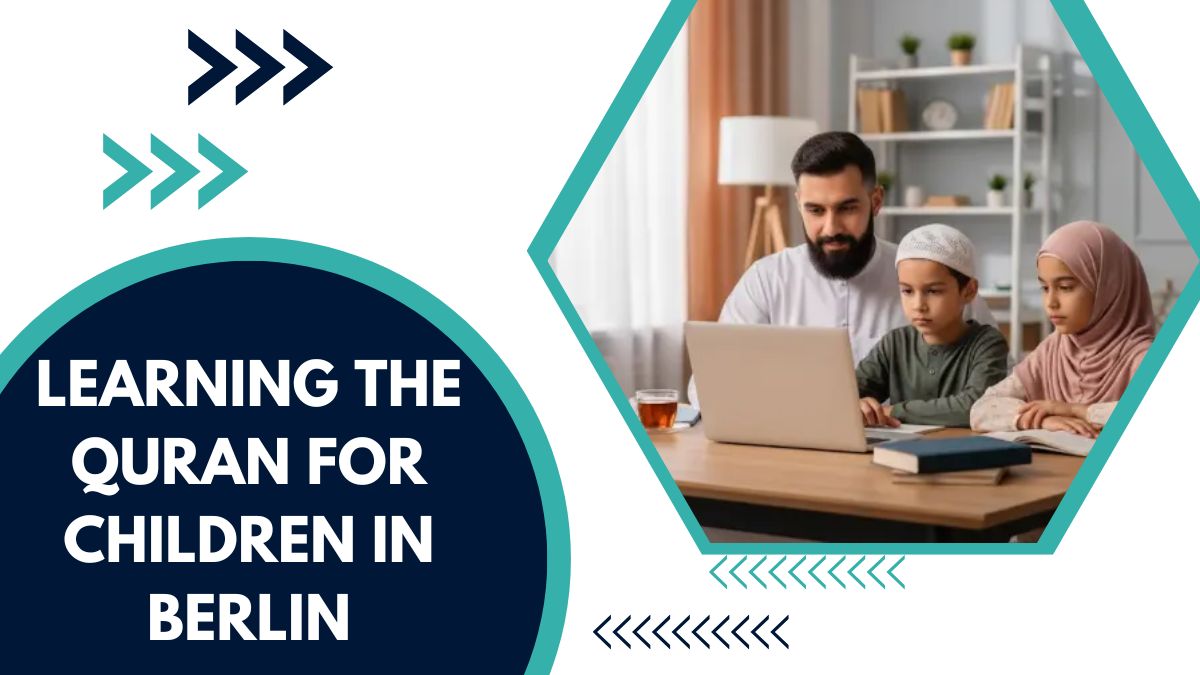
Raising children in Islam is both a gift and a responsibility. For Muslim families in the vibrant metropolis of Berlin, religious education is often a top priority. However, in a city so large and diverse, the question often arises: Where is the best place for my child to learn the Quran?
In this article, you will learn everything about the possibilities, benefits, and the best approaches to Quranic lessons in Berlin.
Table of Contents
Why is Quranic Education So Important for Children?
Before we look at the specific offerings in Berlin, we should understand why early engagement with the Word of Allah (swt) is so transformative.
1. Spiritual Identity: In a Western diaspora like Berlin, Quranic lessons help children develop a strong Muslim identity.
2. Character Building (Adab): Tajweed and Hifz are not just technical learning. They teach patience, discipline, and respect.
3. Cognitive Benefits: Memorizing complex texts in a foreign language (Arabic) boosts memory and linguistic intelligence.
4. Community: Children meet peers and feel at home within the Ummah.
Where Can Children Learn the Quran in Berlin?
Berlin offers an impressive variety of mosques, associations, and private institutes. Depending on the district—whether Neukölln, Wedding, Kreuzberg, or Spandau—there are different focal points.
1. Mosques and Islamic Centers
Many mosques in Berlin offer structured Quranic courses for children. These usually take place on weekends or after school.
- Pros: Community-based learning, direct contact with qualified teachers, religious environment.
- Cons: Large groups can make individual support difficult; teaching methods vary by facility.
2. Private Quran Tutors
Some parents prefer private lessons for their children.
- Pros: Individual attention, flexible scheduling, adapted to the child’s learning pace.
- Cons: Higher costs; quality of teaching can vary.
3. Online Quran Lessons
In recent years, online instruction has gained significant importance.
- Pros: Location-independent, wide selection of teachers, flexible scheduling.
- Cons: Less personal interaction; requires technical equipment and self-discipline.
4. Quran Lessons at Home
Many parents choose to teach their children themselves.
- Pros: Strengthens the parent-child relationship, control over content and pace, no additional costs.
- Cons: Requires time and specific knowledge from parents; less social interaction for the child.
So many options—but which one is right for your child? Denk Arabisch offers Quran Tajweed courses tailored specifically to the needs of your family.
What Should Parents Look Out For When Teaching Their Children the Quran?
When it comes to the topic of “Children Learning Quran in Berlin,” several factors play a decisive role:
1. Teacher Qualifications
A good teacher should have profound knowledge of the Quran, experience in dealing with children, and be patient and motivating.
2. Age-Appropriate Methods
Children learn differently than adults. Lessons should be playful, include visual and auditory elements, and consist of short learning units.
3. Understanding Instead of Just Memorizing
Many programs focus heavily on memorization. However, just as important are understanding the meaning, application in everyday life, and the freedom to ask questions.
4. Motivation and Joy
Compulsion rarely leads to success. Children should have fun learning, receive rewards, and be able to recognize their own progress.
Choosing the right teacher makes all the difference. At Denk Arabisch, we carefully select experienced instructors who understand children’s needs.
Read also: Qalqalah Rules – A Complete Guide For Muslims
What Makes a Good School?
When looking for the right offer, you should pay attention to the following quality features:
1. Qualified Educators: A teacher should not only master the Quran but also be pedagogically trained. Children in Berlin grow up bilingual; therefore, it is often advantageous if the teacher speaks fluent German to explain complex meanings (Tafsir) in a child-friendly way.
2. Tajweed from the Start: It is harder to correct wrong pronunciation later. Ensure that correct articulation points (Makharij) are emphasized from the very first lesson.
3. Positive Reinforcement: Fear should never be a part of the lessons. The best institutes in Berlin work with reward systems, certificates, and motivating teaching methods.
Step-by-Step: The Path to Fluent Reading
A child’s journey toward Khatm (the complete reading of the Quran) is usually divided into three phases:
Phase 1: The Qaida (The Alphabet)
Before opening the Quran, children learn the Arabic alphabet. Popular teaching aids include the Qaida Nurania or the Bagdadi-Qaida. Here, children in Berlin learn the basics of phonetics.
Phase 2: Tajweed Rules
Once the child can read, they learn the rules of beautification. These include Qalqalah (the echo sound), Ghunnah (nasalization), and Madd (lengthening of vowels).
Phase 3: Hifz (Memorization)
This usually begins with Juz Amma (the 30th part of the Quran). These short Surahs are ideal for beginners and can be applied directly in prayer.
Learn the Quran with Denk Arabisch Academy
Master reading and understanding the Quran through structured and supportive learning
Try a Free Trial
Challenges in a Metropolis Like Berlin
Berlin is a pulsating global city, but for Muslim families, life here often brings logistical hurdles. Anyone living in Berlin knows: distances are long, traffic is unpredictable, and daily life is strictly timed. When it comes to integrating Quranic lessons for children into the weekly schedule, parents often reach their limits.
1. The Logistics Trap: Traffic and Parking Shortages
In districts like Neukölln (Sonnenallee), Wedding (Müllerstraße), or Kreuzberg, finding a parking spot in front of mosques during peak times is often a nightmare. Parents spend valuable time in traffic on the A100 city highway or desperately searching for a gap in double-row parking. What should be a spiritual enrichment for the child often begins with stress and haste for the entire family.
2. The “Schedule Jungle”: School, Sports, and Religion
Berlin children have busy calendars. Between all-day school, homework, football practice at a club, or swimming lessons, there is often little room left. If Quranic lessons are then tied to long commutes (e.g., from Spandau to Tempelhof), either the child’s concentration or the consistency of learning suffers.
3. Group Sizes in Densely Populated Areas
Due to high demand in Berlin, classes in popular mosque communities are often overcrowded. A teacher sometimes has to look after 15 to 20 children at once. In a city where individual support in regular schools often falls short, parents are desperately looking for alternatives where their child isn’t just “running along” but truly learns the Tajweed rules precisely.
Read also: Idgham Rules With Examples
Exercises Learning the Quran for Children in Berlin
Exercise 1: Matching Educational Environments and Realities
Match the specific Quran learning format available to Berlin parents with its associated logistical reality or characteristic described in the manual:
— Select the correct learning format —
Densely Populated Mosque Classes
Online One-on-One / Small-Group Instruction
— Select the correct learning format —
Densely Populated Mosque Classes
Online One-on-One / Small-Group Instruction
Exercise 2: Identifying Crucial Foundations for Children
Click on the cards that properly identify the core quality criteria or pedagogical principles recommended for young learners in Germany:
Forcing long, intensive memorization hours from day one while strictly penalizing mistakes.
Teaching correct pronunciation (Tajweed and Makharij) right from the start to prevent stubborn habits later.
Utilizing teachers who can communicate comfortably in German to clearly convey child-friendly meanings (Tafsir).
Prioritizing understanding of meanings, active application, and positive reinforcement over blind repetition.
Exercise 3: Tracking the Journey Toward Fluent Reading
According to the structured three-phase path detailed in the guide, what must children thoroughly master during Phase 1 before progressing to advanced Tajweed rules?
Exercise 4: True or False?
The guide emphasizes that a child not knowing or speaking fluent Arabic is absolutely not an obstacle, as effective modern programs start right from the phonetic alphabet and utilize German translation to help children love the language step by step.
Exercise 5: Practical Memorization Milestones
When entering the final phase of fluent recitation and memorization (Hifz), children safely kickstart their learning journey by focusing on the short, practical Surahs contained in ““.
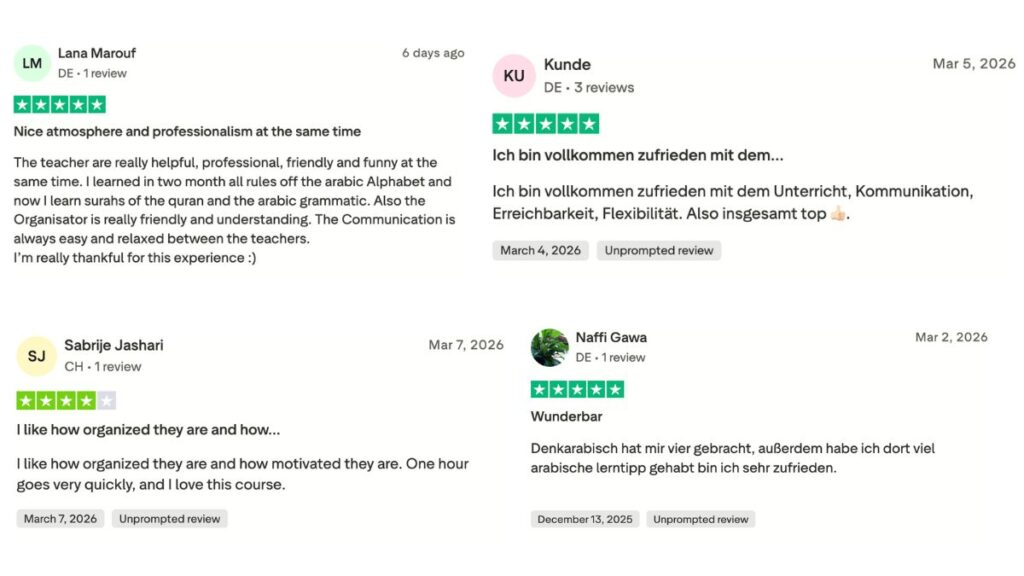
What Our Students Say About Denk Arabisch Academy
See what our students say about learning at Denk Arabisch Academy on Trustpilot. Read their experiences and check out more reviews to discover how our courses help improve Arabic.
Ready to Give Your Child the Best Start?
Don’t wait too long. The earlier your child builds a connection to the Quran, the stronger their foundation becomes—spiritually, mentally, and emotionally.
At Denk Arabisch, we don’t just teach the Quran—we foster confident young Muslims who understand, correctly recite, and love the words of Allah.
✔ Qualified, child-friendly instructors
✔ Flexible online Quran courses – ideal for families in the hectic Berlin daily life
✔ Structured programs with visible progress
Our Courses Include:
- Arabic Courses for German Speakers
- Arabic Levels for German Speakers
- Arabic Dialect Courses for German Speakers
- Qur’an Learning Courses for German Speakers
- Islamic Studies Courses for German Speakers
- Courses for Muslim Kids for German Speakers
👉 Spots are limited and book up quickly.
Register your child now and secure a spot.
Give your child the chance to learn the Quran correctly from the start—before valuable time is lost.
Learn the Quran with Denk Arabisch Academy
Master reading and understanding the Quran through structured and supportive learning
Try a Free TrialConclusion
When you search for “Koran lernen Kinder Berlin,” you are investing in your child’s future—in this world and the hereafter. The selection in Berlin is large enough to find the right teacher for every child and every temperament.
Whether you prefer the traditional mosque atmosphere or the flexibility of an online course: The most important thing is that your child is introduced to the Book of Allah with love and joy.
FAQs
To make your decision easier, we have summarized the most common questions that Berlin parents ask us at Denk Arabisch.
1. At what age should my child start Quranic lessons?
In general, educators and Quran teachers recommend an age of 5 to 6 years. At this age, children develop the necessary attention span and motor skills for articulation. However, it is never too early to play Quranic recitations at home to playfully familiarize their ears with the sounds of the Arabic language.
2. My child hardly speaks any Arabic. Is that an obstacle?
Absolutely not. Most children growing up in Berlin learn Arabic as a foreign or second language. Good instruction starts with the basics (the Qaida) and explains the meaning of the verses in German. The goal is for the child to learn to love the language of the Quran step by step without feeling overwhelmed.
3. How long does it take until my child can read fluently?
This depends heavily on consistency. With two lesson units per week and a short daily review at home (approx. 10–15 minutes), most children can read fluently from the Mushaf within 12 to 18 months.
4. Is online instruction as effective as lessons in the mosque?
Both formats have their merits. While the mosque strengthens the sense of community, online one-on-one lessons offer significantly higher intensity. In Berlin, online lessons also save stressful commuting time. For many families, a hybrid approach—social contact in the community combined with precise Tajweed training online—is the ideal solution.
5. How do I find the “right” teacher among so many options in Berlin?
Look for a trial lesson. Observe how the teacher interacts with your child: Are they patient? Do they use positive reinforcement? In a city like Berlin, it is also important that the chemistry between the family’s values and the teaching approach matches. A teacher who understands the reality of life for children in Germany is often more effective.
6. What does Quranic instruction cost in Berlin?
The costs vary depending on the model:
Mosques: Usually based on donations or low monthly fees (approx. €20–€40).
Private Institutes/Online Academies: Prices for qualified individual or small group lessons often range between €50 and €100 per month, depending on the scope.
7. Can my child also learn during the Berlin school holidays?
Many institutes offer special intensive holiday courses. Since children have no school pressure during the holidays, they often achieve the greatest progress in memorization (Hifz) during these phases.